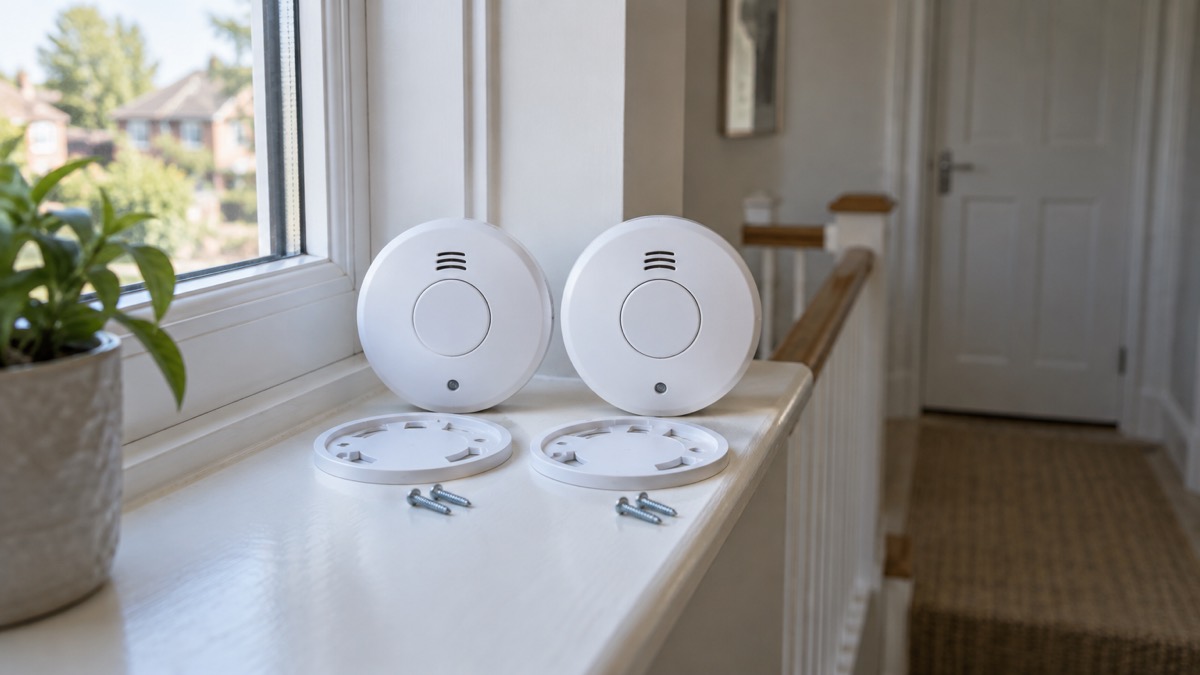
Interlinked alarms are smoke and heat alarms that talk to each other. When one alarm detects a fire, every alarm in the home sounds at the same time, so you get the warning wherever you happen to be, not only in the room where the fire started1. The Scottish Government puts it plainly: "Interlinked alarms means if one goes off, they all go off, so you will always hear an alarm wherever you are in your home"1.
Linking is done either by wires between the alarms (hardwiring) or wirelessly by radio, and the wireless kind does not need WiFi2. A single wireless network can hold up to 50 alarms from the same maker's range, with a recommended maximum distance of 35 metres between alarms3. In Scotland, interlinked alarms have been a legal requirement in every home since February 20224.
This page explains how the linking works, who benefits most, what the law requires in each nation, how to set up a wireless link, and how alarms can be connected to a telecare or lifeline system for someone who needs help to escape.
When one alarm detects a fire, every linked alarm sounds
The idea behind interlinking is simple. A stand-alone alarm only warns people who can hear it, which usually means people in the same room or on the same floor. An interlinked system turns every alarm in the house into a single warning system: the Scottish Fire and Rescue Service describes it as one alarm being triggered and all the alarms going off simultaneously2.
Fire and rescue services across the UK recommend this for the same reason. Devon and Somerset Fire and Rescue Service explains that some battery or mains alarms can be interlinked so that when one alarm detects a fire they all go off together, giving a warning wherever you are in the home8. London Fire Brigade gives the same advice for people being cared for: make sure alarms are interlinked so the person gets early warning9. A NHS home fire safety guide sums up the benefit: "Fitting interlinked alarms will give everyone in your home the earliest warning of fire"10.
The value of that early warning is greatest at night. A fire that starts in a kitchen or living room downstairs may take minutes to produce enough smoke to wake someone sleeping upstairs, and by then the escape route may be blocked. With interlinked alarms, the alarm in the bedroom hallway or landing sounds at the same moment as the one nearest the fire, giving the whole household the same start on escaping. Cornwall Fire and Rescue Service describes the same mechanism: some alarms connect to each other so that when one senses smoke, all the alarms sound11.
If you are planning a whole alarm layout, our guides to smoke alarms and heat alarms cover which type goes where, and how many alarms a house or flat needs covers the count.
Who benefits most from linked alarms
Interlinked alarms suit any home, but fire and rescue services single out several groups for whom they matter most.
Devon and Somerset Fire and Rescue Service says linked smoke detectors are suitable for all households, but particularly recommended for people who hoard, people with complex health needs, people with limited mobility and high fire risk, and complex buildings where there are long distances between detectors12. The reason is the same in each case: the person either may not hear a distant alarm in time, or may need more time to escape, and linking removes the distance problem.
- Large or multi-storey homes. The UK Government's fire safety advice notes linked alarms are useful if you live in a large house or over several levels13. Cornwall Fire and Rescue Service says the same, adding that they are useful in larger homes and for people with hearing difficulties11.
- People who may not hear an alarm. Devon and Somerset Fire and Rescue Service suggests asking a qualified electrician to fit linked alarms for people in a large house or one with more than one floor who may not hear their smoke alarm14.
- People whose escape may be delayed. London Fire Brigade says interlinked alarms are particularly important where a person has any issues that may prevent or delay their escape15.
- People who are deaf or have hearing loss. Manchester Fire and Rescue Service advises fitting a system of interlinked smoke and heat alarms with an interlinked strobe light and vibrating pad, with the pad placed under the pillow at night, so the person receives a vibrating and visual alert if any alarm activates16. Our guide to alarms for deaf and hard of hearing people covers this in full.
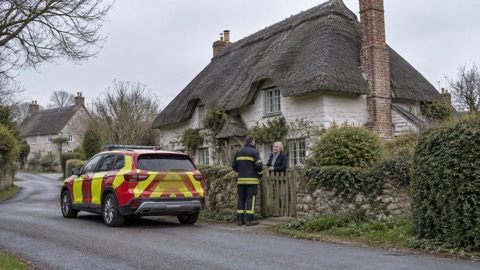
- Homes with loft space, open fires or thatch. Devon and Somerset Fire and Rescue Service recommends installing interlinked smoke alarms if you have loft space, both for homes with open fires or log burners and for thatched properties17.
If someone in the household would be unable to escape without help, that is also the point at which to consider linking the alarms to a telecare system, covered later on this page.
The law: every Scottish home, and rented homes elsewhere
Scotland is the only UK nation that requires interlinked alarms in every home, whoever owns it. New legislation introduced in January 2019 meant every home in Scotland was required to have interlinked fire alarms installed by 1 February 202219. The Scottish Government's current position is that all alarms must be ceiling mounted and interlinked20.
The standard each Scottish home must meet is specific4:
- One smoke alarm in the living room or the room you use most
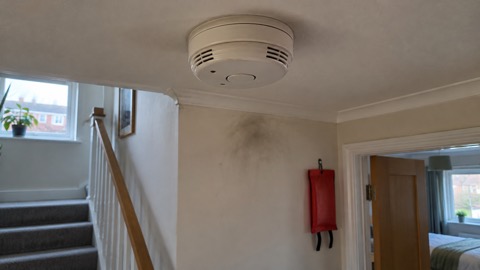
- One smoke alarm in every hallway and landing
- One heat alarm in the kitchen
- All alarms attached to the ceiling and interlinked
The Scottish Fire and Rescue Service confirms that where a home already has non-interlinked smoke alarms, the requirement is to have all smoke and heat alarms interlinked, and that one heat alarm must be installed in every kitchen21. An NHS winter safety campaign for Scotland repeats the same layout: one smoke alarm in the living room or most-used room, one in every hallway and landing, and one heat alarm in the kitchen, all mounted on the ceiling and interlinked22.
Two kinds of alarm meet the standard: sealed battery operated alarms that you can install yourself, and mains wired alarms that require a qualified electrician to install19.
Rented homes in England, Wales and Northern Ireland
In England, the Smoke and Carbon Monoxide Alarm (England) Regulations 2015 came into force on 1 October 2015 and require landlords to install and check smoke and carbon monoxide alarms11. Under the regulations, landlords must have smoke detectors on each floor of the premises, and must supply a carbon monoxide detector and alarm in any room used wholly or partly as living accommodation which contains a solid fuel burning combustion appliance7. The regulations specifically exclude Houses in Multiple Occupation, as these properties are already covered by other legislation11.
The regulations do not require the alarms to be interlinked. However, the Northern Ireland Fire and Rescue Service advises that ideally alarms should be hardwired and interlinked, noting this is a legislative requirement for rented accommodation23, and the same wording appears in its other safety advice24. nidirect, the Northern Ireland Government service, adds a practical point about mains alarms: smoke alarms linked to the home's mains electrics contain a nine volt back-up battery that needs to be changed according to the manufacturer's instructions25. Our guide to alarm rules in Wales and Northern Ireland covers those nations in detail.
What the Tolerable Standard means
If you have read about Scottish alarm law, you will have met the Tolerable Standard. It is the legal measure of whether a house is fit for human habitation in Scotland. Fire detection equipment was added to it by the Housing (Scotland) Act 1987 (Tolerable Standard) (Extension of Criteria) Order 2019, and it also forms part of the Repairing Standard under section 13 of the Housing (Scotland) Act 2006, which landlords must comply with26.
What the standard asks of your home is set out below.
- One smoke alarm installed in the room most frequently used for general daytime living purposes, normally the living room or lounge
- One smoke alarm in every circulation space on each storey, such as hallways and landings
- One heat alarm installed in every kitchen
- All smoke and heat alarms ceiling mounted and interlinked
The guidance adds several details that answer common questions. Alarms can be interlinked via wires (hardwired) or wirelessly (by radio communication)26. Mains-operated alarms with battery backup are permitted, as are tamper proof long-life lithium battery alarms, meaning not PP3 type or user-replaceable26. Open plan combined rooms such as a kitchen and living room need only one alarm, provided it can be located no more than 7.5 metres from any point in the room26. Only heat alarms should be used in kitchens under BS 5839-6:2019, though an existing smoke alarm in a kitchen need not be replaced until the end of its manufacturer's recommended lifespan26.
Two limits are worth knowing. The Tolerable Standard does not require carbon monoxide detectors to be interlinked, or to be interlinked with fire alarms27. And additional alarms beyond the standard, for example in bedrooms, do not cause the system to fail the standard if they are not interlinked to it26. Alarms should be regularly maintained and tested in accordance with manufacturer's instructions26. The standard can also be met by Grade A or Grade C alarms installed in compliance with BS 5839-6, with Grade C systems also including fire alarm sounders and visual or vibrating alarm devices27; our guide to alarm standards and system grades explains the grades.
Radio or hardwired: how alarms link without WiFi
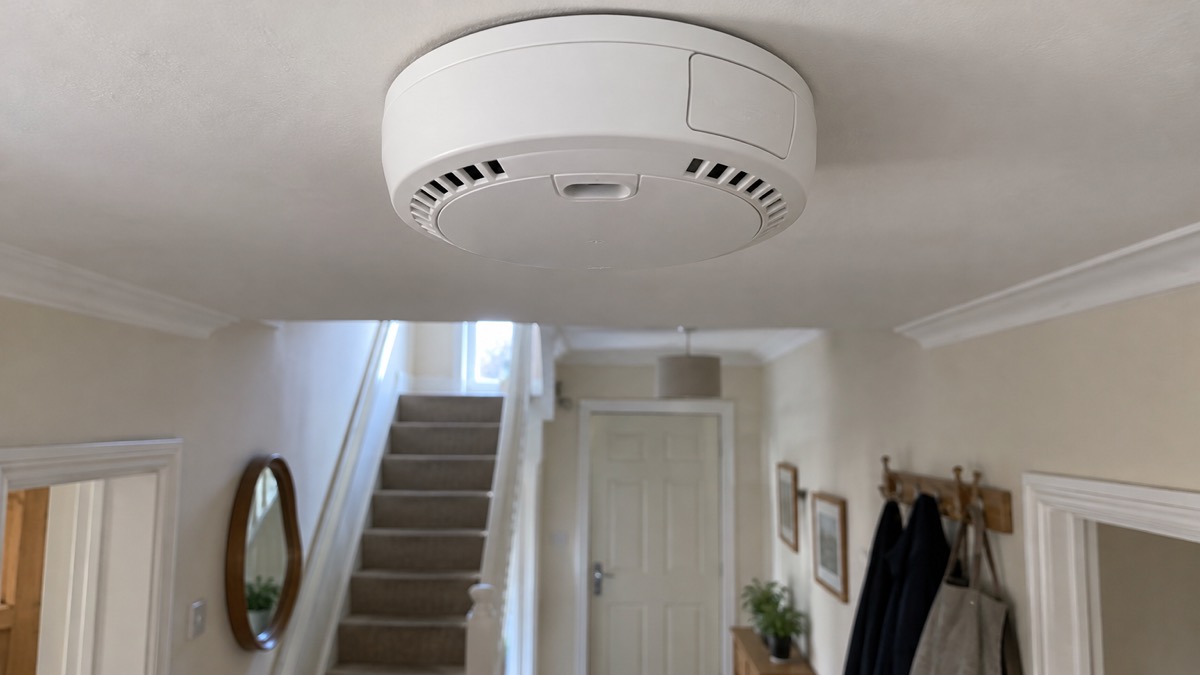
There are two ways to interlink alarms, and both are accepted under the Scottish standard26.
Hardwired alarms are connected to each other by physical cabling, normally installed by a qualified electrician. This is the traditional method and the one fire and rescue services mean when they say alarms should ideally be hardwired and interlinked in rented accommodation23.
Radio interlinked alarms talk to each other over a radio signal. The Scottish Fire and Rescue Service and the Scottish Government both state that these alarms are interlinked by radio frequency and do not need WiFi2. This matters for two reasons. First, the interlink keeps working even if your broadband router is down, unplugged or faulty, because the alarms never used it. Second, there is nothing to connect to your home network, so there is no setup password or app dependency for the alarm-to-alarm link itself.
FireAngel, a maker of interlinked alarms, describes the wireless interlink in its own product information: "this communication is in the form of protected radio frequency, which means there's no need to run cables between the alarms"5. Radio interlinked alarms of this kind include battery models such as the Aico Ei650RF, a battery interlinked radioLINK+ smoke alarm listed in sensory support guidance from South Lanarkshire Council29.
The practical choice between the two comes down to your home and who is doing the work. Sealed battery radio interlinked alarms can be installed by the householder, while mains wired alarms require a qualified electrician19. Our comparison of wireless or wired interlinked alarms and of battery or mains alarms set the two routes out side by side.
Do interlinked alarms work in a power cut?
It depends on the type, and the answer is why the Scottish standard allows both kinds. Sealed battery alarms carry their own power, so a power cut changes nothing: they detect, they link by radio, and they sound19. Mains wired alarms are connected to the home's electricity supply, but they are required to have battery backup: the Tolerable Standard permits mains-operated alarms with battery backup26, and nidirect notes that mains-linked smoke alarms contain a nine volt back-up battery that needs to be changed according to the manufacturer's instructions25. A mains alarm with a healthy back-up battery continues to work in a power cut; one with a flat or missing back-up battery does not. Test your alarms regularly and replace back-up batteries as the maker instructs.
Mixing mains and battery alarms on one interlink
Many households already have some alarms fitted and wonder whether they can add to them rather than start again. London Fire Brigade confirms that some battery or mains alarms can be interlinked, so that when one alarm detects a fire they all go off together15. The key word is "some": whether mains and battery units can share one network depends entirely on the maker's system.
The one firm rule here comes from FireAngel's manual for its own products: "Wi-Safe 2 smoke alarms can only be interlinked with other Wi-Safe 2 smoke alarms and other products within the Wi-Safe 2 range"6. That is a maker speaking about its own system, but it reflects how wireless interlinks generally work: the alarms use a proprietary radio protocol, so an alarm from a different maker, or a different product family from the same maker, will not join the network. If you want a mixed network of smoke, heat and carbon monoxide alarms, buy them from one interlink range and check each product's manual before fitting.
Within the Scottish rules, both mains and battery types are acceptable on the same standard: mains-operated alarms with battery backup, and tamper proof long-life lithium battery alarms, are both permitted26. What matters to the law is that every smoke and heat alarm is interlinked, not that they are all the same power type.
Network size and range: up to 50 devices, about 35 metres
Wireless interlink networks have limits, and they are worth knowing before you plan a layout.
FireAngel's product information for its FP2620W2-R smoke alarm states you can "wirelessly interlink up to 50 Pro Connected or Wi-Safe 2 devices so every alarm in your home sounds together when one detects a fire"5. Its manual gives the same capacity for the W2-Module: it enables the alarm to interlink with up to 50 Wi-Safe 2 devices in a single network6. Fifty devices is far more than any ordinary house needs, so network size is unlikely to be the constraint.
Range is the more practical limit. The manual states the wireless range is over 200 metres in clear air or clear line of sight, but that the effective range may be reduced by walls and obstructions, and that the recommended maximum distance between smoke alarms in the network is 35 metres6. In a typical British house with brick or block internal walls, the working figure to plan around is 35 metres between alarms, not the open-air figure.
| Limit | Figure | Notes |
|---|---|---|
| Devices per network | Up to 50 | FireAngel Wi-Safe 2 and Pro Connected devices5 |
| Range in clear air | Over 200 metres | Line of sight, maker's figure6 |
| Recommended maximum between alarms | 35 metres | Walls and obstructions reduce range6 |
| Interlink compatibility | Same product range only | Wi-Safe 2 alarms interlink only with Wi-Safe 2 products6 |
For almost all flats and houses, 35 metres between alarms is easy to achieve. It becomes a consideration in large or complex buildings, which is one reason Devon and Somerset Fire and Rescue Service specifically recommends interlinked detectors for complex buildings where there are long distances between detectors12. After fitting, test the system from the alarm furthest from the others: press the test button on one alarm and check that every alarm in the network sounds.
Setting up a wireless link
Setting up a wireless system is a two-stage job: fit the alarms, then link them.
- Fit the alarms in the right places. Screw each alarm to the ceiling in the positions the standard requires: a smoke alarm in the living room or most-used room, a smoke alarm in every hallway and landing, and a heat alarm in the kitchen4. All smoke and heat alarms should be attached to the ceiling4. Keep within the recommended 35 metres between alarms6.
- Link the alarms together. Follow the maker's pairing procedure in the product manual to put every alarm on one network, then test the system by triggering one alarm and confirming that all of them sound together. The Scottish Fire and Rescue Service describes the result as all the alarms going off simultaneously when one is triggered2.
The Scottish Government's buying guidance suggests that a general internet search for "radio-interlinked sealed battery powered smoke and heat alarms" should bring up results of alarms that are compliant with the standards28. If you choose mains wired alarms instead, the installation is a job for a qualified electrician19.
Once the system is in, maintain it: alarms should be regularly maintained and tested in accordance with manufacturer's instructions26. Our guides on how often to test alarms and when to replace an alarm cover the routine.
Linking alarms to a telecare or lifeline system
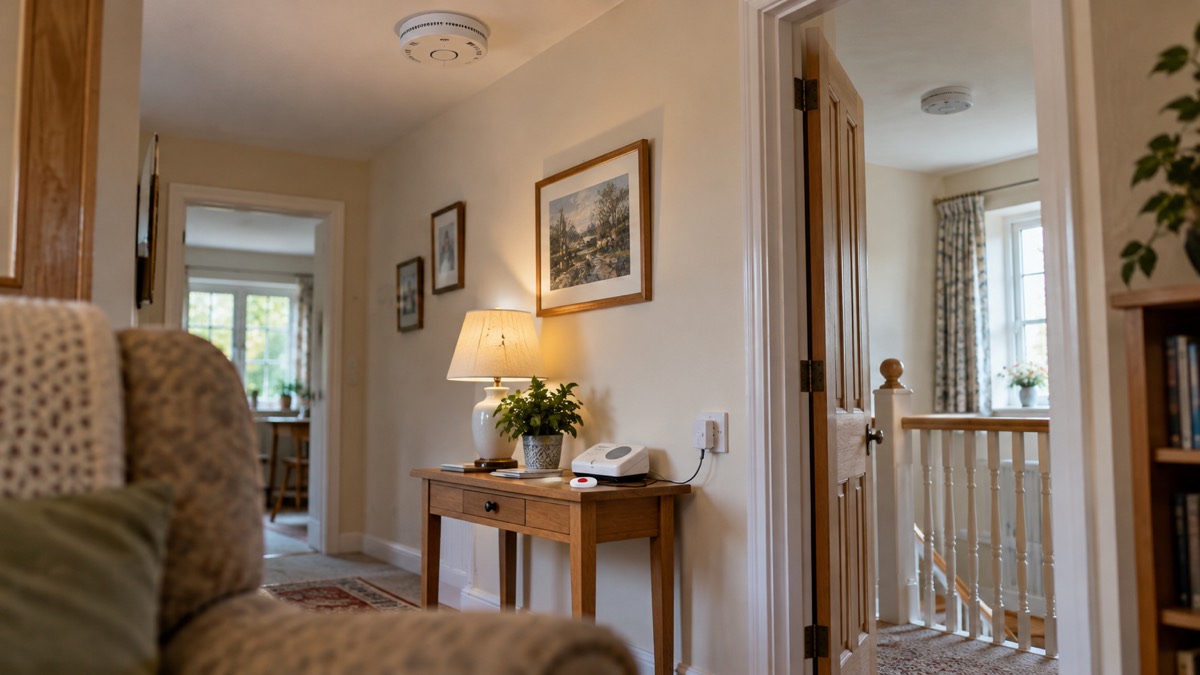
For someone who would be unable to escape without help in a fire, an interlinked alarm system can be taken one step further: connected to a telecare, carecall or lifeline system, so that a sounding alarm also raises an alert to a monitoring centre or carer.
Dorset and Wiltshire Fire and Rescue Service advises carers: "Another consideration is fitting interlinked smoke alarms that connect to the telecare, carecall or lifeline system"30. Devon and Somerset Fire and Rescue Service gives the same advice, recommending an interlinked alarm system to ensure smoke alarms are heard in all rooms of the house31. London Fire Brigade asks carers of smokers to check: "If the person you care for has Telecare fitted, is it linked to smoke alarms?"32, and Dorset and Wiltshire Fire and Rescue Service makes the same check for personal alarm systems, noting that linking them to the smoke alarms can be arranged for additional safety33.
Manchester Fire and Rescue Service gives the clearest instruction on when to act: if you would be unable to escape without help in the event of a fire, talk to your care provider, or the fire service, about linking your smoke alarms to a telecare system34.
In Scotland this is written into the guidance on the Tolerable Standard: where telecare is in use, interlinked smoke and heat alarms should be installed which are compatible with any telecare alarms and connected to the telecare system, ensuring a single system approach27. If you or someone you care for has telecare, tell the telecare provider before choosing alarms, because the alarms must be compatible with the existing system.
Where to get help
If you are unsure what your home needs, your local fire and rescue service is the place to start.
For the wider picture of fire safety at home, see our home emergencies guide, the fire safety checklist, and what to do if a fire starts in your house.
Sources (34)
- Fire and smoke alarms in Scottish homes, Scottish Government, 2024-08-14
- Smoke and heat alarms, Scottish Fire and Rescue Service, 2025-04-14
- HM-SN-1-Generic-Smoke-Heat-User-Manual_D1_WEB.pdf, FireAngel Safety Technology Limited
- What each home needs, Scottish Government, 2024-08-14
- FP2620W2-R smart smoke alarm product page, FireAngel, 2026-10-28
- FP2620W2-R manual, FireAngel, 2019-04
- Fire safety in rented accommodation, Cornwall Fire and Rescue Service, 2026-10-29
- Smoke alarms and vulnerable people, Devon and Somerset Fire and Rescue Service, 2026
- Alarms: carers and support workers, London Fire Brigade, 2026-10-25
- Home fire safety guide, NHS Wirral Community Health and Care, 2025-01-24
- Smoke alarms, Cornwall Fire and Rescue Service, 2021-03-19
- Equipment for carers, Devon and Somerset Fire and Rescue Service, 2026
- Fire safety in the home, accessible version, UK Government, 2022-05-25
- Fire safety for people with hearing difficulties, Devon and Somerset Fire and Rescue Service, 2026
- Smoke alarms and heat alarms, London Fire Brigade, 2026-10-25
- Advice for people who are deaf or have hearing loss, Manchester Fire and Rescue Service, 2026-10-29
- Open fires, Devon and Somerset Fire and Rescue Service, 2026
- Thatched properties, Devon and Somerset Fire and Rescue Service, 2026
- Fire alarms standard campaign 2021 evaluation report, Scottish Government, 2022-01-17
- Home fire safety policy, Scottish Government, 2026-10-29
- Your guide to fire safety, Scottish Fire and Rescue Service, 2023-11-03
- Keep Safe Keep Well winter safety campaign 2024-2025, NHS West of Scotland Innovation Hub, 2024-12
- Home fire safety, Northern Ireland Fire and Rescue Service, 2026-10-22
- Other safety advice, Northern Ireland Fire and Rescue Service, 2026-10-22
- Fire safety and prevention, nidirect, 2025-06-09
- Tolerable Standard guidance: satisfactory fire and carbon monoxide detection, Scottish Government, 2023-06-20
- Tolerable Standard guidance, chapter 16: satisfactory fire detection, Scottish Government, 2023-06
- Where and what to buy, Scottish Government, 2024-08-14
- Sensory support, South Lanarkshire Council, 2026-10-29
- Hearing and sight difficulties: advice for carers, Dorset and Wiltshire Fire and Rescue Service, 2025-11-19
- Fire safety for carers, Devon and Somerset Fire and Rescue Service, 2026
- Caring for smokers, London Fire Brigade, 2026-10-25
- Caring for someone who smokes, Dorset and Wiltshire Fire and Rescue Service, 2025-11-19
- Emollients, Manchester Fire and Rescue Service, 2026-10-29
 Home Fire Safety Checklist
 Bedtime Fire Safety Checks
 Fire Risk Checks for Carers
 What to Do If Fire Starts
 How to Make a Fire Escape Plan
 Fire in a Block of Flats
 Kitchen Fires and Cooking Safety
 Electrical Fires and Sockets
 Smoking, Matches and Lighters
 E-bike Charging Safety
 Hoarding and Fire Risk
 Thatched Properties Fire Risk
 Fireworks and Bonfire Safety
 What to Do After a House Fire
 How Fire Services Respond