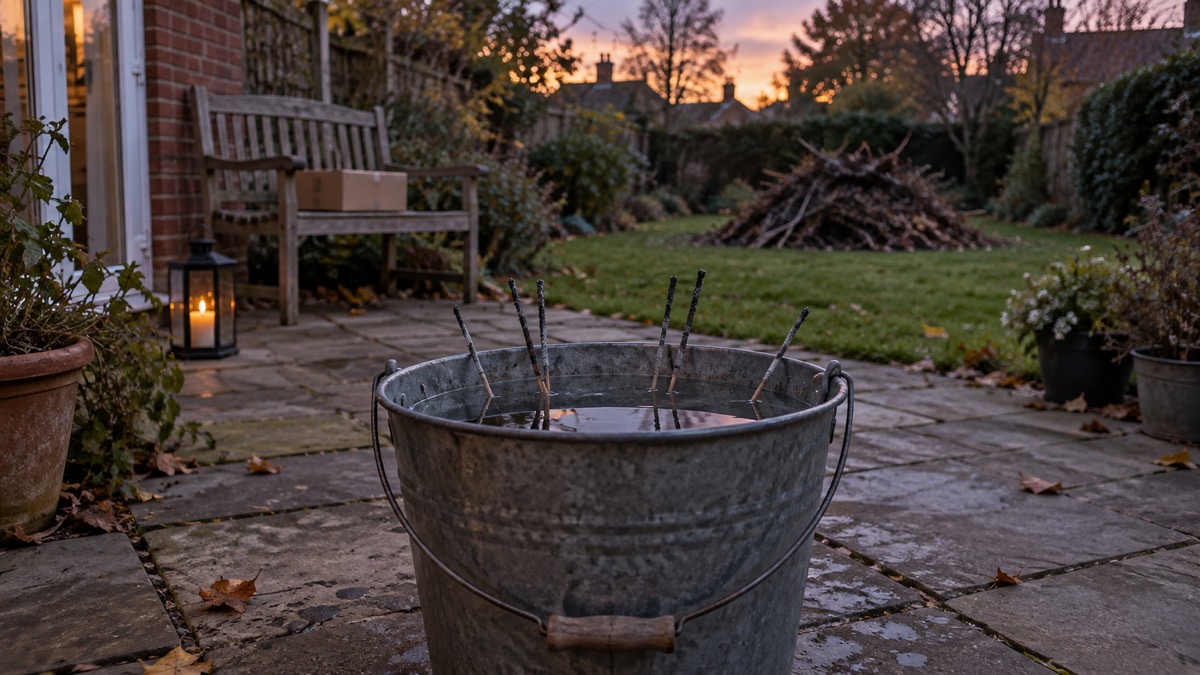
Fireworks night, Diwali, New Year and celebrations through the autumn all bring fireworks, sparklers and bonfires into ordinary gardens. If you are having a firework display at home, follow the Firework Code at all times1. Two rules matter above all others: never give sparklers to children under five2, and never return to a firework once it has been lit2.
The rules you most need to know are straightforward. You must be 18 or over to buy and let off fireworks, and it is illegal for anyone under 18 to possess them in a public place1. Throwing a firework in a street or other public place is a criminal offence with a maximum penalty of a £5,000 fine2. Bonfires should never be lit with petrol or paraffin, and sky lanterns are best avoided altogether, because once released there is no control over where they land2.
An organised display is the safest way to enjoy fireworks
Fire and rescue services across the UK are unanimous on this point. London Fire Brigade recommends that you enjoy a public firework display rather than buy your own fireworks, because public displays are bigger, more fun and a lot safer1. Devon and Somerset Fire and Rescue Service says the same plainly: the safest way to enjoy Bonfire Night is to attend an organised display10. Mid and West Wales Fire and Rescue Service would always recommend that people attend an organised fireworks display2, and the Northern Ireland Fire and Rescue Service recommends attending professionally organised public firework displays rather than holding private garden displays9.
The reason is simple. An organised display puts the fireworks in the hands of trained operators with the right distances, the right equipment and crowd control, and it removes the risks that come with storing, lighting and disposing of fireworks in a domestic garden. Cornwall Fire and Rescue Service advises against holding your own display at home because they often result in accidents11.
If you do choose a home display, plan it. London Fire Brigade advises planning your firework display to make it safe and enjoyable, and ensuring it finishes before 11pm1. The NHS children's health service for Cambridgeshire and Peterborough makes the same point from the injury side: if you are having a firework display or bonfire at home, follow firework safety advice to reduce the risk of accidents12. The rest of this page is that advice.
The Firework Code for a home display
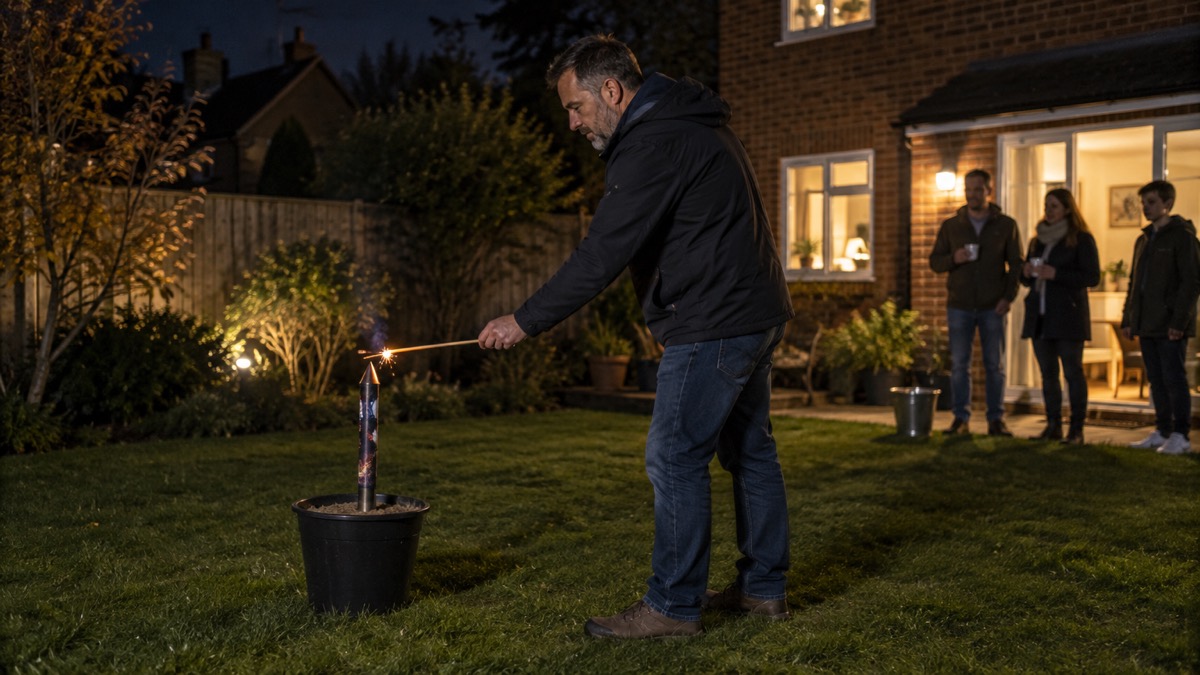
The Firework Code is the standard set of rules that fire and rescue services publish each year for anyone putting on a display at home. Following it is not optional in spirit: Lincolnshire's bonfire safety guidance says to always follow the Firework Code for a safer celebration13, and the Scottish Fire and Rescue Service says that if it is necessary for you to have a home fireworks display, follow the Fireworks Code at all times14.
The core of the code, drawn from current fire service guidance, is this:
- Plan your display to make it safe and enjoyable, and make sure it finishes before 11pm3.
- Buy fireworks from a reputable retailer, marked with a CE or UKCA mark3.
- Read the instructions carefully before the display, in daylight, and follow the minimum distances printed on each firework2.
- Keep naked flames, including cigarettes, away from fireworks2.
- Have one nominated adult light the fireworks, one at a time, at arm's length, using a safety firework lighter or fuse wick2.
- Stand well back3.
- Never return to a firework once it has been lit1.
- Keep a bucket of water ready before you start5.
- Do not drink alcohol if you are setting off fireworks3.
Two of these deserve emphasis. The first is distance: the code's instruction is to stand well back once a firework is lit2. The second is what to do with a firework that has not gone off: never return to it, even if it looks like a dud, because it may still ignite2. The code is built around one responsible person doing the lighting while everyone else watches from distance.
Alcohol and fireworks do not mix
Manchester Fire and Rescue Service states it directly: alcohol and fireworks do not mix and may lead to injury3. If you are hosting rather than lighting, keep strict control of guests' drinking, or consider not offering alcohol until after the fireworks have finished2. Warwickshire's fire safety guidance extends this to sparklers at Christmas: steer clear of alcohol if you are running a display or looking after children15.
Firework categories, buying legally and the sale periods
Fireworks sold to the public in the UK come in four categories, and the category determines where you can safely use them1. Only fireworks up to Category 3 can legally be sold to the general public1.
| Category | What it is | Minimum spectator distance | Who it suits |
|---|---|---|---|
| F1 | The least powerful type you can buy1 | No stated minimum | Small gardens and indoor celebrations |
| F2 | Adult fireworks available in shops and supermarkets1 | At least 8 metres, some require 15 metres2 | Most family gardens |
| F3 | The most powerful fireworks the public can buy; only for large open spaces, use with caution2 | Many have a minimum of 25 metres, about 82 feet2 | Large gardens and open ground only |
| F4 | Prohibited for public sale; for professional use only2 | Not applicable | Nobody in a domestic setting |
The Scottish Fire and Rescue Service puts the F3 distance in perspective: 25 metres is about 82 feet, and you really need a garden the length of a local swimming pool14. If you know of any prohibited F4 fireworks in public hands, contact your fire and rescue service2.
When buying, look for a CE or UKCA mark to make sure the fireworks are safe to use1. Only buy fireworks which carry the CE mark, keep them in a closed box and use them one at a time1. You must be aged 18 or over to buy and let off fireworks1, and in England you can be fined up to £5,000 and imprisoned for up to 6 months for selling or using fireworks illegally16.
Consumer fireworks are only sold during four key periods: Chinese New Year and the three days preceding it, Diwali and the three days preceding it, 15 October to 10 November, and 26 December to 31 December2. Outside these periods, a shop needs a licence to sell fireworks2.
Northern Ireland is different
In Northern Ireland, you must legally have a valid fireworks licence issued by the Department of Justice to buy, possess and use fireworks9. Fireworks must be purchased from a licensed retailer, in accordance with the Fire Safety Code, and marked CE to meet EU requirements17. The Northern Ireland Fire and Rescue Service is blunt about it: it is compulsory to have a licence to use fireworks17. If you are planning a display in Northern Ireland, apply for the licence well before the event.
When you can set fireworks off: the 11pm to 7am curfew
For the majority of the year, it is illegal to set off fireworks, including sparklers, between 11pm and 7am1. Manchester Fire and Rescue Service and Devon and Somerset Fire and Rescue Service both set out the exceptions5:
| Night | Latest time for fireworks |
|---|---|
| Most of the year | 11pm1 |
| Bonfire Night (5 November) | Midnight6 |
| Diwali | 1am6 |
| New Year's Eve | 1am6 |
| Chinese New Year | 1am6 |
The Northern Ireland Fire and Rescue Service adds a neighbourly instruction that applies whatever the date: don't set off noisy fireworks late at night and never after 11pm, only light them outside in an open space, and keep children well away from them17. Planning your display to finish before the curfew is part of the Firework Code itself2.
Sparklers burn at up to 2,000°C: keeping children safe
Sparklers cause serious injury, especially without proper supervision, because they burn at very high temperatures19. The rules for children are consistent across every service:
- Never give sparklers to children under five; only give them to children over the age of five3.
- Always supervise children holding sparklers17.
- An adult should light each sparkler for the child, and children should hold them at arm's length19.
- Light sparklers one at a time, at arm's length, and wear gloves3.
- Give children gloves to wear, and avoid dressing them in loose or flowing clothes that could catch alight easily15.
- Show older children how to hold sparklers away from their body and at arm's length, and teach them not to wave them at other people or run while holding them15.
- Put each sparkler in a bucket of water straight after it goes out20.
That last point matters more than people expect. Warwickshire's guidance warns that sparklers can stay hot for a long time after they appear to have gone out15, which is why the bucket of water, prepared before the display starts, is part of the code5. Remember too that sparklers are classed as fireworks and the same laws apply: it is illegal to set them off in the street or other public places, and the curfew covers them2.
Garden bonfires: no petrol or paraffin, and check for hedgehogs first
The fire and rescue services repeat this every year because flammable liquids cause flash fires that catch the person lighting the bonfire. The safe method is firelighters, and nothing else8. The same rule appears in community preparedness guidance: never use flammable liquids, paraffin or petrol, to light the fire22.
Before you light anything, check the area to make sure there is no wildlife or pets hiding nearby23. Hedgehogs in particular shelter in unlit bonfire piles, so check the pile on the day you light it, not the day you build it. London Fire Brigade also warns never to burn dangerous items such as aerosol cans, paint tins, foam furniture or batteries23, and Lincolnshire's guidance adds a simple rule for the fireworks themselves: never throw fireworks13.
A safe bonfire routine, from fire service guidance:
- Site the bonfire well away from buildings, fences and trees.
- Check the pile for wildlife and pets before lighting23.
- Light it with firelighters only, never petrol, paraffin, diesel, white spirit or mentholated spirit8.
- Never leave the bonfire burning unattended22.
- Never throw fireworks into it13.
- Pour water on the embers before leaving22.
Sky lanterns: why you cannot control where they land
Sky lanterns, also known as Chinese lanterns, have been used in Chinese and Thai celebrations for thousands of years4, but fire and rescue services in the UK strongly advise against them. Manchester Fire and Rescue Service explains the core problem: with no control over the actual flight path once lit and released, the end destination cannot be predicted4. Once lit and released there is no control over its direction or where it lands, and this could have very serious consequences4.
The fire risk is not theoretical. There is no guarantee that the fuel cell will be completely out and cooled when the lantern eventually descends, and any contact with a flammable surface could result in a fire developing4. The Northern Ireland Fire and Rescue Service describes the mechanism: the heat from the candle lifts the lantern into the air, allowing it to float for miles, and once the candle has gone out the lantern falls to the ground or gets trapped in trees and may start a fire9. Devon and Somerset Fire and Rescue Service recommends that you don't use sky lanterns at all, because of the fire hazards and risks they pose to property, crops, livestock and the environment6.
If, despite this advice, someone is set on launching one, Manchester Fire and Rescue Service sets conditions: do not launch within 5 miles of any airport, do not launch in wind speeds in excess of 5 mph, do not launch near built-up areas or roads, crops, thatched buildings, hay bales, trees and power lines, do not attempt to launch damaged lanterns, and be aware that writing messages on the paper can cause damage4. Consider the risk of fire caused by incorrect handling, fuel remaining, or changes to the recommended flight or weather conditions4. The honest summary of the official position is that the conditions are so restrictive, and the consequences so unpredictable, that the services would rather you did not launch them at all.
Dealing with misfired and spent fireworks
A firework that fails to go off is not a dud to be relit. Never return to a firework once it has been lit1. Dorset and Wiltshire Fire and Rescue Service gives the full procedure: soak misfired or partly spent fireworks in a container of water in an area where they cannot be tampered with, preferably away from the display site, and contact the manufacturer or supplier for advice on disposal24. Mid and West Wales Fire and Rescue Service says the same: if you have a defective firework, seek advice on the safe disposal of the damaged firework in the product safety information supplied, or directly from the supplier, manufacturer or importer2.
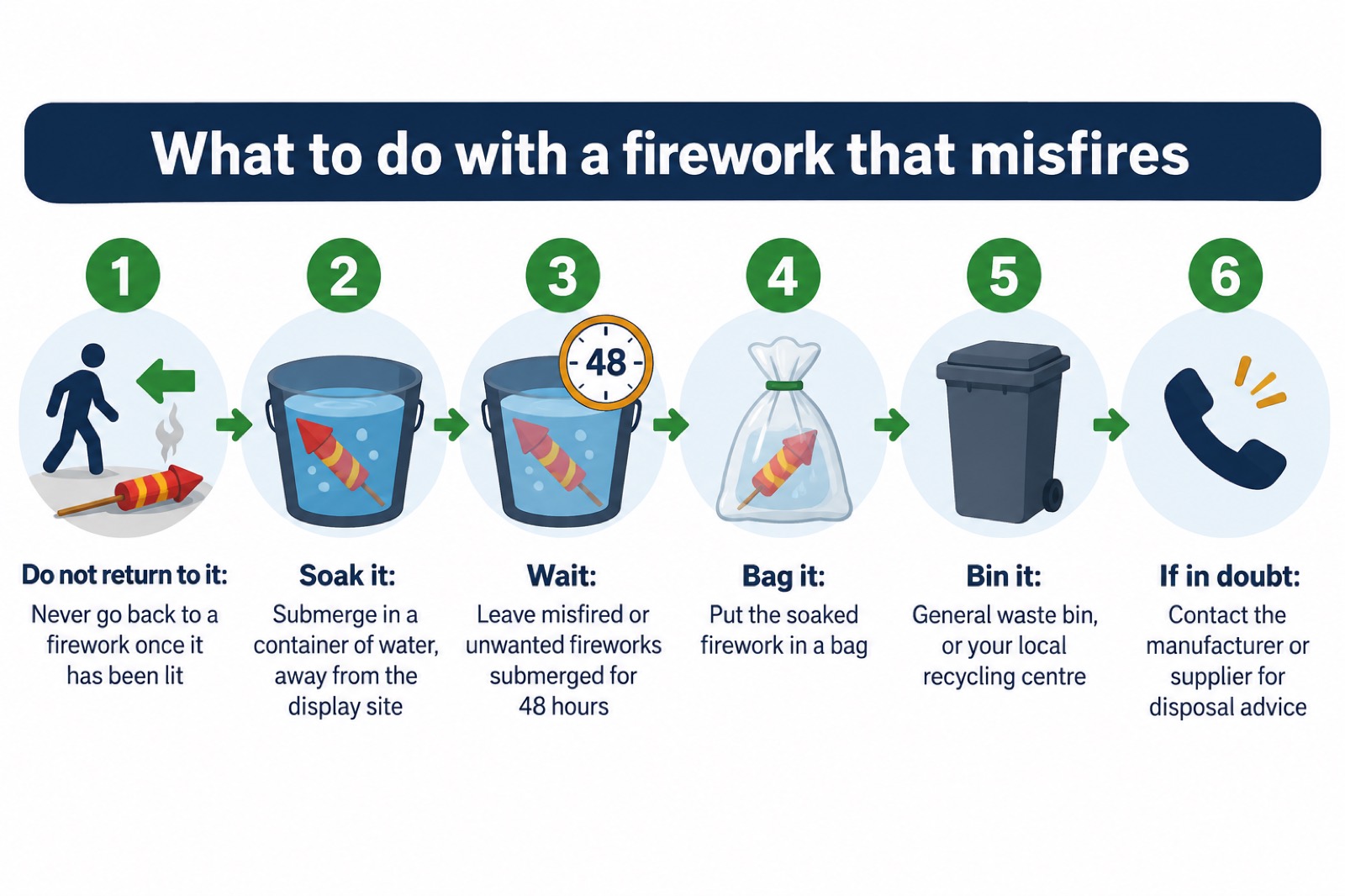
For fireworks that did go off, the disposal is simpler. Fireworks that have successfully gone off can be put in a bin after use6. Manchester Fire and Rescue Service's fuller routine: get a bucket of water ready before you start your display, soak used fireworks for at least 15 minutes, overnight if possible, wrap the soaked fireworks in a plastic bag, then put them in your general waste bin or take them to your local recycling centre5. Devon and Somerset Fire and Rescue Service says that if your fireworks have misfired or are no longer wanted, submerge them in water for 48 hours before putting them in a bag and throwing them in the bin6.
Disposal arrangements vary by area. In North Yorkshire, fireworks are accepted free of charge at household waste recycling centres across the county25. Check your own council's arrangements before you travel. If you have fireworks you no longer want and would rather not handle them yourself, Manchester Fire and Rescue Service asks you to contact the Fire Service on 0800 555 815 to have fireworks safely collected3.
Pets during fireworks
Fireworks are a frightening noise event for pets, and the advice from every service is the same: keep your pets indoors whilst fireworks are going off26. Cornwall Fire and Rescue Service and the government's celebrating-safety guidance both give the same instruction11.
Practical steps around this are covered in more detail in our guide to pets and animals in an emergency. The essentials for a fireworks night are to bring pets in before the displays start, close curtains and doors to muffle the noise, and not to leave them alone in the garden where a stray firework or a panicked escape is possible. If you are holding your own display, warn your neighbours in advance so they can bring their pets in too.
When something goes wrong: calling 999 and reporting misuse
At any sign of danger, or in the event of an emergency, dial 999 and ask for the Fire and Rescue Service9. North Wales Fire and Rescue Service gives the rule that applies to any fire: in the event of a fire, get out, stay out and call 999 immediately27. If a fire takes hold, get everyone out of the property, close any doors you pass, and then call the fire service25. What to do in the first minutes of a house fire is covered in our guide on what to do if a fire starts in your house, and planning ahead is covered in how to make a fire escape plan.
Not every problem is a 999 emergency. Misuse of fireworks, such as fireworks being thrown in the street, is a police matter: throwing a firework in a street or other public place is a criminal offence with a maximum penalty of a £5,000 fine2. In Cornwall and Devon, you can report misuse of fireworks by dialling 101, or call Crimestoppers anonymously on 0800 555 11111. Your own police force's non-emergency number serves the same purpose elsewhere.
At any sign of danger, or in the event of an emergency, dial 999 and ask for the Fire and Rescue Service12. If you have fireworks you no longer want, you can contact the Fire Service on 0800 555 815 to have them safely collected12. For the wider picture of fire risk in your home, our fire safety checklist and guidance on smoke alarms are the place to start.
Sources (27)
- Fireworks safety, London Fire Brigade
- Firework safety, Mid and West Wales Fire and Rescue Service, 2026-10-29
- Fireworks safety, Manchester Fire and Rescue Service, 2026-10-29
- Chinese / Sky Lanterns, Manchester Fire and Rescue Service, 2026-10-29
- Fireworks safety, Manchester Fire and Rescue Service, 2026-10-29
- Fireworks, Devon and Somerset Fire and Rescue Service, 2026
- Halloween safety, Dorset and Wiltshire Fire and Rescue Service, 2026-10-23
- Bonfire safety, Manchester Fire and Rescue Service, 2026-10-29
- Other safety: fireworks, Northern Ireland Fire and Rescue Service, 2026-10-22
- Stay safe this Bonfire Night, Devon and Somerset Fire and Rescue Service, 2024-10-31
- Firework safety, Cornwall Fire and Rescue Service, 2025-07-31
- Burns and scalds, Cambridgeshire and Peterborough NHS children's health, 2026-06-23
- Bonfire safety, Lincolnshire County Council, 2026-10-29
- Firework safety 2023, Scottish Fire and Rescue Service, 2023-11-03
- Christmas safety tips, Warwickshire County Council, 2026-10-29
- Stay safe this Bonfire Night, North Yorkshire Fire and Rescue Service, 2021-10-18
- Don't let fire turn your Halloween into a nightmare, Northern Ireland Fire and Rescue Service, 2026-10-21
- Stay safe this Halloween, Wiltshire and Swindon Prepared, 2026-10-25
- Don't let flames play tricks on your treats this Halloween, Northern Ireland Fire and Rescue Service, 2025-10-21
- Diogelwch Tân Gwyllt, Mid and West Wales Fire and Rescue Service, 2026-10-29
- Bonfires and garden safety, Dorset and Wiltshire Fire and Rescue Service, 2026-07-08
- Are You Ready booklet, Culham Parish Council, 2025-09
- Bonfires, London Fire Brigade, 2026-10-25
- Fireworks safety advice, Dorset and Wiltshire Fire and Rescue Service, 2025-10-30
- Frequently asked questions, North Yorkshire Fire and Rescue Service, 2026-08-18
- Halloween and Bonfire safety, South Wales Fire and Rescue Service, 2026-10-20
- Winter safety, North Wales Fire and Rescue Service, 2026-10-29
 Home Fire Safety Checklist
 Bedtime Fire Safety Checks
 Fire Risk Checks for Carers
 What to Do If Fire Starts
 How to Make a Fire Escape Plan
 Fire in a Block of Flats
 Kitchen Fires and Cooking Safety
 Electrical Fires and Sockets
 Smoking, Matches and Lighters
 E-bike Charging Safety
 Hoarding and Fire Risk
 Thatched Properties Fire Risk
 What to Do After a House Fire
 How Fire Services Respond
 Alarms for Deaf People