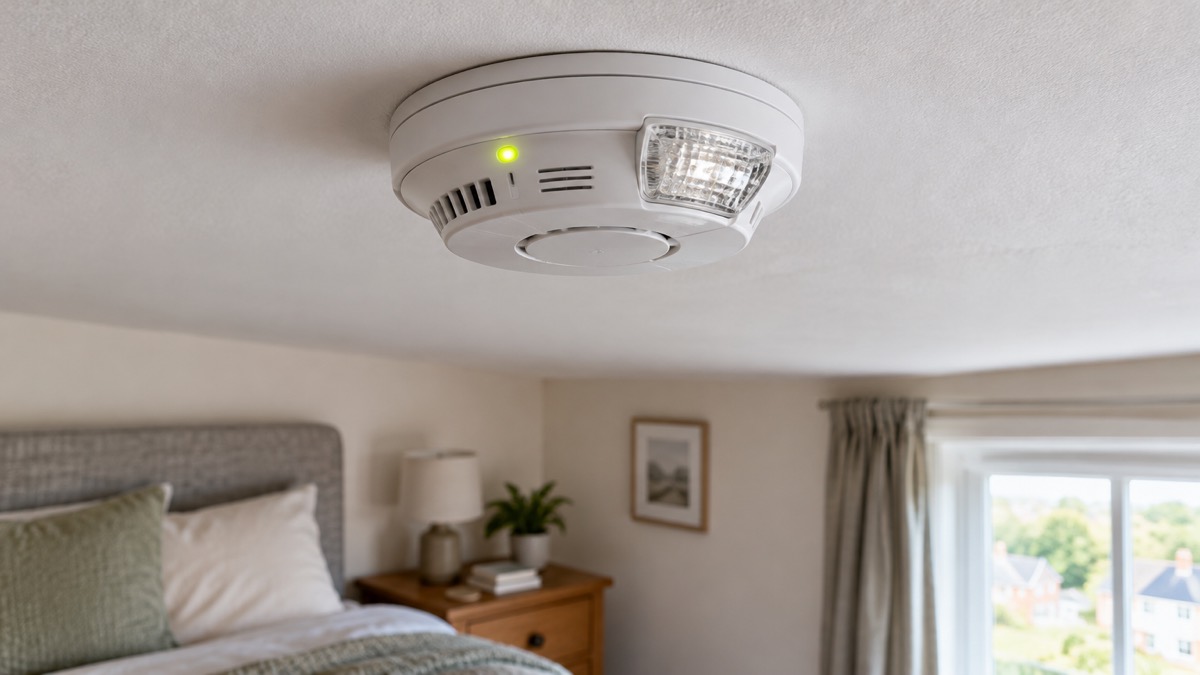
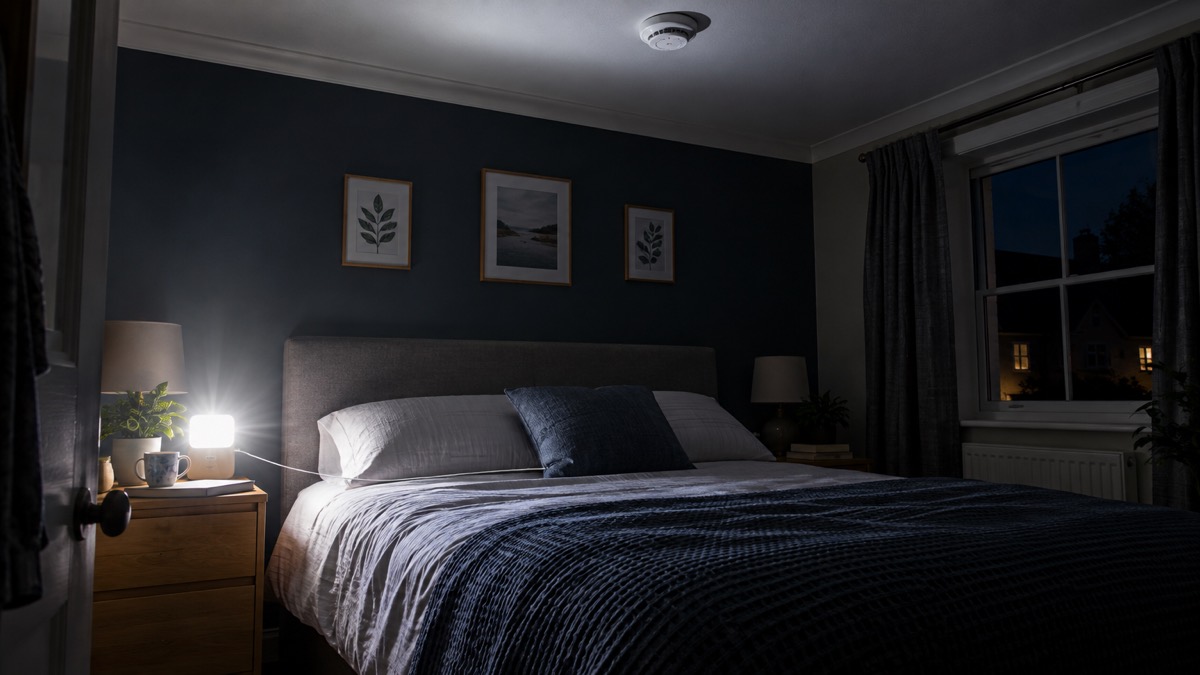
If you cannot hear a standard smoke alarm, a specialist alarm system will warn you in other ways: a flashing strobe light and a vibrating pad that goes under your pillow at night. When any alarm in your home detects smoke, the pad vibrates to wake you and the strobe light flashes to alert you1. Fire and rescue services across the UK are clear that these alarms are available for people who are D/deaf or hard of hearing, usually following an assessment, and in many areas the fire service will fit them free of charge1.
The reason these systems matter is simple. A conventional alarm relies entirely on sound. If you have taken your hearing aids out for the night, or you cannot hear a high-pitched beep from another room, a standard alarm gives you no warning at all while you sleep. The Scottish Fire and Rescue Service puts it plainly:
"These specialist alarms can save lives."
That is the view of the Scottish Fire and Rescue Service, which notes these alarms alert the user to a fire in the home even if they have removed their hearing aid at night3. This page explains how the systems work, how to get one, how to place the pad and the strobe, how to keep the system working, and how to contact the emergency services if you cannot use a voice phone.
How a linked system works: detectors, strobe and pad
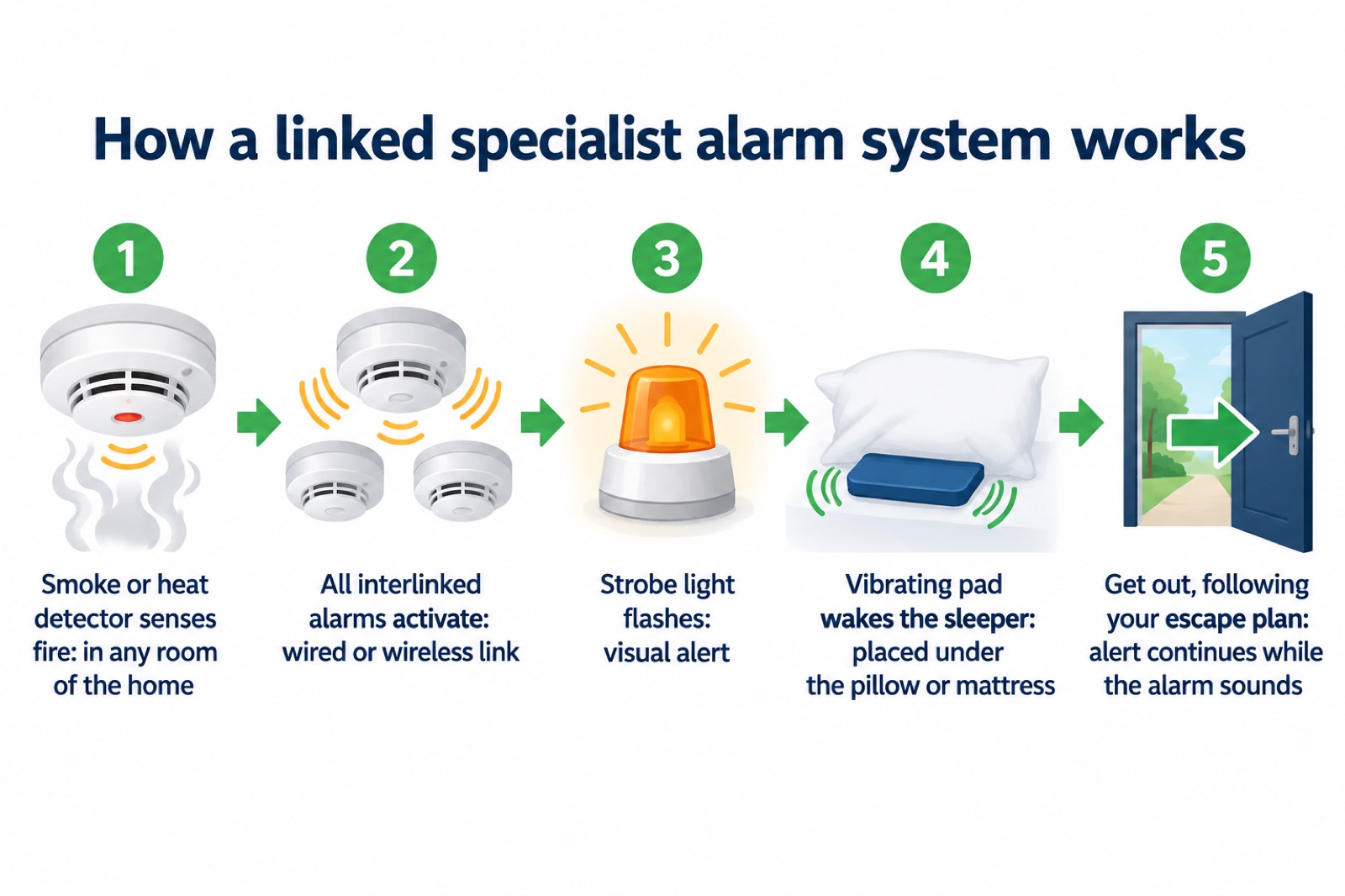
A specialist alarm for a deaf or hard of hearing household is not usually a single unit. It is a system. Greater Manchester Fire and Rescue Service advises people who are deaf or have hearing loss to fit interlinked smoke and heat alarms together with an interlinked strobe light and vibrating pad, so that you receive a vibrating and visual alert if any alarm in the home activates7.
Interlinking is what makes the system work for the whole house. Smoke detectors can be wired or wirelessly interlinked so that if one alarm activates, all alarms activate8. Dorset and Wiltshire Fire and Rescue Service explains that interconnecting or linking alarms are useful in larger properties and for people who are D/deaf or hard of hearing: when one alarm senses smoke, every alarm goes off9. For a deaf household, that means the detector in the kitchen, the one on the landing and the one in the hall all trigger the same strobe and pad in your bedroom, wherever the fire starts.
Devon and Somerset Fire and Rescue Service describes this type of smoke detector as having a vibrating pillow pad and flashing light to alert a user that the smoke alarm is activating8. The alarms themselves detect smoke and fire exactly as conventional alarms do; only the alert is different. If you live in a large house or one with more than one floor, Devon and Somerset also suggests asking a qualified electrician to fit linked alarms, so that when one detects a fire they all sound10.
There is a further option worth knowing about. Dorset and Wiltshire Fire and Rescue Service suggests considering interlinked smoke alarms that connect to a telecare, carecall or lifeline system1. These systems link your alarms to a monitoring service, so that someone is alerted even if you are not at home or do not respond. If you already have a telecare system through your council or a provider, mention it when you ask about alarms, because the fire service can consider how the alarm system links up11.
For a fuller explanation of linking, see interlinked alarms, and for choosing the detectors themselves, see smoke alarms and heat alarms.
Who can get a special alarm, and where to ask
The short answer is that these alarms are for anyone who cannot rely on hearing a conventional alarm. London Fire Brigade's easy-read guidance states it directly: you can get a special alarm if you are deaf, hard of hearing or have a visual impairment12. Devon and Somerset Fire and Rescue Service describes the typical household as deaf or hard of hearing people who live alone, or with others who are also deaf or hard of hearing10. North Wales Fire and Rescue Service says simply that if you have a hearing difficulty you can get a smoke alarm which uses a strobe light and vibrating pads13.
The first place to ask is your local fire and rescue service. Most services offer a free home fire safety visit, and specialist alarms can be fitted during one. London Fire Brigade notes that specialist alarms, for example strobe light and vibrating pad alarms for those who are deaf or hard of hearing, can be fitted as part of a home fire safety visit14, and its guidance for carers says the same15. Devon and Somerset Fire and Rescue Service offers free home fire safety visits without judgement, fitting additional smoke alarms and additional equipment to the property if needed16, and its Home Safety Visit request form lets you specify if the person has an impairment that may mean they need specialist fire or smoke detection and alarm equipment, which can then be fitted free of charge11.
How to ask, in order:
- Request a home fire safety visit from your local fire and rescue service, through its website or by contacting your local community fire station. The Scottish Fire and Rescue Service advises contacting your local community fire station in the first instance, and notes that local organisations or arrangements with local authorities can assist with providing specialist alarms3.
- Say on the request form or in the conversation that you are deaf or hard of hearing and need a strobe and vibrating pad system11.
- If you are in Staffordshire, you can text a request or enquiry to 07528 983 101, a service for residents who are deaf or hard of hearing4.
- In Northern Ireland, the Northern Ireland Fire and Rescue Service says that for anyone with impaired hearing, sensory alarms with a vibrating pad and flashing light are available, and suggests contacting your GP to arrange an assessment17.
- Cheshire Fire and Rescue Service also publishes a contact number for these alarms: 01606 86870018.
If you support someone else, Greater Manchester Fire and Rescue Service advises checking whether the person can hear a sounding alarm from the place where they usually sleep. If they cannot, arrange for them to have interlinked smoke and heat alarms and an interlinked strobe light and vibrating pad, giving a vibrating and visual alert if any alarm in the home activates6. Devon and Somerset Fire and Rescue Service adds that if you or a family member are vulnerable, or have a condition that may prevent or delay escape if there is a fire, you may need a specialist alarm system19.
Beyond the fire service, Action on Hearing Loss provides specialist equipment and advice for deaf and hard of hearing people. North Wales Fire and Rescue Service lists the contact details as 0808 808 0123, textphone 0808 808 9000, SMS 0780 0000360, and www.actiononhearingloss.org.uk13. Northamptonshire Fire and Rescue Service also directs people to the Action on Hearing Loss information line on 0808 808 012320. London Fire Brigade's easy-read booklet suggests contacting your local council for more information12, and the Northern Ireland Fire and Rescue Service has pointed to the Royal National Institute for the Deaf for further information about vibrating pad and flashing light devices21.
Carbon monoxide alarms with visual and vibrating alerts
Carbon monoxide is a separate danger from fire, and it needs a separate detector. Warwickshire County Council explains that CO alarms are specifically designed to detect carbon monoxide, an odourless and invisible gas, while smoke alarms are designed to detect smoke and fire22. A smoke alarm, however good, will not warn you about a faulty boiler or a blocked flue. See carbon monoxide alarms for how these detectors work, and carbon monoxide poisoning symptoms for what the gas does.
The same alert problem applies. If you cannot hear a CO alarm's audible warning, you need the alert in a form you can sense. The Scottish Fire and Rescue Service notes that specialist alarms for deaf and hard of hearing people have features ranging from strobe lighting and vibrating alarms3, and Dorset and Wiltshire Fire and Rescue Service's guidance on fitting interlinked alarms that connect to telecare, carecall or lifeline systems applies to smoke detection in the home1. When you ask the fire service or an installer about a specialist system, ask specifically whether carbon monoxide detection is included or can be linked in, so that the strobe and pad warn you for both dangers.
If your CO alarm ever sounds, or you suspect carbon monoxide, follow the steps in what to do if your CO alarm sounds, and if you smell gas, see what to do if you smell gas.
Systems built to BS 5446-3, and why the standard matters
When you shop for one of these systems, the standard to look for is BS 5446-3:2005. The Scottish Fire and Rescue Service explains:
"British Standard BS5446-3:2005 specifies smoke alarm kits for deaf and hard of hearing people. Products made to this standard give deaf people assurance of quality smoke alarms designed to meet their needs."
That is the Scottish Fire and Rescue Service's description of the standard3. In practical terms, a kit made to BS 5446-3 has been designed and tested as a complete package for a deaf or hard of hearing household, with the strobe, the pad and the interconnection working together, rather than as separate parts assembled ad hoc. Choosing a kit to the standard is the simplest way to be confident the system will alert you when it matters.
For the smoke alarms themselves, Dorset and Wiltshire Fire and Rescue Service advises checking that any alarm you buy meets British Standard 5446 Part 1 (BS 5446-1) and ideally also carries the British Standard Kitemark9. The wider framework of alarm standards, grades and categories is explained in alarm standards.
Scotland has its own published guidance on this subject. The Scottish Government issued guidance for the new fire alarm standard for deaf and deafblind people on 1 August 2023, aimed at deaf and deafblind people as well as Health and Social Care Partnerships and providers23. The general Scottish rule is that specialist alarms, for example if you are deaf or have a Telecare system, must be fitted in addition to any smoke, heat and carbon monoxide alarms required in the home24. In other words, a strobe and pad system does not replace the standard alarms; it supplements them.
Where the pad goes, and where the strobe must not go
Placement is the part that decides whether the system actually wakes you. Cheshire Fire and Rescue Service's advice is to place vibrating pads under a pillow or mattress to wake you in an emergency5. Dorset and Wiltshire Fire and Rescue Service describes these as mains powered alarms with strobe lights and a vibrating pad, which can go underneath your pillow at night9.
The reason for the pillow rather than the mattress top is that a thick mattress can dull the vibration before it reaches you. If you find the pad is not waking you, move it so it sits directly beneath the pillow rather than further under the mattress, and test the system again. The Scottish Fire and Rescue Service describes the arrangement the same way: a vibrating pad is placed under a mattress or pillow at night, and when smoke is detected the pad vibrates and the strobe light flashes to alert the sleeper3.
The strobe module needs to be where you will see it when the pad wakes you, typically the bedside table or a shelf facing the bed. What matters more is where the detectors go, and where they must not go. North Wales Fire and Rescue Service's fire safety guidance for people with dementia, which applies to any home, states that smoke alarms are not needed in every room and are best fitted in hallways and at the top of stairs25. It also warns:
"Smoke alarms should not be in the kitchen and bathroom as heat and vapour from cooking and bathing can set them off unnecessarily."
That is North Wales Fire and Rescue Service's guidance25. False alarms from steam and cooking heat are the most common reason people disable alarms, which is the worst outcome for a deaf household that depends on the system. Use a heat alarm in the kitchen instead; see heat alarm or smoke alarm and where to fit smoke alarms.
Oxfordshire's guidance adds one more option for people with some hearing: if a resident is hard of hearing, choose an alarm with an emergency light that comes on when the alarm is triggered26. Surrey County Council likewise notes that people who are deaf or hard of hearing need additional ways of being made aware the alarm has been activated, including vibrating pads and flashing strobe lights27.
Power cuts, back-up batteries and warning beeps
Most specialist systems are mains powered, with back-up batteries so they keep working when the power fails. Dorset and Wiltshire Fire and Rescue Service describes them as mains powered alarms with strobe lights and a vibrating pad9, and the Scottish Fire and Rescue Service's general guidance on specialised alarms covers mains-powered smoke alarms with back-up batteries, with vibrating pads and flashing lights that warn people who cannot hear well28. A power cut at night is exactly the kind of moment when a fire must not go undetected, so the back-up battery is not an optional extra.
The back-up battery can fail without the system stopping outright. Cheshire Fire and Rescue Service gives the warning sign:
"Signs of this include your alarm making frequent little beeps."
That is Cheshire Fire and Rescue Service's description of a failed back-up battery in a mains-powered smoke alarm5. If you hear frequent little beeps, or someone in the household does, arrange for the battery or unit to be replaced. If you cannot hear beeps at all, ask a hearing household member, neighbour or carer to listen during the weekly test, and check the unit's indicator lights when you test.
One related point about power cuts and phones: as the UK's landline network moves to digital, Ofcom requires providers to have back-up for customers who depend on their landline. Ofcom states this back-up must last for at least one hour in a power cut, but some providers have back-ups that last up to seven hours29. If you rely on a landline-based telecare or lifeline system linked to your alarms, ask your provider what back-up it supplies, so you know how long the link survives a power cut. Our power cuts guide covers preparing for outages generally.
Testing every month and reading the fault lights
A specialist system only protects you if it works, so testing is not optional. Staffordshire Fire and Rescue Service says to make sure you test the alarm every week4, and the Northern Ireland Fire and Rescue Service says the same: test your smoke alarm every week17. Some services phrase it as monthly; Devon and Somerset Fire and Rescue Service's hoarding guidance, for example, says to install working smoke alarms and test them every month16. Weekly is the firmer rule where it is given, so test weekly if you can.
What to check when you test:
- Press the test button and confirm the pad vibrates and the strobe flashes, not just that the audible alarm sounds7.
- Check the pad is still under the pillow or mattress where you actually sleep, not shifted to the foot of the bed5.
- Look at the indicator lights on the strobe module and the alarms for any fault indication, and listen, or ask someone to listen, for the frequent little beeps that signal a failed back-up battery5.
- If the system is linked to telecare, carecall or lifeline, confirm the link is still live with your provider1.
If you support someone who cannot test and maintain their alarms themselves, Greater Manchester Fire and Rescue Service advises testing the alarms for them at least every month, or helping to identify somebody who can6. For a fuller routine, see how often to test smoke and CO alarms and when to replace a smoke, heat or CO alarm.
Calling 999 without a voice phone
In a fire, getting the alarm message out matters as much as getting the alert in. Avon Fire and Rescue Service advises that if it is difficult for you to call 999 yourself, ask someone to do it for you or use one of the alternative services30.
999 BSL is the video relay route for BSL users. Devon and Somerset Fire and Rescue Service explains how to use it: download the app from your app store, allow access to take pictures, record video and discover device location, and in an emergency press the red button to call 999 and connect to a BSL translator and the emergency services10. Ofcom, which approved the service, describes how it works: a deaf person makes a video call to a qualified and experienced BSL interpreter in a call centre, and the interpreter translates what the deaf person signs into spoken English for the emergency services and signs back what the emergency services say31.
emergencySMS lets people with hearing or speech impairments contact the emergency services by sending a text message to 999. Ofcom notes a limitation worth knowing: it relies on written English, which can lead to misunderstandings for BSL users in emergencies31. If BSL is your first language and you need to convey detail quickly, 999 BSL is the more direct route.
South West London and St George's NHS trust lists 999 BSL at https://999bsl.co.uk/ for urgent help, and notes that Deaf BSL users can reach its crisis line using the Convo Now app for iOS or Android32.
Set up at least one of these before you need it. Download the 999 BSL app and register for emergencySMS in advance, because both work far more smoothly when the account exists before the emergency. Our staying informed guide covers communication options in an emergency more broadly, and how fire and rescue services respond to a call explains what happens after you raise the alarm.
Replacing an old system, and alarms for people with sight loss too
When a specialist system reaches the end of its life, do not take it out until the replacement is in place. South Lanarkshire Council's sensory support guidance is explicit: obsolete equipment removal should only take place once a compliant interlinked fire alarm system has been installed, and compatible specialist deaf alert equipment has been fitted and is working correctly33. The risk being guarded against is a gap, even a single night, in which no alarm can wake you.
If your landlord provides the alarms, the Smoke and Carbon Monoxide Alarm (Amendment) Regulations 2022, in force since 1 October 2022, require landlords to install smoke alarms on every floor and carbon monoxide alarms in rooms with fixed combustion appliances excluding gas cookers, and to repair or replace faulty alarms18. So a failed strobe module or a chirping unit in rented accommodation is the landlord's responsibility to fix.
Finally, these systems are not only for people with hearing loss. London Fire Brigade's easy-read guidance says you can get a special alarm if you are deaf, hard of hearing or have a visual impairment12. North Wales Fire and Rescue Service advises considering a strobe light and vibrating pad system for blind or partially sighted residents, explaining that these alarm systems activate in the same way as other smoke alarms but the light and vibrations aid in alerting the resident13. For anyone with reduced vision, it also suggests a brightly coloured sticker on the smoke alarm so it stands out against a white ceiling13. The vibrating pad is the part that carries the message when neither sound nor light can, which is why the pad, not the strobe, is the heart of the system.
Once your alarm system is in place, the remaining step is knowing what to do when it goes off: see what to do if a fire starts in your house and how to make a fire escape plan.
Sources (33)
- Hearing and sight difficulties: advice for carers, Dorset and Wiltshire Fire and Rescue Service
- Smoke alarms, Staffordshire Fire and Rescue Service
- Deaf awareness, Scottish Fire and Rescue Service
- Home fire safety visits, Staffordshire Fire and Rescue Service
- Smoke alarms: stay safe at home, Cheshire Fire and Rescue Service
- Additional advice for carers, Greater Manchester Fire and Rescue Service
- Additional advice for people who are deaf or have hearing loss, Greater Manchester Fire and Rescue Service
- Equipment for people with hearing difficulties, Devon and Somerset Fire and Rescue Service
- Smoke alarms, Dorset and Wiltshire Fire and Rescue Service
- Fire safety for people with hearing difficulties, Devon and Somerset Fire and Rescue Service
- Home safety partnerships, Devon and Somerset Fire and Rescue Service
- Digital easy-read fire safety booklet, London Fire Brigade
- Hearing and sight impairments, North Wales Fire and Rescue Service
- Sprinklers and home fire safety visits, London Fire Brigade
- Ability to respond and escape, London Fire Brigade
- Hoarding and fire safety, Devon and Somerset Fire and Rescue Service
- Home fire safety, Northern Ireland Fire and Rescue Service
- Safe and Well booklet, Cheshire Fire and Rescue Service
- Smoke alarms for vulnerable people, Devon and Somerset Fire and Rescue Service
- Smoke and carbon monoxide alarms, Northamptonshire Fire and Rescue Service
- Winter warning as fire fatalities rise, Northern Ireland Fire and Rescue Service
- Smoke alarms and CO detectors, Warwickshire County Council
- Fire alarm standard: alarms for deaf and deafblind people, Scottish Government, 1 August 2023
- Fire and smoke alarms in Scottish homes, Scottish Government
- Dementia fire safety, North Wales Fire and Rescue Service
- Smoke alarms, Oxfordshire County Council
- Smoke alarms, Surrey County Council
- Smoke and heat alarms at home, Scottish Fire and Rescue Service
- Future of landline calls, Ofcom
- Safety for people with disabilities: hearing, Avon Fire and Rescue Service
- New 999 video call service, Ofcom, 17 June 2022
- Urgent help, South West London and St George's Mental Health NHS Trust
- Sensory support, South Lanarkshire Council
 Home Fire Safety Checklist
 Bedtime Fire Safety Checks
 Fire Risk Checks for Carers
 What to Do If Fire Starts
 How to Make a Fire Escape Plan
 Fire in a Block of Flats
 Kitchen Fires and Cooking Safety
 Electrical Fires and Sockets
 Smoking, Matches and Lighters
 E-bike Charging Safety
 Hoarding and Fire Risk
 Thatched Properties Fire Risk
 Fireworks and Bonfire Safety
 What to Do After a House Fire
 How Fire Services Respond