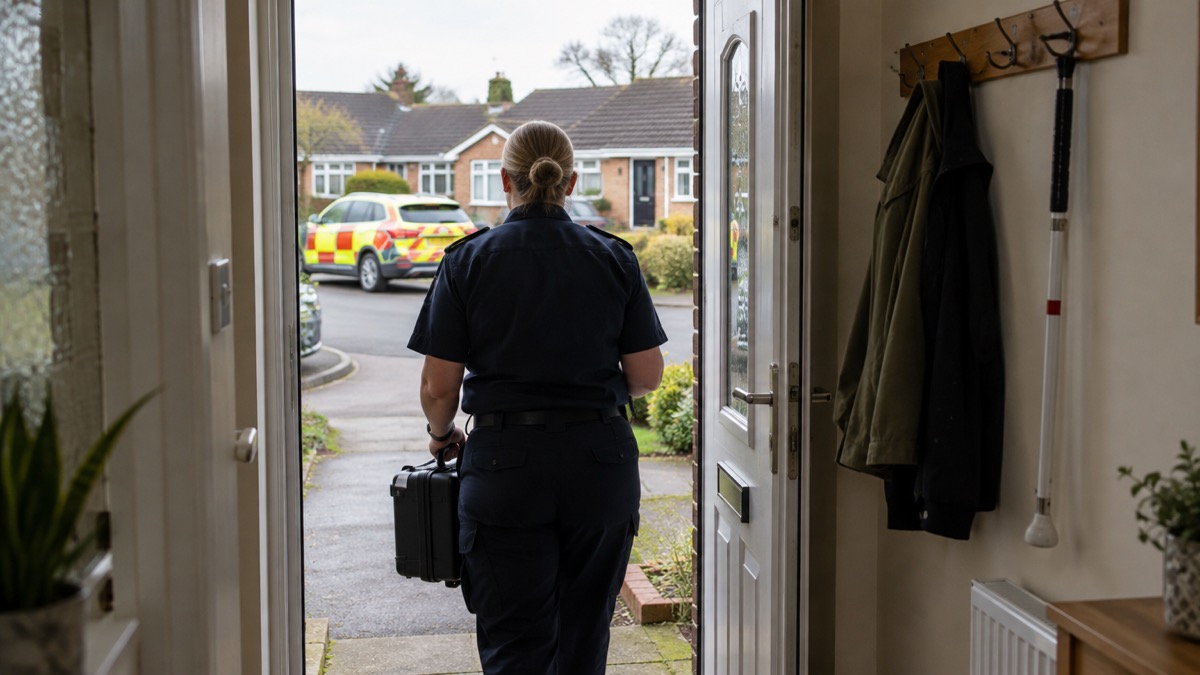
If you are blind or partially sighted, the official fire safety advice for your home is short and practical: put a coloured sticker on your smoke alarm so you can find it to test it, ask your local fire and rescue service for help with alarms, and make sure every warning in your home reaches you in a form you can sense1. The government's fire safety guidance for people with sight, hearing or mobility difficulties sets this out directly, and fire and rescue services across England, Scotland and Wales repeat the same steps1.
Most of what follows takes an hour or two to put right. A sticker costs nothing. If you have a hearing difficulty you can get a smoke alarm which uses a strobe light and vibrating pads3. Where equipment has to be bought, this page explains who normally pays: in rented homes the landlord carries most of the legal duty, and in Scotland the rules on interlinked alarms apply to every home in the country5.
This page is about fire and emergency warnings for households with sight loss. If you also have hearing loss, or you care for someone who does, the sections on strobe light and vibrating pad alarms cover both together.
Make your smoke alarm easy to find: the coloured sticker
The single most repeated piece of advice for people with sight difficulties is also the simplest. Fire and rescue services in England and Wales, and the government's own guidance, all say the same thing: put a coloured sticker on your smoke alarm if you have trouble seeing it to test it1. North Wales Fire and Rescue Service puts the reasoning plainly:
"Consider placing a brightly coloured sticker on your smoke alarm so it stands out against a white ceiling."
That is the whole trick. Most ceilings are white or near white, and most smoke alarms are white or off-white plastic, so the alarm disappears into its background. A sticker in a strong, vivid colour breaks that camouflage and gives your eyes something to lock onto when you look up to test the alarm each month.
The official guidance does not specify a particular colour, only that it should be bright and stand out. Choose the highest-contrast colour you can still see clearly: for most people with residual vision that means a strong red, orange or yellow rather than a pastel shade. If your vision changes, change the sticker to match.
Two points worth knowing:
- Some fire and rescue services can provide coloured covers for smoke alarms, so ask when you contact them1
- Mid and West Wales Fire and Rescue Service suggests asking your local fire service whether they can provide one for you3
Testing a smoke alarm when you cannot see it clearly
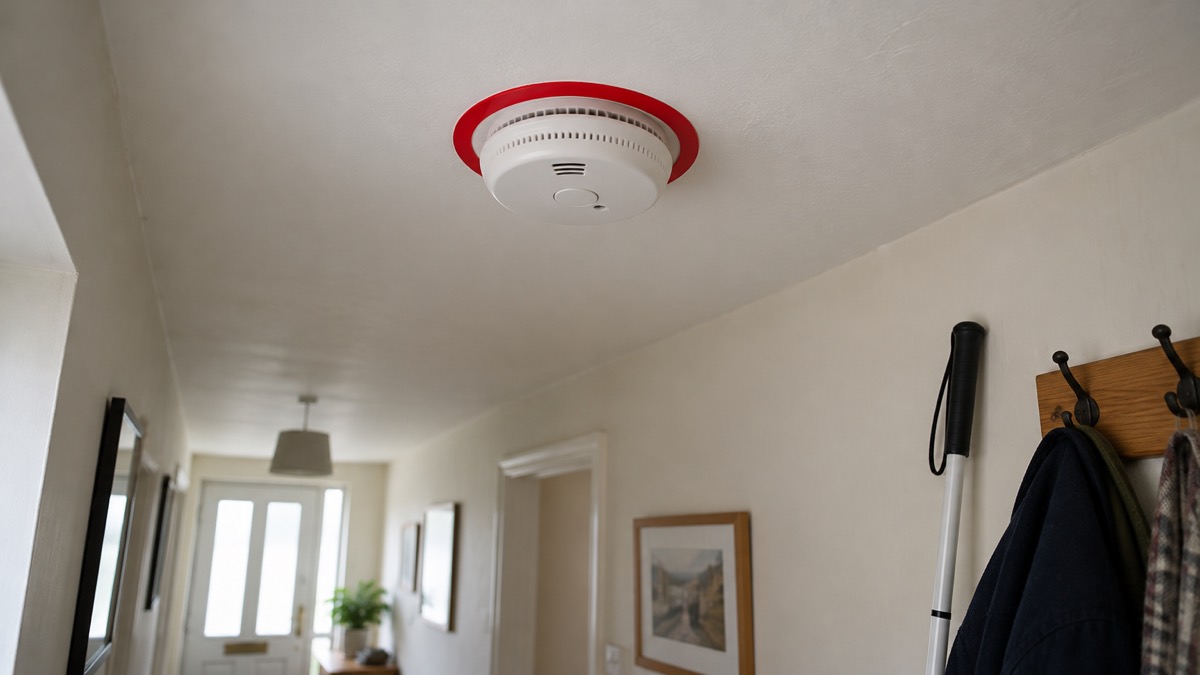
A smoke alarm only protects you if it works, and it only works if it is tested. The government's guidance for people with sight difficulties keeps the test itself unchanged: you still press the test button and listen for the alarm. The coloured sticker from the section above is what makes that possible when the alarm is hard to see1.
If you find it hard to test your smoke alarm, ask someone to help6. That is the official advice from Tyne and Wear Fire and Rescue Service, and it applies whether the difficulty is with seeing the button, reaching it, or both. A family member, a neighbour or a carer can press the test button while you listen from the rooms you use most, which also checks you can hear the alarm from wherever you normally are.
For households where reaching the alarm is the problem rather than seeing it, our page on how to test smoke alarms if you have reduced mobility covers the options in more detail.
If you are a carer, Devon and Somerset Fire and Rescue Service frames the check from your side: if the person you care for has trouble seeing the smoke alarm to test it, try putting a brightly coloured sticker on it7. The sticker and the test belong together; one without the other is only half a safety measure.
Ask your local fire and rescue service for help
Your local fire and rescue service is the first place to turn. Services across the UK run home fire safety checks, and your local service can give advice on specialist alarms and equipment, assistive technology and creating a personal escape plan3.
What the service can do varies by area, but commonly includes:
- A free home fire safety visit, with advice tailored to how you use your home3
- Supplying or fitting smoke alarms, including for people who are vulnerable or have a condition that may prevent or delay escape9
- Specialist alarms such as strobe lights and vibrating pad alarms for people with hearing impairments, linked alarms, and monitored alarms connected to Telecare10
- Coloured stickers or coloured covers for alarms1
For specialist alarms for deaf and hard of hearing people, the Scottish Fire and Rescue Service advises contacting your local community fire station in the first instance; local organisations or arrangements with local authorities can also assist with providing specialist alarms4. Our page on how to refer a vulnerable person for a fire safety check explains the referral process step by step.
In Scotland, the Scottish Fire and Rescue Service has worked with the Royal National Institute of Blind People Scotland to create audio versions of its fire safety leaflets, so you can receive the service's own advice in a format that works for you11.
If calling 999 is difficult for you in an emergency, Avon Fire and Rescue Service advises asking someone to do it for you, or using one of the alternative services12. It is worth working out which alternative suits you before you need it, not during a fire.
Choosing alarms: what to fit for sight, hearing and mobility needs
Not every alarm suits every household. The government's guidance and fire and rescue services describe a range of options, and the right combination depends on who lives in the home and what they can see, hear and do1.
| Alarm type | What it does | Who it suits |
|---|---|---|
| Standard smoke alarm | Sounds when it senses smoke | Households where everyone can hear the alarm, including from sleep1 |
| Alarm with emergency light | A light comes on when the alarm is triggered | Particularly suitable for people who are D/deaf or hard of hearing13 |
| Strobe light and vibrating pad alarm | Flashes and vibrates a pad under the pillow or mattress | People who are deaf or hard of hearing, including when hearing aids are out at night2 |
| Interlinked alarms | When one alarm senses smoke, every alarm goes off | Larger properties and people who are D/deaf or hard of hearing13 |
| Monitored alarm connected to Telecare | Alerts a monitoring service | People who may need help to respond or escape10 |
If you or a family member are vulnerable, or have a condition that may prevent or delay escape if there is a fire, you may need a specialist alarm system9. If you would be unable to respond in the event of a fire, or if your alarm is activated, ensure you have a suitable plan in place to aid escape9.
Some alarms come with an emergency light that comes on when the alarm is triggered, and Devon and Somerset Fire and Rescue Service notes these are particularly suitable for people who are D/deaf or hard of hearing13. For a household with sight loss but normal hearing, the standard audible alarm remains the core protection; the adaptations you need are about finding, testing and responding to it, not replacing it.
Mains-powered alarms with back-up batteries
Mains-powered alarms are powered by your home electricity supply and have a back-up battery in case of a power cut. They need to be installed by a qualified electrician and require testing14. That back-up battery matters for emergency planning: a fire during a power cut is still detected and still sounds.
Many hard-wired smoke alarms also have a back-up battery that will need to be replaced when it fails15. Cheshire Fire and Rescue Service gives the warning sign to listen for:
"Signs of this include your alarm making frequent little beeps."
For households with hearing difficulties, North Wales Fire and Rescue Service describes smoke detectors for the hard of hearing that are mains operated with rechargeable battery back up16. The Disabled Living Foundation can provide more information on remote controlled or easy access alarms17, which may help if reaching or seeing a test button is difficult.
Sight and hearing loss together: strobe light and vibrating pad alarms
If sight loss is combined with hearing loss, an audible alarm alone may not be enough, and a visual alarm alone may not be either. The standard answer is a strobe light and vibrating pad system. North Wales Fire and Rescue Service explains that these alarm systems activate in the same way as other smoke alarms, but the light and vibrations aid in alerting the resident2.
The vibrating pad goes under your mattress or pillow at night; if smoke is detected, the alarm sounds and sets off the pad to assist in waking you18. Devon and Somerset Fire and Rescue Service describes the mains powered versions available to people who are D/deaf or hard of hearing, with a strobe light and a vibrating pad which can go underneath your pillow at night13. Cornwall Fire and Rescue Service describes the same design: a high intensity strobe and a vibrating pillow pad, alerting the user when in bed19.
These alarms can save lives. The Scottish Fire and Rescue Service makes the point that matters most at night:
"These specialist alarms can save lives. They alert the user to a fire in the home, even if they have removed their hearing aid at night."4
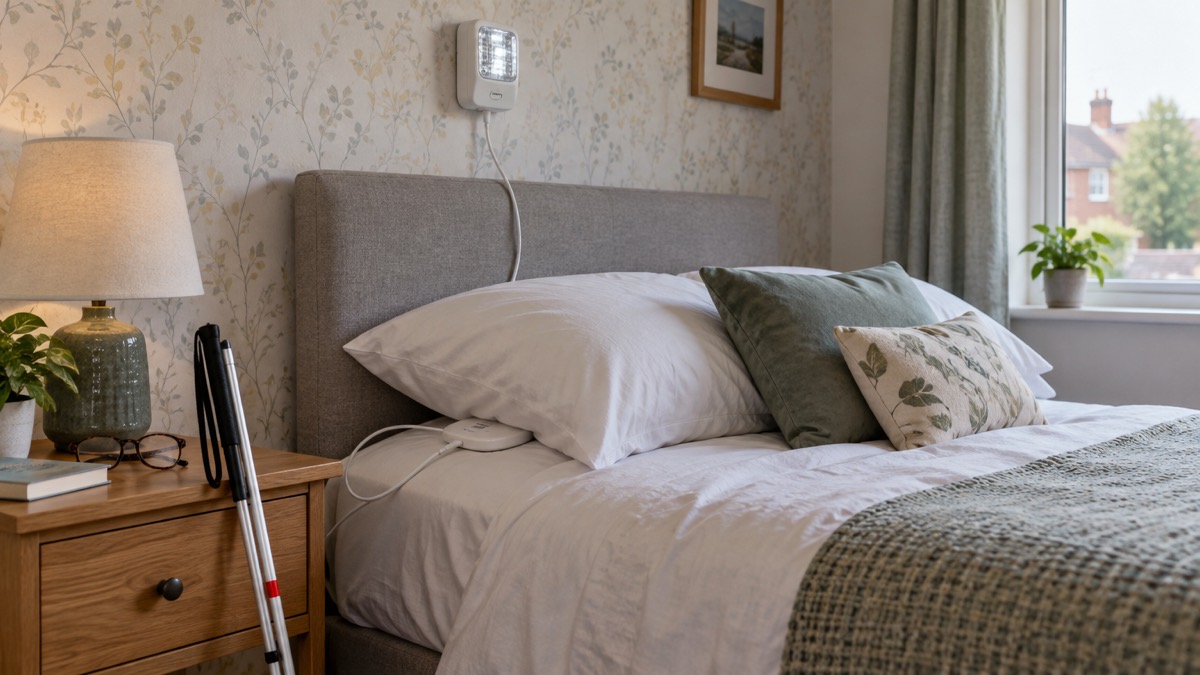
Beyond pads and strobes, a sensory support service can supply a wider set of alerting equipment, including flashing strobe lights, vibrating pillow pads, vibrating pagers and mobile phone alerts20. Vibrating pagers can alert hearing impaired and deaf people that there is an emergency and they need to leave the building, and can also be used to communicate with other people who are part of an assisted escape system and tell them which direction to travel in2. Where a deaf person is likely to be alone in a building, they may need a flashing beacon or similar device; if one is not available, a suitable buddy system will be required, though beacons may not be appropriate where other lighting conflicts with them2.
For carers, Greater Manchester Fire and Rescue Service gives the two-part check. First, for someone with a hearing impairment, check whether they can hear a sounding alarm from the place where they usually sleep. If not, arrange interlinked smoke and heat alarms and an interlinked strobe light and vibrating pad, giving a vibrating and visual alert if any alarm in the home activates21. Second, for someone unable to mobilise or evacuate in response to a sounding alarm, make sure they have a suitable plan in place to aid escape, including assistive technology if required21. Our page on deaf and hard of hearing households in an emergency covers the hearing side in more depth.
Carbon monoxide alarms: audible, never visual
Carbon monoxide alarms follow a different rule for households with sight loss. Lincolnshire County Council's guidance is blunt:
"Alarms purchased should be audible alarms, or hard of hearing alarms (avoid 'colour change' or 'black spot' indicator tools)."10
A colour change or black spot indicator relies entirely on someone seeing a small visual change, which is exactly what sight loss takes away, and it will not wake anyone at night. Buy an audible alarm, or a hard of hearing alarm with a vibrating or strobe alert if someone in the home cannot hear well.
Landlords must install a carbon monoxide alarm in any room used as living accommodation that contains a fixed combustion appliance, excluding gas cookers15. In Scotland, specialist alarms, for example if you are deaf or have a Telecare system, must be fitted in addition to any smoke, heat and carbon monoxide alarms22.
Interlinked alarms in Scotland
Scotland has its own legal standard, and it applies to every home in the country, not just rented ones. Since February 2022, all Scottish homes must have interlinked alarms5. When one alarm senses smoke, every alarm in the home goes off, which is why interlinking is useful in larger properties and for people who are D/deaf or hard of hearing13.
The Scottish standard requires:
- Smoke alarms in living rooms and circulation spaces, and a heat alarm in every kitchen, with all alarms ceiling mounted and interlinked23
- Specialist alarms, for example if you are deaf or have a Telecare system, fitted in addition to any smoke, heat and carbon monoxide alarms22
- Sealed battery or mains-wired alarms meeting the standard25
Who pays depends on your tenure. If you rent your home from a council or housing association, your landlord is responsible for ensuring interlinked fire alarms are in place. If you rent from a private landlord, they must provide interlinked fire and smoke alarms25. Homeowners who are deaf or hard of hearing remain responsible for purchasing and installing the standard interlinked fire alarm system required by law20. For lower income elderly or disabled homeowners, support to install alarms may be available from Care and Repair Scotland25.
The Scottish Government has produced guidance for the new fire alarms standard specifically for deaf and deafblind people, as well as Health and Social Care Partnerships and providers, available on gov.scot and as a downloadable pdf detailing fire alarm accessories and alerts for deaf people4.
What landlords must fit in rented homes
Landlords carry duties in rented homes beyond alarms. Your landlord must ensure furnishings are fire-resistant and meet safety regulations, and you have the right to live in a safe home that is in good repair26. If you live in a building that has areas shared with other tenants, your landlord has legal obligations under the Fire Safety Order as well as the Housing Act for those shared areas27. Your landlord also has a legal duty to give you a copy of the escape plan for your building, so ask for a copy if you do not have one28.
Your responsibilities as a tenant sit alongside the landlord's. You are responsible for checking that alarms are in working order and informing your landlord of any faults10. If the council has reasonable grounds to believe a landlord has not complied with their duties, for example there are missing or defective alarms, it will serve a notice on the landlord requiring them to install working alarms28.
Cherwell District Council recommends that all rented homes are equipped with smoke alarms and heat detectors which are mains-powered with integral battery back-up, wirelessly interlinked and installed by a competent electrician to British Standard BS 5839-6:2019 Grade D LD2, with landlords choosing alarm types based on the needs of their building and their tenants28. If you have sight difficulties, that tenant-needs point is your opening to ask for alarms you can actually find and test.
Other landlord duties that touch on emergency planning:
- If you live in a building with areas shared by other tenants, your landlord has legal obligations under the Fire Safety Order as well as the Housing Act for those shared areas26
- Landlords must ensure furnishings are fire resistant and meet safety regulations29
- In Wales, check your landlord is listed on Rent Smart Wales, as they should be complying with the law on fire safety27
- Your landlord has the right to access your home to inspect damage and carry out repairs, with reasonable notice, and is responsible for repairs if flooding affects your rented home, including making sure water, gas, electricity, sanitation and heating are working30
If you live in a flat and cannot evacuate the building without assistance, you should be offered support by your housing provider or managing agent. Under the Fire Safety (Residential Evacuation Plans) (England) Regulations 2025, housing providers must identify residents unable to evacuate without assistance, offer a person-centred fire risk assessment, discuss and implement reasonable mitigation measures, produce an Emergency Evacuation Statement, and carry out an annual review31. Our page on personal evacuation plans for disabled residents in flates walks through this in detail.
RNIB and other sources of specialist help
The Royal National Institute of Blind People is the main organisation to know. Fire and rescue services consistently signpost it for specialist equipment and advice for blind and partially sighted people2. The helpline number is 0303 123 9999 and the website is www.rnib.org.uk2.
Other organisations worth knowing, depending on your household:
| Organisation | Contact | What it offers |
|---|---|---|
| RNIB | 0303 123 9999, www.rnib.org.uk | Specialist equipment and advice for blind and partially sighted people2 |
| RNID Information Line | 0808 808 0123, textphone 0808 808 9000 | Advice for people who are deaf or hard of hearing needing specialist strobe lights and vibrating pad alarms29 |
| Sense | 0300 330 9250 | Support for people who are deafblind8 |
| Disabled Living Foundation | via its own information service | More information on remote controlled or easy access alarms17 |
For accessible bills and warnings from your energy and water companies, the Priority Services Registers are the route to formats you can read, and our page on what energy and water companies must do for registered customers sets out the duties. If someone calls at your door during an emergency, the doorstep password schemes let you verify them without relying on sight alone.
Planning ahead: the small steps that matter in an emergency
Beyond alarms, the government's emergency preparedness advice for disabled people and carers adds two habits worth building now. Keep mobility aids, such as a long cane, in a familiar place, so you can find it quickly in the event of an emergency33. A cane left in an unfamiliar spot is a small problem on an ordinary day and a serious one in smoke or a power cut.
Second, make a plan with a neighbour or someone else you trust to check on you in an emergency situation if they have not heard from you33. From the other direction, community groups are advised to make a plan to check in on people who might need help if an emergency happens, particularly if the power goes out, with neighbours who have additional medical needs, are new to the area, or cannot use technology well possibly needing checking on in person34. Being known to your neighbours is a form of equipment.
A few final checks for your household:
- Every alarm in the home tested, with the coloured sticker in place1
- An audible carbon monoxide alarm, not a visual indicator, near any fixed combustion appliance10
- A vibrating pad or strobe system if anyone cannot hear a sounding alarm from their bed21
- Your cane or other mobility aid in its fixed, familiar place33
- A neighbour or trusted person who will check on you33
- Your local fire and rescue service contacted for a free home safety visit3
For the wider household preparations that apply to everyone, our getting started guide and the extra help section cover the rest, including personal alarms and key safes that let responders reach you quickly.
Sources (34)
- Fire safety for people with sight, hearing or mobility issues (accessible version), GOV.UK, 2022-08-10
- Hearing and sight impairments, North Wales Fire and Rescue Service, 2026-10-29
- Home safety advice for people with disabilities, Mid and West Wales Fire and Rescue Service, 2026-10-29
- Deaf awareness, Scottish Fire and Rescue Service, 2024-08-08
- Smoke and heat alarms at home, Scottish Fire and Rescue Service, 2025-04-14
- Fire safety for people with disabilities, Tyne and Wear Fire and Rescue Service, 2026
- Hearing and sight difficulties: advice for carers, Devon and Somerset Fire and Rescue Service, 2025-11-19
- Fire safety for people with sight difficulties, Devon and Somerset Fire and Rescue Service, 2026
- Smoke alarms for vulnerable people, Devon and Somerset Fire and Rescue Service, 2026
- Fire alarms and carbon monoxide detectors, Lincolnshire County Council, 2026-10-29
- Sight loss resources, Scottish Fire and Rescue Service, 2024-08-08
- Fire safety for people with hearing difficulties, Avon Fire and Rescue Service, 2024-03-18
- Smoke alarms, Devon and Somerset Fire and Rescue Service, 2026-02-17
- Fire safety in the home (accessible version), GOV.UK, 2022-05-25
- Smoke alarms, Cheshire Fire and Rescue Service, 2026-07-27
- Support for vulnerable people: interventions, North Wales Fire and Rescue Service, 2026-10-29
- Fire safety for people with sight, hearing or mobility difficulties (PDF), GOV.UK, 2021-11
- Smoke alarms, Surrey County Council, 2026-10-28
- Smoke alarms, Cornwall Council, 2021-03-19
- Sensory support, South Lanarkshire Council, 2026-10-29
- Additional advice for carers, Greater Manchester Fire and Rescue Service, 2026-10-29
- Fire and smoke alarms in Scottish homes: what each home needs, Scottish Government, 2024-08-14
- Your guide to fire safety, Scottish Fire and Rescue Service, 2023-11-03
- Fire and smoke alarms in Scottish homes, Scottish Government, 2024-08-14
- Fire and smoke alarms in Scottish homes: what the alarms must have, Scottish Government, 2024-08-14
- Tenants, Devon and Somerset Fire and Rescue Service, 2026
- Student fire safety at home, South Wales Fire and Rescue Service, 2026-09-08
- Housing standards: smoke and carbon monoxide alarms, Cherwell District Council, 2026-10-29
- Fire safety prevention advice, Fire Kills campaign, 2026-03-25
- Housing help if your home is flooded, Somerset Council, 2026-06-04
- Fire safety information for residents living in flats operating an evacuation strategy, Greater Manchester Fire and Rescue Service, 2026-10-29
- Fire safety for people with sight, hearing or mobility difficulties (PDF), GOV.UK, 2021-11
- Advice for disabled persons and carers, Be Ready campaign, 2026-10-20
- Volunteering and helping others, Prepare campaign, 2026-10-19
 Carer's Emergency Plan
 Herbert Protocol Form
 In Case of Emergency Card
 Energy and Water Company Duties
 Personal Alarms
 What Happens When Alarm Pressed
 How Fall Detectors Work
 Home Oxygen Therapy Safety
 Airflow Mattress Fire Risk
 Fire Risk at Home
 Dementia and Emergencies
 Falls at Home
 Living Alone Safely
 Deaf and Hard of Hearing Safety