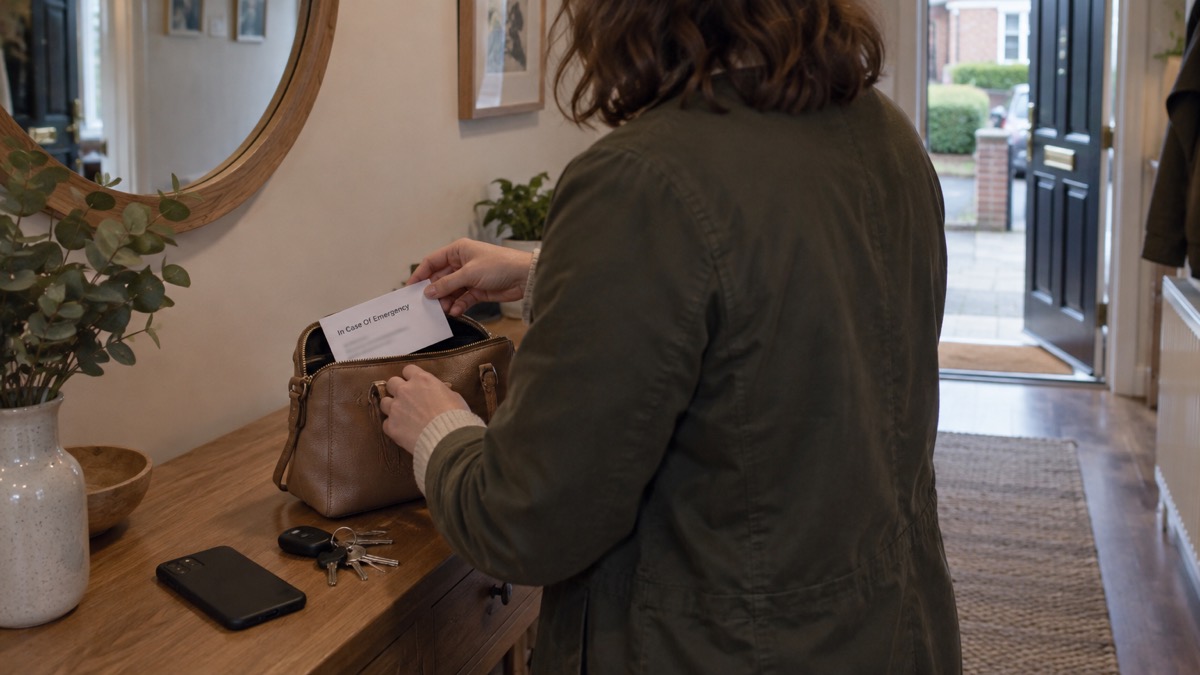
An in case of emergency card is a small piece of paper that speaks for you when you cannot: your name, who to call, and the medical details that change how you are treated. Write it in pencil or print it, keep it in your wallet, purse or bag, and put the same information on your phone. The NHS Tayside carers service asks carers to keep important contact details in an easy-to-find location and to identify family members, friends or neighbours who may be able to help in an emergency1.
You do not need a special form. A household emergency plan should be kept somewhere safe where you can easily find it in an emergency, and a printed or handwritten copy kept somewhere handy with everyone in your home knowing where it is2. What matters is that the card is short enough to read in seconds, current, and somewhere a stranger would look.
This page sets out what to write, who to list, which medical details help a paramedic, and where to keep the card so it is found. It also covers the versions that exist for carers, children and people with dementia, and what to do about a landline that is moving to digital.
The card, item by item
Start with the list below. Each line is something a responder, a neighbour or a stranger helping you would need, and each is drawn from official household planning guidance. Write it in pencil so you can update it, and keep a copy on your phone as well.
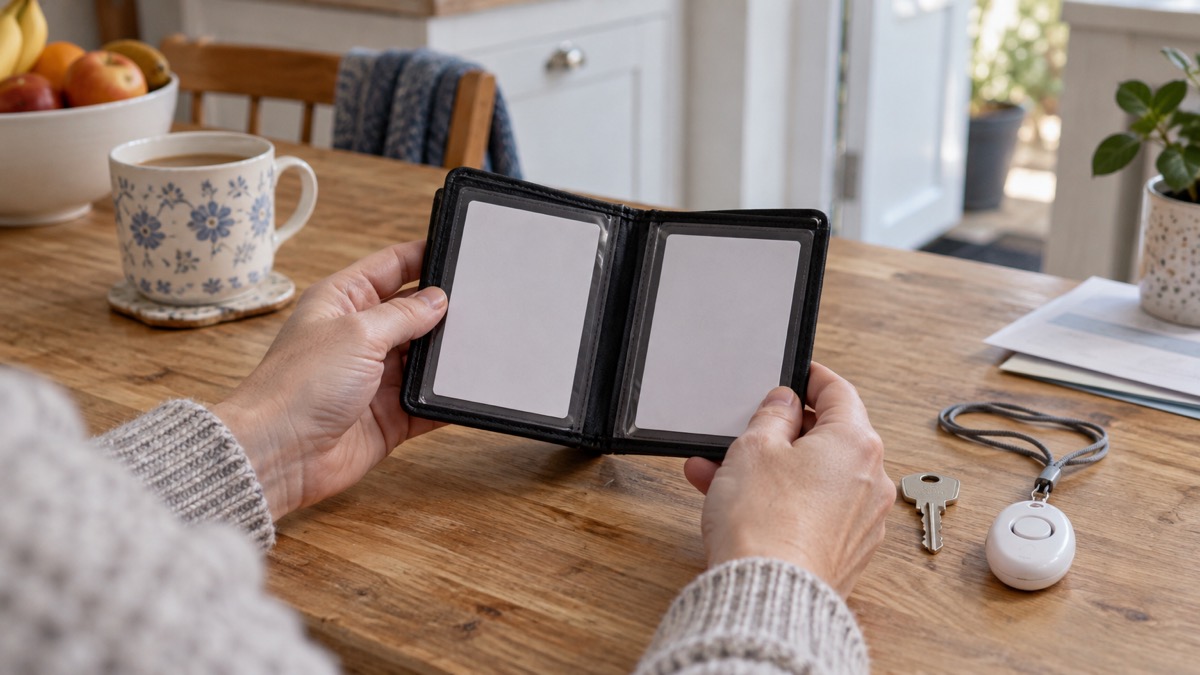
The card itself should be no bigger than a credit card. Write in block capitals or print it, and cover it with clear tape or keep it in a small plastic wallet so it survives rain, a fall or a spill. The Denbighshire emergency supplies guidance suggests keeping personal identification and an emergency contacts list in watertight containers11.
Contacts: who to list and how to show their numbers
Choose people who will answer, who know you well enough to make a decision, and who live close enough to act. Two is usually right: a first contact and a backup. Tell both that you have named them, and tell them what the card says.
The standard way to show a number is the ICE convention. Save the people you would want contacted in your phone's contacts with ICE ahead of their name, or ICE 1, ICE 2 and so on12. The Culham booklet adds two useful variations: if your ICE contact is deaf, type ICETEXT, and for more than one partner save them as ICE1, ICE2 and so on5. The Be Ready checklist goes further and asks you to add emergency contacts or medical information to your mobile phone, often called ICE or Medical ID, so emergency services can access it without unlocking your phone, and to let your chosen contact know13.
| What to show | How to write it | Why it helps |
|---|---|---|
| First contact | Name, relationship, full number | The person a responder rings first6 |
| Backup contact | Name, relationship, full number | Covers a first contact who cannot be reached5 |
| Phone entry | ICE before the name, or ICE 1, ICE 2 | A convention responders and strangers recognise12 |
| Deaf contact | ICETEXT before the name | Tells a caller to text rather than ring5 |
| Someone to check on | Name and number | Flags a person who may need help too4 |
Keep the numbers written down as well as stored. Wiltshire and Swindon Prepared asks the question that makes the case: if you cannot access your phone, how would you find the numbers of family or your insurer14? The Norfolk and Suffolk integrated care board advises keeping important contact details in an easy-to-find location and identifying family members, friends or neighbours who may be able to help15. North Hertfordshire council simply says to keep a list of emergency contact numbers at home16.
For a carer, the contact list is longer. Derbyshire County Council says an emergency plan needs details about the care and support you provide for the person as well as emergency contacts, health needs, preferred routines and any communication difficulties8. Staffordshire County Council adds that the plan should say who to contact in an emergency: family, friends and professionals17.
Medical details that help a paramedic
The medical section of the card has one job: to stop a responder doing something harmful, or to tell them something that changes what they do next. Keep it to the facts that pass that test.
- Medication and doses. The Be Ready checklist asks for a list of any regular medication and doses4. The East of England Ambulance Service asks a caller to pick up the patient's medication if they can9.
- Allergies. Put these first, in capitals, with the reaction.
- Conditions that affect treatment. For example a heart condition, diabetes or epilepsy, in the words your clinician uses.
- How you communicate. The UK Government's Be Ready advice for disabled people and carers suggests carrying information that lets first responders and others know how to communicate with you, stored on a mobile device, written on paper, or printed on a small card7.
- Your GP surgery. The East of England Ambulance Service asks a caller to write down the patient's GP details if they know them9.
If you are waiting for an ambulance, the card does part of the job, but the ambulance service asks you to do more: check that your house number or name is clearly visible from the roadside, get someone to open the doors or stand outside to signal when help arrives, collect any medication the patient may need, and lock away any family pets9. A card that names your medication saves the crew asking, but having the packets ready saves more time.
Where to keep the card so it is found
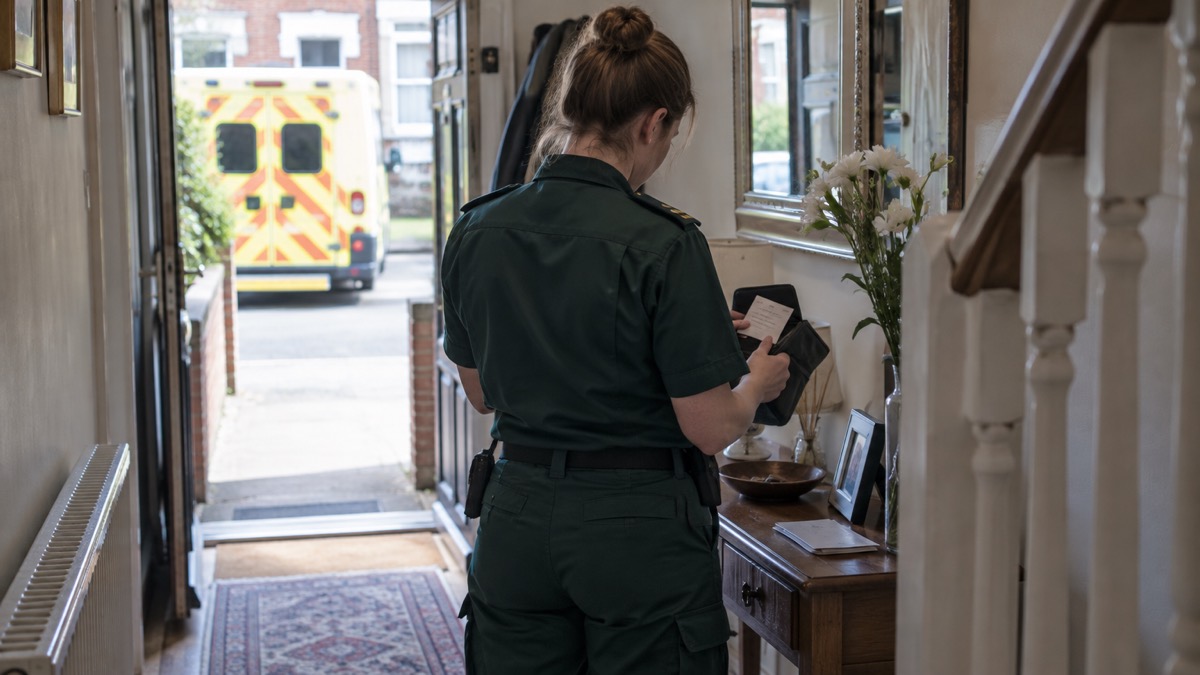
A card only works if someone finds it. Keep it in two places at once: on you, and at home.
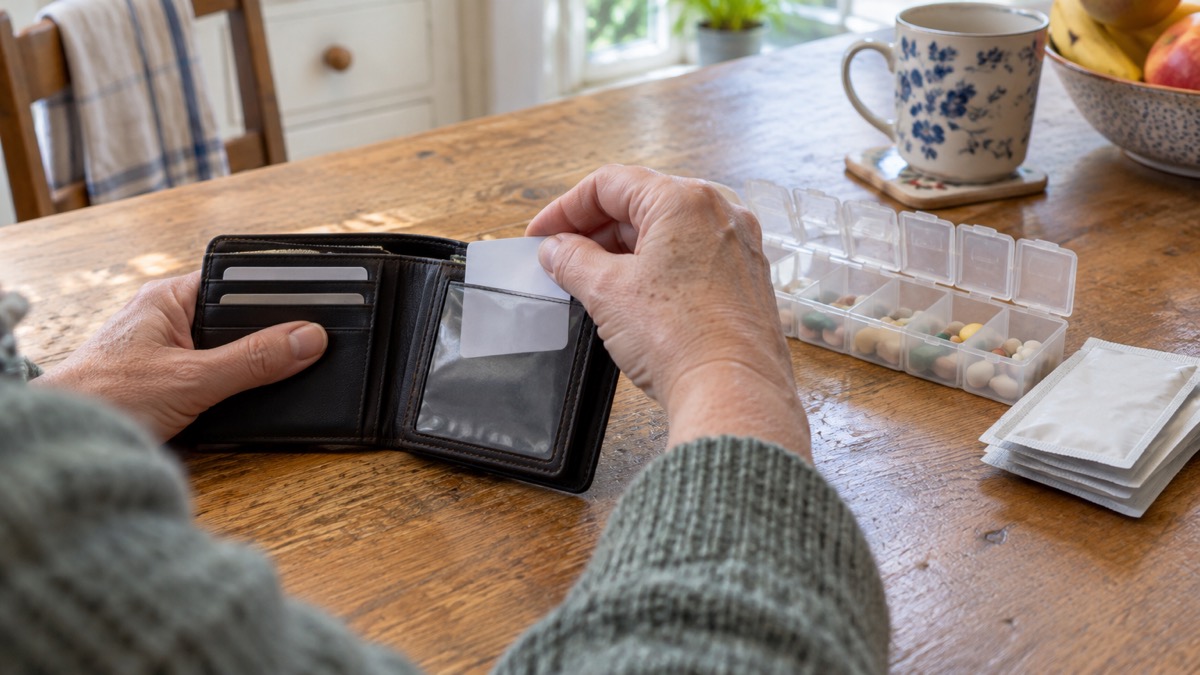
On you, it belongs in a wallet, purse, phone case or bag, in the same pocket every day. If you carry a handbag or a rucksack, put it in a named inner pocket. If you use a walking stick or a wheelchair, a card holder fixed to it works. The Surrey template's advice is to store the details on your mobile device as well as keeping a paper copy somewhere accessible3.
At home, keep a copy where a visitor would look: on the fridge, in a kitchen drawer, or in the household emergency kit. The Denbighshire guidance suggests keeping the kit in a designated place that all household members know, in plastic boxes or backpacks11. The emergency kit checklist for Newport lists a list of emergency contact numbers among the items to keep at home18. Store the details on your mobile device as well as keeping a paper copy somewhere accessible19.
If you are out and about and need help, a Keep Safe Card can be taken to a Safe Place to ask for help20. The Derbyshire scheme's card has space for your name, the name and phone number of a family member or carer, and anything else a person might need to know about you20. That is the same information as your home card, in a form a shop or library will recognise.
Carers: the card that gets cover arranged
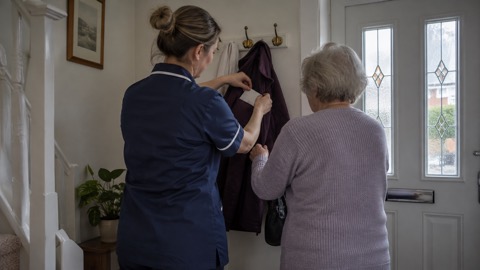
If someone depends on you, an ordinary contact card is not enough. You need a card that triggers a plan. Anyone who provides unpaid care can apply for a carer's emergency card through their council8. The card states that you are a carer and that someone is relying on you to keep them safe and well, shows your emergency plan number and the emergency helpline number, and you should always carry it with you21.
The way it works is simple. You make an emergency plan with your council or carers centre, and you get a card with a phone number on it21. In an emergency, you or someone with you calls the emergency helpline number shown on the card and gives the number of your emergency plan when asked; if you are unable to call, someone else can do this for you21. In Norfolk, the plan is created by filling out the adult carer emergency plan form, which can be printed to share with people in your support network21. In Suffolk, the Family Carer Emergency Plan works the same way: in an emergency, contact Customer First, give them the ID number, and they will get in touch with the contact listed on the plan22.
Cornwall's Emergency Carer's Card Scheme is for carers who are concerned about what would happen if they were taken ill, in an accident, or stopped from getting to the person they care for by another emergency; the card can be used to call the central office to arrange an alternative carer23. The NHS Tayside carers service adds a detail worth copying: there is a matching card for the person you care for, so people understand they depend on you1. For help setting up your plan and getting your card, speak to your local carers centre1.
Children, dementia and the phone in your pocket
Children. Teach children how and when to call 999 and what to do in an emergency such as a fire at home10. Letting children help with the emergency plan and household kit can help them remember the information and feel safer24. A child's card should carry a parent's name and number, one other adult, and any allergy. Keep it in a school bag pocket, and tell the school it is there.
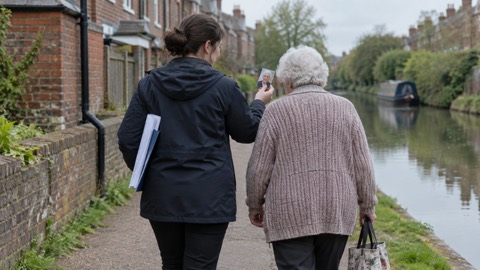
Dementia. If you know someone with dementia, you can fill in a Herbert Protocol form, which can help police find them if they go missing24. A card in a regular pocket, with their name, a contact number and a line about their condition, helps anyone who finds them before the police are called. Our guide to dementia and emergencies covers the wider plan, and the Herbert Protocol page explains the form.
The phone in your pocket. A mobile is the backup for everything else. Keep a charger in your home kit and your car kit26. If your only way of making emergency calls is a landline, or you have a telecare kit connected to your landline, contact your provider to understand whether your phone will work during a power cut27. If you have no other means of calling the emergency services, tell your telecoms provider now28. The old analogue network is being switched off, with most customers expected to be on digital lines by January 202729. If you use a telecare alarm, tell your landline provider and your device supplier before your line is changed4. Our page on personal alarms sets out the options, and will a telecare alarm work in a power cut answers the question directly.
Sources (29)
- Carer's Emergency Card, NHS Tayside, 2026
- Your Home Emergency Plan, Royal Borough of Windsor and Maidenhead, 2026
- Emergency Information Leaflet, Surrey County Council, 2026
- Be Ready Checklist, UK Government, 2026
- Are You Ready Booklet, Culham Parish Council, 2025
- In Case of Emergency (ICE) Card, North West Ambulance Service, 2019
- Advice for Disabled Persons and Carers, UK Government, 2026
- Carer's Emergency Card, Derbyshire County Council, 2026
- Using 999, East of England Ambulance Service, 2026
- Prepare Yourself, Greater Manchester Combined Authority, 2026
- Emergency Supplies Kit, Denbighshire County Council, 2020
- Planning Ahead, Torbay and South Devon NHS Foundation Trust, 2026
- Be ready for emergencies - Be Ready, UK government (Be Ready campaign, beready.campaign.gov.uk)
- Yourself, Wiltshire and Swindon Prepared, 2026
- Be Prepared for Winter Emergencies, Norfolk and Suffolk Integrated Care Board, 2026
- Preparing for Emergencies, North Hertfordshire District Council, 2026
- Plan for Emergencies and Changes, Staffordshire County Council, 2026
- Emergency Kit Checklist, Newport City Council, 2026
- Planning for an Emergency Kit, Wiltshire Council, 2026
- Derbyshire Safe Place Scheme, Derbyshire County Council, 2026
- Carer's Emergency Plan, Norfolk County Council, 2026
- Family Carer Emergency Plan, Suffolk County Council, 2026
- Emergency Planning for Carers, Cornwall Council, 2026
- Emergency Plan, Scottish Government, 2026
- Disabled People and Carers, Scottish Government, 2026
- Future of Landline Calls, Ofcom, 2026
- Power Cuts, UK Government, 2026
- Switchover to Digital Landlines, South Gloucestershire Council, 2026
- Digital Phone Switchover, Argyll and Bute Council, 2026
 Carer's Emergency Plan
 Herbert Protocol Form
 Winter Checks Older Relative