If someone is seriously ill or injured and their life may be at risk, call 999. That is the test the ambulance services across the UK ask you to apply: 999 is for a life-threatening or serious emergency that needs immediate treatment1. If the problem is urgent but not life-threatening, or you simply do not know what to do, call 111 or go to 111.nhs.uk, where advisers assess your symptoms and direct you to the right care3.
The distinction matters because a 999 call that is not an emergency can delay help reaching someone who genuinely needs it5. NHS 111 exists for exactly the middle ground: urgent medical needs that are not a danger to life, and the moments when you are worried but unsure whether something is serious2.
This page sets out what counts as a real 999 emergency, how to choose between the two numbers, what to say when you call, and the situations where 999 must never be used. It also covers the arrangements in Scotland, Wales and Northern Ireland, where the same numbers apply but the advice is sometimes worded differently.
Call 999 only when a life is in danger or the emergency is serious
Every ambulance service in the UK gives the same instruction in slightly different words. You should only call 999 in the event of a life-threatening or serious emergency1. You should only call 999 if you, or someone you are with, is suffering a serious or life-threatening emergency that needs immediate treatment2. Call 999 for life-threatening emergencies only, when someone is seriously injured or ill and their life may be at risk7.
The same rule covers going to A&E. You should only call 999 or go to your nearest A&E department in critical or life-threatening situations11. If life is in danger, dial 999 immediately12.
The reason for the restraint is practical rather than bureaucratic. Call handlers triage every call, and a call that is not an emergency takes time away from one that is. The North East Ambulance Service puts it plainly: do not call 999 if it is not an emergency, as this could delay help reaching someone who needs urgent assistance5.
That does not mean you should hesitate when you are genuinely frightened for someone. The London Ambulance Service advises that if there are no listed symptoms but you believe it is a life-threatening emergency, call 99913. The judgment you are asked to make is about danger to life, not about whether you can name the condition.
What counts as a real 999 emergency
The North West Ambulance Service lists examples of genuine emergencies: cardiac arrest, loss of consciousness, a confused state, fits that are not stopping, chest pain, breathing difficulties, severe bleeding, severe allergic reactions, burns and scalds, suspected stroke, suspected heart attack, a fall from height, serious head injury, stabbing, shooting and serious road traffic incidents14.
Some conditions have their own red flags. For flu, call 999 or go to A&E if you get sudden chest pain, have severe difficulty breathing (gasping, choking or not able to get words out), or start coughing up blood15. For sepsis, if you or anyone else has any of the listed symptoms you should call 999 or go to A&E and ask if it could be sepsis16. For norovirus, phone 999 or go to A&E for severe symptoms including vomiting blood, green vomit, possible poisoning, a stiff neck with pain looking at bright lights, or a sudden severe headache or stomach ache17.
| Situation | What to do | Who advises it |
|---|---|---|
| Cardiac arrest, loss of consciousness, fits that are not stopping | Call 999 | North West Ambulance Service14 |
| Sudden chest pain, severe difficulty breathing, coughing up blood | Call 999 or go to A&E | NHS15 |
| Symptoms that could be sepsis | Call 999 or go to A&E and ask if it could be sepsis | NHS16 |
| Vomiting blood, green vomit, stiff neck with pain in bright light | Phone 999 or go to A&E | NHS inform17 |
| Heatstroke | Call 999 | Guy's and St Thomas' NHS18 |
| Severe bleeding, severe allergic reaction, burns and scalds, suspected stroke or heart attack, serious head injury, a fall from height | Call 999 | North West Ambulance Service14 |
If you are unsure whether a symptom belongs on that list, that is precisely the moment for 111. An adviser can assess what you describe and tell you whether to escalate4.
NHS 111 or 999: how to choose
NHS 111 is the NHS non-emergency number. It is fast, easy and free: call 111 or visit 111 online and advisers assess symptoms and direct you to the best medical care3. Use it if you need urgent but not life-threatening health advice, or when your GP surgery is closed and you cannot get help elsewhere6. It is not a life-threatening situation and therefore is less urgent than a 999 call19.
The services describe 111 as the route for all patients who have an urgent medical need, rather than calling 999 or going to their local A&E2. If you need medical attention but it is not life-threatening, or you do not know what to do, call 1114.
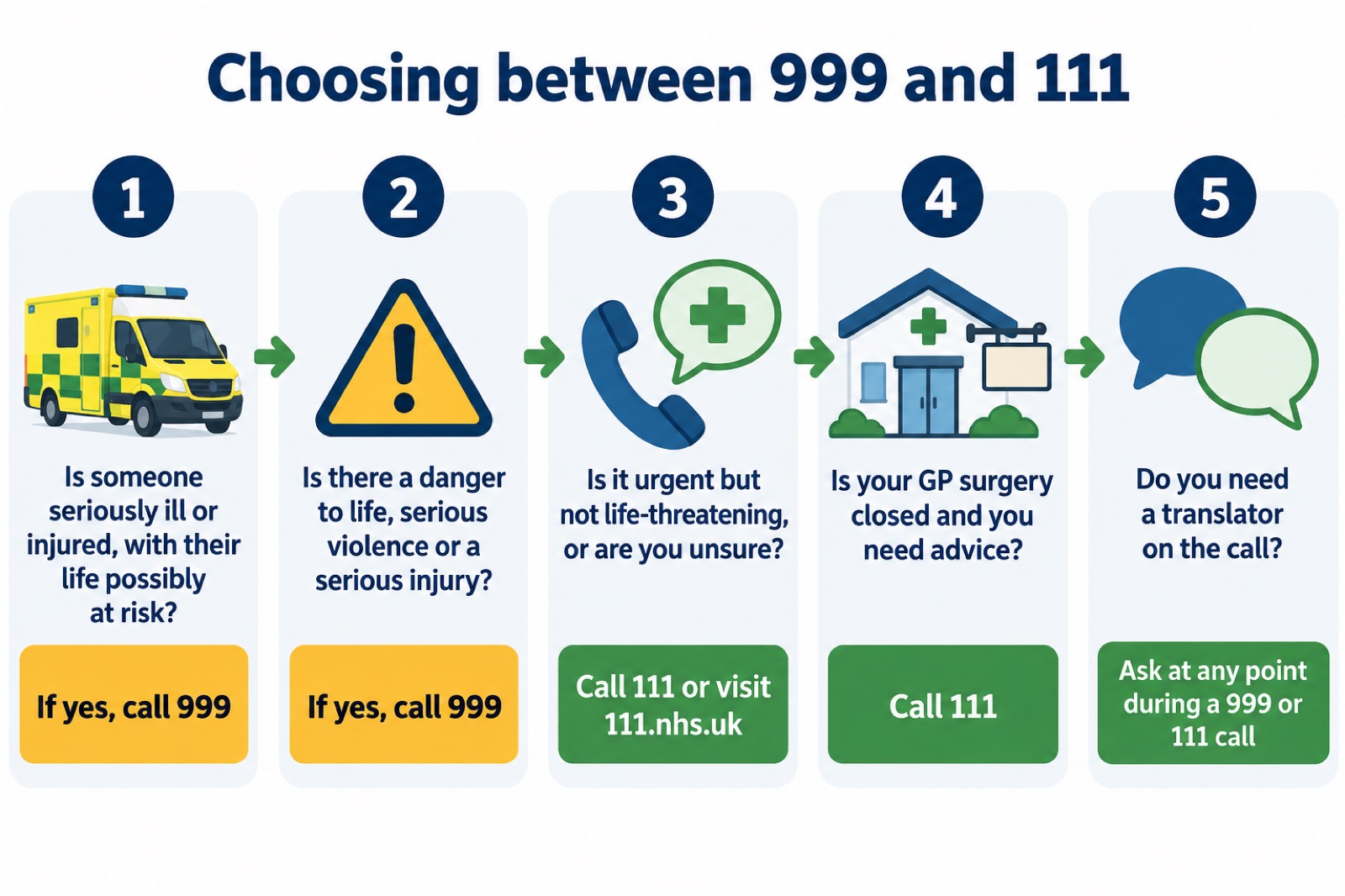
A useful way to hold the difference in mind is that 999 sends help to you, while 111 helps you work out what help you need. Depending on the information you provide, 111 might advise you to call 999 or go to A&E in an emergency20. That is not a failure of the system; it is the system working as designed.
If you are calling about a child, the same logic applies. Contact NHS 111 if a child has had an accident and needs medical attention, or call 999 in life-threatening emergencies21. For a child whose symptoms are getting worse, or who is sicker than you would expect even if their temperature falls, NHS inform advises trusting your instincts and phoning 11122.
Where a 999 call must never be used
A 999 call must never be used for anything that is not an emergency. Do not call 999 if it is not an emergency, as this could delay help reaching someone who needs urgent assistance5. The same applies to the text service: Text 999 should only be used when you cannot make a voice call23.
There is one exception in a fire, and it is about your own safety rather than the phone. The fire and rescue services' message is get out, stay out and call 999, and never go back into the building24. Once you are outside, the call is the priority; re-entering is not.
For the police and fire service, the number is the same. Police, fire and ambulance services all use 999, or 101 for non-emergencies9. Fire, police and ambulance all appear under 999 in Belfast City Council's emergency contact list26. Only use 999 in a real emergency: when there is a danger to life, someone is using or there is an immediate threat of serious violence, serious injury has been caused to someone or their property, or in cases such as road traffic collisions where life is at risk, the road is blocked, or a crime such as a house burglary or robbery is being committed8.
If you feel unsafe or unsure during a fire, call 999 for further information and advice27.
What to say when you call, and calling for someone else
You can call 999 for someone else. The test is whether the person you are with is seriously ill or injured and their life may be at risk, not whether the patient is the one holding the phone7. Stay with them, keep the line open and answer the call handler's questions.
If you need a translator, you can ask for one at any point during a 999 or 111 call. If you speak more than one language, state them both, as less common languages may be more difficult to find a translator for13.
Before you dial, it helps to have three things ready:
- The address, including the postcode and any access details such as a flat number or a locked gate.
- What has happened, in plain words, and whether the person is conscious and breathing.
- Any medication the person takes and any allergies you know about.
For non-emergency police matters, 101 is the number9. For urgent medical advice that is not a danger to life, 111 or 111.nhs.uk is the route3. For a child who is deteriorating but not in immediate danger, 111 is the number NHS inform advises22.
Scotland, Wales and Northern Ireland
The numbers are the same across the UK, but the wording of the advice differs. In Scotland, NHS inform directs people worried about norovirus to phone their GP practice or NHS 24 on 111 rather than attending in person17. In Wales, the ambulance service publishes its own guidance on when to call 999 and on additional support when accessing 99923. In Northern Ireland, nidirect sets out the emergency situations and keeping safe guidance, and the household emergency kit advice lists police, fire and ambulance services under 999, or 101 for non-emergencies9.
| Nation | Urgent non-emergency line | Emergency line | Where the advice sits |
|---|---|---|---|
| England | 111 or 111.nhs.uk | 999 or 112 | NHS ambulance trusts3 |
| Scotland | 111 (NHS 24) | 999 or 112 | NHS inform17 |
| Wales | 111 | 999 or 112 | Welsh Ambulance Service23 |
| Northern Ireland | 111 | 999 or 112 | nidirect9 |
If your mobile provider is experiencing an outage, you will be able to automatically use another provider's network to call 999 or 112 free of charge. This is displayed as emergency calls only on Android or SOS only on iOS10. That matters in a storm or power cut, when the signal you expect may not be there but the emergency call still can be.
Where to get further help
For anything urgent but not life-threatening, start with NHS 111: What It Can Help With and How to Use It, which explains what the service can and cannot do. If you are deciding between an urgent treatment centre, a minor injury unit and A&E, Urgent Treatment Centres, Minor Injury Units and A&E: Which to Use sets out the options. For norovirus, Norovirus: Symptoms, How Long It Lasts and Stopping It Spreading covers when to seek help and how to avoid passing it on. For heat-related illness, Heatwaves and Drought: A Household Guide explains the signs to act on. And for the wider picture of household health emergencies, the Health Emergencies: A Household Guide to Outbreaks, Pandemics and Medicine Supplies section is the place to start.
Sources (27)
- Winter top tips and advice, South Western Ambulance Service NHS Foundation Trust, 2026
- Alternatives to 999, Scottish Ambulance Service, 2026
- When to use 111, London Ambulance Service NHS Trust, 2026
- Using 999, East of England Ambulance Service NHS Trust, 2026
- Your service: 999, North East Ambulance Service NHS Foundation Trust, 2026
- Storm preparation, Cornwall Council, 2026
- Clinical telephone advisor, London Ambulance Service NHS Trust, 2026
- Emergency situations and keeping safe, nidirect, 2025
- Household emergency kit, nidirect, 2026
- Stay connected in severe weather, Ofcom, 2026
- Poisoning, Frimley Healthier Together, 2026
- Flooding during a flood: easy read, Nottinghamshire County Council, 2025
- Your local 999 and 111 services, London Ambulance Service NHS Trust, 2026
- When to call 999, North West Ambulance Service NHS Trust, 2023
- Flu, NHS, 2026
- Recognising sepsis, NHS, 2026
- Norovirus, NHS inform, 2026
- Heatwave advice, Guy's and St Thomas' NHS Foundation Trust, 2026
- NHS 111, Yorkshire Ambulance Service NHS Trust, 2026
- Emergency care and 999, Surrey and Sussex ICB, 2026
- In an emergency, Medway NHS Foundation Trust, 2026
- Sepsis, NHS inform, 2026
- Additional support when accessing 999, Welsh Ambulance Services NHS Trust, 2026
- Get out, stay out and call 999, North Wales Fire and Rescue Service, 2026
- Get out, stay out and call 999, North Wales Fire and Rescue Service, 2026
- Emergency contact numbers, Belfast City Council, 2026
- In the event of a fire, South Wales Fire and Rescue Service, 2026
 Medicine Cabinet Checklist
 Sick at Home Supplies Kit
 Caring for Someone Ill at Home
 How Long to Stay Home With COVID
 Time Off After Sickness
 Stopping Flu Spreading at Home
 How Long to Wash Your Hands
 When Your GP Is Closed
 Disposing of Unused Medicines
 Medicines in a Heatwave
 Taking Someone Else's Medicine
 Ordering Repeat Prescriptions
 Treating Dehydration at Home
 Cold-Health Alerts Explained
 The Glass Test for Meningitis