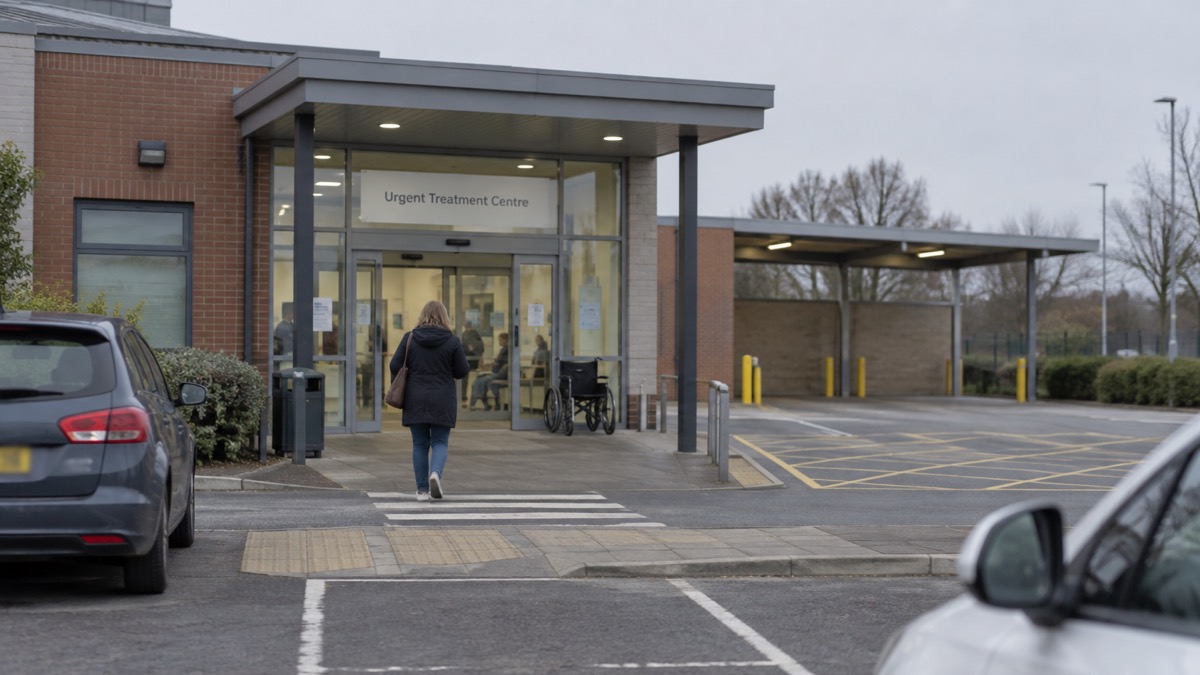
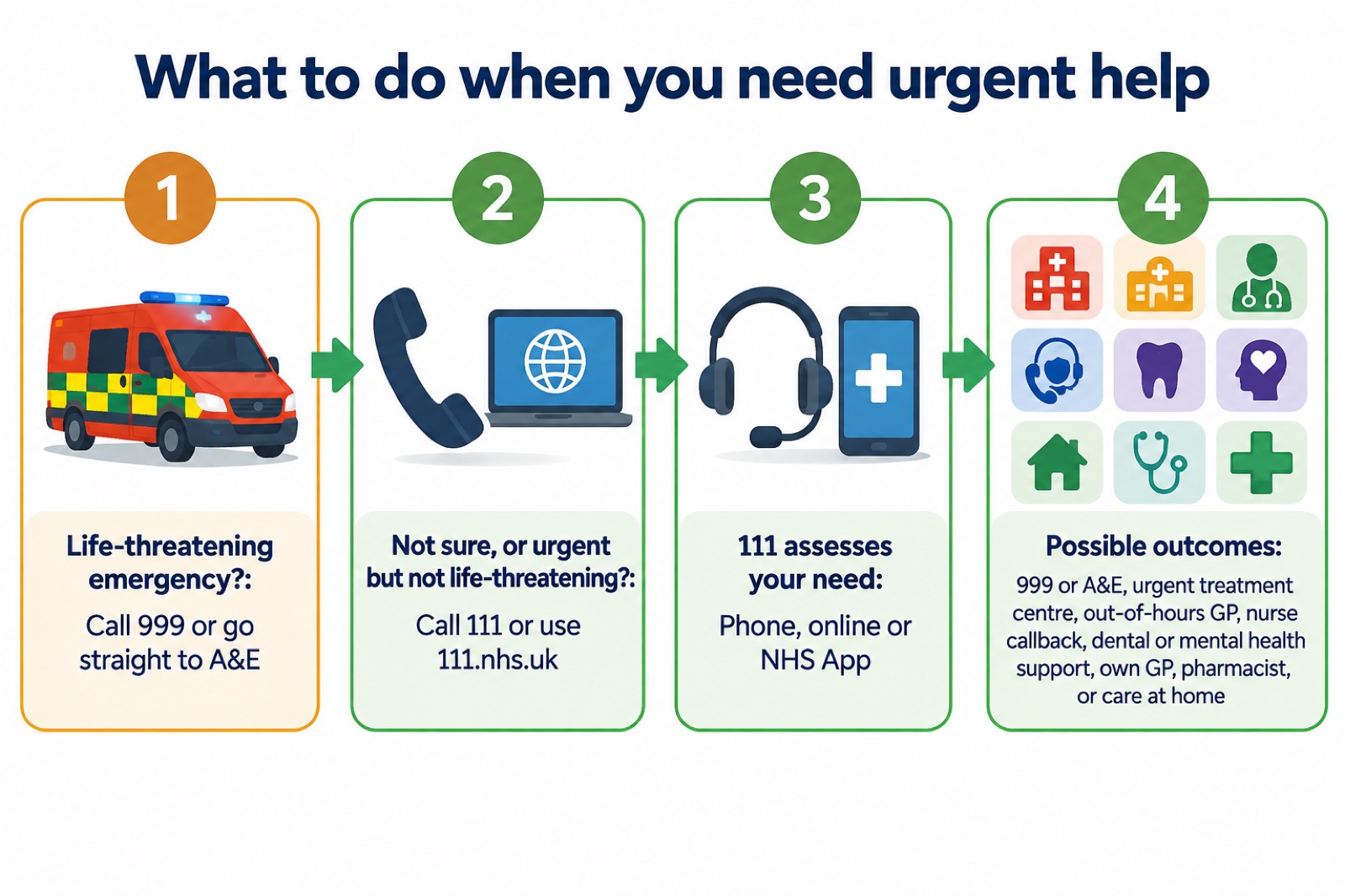
If you or someone in your household is seriously ill or injured, the decision you make in the first few minutes matters: call 999 or go straight to A&E for anything life-threatening, and call 111 or use 111.nhs.uk for everything urgent but not life-threatening1. A&E departments are for serious injuries and life-threatening emergencies, such as heavy bleeding, choking and seizures2. Everything else, from sprains and minor burns to cuts that need stitching, is usually better handled at an urgent treatment centre or a minor injury unit, where you will often be seen faster and closer to home3.
The rule that decides it is simple. NHS guidance is blunt about A&E: it is for life-threatening illnesses and injuries only, it is open 24 hours a day, 7 days a week, and attending unnecessarily could delay treatment for someone more seriously ill4. If you are not sure where to go, call 111 or go to www.111.nhs.uk first for advice5. This page sets out what each service is for, how to find your nearest one, and what to expect.
A&E is for life-threatening emergencies only
Accident and Emergency departments exist for one purpose: emergency care for people with life-threatening conditions, or whose long-term health is at risk without immediate treatment5. NHS guidance across the country repeats the same message. A&E is for life threatening and serious emergencies only9. Only go to Accident and Emergency if it's a life-threatening emergency10. Please only use A&E in a genuine emergency, because doing so helps hospital staff prioritise care for those who need it most11.
The reason is practical rather than bureaucratic. A&E departments are open 24 hours a day, 7 days a week, and their staff, resuscitation equipment and beds are geared to the most serious cases4. When people attend with problems that a minor injury unit, a pharmacy or a GP could have handled, the effect is to delay treatment for someone more seriously ill4. That is why NHS bodies ask patients who need urgent care to call NHS 111 before they decide to walk into the local A&E5.
It also works in the other direction. If you call 999 and need an ambulance, the crew will take you to the most suitable A&E, which may not be the nearest one12. Patients with immediately life-threatening conditions are responded to by skilled paramedics and will normally be taken to A&E or specialist care13. So the question is never "which hospital is closest" but "which service matches the problem".
| Service | What it is for | When to use it |
|---|---|---|
| A&E (Emergency Department) | Life-threatening illnesses and injuries; open 24/74 | Heavy bleeding, choking, seizures, breathing difficulty2 |
| Urgent treatment centre | Injuries needing urgent attention that are not critical or life-threatening7 | Deep cuts, minor fractures, sprains, minor burns14 |
| Minor injury unit | Non-life-threatening minor illnesses and injuries15 | Cuts, sprains, suspected broken bones, minor burns16 |
| NHS 111 | Urgent medical need, or not sure which service you need17 | Any urgent problem when you do not know where to go6 |
When to go to A&E, or call 999
The London Ambulance Service lists the situations that mean A&E or 999: chest pain; a face dropping on one side, being unable to hold both arms up, or difficulty speaking; sudden confusion; a suicide attempt; severe difficulty breathing; choking; heavy bleeding where blood is spraying or pouring; sudden rapid swelling of the face; a seizure or fit; unconsciousness or not responding; and any serious injury or trauma, such as a broken bone sticking out of the skin or burns across the whole body1.
Other NHS guidance gives a matching picture. A&E treats serious, life-threatening problems such as confusion or fits that will not stop, trouble breathing, heavy bleeding that will not stop, severe allergic reactions, and serious burns or scalds12. Surrey and Sussex NHS bodies add loss of consciousness, an acute confused state, chest pain, stroke and major trauma such as road traffic accidents to the list5. For children specifically, NHS guidance says A&E or 999 could include a child blacking out, suspected meningitis, choking, fitting, struggling to breathe, or an injury that is bleeding and will not stop18.
Call 999 rather than driving if any of these apply. Please remember to only call 999 for life-threatening or serious emergencies that need urgent care3. If it is a life-threatening emergency in Scotland, you should phone 999 or go directly to A&E19. Poisoning with any red features, such as suspected swallowing of harmful substances in a child, means going to the nearest Hospital Emergency (A&E) Department or calling 99920. For button batteries specifically, if a child is suspected of swallowing one, do not delay: take them straight to A&E or call 999 for an ambulance21.
"You should only call 999 or go to your nearest A&E department in critical or life threatening situations or red features."
Minor Injury Units: nurse-led care for non-life-threatening injuries
Minor injury units are usually nurse-led. Emergency Nurse Practitioners see, assess, diagnose and treat a wide range of non-life-threatening minor illnesses and injuries, including chest, throat, eye and urinary infections, emergency contraception, sprains and strains, broken bones and wounds, and they treat children as well as adults4. In Scotland, the advice is to visit your local minor injuries unit for non-life threatening but painful injuries, including cuts and minor burns, sprains and strains, and suspected broken bones and fractures22.
The scope is broader than many people expect. Minor injury units in Cornwall and the Isles of Scilly can treat minor illnesses and injuries that have occurred during the last 14 days, including sprains and strains, minor fractures, traumatic wound infections, minor burns and scalds, head injuries where the person has not been unconscious, insect and animal bites and stings, minor eye injuries, cuts, bruising and grazes, and suspected infections of the chest, urinary tract, eye, ear, skin or throat when GPs are closed7. In Northern Ireland, minor injuries units handle injuries to upper and lower limbs, broken bones, sprains, bruises and wounds, bites (human, animal and insect), abscesses and wound infections, broken noses and nosebleeds, and foreign bodies in the eyes and nose23.
Urgent treatment centres are the newer, overlapping type of service. They are there to help with injuries that need attention urgently but are not critical or life-threatening7. Doctors, nurses, paramedics and other healthcare professionals working at urgent treatment centres can help with deep cuts and wounds, eye injuries, minor fractures, severe sprains, minor head injuries, minor burns and scalds, and much more14. These units are equipped to diagnose and deal with many of the most common ailments people attend emergency departments for, including sprains, minor burns and minor illness, and most are open both weekdays and weekends3. They can also be used when you cannot wait for an appointment with your GP3.
There is a clear boundary on the other side. People with life or limb threatening illnesses or injuries should call 999 instead of going to a minor injury unit, and that includes head injury with loss of consciousness or if the person is on blood thinners, chest pain without injury, stroke symptoms, abdominal pain, or severe bleeding7.
Not every Minor Injury Unit can X-ray a suspected fracture
This is the catch that catches people out with suspected broken bones. A minor injuries unit can help with a cut, a minor burn, a sprain or strain, or a suspected broken or fractured bone19. But not all Minor Injury Units offer the full range of treatment, and NHS 111 Wales advises you to contact your Minor Injury Unit to see if they can deal with your injury or illness before visiting16. For example, some may not be able to X-ray to find out if you have a fracture16.
The limits can be specific. Minor injury units in Cornwall cannot X-ray hips, femurs, backs, chests, ribs, faces, or children under 27. So a suspected broken wrist may be fine to take to your local unit, while a suspected broken rib or a facial injury may need A&E regardless of how minor it seems. Some urgent treatment centres do have their own X-ray department: the centres in Runcorn and Widnes have an X-ray department and treat minor cuts or wounds, bites, stings, rashes and allergic reactions, minor burns and scalds, sprains, strains and joint pains, and ear or eye injuries and infections24.
The practical step is to check before you travel. If you are not sure whether the minor injury unit is the NHS service you need, visit NHS 111 online or call 111 to check7. For a broken bone, call 999 during life-threatening emergencies or if the person is unable to move for themselves or is in a lot of pain; use 111 for non-emergency medical help25.
Call 111 first if you are not sure where to go
NHS 111 should be used by all patients who have an urgent medical need, rather than calling 999 or going to your local A&E14. Call NHS 111 if you urgently need medical advice or you are not sure which NHS service you need17. You can get help from NHS 111 by using 111 online, in the NHS App, or by calling 1116. The online service can be reached at 111.nhs.uk or via the NHS App on a smartphone or tablet, and it also supports British Sign Language via SignVideo and text relay on 18001 11126.
What 111 does with your call is the part worth knowing. Depending on what you need, you might be advised to call 999 or go to A&E in an emergency; to go to an urgent treatment centre; to see an evening and weekend (out-of-hours) GP; to book a callback from a nurse; to get urgent specialist support for dental or mental health problems; to contact your own GP surgery; to see a pharmacist for help with a minor illness; or to look after yourself safely at home6. The same list of possible outcomes applies to the online service26.
Under the NHS 111 First approach, if you do need urgent care, NHS 111 can now book you in to be seen quickly and safely in your local A&E27. Contacting 111 first also helps the NHS keep you and your family safe by ensuring you receive the right care in the right place, in a more timely and safe way27. Where 111 arranges an A&E arrival time, you will be seen via an express lane, usually within 30 minutes of arrival, though this can be longer if A&E is extremely busy28. Some urgent treatment centres also provide arrival time slots for patients who contact NHS 11124.
If you do not know where your nearest urgent treatment centre is, use the 111 service to find out14. Our fuller guide to NHS 111: What It Can Help With and How to Use It covers the service in detail, and When to Call 111 and When to Call 999 works through the boundary between the two numbers.
How to find your nearest unit, and check opening hours before you travel
Finding the service is the easy part. If you do not know where your nearest urgent treatment centre is, use the 111 service to find out14. In Wales, you can search for your nearest Minor Injury Unit through the 111 Wales service directory: select hospital from the drop-down, enter your full postcode, town or city, click search, then use the Filter by option and select Minor Injury Unit16. In Scotland, you can use Scotland's Service Directory to find a Minor Injuries Unit near you22.
The step people skip is checking opening hours, and it matters. If you visit a minor injury unit, check the opening hours and waiting times online first, because your nearest may not be the quickest8. Live wait and opening times are published online, so check before you go, as your nearest may not be your quickest7. The NHS Quicker app and website show waiting times, list nearby urgent treatment centres and A&E departments, and sort them by travel time and wait time12.
Opening hours vary enormously between units. Urgent treatment centres in the South Central Ambulance Service region are available seven days a week from early morning till late at night14. In Cornwall and the Isles of Scilly there is a network of 10 minor injury units, most open every day, including evenings and weekends7. In Somerset there are seven Minor Injury Units at community hospitals in Bridgwater, Burnham on Sea, Chard, Frome, Glastonbury, Minehead and Shepton Mallet4. Emergency departments at hospitals, by contrast, are open 24 hours a day, seven days a week29. GP surgeries are generally open 8.00am to 6.30pm on weekdays, and outside those hours you should go online at 111.nhs.uk or call NHS 1114; the out-of-hours period is usually from 6:30pm to 8:00am on weekdays and all day at weekends and bank holidays30.
Walking in, or booking first: how access differs
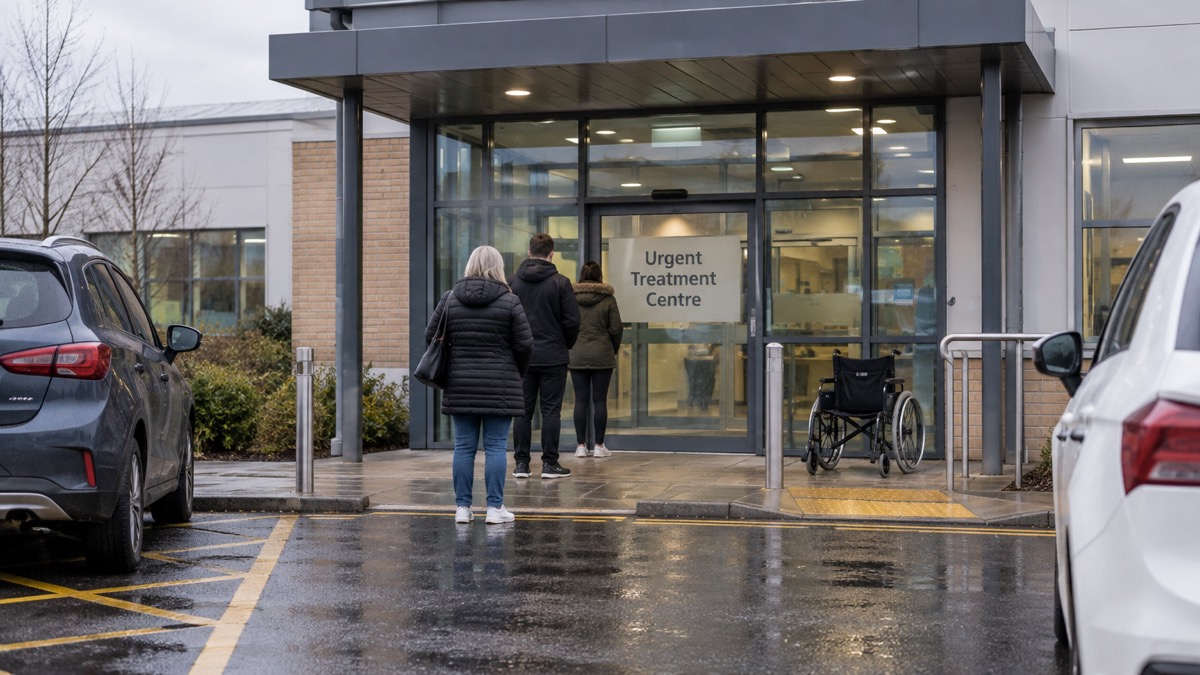
Whether you can just turn up depends on where you live. You can walk into any of the minor injury units in Cornwall without an appointment or calling NHS 1117. At the West Cornwall Hospital Urgent Treatment Centre, no appointment is needed: you can just turn up and be treated by the staff there7. In north east London, at the urgent treatment centres at Barking Community Hospital and Harold Wood Polyclinic, you can call NHS 111 to book an appointment or walk in and wait to be seen, and you do not need to be registered with a GP31. NHS walk-in centres also operate on the basis that you do not need an appointment12.
But walk-in access is not guaranteed everywhere. The Isle of Wight Urgent Treatment Centre at St Mary's Hospital is not a walk-in service, and asks you to call 111 to make an appointment29. This is exactly why checking the local service before you travel is worth the two minutes it takes.
If a walk-in centre or urgent care centre cannot manage your symptoms, they will advise you on what to do next; and if you are unsure whether a walk-in centre can help you, call 111 for advice and they will direct you1. Walk-in centres and urgent care centres provide help when it is not a life-threatening emergency1.
Minor burns, cuts and other common injuries: which service
For minor burns, the Northern Burn Care Network's advice is to call NHS 111 or your GP if in doubt, and to attend the nearest Emergency Department or dial 999 for more serious burns32. NHS guidance on children adds that, depending on the severity of the burn or scald, you should see your GP or go to a minor injuries unit or A&E33. Around 112,000 people visit hospital accident and emergency units each year suffering from burns or scalds incurred in the home or from leisure activities, so this is one of the most common decisions a household faces34.
For cuts, the NHS guidance on children's accidents is specific. Go to A&E or a minor injuries unit if the cut keeps bleeding, if there is a gap between the edges of the wound, or if there is something in the cut such as a piece of glass33.
For limb injuries in children, take the child to A&E or an urgent treatment centre if they have a leg or arm injury and cannot use the limb, or if they have a button battery lodged in their nose or ear33. For suspected broken bones in adults, a minor injuries unit is often the right place, subject to the X-ray limits above16.
| Injury or problem | Where to go | Source |
|---|---|---|
| Minor burn or scald | GP, minor injuries unit or A&E depending on severity; 111 or GP if in doubt | 32 |
| Cut that keeps bleeding, gapes, or has glass in it | A&E or a minor injuries unit | 33 |
| Suspected broken bone | Minor injuries unit or urgent treatment centre; 999 if unable to move or in a lot of pain | 22 |
| Sprain, strain or rash | Urgent treatment centre | 17 |
| Child cannot use a limb after injury | A&E or an urgent treatment centre | 33 |
| Suspected swallowed button battery | A&E straight away or 999 | 21 |
Our First Aid at Home: A Household Guide covers what to do in the first minutes before you travel, and What Is Pharmacy First and What Can a Pharmist Treat? explains the pharmacy option for minor illness.
Scotland, Wales and Northern Ireland: what differs
The services are broadly the same across the UK, but the front door differs. In Scotland, the advice line is NHS 24 on 111. Phone NHS 24 on 111 if you think you need to go to A&E but it is not life threatening, or if you are too ill to wait for your GP practice to open19. If you think you need to visit a minor injuries unit in Scotland, you should phone NHS 24 on 111 first, and NHS 24 will direct you to the best care for your needs19. NHS 24 will help you get the right care in the right place, often closer to home and without the need to go to A&E, which may include a phone or video consultation19. For a life-threatening emergency in Scotland, phone 999 or go directly to A&E19.
In Wales, 111 Wales provides the same triage role and an online service finder. If you have an injury that is not serious, you can go to a Minor Injury Unit for help instead of going to an Accident and Emergency department, and Minor Injury Units in Wales treat broken bones (fractures) among other injuries16. Treatment at NHS hospitals in Wales is free, though if you are not a resident of the UK the Welsh guidance directs you to the Welsh Government website for the rules on charging30.
In Northern Ireland, a minor injuries unit can treat injuries that are not critical or life threatening, with the same broad list of limb injuries, broken bones, sprains, bruises, wounds, bites, abscesses, wound infections, broken noses, nosebleeds and foreign bodies in eyes and nose23. The same principle applies everywhere: 999 for life or limb threatening emergencies, 111 where you are not sure7.
What happens after A&E: outpatient, day patient or admission
Not everyone who goes to A&E stays. NHS hospitals offer treatment as an outpatient, which is an appointment with a specialist with no overnight stay; as a day patient, which means a hospital bed for tests or surgery but no overnight stay; or as an inpatient, which means a stay of one night or more for tests, medical treatment or surgery30. Ambulance services describe the non-emergency side of this as scheduled care: patients who need to be admitted or discharged from hospital, transferred between hospitals for further treatment, or who attend for a scheduled outpatient appointment13.
The numbers bear out how often people go home. Of those attending hospital accident and emergency after an electrical accident at home, 38% of victims are sent home and 47% are referred to out-patients or a GP34. That pattern is a useful reminder that an A&E visit often ends with advice and a referral rather than a hospital bed.
If you are sent home after treatment, follow the advice given. After medical advice or leaving hospital following a poisoning scare, for example, the guidance is to keep an eye on yourself for the next 1 to 2 days, eat and drink as normal, follow any advice given by doctors, and seek medical help again if you feel worse35. If a burn injury is serious or meets the criteria for specialised burn care, the Emergency Doctor will contact the Specialised Burns Service for advice and possible transfer to the most appropriate burn service32.
What urgent care costs, including for visitors from abroad
If you need emergency or urgent medical support in the UK, it is free: A&E, 111 and 999 cost nothing1. Overseas visitors and unsuccessful asylum applicants may be subject to charges for some services, but they will not be refused care at the time it is needed1. More broadly, regardless of residential status or nationality, emergency treatment given at a primary care practice (a GP), in an Accident and Emergency department, or at a walk-in centre is free of charge36. Patients resident in the UK can access primary and secondary healthcare services completely free of charge36.
The practical point for a household is that cost should never be a reason to delay seeking urgent help. Nobody at A&E, at an urgent treatment centre or on the 111 line will ask for payment before treatment in an emergency1.
Getting this right before you need it
The best time to work out your local services is before anyone is ill or injured. Know your nearest A&E, your nearest urgent treatment centre or minor injury unit, and its opening hours and X-ray limits, and save the 111 website or app on your phone. If you or your loved ones have a life-threatening illness or injury, always use 99927. For everything else urgent, 111 will direct you, and may book you in27.
For wider preparation, our Health Emergencies: A Household Guide section covers medicine supplies, outbreaks and caring for someone ill at home, and What to Do When Your GP Is Closed works through the out-of-hours options in detail.
Sources (36)
- Your local 999 and 111 services, London Ambulance Service NHS Foundation Trust
- Find urgent and emergency care services, NHS
- Get the right help and support, South Western Ambulance NHS Foundation Trust
- Which NHS service should I use?, NHS Somerset
- Emergency care and 999, Surrey and Sussex NHS
- When to use NHS 111, NHS, 14 November 2022
- Minor injury unit and urgent treatment centre, NHS Cornwall and Isles of Scilly, 22 September 2026
- Where is best for my care?, NHS Cornwall and Isles of Scilly, 24 March 2026
- Looking after your health in winter, Cumberland Council, 2026
- After a flood, Manchester City Council, 29 October 2026
- Hot weather advice, Mersey and West Lancashire Teaching Hospitals NHS Trust, 29 October 2026
- Health emergencies, Somerset Council, 28 October 2026
- Our clinical response model, Scottish Ambulance Service, 29 October 2026
- Alternatives to 999, South Central Ambulance Service NHS Foundation Trust, 29 October 2026
- Urgent help, South West London and St George's Mental Health NHS Trust
- Minor injury unit, NHS 111 Wales, 2021
- Using 999, East of England Ambulance Service NHS Trust, 28 October 2026
- What to do if your child is unwell, NHS North East London, October 2024
- Right care, right place, NHS 24, 30 October 2023
- Poisoning, Frimley Healthier Together, 29 October 2026
- Button battery factsheet, City of London Family Information Service, 2024
- When should you call 999?, Scottish Ambulance Service, 29 October 2026
- Health care services, Health and Social Care Northern Ireland, June 2024
- When you need urgent healthcare, NHS North Cheshire and Mersey, 11 August 2026
- Learn first aid for broken bones and fractures, British Red Cross
- NHS 111 online, NHS England, 29 October 2026
- What care services can NHS 111 put you in touch with?, North West Ambulance Service NHS Trust, 1 August 2024
- LSC Integrated Care Board :: NHS 111, Lancashire and South Cumbria Integrated Care Board
- Use the right service this winter, Hampshire Hospitals NHS Foundation Trust, 29 October 2026
- What service do I need?, NHS 111 Wales, 2021
- Urgent care in north east London, NHS North East London, 14 April 2026
- Burns first aid, Northern Burn Care Network, 11 March 2022
- What to do if your child has an accident, NHS, 18 December 2025
- Accidents and hazards at home, Somerset Council, 28 October 2026
- Poisoning and accidental swallowing, Healthier Together, 29 October 2026
- National recovery guidance: humanitarian aspects, HM Government, 20 February 2013
 Medicine Cabinet Checklist
 Sick at Home Supplies Kit
 Caring for Someone Ill at Home
 Pandemics and UK Household Plans
 Outbreaks Near You
 UK Health Security Agency
 Staying Home When Ill
 Stopping Infections at Home
 Caring for a Sick Person at Home
 Keeping Prescription Medicine
 Medicine Shortages Explained
 Storing Medicines Safely
 Vaccines Against Outbreaks
 Flu Symptoms and Getting Help
 COVID-19 Symptoms and Testing