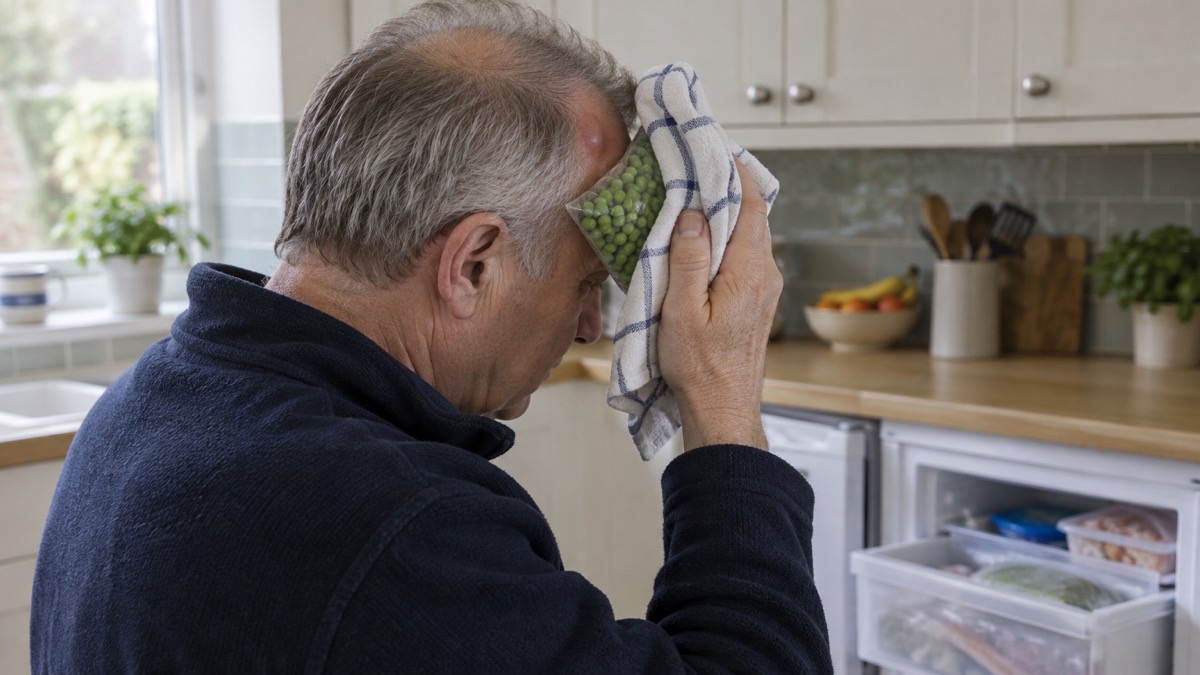
Most head bumps are minor and settle with rest and a cold compress. The decision that matters is whether this one needs an ambulance, a doctor, or just watching at home. The line is clear: call 999 if the person becomes sleepy, vomits or seems confused1. Those three signs mean the brain may have been injured, and they need assessing in hospital, not at home.
If none of those apply, sit the person down, hold something cold wrapped in a cloth against the bump for up to 20 minutes, and keep checking on them1. A lump, a headache and some soreness are normal after a bang to the head1. What you are watching for is change: someone who becomes less responsive, develops weakness or numbness, has a seizure, or has clear fluid or blood coming from an ear or nose needs an ambulance1.
This page covers adults and children. It sets out the danger signs that mean 999, the first aid for a minor bump, how to make and apply a cold compress safely, and when to seek medical advice rather than waiting. It also covers the situations that make a head injury more worrying: a child, an older person, someone who has been drinking, and anyone taking blood-thinning medicine.
Call 999 if they become sleepy, vomit or seem confused
These three signs are the ones to hold in your head. The British Red Cross is direct: "If they become sleepy, vomit or seem confused, call 999"1. Sleepiness here is not ordinary tiredness after a shock. It is a person who is becoming harder to rouse, who drifts off mid-conversation, or who does not respond as they normally would. Vomiting after a blow to the head, and confusion or unusual behaviour, are signs that need hospital assessment.
Ambulance services put serious head injuries on the list of conditions that warrant a 999 call. The North East Ambulance Service says to call 999 when someone is seriously ill or has life-threatening injuries, giving traumatic head injury, severe blood loss, chest pains or loss of consciousness as examples3. The South Western Ambulance Service lists serious head injuries among the reasons to call 9994.
When you call, say what happened and that you suspect a serious head injury. St John Ambulance advises telling the emergency call handler that you suspect a serious head injury, so the right response is sent2. If the person is unresponsive, or you are simply worried, call 999 or 112 for emergency help2.
Other danger signs that need an ambulance
Beyond sleepiness, vomiting and confusion, the Red Cross lists a set of signs that each mean 999: the person becomes less responsive or unresponsive, has numbness or weakness in any part of their body, has clear fluid or blood coming from their ears or nose, has a seizure, or has been in a serious accident or had a severe blow to the head1. Any one of these is enough. You do not need several.
Ambulance services also ask you to call if you think the illness or injury may become worse, or even life-threatening, on the way to hospital6. That is a judgement about the journey as much as the moment: a person who seems stable but is deteriorating needs an ambulance, not a lift in a car.
If you are unsure whether it is an emergency, call 999 and let the call handler decide. The ambulance service triages calls, and if an ambulance is not required you may be advised to seek other help, such as a minor injury unit, a walk-in centre or a GP surgery7. In Northern Ireland, the Hear and Treat service means some patients are assessed over the phone by a clinician, and if the condition is assessed as potentially life threatening the nearest available ambulance is dispatched8.
While you wait, stay calm and stay with the person9. Have their medicines and any medical details ready for the crew. If they become unresponsive and are not breathing normally, that is a cardiac arrest and you should start CPR; our guide to what to do first walks through the check.
First aid for a minor head injury: rest, cold compress and checks
If none of the danger signs are present, treat it as a minor injury. The Red Cross advises the person to rest and to apply something cold to the injury, for example frozen vegetables wrapped in a tea towel, for up to 20 minutes to reduce external swelling and pain1. For a head injury in an adult, sit the casualty down, place a cold compress on the injured area, check their response levels, treat any wounds, and regularly monitor and record their vital signs, leaving them in the care of a responsible person once recovered2.
Rest matters as much as the cold. The general principle for a minor injury is rest, ice, compression and elevation, which can help reduce swelling and pain10. For a head bump, rest means sitting quietly and not rushing back to activity. If a child feels faint, get them to keep their head down or, ideally, lie down; the faint feeling should wear off in a minute or two11.
Then keep checking. Response levels, breathing and behaviour are what you are watching. Note anything that changes, and when it changed, so you can tell a clinician. First aid guidance is to leave the casualty in the care of a responsible person once they have recovered2.
Never put ice directly on the skin
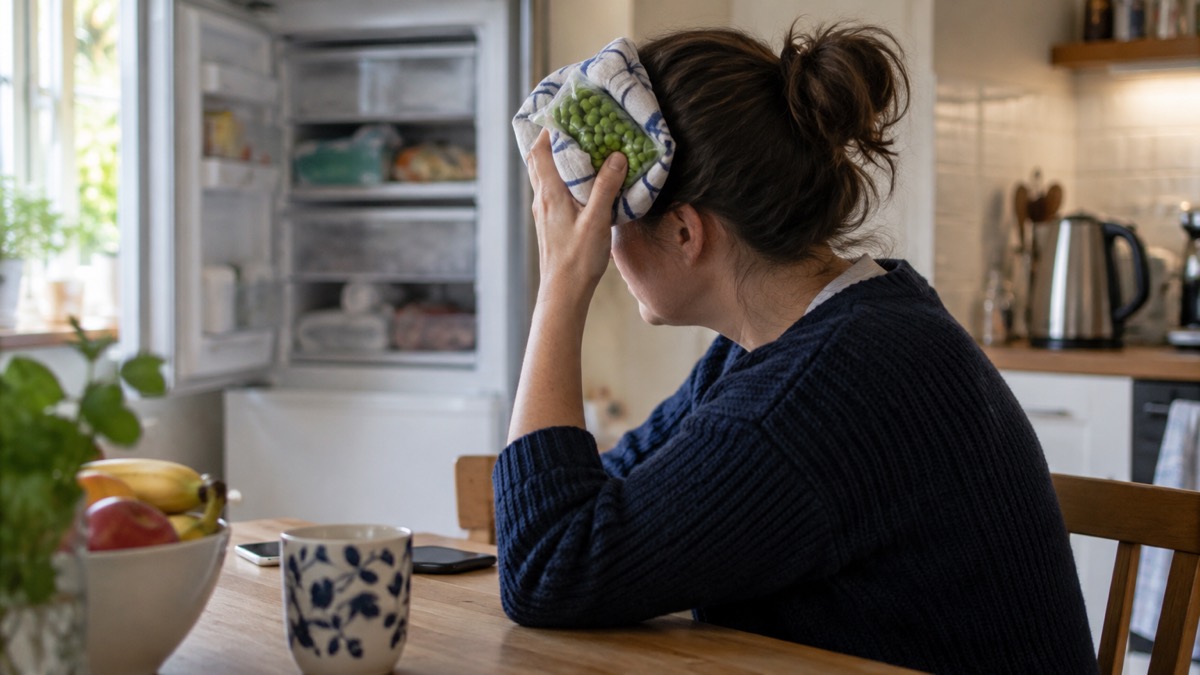
The cold needs a layer between it and the skin. The Red Cross is explicit: "Never place ice directly on the skin, as it's too cold"1. Direct ice can cause an ice burn, which is a second injury on top of the first. Wrap a towel or clothing around frozen vegetables or ice before applying it1.
Never place ice directly on the skin, as it is too cold12. Warm treatments are not recommended as first aid10. Do not use ice or very cold water on a burn or scald, as this can make the wound worse13.
Get medical advice if pain is not settling or getting worse
A headache and a lump are expected after a bump1. What is not expected is pain that stays the same or worsens. St John Ambulance advises the casualty to seek medical help if the head injury appears to get worse, or if any of a list of conditions apply: they are over the age of 65, they have had previous brain surgery, they are taking anti-clotting medication, they have been taking drugs or drinking alcohol, or there is no one responsible to look after them2.
That list is worth reading twice. Older people, people on blood thinners and people who have had brain surgery are at higher risk from a knock that would be trivial for someone else. Someone who has been drinking cannot reliably report their own symptoms, and their judgement is affected. And if no responsible adult can stay with them, the safety net is missing.
For a child, the advice is to contact your GP or call NHS 111 if the bump looks serious or symptoms worsen13. A minor injury unit or urgent treatment centre treats head injuries, needs no appointment and is open late14. If symptoms worsen quickly or you feel very unwell, seek medical help promptly6. Seek medical advice if there is pain following a head injury that is not settling or is getting worse15.
No return to sport until assessed by medical staff
A head injury in sport is not like a sprain. First aid guidance is clear: if the injury is due to a sporting injury, do not allow the casualty to return to sport until assessed by medical staff2. The Resuscitation Council UK's 2025 first aid guidelines add that anyone with suspected concussion should be removed from physical activities5. That means off the pitch, out of the pool, and not back on the bike until a clinician says so.
The reason is that a second blow to a brain that has not recovered can be far more serious than the first. Symptoms can appear or worsen hours after the event, and a player who feels fine at the time may not be fine later. The same caution applies to children in PE and club sport: they should be assessed before returning.
If a neck or spinal injury is suspected, do not attempt to move the casualty2. Our guide to the recovery position when a spinal injury is suspected explains what to do while help comes.
Children, alcohol and other situations that raise the risk
A child with a head injury needs the same danger-sign check as an adult, plus a lower threshold for advice. Call 999 if a child stops breathing, is struggling to breathe, is choking, is unconscious, is limp and floppy, will not wake up, has a seizure or fit, seems suddenly confused or distressed, has been severely injured, or is bleeding heavily13. For a bump that looks serious, or symptoms that worsen, contact your GP or call NHS 11111.
Alcohol changes the picture. Someone who has been drinking may not feel or report pain accurately, may be sleepy for reasons unrelated to the injury, and may be hard to rouse. First aid guidance lists having been drinking or taking drugs as a reason to advise medical help2. Do not let them sleep it off alone; keep checking on them, and call 999 if they become difficult to wake, vomit or seem confused1.
Pregnancy is another reason to lower the threshold. The London Ambulance Service advises pregnant women to call 999 for a seizure, inability to speak, sudden onset of the worst headache ever, loss of consciousness, or confusion16. A headache after a bump that is sudden and severe fits that pattern.
Where to get help
For a minor head injury that is not settling, a minor injury unit or urgent treatment centre can assess it without an appointment and is open late14. Your GP can advise on a bump that is not improving. NHS 111 can advise when you are unsure, and only call 999 for a life-threatening emergency or a severe injury6.
If the person has a seizure, our guide to what to do if someone has a seizure covers the first aid. If you, another adult or a child develops any of the signs of sepsis, it is important to seek urgent medical attention17. For the wider household picture, see First Aid at Home: A Household Guide.
Sources (17)
- Head injury first aid, British Red Cross, 2026
- Head injury, St John Ambulance, 2026
- Your service: 999, North East Ambulance Service, 2026
- When to call 999, South Western Ambulance Service, 2026
- First aid guidelines, Resuscitation Council UK, 2025
- When to call 999 this summer, South Western Ambulance Service, 2026
- What happens when you call 999? | Yorkshire Ambulance Service, Yorkshire Ambulance Service
- Hear and Treat, Northern Ireland Ambulance Service, 2026
- What to do when the ambulance is coming, South Western Ambulance Service, 2026
- Strains and sprains, British Red Cross, 2026
- What to do if your child has an accident, NHS, 2025
- Cool water compress guidance, NHS London, 2026
- What to do if your child is unwell, NHS North East London, 2024
- Where is best, NHS Cheshire and Merseyside, 2026
- Take care of yourself in winter, Staffordshire County Council, 2026
- Advice if you are due to give birth, London Ambulance Service, 2026
- Sepsis, Mid and South Essex NHS, 2026
 Baby and Child Kit Checklist
 Bleeding Control Kit Checklist
 Car Kit Checklist
 CPR on a Baby
 CPR on a Child
 Chest Compression Rate and Depth
 Rescue Breaths or Hands-Only CPR
 Checking Breathing
 Agonal Breathing and CPR
 Breathing During CPR
 Recovery Position and Spine
 Cardiac Arrest vs Heart Attack
 Heart Attack First Aid
 Defibrillator Pad Placement
 Defibrillator on a Child