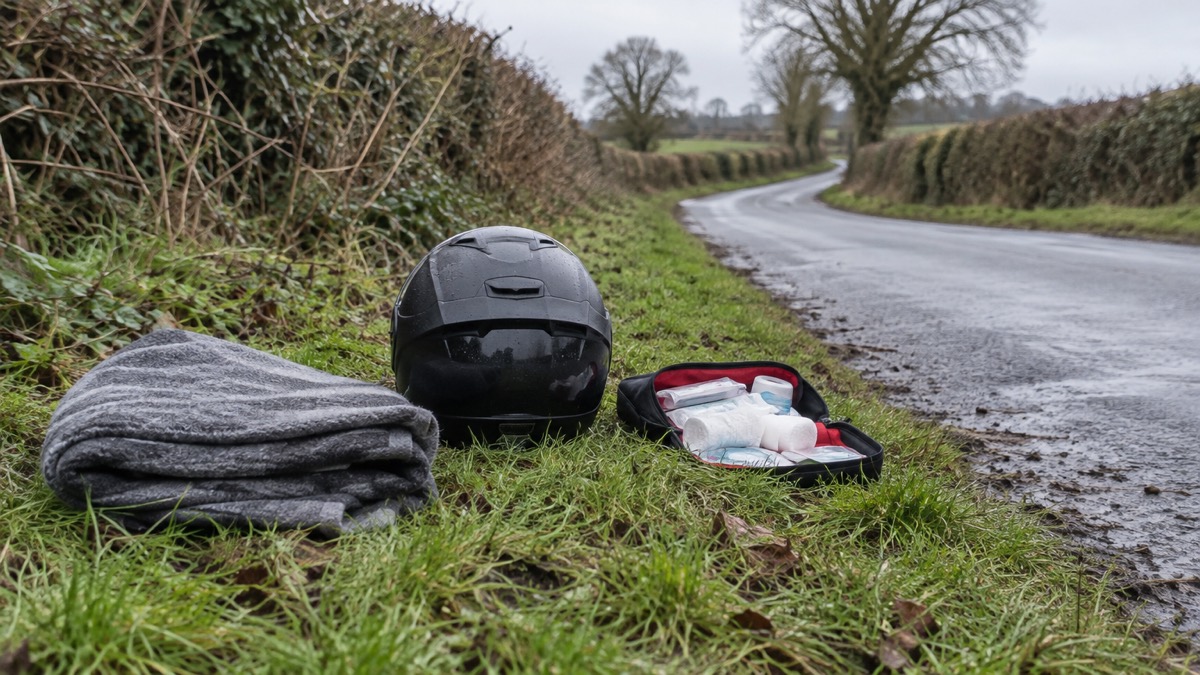
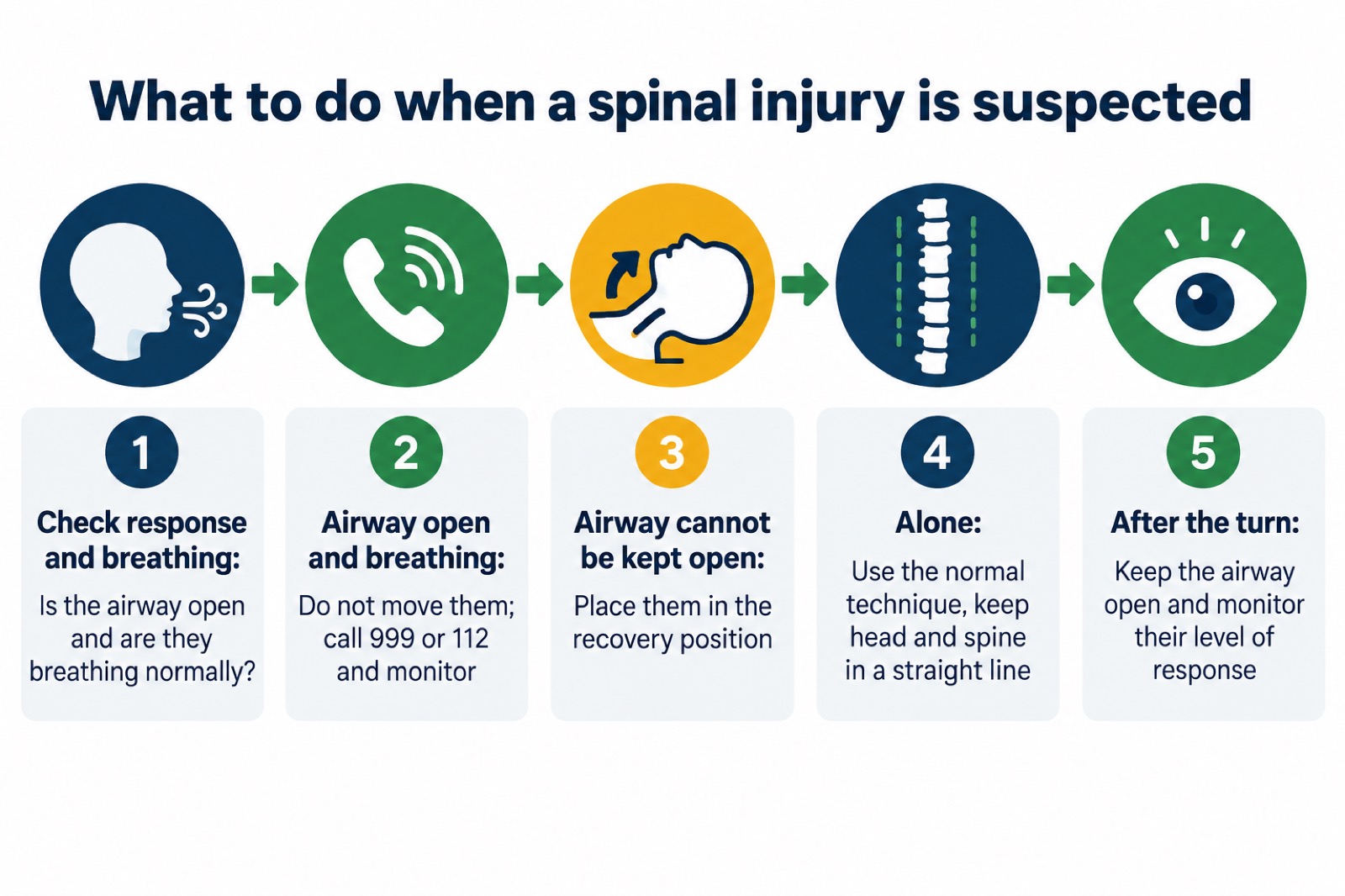
If someone is unresponsive after a fall, a crash or a blow to the head, and you think their neck or back may be injured, the first thing to understand is that keeping them breathing comes before protecting the spine. The NHS advises that if you suspect a spinal injury and the casualty cannot maintain an open airway, you need to place them in the recovery position1. St John Ambulance puts it the same way: if you suspect a spinal injury but cannot maintain an open airway, place the casualty in the spinal recovery position2.
If their airway is open and they are breathing normally, do not move them. The NHS says that if you think someone may have a spinal injury, do not try to move them until the emergency services reach you3. Call 999 or 112 for emergency help if it has not already been done, and monitor their level of response while you wait4.
The spinal recovery position is the standard recovery position done with care to keep the head and spine in a straight line. It is not a different manoeuvre, and it is not something to attempt on someone who is breathing comfortably. It is what you do when the choice is between a protected spine and an open airway, and the airway wins.
Use the spinal recovery position only if the airway cannot be kept open
The recovery position exists for one job: to keep an unresponsive person's airway open. The Red Cross explains that it ensures their tongue falls forward and blood and vomit drain out6. The NHS says that when someone is put into the recovery position, their airway is kept open and any vomit can drain away without interfering with breathing1. That is the whole purpose, and it is why the position matters more than the diagnosis.
When a spinal injury is suspected, that purpose has to be weighed against the risk of moving a damaged neck or back. The guidance resolves it clearly. The NHS says that if you suspect someone has a spinal injury and they cannot maintain an open airway, you need to place them in the recovery position1. St John Ambulance gives the same instruction: if you suspect a spinal injury but cannot maintain an open airway, place the casualty in the spinal recovery position2. The Resuscitation Council UK's 2025 first aid guidelines state that airway opening, if required, always has priority over in-line immobilisation7.
So the test is not "is there a spinal injury?" but "can this person keep their airway open?" If they can, leave them. If they cannot, turn them.
If you are on your own, the NHS advises placing them in the recovery position following the normal technique, trying to keep the head and spine in a straight line where possible while maintaining an open airway1. Do not delay the turn to find a second pair of hands. The Red Cross adds that if you suspect a back or neck injury, you should still move them on to their side so they can keep breathing, keeping the spine in a straight line and getting help to turn them if possible6.
When a spinal injury should be suspected
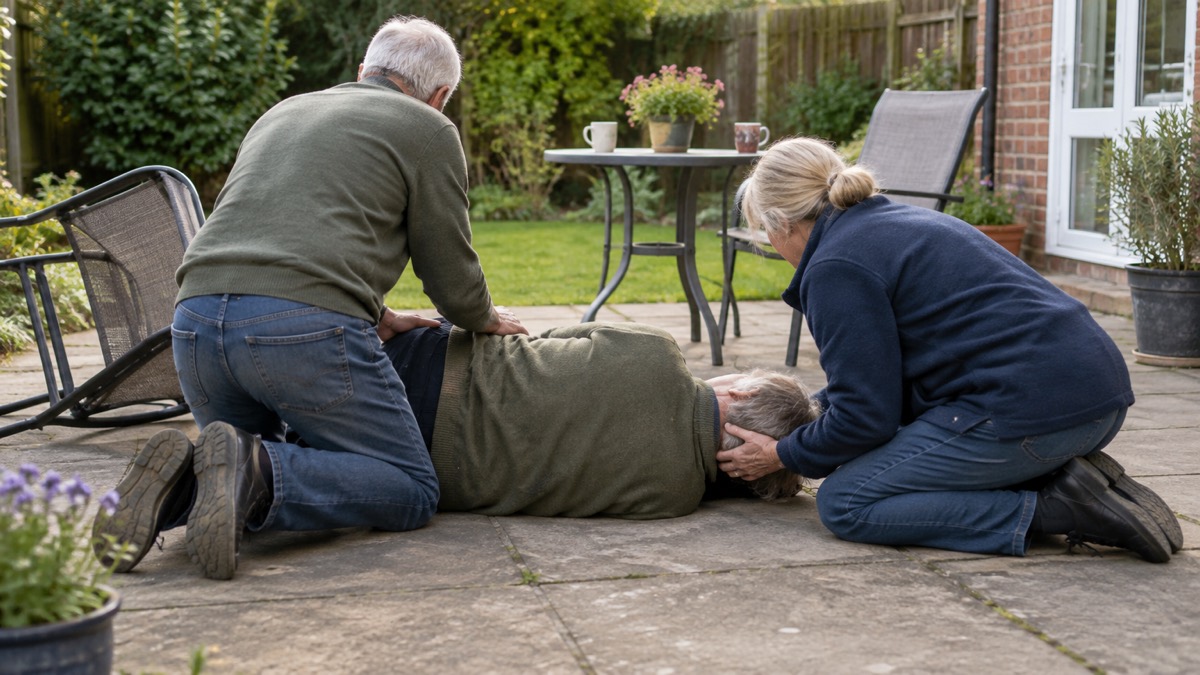
You will rarely know for certain that someone has hurt their neck or back. The guidance is to assume it in the circumstances that commonly cause it. St John Ambulance's advice on traffic collisions is blunt: assume that anyone involved in the accident may have neck or spinal injuries8. That covers drivers, passengers, cyclists and pedestrians.
A head injury is another signal. St John Ambulance says that if you think someone has a serious head injury, call 999 or 112 for emergency help and tell the emergency call handler that you suspect a serious head injury9. Its guidance on head injuries also says to try not to move the casualty from the position you found them in, as they may have a spinal injury, and to move them only if they are in danger9. For a child, its baby and child booklet is direct: if you suspect a neck or spinal injury, do not attempt to move the child10.
Suspect a spinal injury after:
- a road traffic collision, for anyone involved8
- a fall from height, which the NHS lists among the major traumas that warrant a 999 call11
- a serious head injury, where the neck may have been jarred at the same time9
- any accident where the mechanism suggests the neck or back was loaded or twisted
The Resuscitation Council UK adds a practical point for someone who is awake: minimise movement of the neck, and if the person is awake and alert, encourage them to self-maintain their neck in a comfortable, stable position7. Someone who is conscious and talking can often hold their own head still better than you can.
Keeping the airway open comes before keeping the spine still
The reason the airway wins is simple: a person who cannot breathe will die long before a spinal injury is treated. The Resuscitation Council UK's 2025 guidelines state that airway opening, if required, always has priority over in-line immobilisation7. The NHS's guidance on resuscitating a child says the same in plain words: opening the airway takes priority over a possible neck injury12.
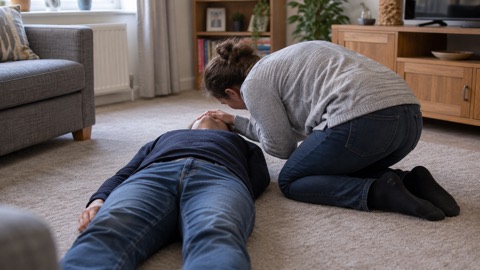
If the casualty is not breathing normally, you need to open their airway. The NHS advises placing your hands on either side of their head, gently lifting their jaw with your fingertips, and taking care not to move their neck3. This jaw thrust opens the airway while keeping the neck in a neutral position, which is why the Resuscitation Council UK names it: using a jaw thrust manoeuvre should maintain a neutral position of the neck7.
If they are breathing but unresponsive and you cannot keep the airway open, that is when you turn them. The standard technique, as set out by the NHS, is:
- Kneel next to them on the floor. Remove their glasses and any bulky objects in their pockets, but do not search their pockets for small items3.
- Make sure both legs are straight. Take the arm nearest to you and place it at a right angle with the palm facing upwards3.
- Bring the other arm across the chest, place the back of their hand against their cheek nearest to you, and hold it there3.
- With your other hand, lift the far knee until the foot is flat on the floor, then pull the far leg to roll them towards you and onto their side3.
- Adjust the top leg so it is at a right angle, and tilt the head right back so the airway stays open3.
The NHS adds that tilting the head and chin back keeps the airway open and allows fluid to drain from the mouth, adjusting the hand under the cheek if needed3. The spinal version of this is the same sequence with one extra intention: keep the head and spine in a straight line as you turn them1.
Where the spinal recovery position is not the right choice
The recovery position is not for everyone who is unresponsive. The Resuscitation Council UK's 2025 guidelines are explicit: in cases of agonal breathing or trauma, do NOT move the person into the recovery position5. Agonal breathing is not normal breathing, and someone in that state needs CPR, not a turn onto their side. If you are unsure whether someone is breathing normally, treat it as not normal and start CPR.
The guidelines also say to place adults and children with a decreased level of responsiveness who do NOT meet the criteria for CPR into a lateral, side-lying recovery position5. The position is for people who are unresponsive but breathing, not for people who are breathing abnormally.
There is a second limit: cooperation. The Resuscitation Council UK says never force an uncooperative person into any position, as this may exacerbate an injury5. If someone is awake, resisting and telling you not to move them, do not wrestle them onto their side. Keep them still, keep them talking, and wait for the ambulance.
The same caution applies to a casualty who is awake and alert with a suspected neck injury. The Resuscitation Council UK advises minimising movement of the neck and encouraging them to self-maintain it in a comfortable, stable position7. Forcing a position on someone who is protecting their own neck can do more harm than good.
What to do while you wait for the ambulance
Once the casualty is in the best position you can manage, your job is to keep them there and keep watching. St John Ambulance says to call 999 or 112 for emergency help if it has not already been done, and to monitor their level of response while waiting for help to arrive4. That means checking regularly whether they are more or less alert, and whether their breathing is changing.
Call 999 if someone is seriously ill or injured and their life may be at risk11. Traumatic back, spinal or neck pain is one of the reasons the ambulance service lists for calling 99913. The NHS also advises calling 999 if you think someone has had a major trauma, such as after a serious road traffic accident, a stabbing, a shooting, a fall from height, or a serious head injury11. If you suspect a serious head injury, tell the call handler that you do14.
While you wait:
- Leave them in the position you found them in until you are satisfied it is safe to move them into a position more suitable for their injury or illness15.
- Keep them comfortable and supported, and reassure them that help is on the way16.
- Keep monitoring their level of response and be ready to start CPR if their breathing becomes abnormal17.
If they become responsive again, the guidance is to put them in the recovery position, leave any defibrillator attached, monitor them and prepare to give CPR again if necessary18. The same applies after a drowning: if the casualty shows signs of becoming responsive, such as coughing, opening eyes or speaking, and starts to breathe normally, put them in the recovery position19.
Children, babies and other casualties
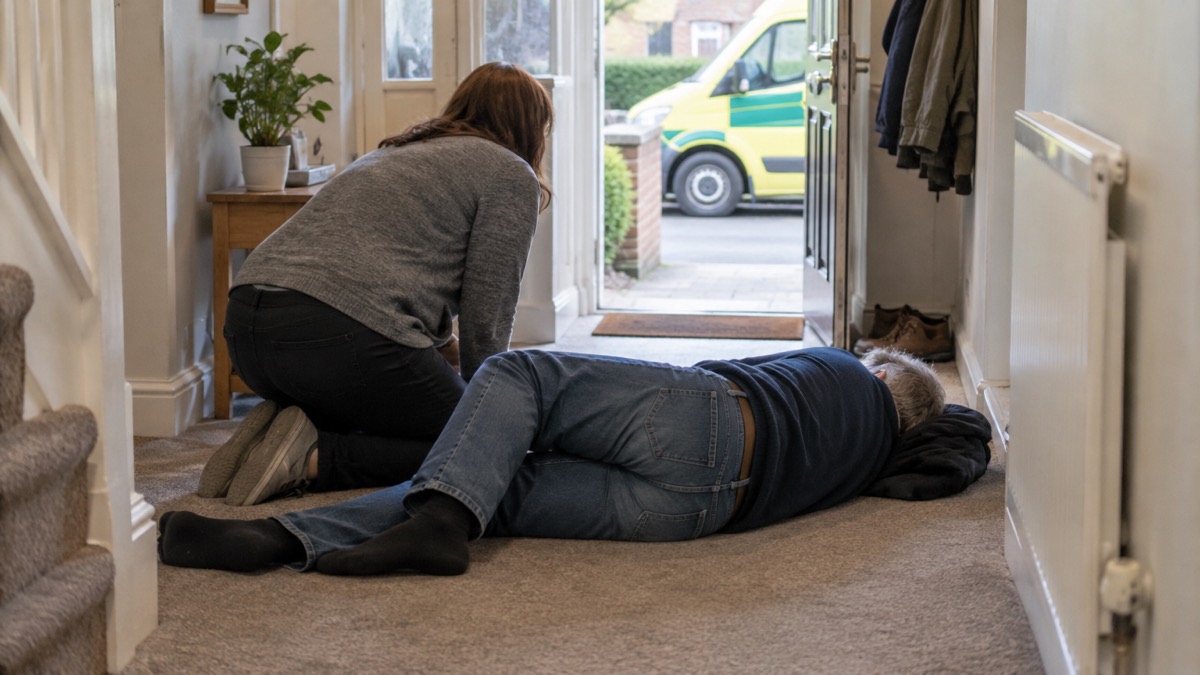
The principles are the same for children and babies, but the technique is scaled to their size. St John Ambulance says that if a baby is not responding to you but is breathing normally, it is safe to put them in the recovery position to keep the airway open and prevent choking20. Its guidance on the child recovery position says to call 999 or 112 for emergency help if it has not already been done21. The NHS's child resuscitation guidance repeats the priority: if a neck injury is suspected, tilt the head carefully a small amount at a time until the airway is open, because opening the airway takes priority over a possible neck injury12.
The recovery position is also used in other emergencies where someone is unresponsive but breathing. If someone loses consciousness while you are waiting for help with heatstroke, put them in the recovery position22. If someone has a stroke and is responding, help them lie down and reassure them that help is on the way16. If someone has taken a drug overdose and is breathing but unconscious, put them in the recovery position23. In each case the position protects the airway while you wait.
For the full sequence of the standard recovery position, including the checks before you start, see The Recovery Position: When and How to Use It. If you are unsure whether someone is breathing normally, How to Check if Someone Is Breathing sets out what to look and listen for, and Agonal Breathing: Should You Start CPR? explains the breathing that means CPR, not the recovery position.
Sources (23)
- Recovery position, NHS, 2025-04-28
- Spinal injury, St John Ambulance, 2026-10-28
- How to put someone in the recovery position, NHS Inform, 2026-07-24
- Recovery position, St John Ambulance, 2026-10-28
- First aid guidelines, Resuscitation Council UK, 2025-10-27
- Unresponsive and breathing, British Red Cross, 2026-10-28
- First aid guidelines, Resuscitation Council UK, 2025-10-27
- Traffic collision, St John Ambulance, 2026-10-28
- Head injury, St John Ambulance, 2026-10-28
- Baby and child first aid booklet, First Aid Training Co-operative, 2025-08
- Emergency care and 999, NHS Surrey and Sussex Integrated Care Board, 2026-10-29
- How to resuscitate a child, NHS, 2026-05-21
- Accident and emergency | SWAST Website, South Western Ambulance Service NHS Foundation Trust (SWASFT)
- Baby and Child Head Injury First Aid | St John Ambulance, St John Ambulance
- How To Do The Secondary Survey | St John Ambulance, St John Ambulance
- Stroke first aid, NHS Inform, 2026-07-24
- Water safety | Devon and Somerset Fire and Rescue Service, Devon and Somerset Fire and Rescue Service
- CPR on women and other people with breasts, St John Ambulance, 2026-10-28
- Drowning, St John Ambulance, 2026-10-28
- Baby recovery position, St John Ambulance, 2026-10-28
- Child recovery position, St John Ambulance, 2026-10-28
- Heatstroke and heat illness, NHS Inform, 2026-07-15
- What to do in an emergency, Oxfordshire County Council, 2026
 Baby and Child Kit Checklist
 Bleeding Control Kit Checklist
 Car Kit Checklist
 CPR on a Baby
 CPR on a Child
 Chest Compression Rate and Depth
 Rescue Breaths or Hands-Only CPR
 Checking Breathing
 Agonal Breathing and CPR
 Breathing During CPR
 Cardiac Arrest vs Heart Attack
 Heart Attack First Aid
 Defibrillator Pad Placement
 Defibrillator on a Child
 Defibrillator Without Training