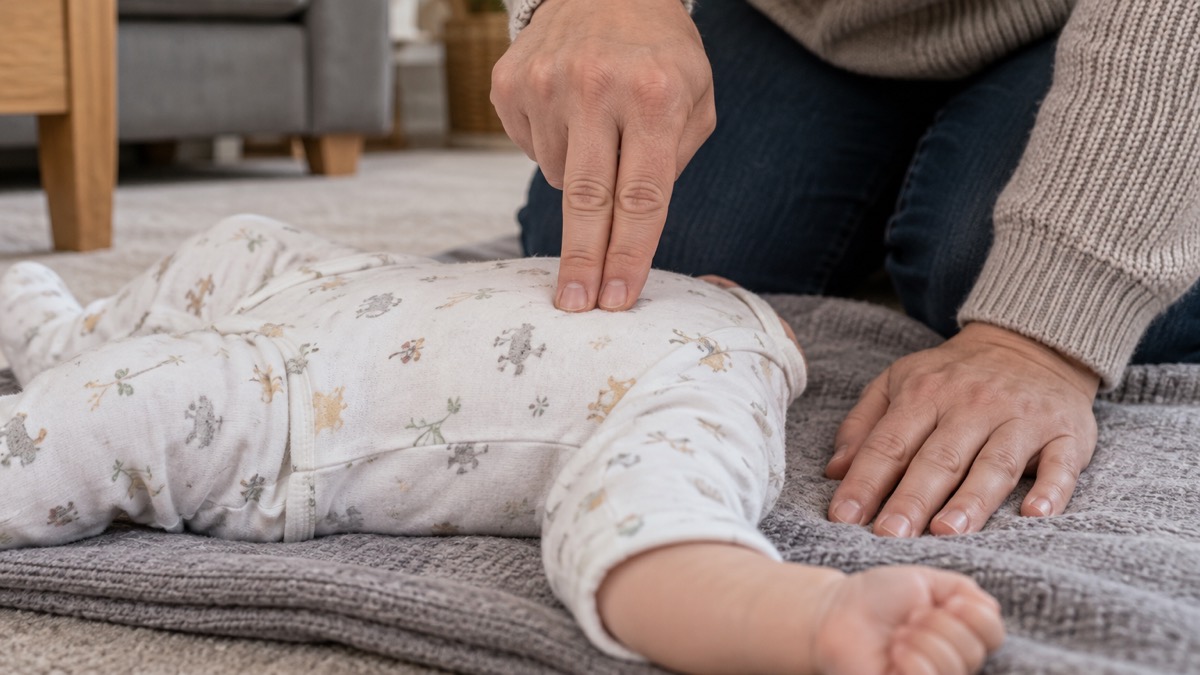
If a baby under one is unresponsive and not breathing normally, call 999 and start CPR straight away1. The method is not the same as for an adult. You check for a response by tapping the sole of the foot, never by shaking. You open the airway with the head in a neutral position, not tilted back. You give five rescue breaths over the mouth and nose, then chest compressions with two fingers, pressing down about 4 cm, in a ratio of 30 compressions to 2 breaths1.
If you are alone, the order changes. NHS inform advises doing CPR for one minute and then phoning 999, putting your phone on speaker so your hands stay free3. If you have no phone with you, the British Red Cross says to give five rescue breaths and one minute of CPR before calling 999 or 112, then take the baby with you to make the call4. Never leave a baby alone mid-resuscitation.
The steps below follow current UK guidance from NHS inform, the NHS, the British Heart Foundation, the Resuscitation Council UK, the British Red Cross and St John Ambulance. Read them now, while nothing is happening. In the moment, the 999 call handler will also give you basic life-saving instructions over the phone, including advice about CPR1.
Check for a response, but never shake a baby
Lay the baby on a firm, flat surface and look at them. Call their name if you know it, and gently tap or flick the sole of the foot to see if they respond3. The British Heart Foundation describes the same check: call the baby's name if known, and tap the bottom of the feet6. St John Ambulance adds that if there is no response, you should shout for people nearby who may be able to help2.
If the baby responds, stop and stay with them. If they do not respond, shout for help and move straight on to opening the airway. If someone else is there, send them to phone 999 while you start. If you are on your own, the timing of the call depends on whether you have a phone to hand, which is covered below.
This check is the response step of the primary survey, the same sequence of danger, response, airway and breathing used for any casualty. For a baby, the response check is gentler and the airway position is different, but the principle is identical: find out quickly whether they need help, and get that help moving.
Open the airway with the head neutral
For a baby under one, the NHS says to keep the head in a neutral position, with the head and neck in line, and to lift the chin with your fingertips under the point of the chin1. Do not tilt the head back the way you would for an older child or an adult. The British Red Cross describes opening the airway by gently tilting the head back and lifting the chin with a fingertip, and places the baby on a firm surface first2.
Once the airway is open, check whether the baby is breathing normally. Look for chest movement, listen for breath sounds and feel for air on your cheek. If they are not breathing normally, or are only gasping, treat it as cardiac arrest and begin CPR. Gasping is not normal breathing, and it is a sign to start, not a reason to wait.
The difference from an older child matters here. For a child over one, the NHS says to open the airway by tilting the head back with a hand on the forehead and lifting the chin with your fingertips1. A baby's airway is softer and more easily kinked, which is why the neutral position is used. If you are unsure whether to treat a small person as a baby or a child, the British Heart Foundation says to make a decision based on their physical features and use the appropriate method6.
Give five rescue breaths over the mouth and nose
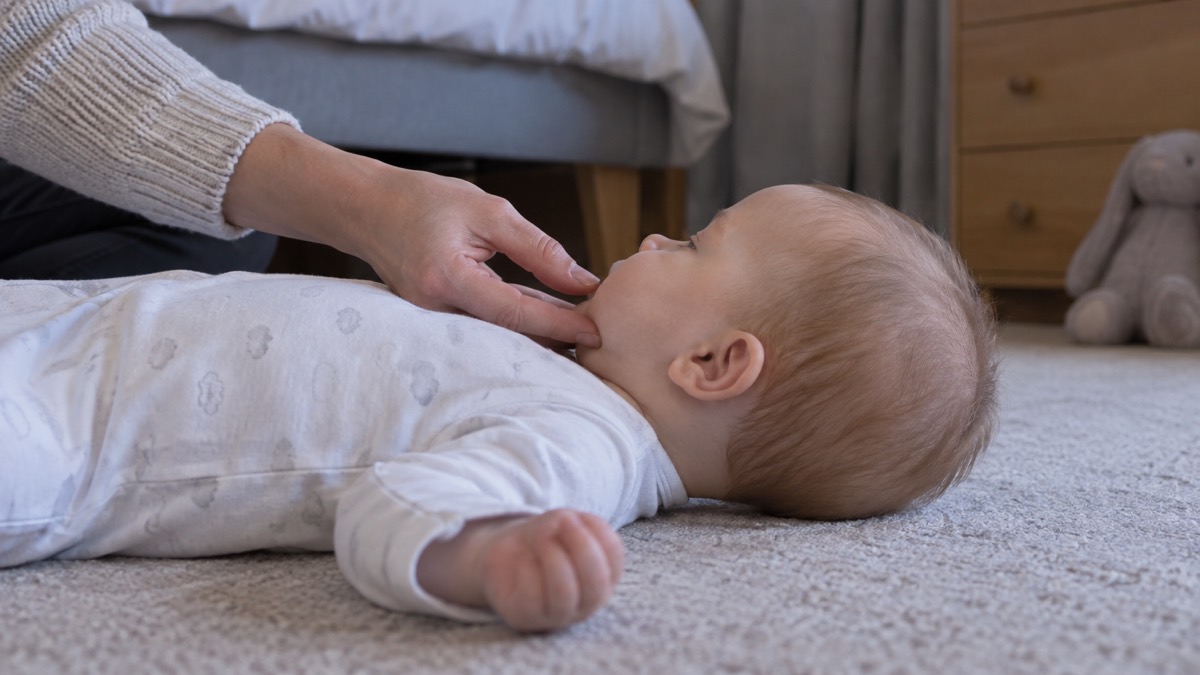
Take a breath, then cover the baby's mouth and nose with your mouth, making sure it is sealed, and blow gently and steadily until the chest rises3. Watch the chest fall, then give another. The NHS says to give five initial rescue breaths before starting compressions1.
If you cannot get a good seal over both the mouth and nose, the British Heart Foundation advises covering either the mouth or the nose, and making sure the part you are not covering is closed6. The NHS gives the same instruction: if you cannot cover both, seal either one, and if you choose the nose, close the lips to stop air escaping1.
| What to do | Baby under one | Child over one |
|---|---|---|
| Head position | Neutral, head and neck in line1 | Tilted back, hand on forehead1 |
| Where you breathe | Over mouth and nose3 | Mouth only, nose pinched1 |
| Initial breaths | Five1 | Five1 |
| Compressions | Two fingers, about 4 cm5 | One hand, a third of chest depth9 |
Blow gently. A baby's lungs are small, and a full adult breath is too much. The aim is to see the chest rise, no more. If the chest does not rise, check the head position and the seal, then try again.
Chest compressions: two fingers, about 4 cm deep
Kneel beside the baby on a firm surface. Place two fingers, the index and middle finger, in the centre of the baby's chest and push down by about 4 cm, roughly one third of the depth of the chest6. The North West Ambulance Service gives the same figure: two fingers in the middle of the infant's chest, pushing down by four centimetres, about one and a half inches, approximately one-third of the chest depth5. If you cannot achieve that depth with two fingertips, the service says to use the heel of one hand5.
Give 30 compressions, then two rescue breaths, and repeat1. Push down hard enough to reach the depth and let the chest come back up fully between compressions. Keep your rhythm steady. The Resuscitation Council UK describes adult compressions as twice per second, and the same steady pace helps here11.
Some guidance describes a different hand position. St John Ambulance describes encircling the baby's chest with both hands and putting your thumbs on the centre of the chest2. The British Heart Foundation describes the two-finger method6. Both are in use. Use the one you have been trained in and can do well, and follow the call handler if they guide you to a particular method.
If you are alone, do one minute of CPR then phone 999
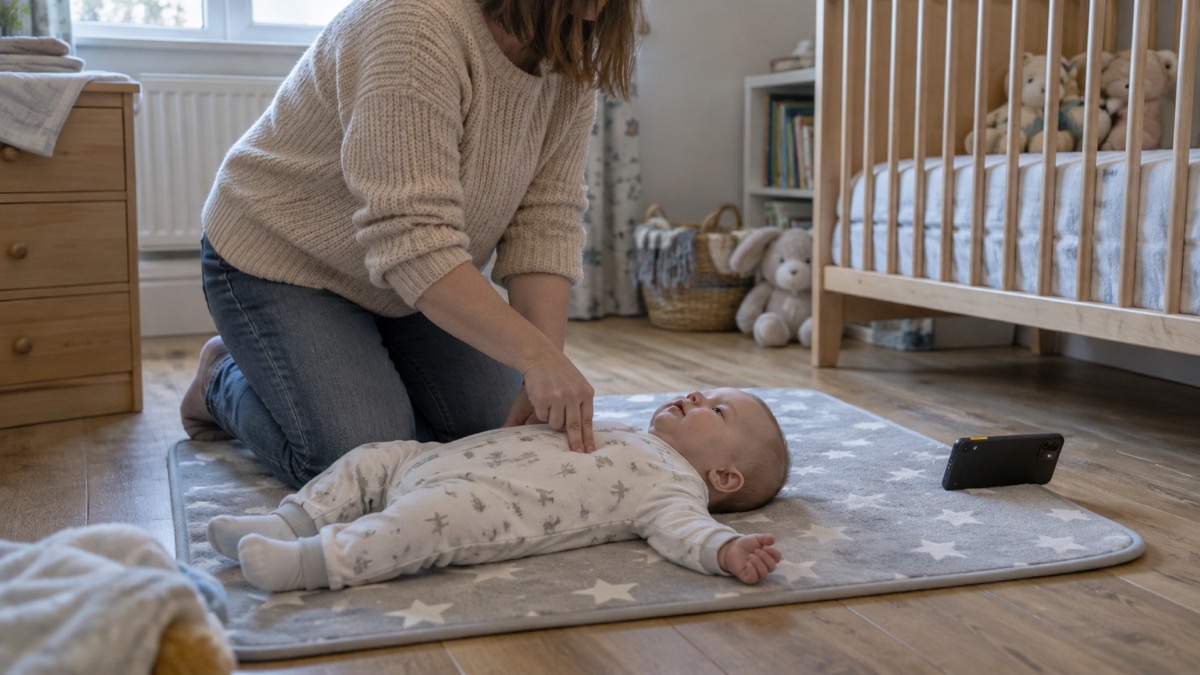
If you are alone with the baby and have a phone, NHS inform says to do CPR for one minute and then phone 999, putting your phone on speaker to make the call3. The same advice is given for a child10. The British Red Cross says to call 999 after you have spent one minute giving rescue breaths and chest compressions13.
If you have no phone with you, the order is different. The British Red Cross says to give five rescue breaths and one minute of CPR before calling 999 or 112, then take the baby with you to make the call7. St John Ambulance gives the same instruction2. Do not leave the baby alone at any point.
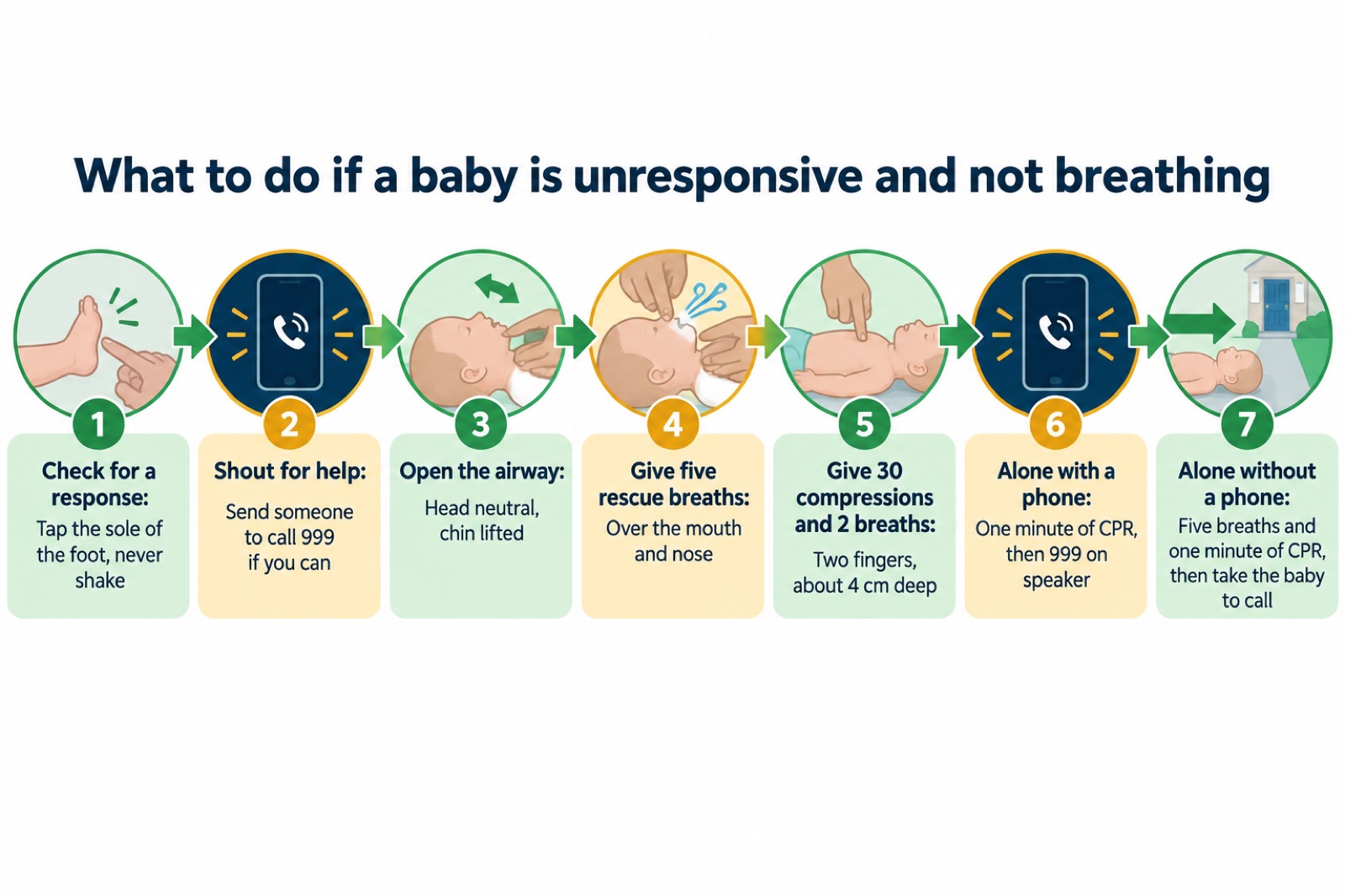
When you get through, tell the call handler that the baby is not breathing and that you are starting CPR. The NHS says you should be given basic life-saving instructions over the phone, including advice about CPR1. Put the phone on speaker and keep working while you listen.
When to stop, and what happens next
Continue CPR until the baby shows signs of life, such as normal breathing, coughing, or movement of the arms or legs, or until qualified help arrives1. If they start breathing, the NHS says to put them in the recovery position1. For a baby, that means holding them on their side with the head slightly lower than the body, and keeping checking their breathing until the ambulance crew takes over.
If the baby is choking rather than unresponsive for another reason, the advice differs. The NHS in Wales says to put the child on a firm, flat surface, shout for help, and call 999 on speakerphone so your hands are free, and not to leave the child at any stage14. Open the mouth and remove an object only if it is clearly visible and easy to grasp, then start CPR14. For the choking steps before CPR, see what to do if a baby is choking.
If the baby has had an accident, such as an electric shock, the NHS says that if you get no response, call 999 and start CPR straight away15. Do not delay to look for other injuries first.
Baby CPR compared with child and adult CPR
The instructions for CPR on a child or baby are different from those for an adult16. The table below sets out the main differences, so you can see at a glance which method fits the person in front of you.
| Step | Baby under one | Child over one | Adult |
|---|---|---|---|
| Response check | Tap the sole of the foot3 | Tap the shoulder and ask loudly1 | Shake the shoulders and ask loudly12 |
| Airway | Head neutral, chin lifted1 | Head tilted back, chin lifted1 | Head tilted back, chin lifted12 |
| Breaths | Over mouth and nose3 | Mouth only, nose pinched1 | Mouth only, nose pinched12 |
| Compressions | Two fingers, about 4 cm6 | One hand, a third of chest depth9 | Two hands, 5 to 6 cm17 |
| Ratio | 30 compressions to 2 breaths1 | 30 compressions to 2 breaths1 | 30 compressions to 2 breaths12 |
The British Heart Foundation notes that if you are unsure whether to treat someone as a child or an adult, you should make a decision based on their physical features and use the appropriate CPR method, and if in doubt between a child and an adult, refer to the adult CPR steps6. For a baby, the size and the softness of the airway are what decide the method.
For the child method in full, see how to do CPR on a child. For adults, see how to do CPR. If you want to understand why the depth and rate matter, see how fast and how deep chest compressions should be.
Learning baby CPR before you need it
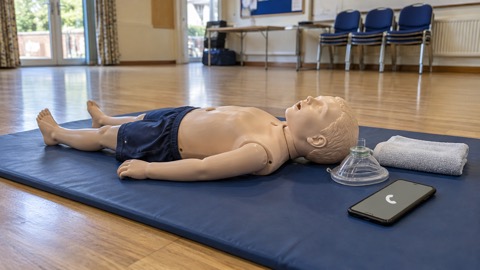
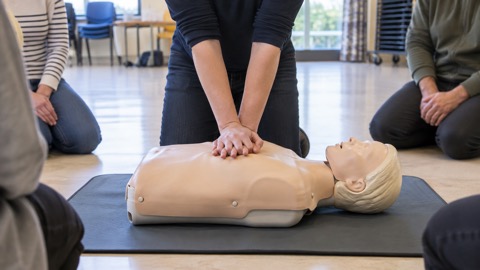
Reading this page is a start, but the steps are easier to recall if you have practised them. A short course gives you the chance to practise rescue breaths and compressions on a manikin, which is the part most people find hardest to remember under pressure.
Keep the emergency number where you can find it quickly. Teach older children how and when to call 999, as Cheshire Fire and Rescue Service advises18. A child who knows how to dial and what to say can summon help while you stay with the baby.
If you have a baby or young child at home, it is worth thinking about what else you would want to hand in an emergency. The baby and child kit checklist sets out what to keep ready. The wider first aid at home guide covers the rest of the household.
Sources (18)
- How to resuscitate a child, NHS, 21 May 2026
- How to do CPR on a baby, St John Ambulance, 2026
- How to give a baby CPR, NHS inform, 24 July 2026
- How to do CPR on a baby (under one year old) - Baby First Aid | St John Ambulance, St John Ambulance
- How to do CPR, North West Ambulance Service, 13 March 2025
- How to do CPR on a child or baby, British Heart Foundation, 29 October 2026
- Unresponsive and not breathing baby, British Red Cross, 29 October 2026
- Baby and Child First Aid Booklet, First Aid Industry Body, August 2025
- How to do CPR on a child, St John Ambulance, 28 October 2026
- How to give a child CPR, NHS inform, 24 July 2026
- How do CPR, Resuscitation Council UK, 2026
- CPR, NHS, 29 October 2026
- Unresponsive not breathing child, British Red Cross, 29 October 2026
- Choking safety, NHS 111 Wales, 5 July 2023
- What to do if your child has an accident, NHS, 18 December 2025
- How to do CPR, British Heart Foundation, 29 October 2026
- How do I perform CPR, Yorkshire Ambulance Service, 29 October 2026
- Be ready for emergencies, Cheshire Fire and Rescue Service, 14 October 2026
 Baby and Child Kit Checklist
 Bleeding Control Kit Checklist
 Car Kit Checklist
 CPR on a Child
 Chest Compression Rate and Depth
 Rescue Breaths or Hands-Only CPR
 Checking Breathing
 Agonal Breathing and CPR
 Breathing During CPR
 Recovery Position and Spine
 Cardiac Arrest vs Heart Attack
 Heart Attack First Aid
 Defibrillator Pad Placement
 Defibrillator on a Child
 Defibrillator Without Training