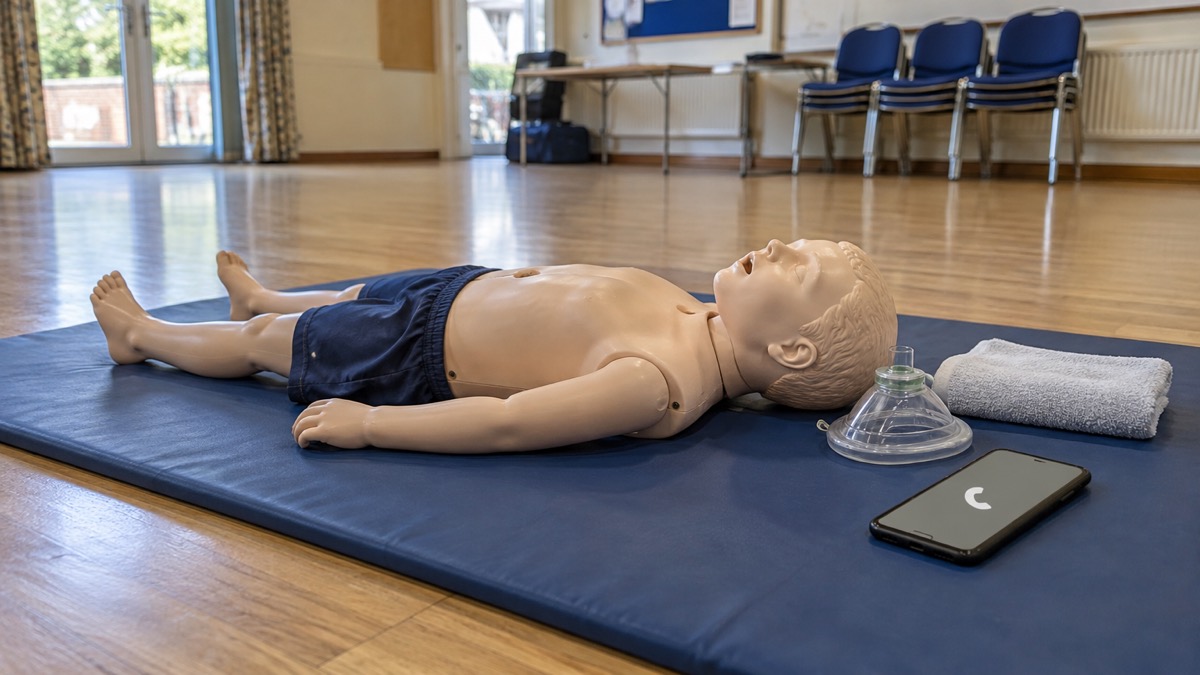
If a child is unresponsive and not breathing normally, call 999 immediately and start child CPR1. The rhythm is 30 chest compressions followed by 2 rescue breaths, and you keep alternating them until help arrives, the child shows signs of life and breathes normally, or a defibrillator is ready to use2. Press down about a third of the depth of the chest, roughly five centimetres, at a rate of 100 to 120 compressions a minute2.
Rescue breaths matter more in children than in adults. St John Ambulance explains that rescue breaths must be performed on a child, because cardiac arrest in children is likely to be caused by a respiratory problem2. That is why the guidance for a child is not hands-only CPR: the breaths are part of the point.
If you are on your own, the order changes. Do CPR for one minute first, then phone 999 and put your phone on speaker so your hands stay free3. A baby under one is slightly different again: five initial rescue breaths before anything else, then 30 compressions to 2 breaths, with compressions given with two fingers or two thumbs4.
The ratio: 30 compressions to 2 breaths
The core of child CPR is a repeating cycle: 30 compressions, then 2 breaths, then straight back to compressions6. The NHS describes it as combining chest compressions with rescue breaths, providing 2 breaths after every 30 compressions6. The Resuscitation Council UK's paediatric out-of-hospital algorithm for 2025 gives the same figure: 30 chest compressions followed by 2 rescue breaths8.
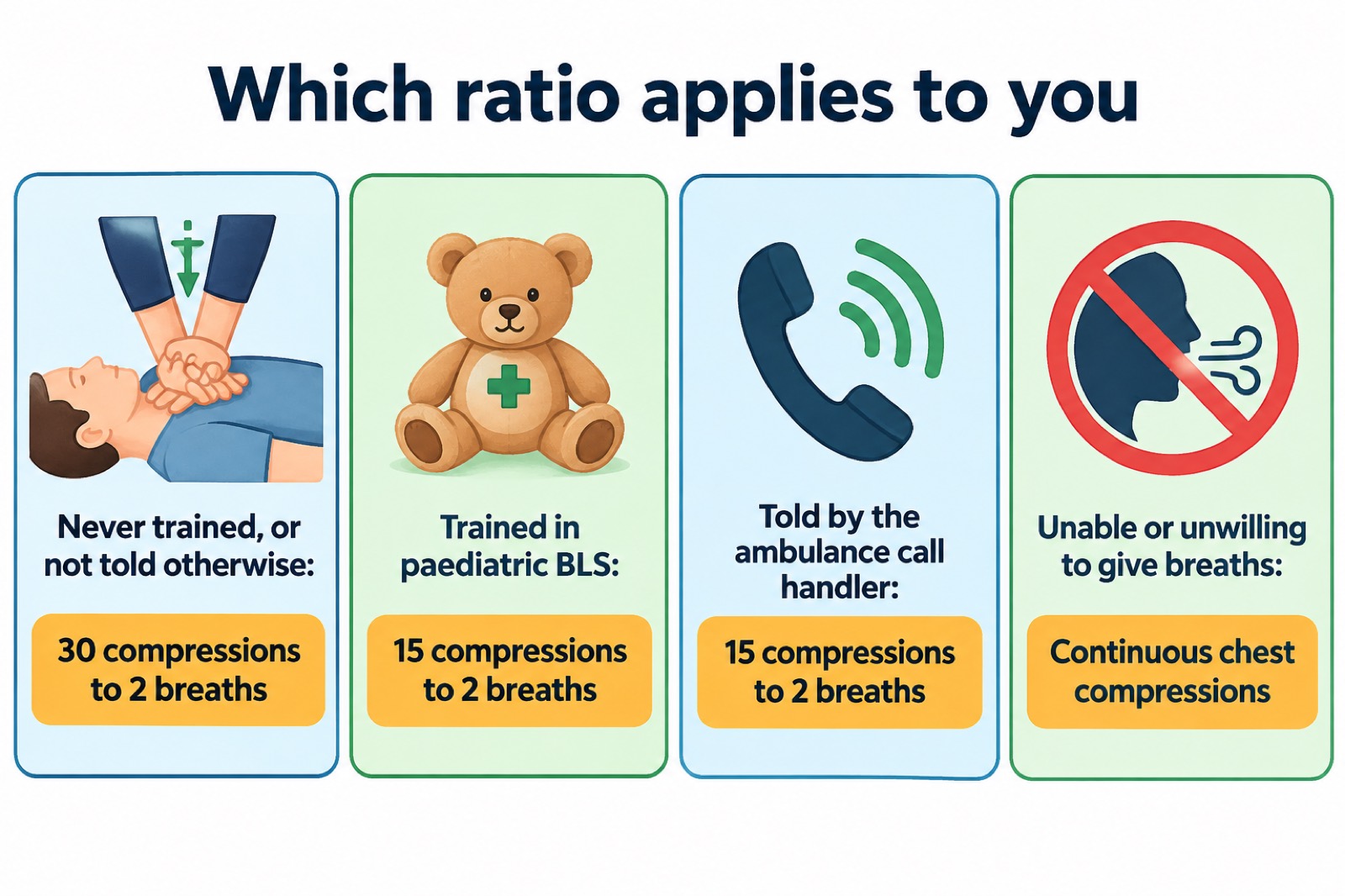
St John Ambulance sets out the same 30:2 pattern and says to keep alternating 30 compressions with two breaths until emergency help arrives and takes over, the child shows signs of life and breathes normally, or a defibrillator is ready to use2. The British Heart Foundation gives the same ratio for anyone trained to give rescue breaths, and notes that if you are unable or unwilling to provide them, you give continuous chest compressions instead9.
That last point is worth holding on to. The ratio is the target, but a rescuer who freezes at the breath stage should not stop pressing. Continuous compressions are far better than nothing.
A practical note on counting: the actual number of compressions delivered in a minute will be fewer than 100 to 120, because of the pauses to give breaths6. Do not try to make up the time by pressing faster. Aim for a steady 100 to 120 a minute while you are pressing, and accept the pauses.
If you are alone, do CPR for 1 minute then call 999
When there is someone else with you, the split is simple: one person calls 999 while the other starts CPR. NHS inform's guidance for a child aged one and over says that if the child isn't breathing, ask someone to phone 9993.
Alone, you do the first minute first. NHS inform advises that if you are alone, you do CPR for one minute and then phone 999, putting your phone on speaker to make the call3. The British Red Cross gives the same instruction: if you are on your own, call 999 after you have spent one minute giving rescue breaths and chest compressions10. The NHS gives the same one-minute rule for children over one, saying to continue resuscitation for about 1 minute before trying to get help, for example by calling 9996.
The reason is the one behind the ratio: a child in cardiac arrest has often stopped breathing first, so a minute of breaths and compressions may do more good than an immediate call. The speakerphone instruction is practical, not incidental. It keeps both hands on the child while the call handler listens and advises.
Opening a child's airway and giving rescue breaths
Before the first breath, the airway has to be open, and the technique depends on age.
For a child over one, the NHS says to open the airway by tilting the head back with a hand on the forehead and lifting the chin with your fingertips under the point of the chin6. For a baby under one, the head goes into a neutral position, with the head and neck in line, and you lift the chin with your fingertips under the point of the chin6. Over-tilting a baby's head can close the airway rather than open it.
Then give five initial rescue breaths6. St John Ambulance describes each one: blow gently and steadily for up to one second until the chest rises2. The test is visible movement of the chest, not the size of your breath.
If the chest does not rise, the NHS says to make up to 5 attempts to achieve effective breaths, enough to make the chest visibly rise, and then move on to chest compressions combined with rescue breaths attempts6. Do not spend minutes on breaths that are not working.
The British Red Cross booklet adds the mechanics: pinch the soft part of the nose and place your lips over the child's mouth, blow gently and steadily for one second and watch for the chest to rise11.
Chest compressions: one-third of the chest depth at 100 to 120 a minute
Compressions are where most of the circulation comes from, so the depth and rate matter.
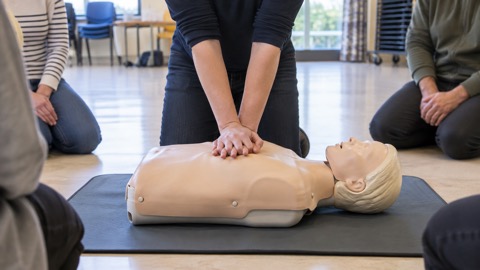
The NHS gives the target as 5cm for a child and 4cm for a baby, which is approximately one-third of the chest depth6. St John Ambulance gives about five centimetres for a child and about four centimetres for a baby, again a third of the chest depth2. The Resuscitation Council UK gives the same: about a third of the depth of the chest, 5cm for children aged 1 to 18 and 4cm for babies aged 0 to 12 months7. The North West Ambulance Service puts it as approximately one-third of the chest depth at the same rate, 100 to 120 compressions per minute12.
For technique, St John Ambulance says to kneel by the child and put one hand in the centre of the child's chest2. Push down a third of the depth of the chest, about five centimetres, then release, and repeat at a rate of 100 to 120 compressions a minute2. The NHS adds that in larger children, or if you are small, this may be done more easily by using both hands with the fingers interlocked, avoiding pressure on the ribs6.
The surface matters too. The NHS advises that compressions should ideally be on a firm surface, and that if the casualty is on a bed, and it is safe for you to do so, you move them to the floor13.
| What | Child (1 and over) | Baby (under 1) |
|---|---|---|
| Hand position | One hand in the centre of the chest; two hands with fingers interlocked for a larger child or a small rescuer6 | Two fingers, or two thumbs with both hands encircling the chest4 |
| Depth | About 5cm, a third of the chest depth6 | About 4cm, a third of the chest depth6 |
| Rate | 100 to 120 a minute6 | 100 to 120 a minute5 |
| Ratio | 30 compressions to 2 breaths6 | 30 compressions to 2 breaths, after 5 initial breaths4 |
When the ratio is 15:2 instead
There is a second ratio, and it is not for everyone. The Resuscitation Council UK says that if you are specifically trained in paediatric basic life support, use a compression-to-ventilation ratio of 15:27. St John Ambulance gives the same condition for children and for babies: if you are trained in paediatric BLS, or the ambulance call handler tells you to, use the 15:2 ratio2.
So there are two routes to 15:2. The first is a current paediatric BLS qualification. The second is being told to by the call handler when you ring 999. If neither applies, the ratio is 30:26.
This is not a detail to worry about in advance. If you have never trained, you will not be expected to use 15:2, and the call handler will talk you through what they want. If you have trained, you already know which ratio your training used.
Babies under 1: five rescue breaths first and two-finger compressions
A baby under one is not a small child for CPR purposes, and the sequence starts differently.
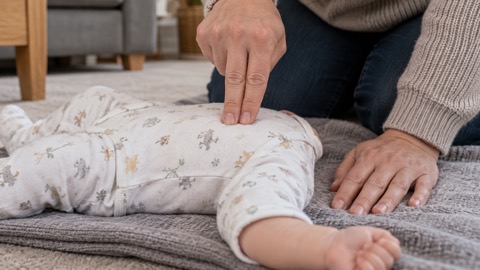
St John Ambulance says to always start with five initial rescue breaths and then 30 compressions followed by two breaths4. The NHS gives the same five initial rescue breaths, described as mouth-to-mouth resuscitation6. NHS inform's baby guidance says to give 2 rescue breaths after 30 chest compressions if you're trained to do so5.
For compressions on a baby, St John Ambulance says to use both hands to encircle the baby's chest and put your thumbs on the centre of the baby's chest4. The Resuscitation Council UK describes compressions using thumbs, thirty times, twice per second7. The depth is about four centimetres, a third of the chest depth6.
The rate is the same as for a child: 100 to 120 compressions per minute5. Keep alternating 30 compressions with two breaths until emergency help arrives and takes over, the baby shows signs of life and breathes normally, or a defibrillator is ready to use4.
If you are alone with a baby, the same one-minute rule applies: do CPR for one minute and then phone 999, putting your phone on speaker5.
If the baby becomes responsive, coughing, opening their eyes, making a noise, and starts to breathe normally, St John Ambulance says to put them in the recovery position and monitor their level of response, preparing to give CPR again if necessary14. Our guide to the recovery position covers how to do that, and How to Do CPR on a Baby Under One goes further into the baby-specific sequence.
Where to learn it properly, and what to do next
Reading this is a start, not a substitute for practice. The Resuscitation Council UK publishes public guidance on how to do CPR7. Our guide to first aid courses sets out the types and lengths available, and Learning CPR Free Online covers free options you can do at home.
Two things are worth doing before you ever need this. First, know where your nearest defibrillator is: our guide to public access defibrillators explains how to find one, and Can You Use a Defibrillator on a Child or Baby? covers the child settings and pads. Second, teach the children in your household how to ring 999 and what to say: our guide to teaching children basic life-saving skills covers that.
If the emergency is a choking child rather than a cardiac arrest, the sequence is different: see What to Do if a Child Is Choking and What to Do if a Baby Is Choking. The NHS advises calling 999 and putting the phone on speakerphone so your hands are free15. For the wider picture of what to keep at home, start with First Aid at Home: A Household Guide.
Sources (15)
- Basic first aid, Royal Wolverhampton NHS Trust, 2026-10-29
- Child CPR, St John Ambulance, 2026-10-28
- How to give a child CPR, NHS inform, 2026-07-24
- How to do CPR on a baby, St John Ambulance, 2026-09-24
- How to give a baby CPR, NHS inform, 2026-07-24
- How to resuscitate a child, NHS, 2026-05-21
- How do CPR, Resuscitation Council UK, 2026
- Paediatric out-of-hospital BLS algorithm 2025, Resuscitation Council UK, 2025-10
- Sudden Cardiac Arrest | St John Ambulance, St John Ambulance
- Unresponsive and not breathing child, British Red Cross, 2026-10-29
- Baby and Child First Aid Booklet, First Aid Training, 2025-08
- Learn to save a life, North West Ambulance Service, 2024-06-18
- CPR, NHS, 2026-10-29
- Baby CPR, St John Ambulance, 2026-10-28
- How to stop a child from choking, NHS, 2024-10-28
 Baby and Child Kit Checklist
 Bleeding Control Kit Checklist
 Car Kit Checklist
 CPR on a Baby
 Chest Compression Rate and Depth
 Rescue Breaths or Hands-Only CPR
 Checking Breathing
 Agonal Breathing and CPR
 Breathing During CPR
 Recovery Position and Spine
 Cardiac Arrest vs Heart Attack
 Heart Attack First Aid
 Defibrillator Pad Placement
 Defibrillator on a Child
 Defibrillator Without Training