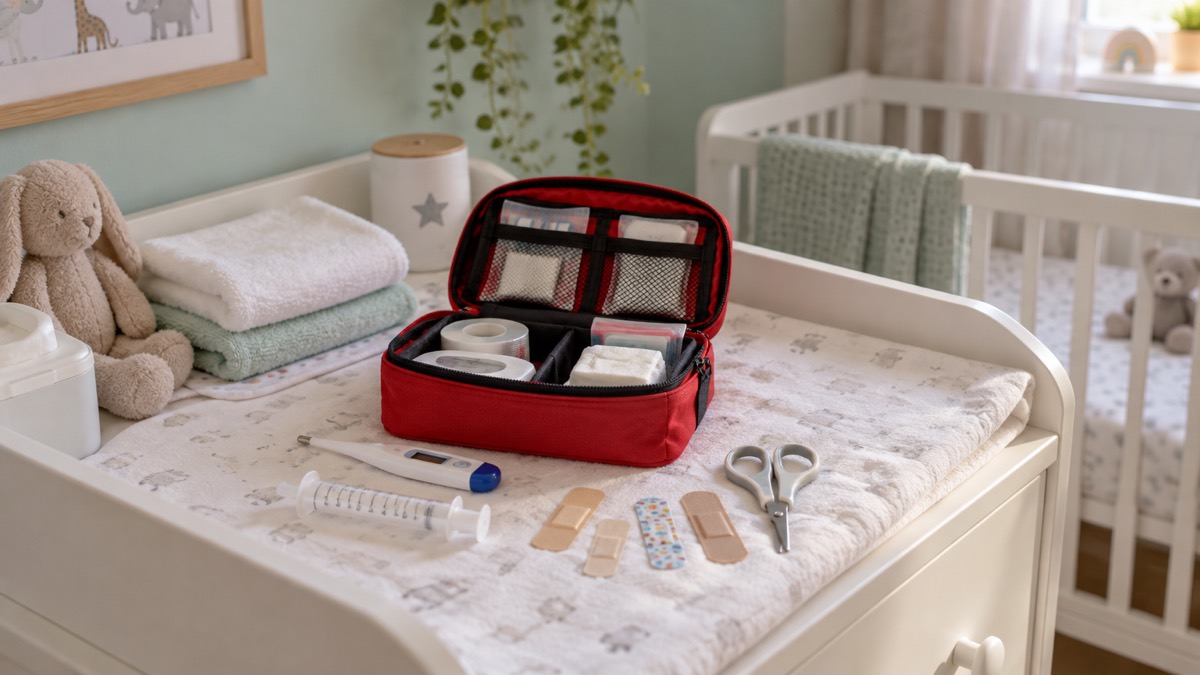
A first aid kit for a baby or young child is a standard household kit with a few child-specific additions: an age-appropriate painkiller, a measuring spoon or no-needle dosing syringe, a digital thermometer, and enough dressings to cover small cuts and grazes. The NHS lists plasters in a variety of sizes and shapes, sterile gauze dressings, bandages, safety pins, disposable gloves, tweezers, scissors, a thermometer, antiseptic cream and painkillers as the basics of a home kit1. For a family with a baby, the kit also needs to be stored out of reach, checked for expiry dates, and backed by knowing what to do if your child stops breathing.
The most important thing in the kit is not an object. It is knowing how to use it. That means reading the label on every medicine, knowing that aspirin should not be given to children under 16, and knowing when to call NHS 111 rather than 9992. It also means knowing the child CPR steps, because a baby under one is resuscitated differently from an adult3.
This checklist sets out what to keep, why each item matters, how to give medicine accurately, and how to keep the kit ready. It is written for an ordinary UK household, with notes where arrangements differ in Scotland, Wales and Northern Ireland.
Baby and child first aid kit checklist
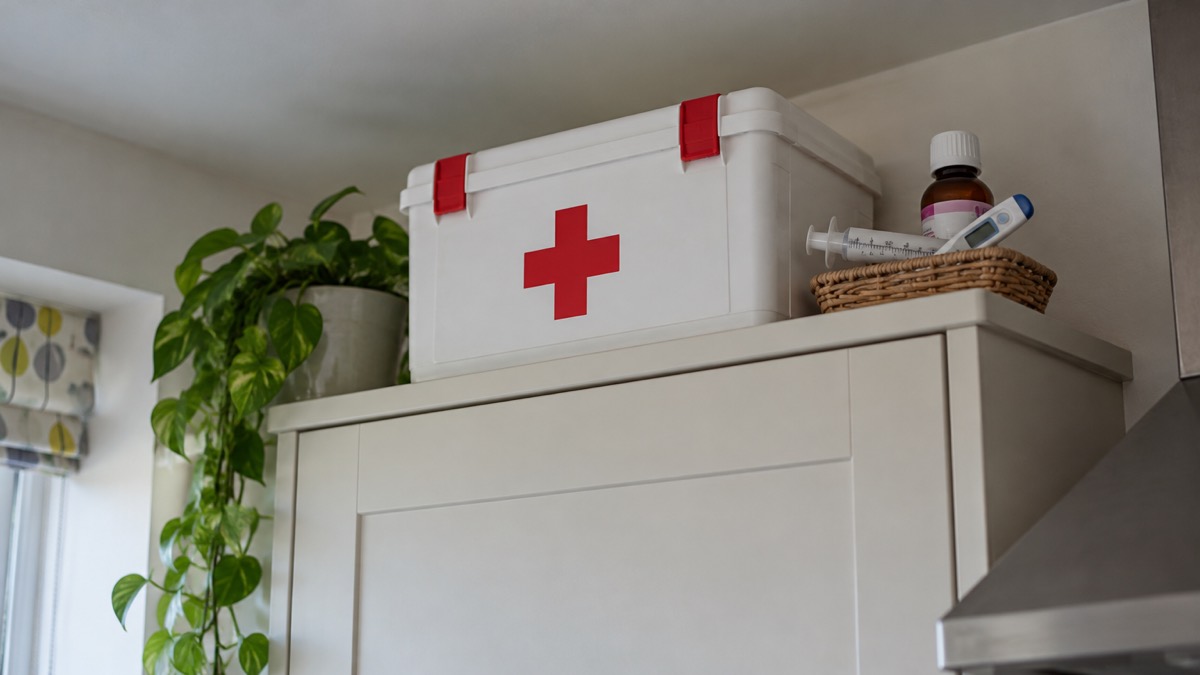
Start with a box that is clearly marked. NHS Wales advises buying a first aid box that is green with a white cross, or writing "First Aid" on a homemade box so others know what it is8. Keep it in a clean, waterproof container, whether you buy a ready-made kit or put your own together1.
The list below covers the core kit for a household with a baby or young child. Each item has a reason beside it.
The government's "Get Prepared" checklist for households lists a first aid kit including waterproof plasters, bandages, a thermometer, antiseptic, eyewash solution, sterile dressings and gloves, medical tape and tweezers12. That is the baseline. The child-specific additions are the painkiller, the dosing syringe, the thermometer and the antihistamine.
Giving medicine to babies: spoons, syringes and child doses
Giving medicine to a baby is where small errors matter most. The NHS advises using a medical spoon or syringe for giving babies and children their medicines, because these are more accurate and much safer than a teaspoon4. A teaspoon varies in size, so a "spoonful" is not a reliable dose.
Keep an age-appropriate painkiller that contains paracetamol or ibuprofen, plus a measuring spoon or, for younger children, a no-needle dosing syringe, and always follow the dosage instructions on the label4. Liquid paracetamol for children is specifically listed among the common medicines a household should keep13.
The Northern Ireland guidance is blunt about labels: pain relievers such as paracetamol or aspirin should always be read carefully, and there are special child versions available2. The same principle applies to every medicine in the kit: the label, not memory, decides the dose.
A simple medicine routine for a household with young children:
- Keep the dosing syringe or spoon with the medicine, not in a drawer elsewhere.
- Write the time of the last dose on a note or the box, so two adults do not double up.
- Check the label every time, even for a medicine you have used before.
- Keep all medicines out of reach and out of sight of children.
If you are worried about your child and are not sure whether they need medical help, call NHS 1117. In Wales, use NHS 111 Wales where it is available in your area14.
Baby and child CPR: check the current NHS guidance
A first aid kit cannot restart a heart. Knowing the current NHS guidance on child and baby CPR is the part of the kit that matters most, and it is worth checking it before you need it, because the guidance is updated.
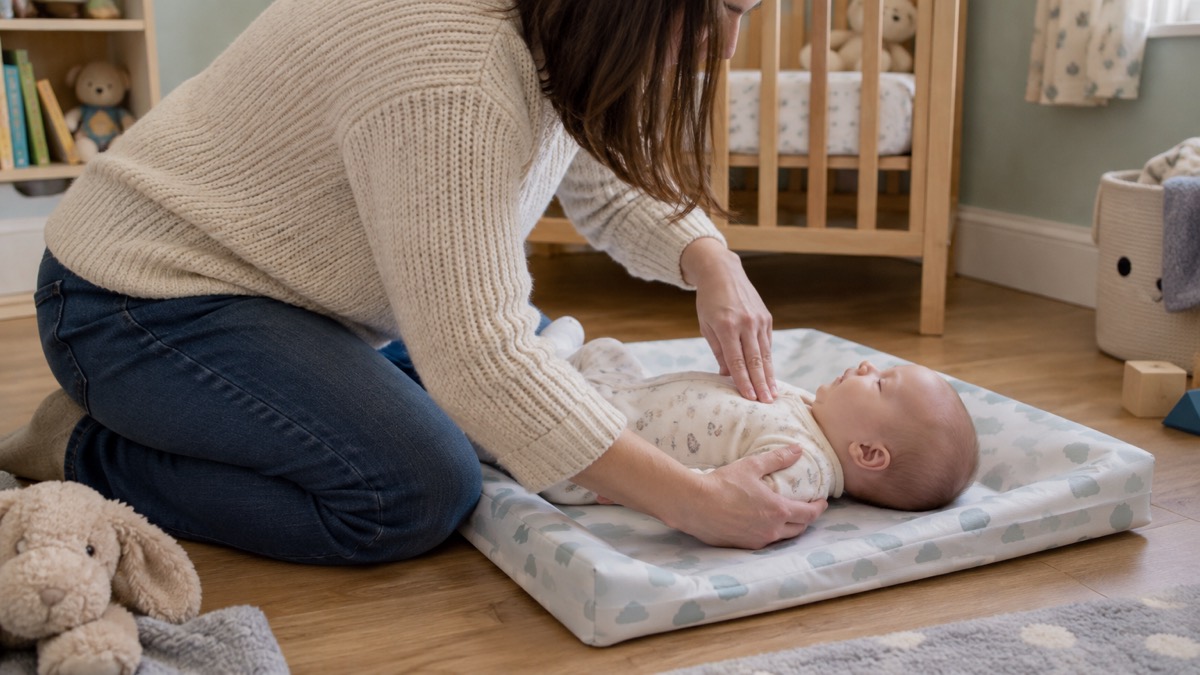
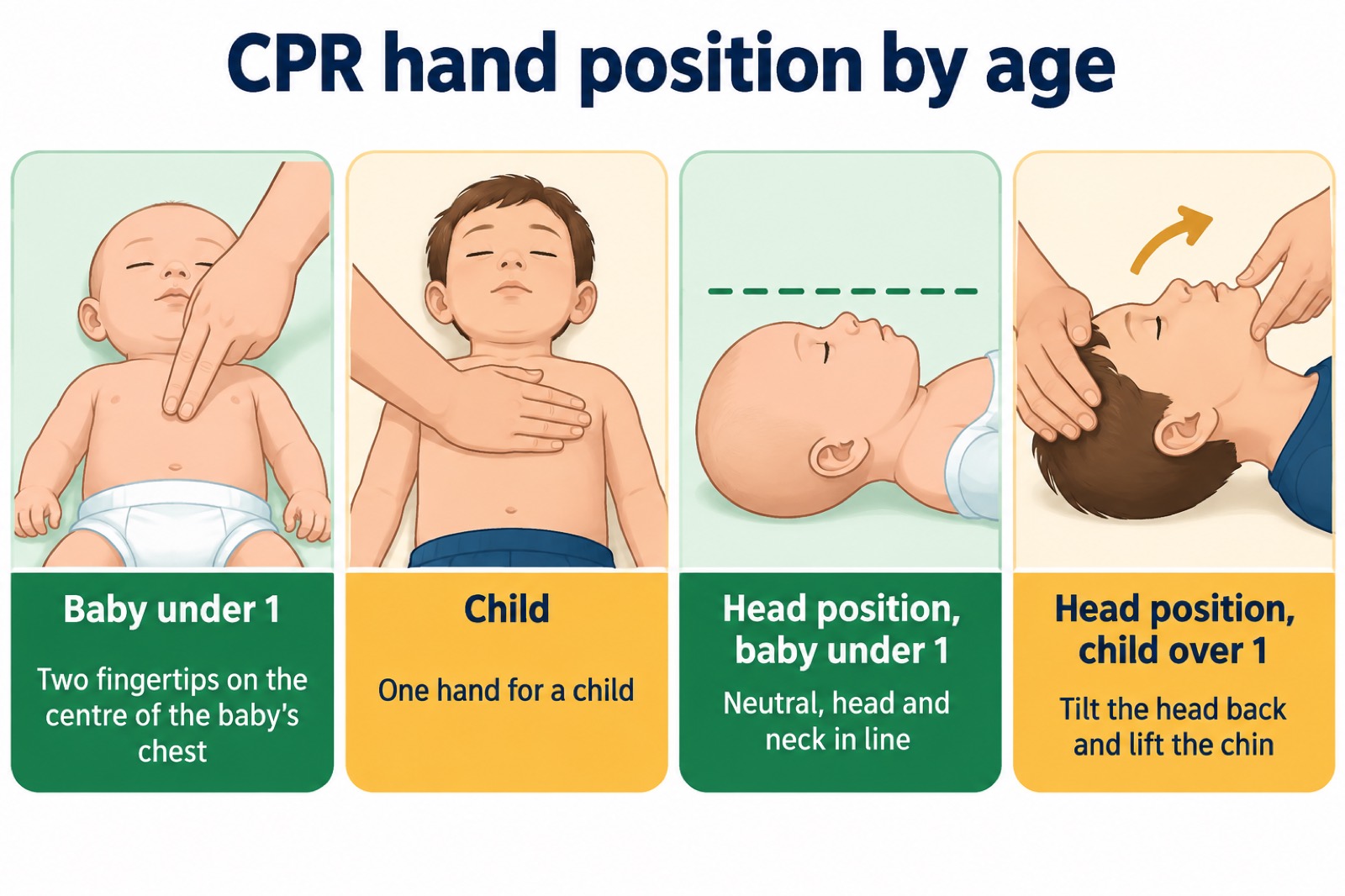
The NHS advises checking for hazards, such as electrical equipment or traffic, before starting3. For a baby under one, open the airway with the head in a neutral position, with the head and neck in line, lifting the chin with your fingertips under the point of the chin3. For a child older than one, place your hand on their forehead and gently tilt their head back, and gently lift the chin15.
The compression technique differs by age. NHS ambulance service guidance is to use one hand for a child and two fingers for a baby5. NHS inform's baby CPR page, dated 24 July 2026, says to place two fingertips of your lower hand on the centre of the baby's chest16. Continue until your child shows signs of life, such as normal breathing, coughing or movement of arms or legs, in which case put them in the recovery position, or until qualified help arrives3.
The NHS says to learn basic first aid, and notes that St John Ambulance, British Red Cross and your local NHS Ambulance Service run first aid courses, and that your health visitor or local children's centre may also run courses7. St John Ambulance advice pages cover everything from CPR and the recovery position to specialist advice for treating children and babies17. For the full steps, see how to do CPR on a baby under one and how to do CPR on a child.
Keeping the kit stocked and ready
A kit that is out of date or out of reach is not a kit. The Health and Safety Executive advises checking your kit regularly, noting that many items, particularly sterile ones, are marked with expiry dates, and that expired items should be replaced and disposed of safely9. For non-sterile items without dates, check that they are still fit for purpose9.
A workable routine for a family:
- Check the kit every six months, or whenever you change smoke alarm batteries.
- Replace expired sterile dressings, plasters and medicines.
- Check that the thermometer still works and has a battery.
- Restock anything used, so the kit is complete again.
- Keep the box out of reach of children, but tell other adults where it is.
The kit should travel as well as stay at home. The NHS suggests keeping a home or car first aid kit by buying a ready-made one or putting together your own in a clean, waterproof box1. For the car, government guidance lists spare warm clothes and boots, a blanket, a first aid kit and a phone charger18. A winter vehicle checklist also lists a first aid kit among the items to keep in your vehicle19.
For the nappy bag, a small version of the home kit is enough: plasters, gauze, tape, a digital thermometer, a dosing syringe and an age-appropriate painkiller. Keep baby supplies such as nappies and ready-made formula at home for emergencies too20. The car kit checklist and the first aid kits for the home guide go into more detail on choosing and packing.
Where to get help, and when to call
Knowing who to call is part of the kit. The NHS advises calling NHS 111 if you are worried about your child and are not sure whether they need medical help7. If your child has had an accident and needs medical attention, contact NHS 111, or call 999 in life-threatening emergencies21. If your child loses consciousness or has a fit, phone 999 immediately6.
For babies, some symptoms need a call rather than a wait. If your baby suddenly develops a high pitched cry, contact your GP or call NHS 11122. If your baby develops a rash and seems unwell, contact your GP or call NHS 11122. If a fit has not stopped within five minutes, call 999; if it stops but it was the child's first fit, take them to the nearest accident and emergency department14.
In Wales, the advice is to call NHS 111 Wales if it is available in your area when you are worried and not sure whether your child needs medical help14. If your child is coughing or wheezy, call NHS 111 Wales or your GP for advice23. The Welsh pages on baby accidents and resuscitation were last updated in 2023, so check the current NHS guidance for CPR steps14.
For more on what to do in the first moments, see what to do first: danger, response, airway and breathing and the first aid at home guide.
Sources (23)
- What should I keep in my first aid kit?, NHS, 2026
- First aid, nidirect, 2025
- How to resuscitate a child, NHS, 2026
- Safety and first aid kit, NHS 111 Wales, 2021
- What to do when someone isn't breathing, North West Ambulance Service, 2025
- What to do if your child is unwell, North East London ICB, 2024
- What to do if your child has an accident, NHS, 2025
- Newborn essentials and first aid, NHS 111 Wales, 2021
- What to put in your first aid kit, Health and Safety Executive, 2026
- Common medicines, NHS Tayside, 2026
- Preparing for emergencies, North Hertfordshire Council, 2015
- Get prepared for emergencies, UK Government, 2026
- Stay cool and safe in hot weather, Somerset Council, 2026
- Resuscitating a baby, NHS 111 Wales, 2023
- Paediatric cardiac arrest first aid guide, North East Ambulance Service, 2024
- How to give a baby CPR, NHS inform, 2026
- What to keep in your medicine cabinet, Hertfordshire and West Essex Healthier Together, 2026
- Emergency supplies kit, Denbighshire Council, 2020
- Self care at home advice, South Western Ambulance Service, 2026
- Planning for an emergency kit, Wiltshire Council, 2026
- Child safety, Berkshire Healthcare NHS Foundation Trust, 2026
- Baby accidents: what to do, NHS 111 Wales, 2023
- Emergency kit checklist, Neath Port Talbot Council, 2026
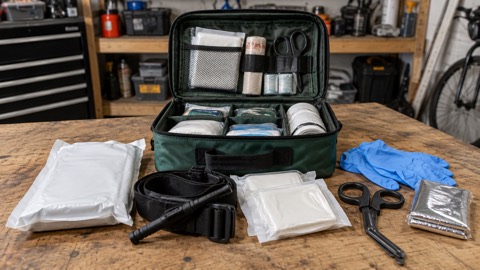 Bleeding Control Kit Checklist
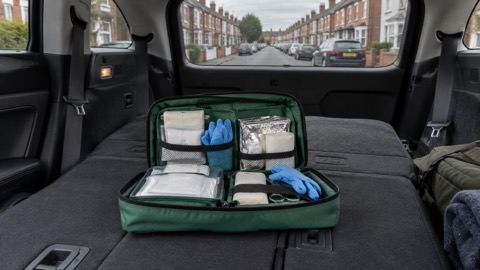 Car Kit Checklist
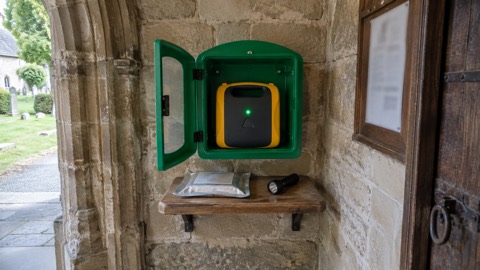 Defibrillator Guardian Checklist