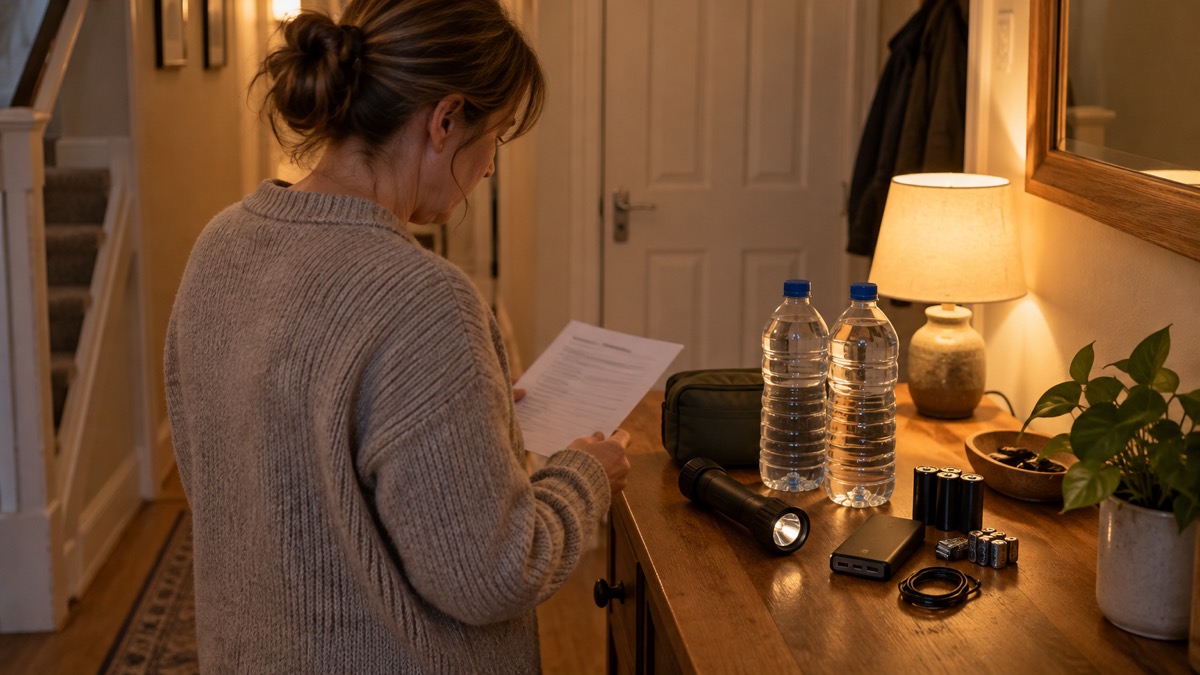
Checking an emergency kit is not a one-off job. The government's Be Ready campaign advises households to set a reminder every six months to check expiry dates and swap out items that need replacing, or to update the kit if circumstances have changed1. North Devon Council gives the same message in slightly broader terms: check your plan and supplies periodically, replace expired items and keep devices charged2. A kit that was complete when you packed it will quietly go out of date, run flat and stop fitting your household unless someone looks at it.
The good news is that a check does not take long once it is set up properly. Denbighshire Council's emergency supplies advice is to make a list of all the kit's contents, keep it outside the kit or somewhere prominent in your home, and write every expiry date on that list together with the date each item needs changing3. With that list, a six-monthly check becomes a matter of reading dates rather than unpacking everything. This page sets out what to check, how often, and what to do after you have actually had to use the kit.
If you are still building your kit, start with What to Keep in a Household Emergency Pack at Home and the Household Preparedness Checklist, then come back here to keep it current.
A routine you will actually keep
The single most useful habit is a fixed reminder. The Be Ready checklist tells households to set a reminder every six months to check expiry dates and swap out items that need replacing, or to update the kit if circumstances change, such as a new baby, a change of medication or a house move4. Pick dates you will notice: the clocks changing in spring and autumn work well, because they already prompt people to check other things around the home.
Alongside the six-monthly kit check, a few items need more frequent attention and a few need less. Smoke alarms should be tested every week, with the battery changed once a year unless it is a ten-year alarm, and the whole alarm replaced after 10 years5. At the other end of the scale, your household plan itself only needs a full review once a year: the North Yorkshire Local Resilience Forum's community emergency plan template advises reviewing the plan on an annual basis and checking all the details are still correct8. West Northamptonshire Council adds that a grab bag should be updated regularly throughout the year, to ensure everything is still relevant and in working order9.
A workable routine looks like this:
- Every week: test each smoke alarm5.
- Every six months: check the whole kit against your contents list, replace expired items, swap the food and water, and update anything that no longer fits the household4.
- Every year: review your household plan and emergency contact numbers in full8, and check that any printable checklist details, such as phone numbers for family and medical providers, are still up to date10.
- After every use: restock what you used and reset the six-month reminder.
Central Bedfordshire Council, whose printable Emergency Kit Checklist and Emergency Contacts List is designed to be filled in with personal details, makes the same point about contact numbers: check once in a while that the details are still up to date, such as emergency phone numbers for family and medical providers10. Phone numbers change more often than torch batteries go flat, and an out-of-date contact list is the most common thing to fail in an otherwise well-kept kit.
Expiry dates: what to look for and what to do
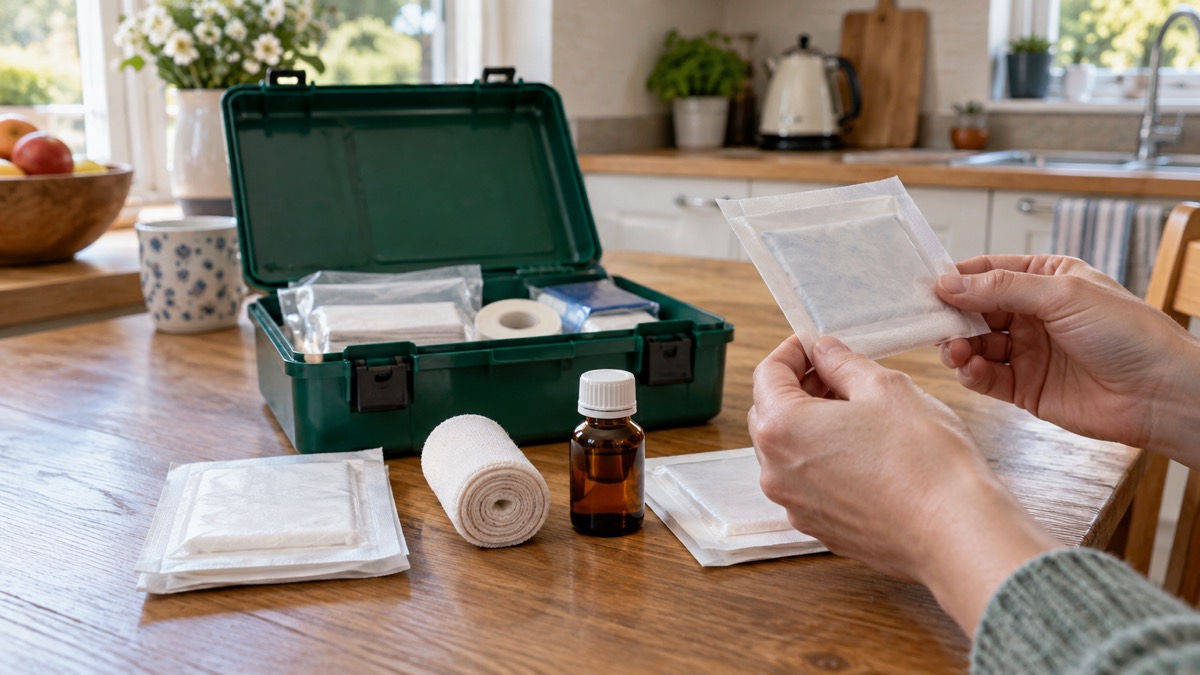
The Health and Safety Executive's first aid guidance, written for workplace kits but applying equally to a household kit, is blunt about the mechanics: many items, particularly sterile ones, are marked with expiry dates, and you should replace expired items, disposing of them safely11. For non-sterile items without dates, the advice is to check that they are still fit for purpose11. That two-part test, dated items against their date, undated items against their condition, is the right way to approach the whole kit, not just the first aid box.
Lancashire Prepared's industrial incident advice makes the same point about food: keep a stock of essential supplies, and remember to check the use by dates of perishable items regularly12. Use by dates on food are safety dates, not quality dates, so anything past one should not stay in the kit. Best before dates are more forgiving, but a kit is not the place for borderline food: you will be eating it under stress, possibly without power to cook it.
The NHS winter campaign advice for medicine cabinets applies the same discipline to medicines: it is worth checking expiry dates regularly and replacing items when needed13. Medicines past their date may simply not work, which in an emergency is as bad as not having packed them.
A practical way to handle disposal and replacement together:
- Take expired sterile first aid items and medicines out of the kit immediately, so they cannot be used by mistake11.
- Dispose of them safely, as the Health and Safety Executive advises11.
- Put a replacement in the kit straight away so the item is not missing when it is needed11.
Rotating stored food
Food is the part of a kit that goes out of date fastest, and Denbighshire Council's advice solves it in one move: just replace the whole food side of the kit every six months and live off the replaced food for a few days3. In other words, the food you store is ordinary food you would eat anyway, moved through your kitchen rather than left to expire in a bag. This avoids what the council calls monthly changes, the fiddly business of replacing individual items one at a time, and it means nothing in the kit is ever more than six months past its packing date.
How much food to hold depends on your household's plan. Central Bedfordshire Council recommends a Home Emergency Kit that lets you look after yourself and your family for at least 7 days of disruption10. Whatever you store, keep it to food that needs no cooking or that you can prepare with the equipment you also have in the kit, and remember the small items that make it usable: Lincolnshire's emergency advice includes a can opener for canned food in a pet kit, and the same applies to your own tins14.
On each six-monthly check:
- Move the stored food into your everyday cupboards and eat it over the following days3.
- Replace it with fresh supplies of the same items3.
- Check that any can opener and utensils are still in the kit14.
- Adjust quantities if the household has changed size4.
For a fuller guide to what to store and how to use it without power, see Emergency Food: A Household Guide.
Replacing stored bottled water
Bottled water has a shelf life, and Denbighshire Council's guidance is specific: bottled water will have to be replaced every six months3. Treat it like the food, swapping it out on the same six-monthly check, and use the replaced bottles for drinking and cooking at home rather than pouring them away.
How much to store is set by official guidance. The government's Be Ready checklist advises bottled water for 3 days, at 3 litres per person per day for drinking, with more needed for other tasks such as cooking and washing4. Worcestershire's household emergency plan and North Devon's guidance both give a minimum of 2.5 to 3 litres of drinking water per person per day, the figure North Devon attributes to the World Health Organisation for survival2. The two figures sit comfortably together: 3 litres per person per day is the safer planning number, and it covers only drinking, so a household that wants water for cooking and washing needs more on top.
| Source of advice | Amount per person per day | Covers | Replace |
|---|---|---|---|
| Be Ready checklist4 | 3 litres | Drinking, for 3 days | Every 6 months3 |
| Worcestershire household plan15 | 2.5 to 3 litres (minimum) | Drinking | Every 6 months3 |
| North Devon Council, citing WHO2 | 2.5 to 3 litres (minimum) | Drinking for survival | Every 6 months3 |
| Wiltshire and Swindon Prepared, pets16 | A couple of bottles | Pets, with a bowl | With the same check |
If you store water in your own containers rather than shop-bought bottles, the inspection regime is different. The Drinking Water Inspectorate's guidance on private supply storage tanks says the tank must be inspected regularly, at least annually and preferably every six months17, and its advice on storage tanks and cisterns recommends checking annually for the condition of the tank and the quality of the water where the tank stores drinking water18. That guidance is written for private water supplies, but the principle applies to any household water container: look at it, clean it if needed, and refresh the water on a schedule rather than leaving it indefinitely.
Pets need water too. Wiltshire and Swindon Prepared's pet kit advice is to include a couple of bottles of water and a bowl to keep it in16. For more on storing and treating water, see Water in an Emergency: A Household Guide.
Batteries, torches and radios on each check
Batteries are the most common failure in a stored kit, because they drain sitting in devices and expire sitting in packets. The fire and rescue services' advice on smoke alarms shows the pattern every battery-powered item follows. Staffordshire Fire and Rescue Service advises: test your smoke alarm every week, change the battery once a year unless it is a ten-year alarm, and after 10 years get a whole new alarm5. The Fire Kills campaign adds that if any of your alarms have one-year batteries, change them every year, and only take the batteries out when you need to replace them19. That last point matters for kit torches and radios as well as alarms: batteries left in a device slowly discharge, so store spares in their packaging and in the device only what you are prepared to test.
On each six-monthly check of torches and radios:
- Check the torch and its spare batteries regularly, as the emergency pack advice sets out4.
- Consider a wind-up torch or radio as a backup that does not depend on batteries4.
The Scottish Government's Ready Scotland kit advice includes a torch and spare batteries in the car emergency kit20, and Neath Port Talbot's emergency kit checklist likewise expects a battery torch with spare batteries or a wind-up torch in the household kit21. Whichever you carry, the check is the same: does it light, does it tune, and are the spares still alive.
Two winter items deserve their own battery and wear checks. The London Fire Brigade's winter guide advises checking electric blankets regularly for wear and tear and replacing them at least every 10 years7. Government guidance on sight, hearing and mobility adds that electric blankets should be tested every three years, and that your local fire and rescue service or Age UK may do this for you for free22. And the Mid and South Essex NHS advice on burns prevention is clear on hot water bottles: replace every two years, never fill with boiling water, and always use a protective cover to prevent burns6.
"Replace every two years, never fill with boiling water, and always use a protective cover to prevent burns."
For more on lighting choices, see Emergency Lighting at Home: Torches, Lanterns and Candles.
Medicines and first aid items to replace
Medicines are the category where an out-of-date item is not just useless but potentially harmful, so they lead the check. The Health and Safety Executive's first aid guidance applies directly: check your kit regularly, replace expired items and dispose of them safely, and for non-sterile items without dates, check that they are still fit for purpose11. Plasters, sterile dressings and wipes all carry expiry dates because sterility cannot be guaranteed forever; a dressing past its date may no longer be clean enough to put on a wound.
Beyond the first aid box, think about the medicines your household depends on. Neath Port Talbot's kit checklist includes essential medication among the things to take if you have to leave your home21, and Carmarthenshire Council's checklist similarly lists essential medicines among items to gather if there is time23. Essential means the prescriptions and regular medicines someone in the house would miss within a day or two, so the check is: is the kit's supply current, in date and enough for a few days away from home?
Medicines in a first aid kit should be checked regularly to make sure they are within their use-by dates13. For the emergency kit itself, the advice is to keep a list of current medication, or spares so long as they do not go out of date3. That makes the six-monthly check the moment to confirm every medicine in the kit is still in date and to swap out anything that is not.
If someone in your household depends on medical equipment or needs extra help in an emergency, see Extra Help in an Emergency and First Aid at Home.
After you have used the kit
A kit that has been opened, even partly, needs a check before it goes back in storage. The first job is restocking: replace anything used, and check the use by dates on what is left, as Lancashire Prepared advises for stocked supplies12. Reset your six-monthly reminder from the date of use, not the date of the last routine check, so the cycle stays honest.
Electrical items that were used deserve a closer look. The Health and Safety Executive's electrical safety FAQs advise that electrical equipment should be visually checked to spot early signs of damage or deterioration, and tested by a competent person often enough that there is little chance the equipment will become dangerous between tests, with equipment used in a harsh environment tested more frequently24. An emergency is a harsh environment: a heater dragged out to a cold room or a torch dropped on a stairs should be looked over before it goes back in the kit.
The same principle extends to appliances around the home that an emergency puts to unusual use. The London Fire Brigade's Total Recalls campaign advises regularly checking whether your appliances have been recalled, using the Government's product recall site, the manufacturer's website or Electrical Safety First's recall register25. North Yorkshire Fire and Rescue Service reminds tenants that landlords must keep appliances and flues in good order and checked for safety at least once every 12 months26. And for outdoor heating, the Scottish Fire and Rescue Service advises regularly cleaning and checking containers for damage, and never using a leaking container27.
A post-use checklist:
- Restock everything used, and swap in fresh food and water3.
- Visually check any electrical equipment used, for damage or deterioration24.
- Check heating and cooking containers for damage before storing them; never store or use a leaking container27.
- Recharge or replace batteries in anything that ran flat4.
- Check appliance recall lists if any appliance was in heavy use25.
- Reset the six-monthly reminder4.
Storing the kit so checks stay quick
How the kit is stored decides how painful the checks are. Denbighshire's advice to keep the contents list outside the kit, with every expiry date and its change date written on it, only works if the kit itself lives in one known place3. West Northamptonshire's point that the grab bag should be updated regularly throughout the year is easiest to honour when the bag is reachable, not buried at the back of a loft9. For a full guide to locations, containers and keeping supplies dry, see Where and How to Store Your Supplies Safely.
A few storage habits directly extend the life of what you have:
- Keep spare batteries in their packaging until needed, and only remove batteries from a device to replace them19.
- Store food and water somewhere cool and dark, and rotate them on the six-monthly cycle rather than leaving them longer3.
- Keep the grab bag's clothing and toiletries current for the season and the people in the household9.
- Keep copies of important documents with the kit. See Important Documents.
Seasonal changes and sharing the work
Two things change a kit over time: the seasons and the household. Seasonally, the car kit is the clearest example, and winter is when electric blankets and hot water bottles come out, which is why their checks, every three years for testing and at least every 10 years for replacement for blankets7, and every two years for hot water bottles6, belong on an autumn check rather than a mid-winter scramble.
The household changes too. The Be Ready checklist's instruction to update your kit if your circumstances change4 covers a new baby, a new pet, someone moving in or out, a change in medication or a change of car. Carmarthenshire's checklist of what to take if you leave home, from essential medicines and spare glasses to pets and a child's special toy23, is a useful list to re-read each year against who actually lives with you now. See also Supplies to Pack for Babies and Young Children and Pets and Animals in an Emergency.
Sharing the checks across the household is not just about workload. Everyone should know where the kit is and what is in it, because the person who packed it may not be home when it is needed. Splitting the six-monthly check, one person on food and water dates, another on medicines and first aid, another on batteries and torches, means each part gets a fresh pair of eyes. The annual plan review is a natural moment to walk everyone through the kit together.
One longer-cycle item belongs here rather than anywhere else: North Wales Fire and Rescue Service advises having your household wiring checked at least once every 10 years to ensure the safety of you, your family and your home28. It is not part of the kit, but a house that can safely power a recharging torch is part of being ready.
Where to get help and further advice
Your local fire and rescue service is the main port of call for the safety checks around a kit, from smoke alarms to the other fire safety items a household keeps. Contact your own service to ask what it offers and what its current advice is for your area.
For supplies themselves, the government's Be Ready campaign and its printable checklist1, the Scottish Government's Ready Scotland kit page20, and your own council's emergency planning pages, such as Neath Port Talbot's emergency kit checklist21, set out what to keep and, by implication, what to keep checking.
Related pages on this site: The Government's Be Ready Checklist Explained, Grab Bags: What to Pack If You Have to Leave Home, What to Keep in Your Car in Case of a Breakdown or Storm, and How Many Days Your Supplies Should Last.
Sources (28)
- Be Ready for Emergencies, UK Government Be Ready campaign, 2026
- Be Prepared for Emergencies, North Devon Council, 2026
- Emergency Supplies Kit, Denbighshire Council, 2020
- Be Ready Checklist, UK Government Be Ready campaign, 2026
- Smoke Alarms, Staffordshire Fire and Rescue Service, 2026
- Burns Prevention and Tips, Mid and South Essex NHS Foundation Trust, 2026
- Extreme Weather Winter Guide, London Fire Brigade, 2025
- Community Emergency Plan Template, North Yorkshire Local Resilience Forum, 2025
- Protecting Yourself, West Northamptonshire Council, 2024
- Emergency Kits and Grab Bags, Central Bedfordshire Council, 2026
- What to Put in Your First Aid Kit, Health and Safety Executive, 2026
- Industrial Incident Advice, Lancashire Prepared, 2026
- Be Prepared for Winter Emergencies, NHS Norfolk and Suffolk Integrated Care Board, 2026
- Get Help and Advice in an Emergency, Lincolnshire County Council, 2026
- Household Emergency Plan, Worcestershire County Council, 2026
- Your Pets, Wiltshire and Swindon Prepared, 2026
- Water Storage, Private Supply Networks, Drinking Water Inspectorate, 2025
- Water Storage Tanks and Cisterns, Drinking Water Inspectorate, 2026
- Fire Kills Prevention, Fire Kills campaign, 2026
- Emergency Kit, Scottish Government Ready Scotland campaign, 2026
- Emergency Kit Checklist, Neath Port Talbot Council, 2026
- Sight, Hearing and Mobility Guidance, UK Government, 2021
- Get Prepared, Carmarthenshire County Council, 2026
- Electricity Safety FAQs, Health and Safety Executive, 2026
- Total Recalls: Making White Goods Safer, London Fire Brigade, 2026
- Student and Rented Accommodation Safety, North Yorkshire Fire and Rescue Service, 2026
- Outdoor Heating Safety, Scottish Fire and Rescue Service, 2024
- Looking After the Electrics, North Wales Fire and Rescue Service, 2026
 30-Day Household Checklist
 Emergency Plan Template
 Supply Interruption Checklist
 Home Emergency Pack
 Grab Bags
 What to Keep in Your Car
 Important Documents
 Cash to Keep at Home
 How Many Days Supplies Last
 Storing Your Supplies Safely
 Rucksacks and Holdalls
 Keeping Supplies Dry
 Foil Blankets
 Portable Jump Starters
 Supplies for Babies and Children