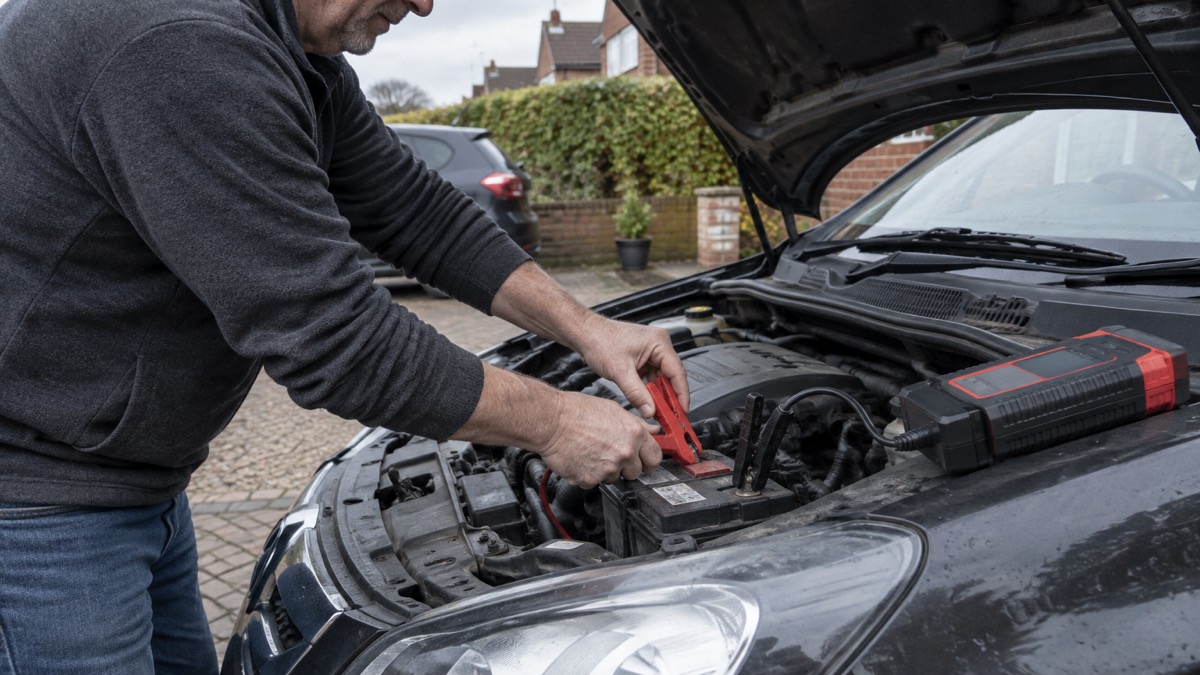
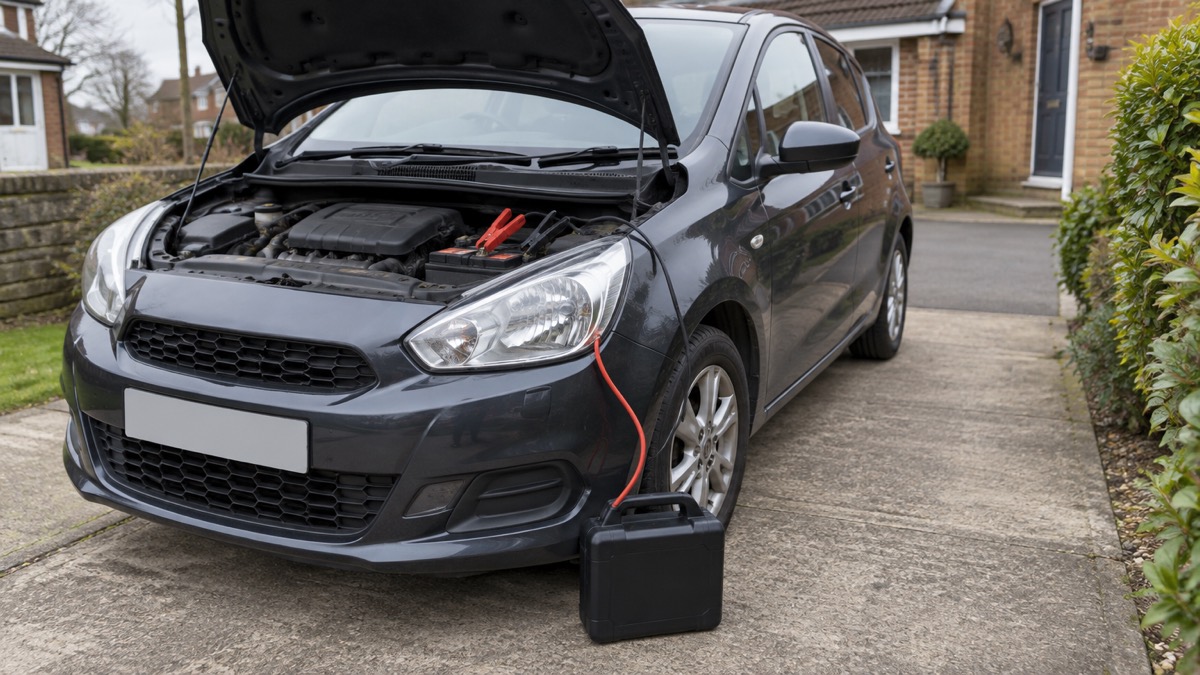
A portable jump starter is a small battery pack with a pair of clamps that starts a car, van or motorcycle with a flat battery without needing a second vehicle or a set of jump leads. Many also work as a power bank for phones and tablets, and some come with a built-in tyre inflator, which makes them a useful single item for a car emergency kit. You can see examples of what these units do on our pages for the NEBO Assist Air Jump Starter and the Ring RJS010T Ultraboost 500 Jump Starter.
What makes a jump starter small and powerful is its lithium-ion battery, the same technology as in your phone or laptop. That battery is safe during normal use, but fire and rescue services across the UK are clear that lithium-ion batteries present a fire risk when they are over-charged, short-circuited, submerged in water or damaged1. When a lithium-ion battery fails, it can explode or cause a rapidly developing fire3. This page sets out what that means in practice: how to buy one safely, how to charge and store it, which models have been recalled, and what to do if a battery fire does start.
Why a jump starter's battery matters more than its features
When you compare jump starters, the specifications that matter most are the current the unit can deliver to the starter motor, the size of vehicle it is rated for, and the extras it carries, such as USB ports for charging phones or a built-in tyre inflator. But every one of those specifications sits on top of the same component: a lithium-ion rechargeable battery. The maker NEBO describes the chemistry plainly in its own manual: "When used correctly, lithium-ion rechargeable batteries provide a safe and dependable source of portable power"4.
The phrase "when used correctly" is doing the work in that sentence. Fire and rescue services in England, Scotland and Wales all give the same account of what goes wrong. Staffordshire Fire and Rescue Service states that lithium-ion batteries "are an emerging risk and can present a fire risk when over-charged, short-circuited, submerged in water or if they are damaged"2. Essex County Fire and Rescue Service gives the same list and adds that these batteries are a main cause of waste fires when they are thrown away with general rubbish or mixed with recyclable materials like card, metal and plastic1. Mid and West Wales Fire and Rescue Service warns that the risks extend beyond the battery itself to the whole household: improper charging or storage "increases the risk of a house fire, garage fire or personal injury"7.
The scale of the danger follows the size of the battery. North Wales Fire and Rescue Service puts it directly: "The larger the battery, the larger the danger"5. A jump starter's battery is smaller than an e-bike's, but it is larger than a phone's, and it lives in a car boot or a garage, where it gets knocked about, left in heat and cold, and forgotten for months between uses. That combination is exactly why the rest of this page is about habits rather than brands: which unit you buy matters less than how you buy it, charge it, store it and dispose of it.
How to tell whether a device has a lithium-ion battery
Not every battery-powered item in your house is lithium-ion, and the check is simple. Portsmouth City Council's battery safety guidance for its tenants says: "You can tell if a device has lithium ion batteries by reading the manual or finding the symbol Li on it"11. The council's accessible battery safety flyer repeats the same advice: read the manual, or look for the Li symbol on the device12. If you are choosing a jump starter, the product description and the box will almost always name the chemistry, because lithium-ion is what makes the unit light enough to carry.
The reason to check is that lithium-ion batteries are now in most of the rechargeable things a household owns. North Yorkshire Fire and Rescue Service lists where they are found: "They are also found in mobility aids, mobile phones, power-packs, laptops, children's toys, power tools and e-cigarettes"13. Lincolnshire County Council adds e-bikes and e-scooters to that list14, and the Scottish Fire and Rescue Service includes vapes, hoverboards and larger items such as e-bikes3. A jump starter sits in this family as a power-pack: a box whose whole purpose is to store a lot of electrical energy in a small space.
That prevalence is why fire services keep repeating the same basic advice. The average UK household now has many rechargeable items containing lithium-ion batteries5, and each of them carries the same set of risks when charged, stored or disposed of incorrectly. The habits you build around a jump starter are the same habits that protect your phone, your laptop and your child's toys, so they are worth getting right once.
Buy new, from a reputable seller
The single most important buying rule for any lithium-ion product, including a jump starter, is to buy it new from a reputable retailer. North Wales Fire and Rescue Service applies the rule directly to batteries: "Never be tempted to buy a lithium battery second-hand as you won't know it's history, damage it may have suffered or the dangers it could pose"5.
The recalls listed later in this page show why. A second-hand jump starter may be one of the recalled models, and without the original packaging, receipt or batch information you may never know. The Fast Charge Jump Starter 260 and 9000mAh Power Bank recalled in March 2024 was identified by its barcode, 5055175250144, and its batch number, 38/2115; the Ring RPPL360 Fast Charge Lithium Jump Starter recalled in March 2023 was identified by barcode 505517525015116. A private seller on a marketplace is unlikely to pass that information on, and the fault in the RPPL360 was a manufacturing defect in the cable sleeving that you cannot see from the outside16.
There is also a market-place dimension to the risk: recalled battery products have appeared on online marketplaces, so the buyer carries more of the checking burden. Surrey County Council's fire safety advice to households, while written about heaters, states the general principle: "Always purchase from recognised and trusted brands. Avoid using a second hand heater"17. Apply the same principle to a jump starter.
Thermal runaway: what actually makes the battery catch fire
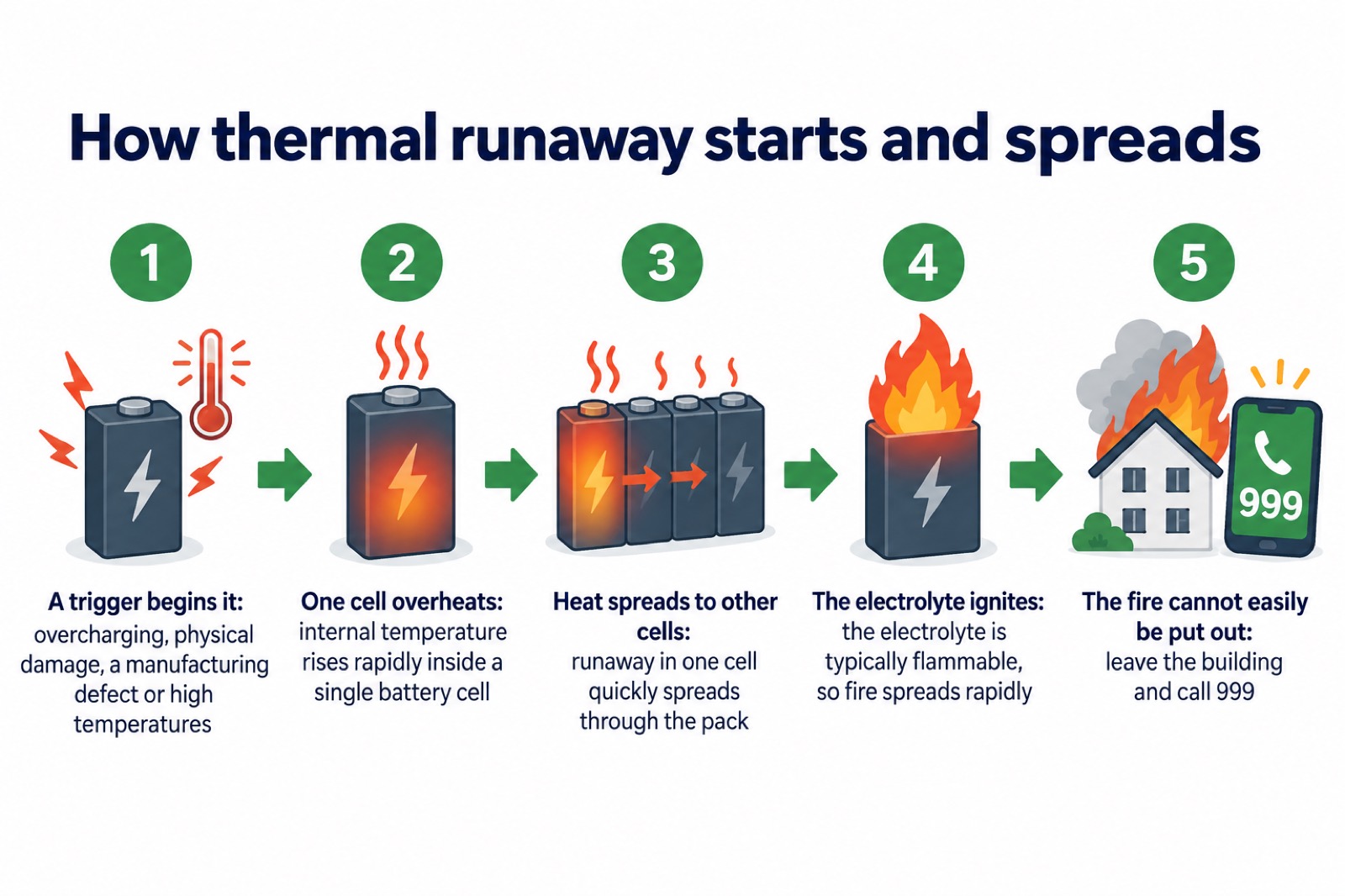
The failure mode behind almost every lithium-ion fire is called thermal runaway. Devon and Somerset Fire and Rescue Service describes it as "rapid overheating (a process called thermal runaway) leading to fire or explosion"8. North Yorkshire Fire and Rescue Service explains the mechanism: "There is a heightened risk of explosion because of something called a 'thermal runway' where internal temperatures of the battery continue to increase making it unstable"13. Dorset and Wiltshire Fire and Rescue Service gives the fuller picture: thermal runaway is "where the internal temperature increases rapidly leading to further heat generation and potential ignition of the electrolyte", and the electrolyte in a lithium-ion battery is typically flammable, which means a fire can be difficult to extinguish and may spread rapidly18.
Several things can start the process. Dorset and Wiltshire Fire and Rescue Service lists the triggers as "overcharging, physical damage, manufacturing defects, or exposure to high temperatures"18. North Wales Fire and Rescue Service, writing about e-cigarettes, gives a matching list: thermal runaway "can be caused by overcharging, physical damage or a defect within the battery during manufacture"19. For a jump starter, the realistic triggers are a drop onto a hard floor, a unit left on charge for days, a unit left in a hot car in summer, or a manufacturing fault you cannot see.
Once started, thermal runaway is self-sustaining and fast. Devon and Somerset Fire and Rescue Service describes what happens inside the pack: "If one cell of a lithium-ion battery overheats, it can enter a state of thermal runaway which can quickly spread to other cells", and compares the resulting reaction to "several fireworks going off at once, with such ferocity and intense heat it cannot be put out easily"8. This is why every fire service gives the same instruction if a battery fire starts: do not fight it, leave and call 999. The recall notices show the same mechanism at work in real products: the ESR HaloLock power banks were recalled because their batteries "can overheat during use, causing the power bank to enter into thermal runaway, causing a fire"20, and a YIYUANJI rechargeable torch was reported for a serious risk of fire and burns because under fault conditions its cells "may overheat and do not vent, causing the battery to enter into thermal runaway"21.
Charging a jump starter safely
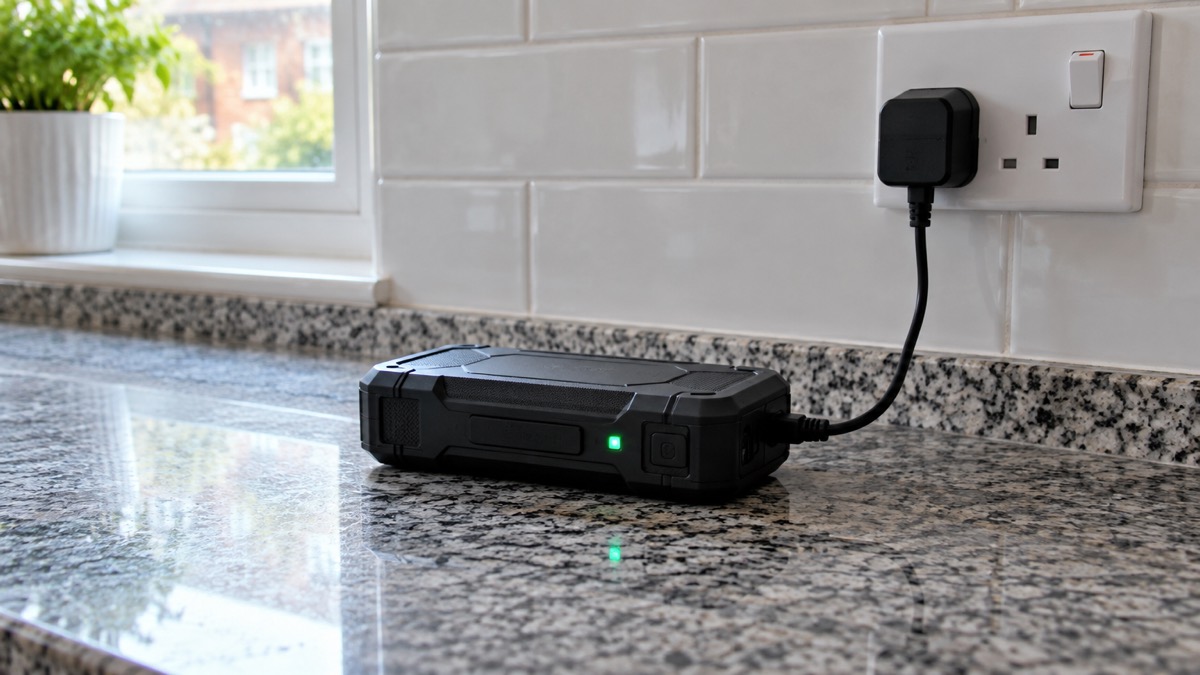
The habits around charging are where you most reduce the fire risk, and every fire and rescue service gives broadly the same instructions. Mid and West Wales Fire and Rescue Service states the core rule: "Disconnect the charger once the battery is full. Continuous charging increases fire risk"7. The same service warns against covering a device while it charges, because "This traps heat and increases fire risk"7. Devon and Somerset Fire and Rescue Service adds a practical tip for preventing overcharging: "use a charger that automatically shuts off or has a timer"10. For a jump starter, that means using the charger the maker supplies, topping the unit up when it needs it, and unplugging it when the indicator says it is full.
Charge it where you can see it. Torfaen County Borough Council's guidance, shared with other Welsh councils, advises: "Charge batteries in a safe, visible location. Avoid charging near flammable materials or in escape routes"22. That last point matters more than it sounds: a jump starter charging in a hallway, on a landing or beside a back door is a hazard sitting on your escape route. Charge it on a hard surface, in a room you are using, away from bedding, sofas, curtains and paper.
Watch for the warning signs while a battery is charging or in use. East Sussex County Council's trading standards advice is to "Stop using your charger or battery immediately if you notice it overheating, deforming, making hissing or cracking noises, smelling, smoking or performing poorly"9. Any of those signs in a jump starter means stop charging it, move it outside if you can do so safely, and do not use it again. London Fire Brigade makes the underlying point about damage: "A damaged lithium-ion battery can fail unexpectedly and start a fire"23.
- Use the charger the maker supplies, and unplug it once the battery is full7
- Charge on a hard, visible surface, away from flammable materials and escape routes22
- Never cover a charging device; covering traps heat7
- Stop using the unit immediately if it overheats, deforms, hisses, cracks, smells, smokes or performs poorly9
- Do not charge it unattended overnight or while you are out10
Storing it, and keeping it ready
A jump starter is no use in an emergency if it is flat, so the maker's own guidance on keeping it topped up matters. NEBO's manual for its Assist 800 Jump Starter describes the indicator system: the lights show green when the unit is fully charged, and "the indicator shifts from green to red, signalling when it's time to recharge"4. Check the indicator periodically, ideally when you do your regular kit checks, and top the unit up when it asks for it rather than leaving it plugged in permanently.
Where you store it matters for two reasons: temperature and impact. Devon and Somerset Fire and Rescue Service lists exposure to hot temperatures as a cause of battery fires, alongside overcharging, charging on flammable surfaces, and using batteries the manufacturer does not recommend10. A car parked in summer sun gets hot enough to worry about, so if you keep the jump starter in the car, store it out of direct sunlight, and consider bringing it indoors during a heatwave. The same service's heatwave safety guidance notes that lithium-ion batteries in phones, vapes, e-bikes and e-scooters "can become a fire risk when exposed to high temperatures or charged incorrectly"24. Cold does not carry the same fire risk, but a very cold battery may deliver less current when you need it, so a garage shelf or a cupboard beats a freezing car boot for long-term storage.
Keep the unit away from children. NEBO's manual states: "This product and its accessories are not toys and should be kept away from children"4. And do not attempt any repairs or battery replacement: "Do not disassemble, the the product. There are no user-serviceable parts inside. Incorrect reassembly may result in shock or fire hazard"4. If the battery will no longer hold charge, the unit is finished: replace the whole thing and recycle the old one.
For the wider household kit, a jump starter complements jump leads rather than replacing them: leads need a second car, a jump starter does not, but leads never go flat. Our page on what to keep in your car covers how the two fit together, and the household emergency pack page covers the rest of the kit.
Recalled jump starters and battery packs: check before you buy or charge
Several portable battery products have been recalled in the UK in recent years, and two of them are jump starters. If you own any of the items below, follow the notice's instructions, which in each case mean stopping use immediately.
| Product | Recalled | The risk | What to do |
|---|---|---|---|
| Ring RPPL360 Fast Charge Lithium Jump Starter | March 2023 | High risk of fire; a manufacturing fault can damage the battery cable sleeving, allowing a short circuit, PCB overheating and possible ignition of the lithium-ion battery16 | Stop using it, store it outside protected from water and rain, contact the retailer for a refund and safe disposal16 |
| Fast Charge Jump Starter 260 and 9000mAh Power Bank (Ring Automotive, model RPPL260, batch 38/21) | March 2024 | Risk of fire; the product may not cut off power in standby mode, with risk of thermal runaway15 | Stop using it, store it outside protected from water and rain, contact the retailer or Ring Customer Services15 |
| Ring Automotive Cordless Tyre Inflator RTC6000/RETC6000 | July 2025 | Certain batches have a lithium-ion battery protection loop fault that may allow overcharging, overheating and fire25 | Stop using it immediately; check batch codes and serial numbers and complete the recall form on the Ring Automotive recall page26 |
| Belkin BoostCharge USB-C BPB002 and Playa USB-C PB0003 power banks | November 2025 | Lithium-ion batteries can overheat in use, leading to localised smoking, melting and a risk of fire27 | Stop using immediately and complete the recall form on the Belkin website for a refund or replacement27 |
| ESR HaloLock wireless power banks, sold via Amazon | November 2025 | Batteries can overheat during use, causing the power bank to enter thermal runaway and catch fire20 | Stop using it and follow the recall notice20 |
The tyre inflator recall matters directly here because many jump starters are sold with, or alongside, a tyre inflator, and the Ring Automotive cordless inflator is exactly that kind of product. The Office for Product Safety and Standards recalled it from end users in July 2025, and Darlington Borough Council's trading standards notice advises: "Users are advised to stop using the product immediately. For more information on affected batch codes/serial numbers and to complete a recall form, please visit" the Ring Automotive recall page26. If you bought a jump starter and inflator as a set, check both.
The power bank recalls are relevant for the same reason: many jump starters double as power banks for phones and tablets, and the failure mode is identical. The Belkin notice states that "The product presents a risk of fire as the lithium-ion batteries can overheat whilst in use. This can lead to localised smoking, melting and/or a risk of fire", and that consumers should stop using the product immediately and complete the recall form on the Belkin website to receive a full refund or replacement27. The Fast Charge Jump Starter 260 notice shows how a jump starter-specific fault looks: the product "may not cut off power in standby mode, with risk of thermal runaway of the lithium-ion battery", and it failed the requirements of the Electrical Equipment (Safety) Regulations 201615.
If a lithium-ion battery fire starts
Every fire and rescue service that has published on this subject gives the same instruction, and it is worth being clear about. Devon and Somerset Fire and Rescue Service: "If your battery catches fire, do not attempt to put it out yourself, get out and call the fire service"8. East Sussex County Council's trading standards team: "People should never try to extinguish lithium-ion battery fires themselves but leave the area or building as quickly as possible and call 999"9. The reason is the chemistry: the electrolyte is flammable, the fire spreads rapidly, and thermal runaway generates intense heat that cannot easily be put out8.
This is the one emergency on this page where the right action is to do less, not more. Do not carry a burning or smoking device through the house. Do not throw water on it. Do not go back for it. Get everyone out, close doors behind you if you can, and call 999. A working smoke alarm is what turns a battery failure into a near-miss rather than a tragedy, so check yours as part of your regular kit checks; our home emergencies page covers alarms and the wider fire precautions for your home.
The last piece of battery safety is disposal, and it is where many household fires in waste lorries and recycling centres begin. Essex County Fire and Rescue Service states that lithium-ion batteries "are a main cause of waste fires and can be extremely dangerous when thrown away with general rubbish, or mixed with recyclable materials like card, metal and plastic"1. Devon and Somerset Fire and Rescue Service explains the mechanism: "When put into general household waste, these batteries can get crushed or punctured as they are taken to recycling centres", releasing flammable electrolytes into the air which can trigger explosions and rapidly spreading fires10. The Scottish Fire and Rescue Service gives the same warning about batteries placed in the general waste bin at home3. Take a dead jump starter to a household recycling centre or a battery collection point, and never to the kerbside bin.
Choosing well: a short checklist
Pulling the whole page together, here is what to do at each stage of owning a portable jump starter.
- Buy new from a reputable retailer, and check the product complies with UK electrical safety standards; never buy a lithium battery second-hand5.
- Confirm the chemistry by reading the manual or looking for the Li symbol, so you know you are handling a lithium-ion product11.
- Keep the box, receipt and batch details so you can check quickly against recall notices15.
- Charge it with the supplied charger, in view, on a hard surface, away from flammable materials and escape routes, and unplug it once full7.
- Store it out of direct sunlight and heat, away from children, and bring it indoors during hot weather4.
- Check the charge indicator regularly and top up when it shifts from green to red, rather than leaving it on permanent charge4.
- Stop using it immediately if it overheats, deforms, hisses, cracks, smells, smokes or performs poorly9.
- Never disassemble it; there are no user-serviceable parts, and incorrect reassembly may result in shock or fire4.
- Check the recall list if you own a Ring RPPL360, a Fast Charge Jump Starter 260, a Ring RTC6000 or RETC6000 tyre inflator, or any of the recalled power banks15.
- Recycle the old unit at a battery collection point, never in household waste or mixed recycling1.
A jump starter earns its place in the car kit by starting a flat battery when no one else is around, and by keeping a phone charged while you wait for help. Treated the way the fire and rescue services describe, charging in view, unplugged when full, stored cool and checked for recalls, it stays a safe and dependable source of portable power.
Sources (27)
- Batteries and charging safety, Essex County Fire and Rescue Service, 2026-10-29
- Lithium-ion batteries, Staffordshire Fire and Rescue Service, 2026-10-29
- Lithium-ion batteries, Scottish Fire and Rescue Service, 2026-10-25
- Assist 800 Jump Starter, NEBO Tools, 2026-10-25
- Lithium-ion batteries, North Wales Fire and Rescue Service, 2026-10-25
- NIFRS issues safety plea following two house fire fatalities in one day, Northern Ireland Fire and Rescue Service, 2025-12-12
- Lithium battery fire safety, Mid and West Wales Fire and Rescue Service, 2026-10-26
- Battery fires, Devon and Somerset Fire and Rescue Service, 2026
- Product safety, East Sussex County Council, 2026-10-29
- Recycle your batteries, prevent fires, Devon and Somerset Fire and Rescue Service, 2024-03-15
- Battery safety, Portsmouth City Council, 2026-10-26
- Battery safety flyer, January 2026, Portsmouth City Council, 2026-01
- E-scooter, e-bike and mobility scooter fire safety advice, North Yorkshire Fire and Rescue Service, 2026-03-25
- Electrical safety, Lincolnshire County Council, 2026-10-29
- Product recall: Fast Charge Jump Starter 260 and 9000mAh Power Bank 2402-0097, GOV.UK, 2024-03-01
- Product recall: Ring RPPL360 Fast Charge Lithium Jump Starter 2303-0111, GOV.UK, 2023-03-27
- Fire safety at home, Surrey County Council, 2026-10-15
- Batteries, Dorset and Wiltshire Fire and Rescue Service, 2025-08-07
- E-cigarettes, North Wales Fire and Rescue Service, 2026-10-28
- Product recall: ESR HaloLock wireless power banks sold via Amazon 2511-0217, GOV.UK, 2025-11-26
- Product safety report: YIYUANJI rechargeable torch sold via Amazon 2408-0050, GOV.UK, 2025-01-30
- Lithium battery fire safety, Torfaen County Borough Council, 2026-10-29
- E-bike conversion kits: fire risks and safety advice, London Fire Brigade, 2026-10-25
- How to stay safe during a heatwave, Devon and Somerset Fire and Rescue Service, 2026-06-23
- Product recall: Ring Automotive cordless tyre inflator 2507-0008, GOV.UK, 2025-07-21
- Product safety notice: Ring Automotive Cordless Tyre Inflator, Darlington Borough Council, 2025-07-23
- Product recall: Belkin BoostCharge USB-C BPB002 and Playa USB-C PB0003 power banks 2511-0225, GOV.UK, 2025-11-26
 30-Day Household Checklist
 Emergency Plan Template
 Supply Interruption Checklist
 Home Emergency Pack
 Grab Bags
 What to Keep in Your Car
 Important Documents
 Cash to Keep at Home
 How Many Days Supplies Last
 Storing Your Supplies Safely
 Checking and Restocking Supplies
 Rucksacks and Holdalls
 Keeping Supplies Dry
 Foil Blankets
 Supplies for Babies and Children