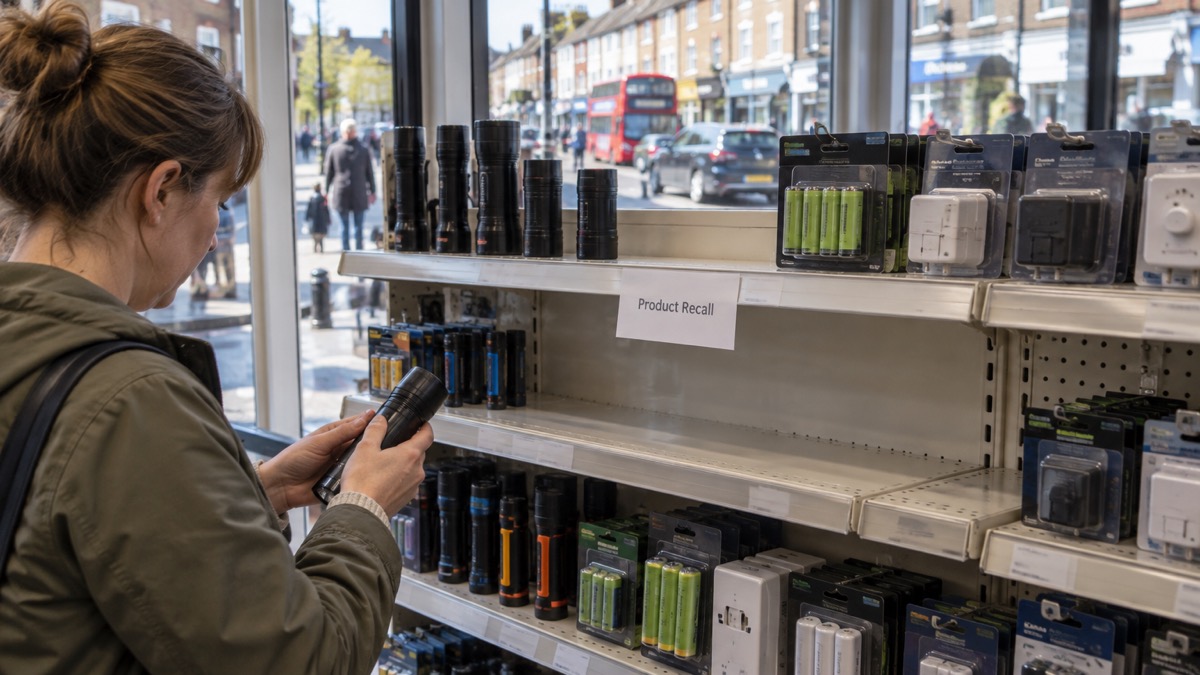
A torch is one of the safest things you can keep at home for a power cut: the government's own preparedness advice is to keep a battery or wind-up torch, with spare batteries, because torches are safer than candles1. But the charger you top it up from, and the rechargeable battery inside it, can be a different matter. Counterfeit electrical chargers can be deadly, and many fail to meet UK safety regulations, leading to fires and injury, according to London Fire Brigade2.
If you think a torch, lantern or charger in your home is unsafe, or you have heard a product like yours has been recalled, the advice is simple: stop using it straight away. London Fire Brigade's guidance on e-bike and e-scooter batteries applies to any battery or charger: don't continue to use a battery or charger that has been identified as unsafe3. Then check whether it has been recalled, report it if it is dangerous, and replace it with one that meets UK safety standards.
This page walks through each of those steps in order: what to do the moment you suspect a problem, how to check the UK recall lists, how to register your appliances so you hear about recalls first, how to report an unsafe product, and what to look for when you buy a charger online, where the risks are greatest.
Stop using a torch or charger you think is unsafe
The first rule is the simplest: if a battery or charger becomes unusually hot, swollen or damaged, stop using it immediately. That is the advice of the Northern Ireland Fire and Rescue Service, and it applies just as much to the battery pack inside a rechargeable torch as it does to a phone charger4. London Fire Brigade gives the same instruction for lithium-ion batteries: if a battery is swelling, stop charging immediately2.
The government's safety message on e-bikes and e-scooters sets out the warning signs in full, and they are worth knowing for any rechargeable device in your home, torches and lanterns included. You must stop using or charging your battery immediately if you notice any of the following9:
- Overheating: the device or battery getting unusually hot
- Deformation: the battery swelling, bulging or changing shape
- Noise: hissing or cracking sounds10
- Smell: an unusual or chemical odour
- Performance: the device not holding charge or working as it should
- Smoke: smoke coming from the battery or device10
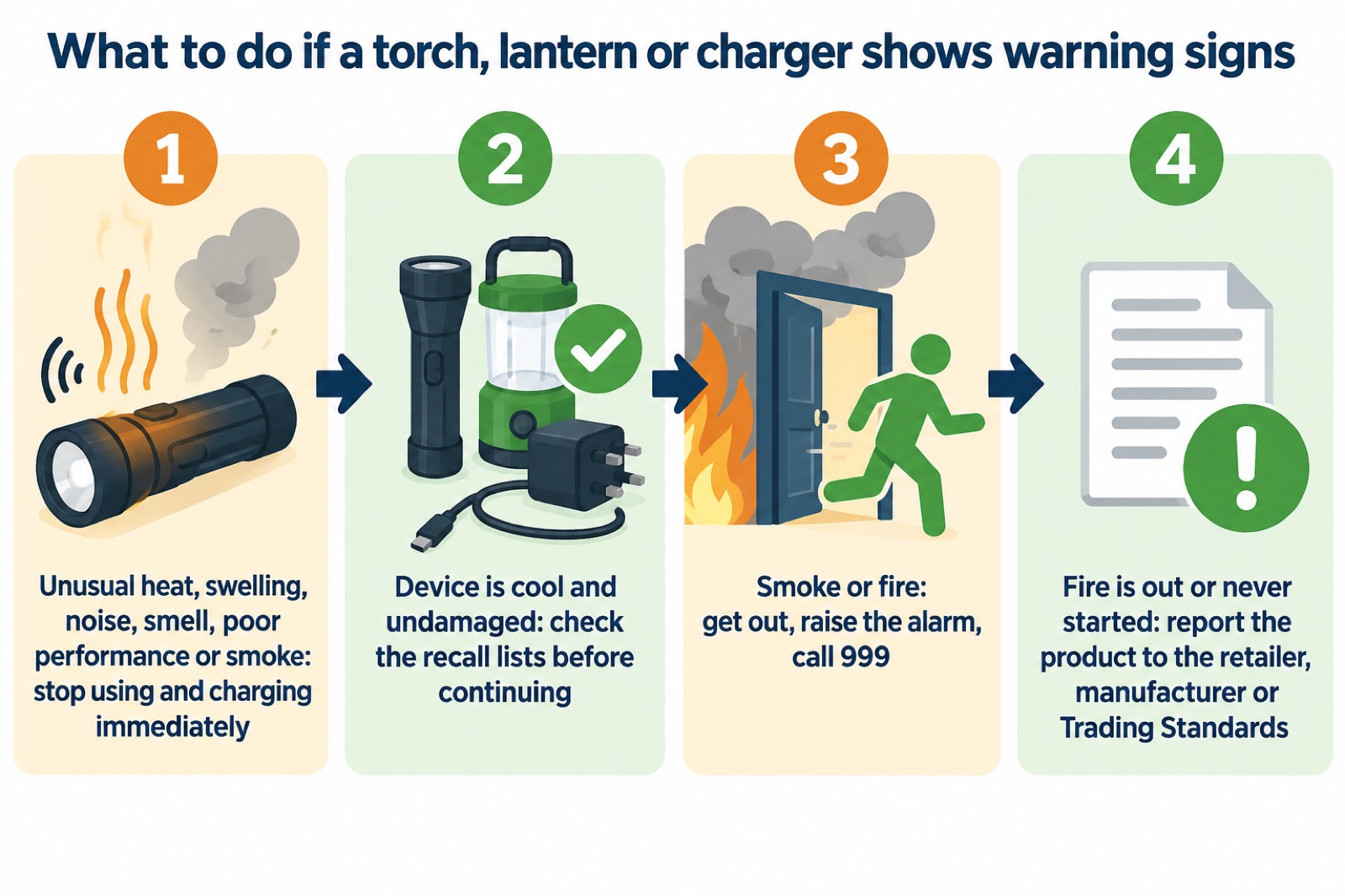
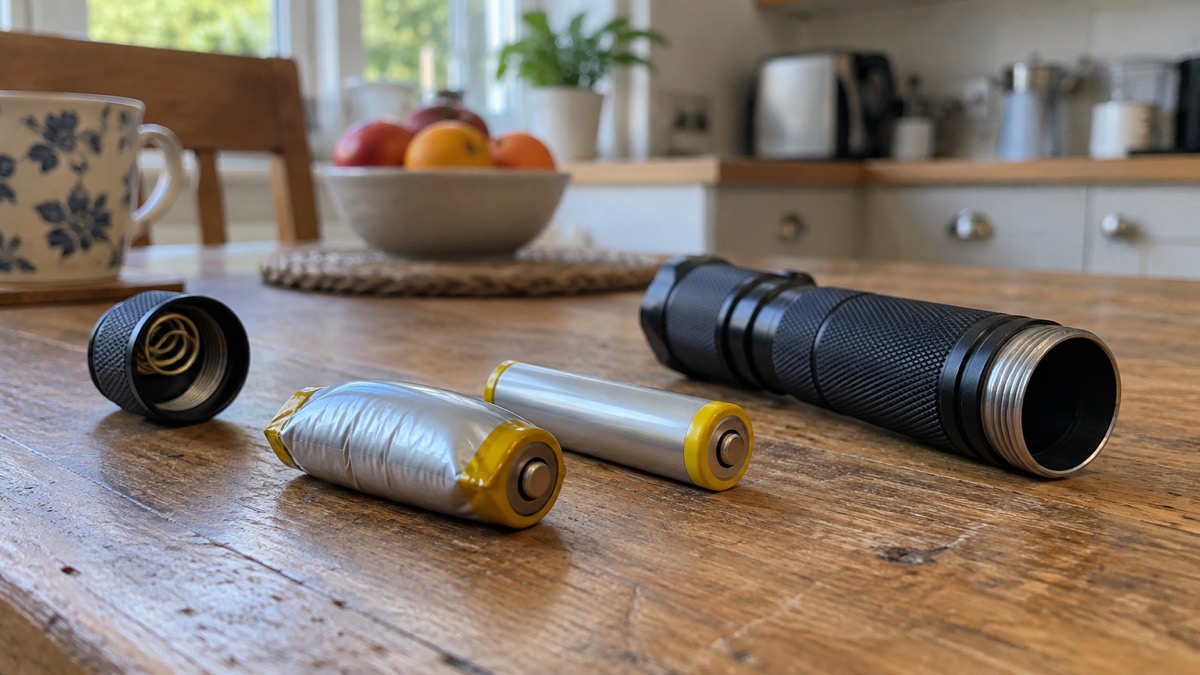
If the worst happens and a battery begins to smoke or catches fire, London Fire Brigade's instruction is plain: get out immediately, raise the alarm, call 999, and do not attempt to tackle the fire yourself11. Lithium-ion battery fires can spread rapidly and produce toxic smoke, so getting everyone out of the building comes before anything else12. On average there is a fire from a lithium-ion battery in an e-bike or e-scooter every two days in London, which gives a sense of how common these failures now are12.
It is also worth understanding why chargers cause fires in the first place. Devon and Somerset Fire and Rescue Service notes that electrical chargers and appliances which do not comply with British or European safety standards are a common cause of fire, alongside faulty electric blankets, and advises always using the correct charger for the device13. A cheap or fake charger that pushes the wrong current into a torch battery can damage it in ways you cannot see, and the failure may come later, on a charge you thought was routine. If you want to know more about matching chargers to devices, see can the wrong USB charger damage a torch battery.
How to check whether your torch or charger has been recalled
Checking for recalls is quick, and it is the single most useful habit on this page. London Fire Brigade's easy-read fire safety booklet puts it simply: check with the Government website to see if the product has been recalled by the maker14. The government's Product Recalls and Alerts website is the official list, and the government's e-bike and e-scooter safety message directs people there to check whether products have been recalled15.
There are three places to check, and they cover slightly different ground:
| Where to check | What it covers | Who runs it |
|---|---|---|
| Product Recalls and Alerts website | Recalled products across all categories | UK government5 |
| Electrical Safety First's recall register | Recalled electrical products | Electrical Safety First, an independent charity16 |
| The manufacturer's website | Recalls and faults for that maker's products only | The manufacturer17 |
London Fire Brigade's Total Recalls campaign, which was built around making white goods safer, says the most important thing you can do is to regularly check if your appliances have been recalled, using the government's product recall site, the manufacturer's website or Electrical Safety First's recall register17. The National Fire Chiefs Council gives the same advice for anything you have bought: check any products you have bought are not subject to a product recall, using Electrical Safety First's website or the government website18.
The habit matters at particular times of year. North Yorkshire Fire and Rescue Service points out that if you have bought an outfit for yourself or a child, or decorations for Halloween, you can check on the government website whether your purchase has been recalled19. The same goes for a torch or set of lanterns bought ahead of a storm season or for a camping trip: check it once, when you buy it, and you know where you stand.
For the lights you already own, a quick annual check is enough for most households. Our lighting checks before winter page builds recall checking into a wider look at your torches, lanterns and batteries before the season when you are most likely to need them.
Register your appliances to hear about recalls first
Checking recall lists works, but it depends on you remembering to look. Registration turns that around: the manufacturer comes to you. Fire services across the UK recommend the Register My Appliance service, which lets you register your appliances and get a notification if a product is recalled20.
North Yorkshire Fire and Rescue Service is blunt about why it matters: "For this reason, we always recommend registering your electrical appliances so that you can be made aware if a product is recalled"21. Devon and Somerset Fire and Rescue Service lists the same service in its home fire safety checklist22, and its guidance for carers repeats it23. North Yorkshire Fire and Rescue Service gives the address to use: visit registermyappliance.org.uk to receive updates on faults and recalls6.
Registering takes minutes, and London Fire Brigade says what you get out of it7:
- Be the first to know of any safety repairs or recalls
- Improve your after sales service
- Keep in touch with upgrade news
The same logic applies to smaller items. Devon and Somerset Fire and Rescue Service advises registering a portable heater when you purchase it, so you will be made aware of any product recalls24. A rechargeable torch or lantern with a built-in lithium-ion battery is the same kind of product: it has a maker, a model and a batch, and if a fault emerges the maker can only contact you if it knows you own one.
Second-hand items need extra care rather than less. London Fire Brigade's white goods advice is to take extra care with second-hand appliances, ensuring they have been safety checked and are not listed on the product recall register7. A torch bought second-hand or handed down within the family can still be registered with its manufacturer, and still checked against the recall lists before you rely on it during a power cut.
If you choose not to register a product, Scottish Fire and Rescue Service notes that product recalls can still be checked via Electrical Safety First or the UK government website25. Registration is the easier path, but it is not the only one.
Millions of recalled electrical items are still in UK homes
Recalls only work if people hear about them and act. Electrical Safety First, the independent charity that runs the UK's electrical recall register, reports that the response rate to a recall is often worryingly low, which means "there are potentially millions of recalled electrical items still in UK homes"26.
That figure is not a scare story: it is the arithmetic of a system that depends on owners coming forward. A maker can announce a recall, but unless it knows who bought the product, or the owner happens to see the announcement, the item stays in a drawer, a cupboard or a charging socket. This is the strongest argument for registration in the section above, and for checking the recall lists before you use any second-hand light or charger.
The scale of the underlying problem is visible in the fire data. The National Fire Chiefs Council reported that in 2024, the Office for Product Safety and Standards received reports of 211 e-bike and e-scooter battery fires, nearly half of which occurred indoors27. As reporting to the Office for Product Safety and Standards is voluntary, those figures are also likely to represent an underestimate27. Those fires involve larger batteries than a torch holds, but the same failure modes, counterfeit chargers, substandard cells and incompatible replacements, run through all of them.
Reporting an unsafe product: manufacturer first, then Trading Standards
If you are concerned about the safety of a product, London Fire Brigade's advice is to stop using it and make your concern known to the retailer, the manufacturer or your local Trading Standards office7. That order is deliberate: the retailer or manufacturer can identify the batch, tell you whether a recall is already running, and in many cases replace the item. Trading Standards is the enforcement route if the seller will not act.
The steps in order:
- Stop using the product and unplug it from the charger3.
- Contact the retailer or manufacturer with the product name, model and what happened7.
- Contact your local Trading Standards office if you are not satisfied with the response, or if you believe the product is dangerous and still on sale7.
- Keep the product, packaging and receipt somewhere safe and out of use until you are told what to do with it.
Electrical Safety First offers a further route for a second opinion. The charity says: "If you want to forward us supporting documentation and images relating to the product, we can objectively review its safety"26. You can send supporting documentation and images to enquiries@electricalsafetyfirst.org.uk for an objective safety review26. That can be useful when a product has not been recalled but you have doubts about it, for example a charger that runs very hot.
For anything involving a battery fire, or a product that has actually failed, call 999 and get out first11. The reporting steps above come after everyone is safe.
Buying online: why marketplace chargers carry more risk
The risks are not spread evenly across the market. The government's fire safety guidance on e-bike conversion kits states plainly that batteries purchased online may not meet UK safety regulations and are more likely to fail8. South Wales Fire and Rescue Service warns shoppers to avoid buying cheap chargers online, because "there are a lot of fakes on the market, and it can be difficult to spot the difference"28.
The problem with online marketplaces is structural, and it is worth understanding so you can shop around it. Devon and Somerset Fire and Rescue Service advises avoiding market stalls and third party sellers on online marketplaces, because there is no guarantee the product has been through Product Safety testing29. When you buy from a marketplace seller, you may not be buying from the manufacturer or from a retailer the manufacturer supplies, and the chain of accountability that makes recalls work is broken.
The same warning appears across product categories:
- Chargers: beware of products that can be bought cheaply online, such as chargers23
- Toys and button batteries: be careful buying toys online, overseas or in markets, as these may not meet UK toy safety standards30
- Lithium-ion battery products generally: buy from reputable retailers, especially online, and check that the devices meet British or European safety standards25
The National Fire Chiefs Council has called for online marketplaces to be regulated to ensure all lithium-ion battery products sold in the UK meet designated safety standards27. Until that happens, the practical advice from fire services is consistent: buy from a reputable retailer that you know and trust, and if you need a replacement charger or battery, get it from the original manufacturer29. A conversion kit illustrates the risk at its clearest: the battery and charger may be purchased separately, sometimes from different sellers, which increases the risk of incompatible equipment being used8.
Safety markings on chargers and batteries
The quickest check you can make on any charger or battery, before you plug it in, is to look for the safety mark. North Yorkshire Fire and Rescue Service advises: "Always look for the UKCA or CE mark that indicates chargers comply with UK or European Safety standards"21. Oxfordshire County Council Fire and Rescue Service gives the same instruction for e-bike and e-scooter batteries: check for the CE or UKCA safety marking so it meets safety standards31.
What the marks mean in practice:
| Mark | What it indicates | Where you will see it |
|---|---|---|
| UKCA | The product complies with UK safety standards | On the charger or battery casing21 |
| CE | The product complies with European safety standards | On the charger or battery casing21 |
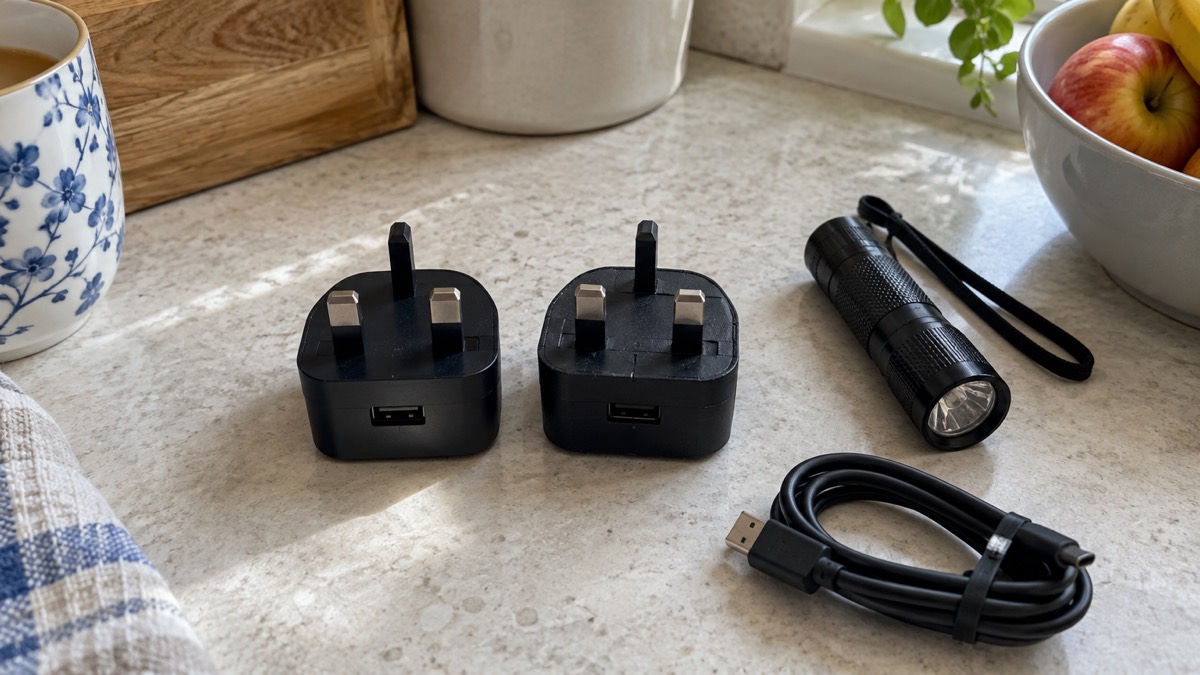
The absence of either mark is a warning in itself. Mid and West Wales Fire and Rescue Service warns that cheap chargers and batteries may not meet UK safety standards and can be dangerous32, and London Fire Brigade's position on counterfeits is stronger still: many fail to meet UK safety regulations, leading to fires and injury2. South Wales Fire and Rescue Service adds that you should only buy items from the right shops and make sure the battery and charger meet UK safety standards28.
For the lights in your home, the check takes seconds. Pick up each rechargeable torch, lantern and charger you own and look at the casing or the plug. If there is no UKCA or CE mark, or the mark looks printed rather than moulded, treat the item as unverified and check it against the recall lists before using it again. Our page on charging and storing rechargeable torches safely covers the day-to-day side of the same habit.
Safe charging on hard, flat surfaces
Where you charge matters as much as what you charge. Mid and West Wales Fire and Rescue Service's advice is to charge on a hard, flat surface, using stable, non-flammable surfaces like a kitchen worktop, and to avoid soft furnishings or carpets32. Devon and Somerset Fire and Rescue Service puts it more forcefully: charge your device on a hard, safe surface, and never on a carpet or bed, and definitely never under a pillow20.
The reason is heat. The Northern Ireland Fire and Rescue Service explains that you should never charge devices on beds, sofas or under pillows, because heat cannot escape4. A battery that is charging normally still gets warm, and on a soft surface that warmth builds up instead of dispersing. Devon and Somerset Fire and Rescue Service's battery fire guidance repeats the point: avoid charging on soft, flammable surfaces, like bedding29.
The rules for charging a torch, lantern or any rechargeable device at home:
- Use a hard, flat, stable, non-flammable surface, such as a kitchen worktop32
- Never charge on a bed, sofa, carpet or under a pillow20
- Use the approved charger that came with the device4
- Stop charging immediately if the battery becomes hot, swollen or damaged2
- Do not leave devices charging unattended overnight where you can avoid it
The National Fire Chiefs Council's Charge Safe campaign adds a warning-signs check to the routine: stop using or charging your battery immediately if you notice any of the warning signs, which include smoke coming from the battery or device10. London Fire Brigade's guidance on charging e-bikes and e-scooters safely makes the same point about making sure your battery and charger meet UK safety standards before you even begin33.
Who regulates product safety in the UK
Product safety in the UK is overseen by the Office for Product Safety and Standards, described in the government's own safety message as "the UK's national product regulator, the Office for Product Safety and Standards (OPSS)"5. It publishes the Product Recalls and Alerts list that this page has pointed you to throughout, and it receives reports of product fires, though reporting to it is voluntary, so its fire figures are likely to be an underestimate27.
Below the national regulator sit the enforcement bodies you would actually contact: Trading Standards offices, which handle unsafe products sold in your area, and the fire and rescue services, which deal with the consequences and publish most of the practical safety advice in this page. The National Fire Chiefs Council, the body that speaks for UK fire services, has pressed for stronger regulation of lithium-ion battery products, warning that the batteries are everywhere but safety standards have not caught up27.
For an ordinary household, the practical picture is simpler than the structure behind it:
- Recall lists and alerts: the Office for Product Safety and Standards, via the government website5
- Unsafe products you have bought: the retailer, the manufacturer, then your local Trading Standards office7
- A second opinion on a product's safety: Electrical Safety First, at enquiries@electricalsafetyfirst.org.uk26
- A fire, or a battery smoking: 999, get out, raise the alarm11
Checking on older relatives and their lights and chargers
Much of this page comes down to habits that are easy for one person and hard for another. North Yorkshire Fire and Rescue Service's winter safety advice includes a simple instruction: check on any elderly or vulnerable neighbours or relatives34. A recall check is a good thing to do while you are there.
A short visit can cover the points that matter:
- Look through their torches and chargers for damage, swelling or missing safety marks4
- Check the recall lists for anything rechargeable they own5
- Make sure nothing is charging on a bed, chair or carpet20
- Register their appliances so they hear about recalls without having to look6
Many fire and rescue services offer free home fire safety visits, and Devon and Somerset Fire and Rescue Service lets you book one online35. Our page on free home fire safety visits from your fire service explains what they involve and how to arrange one, and our guide to lights for older and disabled people in a power cut covers the lighting side of the same visit.
Sources (35)
- Power cuts: be informed about hazards, GOV.UK Prepare campaign, 2026-10-21
- Batteries and chargers, London Fire Brigade, 2026-10-25
- Registering your e-bike or e-scooter for safety alerts and product recalls, London Fire Brigade, 2026-10-25
- Charge safely for your own safety: NIFRS urges students to put fire safety first, Northern Ireland Fire and Rescue Service, 2026-09-21
- Government safety message on e-bikes and e-scooters, GOV.UK, 2026-08-18
- Stay safe in the kitchen this autumn, North Yorkshire Fire and Rescue Service, 2025-10-01
- White goods safety, London Fire Brigade, 2026-10-25
- E-bike conversion kits: fire risks and safety advice, London Fire Brigade, 2026-10-25
- Spot the warning signs: could your e-bike or e-scooter start a fire?, London Fire Brigade, 2026-10-25
- Charge Safe campaign, National Fire Chiefs Council, 2026-10-09
- What to do if there's a fire caused by an e-bike or e-scooter, London Fire Brigade, 2026-10-25
- E-bikes and e-scooters fire safety, London Fire Brigade, 2026-10-25
- Home safety partnerships for carers, Devon and Somerset Fire and Rescue Service, 2026
- Digital easy-read fire safety booklet, London Fire Brigade, 2026
- Charge Safe Campaign - North Yorkshire Fire & Rescue Service, North Yorkshire Fire & Rescue Service
- Your guide to fire safety, Scottish Fire and Rescue Service, 2023-11-03
- Total Recalls: making white goods safer, London Fire Brigade, 2026-10-25
- E-bikes and e-scooters fire safety guidance, National Fire Chiefs Council, 2025-01-21
- Stay safe this Halloween, North Yorkshire Fire and Rescue Service, 2023-10-27
- Top ways to reduce your risk of having a fire at home, Devon and Somerset Fire and Rescue Service, 2026
- Electrical safety at home, North Yorkshire Fire and Rescue Service, 2026-09-14
- Home fire safety checklist, Devon and Somerset Fire and Rescue Service, 2026
- Fire safety for carers, Devon and Somerset Fire and Rescue Service, 2026
- Stay warm safely this winter, Devon and Somerset Fire and Rescue Service, 2026
- Lithium-ion batteries at home, Scottish Fire and Rescue Service, 2025-11-27
- Summer safety tips, Electrical Safety First, 2026-10-25
- Lithium-ion batteries are everywhere but safety standards haven't caught up, warn fire chiefs, National Fire Chiefs Council, 2025-11-19
- Lithium-ion batteries: general guidance and advice, South Wales Fire and Rescue Service, 2026-01-13
- Battery fires at home, Devon and Somerset Fire and Rescue Service, 2026
- Swallowed something: symptoms checker, Alder Hey Children's NHS Foundation Trust, 2025-09-25
- Charging safety at home, Oxfordshire County Council Fire and Rescue Service, 2026
- Lithium battery fire safety in your home, Mid and West Wales Fire and Rescue Service, 2026-10-26
- How to charge e-bikes and e-scooters safely, London Fire Brigade, 2026-10-25
- Top tips for keeping warm and safe this winter, North Yorkshire Fire and Rescue Service, 2023-11-29
- Book a home safety visit, Devon and Somerset Fire and Rescue Service, 2026
 Spare Batteries for Lights
 Candle Safety Checklist
 Lighting Checks Before Winter
 Lighting Home in a Power Cut
 Choosing a Torch for Home
 Head Torches for Power Cuts
 Lanterns for Lighting a Room
 Emergency Bulbs
 Solar and Wind-Up Lamps
 Lumens and Beam Distance
 Torch Batteries Explained
 Charging and Storing Torches
 Candle Fire Safety at Home
 Lights for Disabled People
 Torches, Candles and Children