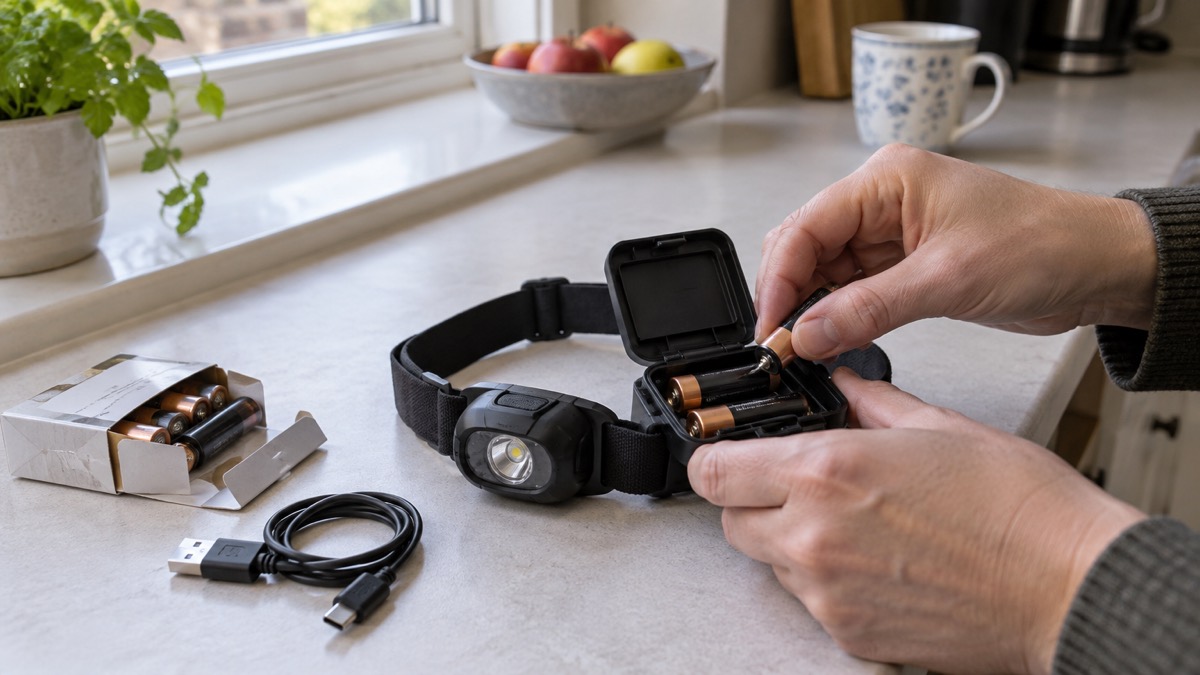
When the power goes off, the first thing you need is light that you can find and switch on without fumbling. A head torch does one job better than any other light: it points where you look and leaves both hands free, which is exactly what you want on the stairs, in the kitchen, or when you are helping someone else in the dark.
Fire and rescue services across the UK are consistent on this point: keep torches and batteries in an easy to find place1, and choose torches or battery-powered lights rather than candles when you are without power2. A head torch is simply the most practical form of that advice for anything you need to do with your hands.
Keep a head torch where you can find it in the dark
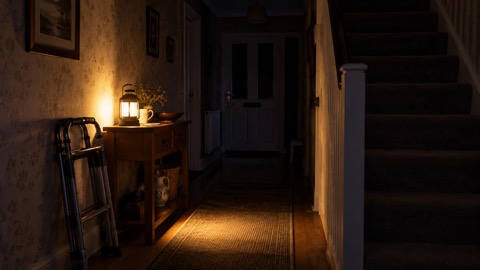
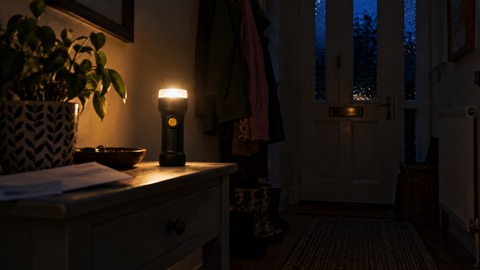
The Scottish Fire and Rescue Service's power cut advice is short and direct: keep torches and batteries in an easy to find place1. Anglesey Council's winter readiness advice adds the reason a torch earns its place: leave it somewhere you can access easily so you can use it to check the fuse box and make your way around the house safely8. Wiltshire and Swindon Prepared puts it the same way: have a torch to hand, know where it is located in your home and how you could easily put your hands on it9.
A head torch earns its keep at the moment the lights go out because you can put it on and then forget about it. You are not carrying it, balancing it on a shelf or holding it in your teeth while you carry a child or open a cupboard. That matters most in the first minutes of a cut, when you are moving through an unfamiliar dark house.
Where you keep it is as important as owning it:
- Keep a torch handy, in case you are without power during the night1
- Make sure everyone in the home knows where the torches and spare batteries are kept10
- Keep a torch handy in case you are without power during the night, and check that the batteries are working, with a spare set to hand9
- If a power cut happens during daylight hours, turn one light switch on, so you know when the supply comes back if the outage continues into the evening11
If you are comparing a head torch with a handheld torch or a lantern, our page on torch or head torch for a power cut sets out what each does best, and where to keep torches so you can find them in the dark covers storage places in more detail.
Choosing a head torch: brightness, beam and battery life
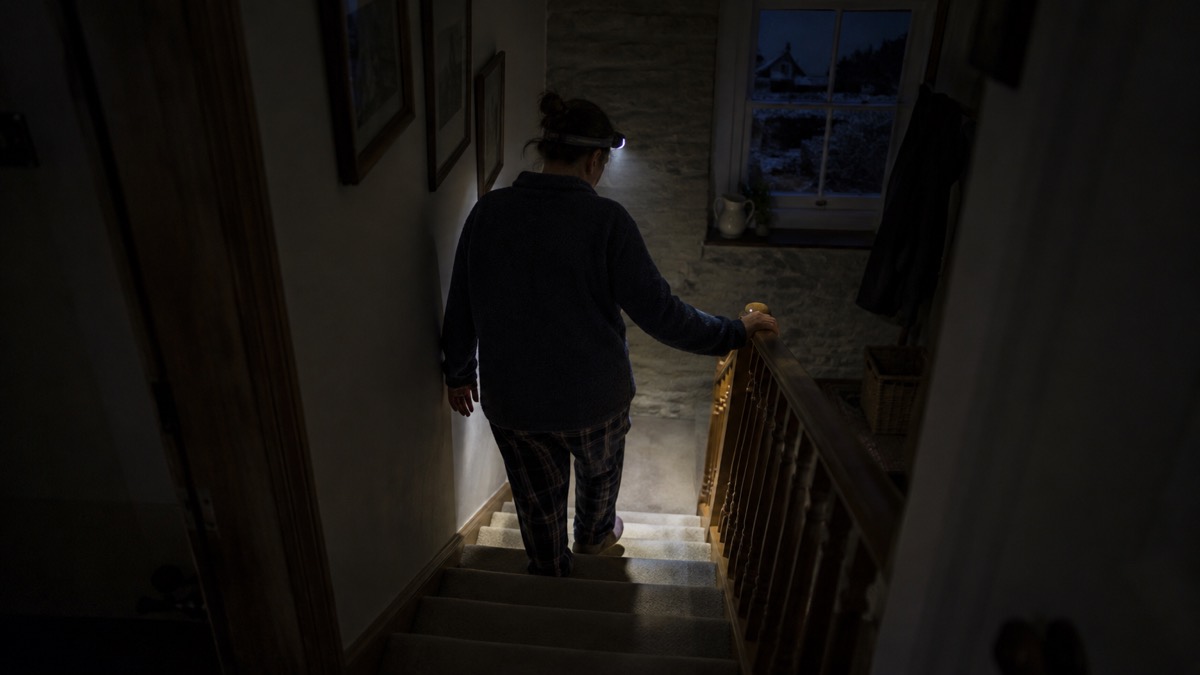
What separates a useful emergency head torch from a disappointing one is not the brightest beam on the box. It is whether the torch still works when you pick it up months later, whether it has a low mode that lasts, and whether it fits comfortably enough that you forget you are wearing it.
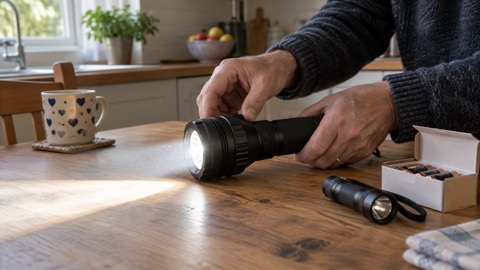
Brightness is measured in lumens, and makers list a figure for each mode. Ledlenser's H8R 25th Anniversary Edition rechargeable head torch, for example, is listed by the maker at 10 lumens on its low power mode12. On that setting the maker states a 20m beam and a 120-hour runtime12. Our page on lumens, beam distance and run time explains how these numbers relate to each other.
What to weigh up when you compare models:
- Modes: more than one brightness setting lets you drop to a low mode that sips power during a long outage
- Red light mode: preserves night vision and is less disruptive to others in the room13
- Fit and adjustment: an adjustable strap that stays comfortable matters if you may wear it for an hour or more
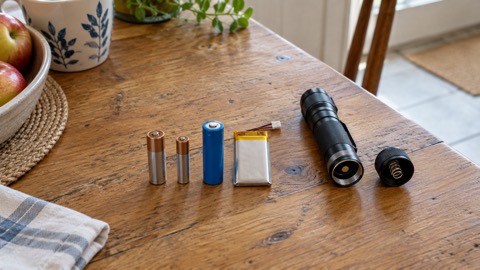
- Battery type: rechargeable, disposable, or a model that takes both13
- Water resistance: the maker of the HF4R PRO states it carries an IP67 rating, full dust protection and water resistance to submersion up to 1 metre13
SP Energy Networks, the electricity network operator, adds a practical point about the wider household kit: keep a torch with charged batteries or a wind-up dynamo torch within easy reach, and note that you can also buy battery-powered lights that plug into a power socket and come on automatically during a power cut14. Those plug-in failure lights are a good companion to a head torch rather than a replacement for one: they light a room, while the head torch lights whatever you are actually doing. Our power failure lights and rechargeable emergency bulbs page covers those.
For the general background on torch types, see torches: types and how to choose one for home.
Rechargeable or standard batteries: how each one behaves
This is the choice that decides how your head torch behaves in a real outage, and the honest answer is that each has a weakness.
A rechargeable head torch is convenient right up until it has sat uncharged in a drawer for six months. Its strength is that you top it up from a USB socket, and many people find that easier than buying batteries. Its weakness is that if it is flat when the power goes, and the outage is already underway, you cannot charge it. That is why storm advice is to charge mobile phones, power banks and any back-up batteries for medical equipment before or when a storm is forecast, in case there is a power cut4, and why the advice if you rely on your phone's torch is to make sure your phone is fully charged before you go out15.
A standard-battery head torch is the opposite: it will still work after years in a drawer, provided you have fresh batteries, but only if you actually have them. Wiltshire and Swindon Prepared's advice is blunt on this: make sure you have spare batteries if the torch is battery operated9. The Met Office's winter checklist carries "torch and spare batteries" as a single item16, and the Norfolk and Suffolk NHS winter advice is to keep a charged power bank, a torch and spare batteries at home17.
Some models take both. Ledlenser states its HF4R PRO operates with both a rechargeable battery, included, and disposable batteries via a Connect Adapter, charging over USB-C, so, in the maker's words, "you're never left without light when it matters"13. A dual-source model is one way to hedge the weakness of each type, at the cost of carrying the adapter.
| Rechargeable | Standard batteries | Dual (rechargeable plus adapter) | |
|---|---|---|---|
| Ready after months in a drawer | Only if kept charged | Yes, with fresh spares | Yes, via disposable batteries |
| Topping up | USB socket, at home | Buy and store spares | Either |
| Weakness | Flat battery with no power to charge | No spares when shops are shut | Must keep the adapter with it |
| Official advice | Charge before storms4 | Keep spare batteries9 | Maker's stated design13 |
If you want to go further on the battery question, rechargeable or battery torches for emergencies compares the two across torch types, and torch batteries: AA, AAA, 18650 and built-in packs covers the formats themselves.
Charging safely before and after an outage
Charge before the cut, not during it. The UK government's storms guidance says to charge mobile phones, power banks and any back-up batteries for medical equipment in case there is a power cut, before or when a storm is forecast4. Devon and Somerset's advice at the time of Storm Eunice was the same in spirit: safely charge your phone and laptop and check you have batteries for torches in case you have a power cut18.
For households caring for someone with medical equipment, an NHS letter to families of technology-dependent children is specific about head torches: chargeable lamps and head torches are useful to allow your hands to be free for care such as suction, and the letter advises getting these now rather than waiting, because there may be a shortage in the shops in the unlikely event a power outage is announced3. That is the clearest official statement of why a head torch, rather than any torch, is worth having in a caring household.
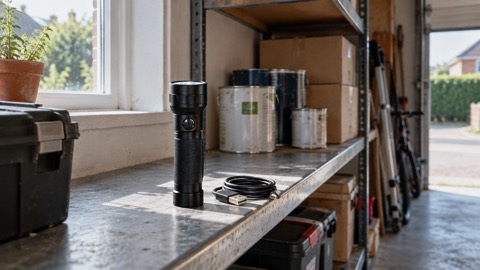
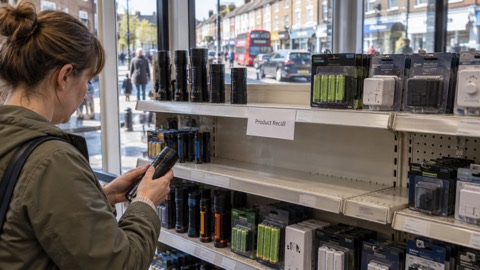
Charging itself needs a little care. Electrical Safety First has published a recall notice covering an 18650 lithium battery charger sold for LED torches and rechargeable torches, described as a black one-slot battery charger with supply cord and three-pin plug19. The lesson for any household is not about that one product: chargers and the lithium cells they feed can fail, so charge on a hard surface, not on bedding or paper, and check whether anything you own has been recalled. Our pages on charging and storing rechargeable torches safely and recalled and unsafe torches and chargers go into this in detail.
A routine that keeps you ready:
- When a storm or severe weather warning is issued, charge phones, power banks and back-up batteries4
- Keep a torch handy in case you are without power during the night9
- When a storm is forecast, charge mobile phones, power banks and any back-up batteries for medical equipment in case there is a power cut4
- Keep a torch with charged batteries or a wind-up dynamo torch within easy reach16
Keep lights away from curtains, paper and bedding
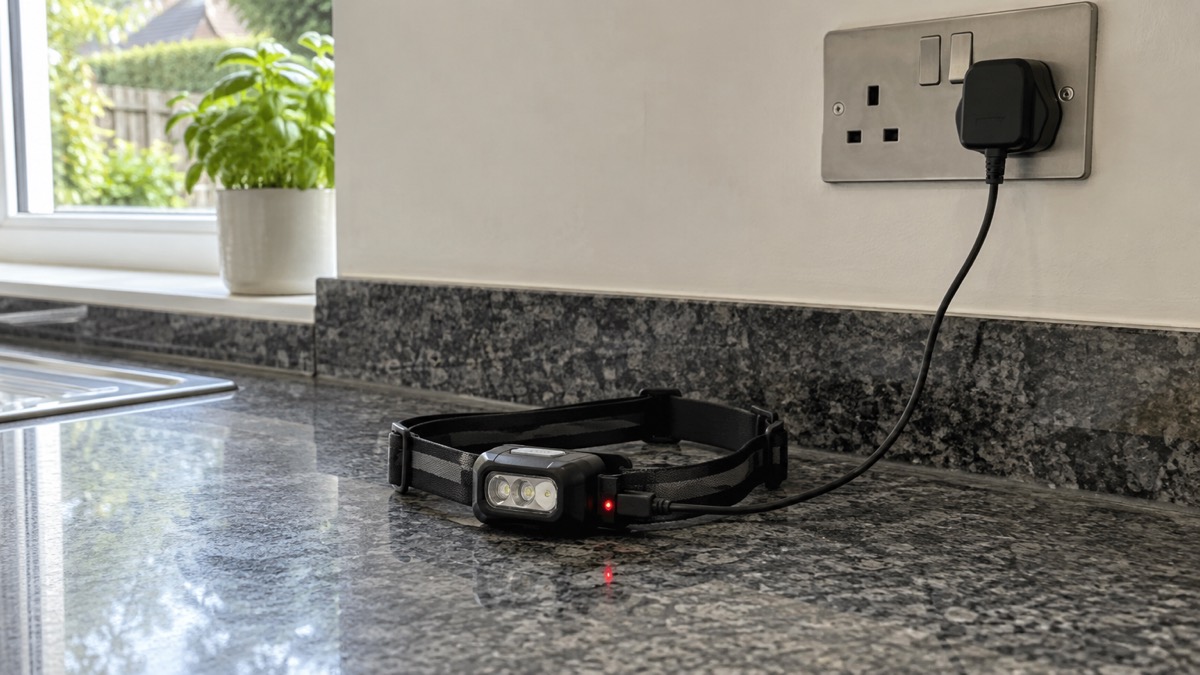
This section is about the lights that burn: candles, tea-lights, incense and oil burners. If you use none of them, your head torch makes the whole question moot, but many households do, and the fire services' warnings are consistent across the UK.
Candle safety advice is to keep candles away from curtains, papers, open windows and draughts, try not to move candles while they are lit, and make sure candles are out before you leave a room or go to bed20. The same advice covers candles, incense sticks and oil burners: keep them away from curtains, clothing and furniture, always stay in the room while the flame is lit, and make sure the flame is out before you go to bed21. On tea-lights specifically, keep them away from flammable objects such as curtains and paper22.
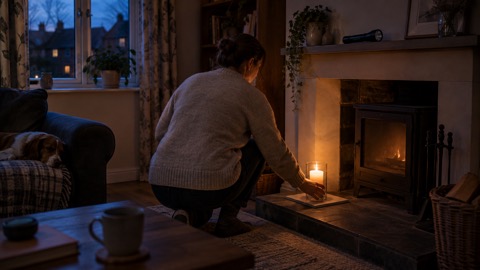
The practical alternative is the whole point of this page. Devon and Somerset Fire and Rescue Service, reporting a worrying increase in fire risks during power cuts, asks households to choose torches or battery-powered lights rather than candles if they need to light their home without power2. Devon and Somerset's general home fire safety advice goes further: it is safest to avoid using candles at all and choose safer alternatives such as battery-powered lights24. If you do keep candles in the house, our candle fire safety page and candle safety checklist cover the full set of precautions.
Why candles are riskier than a head torch
Official preparedness advice for the public is to keep some basic supplies at home, including a torch and batteries, which is safer than candles, and a wind-up radio to get updates during a power cut25.
The National Risk Register's preparedness advice for the public is to keep some basic supplies at home such as bottled water, a torch and batteries, which is safer than candles, and a wind-up radio to get updates during a power cut25. Devon and Somerset's severe weather advice is to use a standing electric torch or battery-powered lights in a power cut, because candles are a fire risk26. Wiltshire and Swindon Prepared's guidance acknowledges that candles can be used but that they present a fire hazard, so it is best to stick with torches9.
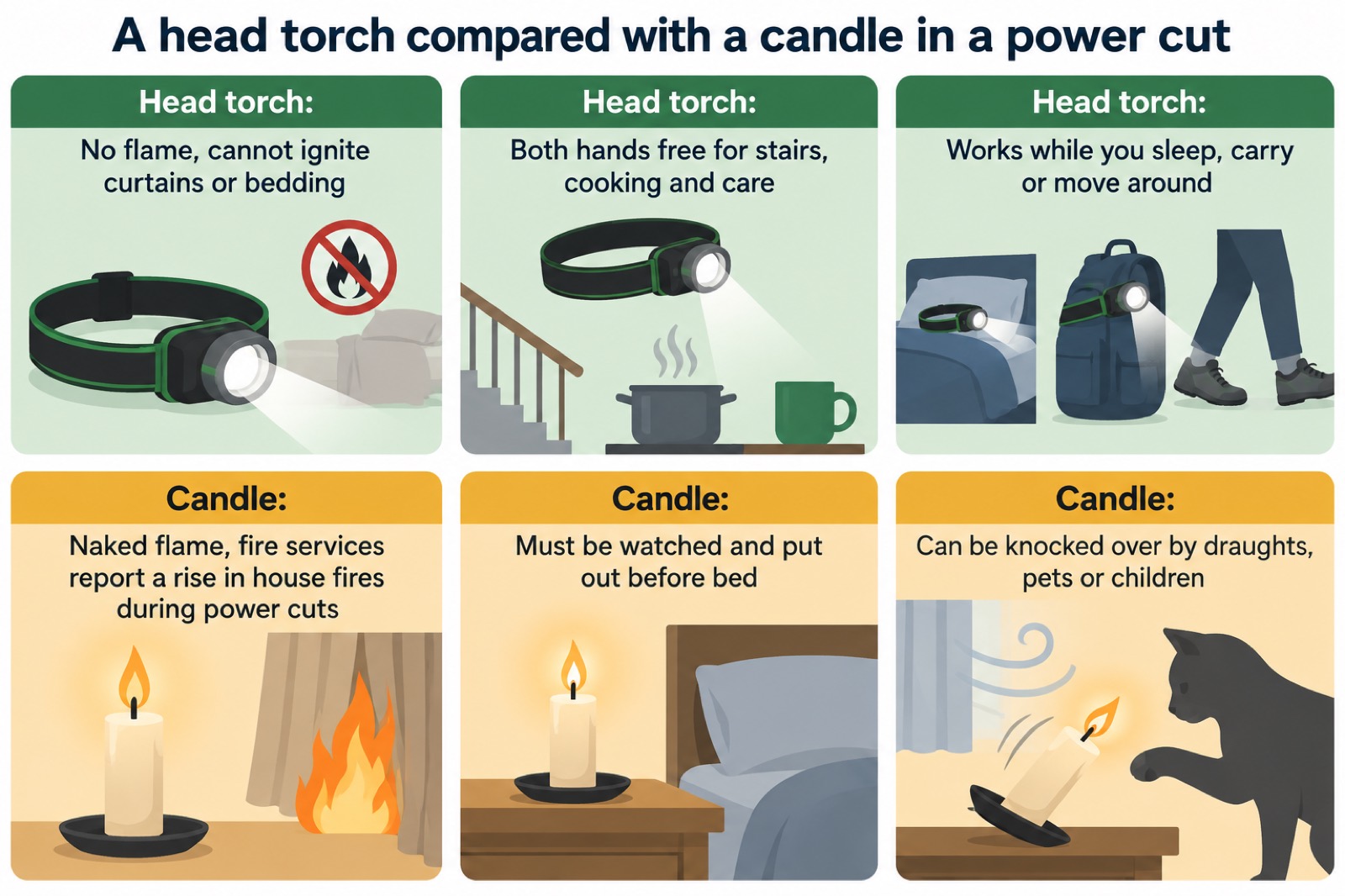
A head torch removes the flame from the room entirely: it cannot be knocked over by a draught, a pet or a child, and it cannot set bedding alight while you sleep. That is why the advice is to use a torch rather than candles during a power cut25.
There are seasonal versions of the same warning. Devon and Somerset's Halloween advice is to use battery-powered tea lights instead of candles in decorations such as pumpkins, because it reduces fire risk27, and the Northern Ireland Fire and Rescue Service advises parents to provide children with a torch or glow stick as part of their costume28. If you are weighing the two options in detail, LED candles or real candles: which is safer? compares them directly.
Register your torch so you hear about safety recalls
Electrical products, including torches and their chargers, are recalled when a fault is found, and households that never registered the product often never hear about it. Electrical Safety First's recall notice for an 18650 lithium battery charger sold with LED torches and rechargeable torches is a working example of how these faults surface19.
The official habit to copy comes from fire service advice on portable heaters: register the heater when you purchase it, so you will be made aware of any product recalls7. The same logic applies to a head torch or its charger. Keep the receipt, fill in the maker's registration card or online form, and check the recall pages from time to time.
What to do:
- Register the product with the maker when you buy it, so recall notices reach you7
- Check Electrical Safety First's product recall listings for torches and chargers you already own19
- If a charger or battery shows damage, heat or a strange smell, stop using it and check whether it has been recalled19
- Report a power cut, or get information about one, by calling 105, the free UK-wide power cut number6
Our recalled and unsafe torches and chargers page explains how to check and what to do if something you own is on a list.
Using a head torch outdoors, in the car and in bad weather
A head torch kept for power cuts will also earn its keep outside the house, and official winter advice treats torches as part of a wider kit rather than a single indoor item.
The Met Office's winter car kit advice states that a large torch with spare batteries, or a wind-up torch which does not require battery power, is essential for your vehicle29. The Scottish Government's ready campaign emergency kit includes a battery-operated torch and spare batteries, or a wind-up torch30. If you keep a head torch in the car, remember that cold affects batteries, so check it before winter and keep the spares somewhere warmer than the boot.
In severe weather, follow the wider official advice: North Yorkshire Fire and Rescue Service, during an amber warning for Storm Debi, advised drivers to use dipped headlights31, and the Northern Ireland Fire and Rescue Service, ahead of Storm Éowyn, told households to be prepared for a power cut by having a torch or battery operated candles ready32. Our page on what IPX ratings mean for torches and lanterns explains the rating system.
For walking in the dark with children, the same advice as Halloween applies year round: give children a torch or glow stick rather than a flame28. Our page on torches, candles and children: keeping them safe covers the household arrangements.
What to do when the power actually goes off
Everything above is preparation. When the cut happens, the sequence is short.
- Use the torch to check on the fuse box and make your way around the house safely33
- Leave one light switched on so you know when the power returns; if the cut began in daylight, this matters even more if it continues into the evening11
- Use a torch rather than candles for lighting during the cut, and a wind-up radio to get updates25
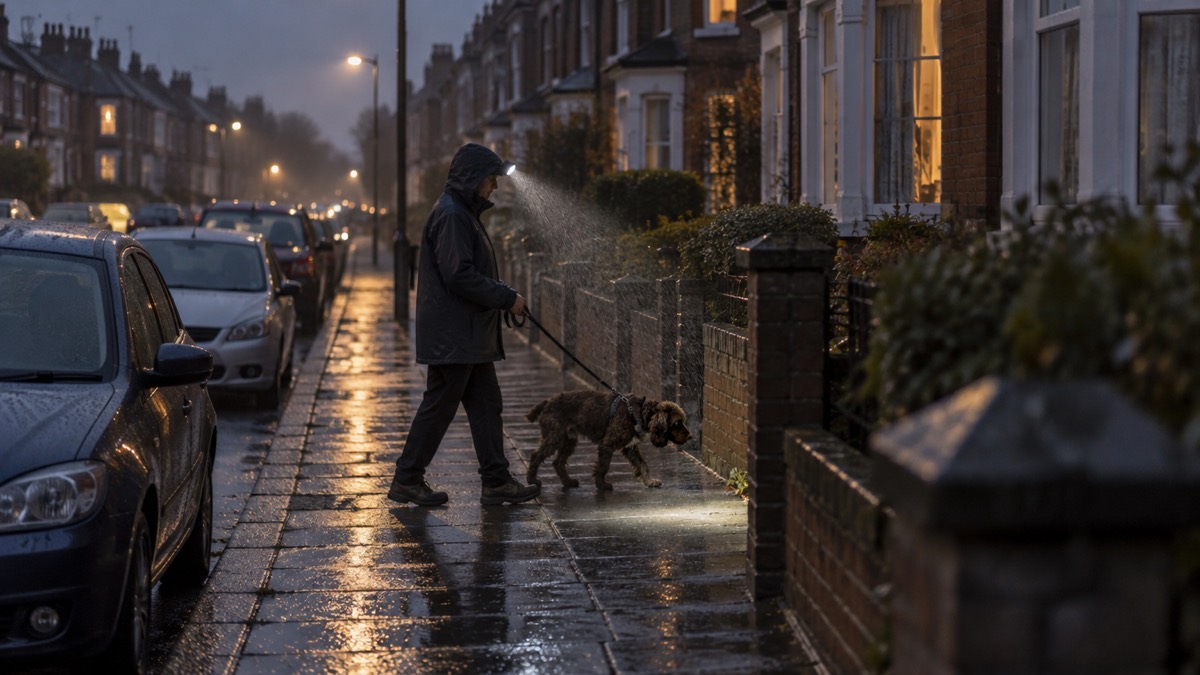
The government's preparedness campaign for power cuts recommends keeping a battery or wind-up torch, and spare batteries, at home, alongside a wind-up radio to get updates25. A head torch covers the lighting part of that kit; a battery or rechargeable lantern covers lighting a whole room for a family sitting out an evening outage, and our power cut checklist pulls the whole household kit together.
For households that include older or disabled people, who may not be able to reach a torch stored on a high shelf or manage a fiddly strap, see lights for older and disabled people in a power cut, and consider asking your fire service about a free home fire safety visit.
Sources (33)
- Power cuts: safety advice, Scottish Fire and Rescue Service
- Fire service sees worrying increase in carbon monoxide incidents and fire risks due to power cuts, Devon and Somerset Fire and Rescue Service, 2022-02-20
- Parental letter re power shortages, NHS, 2022-11-25
- Storms: be informed about hazards, UK government preparedness campaign, 2026-10-19
- Power cuts: be informed about hazards, UK government preparedness campaign, 2026-10-21
- Adverse weather events, Llangattock Community Council, 2026-10-25
- Stay warm safely this winter, Devon and Somerset Fire and Rescue Service, 2026
- Winter ready, Anglesey County Council, 2026-10-25
- How to prepare for the loss of electricity, Wiltshire and Swindon Prepared, 2026-10-25
- 12 tips to prepare for a power cut, Horsted Keynes Parish Council, 2026
- Strong winds and heavy rain warning: information and advice, nidirect, 2026-01-27
- H8R 25th Anniversary Rechargeable Head Torch | 600 lumens, ledlenser.co.uk
- HF4R PRO rechargeable head torch 2026, 650 lumens, Ledlenser, 2026-10-25
- Being prepared for a power cut, SP Energy Networks, 2026-10-26
- WeatherReady weather hacks, Met Office, 2026-10-26
- WeatherReady winter poster, winter 2026, Met Office, 2026
- Be prepared for winter emergencies, NHS Norfolk and Suffolk, 2026-10-01
- Storm Eunice: how you can stay safe, Devon and Somerset Fire and Rescue Service, 2022-02-17
- 18650 lithium battery charger for LED torch: recall notice, Electrical Safety First, 2022-06
- Student fire safety, South Wales Fire and Rescue Service, 2026-09-08
- Easy read fire safety booklet, London Fire Brigade, 2026
- Candle safety, Scottish Fire and Rescue Service, 2024-06-12
- Heating and gas, Scottish Fire and Rescue Service, 2024-11-21
- Top ways to reduce your risk of having a fire at home, Devon and Somerset Fire and Rescue Service, 2026
- National Risk Register, Cabinet Office, 2020
- Safety in severe weather conditions, Devon and Somerset Fire and Rescue Service, 2026
- Safety during Halloween, Devon and Somerset Fire and Rescue Service, 2026-10-14
- Don't let fire turn your Halloween into a nightmare, Northern Ireland Fire and Rescue Service, 2026-10-21
- Winter car kit, Met Office, 2026-10-25
- Emergency kit, Scottish Government ready campaign, 2026-10-22
- Amber warning in place as Storm Debi hits North Yorkshire, North Yorkshire Fire and Rescue Service, 2023-11-13
- NIFRS Storm Éowyn operational incident update, Northern Ireland Fire and Rescue Service, 2025-01-24
- national-grid-homeowner-preparing-for-a-power-cut.pdf, National Grid Electricity Distribution
 Spare Batteries for Lights
 Candle Safety Checklist
 Lighting Checks Before Winter
 Lighting Home in a Power Cut
 Choosing a Torch for Home
 Lanterns for Lighting a Room
 Emergency Bulbs
 Solar and Wind-Up Lamps
 Lumens and Beam Distance
 Torch Batteries Explained
 Charging and Storing Torches
 Candle Fire Safety at Home
 Lights for Disabled People
 Torches, Candles and Children
 Recalled Torches and Chargers