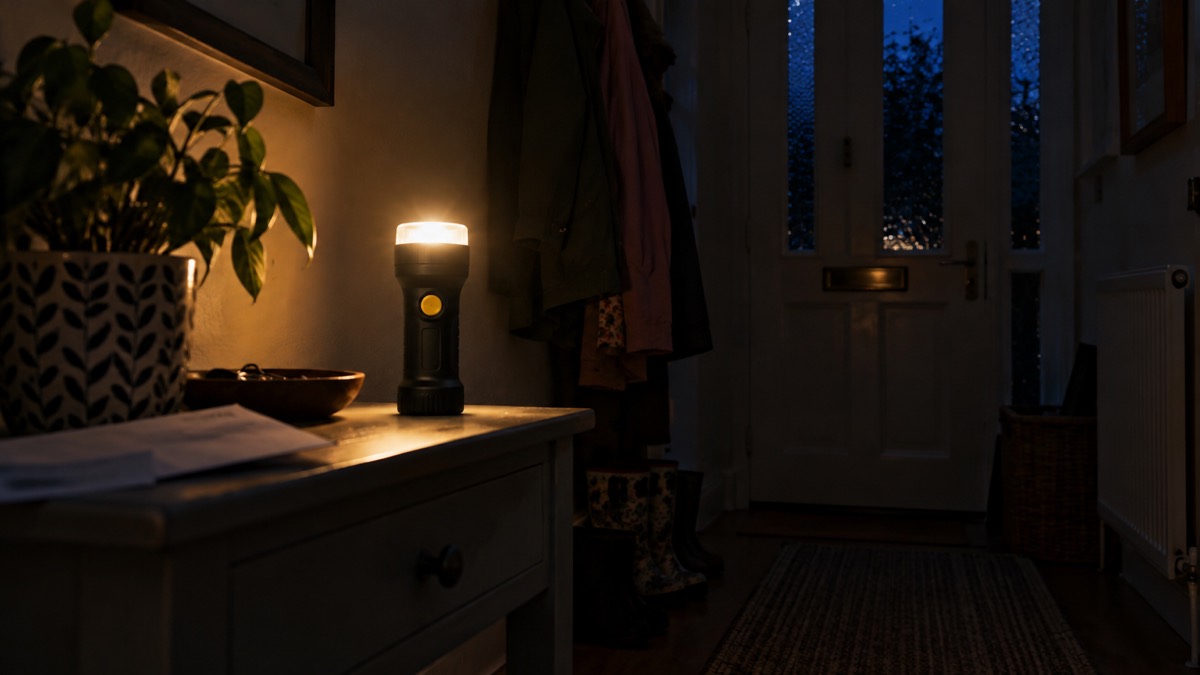
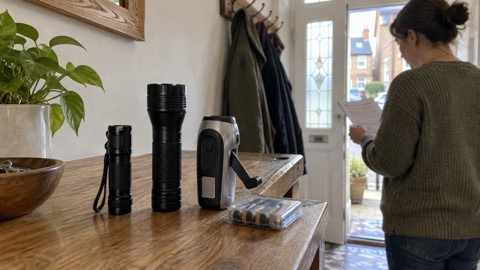
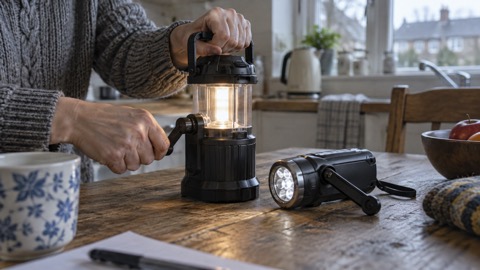
When there are children in the house, the safest light in a power cut or an emergency is not a candle. Government preparedness guidance is blunt about it: keep a battery or wind-up torch, and spare batteries, at home, because torches are safer than candles1. The same message runs through the Be Ready checklist2 and through fire service advice across the UK, which goes further and says the safest way to enjoy candles at all is to use LED battery-operated ones instead, making sure the batteries cannot be accessed by children or pets3.
This page brings together what fire and rescue services, the NHS and child safety charities say about children and lighting: which lights to choose, where lit flames must never go, how to keep the button batteries inside small lights away from small children, and exactly what to do if a child is burned or swallows a battery. The two emergencies at the end are the ones to read now, before you ever need them: cool a burn under running water for at least 20 minutes, and take a child who may have swallowed a button battery straight to A&E.
Battery tea lights and torches are safer than candles around children
Every fire and rescue service that has published guidance on this reaches the same conclusion. Devon and Somerset Fire and Rescue Service says it is safest to avoid using candles at all and to choose safer alternatives such as battery-powered lights8. The National Fire Chiefs Council's cost of living toolkit lists LED candles and lights, and battery or wind-up torches, as the products that are safer to light your home9. North Yorkshire Fire and Rescue Service recommends battery-operated candles in pumpkins and lanterns because they are much safer than traditional candles10, and Devon and Somerset's Halloween advice is to use battery-powered tea lights in decorations to reduce fire risk11.
The reason is simple: a battery light cannot set fire to a costume, a curtain or a child. Fire and rescue services warn that every year many adults and children are injured when lit candles come into contact with costumes and wigs12, and children's Halloween and dressing-up costumes are a particular concern around any naked flame. Scottish Fire and Rescue Service says battery-operated candles are the safest way to light up scary things at Halloween12, and North Yorkshire Fire and Rescue Service advises considering battery-oper lights within homemade lanterns and pumpkins because they are much safer than candles13.
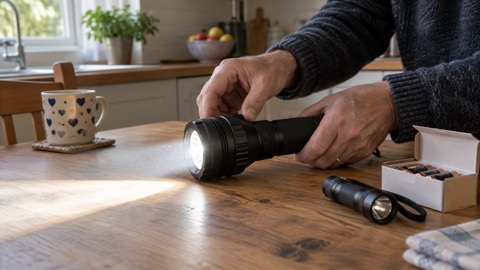
For everyday preparedness, the choice is between a torch a child can hold, a lantern that lights a room, and battery tea lights for decorations:
| Light | What it does | Who it suits |
|---|---|---|
| Battery or wind-up torch | Lights one person's way; safer than candles1 | Every household; children can carry their own |
| LED lantern | Lights a whole room without any flame9 | Families with young children at bedtime |
| Battery tea lights and LED candles | Give candle-like light in pumpkins and decorations with almost no fire risk10 | Halloween, Christmas and celebrations |
If you are choosing a torch for a child to use themselves, look for one where the battery compartment needs a screwdriver or a firm twist to open, and keep spare batteries stored away from small hands. Our pages on torches, lanterns and battery tea lights in pumpkins go into the choices in more detail, and LED candles or real candles compares the two side by side.
Where candles and lit flames must never go when children are in the house
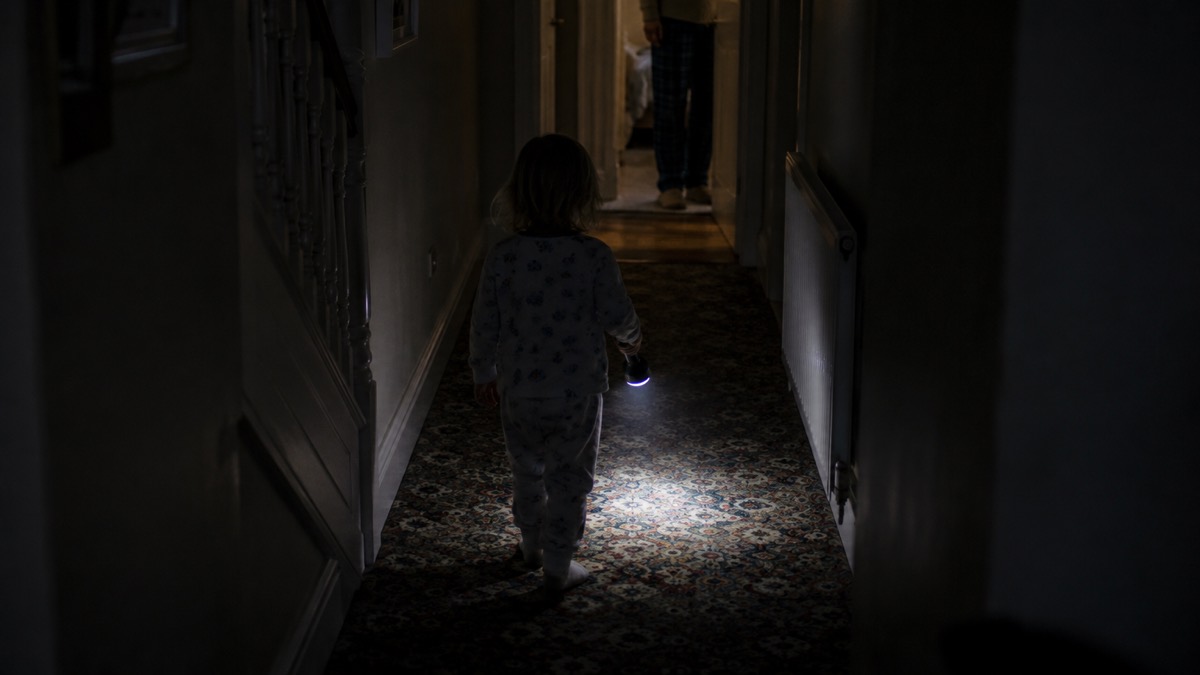
If you do use real candles, the rules from fire and rescue services are consistent and strict. South Wales Fire and Rescue Service says children should never be left alone with lit candles4. North Yorkshire Fire and Rescue Service says the same: never leave children or pets alone in a room with lit candles10. North Yorkshire's Halloween advice adds that you should put candles out when you leave the room, and make sure they are put out completely at night13.
The Northern Ireland Fire and Rescue Service says never leave burning candles unattended, always extinguish them before going to sleep and be sure the wick ember is no longer glowing, never burn a candle on or near anything that can catch fire, and never use a candle as a nightlight14. Wiltshire and Swindon Prepared adds the basics of placement: put candles in a holder and keep them away from things that may burn15.
Around children, the rules extend to the things that light the candle as much as the candle itself. NHS guidance on preventing burns and scalds in children says to keep matches, lighters and lit candles out of young children's sight and reach16. The Northern Ireland Fire and Rescue Service warns never to let children play with matches or cigarette lighters, to teach children not to play with fire, and to keep matches and lighters where children are not tempted to play with them14. Devon and Somerset Fire and Rescue Service says to teach children never to play, or leave toys, close to a fire or heater17.
A short checklist for any household that uses real candles:
- Never leave a child alone in a room with a lit candle10
- Put candles out when you leave the room, and completely at night13
- Never use a candle as a nightlight14
- Keep candles in a holder, away from anything that can burn15
- Keep matches and lighters out of young children's sight and reach16
- Keep toys away from fires and heaters17
The same caution applies to sparklers, which are lit flames in children's hands. The Northern Ireland Fire and Rescue Service says to keep children away from any naked flames, including sparklers18, and to ensure children hold sparklers at arm's length with an adult lighting them18. Its safety appeals say never give sparklers to children under 5 because they will not understand how to use them safely19, and North Yorkshire Fire and Rescue Service says always to supervise children with sparklers21. Sparklers burn at very high temperatures, and to a young child the heat is equivalent to a welding torch20.
If your household uses candles regularly, our candle safety checklist and the page on candle fire safety at home cover the full set of precautions, and many fire and rescue services offer a free home fire safety visit you can request.
Button cells in small lights and torches: keeping them out of reach
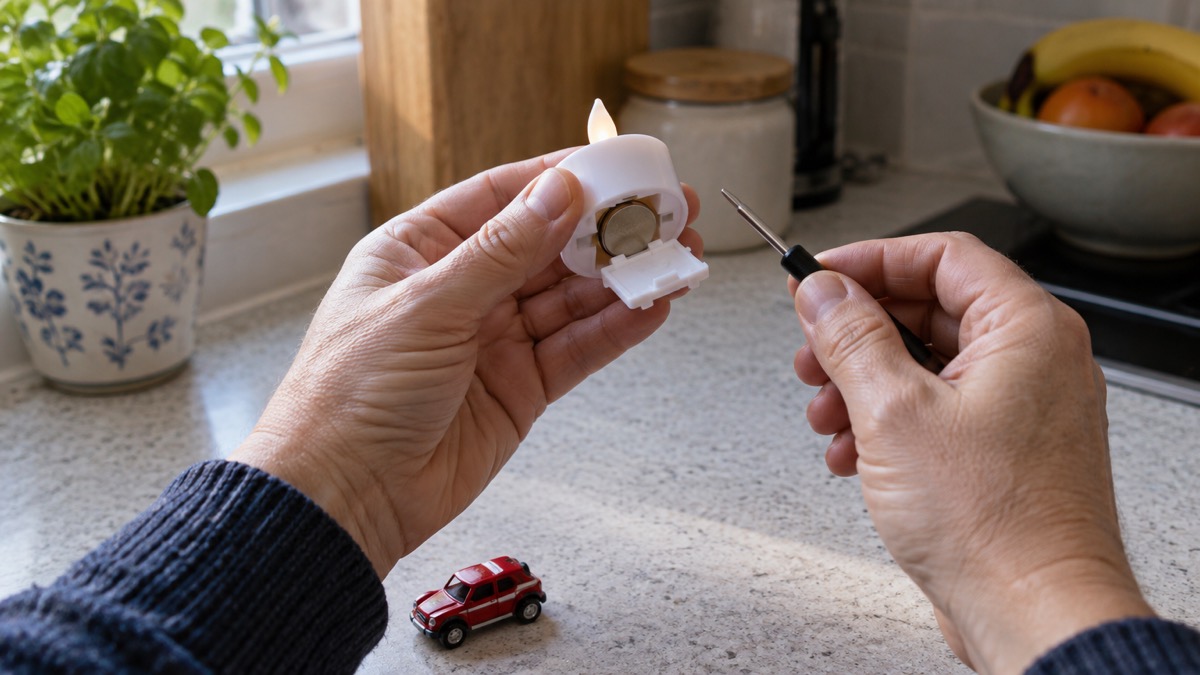
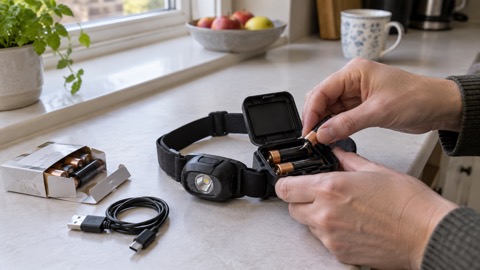
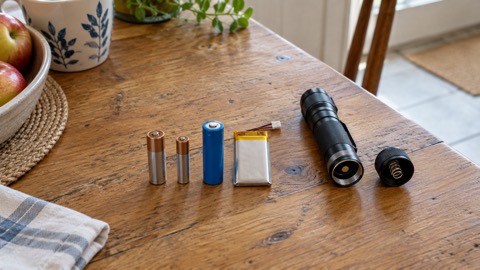
The batteries that power small lights, tea lights and novelty torches are often button cells, and they are a serious hazard to small children. An NHS safety notice lists the places a child can find button batteries: toys where the battery compartment is not secured, string lights and nightlights, small remote controls, car key fobs or key finders, musical cards and books, light-up toys and novelty items, and digital scales and thermometers22. Battery tea lights, glow wands and small torches bought for children sit squarely in that list.
The NHS advice is to keep products well out of your child's reach if the battery compartment is not secured22. Great Ormond Street Hospital adds a rule for storage: keep new batteries in their original blister packaging, out of the sight and reach of children23. That applies to the spare coin cells you keep for your torches and tea lights as much as to the ones inside them; our page on storing spare coin cell batteries safely with children covers this in detail.
When you buy a light for a child to use, check the battery compartment before anything else. A compartment that needs a screwdriver, or a firm simultaneous press-and-turn, is what you want. A back that pops off with a thumbnail is not, however good the light itself is. The National Fire Chiefs Council also warns about where you buy: online marketplaces do not have to adhere to the same safety standards as high street retailers, so buy from the websites of brands you trust9. A cheap light from an unknown seller is more likely to have an insecure compartment and no safety marking.
If a child swallows a button battery: go to A&E straight away
This is the one emergency on this page where minutes matter, and every NHS source gives the same instruction.
NHS first aid guidance for parents says if your child swallows a button battery or magnet, or you think they may have swallowed one, call 999 or take them to A&E straight away6. Alder Hey Children's Hospital says the most important thing to do is get your child to A&E as soon as possible24. If you suspect your child may have swallowed a battery but you are not sure, Alder Hey says you can call NHS 111 for advice24. Great Ormond Street Hospital says the same: if you suspect your child has swallowed a button battery, take them to your nearest A&E department as quickly as possible23.
At hospital, the doctors will usually x-ray your child to locate the button battery and estimate its size. The local hospital may try to remove the battery by passing an endoscope down the child's throat to grasp and pull it up, usually while the child is under general anaesthetic23. Knowing this in advance helps: it is a routine procedure for the team, and the important part is getting there quickly.
The steps, in order:
- If you know or suspect your child has swallowed a button battery, do not wait to see if symptoms develop6.
- Take them straight to A&E, or call 999 for an ambulance22.
- If you are unsure whether anything was swallowed, call NHS 111 for advice24.
- Tell the hospital what kind of battery it was, and bring the packet or a matching battery if you can safely do so23.
Because the batteries inside flat or spent lights are still a swallowing risk, do not leave old coin cells in a drawer a child can reach; our page on whether flat button batteries are still dangerous explains why.
First aid for a burn or scald: cool for 20 minutes
A burn is caused by dry heat, from an iron, hair straighteners or a hot radiator. A scald is caused by something wet, such as a hot bath or cup of tea. The NHS is clear that both should be treated in the same way7, and NHS guidance elsewhere adds that burns can also be caused by electricity or chemicals, and scalds by hot liquids or steam25.
Cooling is the first thing to do, and the instruction is the same in every source here: cool the burn under cool running water for at least 20 minutes26. NHS first aid guidance for children says to put the burn or scald under cool running water for 20 to 30 minutes to reduce the heat in the skin6. NHS 111 Wales says to cool the burn with cool or lukewarm water for 20 minutes27, and the Northern Burn Care Network says to place the affected area in cool water or under a gently running cold tap for at least 20 minutes28. Maidstone and Tunbridge Wells NHS Trust says simply: cool the affected area immediately with cool running water for at least 20 minutes5.
After cooling, cover the burn. NHS 111 Wales says to cover the burn by placing a layer of cling film over it, and a clean plastic bag could also be used for a burn on the hand27. If the face or eyes are burnt, sit your child up as much as possible, because this helps to reduce swelling7.
What not to do matters as much as what to do. NHS guidance for children says: do not use ice, iced water, or any creams or greasy substances such as butter, and do not put your child in a cold bath7. Old folk remedies, butter, toothpaste and creams can trap heat in the skin and make the injury worse; cool water and cling film are all the burn needs before you get help.
For minor burns, keep the burn clean and do not burst any blisters that form30. Burns can be very painful and may cause red or peeling skin, blisters, swelling, or white or charred skin16.
When a child's burn needs a doctor, 111 or 999
The rules for getting help are clear and consistent across NHS sources, and they are stricter for young children than for adults.
Call 999 or go to A&E if the burn is very large or deep, is on the face, genitals or bottom, or has been caused by acid or a chemical, or by electricity25. Healthier Together gives the same list for children and says to get urgent help in those circumstances26. Maidstone and Tunbridge Wells NHS Trust says to call 999 for emergency assistance immediately for chemical burns5, and NHS 111 Wales says if it is an acid or chemical burn, dial 99927.
For anything less severe, the route depends on how worried you are. The Northern Burn Care Network says if in doubt, call NHS 111 or your GP for advice on minor burns, and for more serious burns visit your nearest Emergency Department or dial 999 as soon as possible28. Maidstone and Tunbridge Wells NHS Trust says to call for help depending on the severity: consult a pharmacist, your GP, call 111, or dial 999 in severe cases5.
| Situation | What to do |
|---|---|
| Very large or deep burn, or on the face or bottom | Call 999 or go to A&E25 |
| Burn caused by acid, a chemical or electricity | Call 99927 |
| Child under 5 with any burn or scald | Always seek advice from a health professional7 |
| Minor burn, unsure what to do | Call NHS 111 or your GP28 |
| Child under 10 after a burn | Should get medical attention, as they are at greater risk27 |
Two age rules are worth remembering. NHS guidance for Norfolk says if your child is under 5 and has a burn or scald, always seek advice from a health professional, and call your GP, NHS 111 or 999 to seek medical advice if your child is under 5 or if you are worried7. Cambridgeshire and Peterborough NHS guidance says the same29. NHS 111 Wales adds that people at greater risk from the effects of burns, such as children under 10 years old, should also get medical attention after a burn or scald27.
Small burns and scalds can often be treated at home and can take around 2 weeks to heal25. While healing, the NHS says to take painkillers such as paracetamol or ibuprofen to help with pain25. Burns and scalds can sometimes lead to further problems, including shock, heat exhaustion, infection and scarring27, which is why the under-5 and under-10 rules exist. In hospital, the size and depth of the burn will be assessed and the affected area cleaned before a dressing is applied; in severe cases skin graft surgery may be recommended27.
Hot drinks, pans and heaters during an emergency
Power cuts and emergencies change the routine in a house, and that is exactly when the everyday burn hazards to children get closer to them. Cooking on a camping stove you do not normally use, heating water for bottles, or keeping warm near a heater all need the same supervision as candles.
The Child Accident Prevention Trust reports that almost half of all serious burns are to children under two and 70 per cent are to children under five31. Its practical advice is to look for safe zones in your house where you know your child cannot reach your hot drink31. Cambridgeshire and Peterborough NHS guidance says to keep saucepans at the back of the cooker where possible, and turn the handles out of reach29. NHS guidance also reminds parents to keep matches, lighters and lit candles out of young children's sight and reach16, and to teach children never to play, or leave toys, close to a fire or heater17.
If you are using a heater or any naked flame during a power cut, keep children away from it. The Northern Ireland Fire and Rescue Service says to keep children away from naked flames19, and its Halloween safety appeal says to avoid using a naked flame or candle in pumpkins and to use a torch, glow stick or battery-operated candle instead20.
One piece of teaching is worth practising with children before you ever need it. Scottish Fire and Rescue Service advises having children practise what to do if their clothing catches fire: stopping still, dropping to the ground, covering the face with hands, and rolling over and over to put the flames out12.
Teaching children fire safety at home
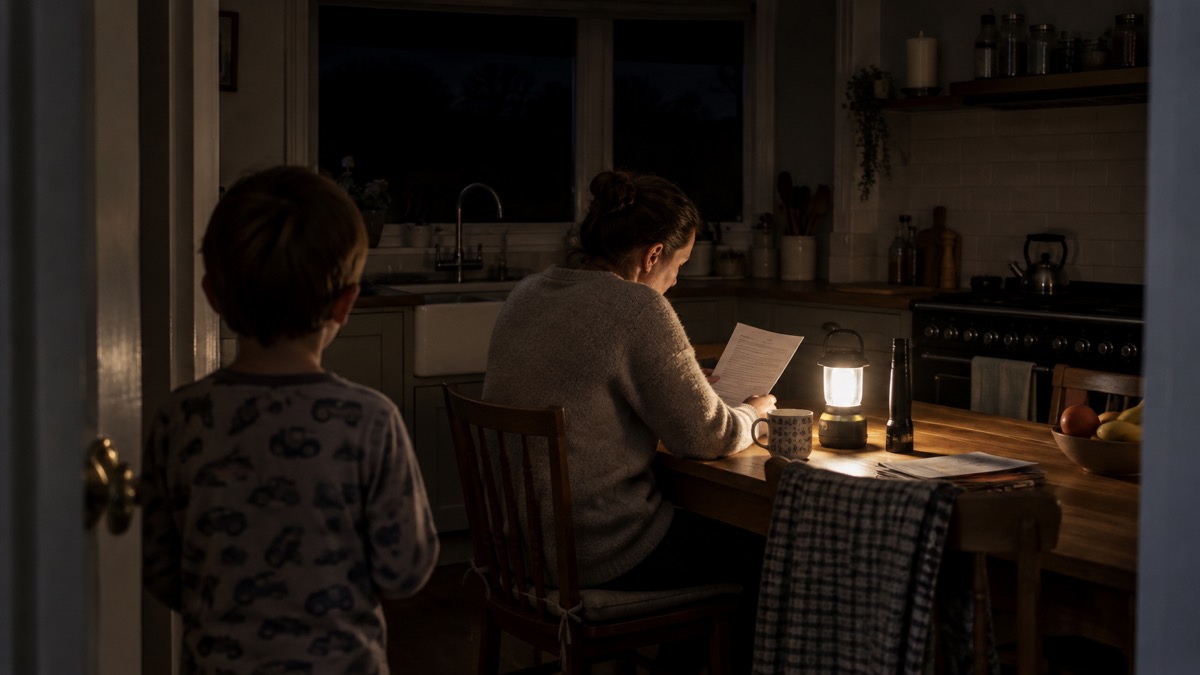
Alongside the physical precautions, fire and rescue services ask parents to teach children what to do around fire. Devon and Somerset Fire and Rescue Service says to explain that fire is not a toy and that it can hurt and cause damage17. Wiltshire and Swindon Prepared teaches children the emergency basics: call 999, ask for the fire and rescue service, and tell them your address, and only call 999 in a real emergency32. It also teaches children never to go back inside for anything, even toys or pets32.
The Government has developed a leaflet for parents and carers on fire safety which contains useful tips33, and it is worth reading with older children. Practising the 999 call, including your address, is something a child of five or six can learn, and it is the piece of teaching that fire services themselves put first.
For the lighting side of preparedness, the habit to build is simple: every child old enough to carry one knows where their torch is, and no child, of any age, has access to matches, lighters or coin cells. Our page on where to keep torches so you can find them in the dark helps with the first half, and the power cut checklist covers the rest of what a household needs ready.
Sources (33)
- Power cuts: be informed about hazards, Prepare (UK government campaign), 2026-10-21
- Be ready for emergencies, Be Ready (UK government campaign), 2026-10-21
- Candle safety advice, Merseyside Fire and Rescue Service, 2026-10-26
- Halloween and bonfire safety, South Wales Fire and Rescue Service, 2026-10-20
- Burns prevention and tips, Maidstone and Tunbridge Wells NHS Trust, 2026-10-25
- What to do if your child has an accident, NHS, 2025-12-18
- Burns and scalds in children, Just One Norfolk (NHS), 2026-10-25
- Top ways to reduce your risk of having a fire at home, Devon and Somerset Fire and Rescue Service, 2026
- Cost of living toolkit, National Fire Chiefs Council, 2022
- Halloween safety tips, North Yorkshire Fire and Rescue Service, 2025-10-24
- Safety during Halloween, Devon and Somerset Fire and Rescue Service, 2026-10-14
- Halloween candle safety, Scottish Fire and Rescue Service, 2023-10-17
- Safety advice for Halloween, North Yorkshire Fire and Rescue Service, 2019-10-24
- Home fire safety, Northern Ireland Fire and Rescue Service, 2026-10-14
- Cut the risk of fire in your home, Wiltshire and Swindon Prepared, 2026-10-25
- Burns and scalds self help, Andaman Surgery (NHS), 2026
- Talk to your children about fire safety, Devon and Somerset Fire and Rescue Service, 2026
- Don't let fire turn your Halloween into a nightmare, Northern Ireland Fire and Rescue Service, 2026-10-21
- NIFRS issues safety advice to those celebrating Halloween, Northern Ireland Fire and Rescue Service, 2023-10-23
- NIFRS safety appeal: make this Halloween a night for treats not tragedies, Northern Ireland Fire and Rescue Service, 2021-10-25
- Stay safe this Bonfire Night, North Yorkshire Fire and Rescue Service, 2019-10-22
- Button battery safety leaflet, WWL Teaching Hospitals NHS Foundation Trust, 2026-10-25
- Button batteries: using them safely, Great Ormond Street Hospital, 2018-10-01
- What to do if your child swallows a button battery, Alder Hey Children's NHS Foundation Trust, 2022-12-22
- Burns and scalds, NHS, 2026-03-31
- Burns and scalds prevention, Healthier Together (NHS), 2026-10-25
- Burns and scalds, NHS 111 Wales, 2021
- First aid for burns, Northern Burn Care Network (NHS), 2022-03-11
- Burns and scalds, Cambridgeshire and Peterborough NHS, 2026-06-23
- Burns and scalds self help, Victoria Road Surgery (NHS), 2026
- Burns and scalds, Child Accident Prevention Trust, 2026-09-07
- What children should know about fires, Wiltshire and Swindon Prepared, 2026-10-25
- Domestic fire: be informed about hazards, Prepare (UK government campaign), 2026-10-12
 Spare Batteries for Lights
 Candle Safety Checklist
 Lighting Checks Before Winter
 Lighting Home in a Power Cut
 Choosing a Torch for Home
 Head Torches for Power Cuts
 Lanterns for Lighting a Room
 Emergency Bulbs
 Solar and Wind-Up Lamps
 Lumens and Beam Distance
 Torch Batteries Explained
 Charging and Storing Torches
 Candle Fire Safety at Home
 Lights for Disabled People
 Recalled Torches and Chargers