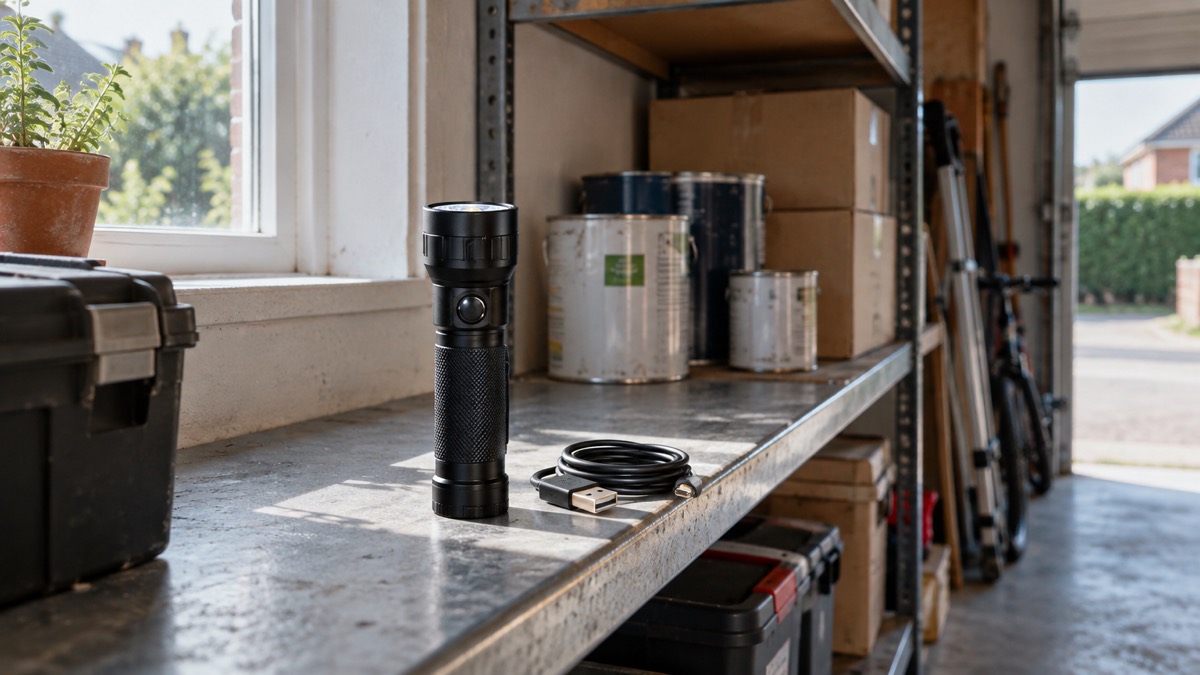
A rechargeable torch is one of the safest and most useful things you can keep for a power cut. The government's power cut advice is to keep a battery or wind-up torch, with spare batteries, at home, because torches are safer than candles1. But the lithium-ion battery inside a rechargeable torch or lantern needs a little care. Fire and rescue services across the UK warn that if a lithium-ion battery is improperly charged, handled, stored or disposed of, there is a risk of overheating, fire or explosion2.
The good news is that the rules are simple. Charge during the day, with the right charger, on a hard surface, where you can see it. Store torches somewhere cool, dry and easy to reach, and keep them topped up. Never put an old battery in the bin. This page sets out what fire services say to do, nation by nation where the advice differs, and what to do if a battery goes wrong.
Where to keep torches and how to store them

Store torches and lanterns somewhere you can reach easily in the dark. Anglesey Council's winter advice is to keep a battery or wind-up torch somewhere you can access easily, so you can use it to check the fuse box and make your way around the house safely6. A parish council power cut guide adds a point that matters for the whole household: make sure everyone in your home knows where the torches are kept, so the nearest person can retrieve them and then safely help others7. If you have children or older people in the house, that shared knowledge is worth more than any extra torch. Our page on where to keep torches so you can find them in the dark goes into this in more detail.
For the battery itself, temperature and damp are the two things to control. The Scottish Fire and Rescue Service advises storing products that use lithium batteries in a cool place, avoiding exposure to extreme heat or cold2. The National Fire Chiefs Council's guidance says the same: store batteries in a cool place, and avoid excessively hot or cold areas8. A drawer in a room that stays reasonably temperate is ideal. Avoid a windowsill in full sun, an airing cupboard, a loft that freezes in winter, or a damp shed or garage.
How much charge to leave in a stored torch depends on the battery, so follow the maker's own instructions. The National Fire Chiefs Council guidance is to follow manufacturer's instructions for the storage and maintenance of lithium-ion batteries if they are not going to be used for extended periods8. That instruction is on the maker's manual or product page for your specific torch. It is worth knowing that advice differs by battery chemistry: the Caravan and Motorhome Club, for example, advises that a leisure battery should be recharged after use and, if the caravan is stored for more than one month, removed and stored fully charged in a cool, dry place9. That is a different kind of battery from the lithium-ion pack in a rechargeable torch, which is exactly why the maker's instructions come first. Our page on torch batteries explains the types you are likely to meet.
Finally, think about where in the home a charging or stored battery sits. The Scottish Fire and Rescue Service advises avoiding keeping lithium-battery products in escape routes or communal areas, because in a fire they could block people from leaving the building safely2. A torch on a hallway landing shelf is convenient, but a landing is an escape route. Charge and store in a room that is not between you and the front door.
Charging safely: the right charger, the right place, the right time
Most lithium-ion battery fires are preventable, and the causes are well known. Devon and Somerset Fire and Rescue Service list overcharging, charging devices on flammable surfaces such as a bed or under a pillow, using batteries that are not recommended by the manufacturer, and exposing them to hot temperatures or water10. Each of those has a simple fix.
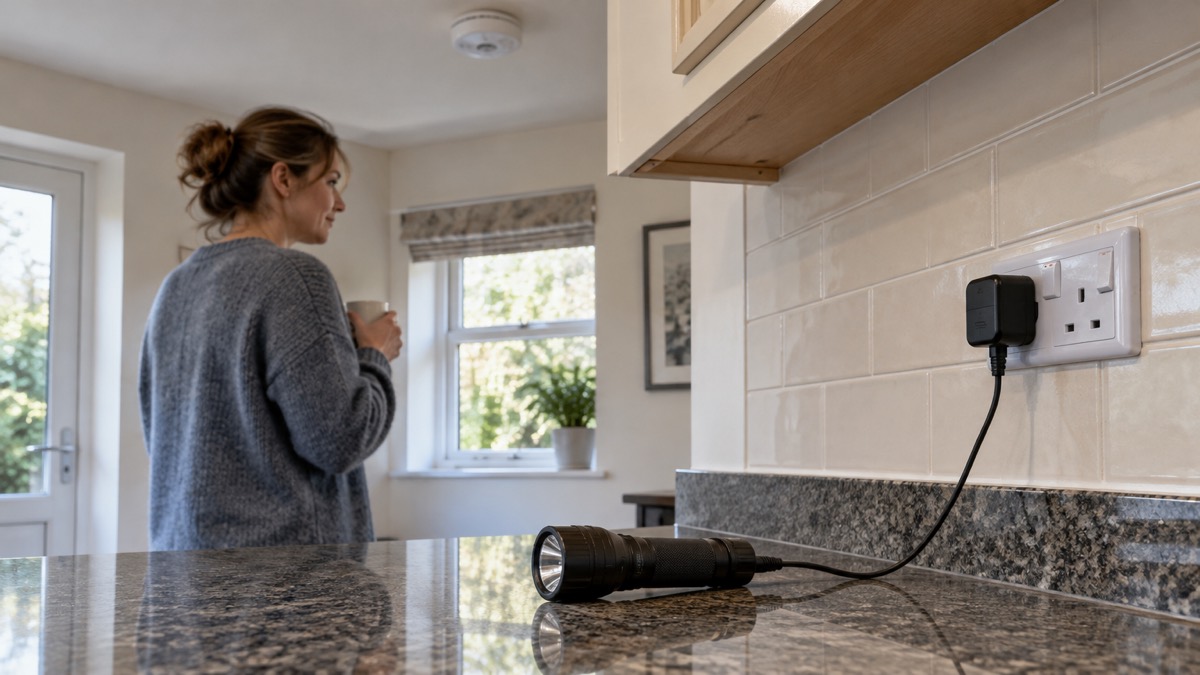
Use the charger that came with your torch. Mid and West Wales Fire and Rescue Service are direct on this: always use the charger that came with your device or a genuine replacement from a trusted supplier4. Cheap chargers and batteries may not meet UK safety standards and can be dangerous4. If the original cable is lost, replace it with a genuine one from a trusted supplier rather than an unbranded substitute.
Charge during the day, while you are awake and nearby. Devon and Somerset Fire and Rescue Service say to charge your devices and equipment during the day, instead of at night while you are sleeping, and to charge them away from escape routes3. Their recycling campaign puts it more bluntly still: never leave batteries unattended while charging and do not charge them overnight10. North Yorkshire Fire and Rescue Service give the same advice for e-cigarette batteries: never leave them unattended whilst on charge, and do not leave them charging for long periods of time11. A torch battery is small, but the same principle applies.
Charge on a hard, non-flammable surface. A kitchen worktop or a table is right; a bed, sofa or under a pillow is not, because charging on flammable surfaces is a known cause of battery fires10. Keep the charging torch away from curtains, bedding and paper.
Use a socket that is RCD protected, in a room with working smoke alarms. Devon and Somerset Fire and Rescue Service advise charging batteries in a safe place from a socket that is RCD protected, and in an area with working smoke alarms3. An RCD is the safety device in your consumer unit or plug that cuts power if it detects a fault. If you are not sure whether your sockets are RCD protected, a qualified electrician can tell you.
Do not charge near anything that can burn. The National Fire Chiefs Council guidance says not to charge batteries or store devices near combustible or flammable materials8. And do not charge or store batteries in direct sunlight or in hot locations12.
If you are choosing between a rechargeable torch and one that takes disposable batteries for emergencies, our comparison of rechargeable and battery torches weighs up the trade-offs, and our page on whether you can use a torch while it charges answers a common question.
Never cover a torch or battery while it charges
This rule is repeated by every fire and rescue service that publishes on the subject, and it is the one people most often break without realising. A torch tucked under a cushion, a charger with a coat thrown over it, a battery pack charging inside a bag: all of them trap the heat that charging normally produces.
North Yorkshire Fire and Rescue Service put it simply: never cover a charger as it may build up heat during the charging process11. The National Fire Chiefs Council's Charge Safe campaign says do not cover chargers or battery packs while they are charging13, and London Fire Brigade, South Wales Fire and Rescue Service and Oxfordshire Fire and Rescue Service all give the same instruction for chargers and battery packs5. The reason is mechanical: batteries generate heat as they charge, and that heat needs somewhere to go. Insulation around the battery raises its internal temperature, and overheating is one of the routes to battery failure.
The same logic applies to what is around the torch, not just on it. Do not charge a torch while it is inside a drawer, a pocket or a bag, and do not rest anything on top of the cable or plug, which also needs air around it to stay cool.
USB-C chargers and cables: what a safe one does
Many rechargeable torches and lanterns now charge over USB-C, and that creates one specific risk worth understanding. Wiltshire and Swindon Prepared warn:
"Be careful with any rechargeable device - different USB chargers give different voltages, which can cause the lithium battery to be over-cooked to the point where it explodes"
In practice, that means the little white plug from an old phone may not be the right partner for your torch, and a cheap unbranded one may be worse. The safe approach is the one fire services give for all lithium-ion devices: use the charger that came with the device, or a genuine replacement from a trusted supplier4. If your torch came with a specific wall plug or a specific cable, use that. If it came with just a cable and expects you to supply the plug, check the maker's instructions for what power output the plug should have, and buy a quality one that matches.
Cheap is the word to watch for. Mid and West Wales Fire and Rescue Service warn that cheap chargers and batteries may not meet UK safety standards and can be dangerous4. A genuine replacement costs a little more and removes a whole class of risk. Our narrow page on whether the wrong USB charger can damage a torch battery covers this in more detail, and the wider subject of charging backup power devices is on our backup power section page.
Check the cable itself now and then. A cable with cracked insulation, a bent plug or a loose connection should be replaced, not coaxed along, because a faulty connection can heat up at the plug.
Damaged or dropped batteries can catch fire without warning
Lithium-ion batteries are lightweight, energy dense and long lasting, but they can be more volatile than traditional batteries4. They are found in a huge range of household items: mobile phones, laptops, vapes, children's toys, tools and toothbrushes, as well as torches and lanterns4. The National Fire Chiefs Council noted in November 2025 that lithium-ion batteries are increasingly used in many household appliances, and that misuse, such as unsafe charging or product modifications, can significantly increase fire risks17.
The single most important thing to know is what physical damage does. The Scottish Fire and Rescue Service state it plainly:
"Where the battery is damaged, it can overheat and catch fire without warning."
Batteries can be damaged by dropping them, and where the battery is damaged it should be replaced, and should not be used or charged5. So if a torch takes a hard fall onto a hard floor, or a spare 18650 cell gets dented, do not put it on charge to "see if it still works". Check it for signs of damage, and if you suspect damage, replace it.
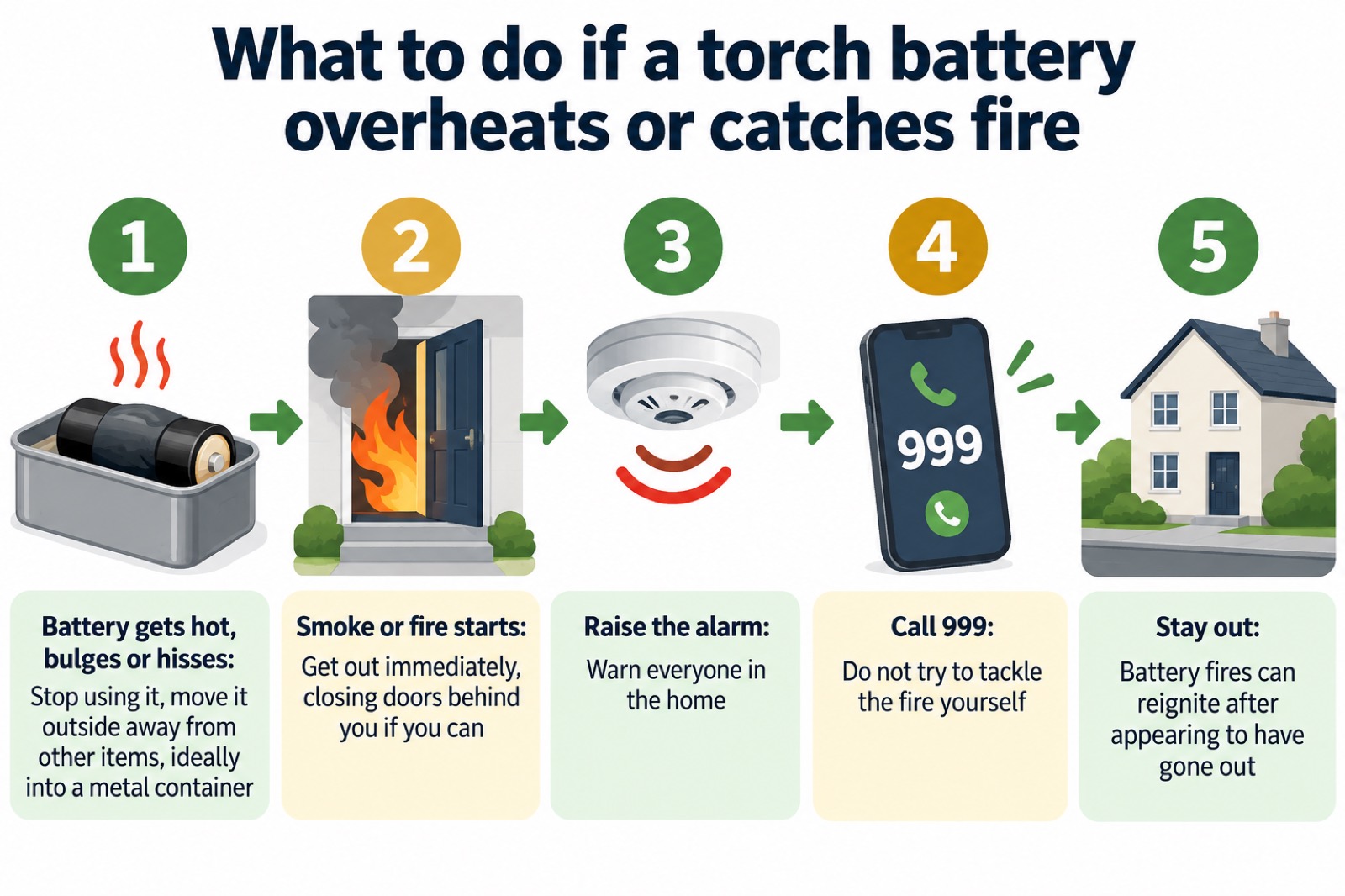
What are the warning signs of a failing battery? London Fire Brigade's guidance for e-bike and e-scooter batteries, which applies to any lithium-ion pack, is to watch for the battery getting unusually hot, starting to bulge, or hissing18. London Fire Brigade give the same signs for vape batteries: if the battery gets unusually hot, starts to bulge or starts hissing, stop using it immediately and leave it in a safe place until you can dispose of it properly19. North Yorkshire Fire and Rescue Service add that when a lithium-ion battery is overcharged or overheated, it rapidly overheats, releases toxic fumes and ignites, causing intense fires that are hard to extinguish20.
West Sussex County Council's safety notice adds the general hazard: if batteries are not used correctly, they can overheat, start an intense fire that develops quickly, and even explode21. And the Scottish Fire and Rescue Service warn that the ferocity of a fire caused by a lithium-ion battery can be significant and prevent you from escaping from your home2. That is why the storage and charging habits on this page matter: they are what keeps a small, useful battery a small, useful battery.
If a battery overheats or catches fire: get out, stay out, call 999
Every fire and rescue service in the UK gives the same instruction for a lithium-ion battery fire, and none of them add any exceptions. Devon and Somerset Fire and Rescue Service: in the event of a fire, get out, stay out, and call 9993. North Wales Fire and Rescue Service: in the event of a fire, do not try and tackle it yourself, leave and call 99922. The National Fire Chiefs Council guidance: do not attempt to extinguish the fire, get out, stay out, call 9998. London Fire Brigade say the same for e-bike and e-scooter batteries: get out immediately, raise the alarm, call 999, and do not attempt to tackle the fire yourself18.
Do not go back for anything, and do not try to put the fire out with water or a blanket. Battery fires behave differently from ordinary fires. Devon and Somerset Fire and Rescue Service report that these fires can spread quickly, are difficult to extinguish, and can reignite after appearing to have gone out23. That last point matters even after the event: a battery fire that seems to have died down can flare up again, so stay out and let the fire service confirm it is fully out.
If a battery is showing warning signs but has not caught fire, treat it as a disposal problem, not a charging problem: store it outside, away from other items, and take it to a recycling point as described below.
Recycling old torch batteries: never in household waste
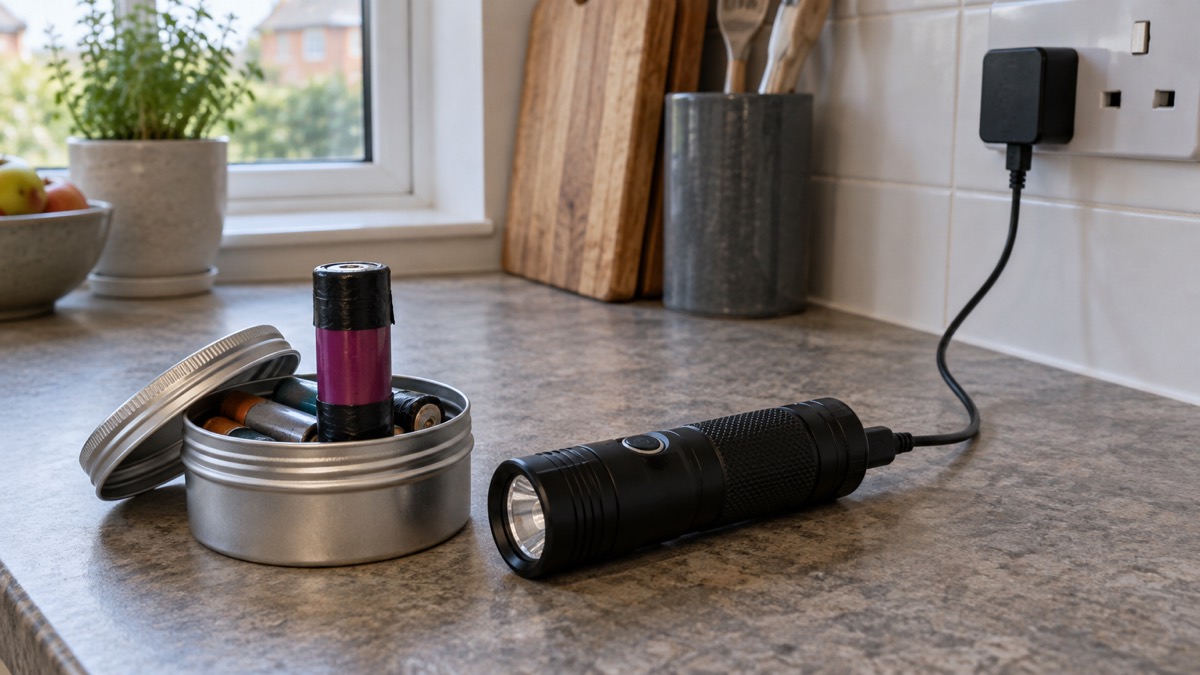
This is the rule that does most of the work in preventing battery fires, because most of them happen after a battery has been thrown away. Mid and West Wales Fire and Rescue Service state it as an absolute: never throw lithium batteries in household rubbish4. The Scottish Fire and Rescue Service agree: they should never be placed in household waste2. Devon and Somerset Fire and Rescue Service explain what happens when they are: batteries put into general household waste can get crushed or punctured on the way to recycling centres, releasing flammable electrolytes into the air, which can trigger explosions and rapidly spreading fires10.
The National Fire Chiefs Council has warned that fires involving lithium-ion batteries are a disaster waiting to happen, though they are preventable by correctly and carefully disposing of electricals24. Devon and Somerset Fire and Rescue Service add that when damaged or crushed, lithium-ion batteries can ignite without warning23.
So where do old torch batteries go?
- Tape the terminals first. Mid and West Wales Fire and Rescue Service advise taping over the terminals with electrical tape to prevent short circuits and fire risk4. This applies to any loose rechargeable cell, including spare 18650s and removable torch packs.
- Use a battery recycling point. Devon and Somerset Fire and Rescue Service point to designated battery and vape recycling points, often available in supermarkets, or placing batteries in a small, clear tied bag on top of recycling boxes for kerbside collection where your council offers it23.
- Take them to a household waste recycling centre. Mid and West Wales Fire and Rescue Service advise taking devices to a household waste recycling centre, or returning them to a retailer when buying a replacement4. North Yorkshire Fire and Rescue Service say a lithium battery must be taken to a household refuse and recycling plant, or your local authority contacted for more information20.
- Check your local rules. London Fire Brigade advise checking your local authority's website or the recycle your electricals website for the safe way to dispose of lithium-ion batteries in your area25. Most local recycling centres accept lithium-ion batteries, and they should be disposed of alongside Waste Electrical and Electronic Equipment items2.
One trap to avoid: batteries hidden inside devices. North Yorkshire Fire and Rescue Service warn that many electrical items contain hidden batteries which can cause fires if they incorrectly enter the waste stream12. If you are binning an old torch with a built-in battery, it does not go in the household bin either. London Fire Brigade say lithium-ion batteries should not be placed in the same bins as your regular rubbish or recycling25. Take the whole device to a recycling centre, or return it to a retailer when buying a replacement4.
Keeping stored torches ready: checks, spares and recalls
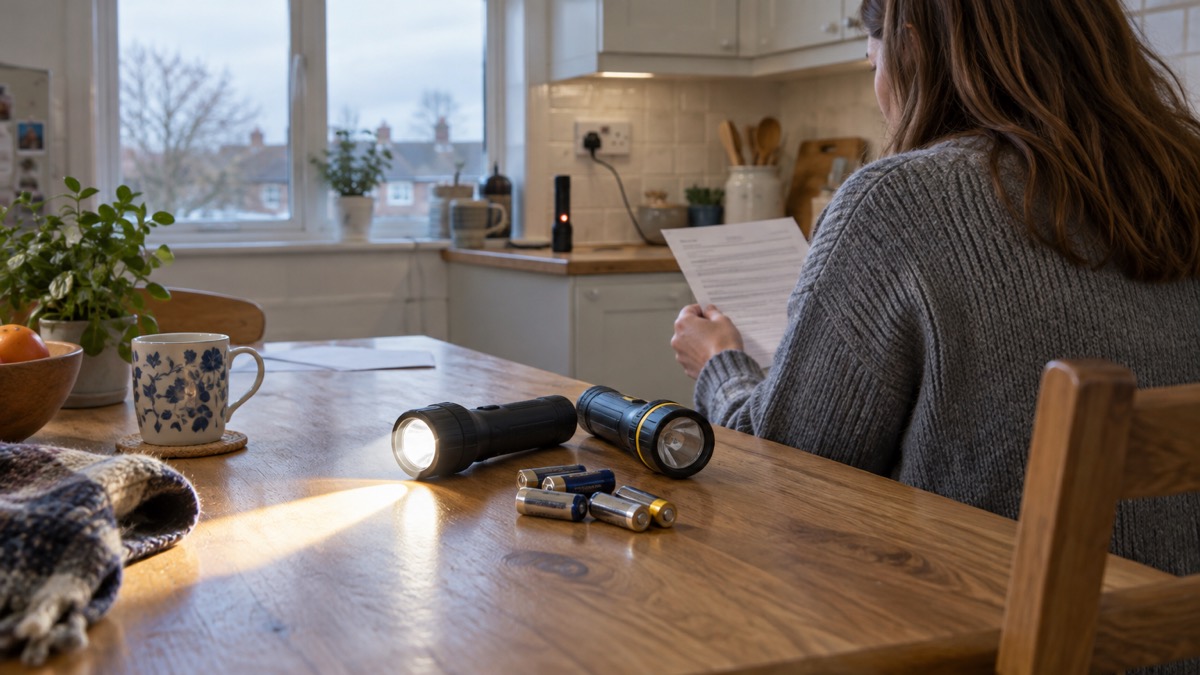
Storage is only useful if the torch works when you reach for it. Rechargeable batteries lose charge over time, so a torch that sat in a drawer since last winter may be nearly flat by the time the next power cut arrives. The National Fire Chiefs Council guidance to follow manufacturer's instructions for storage and maintenance when batteries will not be used for extended periods8 is the starting point, and a simple habit finishes the job: every few months, and always before winter, switch each stored torch on briefly and top up anything that has drained.
The official winter checklists all assume you have done this. The Met Office's WeatherReady winter checklist lists a torch and spare batteries among the essentials26, and the government's power cut advice is to keep a battery or wind-up torch, with spare batteries, at home1. Our lighting checks before winter page turns this into a full checklist, and our page on spare batteries to keep for your lights covers which spares are worth holding.
Two more things belong in a routine check:
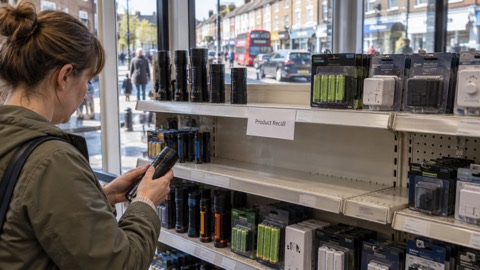
- Recalls. Power banks, chargers and torches can all be recalled, so check your model against recall notices before relying on it, and stop using anything that has been recalled. Our page on recalled and unsafe torches and chargers explains how to check and report.
- Damage. While you have each torch in your hand, look it over for the warning signs above: heat, bulging, hissing, cracks or dents. A damaged battery should be replaced, not used or charged5.
If a power cut does arrive, everything on this page pays off at once: a charged torch you can find in the dark, spare batteries that are not dead, and no charging cable left running unattended overnight. Our pages on lighting your home safely when the power goes off and the wider power cuts guide take it from there.
Sources (26)
- Power cuts: be informed about hazards, Prepare for Emergencies (GOV.UK campaign), 2026
- Lithium-ion batteries, Scottish Fire and Rescue Service, 2025
- Battery fires, Devon and Somerset Fire and Rescue Service, 2026
- Lithium battery fire safety in your home, Mid and West Wales Fire and Rescue Service, 2026
- E-bike and e-scooter fire safety, Scottish Fire and Rescue Service, 2026
- Winter ready, Isle of Anglesey County Council, 2026
- 12 tips to prepare for a power cut, Horsted Keynes Parish Council, 2026
- E-bikes and scooters fire safety guidance, National Fire Chiefs Council, 2022
- Batteries: technical advice, The Caravan and Motorhome Club, 2026
- Recycle your batteries, prevent fires, Devon and Somerset Fire and Rescue Service, 2024
- Electrical safety at home, North Yorkshire Fire and Rescue Service, 2026
- Charge Safe campaign, North Yorkshire Fire and Rescue Service, 2026
- Charge Safe campaign, National Fire Chiefs Council, 2026
- E-bikes and e-scooters, South Wales Fire and Rescue Service, 2026
- Charging safety, Oxfordshire County Council Fire and Rescue Service, 2026
- Reminder not to cut corners with electrical safety this Christmas, Wiltshire and Swindon Prepared, 2026
- Lithium-ion batteries are everywhere but safety standards haven't caught up, warn fire chiefs, National Fire Chiefs Council, 2025
- Spot the warning signs: could your e-bike or e-scooter start a fire?, London Fire Brigade, 2026
- Vaping and e-cigarettes, London Fire Brigade, 2026
- E-scooter, e-bike and mobility scooter fire safety advice, North Yorkshire Fire and Rescue Service, 2026
- Lithium-ion batteries safety, West Sussex County Council, 2023
- Lithium-ion batteries at home, North Wales Fire and Rescue Service, 2026
- Residents urged to think before binning batteries, Devon and Somerset Fire and Rescue Service, 2026
- Over 1,200 battery fires in bin lorries and waste sites across the UK in last year, National Fire Chiefs Council, 2024
- How to dispose of batteries from your e-bike or e-scooter, London Fire Brigade, 2026
- WeatherReady winter checklist, Met Office, 2026
 Spare Batteries for Lights
 Candle Safety Checklist
 Lighting Checks Before Winter
 Lighting Home in a Power Cut
 Choosing a Torch for Home
 Head Torches for Power Cuts
 Lanterns for Lighting a Room
 Emergency Bulbs
 Solar and Wind-Up Lamps
 Lumens and Beam Distance
 Torch Batteries Explained
 Candle Fire Safety at Home
 Lights for Disabled People
 Torches, Candles and Children
 Recalled Torches and Chargers