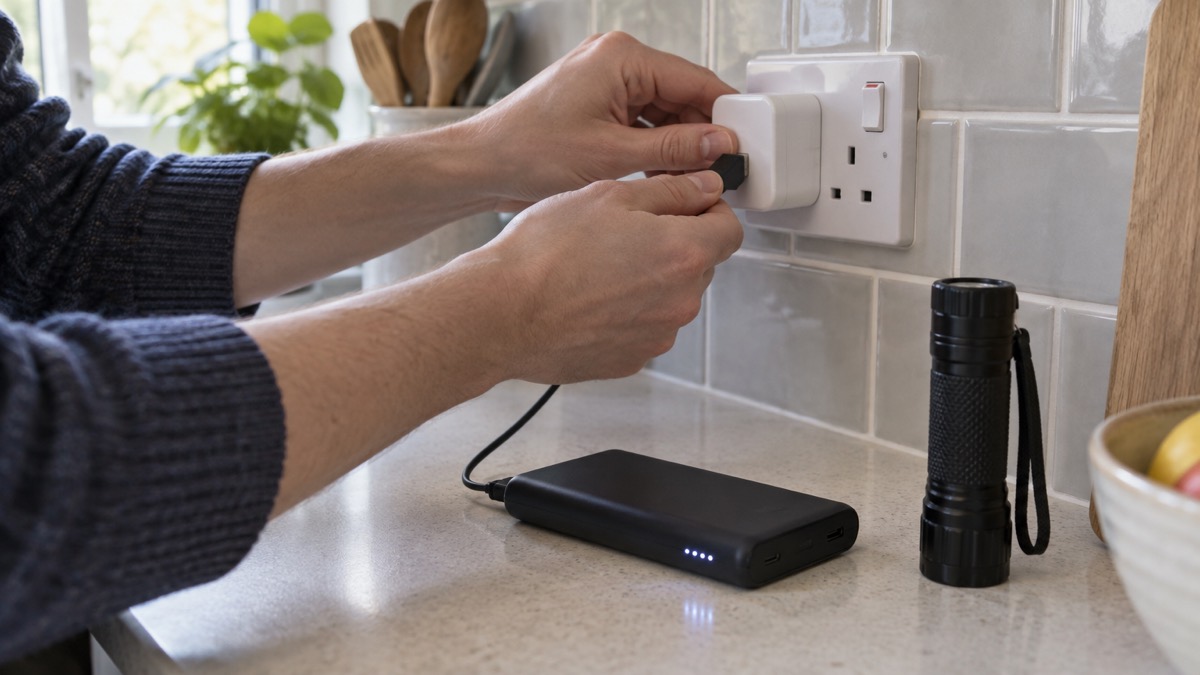
When the power goes off, the first thing most households reach for is the phone. It is how you report the cut, call for help, and let family know you are safe. That is why official guidance across the UK is consistent on one point: keep mobile phones, laptops, tablets, and power banks fully charged, so you will have use of battery power for a short time at least1. A power bank is a simple piece of backup power most homes can own: a battery, some circuitry, and one or more charging ports, often USB or USB-C2, and it is a piece of kit that emergency preparedness advice across the UK recommends keeping charged.
A charged power pack, even if it just charges a phone, helps you stay in contact with loved ones in an emergency or power cut2. Battery power packs are a reliable source of power to draw on when the electricity goes off, letting you charge your phone and still use it at the same time3. This page explains what a power bank is, how to choose one, how to charge and store it safely, and the fire and recall warnings you should know before you rely on one.
Keep a fully charged power bank ready for a power cut
The single most important habit is to keep your power bank charged before you need it. A power bank that has sat in a drawer for months at half charge is of little use when the lights go out. Official guidance from preparedness bodies in England, Scotland, Wales and Northern Ireland all make the same point: keep a fully-charged power bank available, in case you need to charge your phone, tablet or other devices8.
The best time to top it up is before bad weather. When storms and high winds are forecast, the Scottish Government's Ready Scotland campaign advises: "Charge mobile phones and power banks in case there's a power cut. Find your emergency plan and make sure it's up to date"4. The UK government's Prepare campaign gives the same advice, adding that you should also charge any back-up batteries for medical equipment9. The Met Office's winter preparation advice goes further, suggesting you consider a separate battery charger, and store key information such as the power cut helpline number (105) on your phone5.
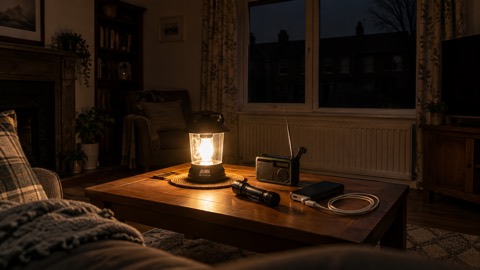
A power bank works alongside the rest of a basic power cut kit. The essentials that could help you cope with a power cut are battery candles, torches and batteries, and a mobile phone power pack10. Keep a torch handy as well11, and store a battery or wind-up torch somewhere you can access easily, so you can use it to check the fuse box and make your way around the house safely12. If you are building a wider kit, our power cut checklist page sets out the full list.
One group should plan further ahead. If you use medical equipment that requires a power supply, make a plan with your care provider and clinical care team now about what will happen in a power cut; the plan should set out what action you, or someone you care for, needs to take and who to contact13. See our guide to powering medical devices from a battery for more.
What a power bank is: a battery, circuitry and USB ports
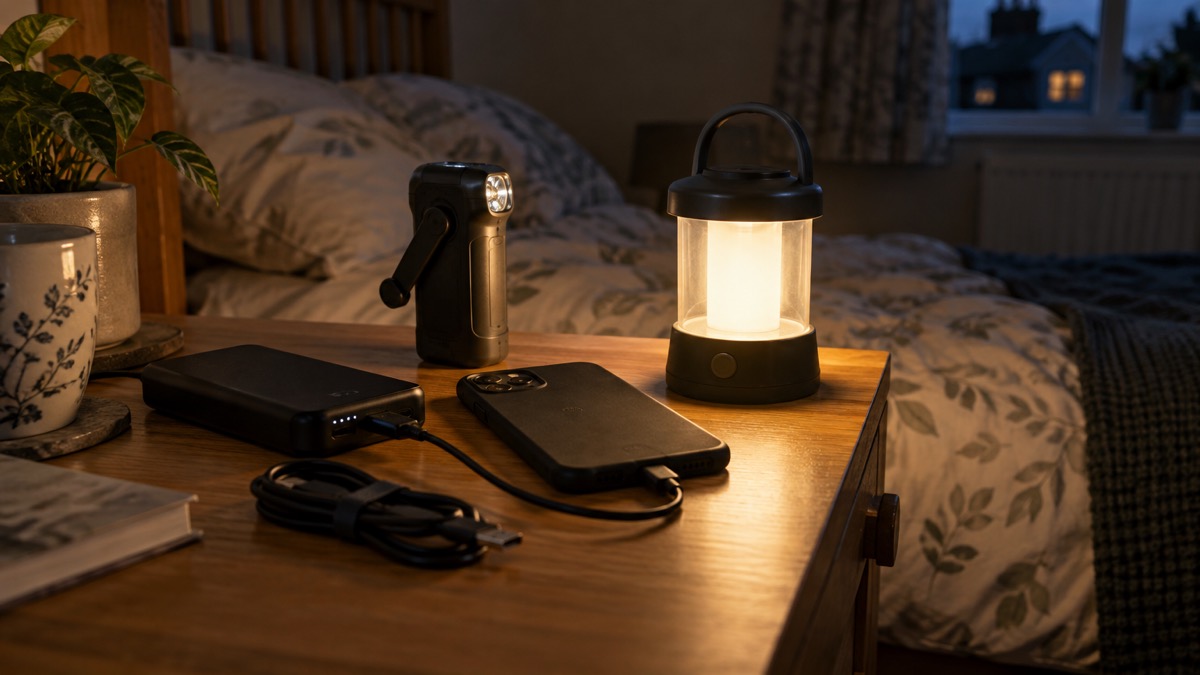
A power bank is a rechargeable lithium-ion battery in a case, with circuitry that controls how power flows in and out, and one or more USB ports for charging your devices. You charge the bank itself from the mains, then carry it charged and plug your phone, tablet or other USB device into it when you need to. It is small, needs no fuel, makes no noise, and can be used indoors, which is why preparedness bodies single it out for households: having a power pack that's charged can be very helpful in an emergency or power cut2.
Power banks sit at the small end of a range of backup power options. They are designed for phones, tablets and other small USB devices, not for fridges, heating or anything that plugs into a wall socket. If you need to run mains equipment, you are looking at a portable power station or a generator instead, and our comparison of power banks or power stations explains the difference. For most households, the realistic job of a power bank is keeping phones alive so you can call for support, report the cut on 105, and follow news updates.
Because power banks contain lithium-ion batteries, the same chemistry used in e-bikes, e-scooters and laptops, they carry the same fire risks if they are charged carelessly, damaged, or bought from an unreliable seller. Most power banks use lithium-ion batteries that will naturally get warm during charge and discharge cycles14. The rest of this page covers the maker's safety rules in full.
Choosing a power bank: capacity, ports and what it can charge
Choose a power bank by what it needs to do for your household. The key questions are how many devices it must charge, how many times, and how quickly. A bank that will only ever top up one phone in a short power cut needs less capacity than one that must keep two phones and a tablet going through a storm. The pack's capacity, printed on it and in its specifications, tells you how much charge it holds; its ports and output ratings tell you what it can charge and how fast. Our guide to USB-C charging, power delivery and cables explains what the port markings mean.
Official guidance does not set a minimum capacity, but it does set the job: a power bank exists so you can charge your phone, tablet or other devices when the mains is off8. When comparing banks, check the maker's stated number of full phone charges, and remember that a phone being used while it charges, for calls or news updates, draws power at the same time as it stores it. Note also that most portable battery packs do not support charging and discharging at the same time3.
| What to check | Why it matters |
|---|---|
| Capacity | How much charge the bank holds, and so how many times it can refill your devices |
| Ports | How many devices can be charged at once, and what connectors they need |
| Output | How quickly each port charges, and whether it suits phones only or tablets too |
| Included cable | Whether you need to supply your own charging cable for your devices |
| Safety markings | That the product meets UK safety standards; see our page on UKCA, CE and battery safety markings |
If you rely on a landline rather than a mobile, note that your landline provider has obligations too. If you don't have a mobile or live somewhere where there's no signal, your landline provider should offer you a solution such as a battery back-up unit so you can still make emergency calls during a power cut15. These back-up units must last for at least one hour in a power cut, but some providers have back-ups that last up to seven hours16. Ask your provider what they supply, and see our power cuts guide for the full picture on the digital landline switchover.
Charging your phone from a power bank
Using a power bank in a power cut is straightforward, but a few habits make it work better.
- Before bad weather arrives, charge your phone and your power bank fully4.
- When the power goes off, confirm the cut by checking whether neighbours are affected, and report it by calling 10517.
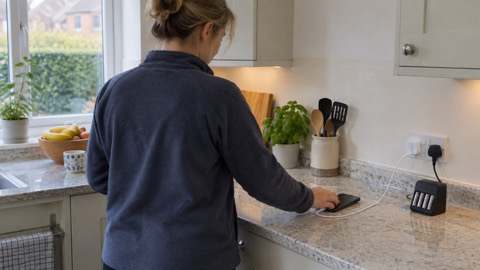
- Plug your phone into the power bank with a cable in good condition, and keep using the phone as normal; the bank supports charging and use at the same time3.
- When the phone is charged, unplug it, and keep the power bank for the next time you need it.
Check your charging cable before you rely on it. If your charging cable is cracked, severely twisted or has exposed wires, don't use it, it could cause a fire18. Electrical devices, cables and plug sockets can be a source of fire18, so a damaged cable is not a small matter. Keep a spare known-good cable in your emergency kit alongside the bank.
Store key information on your phone before an emergency, not during one. The Met Office advises storing the power cut helpline number (105) on your phone5, and Ready Scotland lists 105 as the number to call for a power cut17. If the mobile network is also down, which can happen in severe storms, a charged phone still holds your emergency plan, contact numbers and useful information, so charging remains worthwhile even when you cannot call.
Safe charging: never overnight or while you are out
The clearest and most repeated rule from every fire and rescue service in the UK is this: never charge batteries while you are asleep or away from the home. Only charge while awake and alert, so if something goes wrong you can respond quickly14. The Scottish Fire and Rescue Service puts it plainly: "To make sure you can respond quickly in the event of a fire, you should not charge your battery while you are asleep or away from home"19. North Yorkshire Fire and Rescue Service's bedtime routine advice is the same: never leave electrical items charging overnight6.
This matters because a lithium-ion battery fire is not like an ordinary electrical fire. The ferocity of a fire caused by a lithium-ion battery can be significant and prevent you from escaping from your home19. A fire that starts while you are asleep, or while the house is empty, can take hold before anyone can act. The National Fire Chiefs Council's Charge Safe campaign states it as a rule: never leave a battery charging unattended, and don't charge it while you are asleep or away from home20.
The fire services' charging rules, applied to a power bank, come down to this list:
- Charge during the day, while you are awake and nearby21
- Avoid charging near flammable materials19
- Do not overload power sockets or use unsuitable extension cords; always use uncoiled extension leads that are properly rated for your devices19
- Use one plug per socket22
- Follow the manufacturer's instructions, always use the approved charger, and unplug when it is finished23
- Charge in an area with a working smoke alarm23
- Do not cover chargers or battery packs when charging23
- Ensure devices are charged away from escape routes21
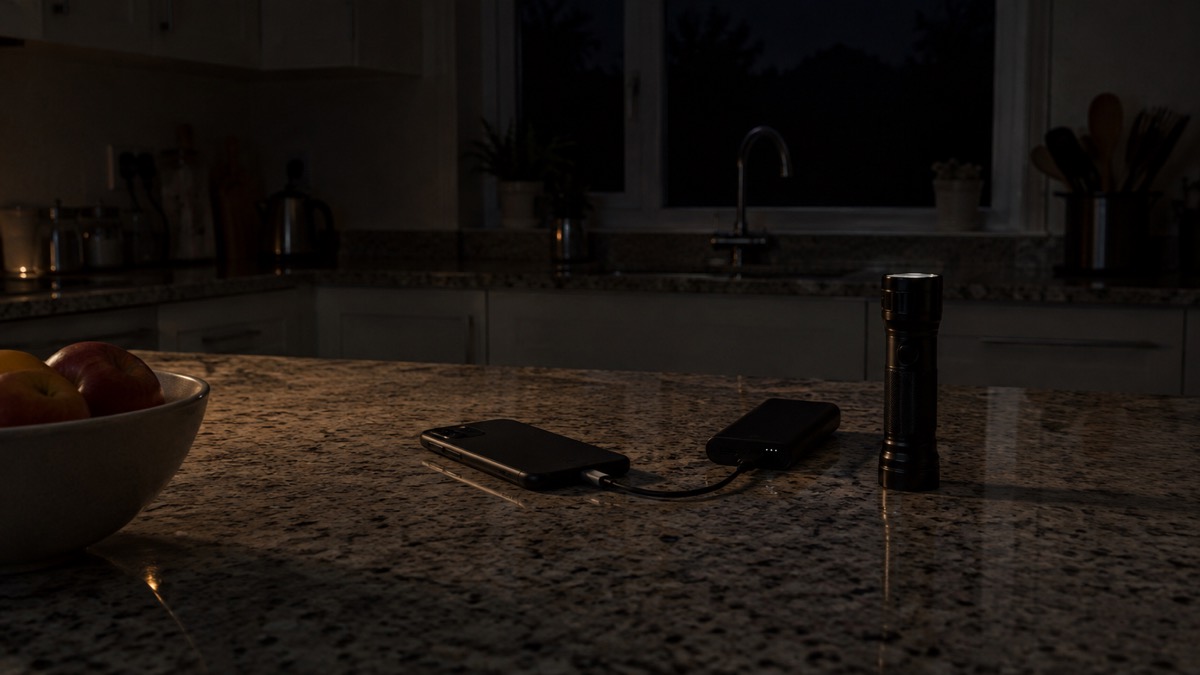
Two further points of electrical hygiene are worth checking once and then forgetting. Badly wired plugs, where any coloured wires stick out, could come loose, and debris can get into the plug24. And the biggest risk of electrical fire comes from damaged or overloaded sockets, or from "daisy-chained" extension leads that have been plugged into each other25. If you use extension leads with any charging set-up, our page on extension leads and overloading with backup kit covers the rules in detail, and our safe battery charging checklist turns all of this into a routine you can follow.
Swollen, bulging or damaged power banks are a fire risk
A power bank that is swollen, bulging, hissing, or unusually hot has failed and is a fire risk. Stop using it immediately, keep it away from anything flammable, and do not put it in the bin. Our page on what to do if a battery starts swelling covers the steps, and how to dispose of a damaged lithium battery explains safe disposal. The warning signs that a lithium battery is dangerous are set out on our battery warning signs page.
If a power bank or any battery device does catch fire, do not try to tackle it. London Fire Brigade's advice for lithium-ion battery fires is to get out immediately26. Call 999 once you are outside and safe. Because these fires produce toxic smoke26, stay out of the smoke and keep others away.
Damage can come from water as well as heat. Power cuts are common during adverse weather events, and electrical items may break down if they have come into contact with water27. A power bank that has been wet through, whether from flooding or a spill, should be treated as unsafe: do not charge it, do not use it, and dispose of it responsibly. If you are preparing for flooding rather than a storm, keep charging kit and power banks high up, well above any expected water level.
Where and how to store a power bank
Store your power bank where you can find it in the dark, and where it is safe while it waits. The same principle that applies to torches applies here: leave it somewhere you can access easily12. A kitchen drawer or a shelf in the hall cupboard, with the charging cable coiled beside it, means you are not hunting through the house by torchlight.
Keep these storage habits:
- Store it at room temperature, away from direct heat, and away from flammable materials19
- Keep it out of escape routes and doorways, so a fault cannot block your way out21
- If you have used a power bank during a power cut, recharge it before storing it so you are ready for the next outage23
- Keep it well above floor level if your home is at risk of flooding27
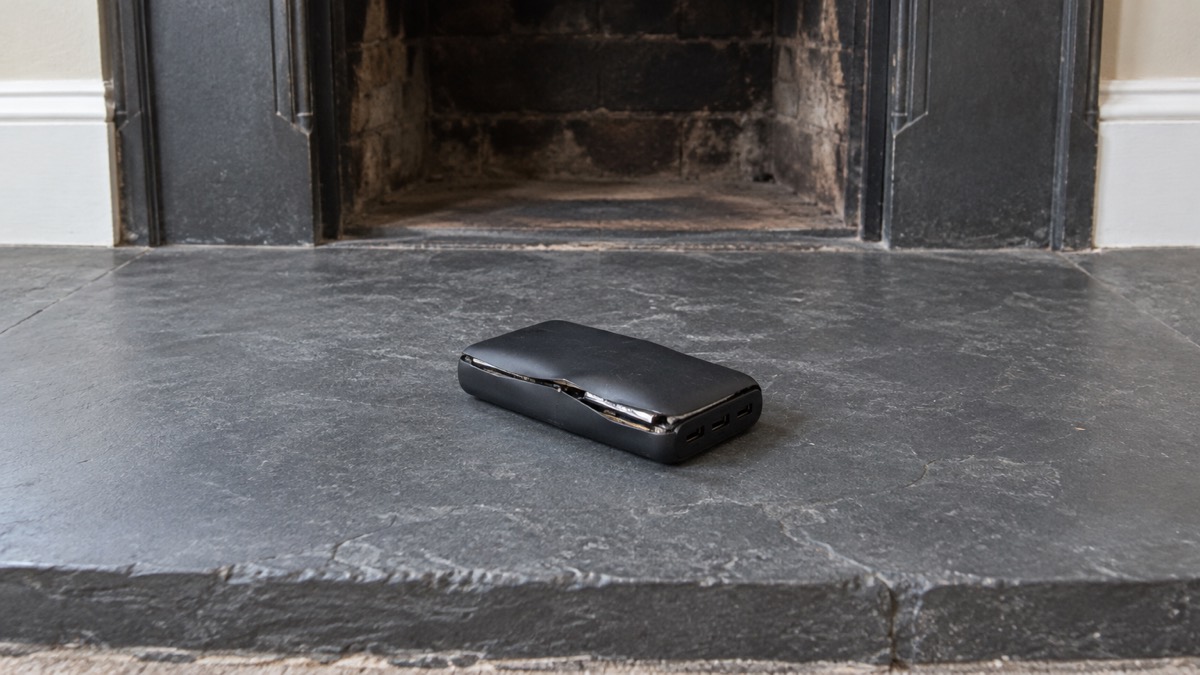
Storage matters as much as charging. Protect your power bank from damage and do not immerse it in water28, and do not leave it in a parked car where it could get cold in winter or hot in summer28. If you have used a power bank during a power cut, recharge it before storing it away so it is ready for the next outage29. Keep torches and batteries in an easy to find place12, so you can check the fuse box and make your way around the house safely if the power goes off again. Our page on battery storage temperature covers the storage conditions in more detail.
Registering your power bank and phone for recalls
Electrical products are recalled when a fault is found that could make them dangerous, and power banks and chargers are among the product types affected. The way to hear about a recall is to hear from the maker. Register your power bank, and your phone and its charger, with the manufacturer when you buy them, using the registration card or website address in the packaging. Keep proof of purchase. Then check the maker's website periodically for safety notices, and act on any recall notice immediately: stop using the product and follow the maker's instructions for return or replacement.
Recalls matter more than they might seem, because a recalled product is one the maker has already accepted is unsafe. A power bank you rely on in an emergency is a product you will leave charging and unattended in daily use, so a known fault in that product is exactly the kind of risk a recall exists to remove. If you have bought second-hand or been given a power bank, check the maker's website for that model before you rely on it.
The charging accessories deserve the same attention. If your charging cable is cracked, severely twisted or has exposed wires, don't use it, it could cause a fire18. A charger that came from an unknown seller may never have been checked at all, which leads to the next point.
Buying safely: why online marketplaces carry risk
Where you buy a power bank matters as much as which one you buy. Official guidance is blunt about this: "Online Marketplaces do not have to adhere to the same safety standard as high street retailers"7. A power bank sold through a marketplace listing, or advertised on social media, may not have been through the checks a product sold directly by a reputable brand has. The same guidance warns that a device bought from an online marketplace or social media claiming to save money on energy might be a dangerous device which won't save you energy7.
The practical rule from that guidance is to buy from websites of brands you trust7. For a product whose whole job is to hold a large amount of energy in a small case, and which you will leave charging in your home, that is not caution for its own sake. An unsafe power bank is a fire risk in exactly the way the fire services describe: lithium-ion battery fires can spread rapidly and produce toxic smoke26.
Before you buy, check the listing for the maker's own specifications, the safety markings, and the maker's name you can verify. Our page on UKCA, CE and battery safety markings explains what to look for on the product and packaging, and our page on whether batteries and chargers from online marketplaces are safe goes into the question in depth. If a price looks too good, treat that as a warning rather than a bargain.
Getting help: who to call and who to register with
Two numbers and one register cover most of what a household needs in a power cut. To report or check a power cut, call 10517; this free number connects you to your local network operator. In an emergency involving fire, get out, stay out and call 99926.
If you or someone you care for depends on electricity for medical equipment, make a plan with your care provider and clinical care team now about what will happen in a power cut, setting out what action to take and who to contact13. Our guide to powering CPAP, oxygen and other medical devices from a battery covers the options.
Finally, keep your emergency plan itself up to date. Ready Scotland advises finding your emergency plan and making sure it is up to date when storms are forecast4, and its emergency planning guidance covers what a household plan should contain17. A charged power bank, a torch you can reach in the dark, and a plan everyone in the house knows are the three things that carry most households through a power cut safely.
Sources (29)
- Strong winds weather warning: information and advice, nidirect (Northern Ireland government), 2026-10-24
- Personal resilience: yourself, Wiltshire and Swindon Prepared, 2026-10-25
- How to prepare for the loss of electricity, Wiltshire and Swindon Prepared, 2026-10-25
- Storms and wind, Ready Scotland, 2026-03-24
- 10 things you should do now to prepare for winter, Met Office, 2026-10-25
- Bedtime routine and escape plan, North Yorkshire Fire and Rescue Service, 2026-03-27
- Cost of living toolkit, National Fire Chiefs Council, 2022
- 12 tips to prepare for a power cut, Horsted Keynes Parish Council, 2026
- Storms: be informed about hazards, Prepare Campaign (UK government), 2026-10-19
- Stay safe in a thunderstorm, Met Office, 2026-10-25
- Adverse weather events, Llangattock Community Council, 2026-10-25
- Winter ready, Isle of Anglesey County Council, 2026-10-25
- Power cuts: be informed about hazards, Prepare Campaign (UK government), 2026-10-21
- E-bikes and e-scooters, Scottish Fire and Rescue Service, 2026-10-25
- UK transition from analogue to digital landlines, GOV.UK, 2023-01-06
- Future of landline calls, Ofcom, 2026-08-26
- Emergency plan, Ready Scotland, 2026-03-24
- Student safety, Devon and Somerset Fire and Rescue Service, 2026
- Lithium-ion batteries, Scottish Fire and Rescue Service, 2025-11-27
- Charge Safe campaign, National Fire Chiefs Council, 2026-10-09
- Battery fires, Devon and Somerset Fire and Rescue Service, 2026
- Cut the risk of fire in your home, Wiltshire and Swindon Prepared, 2026-10-25
- Home fire safety, Northern Ireland Fire and Rescue Service, 2026-10-14
- Looking after the electrics, North Wales Fire and Rescue Service, 2026-10-25
- Home safety partnerships for carers, Devon and Somerset Fire and Rescue Service, 2026
- What to do if there's a fire caused by an e-bike or e-scooter, London Fire Brigade, 2026-10-25
- Food safety in the kitchen: flooding, Food Standards Scotland, 2026-10-25
- Electrical Safety Advice for Power Banks, Electrical Safety First
- How to Stay Warm Without Power: 10+ Tried and Tested Tips - Jackery, Jackery
 Power Cut Backup Power Checklist
 Backup Power Before Winter
 Safe Battery Charging at Home
 What to Keep Running in a Cut
 Power During an Outage
 Watts and Watt-Hours
 Portable Power Stations
 Portable Generator Types
 Generator Safety
 LPG Cylinders and Regulators
 Connecting to Your Home's Wiring
 Home Battery Storage
 Portable Solar Panels
 12V Inverters
 Leisure and LiFePO4 Batteries