
The short answer is room temperature, in a dry place, away from heat and cold. Duracell, which makes batteries, recommends storing them at room temperature in a dry environment, and says extreme heat or cold reduces battery performance1. Fire and rescue services across the UK give the same advice for the rechargeable lithium-ion batteries in power banks, power stations, e-bikes and e-scooters: store them in a cool, dry place and avoid extreme temperatures2.
That matters for an ordinary household because the batteries you keep for a power cut are only useful if they still hold charge when you reach for them. Heat and cold both work against that. Heat speeds up ageing and raises the risk of overheating; freezing conditions can cause lasting damage to lithium-ion cells5. The fix is simple: choose where you keep your spares with the same care you would give to a smoke alarm, and check them now and then.
This page covers where to keep batteries at home, what heat and cold actually do to them, how to store loose cells and button batteries safely, and what to do with a battery that has been somewhere cold before you charge it.
Room temperature, dry, and out of the extremes
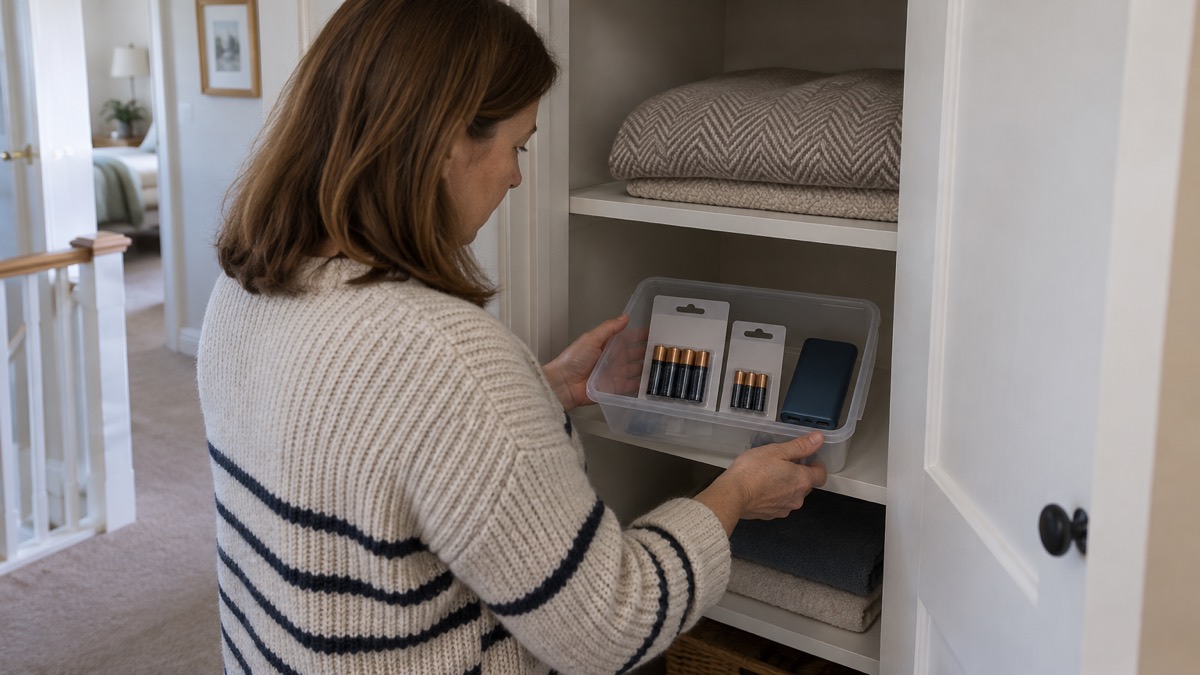
The working rule for a household is to keep batteries where you keep the rest of your everyday things: a cupboard or drawer in a living room, hallway or bedroom, not a garage, loft or shed. Duracell's advice is room temperature in a dry environment, and it adds that refrigeration is not necessary or recommended1. That last point is worth repeating, because putting batteries in the fridge is a habit some people still have. It does not help, and the damp and condensation in a fridge work against the dry conditions batteries need.
Fire and rescue services frame the same advice around avoiding extremes. London Fire Brigade says to avoid storing, using or charging batteries at very high or low temperatures2. The Scottish Fire and Rescue Service says to store the product and its batteries in a cool place, avoiding exposing them to extreme heat or cold3. The National Fire Chiefs Council, which coordinates fire safety guidance across the UK, tells people to store and charge e-bike and e-scooter batteries in a cool, dry place4. Oxfordshire County Council's fire safety pages say the same for e-bikes, e-scooters and their batteries: a cool place, avoiding extreme temperatures8.
Battery makers give the same instruction for the small cells in torches and radios.
There is no single number that fits every battery, and the guidance is deliberately about avoiding extremes rather than hitting a target. What you can act on is the direction of travel: a steady, dry indoor spot is right, and anywhere that swings from hot to freezing is wrong.
Why very hot or very cold storage shortens battery life
Heat and cold damage batteries in different ways, and both reduce what you get out of them when you need them.
Heat is the more serious of the two. Fire and rescue guidance for e-bike and e-scooter batteries explains that heat can cause the chemicals inside the battery to break down more quickly, reducing its lifespan, affecting charging performance and increasing the risk of overheating or failure5. Devon and Somerset Fire and Rescue Service puts it plainly: exposure to high temperatures speeds up battery ageing and increases the chance of battery failure9. Electricity North West, the network operator for the north west of England, warns that high temperatures can cause batteries, especially lithium-ion, to overheat and potentially catch fire, and says to keep power banks and spare batteries out of direct sunlight and away from enclosed spaces like glove compartments10.
Cold is less dramatic but still costly. The same fire and rescue guidance says cold temperatures can reduce the performance of lithium-ion batteries, with reduced range, slower charging and the battery losing charge more quickly, because the chemical reactions inside slow down5. Very low temperatures can affect the internal structure of the battery and reduce its ability to hold a charge, and repeated exposure can lead to permanent capacity loss, internal damage and reduced battery life5. Lithium-ion batteries are not designed to operate in freezing conditions5.
Alkaline cells are more forgiving but not immune. Duracell says extreme heat or cold reduces battery performance1. One maker of outdoor charging gear, BioLite, states that rechargeable lithium-ion batteries perform better than alkalines in cold conditions, delivering more consistent power and being less likely to fail in freezing temperatures11. That is a maker's claim about its own market, but it points the same way: if a battery is going to sit somewhere cold, lithium-ion copes better than alkaline, and neither should be left there long term.
Where not to keep them: garages, sheds, cars and lofts
The places people naturally think of for spare kit, the garage, the shed, the boot of the car, are the worst places for batteries. Each one exposes them to the extremes the guidance warns about.
| Place | Why it is a problem | What to do instead |
|---|---|---|
| Garage or shed | Swings between summer heat and winter freezing; often damp | Keep spares indoors in a dry cupboard1 |
| Car, including the boot and glovebox | Very hot in sun, very cold in winter; glove compartments are enclosed | Take power banks and spares with you10 |
| Loft | Very hot in summer, cold in winter, and hard to check | Store on a living floor instead1 |
| Fridge or freezer | Damp and condensation; refrigeration is not recommended | Room temperature is correct1 |
| Windowsill | Direct sunlight heats the battery | A shaded cupboard away from windows13 |

Electrical Safety First, the electrical safety charity, warns against leaving a laptop in a parked car where it could get cold in winter or hot in summer, because extreme temperatures can be dangerous12. London Fire Brigade gives the same warning for vape batteries: direct sunlight or freezing temperatures can damage the battery, and you should avoid storing, using or charging batteries in these extremes, for example in a car16.
If a garage or shed is genuinely your only storage, treat it as a compromise rather than a solution. Keep batteries in a sealed container off the floor, away from damp, and bring them indoors before winter. A cool, dry, steady indoor cupboard is better for them than any amount of careful packing in an outbuilding.
Storing loose batteries and button batteries safely
Loose cells rolling around in a drawer are a small but real hazard, mainly because their contacts can touch metal or each other. Duracell's advice is to store batteries in a dry place at normal room temperature without the contacts touching6. Keeping them in their original packaging, or in a small pouch or box with the terminals covered, does the job.
Button batteries need more care than any other kind, because of the risk to small children. The Child Accident Prevention Trust says to store button batteries in a safe place, up high and out of reach of children, and to avoid leaving them loose in drawers or on surfaces7. That applies to the spares in a kitchen drawer as much as to the ones in a grab bag.
For lithium-ion packs, storage is also about condition. The National Fire Chiefs Council says not to use or charge batteries that are damaged, swollen, leaking or unusually hot, and not to put damaged batteries in household waste17. If a battery has been stored somewhere damp and shows any of those signs, stop using it and dispose of it properly rather than putting it back into service. There is more on spotting trouble in our guide to warning signs a lithium battery is dangerous.
A few habits keep stored batteries in good order:
- Keep spares in a dry place at normal room temperature, contacts apart18
- Store button batteries up high and out of reach of children7
- Do not use or charge batteries that are damaged, swollen, leaking or unusually hot19
- Keep them out of direct sunlight and away from radiators20
- Do not store them in the fridge1
Follow the storage guidance in your user guide
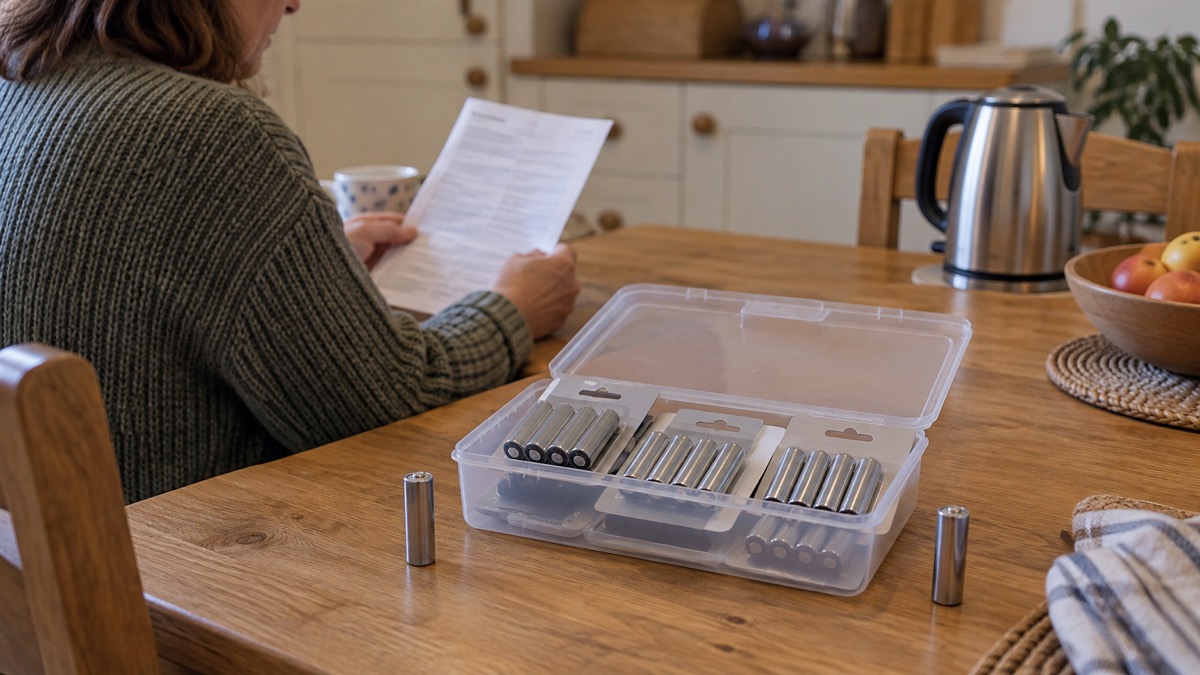
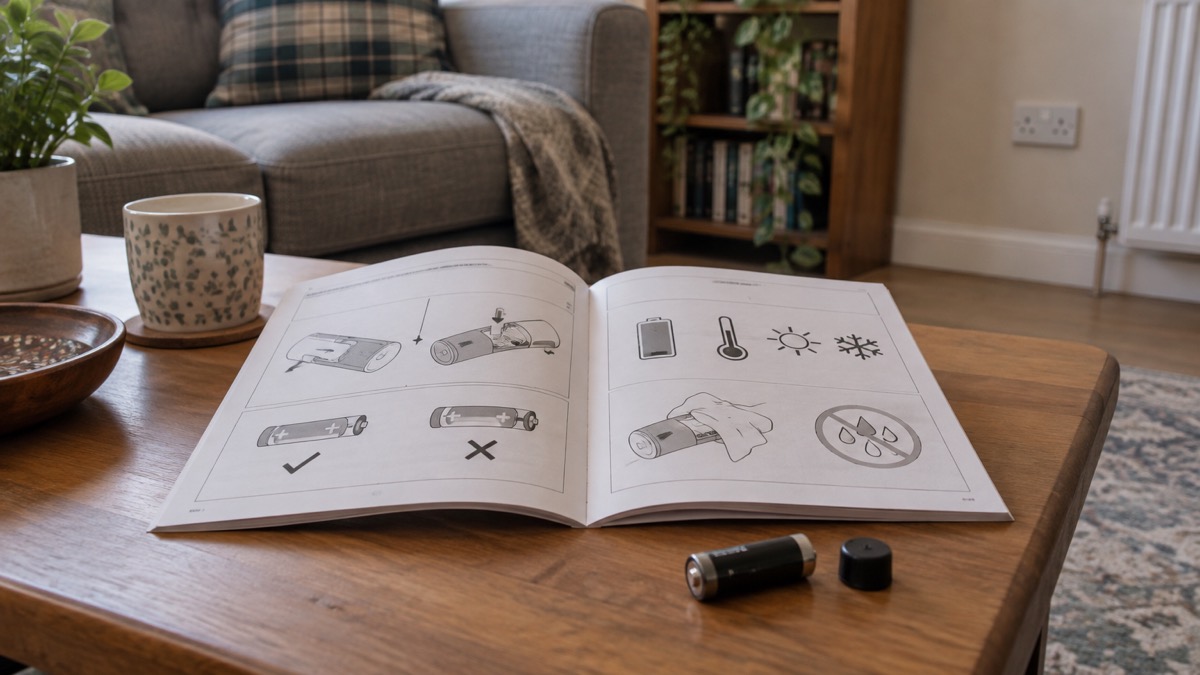
General advice gets you most of the way, but the maker of your particular device knows its limits. Fire and rescue guidance is consistent on this point: always follow the battery usage, storage and charging guidelines in the user guide21. For lithium-ion batteries that will not be used for a long time, the National Fire Chiefs Council says to follow the manufacturer's instructions for storage and maintenance22. The Scottish Fire and Rescue Service and South Wales Fire and Rescue Service give the same instruction for e-bike and e-scooter batteries that are not going to be used for extended periods3.
That matters because makers set their own temperature limits, and they vary. GP lists an operating temperature range of -30°C to +60°C for its lithium AA batteries13. BLUETTI's winter guidance for its power stations says to store batteries and power stations in a dry, insulated indoor space, avoid prolonged exposure to temperatures below 0°C, and allow batteries to warm to room temperature before charging24.
Those figures are not a target for your cupboard; they are the outer limits a maker will stand behind. The practical reading is that charging in the cold is the riskier operation, and that a maker's own manual overrides any general rule. If your manual gives a storage temperature, use it.
Charging after cold storage, and the hot battery rule
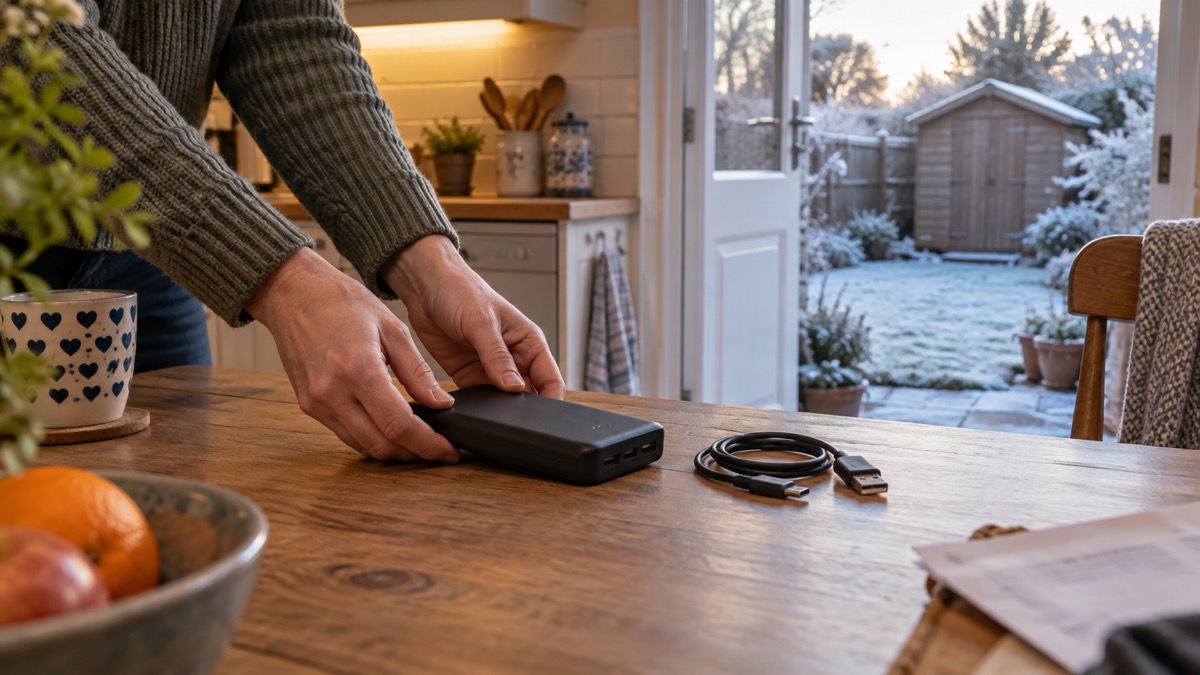
If a battery has been somewhere cold, the order of operations matters. Fire and rescue guidance says to allow cold batteries to warm to room temperature before charging, because charging a battery when it is extremely cold can damage it5. If it has been left in freezing conditions, let it warm up slowly indoors before using or charging it5. Do not rush this with a radiator or a hairdryer; slow warming indoors is what the guidance describes.
The opposite problem has its own rule. Do not charge a battery that already feels very hot5. If a battery has been in a hot car or a sunny window, let it cool to room temperature first.
For the rechargeable cells in torches and radios, the same principle applies in a milder form. Duracell says its cells are designed to be used under normal atmospheric conditions and in fairly constant temperatures, approximately 21°C25. That is a description of normal use, not a storage target, but it confirms that steady indoor conditions are what batteries are built for.
Lithium-ion versus alkaline: what is different
The storage rules are broadly the same for both chemistries, but the tolerances are not. Lithium-ion batteries are the ones in power banks, power stations, laptops, e-bikes and e-scooters, and they are the ones fire services focus on because of the fire risk when they fail.
| --- | --- | --- |
|---|---|---|
| Heat risk | Performance reduced by heat1 | Can overheat and potentially catch fire10 |
| Charging in the cold | Not rechargeable | Warm to room temperature first5 |
| Fire risk if it fails | Low | High; can burn at over 700°C to 1000°C26 |
The fire risk is why lithium-ion storage gets so much official attention. The Scottish Fire and Rescue Service advises that when storing products that use lithium batteries, such as e-bikes or e-scooters, you should avoid keeping them in escape routes or communal areas, because in the event of a fire they could block people from leaving the building safely3. That is a storage instruction as much as a fire safety one, and it applies to any large lithium battery in the home, including a power station.
For smaller lithium-ion kit, the same logic applies at a smaller scale: keep it where a problem would be noticed and where it would not block your way out. Our guide to lithium-ion battery safety at home covers the wider picture, and if you are storing a power station between outages, how to store a power station when not in use goes into more detail.
A storage routine for a household
You do not need special equipment to store batteries well. You need a consistent place, a quick check now and then, and the discipline to keep spares out of the shed and the car.
- Choose an indoor cupboard or drawer, dry and away from windows and radiators1.
- Move any batteries currently in the garage, shed, loft or car indoors10.
- Keep loose cells in their packaging or a pouch, contacts apart6.
- Put button batteries up high and out of reach of children7.
- Do not use or charge batteries that are damaged, swollen, leaking or unusually hot19.
- Before charging anything that has been cold, let it warm to room temperature5.
For the kit that keeps a household going in a power cut, this routine sits alongside the wider checks in our power cut backup power checklist and backup power checks before winter. If you are choosing what to keep charged in the first place, power banks and portable power stations are the two main options, and the backup power section explains how they fit together.
Sources (26)
- Batteries affected by temperature, Duracell, 2026-10-26
- Batteries and chargers, London Fire Brigade, 2026-10-25
- Lithium-ion batteries, Scottish Fire and Rescue Service, 2025-11-27
- Charge Safe, National Fire Chiefs Council, 2026-10-09
- Heat, cold and rain: how weather conditions affect e-bikes and e-scooters, London Fire Brigade, 2026-10-25
- When should I remove batteries from my device?, Duracell, 2026-10-26
- Store button batteries safely, Child Accident Prevention Trust, 2025-08-04
- Charging safety, Oxfordshire County Council, 2026
- Battery fires, Devon and Somerset Fire and Rescue Service, 2026
- Be summer ready, Electricity North West, 2026-10-25
- BioLite Range 400, BioLite, 2026-10-25
- Laptops and notebooks, Electrical Safety First, 2026-10-25
- GP Lithium AA battery, GP Batteries, 2026-10-25
- GP Lithium 9V battery, GP Batteries, 2026-10-25
- GP Lithium CR14250 battery, GP Batteries, 2026-10-25
- Vaping and e-cigarettes, London Fire Brigade, 2026-10-25
- Lithium-ion batteries, National Fire Chiefs Council, 2026-10-09
- Frequently Asked Questions about Duracell Products - Duracell, Duracell UK
- NFCC guidance on e-bikes and scooters, National Fire Chiefs Council, 2022-01
- Lithium Battery Fire Safety, Mid and West Wales Fire and Rescue Service (mawwfire.gov.uk)
- Electrical safety, North Yorkshire Fire and Rescue Service, 2026-09-14
- E-bikes and e-scooters fire safety guidance, National Fire Chiefs Council, 2025-01-21
- E-bikes and e-scooters, South Wales Fire and Rescue Service, 2026-07-29
- Winter storm backup power, BLUETTI, 2026-10-25
- Can I recharge any battery?, Duracell, 2026-10-26
- E-scooter, e-bike and mobility scooter fire safety advice, North Yorkshire Fire and Rescue Service, 2026-03-25
 Power Cut Backup Power Checklist
 Backup Power Before Winter
 Safe Battery Charging at Home
 Running a Generator Indoors
 Carbon Monoxide from Generators
 Generator Sizing for a Power Cut
 Generator Run Time on a Tank
 Storing Petrol at Home
 Diesel Storage at Home
 Storing a Generator
 Generators in Cold Weather
 Generator Noise and Neighbours
 Power Station Capacity Sizing
 Power Station Run Time
 Power Station for a Gas Boiler