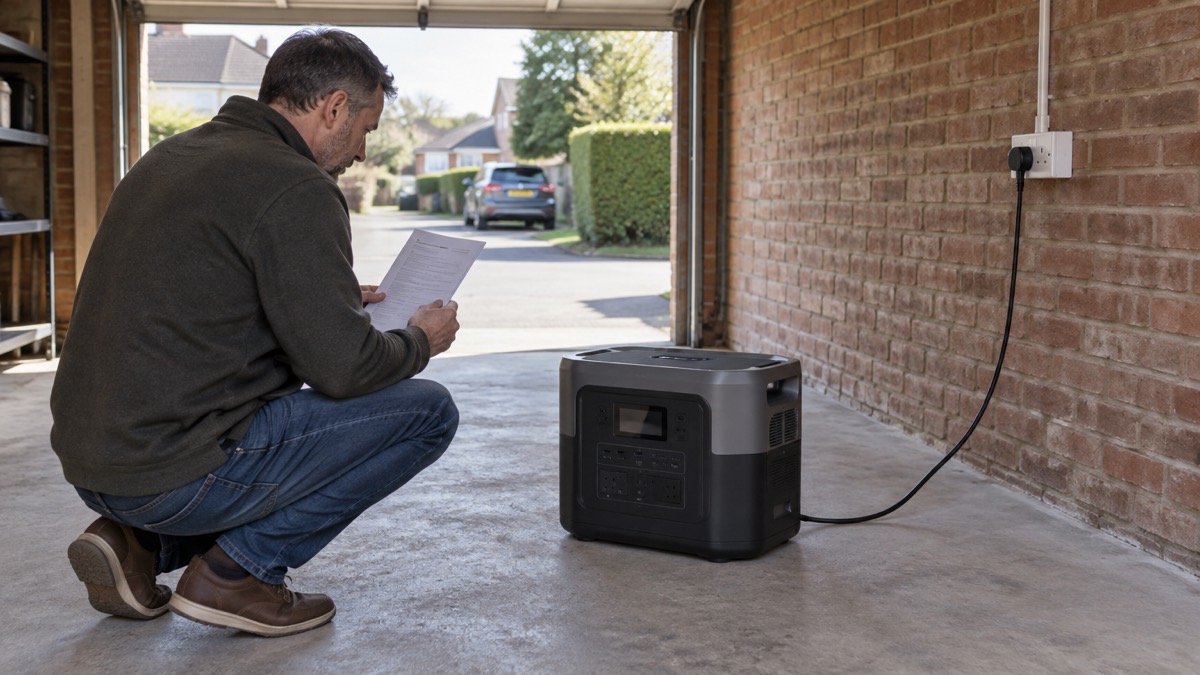
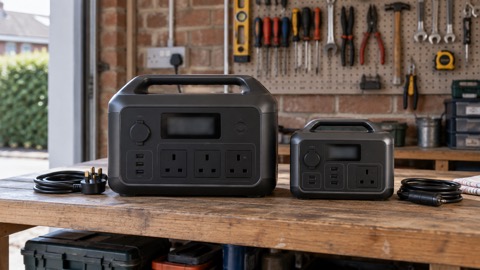
A portable power station is a large rechargeable lithium battery with mains sockets and USB ports built in. It is not a generator: there is no fuel and no exhaust, so it produces no carbon monoxide. Its fire risk comes from the battery itself, and from how and where you charge it. Fire and rescue services are clear that lithium batteries can present a fire risk when over-charged, short-circuited, submerged in water or if they are damaged1. The larger the battery, the larger the danger2.
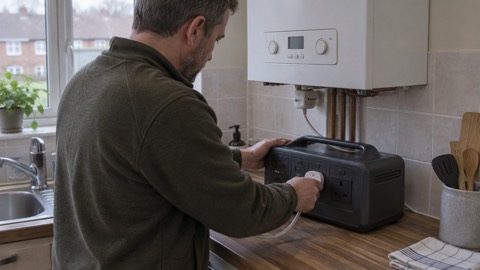
The good news is that the risk is manageable, and it is mostly about placement and charging habits. Charge the unit on a hard, non-flammable surface, away from anything that burns, never on bedding, and not overnight. Keep it dry, keep it out of direct sunlight, and never exceed its output rating. The maker of the Anker SOLIX F2000 states: "Do not use the product in excess of its output rating. Overload outputs above the rating may result in a risk of fire or injury"3.
This page covers what the unit is, how to charge it safely from the mains, a car socket or solar panels, how to match what you plug in to what the unit can supply, how to use one during a power cut, and why it is not the right answer for medical appliances. For the wider picture, see Portable Power Stations: What They Do and How to Choose.
What a portable power station is, and where its fire risk comes from
A power station stores energy in lithium-ion cells, the same chemistry as a phone, a laptop or an e-bike. Fire services describe these batteries as a fire risk when over-charged, short-circuited, submerged in water or damaged1. Where a battery fails, it can lead to a rapidly developing fire7. That is the worst case, and it is rare, but it is why the placement rules matter.
The size of the battery sets the scale of the danger. As North Wales Fire and Rescue Service puts it, "The larger the battery, the larger the danger"2. A power station holds far more energy than a phone, so a fault inside it has more to release. That is not a reason to avoid one; it is a reason to treat it as a piece of electrical equipment rather than a gadget.
Most home battery fires trace back to a handful of causes. Overcharging is one: charging too long or with too much voltage can cause overheating and fires8. Heat is another: covering a device while it charges traps heat and increases fire risk4. Water damage and physical damage are others1. Second-hand batteries and chargers can be a serious fire risk, so buy from a reputable seller and use the charger the maker supplied5.
Charging safely from the mains, a car socket or solar panels
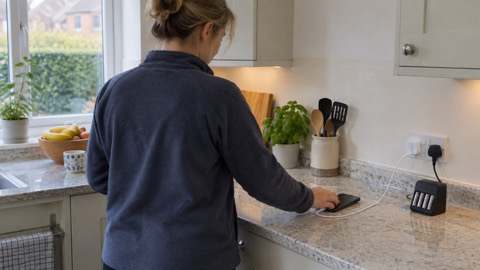
Where you charge the unit matters as much as how. Electrical Safety First advises that it is dangerous to charge a battery close to combustible materials or hazardous substances, or where high temperatures or direct sunlight are likely5. Fire services add that placing combustibles such as clothing or paper close to electrical equipment and sockets is a risk10. In practice: a hard floor or worktop, clear of curtains, paperwork and soft furnishings.
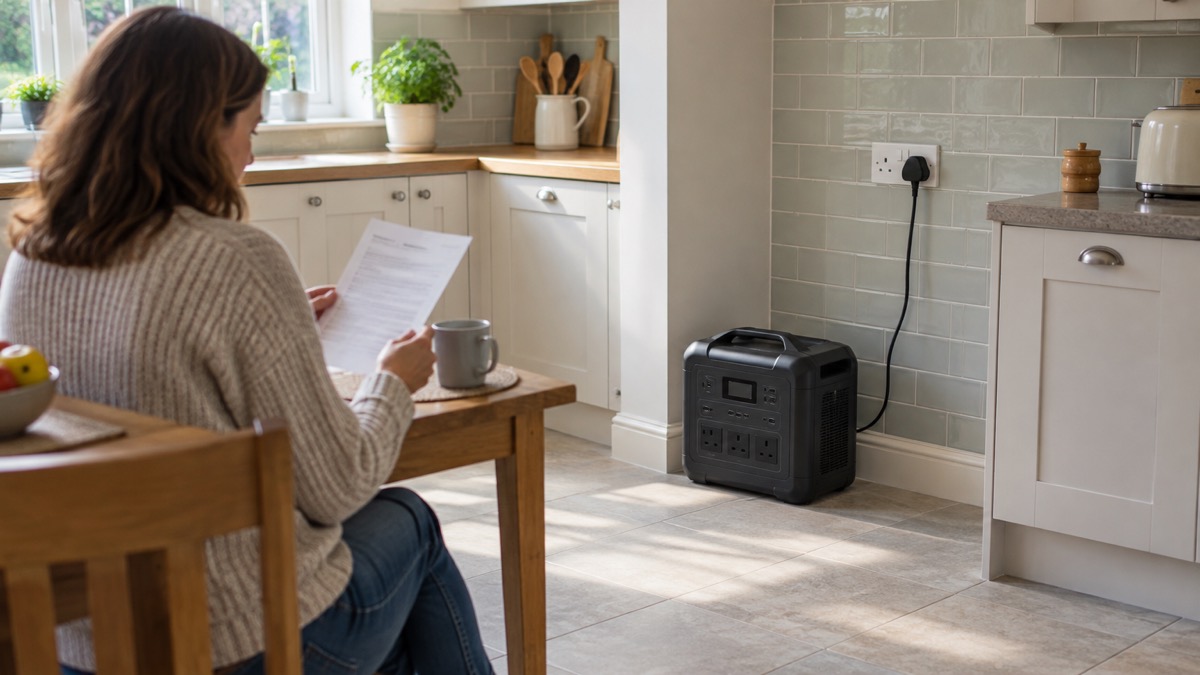
Never charge on a flammable surface such as bedding, because it increases the risk of fire spread11. Do not leave phones, laptops or other devices with lithium batteries charging overnight12. The same caution applies to a power station: charge it while you are awake and in the house, then unplug it.
Check the cable every time. "If your charging cable is cracked, severely twisted or has exposed wires, don't use it, it could cause a fire"6. Use one plug per socket, and do not overload sockets with adaptors13. Block plug adaptors are a particular hazard: many are not fused and are a fire risk13.
| Charging method | What to watch for |
|---|---|
| Mains socket | One plug per socket; no block adaptors; uncoil extension leads fully and use one rated for the device13 |
| Car socket | Keep the cable undamaged and the unit secure while charging on the move6 |
| Solar panels | The fire risk from solar panels is low, but bad installations, poor connections and cable damage through vermin and weathering cause problems15 |
Solar charging brings its own checks. The risk of fire from solar panels is low, but known problems can occur through bad installations, poor quality connections and cable damage through vermin and weathering15. If you use a folding panel, inspect the cable and connectors before each use, and keep the panel and its wiring out of standing water. For more on this, see Portable Solar Panels for Charging in a Power Cut.
Matching the load to the unit: small loads for phones, laptops and lights
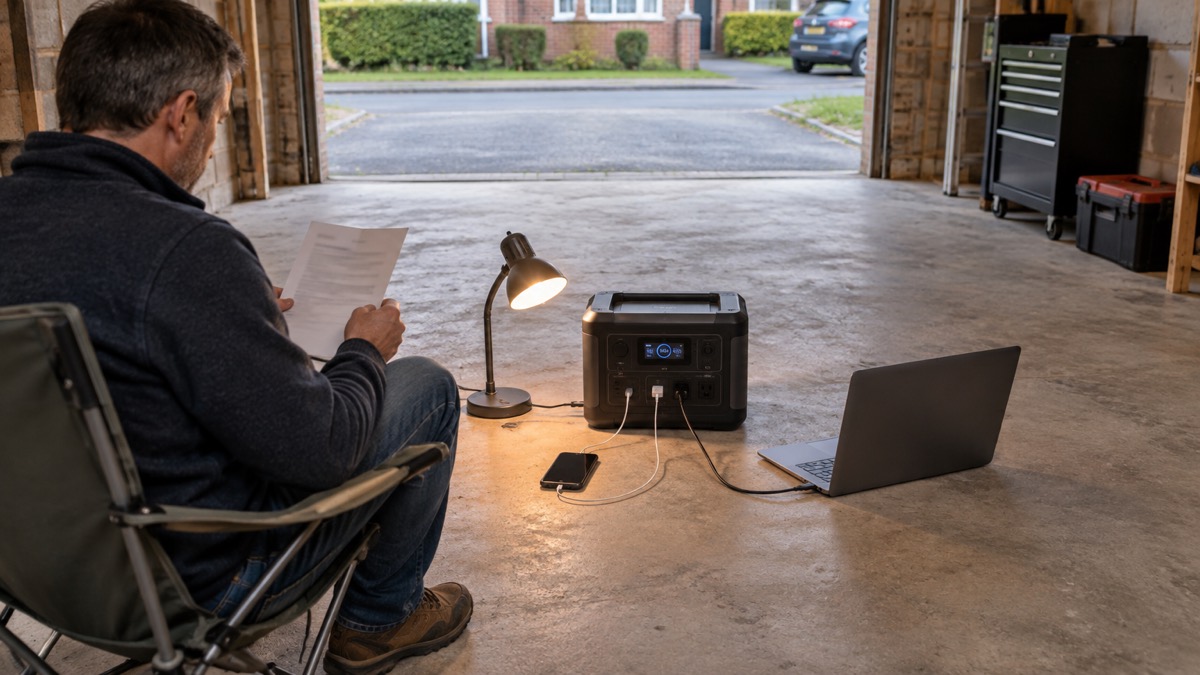
A power station's capacity is measured in watt-hours, and its output in watts. The output figure is the ceiling: exceed it and the unit may overheat. The maker's instruction is unambiguous: "Do not use the product in excess of its output rating. Overload outputs above the rating may result in a risk of fire or injury"3. Check the wattage printed on each appliance before you plug it in.
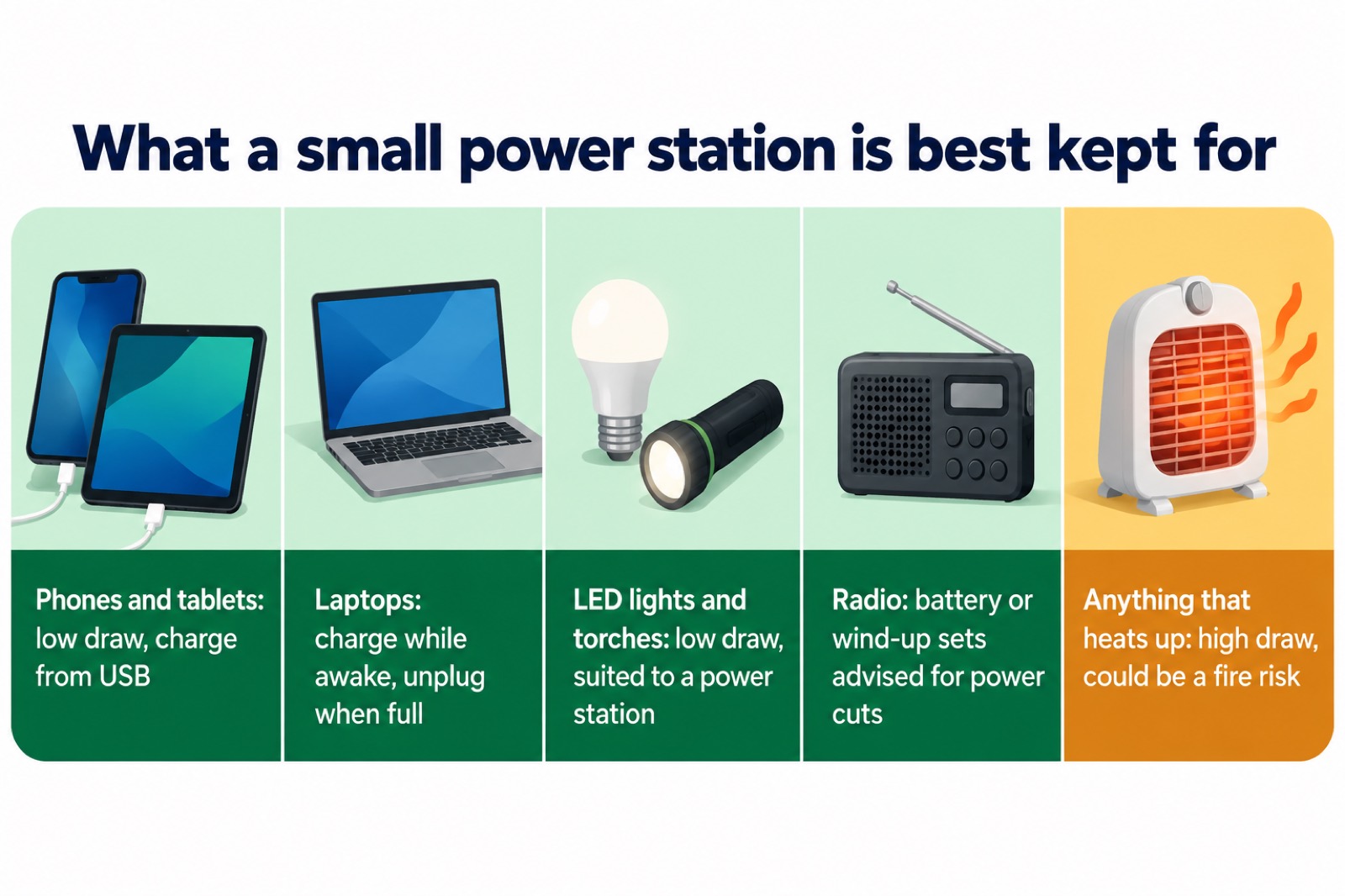
For phones, laptops, lights and a radio, a small unit is the sensible size. These are small loads, and a modest battery will run them for hours. Anything that heats up is a different matter: fire services warn that anything that heats up needs a lot of electricity and could be a fire risk16. Kettles, heaters and heated throws fall into that category and should not be run from a small unit.
If too many electrical items draw power from one socket it can overheat and catch fire17. That applies to the power station's own sockets as much as to a wall socket. Spread the load, and add up the wattages of everything you plan to run at once before you switch it on.
Using one during a power cut at home
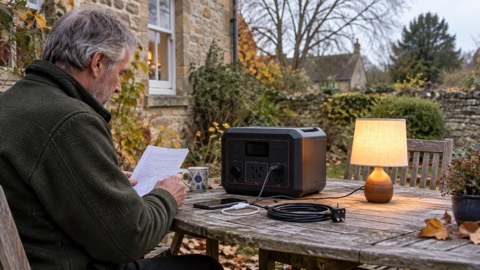
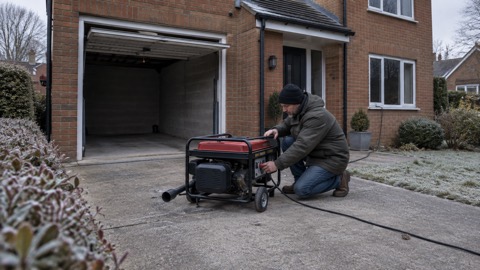
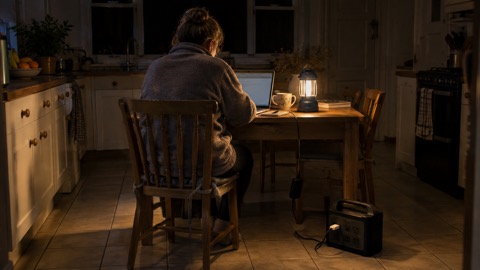
A power station earns its place in a power cut because it is quiet, produces no exhaust and can be used indoors. That last point is the important one: unlike a petrol generator, it does not produce carbon monoxide, so it does not carry the generator's indoor danger. It still needs the same care as any electrical equipment.
Set it up before the lights go out. Charge it fully, check the cables, and decide which devices it will run. During the cut, keep it on a hard surface, keep it dry, and do not cover it while it is in use. Use one plug per socket19. Keep cables out of walkways so nobody trips in a dark room.
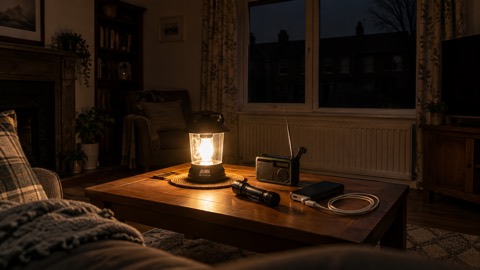
Firefighters are called to fires started by candles or portable heaters during a power cut20. A power station lets you avoid both: run LED lights from it instead of lighting candles, and do not bring a portable heater into a room to replace the central heating. If you need light, a torch or lantern on a power station is far safer than a flame. See Emergency Lighting at Home: Torches, Lanterns and Candles for the alternatives.
Keep a battery or wind-up radio and spare batteries, and write down radio station frequencies on paper, so you can hear updates if the mobile network is busy18. A power station will keep that radio and your phones going. For the wider plan, see Using Generators and Power Stations During an Outage.
Not intended for medical appliances
A portable power station is a consumer electrical product, not a medical device. It is not intended to power oxygen concentrators, CPAP machines, home dialysis or other medical appliances, and treating it as one is a plan that can fail at the worst moment. If someone in the household depends on powered equipment, the plan needs to come from their care team and their electricity supplier, not from a battery bought off the shelf.
Fire services identify medical oxygen equipment as one of the fire risks in care at home, alongside emollients used to treat skin conditions and telecare systems that are not installed correctly21. That is a reason to have the equipment and its power supply assessed properly, not a reason to improvise.
There is a deadline worth knowing about. The UK landline digital switchover is due to be complete by January 2027, and the change may affect telecare devices and personal alarms; providers should contact users before the switch22. If you rely on a telecare alarm, ask your provider what happens to it during a power cut and after the switchover.
For households with medical needs, ask the electricity supplier about the Priority Services Register, which gives extra support during a power cut. For the equipment side, see Powering CPAP, Oxygen and Other Medical Devices From a Battery.
Safe disposal and what to do with a damaged unit
A power station that is old, damaged or no longer holds charge is a fire risk if it goes in the bin. Many incorrectly disposed of electricals can easily cause fires when they enter the waste stream, posing a risk to workers in waste and recycling centres23. Many electrical items contain hidden batteries which can cause fires if they incorrectly enter the waste stream24.
Take it to a household waste and recycling centre that accepts batteries, or use a retailer take-back scheme. Do not put it in a general waste bin, and do not store a damaged unit in the house while you decide what to do with it. If a battery starts to swell, overheat or give off smoke, move it away from anything that burns and call the fire and rescue service.
For more on spotting trouble early, see Warning Signs a Lithium Battery Is Dangerous and What to Do If a Lithium Battery Catches Fire.
Sources (24)
- Batteries and chargers, London Fire Brigade, 2026-10-25
- Lithium-ion batteries, North Wales Fire and Rescue Service, 2026-10-25
- Anker SOLIX F2000 user manual, Anker, 2026-10-26
- Lithium battery fire safety, Mid and West Wales Fire and Rescue Service, 2026-10-26
- Hoverboards and self-balancing boards, Electrical Safety First, 2026-10-25
- Student safety, Devon and Somerset Fire and Rescue Service, 2026
- Lithium-ion batteries, Scottish Fire and Rescue Service, 2025-11-27
- Battery fires, Devon and Somerset Fire and Rescue Service, 2026
- How to dispose of batteries from your e-bike or e-scooter, London Fire Brigade, 2026-10-25
- Home safety partnerships, Devon and Somerset Fire and Rescue Service, 2026
- Other safety, Northern Ireland Fire and Rescue Service, 2026-10-22
- Bedtime checks, London Fire Brigade, 2026-10-25
- Top ways to reduce your risk of having a fire at home, Devon and Somerset Fire and Rescue Service, 2026
- Electricity, Health and Safety Executive, 2026
- Solar panels, Electrical Safety First, 2026-10-26
- Stay warm safely this winter, Devon and Somerset Fire and Rescue Service, 2026
- Electrical safety, North Yorkshire Fire and Rescue Service, 2026-09-14
- Power cuts, UK Government Be Ready campaign, 2026-10-21
- Cut the risk of fire in your home, Wiltshire and Swindon Prepared, 2026-10-25
- Power cuts, Scottish Fire and Rescue Service, 2026-10-25
- Home safety position statement, National Fire Chiefs Council, 2025-12
- Telecare, Age UK, 2027-01
- Recycle your electricals, National Fire Chiefs Council, 2026-10-06
- Charge safe campaign, North Yorkshire Fire and Rescue Service, 2026-08-18
 Power Cut Backup Power Checklist
 Backup Power Before Winter
 Safe Battery Charging at Home
 Running a Generator Indoors
 Carbon Monoxide from Generators
 Generator Sizing for a Power Cut
 Generator Run Time on a Tank
 Storing Petrol at Home
 Diesel Storage at Home
 Storing a Generator
 Generators in Cold Weather
 Generator Noise and Neighbours
 Power Station Capacity Sizing
 Power Station Run Time
 Power Station for a Gas Boiler