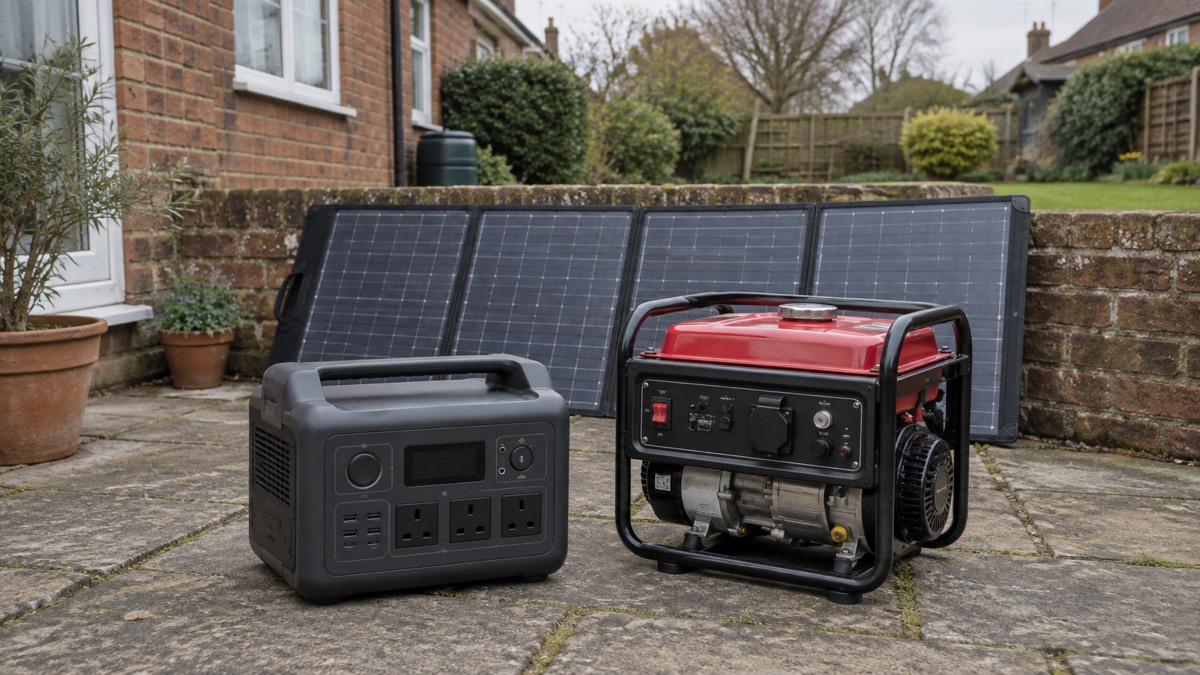
If you are weighing up backup power for a power cut, the choice comes down to two very different things. A portable power station is a rechargeable battery with sockets and USB ports: silent, fume-free, and safe to use in the room you are sitting in. A petrol generator converts fuel to kinetic energy and then into electricity, usually using an internal combustion engine, and most consumer, workshop and home models use petrol or diesel1. Machine Mart lists generators supplying from 700 Watts to 6500 Watts (0.7kVA to 6.5kVA)2.
For most ordinary households the deciding factor is not power but placement. The Health and Safety Executive says never use petrol powered equipment indoors or in enclosed spaces unless the ventilation needs have been fully assessed3. A power station has no such limit. A generator does, and getting it wrong can kill: the London Fire Brigade warns that petrol or diesel generators run indoors can produce fatal levels of carbon monoxide4.
So the practical answer is this. If you want to keep phones charged, run a router, a lamp, a laptop or a small fridge, a power station does the job indoors with no fuel and no fumes. If you need to run power tools, a pump, a heater or a whole circuit of appliances for hours, a generator gives you far more output, but it goes outside, well away from doors, windows and vents, and you plan the fuel, the noise and the siting before the cut happens5.
| Portable power station | Petrol generator | |
|---|---|---|
| What it is | Rechargeable battery with sockets and USB7 | Engine driving an alternator5 |
| Output | Suited to low power demand7 | From 700 Watts to 6500 Watts (0.7kVA to 6.5kVA)3 |
| Fuel | None; recharged from mains, car or solar13 | Petrol, diesel or LPG3 |
| Indoors | Safe to use indoors | Never indoors; carbon monoxide risk15 |
| Noise | No engine noise | Noise comes from the engine, exhaust, air intake and vibration17 |
| Suits | Phones, router, lamp, laptop, small fridge | Tools, lighting, pumps, workshop equipment and general site use5 |
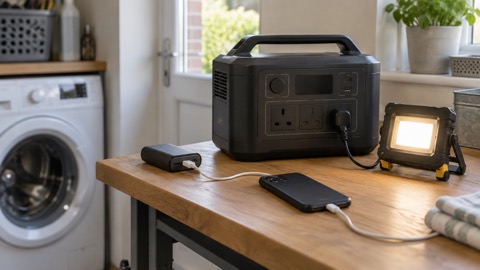
A power station is a rechargeable battery with sockets and USB ports
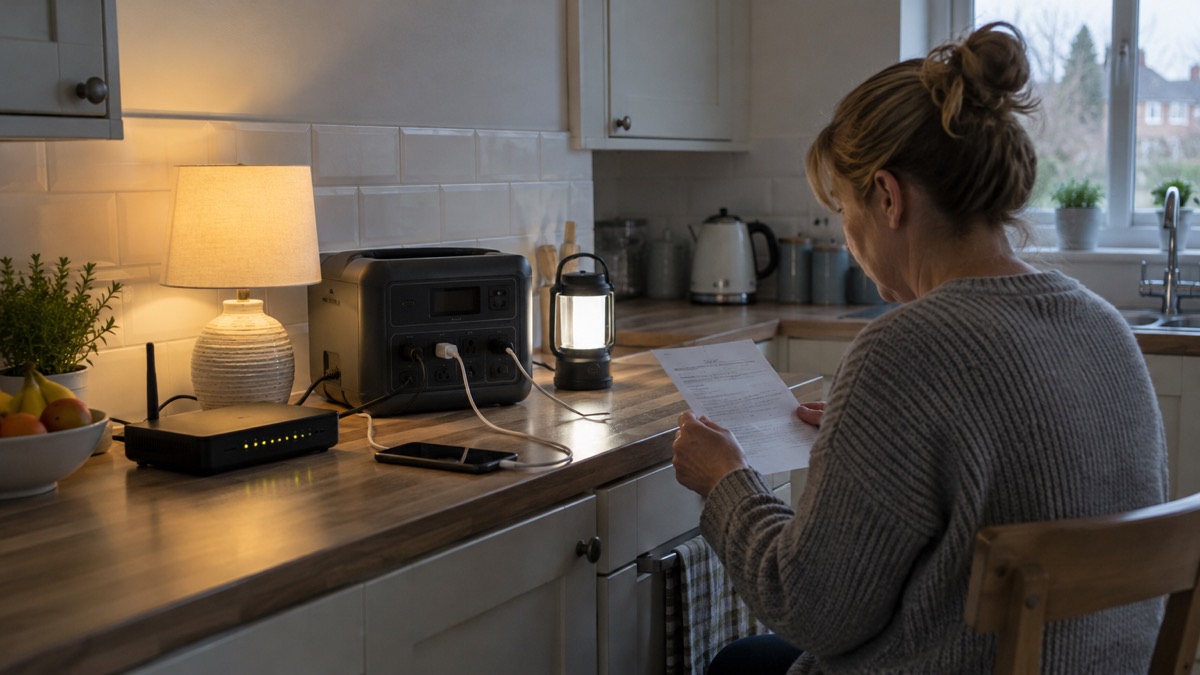
A power station stores energy in a battery and gives it back through ordinary sockets and USB ports. Which? describes battery generators as smaller and more portable than generators that use a fuel tank, but only really useful if you have low power demand7. That is the honest limit: a power station is excellent at the small, constant jobs that make a cut bearable, and poor at the heavy ones.
What it does well is the everyday load. Phones, a router, a laptop, a lamp, a radio and a small fridge are all within reach of a mid-sized unit. What it will not do is run an electric shower, an oven or a fan heater for long. If you want to work out what your own appliances draw, see Watts, Watt-Hours and Surge Explained, and for capacity in detail, What Capacity Power Station Do I Need?.
The other advantage is that it can be recharged without fuel. Anker says its SOLIX C300 DC can be charged by PD, solar panels or your car8. Jackery says its Solar Generator 600 v2 recharges via AC, solar or car, with hybrid charging topping up in 70 minutes, solar in 8 hours and car in 7.5 hours9. EcoFlow lists AC power, a car adapter, a Type-C cable and portable solar panels for its RIVER 2 series10. None of that needs a petrol can in the shed.
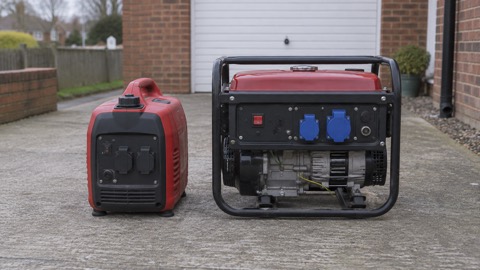
A petrol generator burns fuel to make electricity, from 700W to 6.5kW
A generator turns an engine to make electricity. Clarke describes conventional petrol generators as using an engine to drive an alternator at a relatively constant speed, practical for tools, lighting, pumps, workshop equipment and general site use, often providing a higher output for the price5. That higher output is the reason people choose one: it can start and run things a battery cannot.
The range is wide. Briggs & Stratton's ProMax 7500EA provides 7500 starting watts and 6000 running watts11, and its ProMax 9000EA provides 9000 starting watts and 7000 running watts12. Champion's 5500 watt model lists a fuel consumption of 3.29 litres per hour at 75% load6. Starting watts matter because motors and compressors draw a surge when they start; running watts are what the machine sustains. For the difference in plain terms, see Watts, Watt-Hours and Surge Explained.
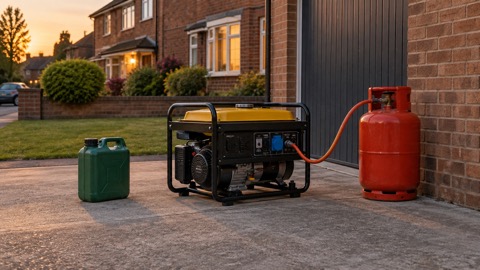
Fuel choice matters too. Which? notes that diesel generators are more efficient compared to petrol-powered ones, although the fuel will cost you more7. Petrol is easier to buy in small quantities but needs storing with care; see How Much Petrol Can I Store at Home Safely?. Dual fuel models add LPG as an option, covered below.
Where a generator must never go: carbon monoxide and siting
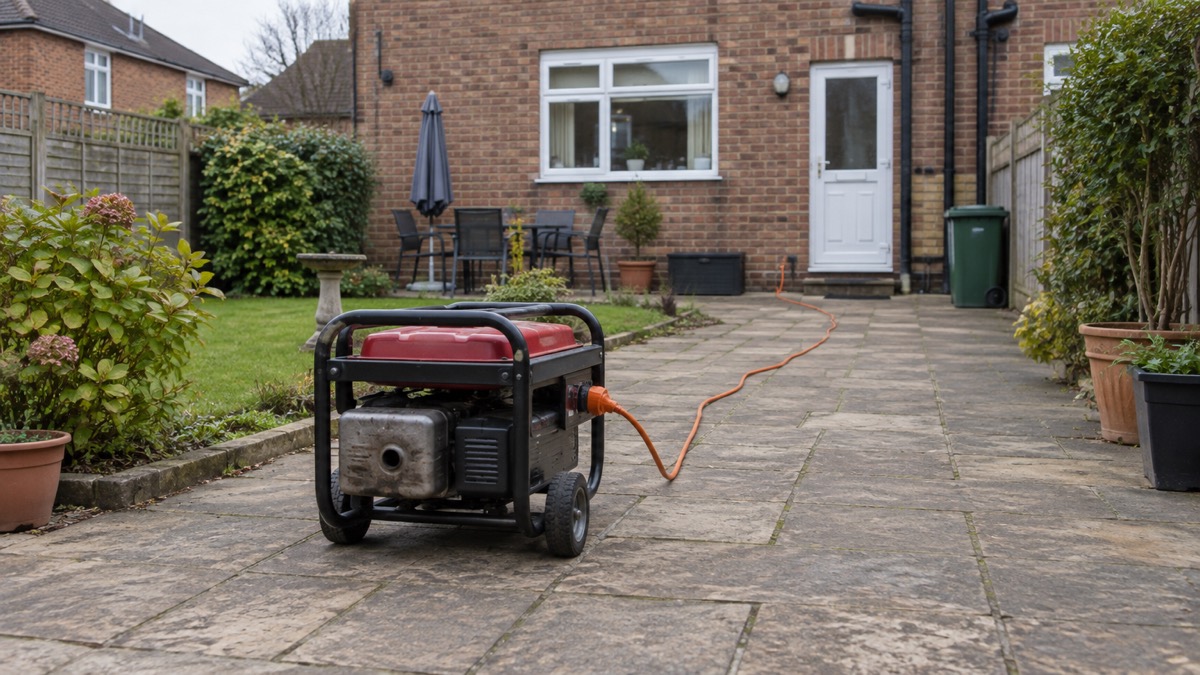
This is the section that matters most. Carbon monoxide from a generator is colourless and can build up fast. Wiltshire and Swindon Prepared says do not use petrol or diesel generators or other similar fuel-driven equipment indoors because their exhaust gases contain carbon monoxide, which can poison if in high concentrations in the air15. The London Fire Brigade's flooding aftercare advice is blunter: never run a petrol or diesel-powered generator indoors, as they can produce fatal levels of carbon monoxide4.
The Northern Ireland Executive's severe weather advice says never use standby generators indoors, as the fumes from the engine can be lethal, and to be careful where you put a generator in case of carbon monoxide poisoning16. The Health and Safety Executive says to locate petrol generators outside in well ventilated spaces so that fumes disperse and cannot gather or drift into building openings3. Clarke's own instruction is to never operate a generator inside a house, garage, shed, tent or caravan, and to keep it outdoors and well away from doors, windows and vents5.
The risk is not theoretical. The Gas Safety charity's case studies record a generator run in the porch of a mobile home, and note that petrol is often not associated with carbon monoxide but any combustible fuel can produce CO, in any location17. A carbon monoxide alarm is useful at home, but the fire and rescue services warn not to rely on one to keep you safe in a tent or awning, because they are not designed for those conditions19.
Recharging a power station: mains, car socket or solar
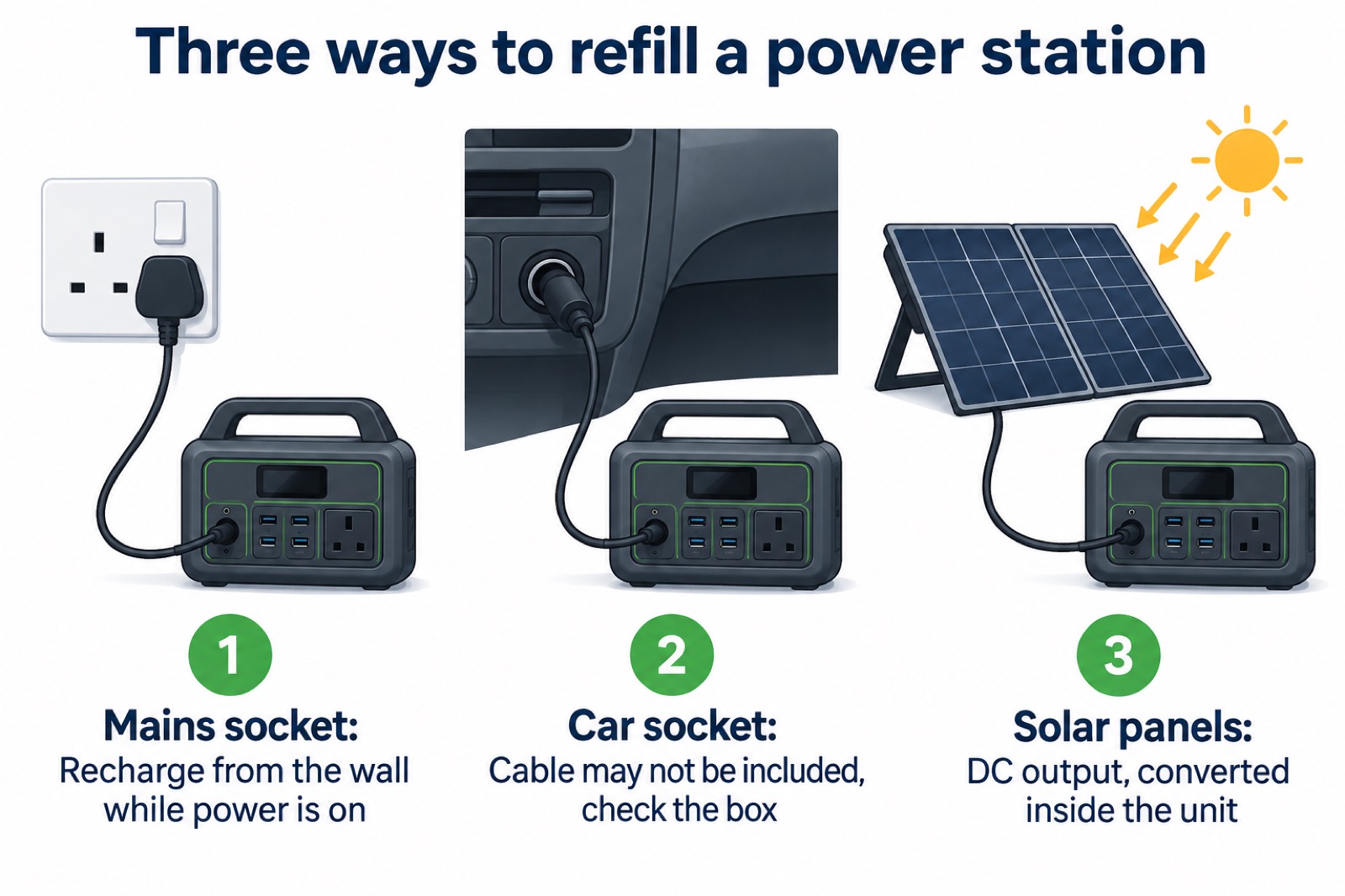
A power station is only as good as your ability to refill it. There are three routes, and most units offer all of them. Anker says its SOLIX C300 DC can be charged by PD, solar panels or your car8. Jackery says all its portable power stations can be charged via SolarSaga solar panels, wall outlets or car ports, and that in most cases they support simultaneous AC and solar charging for faster recharging, though most models do not support car charging and solar charging at the same time20.
The car route has a catch worth knowing before an outage. Anker's manual for the SOLIX F3800 says to recharge by connecting to a car's output port with the car charging cable, which is not included21. Check what comes in the box. For more on this route, see Can You Charge a Power Station from Your Car?.
Solar is the route that keeps working when the grid does not. The Caravan and Motorhome Club explains that the power generated by a solar panel is direct current (DC), so if you want to use it to power something that uses a three-pin 230V socket you need an inverter22. A power station with a built-in solar input does that conversion for you. Bear in mind that UK winter sun is weak, so solar is a top-up rather than a guarantee; see How Long Does Solar Charging Take in the UK? and What Size Solar Panel Do I Need to Charge a Power Station?.
Choosing by output, run time, noise and fuel
Start with what you need to run, not with the machine. Pramac's guidance is to choose a portable generator by considering usage (home standby, long run or temporary run use), tension (single phase or three phase) and power (how much power you need for the items you care about)23. That order works for a power station too: list the appliances, add up the watts, then decide.
Output decides what will start. A generator's starting watts must cover the surge from a motor, and its running watts must cover the steady load11. A power station's capacity and output decide the same things in battery terms; see What Size Generator Do I Need for a Power Cut? for the generator side. When you choose a generator, weigh maximum output, output voltage, start method, run time, sound output, fuel used and output socket type14.
Run time depends on fuel and load. Champion's 5500 watt model uses 3.29 litres per hour at 75% load6, so a bigger tank or a lighter load stretches the run. For a power station, run time depends on the battery capacity against the load; see How Long Will a Power Station Run a Fridge or Laptop?.
Noise is where the two diverge sharply. Champion lists its 3200 watt petrol generator at 68 dBA at 7 metres24 and its 5500 watt remote-start model at 74 dBA at 7 metres6. A power station has no engine to hear. If noise is your main worry, see How Loud Is a Generator? Noise and Neighbours.
Fuel is the last variable. Which? notes diesel is more efficient than petrol but costs more7. Dual fuel models add LPG: Champion says LPG is around 30% to 50% cheaper to run currently than petrol, gives a longer run time from a bigger cylinder, burns more cleanly so it can be used around food or petrol-free campsites, has no bad smells and minimal spillage risk, lowers maintenance costs and refuels fast by connecting a new bottle14. You will need the right cylinder and regulator; see LPG Cylinders and Regulators for Dual-Fuel Generators.
| What you need to run | Sensible choice | Why |
|---|---|---|
| Phones, router, lamp, laptop | Power station | Low demand, indoor use, no fumes7 |
| Small fridge for a few hours | Larger power station | Low demand but steady draw7 |
| Power tools, pump, heater | Petrol generator | Higher output for the price5 |
| Long outage, heavy load | Generator with fuel plan | Fuel consumption and run time decide6 |
| Quiet street, close neighbours | Power station, or a quieter generator | 68 to 74 dBA at 7 metres on the models listed24 |
Connecting a generator to your home, and other practical limits
A generator is not a plug-in replacement for the mains. Clarke says never connect a portable generator directly to household wiring or a wall socket, as this can create dangerous backfeed into the electricity network and may cause serious injury, fire or damage5. SP Energy Networks says that before connecting a generator the incoming supply must be switched off and isolated from your own electrical circuits and the generator, otherwise you risk damaging your property and endangering the lives of employees working on power lines25. The safe route for most households is extension leads to individual appliances; for the proper fixed route, see Connecting a Generator or Battery to Your Home's Wiring.
Sockets vary by model, so check before you buy. Champion's 3200 watt generator has a 12VDC output as well as 16A 120V and 230V sockets24. Its 5500 watt model has two 110V and one 240V socket6. Its 2200 watt inverter has one 110V 16 amp socket and overload protection26. 230V is the standard UK domestic voltage; 110V is the lower voltage used on UK construction sites. If you are buying for the home, 230V sockets are what ordinary appliances need.
Starting method is a practical choice. Champion lists its 5500 watt model as recoil, electric and remote start6, and Briggs & Stratton's ProMax 9000EA has an electric key start27. Electric start is easier in cold weather or for anyone who would struggle with a cord; pull-cord needs no battery. For more, see Will a Generator Start in Cold Weather?.
Finally, know what your network operator will and will not do. UK Power Networks says generators are only provided in exceptional circumstances, such as for medical needs like oxygen equipment, mobility aids or end-of-life care28. Northern Ireland Networks advises being careful where you site a generator in case of carbon monoxide poisoning, and making sure there is plenty of air flow around it to supply oxygen and remove the fumes29. If you rely on powered medical equipment, see Powering CPAP, Oxygen and Other Medical Devices From a Battery and ask about the Priority Services Register with your network operator.
Sources (29)
- Diesel Generators vs Petrol Generators - Expert Advice - Machine Mart, Machine Mart
- Generators Buyer's Guide - Expert Advice - Machine Mart, Machine Mart
- Carbon monoxide, Health and Safety Executive, 2026
- After a flood, London Fire Brigade, 2026-10-25
- Generators, Clarke International, 2026-10-25
- Champion 5500 Watt Petrol Generator With Remote Start, Champion Power Equipment, 2026-10-25
- How to buy the best generator, Which?, 2026-01-20
- Anker SOLIX C300 DC Portable Power Station, Anker SOLIX, 2026-10-25
- Jackery Solar Generator 600 v2, Jackery, 2026-10-25
- Portable power stations, EcoFlow, 2026-10-25
- ProMax 7500EA, Briggs & Stratton, 2026
- ProMax 9000EA, Briggs & Stratton, 2026
- Portable Power Station Buyers Guide - Expert Advice - Machine Mart, Machine Mart
- Champion 3500 Watt LPG Dual Fuel Inverter Generator, Champion Power Equipment, 2026-10-25
- Generators, Wiltshire and Swindon Prepared, 2026-10-25
- Strong winds and heavy rain warning: information and advice, Northern Ireland Executive, 2026-01-27
- Kelly Webster and Lauren Thornton case study, Gas Safety charity, 2021
- Fatal case studies, Gas Safety charity, 2020-02-12
- Camping and caravanning safety, Devon and Somerset Fire and Rescue Service, 2026
- Jackery buying guide, Jackery, 2026-10-25
- Anker SOLIX F3800 Portable Power Station user guide, Anker, 2026-10-26
- Solar power, Caravan and Motorhome Club, 2026-10-25
- FAQs, Pramac, 2026-10-25
- Champion 3200 Watt Petrol Generator, Champion Power Equipment, 2026-10-25
- Planned interruptions, SP Energy Networks, 2023
- Champion 2200 Watt Inverter Petrol Generator 110V, Champion Power Equipment, 2026-10-25
- Open frame generators, Briggs & Stratton, 2026
- Advice and support FAQs, Electricity North West, 2026-10-25
- Power cuts advice, Northern Ireland Networks, 2026-10-25
 Inverter vs Open-Frame Generator
 LPG vs Petrol Generator
 Power Bank vs Power Station