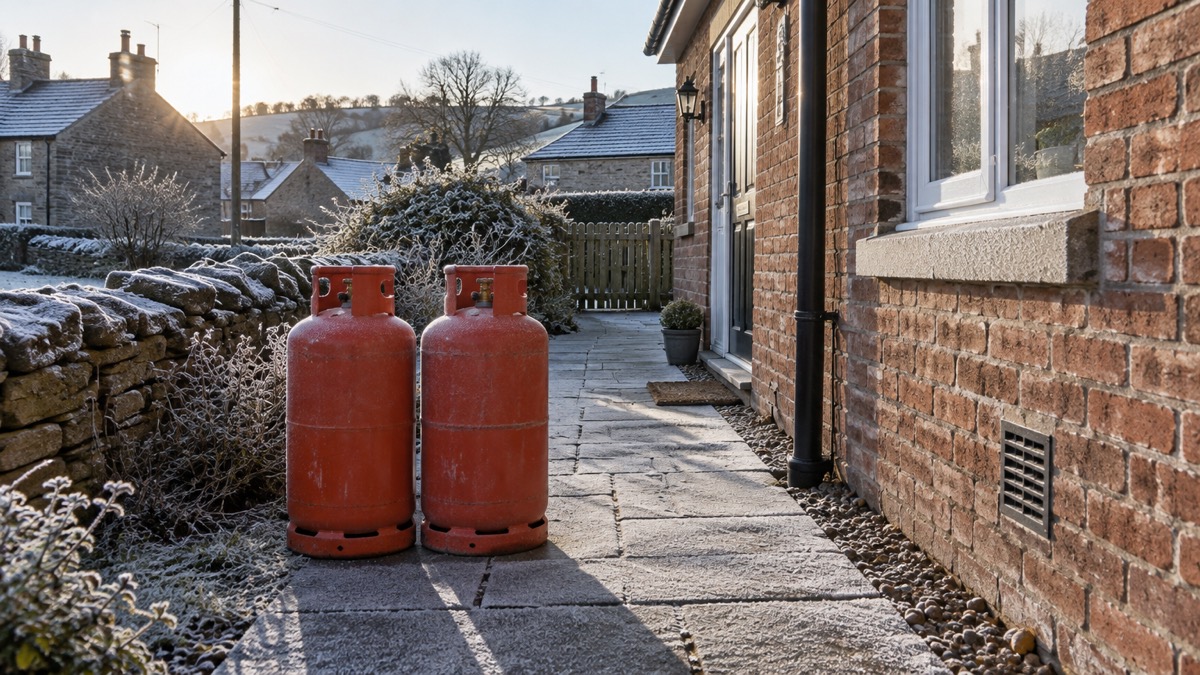
A dual-fuel generator gives you a choice of fuels in a power cut: petrol from a can, or LPG from a gas bottle. The LPG side is the part most households are less familiar with, because it brings in a cylinder, a regulator and a hose that must all match each other and match the generator. Get that right and the gas side is straightforward: the maker of the Champion 3500 Watt LPG dual-fuel inverter describes refuelling as simply connecting up a new bottle and going1.
The two numbers to hold on to are these. In the UK, a butane regulator is pre-set at nominally 28 to 30 mbar, and a propane regulator is pre-set to 37 mbar2. Most dual-fuel generators sold in the UK run on propane, and the two Champion dual-fuel models covered below both include a 37 mbar regulator3. If you smell gas at any point, call the National Gas Emergency Service on 0800 111 999 immediately4.
This page covers the whole gas side of a dual-fuel set-up: choosing the cylinder and regulator, connecting them safely, storing cylinders at home, and knowing when to replace parts. For the wider picture, see Backup Power at Home, Portable Generators and the comparison of LPG and petrol for emergencies.
If you smell gas: call 0800 111 999
Before anything else, know what to do if something goes wrong. The National Gas Emergency Service is available 24 hours a day, 365 days a year on the freephone number 0800 111 999, and it will send out an engineer to keep you and your property safe6. The same number applies whether you smell gas in your home or your business, and the National Energy System Operator's advice is simple: if you smell gas or suspect a leak, call 0800 111 999 immediately4.
The Health and Safety Executive (HSE) gives the same number for a suspected leak from an appliance or its pipework7. If your carbon monoxide alarm sounds, Devon and Somerset Fire and Rescue Service also directs you to the Gas Emergency Helpline on 0800 111 9998. The NHS advises calling the free National Gas Helpline immediately on 0800 111 999 if you think a gas appliance is leaking carbon monoxide9.
For an LPG set-up specifically, there is a second call to make. Liquid Gas UK, the trade body for the LPG industry, advises that if you think you have an LPG leak at a cylinder or the associated pipework, you should call your LPG supplier so they can come and make safe2. The fire and rescue services add the immediate step: if you suspect a leak, turn off the main cylinder valve10.
Butane or propane: matching the cylinder to your generator
LPG is the umbrella term: it covers both butane and propane, stored as a liquid under pressure11. Your generator's instructions specify which one it takes, and Liquid Gas UK's guidance for gas appliances is that the cylinder should be of the correct type for the appliance, either propane or butane, and of a size specified in the manufacturer's instructions12. The HSE makes the same point for heaters: ensure the correct size and type of gas bottle is being used7.
The dual-fuel generators sold in the UK for household backup run on propane. Champion's 2200 Watt "Mighty Atom" dual-fuel inverter is listed by the maker as running on petrol or propane3, and the Champion 3500 Watt dual-fuel inverter is likewise listed as dual fuel with a 37 mbar regulator included1.
The cylinder type determines the connection. Liquid Gas UK's guidance on patio heaters explains that a butane cylinder will probably have a clip-on or snap-on valve, which must be compatible with the regulator connector, while a propane cylinder will have either a screw or a clip-on connection, the clip-on type being the "patio gas" cylinders12. Regulators come in these two basic patterns, screwed connectors and quick-connect clip-on types, and they are specific to the type of cylinder they can be attached to5.
| Cylinder type | Typical connection | Typical use |
|---|---|---|
| Butane | Clip-on or snap-on valve, must match the regulator connector12 | Portable heaters, camping |
| Propane | Screw fitting (left-hand thread) or clip-on "patio gas"12 | Patio heaters, dual-fuel generators |
| Propane, 19 kg bottle | Screw fitting | The bottle size Champion cites for its dual-fuel generators3 |
One point worth knowing before you buy: a reviewer of the Mighty Atom reports on the maker's own product page that, at the time of writing, the generator would not run on propane3. Treat that as a single reported experience rather than a settled verdict, but it is a reminder to test the gas side of your set-up before you need it, not during a power cut.
Regulator pressure: 28 to 30 mbar butane, 37 mbar propane
The regulator is the small fitting between the cylinder and the appliance that steps the pressure in the bottle down to the pressure the appliance is built for. In the UK, butane regulators for domestic use are pre-set at nominally 28 to 30 mbar, and a propane regulator is pre-set to 37 mbar2. Liquid Gas UK's guidance on mobile heaters states that a suitable 28 to 30 mbar rated butane regulator must be included in the connection between the cylinder and the appliance13, and its patio heater guidance gives the normal pressures as 28 mbar butane or 37 mbar propane12.
For a dual-fuel generator, the number to check is 37 mbar, because these machines run on propane. Both Champion dual-fuel models list their regulator type as 37 mBar, included in the box3. The maker's guidance on fitting a regulator is to make sure the outlet pressure of the regulator is the same as the inlet pressure requirement of the appliance, and to ensure it is the correct size for the cylinder valve, never forcing it onto one of the wrong size5.
There is one exception worth knowing about. In touring caravans and motorhomes built to standard EN 1949, the regulators are installed by the manufacturer and pre-set at 30 mbar for both butane and propane5. That arrangement applies to leisure vehicles, not to a generator in your garden, but it explains why you may see 30 mbar regulators sold for caravan use. For a generator, follow the maker's specification.
Choosing a new regulator: BS EN 16129 and under 3 years old
If you are buying a regulator, two things to check are the standard it is marked to and how old it is. Liquid Gas UK's guidance is that regulators must be marked and certified to BS EN 16129, a standard which has superseded regulators previously marked to BS 3016 or BS EN 1286413. The same guidance, in its detailed form, adds that BS EN 16129 has progressively replaced the standards BS EN 12864, BS EN 13785 and BS EN 13786, and that when purchasing a new regulator you should check it is less than 3 years old from the date of manufacture5.
The age rule matters because regulators age. Any regulator marked BS 3016 will be over 10 years old and should be replaced13. Liquid Gas UK also lists BS 3016, BS EN 16129 and BS EN 12864 as markings to look for, and notes that regulators to BS EN 13875 or BS EN 13876 may be needed by some equipment for professional use or for some installations2. For a household generator, BS EN 16129 is the standard to buy.
The hose matters as much as the regulator. Liquid Gas UK's mobile heater guidance says to use only marked and certified hoses to BS EN 16436-1 Class 2/3, bearing the year and name of the manufacturer13. Its patio heater guidance specifies hose to BS EN 16436-1 Class 2 fitted with suitable clips12. If a hose shows signs of cracking, splitting or other deterioration, it should be exchanged for new hose manufactured to BS EN 16436-1 Class 212. Where a hose connects directly to a cylinder, or the outlet pressure of the regulator exceeds 50 mbar, use a hose clearly marked as "High Pressure LPG"2.
Connecting a regulator to the cylinder safely
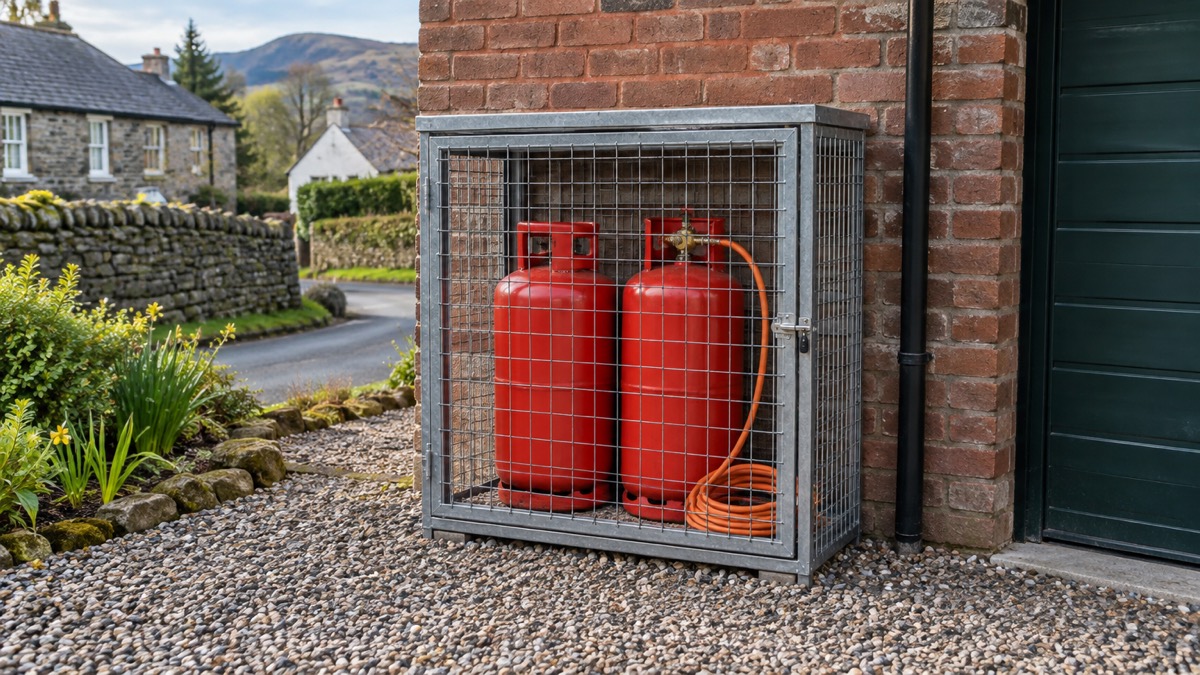
Connecting the regulator is where most mistakes happen, and the instructions are precise. Liquid Gas UK's guidance is to connect regulators to cylinders in accordance with the manufacturer's instructions5. The Scottish Fire and Rescue Service's rule for portable gas heaters applies equally here: never turn on the valve of the new cylinder until the appliance is securely connected11. Devon and Somerset Fire and Rescue Service adds the basic check: make sure the gas pipe connection is secure, and if you suspect a leak, turn off the main cylinder valve10.
The thread catches many people out. Most screwed connections, apart from special cylinders such as Camping Gaz, Calor 340 or Primus, use a left-hand thread and tighten in the opposite direction to a normal screw5. Liquid Gas UK's patio heater guidance puts it plainly for propane: screw connections are left-hand, so undo it clockwise, and use a correct spanner12. Always use the correct sized spanner to tighten any screwed connection, and do not over tighten5. Do not force a regulator onto the cylinder valve if it does not fit easily5.
There is also a position rule for the hose. Where a regulator is not fitted directly to the cylinder outlet, it and any changeover valve should be secured at a position higher than the cylinder outlet, so that the hose slopes downwards from the regulator to the cylinder valve5. And when the set-up will not be used for a long period, such as when the premises are unoccupied, it is recommended that the cylinder valve is turned off until required5.
- Check the regulator is the correct one for the cylinder and the generator, and that its outlet pressure matches the generator's requirement5.
- Connect the regulator to the cylinder following the manufacturer's instructions, remembering that screw fittings are left-hand thread5.
- Tighten with the correct sized spanner, without forcing and without over tightening5.
- Secure the hose so it slopes downwards from the regulator to the cylinder valve5.
- Check the connection is secure before opening the cylinder valve10.
- Only then open the valve, and only when the generator is connected and ready11.
A safety notice from 2024 shows why these checks matter. Morco, a maker of LPG water heaters, issued a critical safety upgrade alert after finding that gas leaking from an installation test-point could ignite, causing the plastic bezel and control knobs at the front of the water heater to catch fire and melt. Morco stresses that if an LPG water heater is suspected of leaking gas, the supply should be disconnected and Morco or a suitably qualified Gas Safe registered engineer contacted straightaway14. The lesson generalises: any smell of gas around an LPG appliance means isolating the supply and getting a qualified person involved.
Where to keep the regulator and hose while it runs
Where you put the cylinder and generator matters as much as how you connect them. Wiltshire and Swindon Prepared's guidance on generators asks the practical question: how will you deploy it? It will need to be secure with good airflow15. That means outdoors or in a genuinely well-ventilated space, never indoors where exhaust can build up. The carbon monoxide risk from running generators is covered in full on our generator safety and carbon monoxide pages.
The regulator itself needs protecting while it is in use. Liquid Gas UK advises making sure the vent on a regulator does not point upwards and is not installed in a position that allows the ingress of water, whether by rain, snow or any trickling or pooling5. The vent must also not be blocked by other contaminants, for example mortar from building works5, and the regulator should be protected from sea water spray unless it is designed for that environment or suitably protected5.
When the regulator is disconnected, storage matters. If a regulator is disconnected from its gas supply, ensure it is stored correctly so that no contaminants enter, protected from water, with the connections adequately plugged or capped5. A regulator left lying uncapped in a shed can pick up dirt or insects that cause problems when it is next used.
For installations that go beyond a portable generator, the rules change. Liquid Gas UK advises using a qualified and registered Gas Safe installer for gas installations covered by the Gas Safety (Installation and Use) Regulations, which cover all installed internal appliances and pipework in habitable, residential and commercial properties in the UK5. A cylinder and a hose feeding a generator in the garden is a portable set-up; anything fixed into the home's pipework is not, and needs a Gas Safe engineer.
When should you replace an LPG regulator?
Regulators do not last forever, and there are clear rules for when to change them. Liquid Gas UK's guidance is to replace any regulator which is not working properly, or after 10 years of life13. Where a manufacturer states a service life, follow it; if it is not known, the recommended service life is 10 years, so long as the regulator has been used correctly according to the manufacturer's instructions5. Replace a regulator if it shows signs of wear, leakage or damage5, and regulators marked BS 3016 are now over 10 years old, so it is recommended that they are replaced5.
Hoses have their own schedule. Champion's service schedule for its 3500 Watt dual-fuel generator states, every 3 years, replace the fuel line and replace the LPG hose1. That is the maker's own maintenance interval for its own product, and it is a sensible marker for any similar set-up. Liquid Gas UK's patio heater guidance adds the visual check: if the flexible hose connecting the regulator to the appliance shows signs of cracking, splitting or other deterioration, exchange it for new hose to BS EN 16436-1 Class 212.
The Health and Safety Executive adds a maintenance point that applies to all LPG equipment. The HSE warns that LPG equipment can be particularly vulnerable, and that blocked or partially blocked burners can lead to higher carbon monoxide levels and flame failure; LPG can also leak from damage to hoses16. Properly maintaining the equipment is the HSE's advice, which means checking hoses as part of the routine, not only when something goes wrong.
| Part | Replace when | Source |
|---|---|---|
| Regulator | Not working properly, or after 10 years of life13 | Liquid Gas UK |
| Regulator marked BS 3016 | Now: these are over 10 years old13 | Liquid Gas UK |
| Regulator with wear, leakage or damage | Immediately5 | Liquid Gas UK |
| LPG hose on a Champion 3500 dual-fuel | Every 3 years, per the maker's service schedule1 | Champion |
| Hose showing cracking, splitting or deterioration | Immediately, with BS EN 16436-1 Class 2 hose12 | Liquid Gas UK |
Storing cylinders: valve up, never below ground
Storage is where a gas bottle spends most of its life, and the rules are consistent across the fire and rescue services and the LPG industry. Liquid Gas UK's guidance is to transport, store and use cylinders and cartridges with their valve uppermost2, and not to store or use cylinders in cellars or below ground level2. The Scottish Fire and Rescue Service says the same for portable heaters: store spare cylinders upright11.
The London Fire Brigade's advice for propane cylinders is to store spares upright and outside whenever possible, and never in basements, under stairs or in cupboards containing electric meters or equipment17. Empty cylinders should be collected regularly rather than allowed to accumulate17. Devon and Somerset Fire and Rescue Service's heater guidance is to store gas cylinders outside, away from direct sunlight and frost, and not to store more cylinders than you need18, advice the same service repeats for barbecues19.
Changing cylinders has its own rules. North Yorkshire Fire and Rescue Service advises changing gas cylinders only when they are completely empty, and storing them away from caravans and vehicles20. The same service advises changing cylinders for portable heaters in a well-ventilated place, away from sources of heat and ignition21. Liquid Gas UK adds that you should always change a cartridge in the open air, never in a tent or building2.
There is also a quantity limit worth knowing. Liquid Gas UK's guidance on cylinders and cartridges at home limits storage and use to up to four cylinders or cartridges2. For a household keeping one bottle on the generator and one spare, that is comfortably within the limit, but it is a firm ceiling rather than a target.
Cylinders belong to the gas company: refills and returns
One point that surprises many households is that you do not own the bottle. The majority of LPG cylinders in the UK are the property of the gas company, which owns, fills, maintains and inspects the cylinders in accordance with UKLPG Code of Practice 122. When a cylinder is empty, no attempt should be made to refill it: refillable cylinders are the property of the gas supplier and under no circumstances can they be refilled or disposed of, they must be returned to the distributor or dealer2. LPG cylinders must only be filled by competent personnel who have the correct training, experience and equipment2.
Disposal follows the same logic. Liquid Gas UK's advice is to always return cylinders to your supplier or their nearest stockist, because LPG cylinders remain the property of the gas company who supplied them2. Treat cylinders and cartridges as full even when they seem empty: the gas residue they contain could lead to danger, and cartridges must never be thrown onto fires. Small numbers of empty cartridges can go into recycling or normal refuse, but significant quantities should be disposed of by arrangement with the local authority or a specialist waste contractor2.
The practical effect for a household with a dual-fuel generator is that you buy into a bottle exchange scheme rather than buying bottles outright. You pay a deposit or hire charge, and when a bottle runs empty you swap it for a full one at a stockist. The majority of LPG cylinders in the UK remain the property of the gas company, which owns, fills, maintains and inspects them2.
Carbon monoxide: the risk that comes with any fuel-burning kit
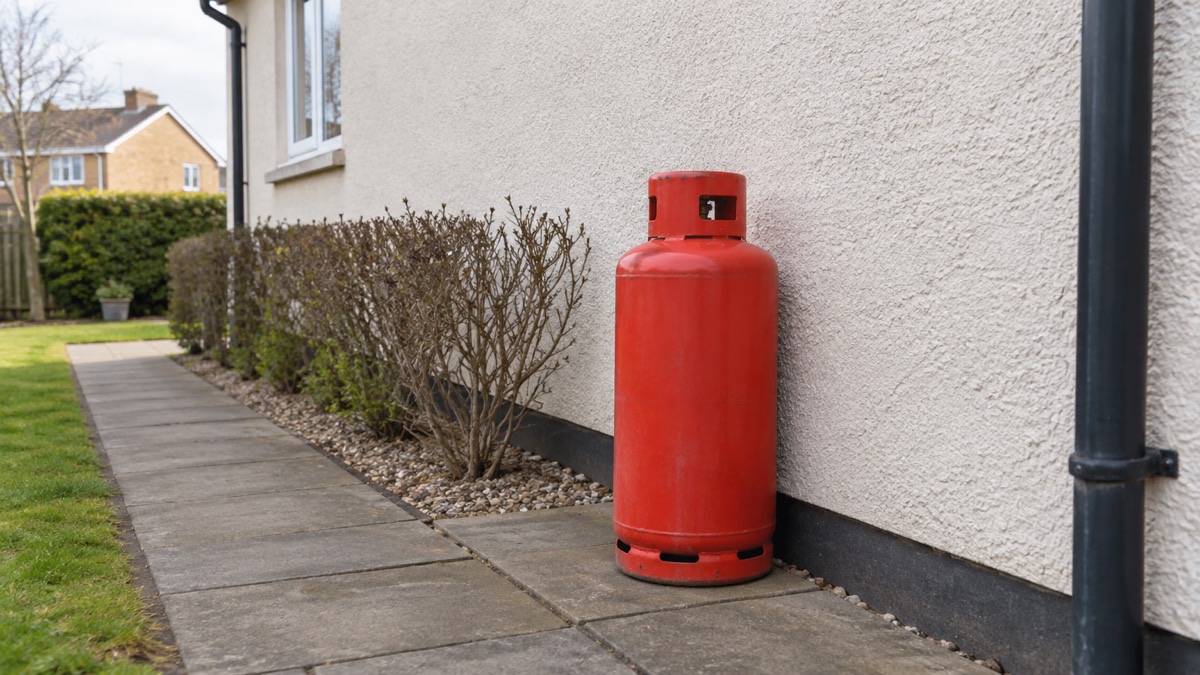
Running a generator on LPG does not remove the carbon monoxide risk that comes with any fuel-burning machine. The Health and Safety Executive identifies using equipment involving LPG in enclosed spaces as a cause of carbon monoxide, for example work equipment or heaters and cookers in welfare facilities16. The HSE's specific warning for LPG equipment is that blocked or partially blocked burners can lead to higher carbon monoxide levels and flame failure, and that LPG can leak from damage to hoses16. That is the maintenance case made above, restated as a safety case.
If you use a carbon monoxide monitor, the NHS smoking-status guidance gives the expected readings: 0 to 6 ppm for a non-smoker, 7 to 10 ppm for a light smoker, 11 to 20 ppm for a smoker and 20+ ppm for a heavy smoker22. These figures come from NHS stop-smoking services and describe what a monitor reads on a person's breath in normal circumstances; they are a reminder that a monitor is a measuring device whose readings need context, not a substitute for getting fresh air and calling for help when someone has symptoms.
The emergency route is the same as for gas. If you think a gas appliance is leaking carbon monoxide, call the free National Gas Helpline immediately on 0800 111 99923. The London Fire Brigade's winter guidance adds that before returning to your home you should call the Gas Emergency number for safety advice on 0800 111 999, even if the suspected source is not a gas appliance or boiler. For the full picture on generators and carbon monoxide, including where not to run one, see Can You Run a Generator Indoors or in a Garage? and Carbon Monoxide from Generators.
What a dual-fuel generator uses from a bottle
To plan how many bottles to have ready, the maker's own figures give a starting point. Champion states that its 3500 Watt dual-fuel inverter has a runtime of 16 hours on only a 19 kg bottle of LPG1. The smaller 2200 Watt Mighty Atom is stated to run for up to 10.5 hours at 25% load on petrol, or up to 34 hours with a 19 kg propane bottle3. Fuel consumption figures for the Mighty Atom are given as 0.33 kg per hour on LPG at 25% load and 0.65 kg per hour at full load3.
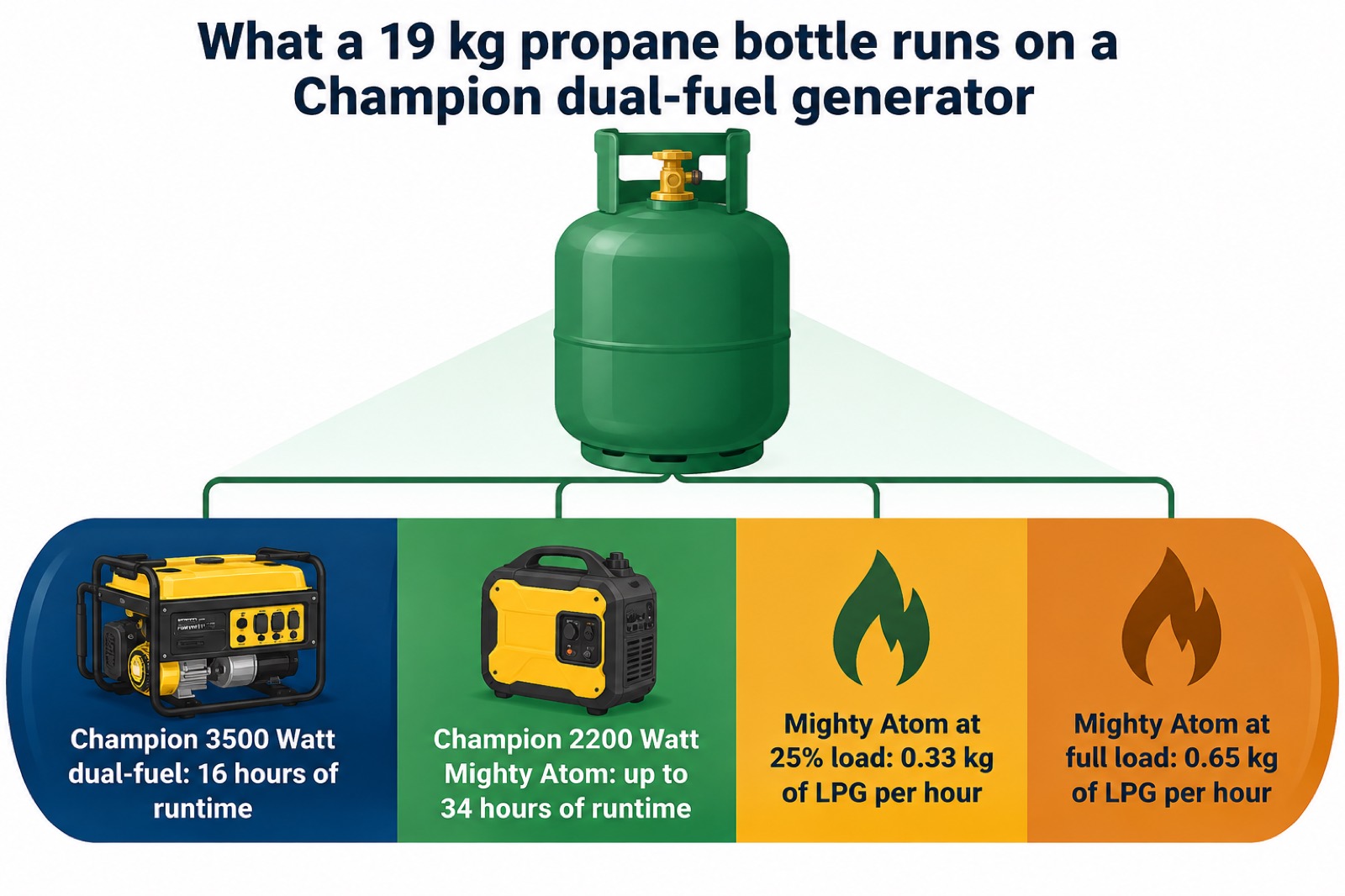
Those are the maker's figures for its own products, measured under the maker's stated conditions, so treat them as a planning guide rather than a promise. The maker notes that you can extend running time simply by using a bigger cylinder, since you are no longer limited by the generator's internal fuel tank17. Bear in mind that household storage and use is limited to up to four cylinders or cartridges2. For how to work out what your household actually needs to keep running, see Deciding What to Keep Running When the Mains Fails and What Size Generator Do I Need for a Power Cut?.
Sources (23)
- Champion 3500 Watt LPG Dual Fuel Inverter Generator 73001i-DF, Champion Power Equipment, 25 October 2026
- Guidance on LPG cylinders and cartridges, Liquid Gas UK, 2022
- Champion 2200 Watt LPG Dual Fuel Inverter Generator 92001i-DF, Champion Power Equipment, 25 October 2026
- Energy outages: what to do, National Energy System Operator
- Guidance on LPG regulators and connections, Liquid Gas UK, April 2022
- What you might need in a gas outage, Wiltshire and Swindon Prepared, 25 October 2026
- Gas safety: frequently asked questions, Health and Safety Executive
- Request a home safety visit | Devon and Somerset Fire and Rescue Service, Devon and Somerset Fire and Rescue Service
- Yorkshire Smokefree, Yorkshire Smokefree (South West Yorkshire Partnership NHS Foundation Trust)
- Camping and caravanning safety, Devon and Somerset Fire and Rescue Service, 2026
- Heating and gas safety at home, Scottish Fire and Rescue Service, 21 November 2024
- Guidance on LPG patio heaters, Liquid Gas UK, 2022
- Consumer Guidance Sheet 42: safe use of mobile heaters, Liquid Gas UK, April 2026
- Morco open flued LPG water heaters: critical safety upgrade alert, CO-Gas Safety, 31 July 2024
- Generators: risks and guidance, Wiltshire and Swindon Prepared, 25 October 2026
- Carbon monoxide: hazardous substances, Health and Safety Executive, 2026
- Portable heaters, gas fires and open fires, London Fire Brigade, 25 October 2026
- Heater safety at home, Devon and Somerset Fire and Rescue Service, 2026
- Barbecue safety, Devon and Somerset Fire and Rescue Service, 2026
- Caravans and camping safety, North Yorkshire Fire and Rescue Service, 13 May 2026
- Heating your home safely, North Yorkshire Fire and Rescue Service, 9 March 2026
- Carbon monoxide information, NHS Yorkshire Smokefree Wakefield
- Carbon monoxide poisoning, NHS
 Power Cut Backup Power Checklist
 Backup Power Before Winter
 Safe Battery Charging at Home
 What to Keep Running in a Cut
 Power During an Outage
 Watts and Watt-Hours
 Portable Power Stations
 Portable Generator Types
 Generator Safety
 Connecting to Your Home's Wiring
 Home Battery Storage
 Portable Solar Panels
 12V Inverters
 Leisure and LiFePO4 Batteries
 Power Banks for Phone Charging