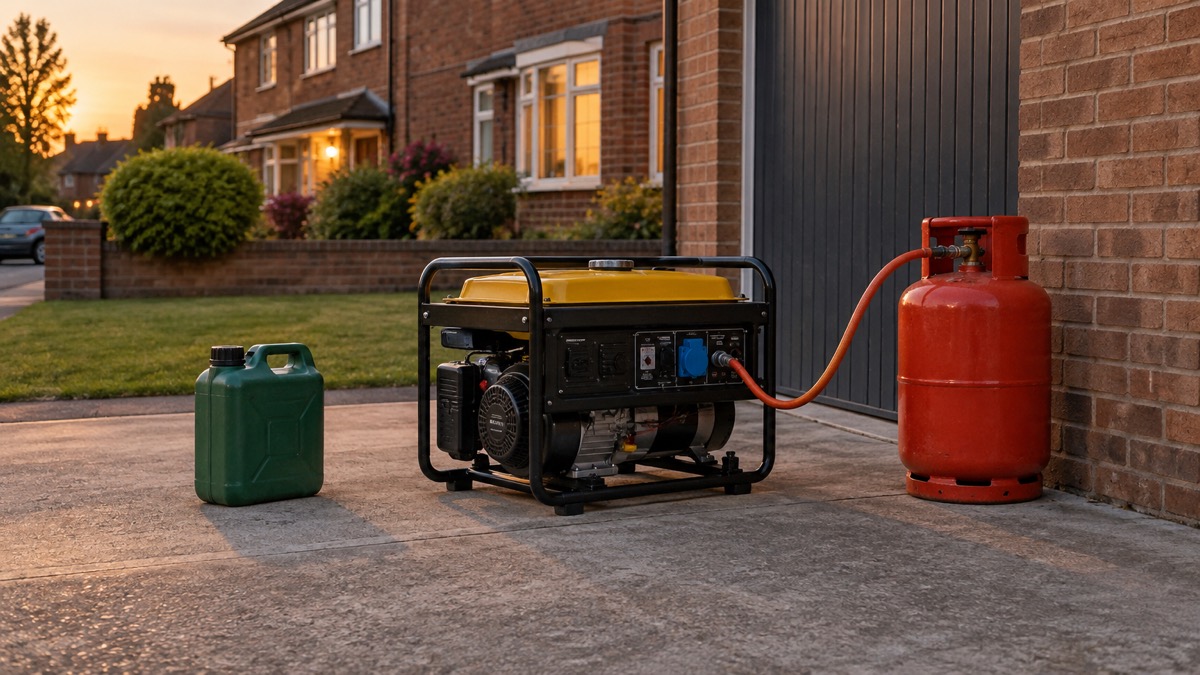
If you are weighing up an LPG generator against a petrol one for a power cut, the short answer is that both will make electricity, but they suit different households. Petrol is the familiar, widely available fuel and petrol generators are generally quieter than diesel ones1. LPG burns more cleanly, which lets a dual fuel machine be used where petrol is not appropriate, such as around food2. The trade-off is that LPG uses more fuel for the same power, and it brings its own storage and regulator rules.
Whichever fuel you pick, the safety rules are the same and they are not negotiable. A generator must never be run indoors, in a garage, shed, tent or caravan, because the exhaust gases contain carbon monoxide, which can kill3. If you want to connect a generator to your home's wiring, only a qualified electrician can do it safely5. For most households, a generator is a way to run a few appliances through extension leads, not to power the whole house.
This guide sets out how the two fuels compare, what dual fuel machines do, the output and socket details worth checking, and where to get help if the network operator is involved. It is written for an ordinary UK household with no prepping background, so it starts with what to do now and works through what to get ready.
LPG for long backup, petrol for occasional portable power
The first decision is how you expect to use the machine. If you want a generator that sits ready for a long outage and can run for many hours without constant refuelling, LPG has a clear advantage. A Champion 3000 watt dual fuel inverter generator is listed as running for up to 11.5 hours on petrol or up to 34 hours on propane at 25% load using a 19kg propane canister6. That longer run time on a single canister is the main reason a household with a long outage in mind might lean towards LPG.
Petrol suits the household that wants occasional, portable power: running a few tools, lighting or a pump for a few hours and then putting the machine away. Conventional petrol generators use an engine to drive an alternator at a relatively constant speed, are practical for tools, lighting, pumps, workshop equipment and general site use, and often provide a higher output for the price8. Petrol is also cheaper than diesel and quieter than diesel generators, though petrol machines require regular maintenance1.
There is a middle option worth knowing about. Diesel generators generally last longer than petrol generators with long running time, but diesel is more expensive to buy and can be noisier than petrol alternatives1. For a household, though, the realistic choice is usually between petrol and LPG, because those are the fuels a dual fuel machine can use and the ones most easily stored at home.
| Fuel | Best suited to | What to know |
|---|---|---|
| Petrol | Occasional portable power, tools, short outages | Cheaper than diesel and quieter than diesel; needs regular maintenance1 |
| LPG (propane) | Longer backup, fewer refuels | Cleaner emissions allow use where petrol is not appropriate, such as around food2 |
| Diesel | Long running time, heavier duty | Lasts longer than petrol but costs more to buy and can be noisier1 |
LPG uses more fuel for the same power
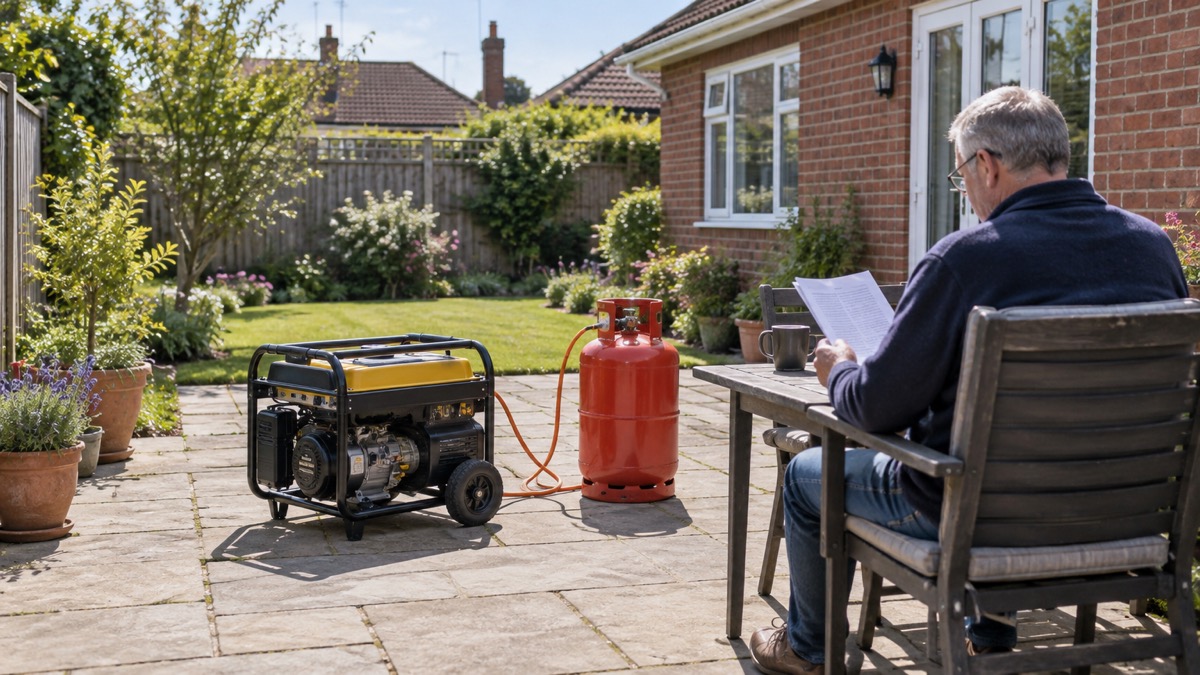
The headline trade-off with LPG is fuel consumption. A dual fuel generator will use more LPG by weight than petrol for the same electrical load, so you need to plan canister size and refuelling around that. The maker's own figures show the pattern. The Champion 3000 watt Atom Fusion dual fuel model is listed at 0.9 litres per hour on petrol and 0.483 kg per hour on LPG at 25% load, and at 2.0 litres per hour on petrol and 0.917 kg per hour on LPG at 100% load6. The Champion 3500 watt dual fuel inverter is listed at 0.88 litres per hour on petrol and 0.8 kg per hour on LPG at 25% load, and at 1.97 litres per hour on petrol and 1.26 kg per hour on LPG at 100% load2.
Those figures are given in different units, litres for petrol and kilograms for LPG, so they cannot be compared directly without knowing the density of the fuel. What matters for planning is that the LPG figure rises more steeply as load increases, which is why a larger canister and a realistic view of what you will run matter. If you only need to run a fridge, a few lights and a phone charger, you are working at the low end of the load range and the fuel goes further.
The practical lesson is to size the generator to your load rather than buying the biggest machine you can find. A generator running at 25% load uses far less fuel than one running flat out, and the run time figures quoted by makers assume that lighter load. If you are unsure what your appliances draw, the guide to watts, watt-hours and surge explains how to add them up.
Dual fuel generators: petrol and LPG in one machine
A dual fuel generator takes either petrol or propane, so you are not locked into one fuel. The Champion 3000 watt Atom Fusion is described by its maker as dual fuel, with a 149cc engine powered on either petrol or propane6. The Champion 3500 watt LPG dual fuel inverter is listed simply as dual fuel2. That flexibility is useful: you can keep petrol for short runs and a propane canister for longer ones, or switch if one fuel runs out.
Dual fuel machines also tend to carry the features that make a generator easier to live with. The Champion 3500 watt dual fuel inverter has automatic low oil shutoff, parallel connectivity and electric start2. The Atom Fusion dual fuel has low oil shutoff and parallel connectivity6. Low oil shutoff protects the engine by stopping it if the oil level drops, which matters on a machine that may run for hours unattended.
LPG's cleaner emissions are the other reason households choose it. The maker states that cleaner emissions allow for use in situations where petrol is not appropriate, such as around food or on sites that do not allow petrol for fire risk precautions2. That does not mean an LPG generator can go indoors: the carbon monoxide rules apply to any fuel-burning generator, and the maker's own guidance is never to operate a generator inside a house, garage, shed, tent or caravan8.
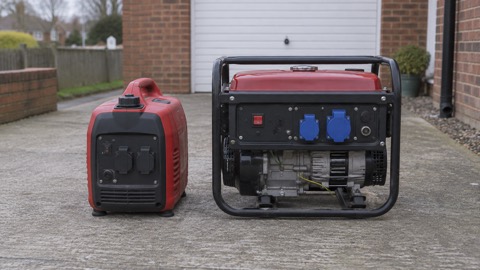
If you are comparing a dual fuel machine with a straight petrol one, the portable generators guide sets out the petrol, diesel, dual fuel and inverter types side by side.
Output, sockets and starting: what to check before you choose
Generators come in a wide range of outputs and voltages, and the details decide what you can plug in. The Champion 2200 watt inverter petrol generator is listed with a starting output of 2500 watts, a 12 volt DC output, and one 110 volt 16 amp AC outlet9. The Champion 3200 watt petrol generator is listed with a 12 volt DC output supply as well as 16 amp 120 volt and 230 volt sockets10. The Champion 5500 watt petrol generator with remote start has a socket rating of 32/32 amps11.
Voltage matters more than many buyers realise. Dual voltage generators will only give approximately 50 to 60% of the rated output wattage on 120 volts per socket, according to the maker10. If you are buying for UK household appliances, you want 230 volt sockets, and you should check the socket rating against what you plan to run.
Starting method is the other thing to check. The Champion 3200 watt petrol generator has a recoil start10, while the Champion 3500 watt dual fuel inverter has electric start2. Electric start is easier for someone who may struggle with a pull cord, but it depends on the machine's battery being charged.
| Check | Why it matters | Example from the maker's listings |
|---|---|---|
| Output in watts | Decides what you can run at once | 2200 watt model with 2500 watt starting output9 |
| Voltage | UK appliances need 230 volts | 3200 watt model has 120 volt and 230 volt sockets10 |
| Socket rating | Limits what can be plugged in | 5500 watt model rated 32/32 amps11 |
| Starting method | Recoil or electric start | 3200 watt model is recoil start10; 3500 watt dual fuel is electric start2 |
| Low oil shutoff | Protects the engine | Automatic on the 3500 watt dual fuel2 |
Where a generator must never go: carbon monoxide risk
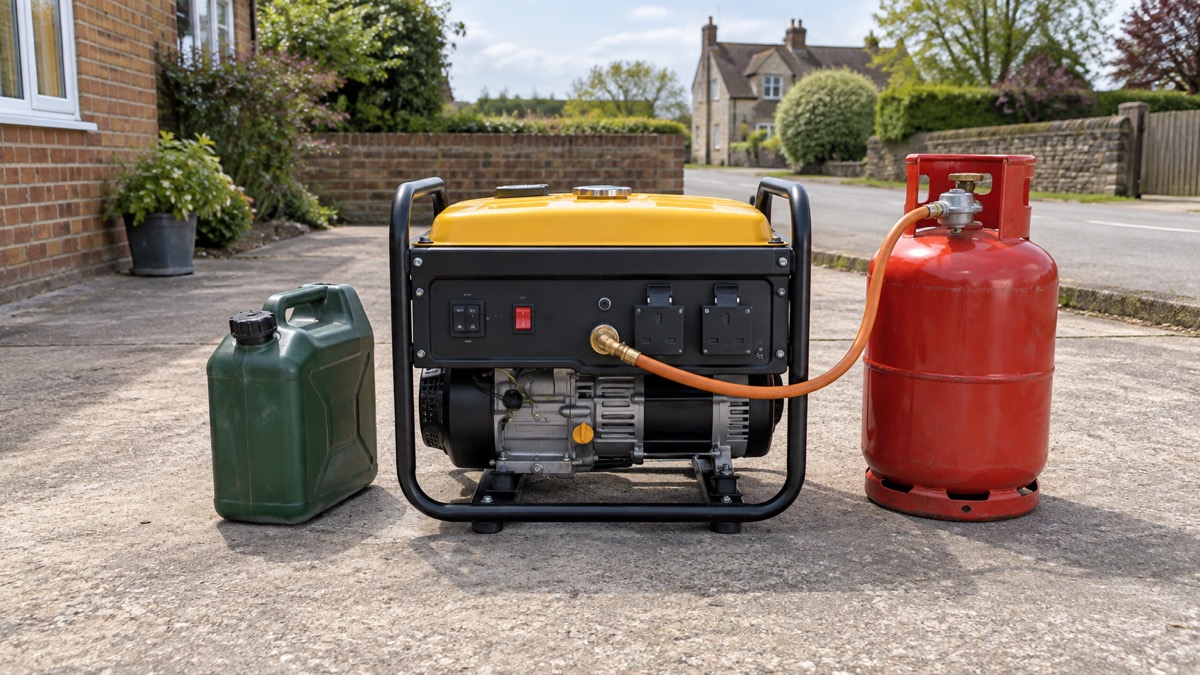
This is the section to read twice. Carbon monoxide from a generator can kill, and it can kill quickly. The Health and Safety Executive warns that using petrol powered equipment such as generators indoors or in enclosed spaces can create significant levels of carbon monoxide which can kill even after a few minutes12. The HSE advises locating petrol generators outside in well ventilated spaces so that fumes disperse and cannot gather or drift into building openings13.
Official guidance is consistent across the UK. Wiltshire and Swindon Prepared says do not use petrol or diesel generators or other similar fuel-driven equipment indoors because their exhaust gases contain carbon monoxide14. The London Fire Brigade says never run a petrol or diesel-powered generator indoors, as they can produce fatal levels of carbon monoxide15. Runnymede Borough Council says do not use petrol or diesel generators indoors because the exhaust gases contain carbon monoxide, which can kill16. Northern Ireland's nidirect warns that if you are using a generator, be careful where you put it in case of carbon monoxide poisoning, and never use standby generators indoors, as the fumes from the engine can be lethal17.
National Grid's safety advice is equally direct: never use a portable generator or barbeque indoors during a power cut or planned interruption to your supply19. Northern Powergrid adds that you should make sure there is plenty of air flow around the generator to supply oxygen and remove the fumes18. The HSE also notes that LPG equipment can be particularly vulnerable, because blocked or partially blocked burners can lead to higher carbon monoxide levels and flame failure, and LPG can leak from damage to hoses12.
If you want to understand the warning signs and what to do if you suspect carbon monoxide, the generator carbon monoxide guide and the generator safety guide go further. The narrow question of whether a generator can ever run in a garage is answered in Can You Run a Generator Indoors or in a Garage?.
Ask a qualified electrician before connecting to your home
Plugging an appliance into a generator through an extension lead is one thing. Connecting a generator to your home's wiring so it feeds the sockets and lights is another, and it is not a DIY job. Wiltshire and Swindon Prepared says it takes research by you and the advice and expertise of a qualified electrician for a generator to help you20. National Grid says that should you decide to hire a generator, for safety reasons it is essential that it is connected by a qualified electrician21.
The network operators are just as clear. SP Energy Networks says only a qualified electrician can connect a generator safely5. Before connecting a generator, the incoming supply must be switched off and isolated from your own electrical circuits and the generator, otherwise you risk damaging your property and endangering the lives of SP Energy Networks employees working on power lines some distance from your home22. National Grid's planned interruption leaflet repeats that for safety reasons it is essential that the generator is connected by a qualified electrician23.
Electricity North West makes a further point that is worth hearing before you buy: using a generator is not always the simplest solution, because there will not be enough generators to keep everyone powered, and it may take longer to install and connect a generator to your local substation than the duration of the emergency power cut24. If you do choose to connect your own generation, this must be done by a qualified professional24. Northern Powergrid says the same: connecting your own generation must be done by a qualified professional, and whether to buy one is a personal decision25.
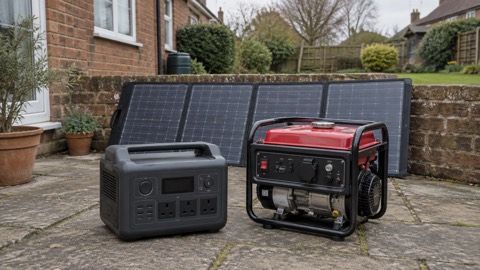
The connecting to the home guide explains the options in more detail. If you are weighing up a generator against a battery system, the generators or power stations comparison sets out the differences.
When the network operator brings a generator to you
Your distribution network operator is the company that delivers, manages and maintains the infrastructure to deliver gas and electricity to your home, and it is not the same as the supplier you pay your bills to26. When a fault affects a small number of properties for an extended period, the network operator may use a generator to restore supply temporarily while permanent repairs are completed27. Electricity North West says generators will sometimes be used for temporarily restoring customers whilst permanent repairs are completed, and that they are ordered through network partners who ensure a robust refuelling strategy is in place and connect to the network safely27.
Who gets one is tightly limited. Electricity North West says generators are only provided in exceptional circumstances, such as for medical needs like oxygen equipment, mobility aids or end-of-life care7. In exceptional circumstances, such as weddings or funerals, it does its best to provide a generator to minimise the impact of the power cut7. For most households, the network operator's job is to repair the fault, not to lend you a machine.
If someone in your household depends on electricity for medical equipment, the Priority Services Register is the route to tell your supplier and network operator in advance. Kidney Care UK explains that the register is used to flag vulnerable customers so they can be prioritised28. You can ask your supplier to add you, and it is free.
When the repair is done, reconnection can bring its own brief interruption. Electricity North West says you may experience a short outage whilst being connected back to the network after the repair27. Switch off and unplug sensitive equipment until the supply is steady.
LPG regulator safety and looking after the machine
If you go down the LPG route, the regulator that sits between the canister and the generator is a safety-critical part. CO-Gas Safety warns that an unchecked LPG regulator can lead to an explosion, and advises that if in doubt, and the regulator has not been checked recently, you should obtain the service of a Gas Safe Registered Engineer qualified in LPG to check it as soon as possible29. Liquid Gas UK says failure of a regulator may result in a fire or explosion if the LPG accumulates and an ignition source is present.
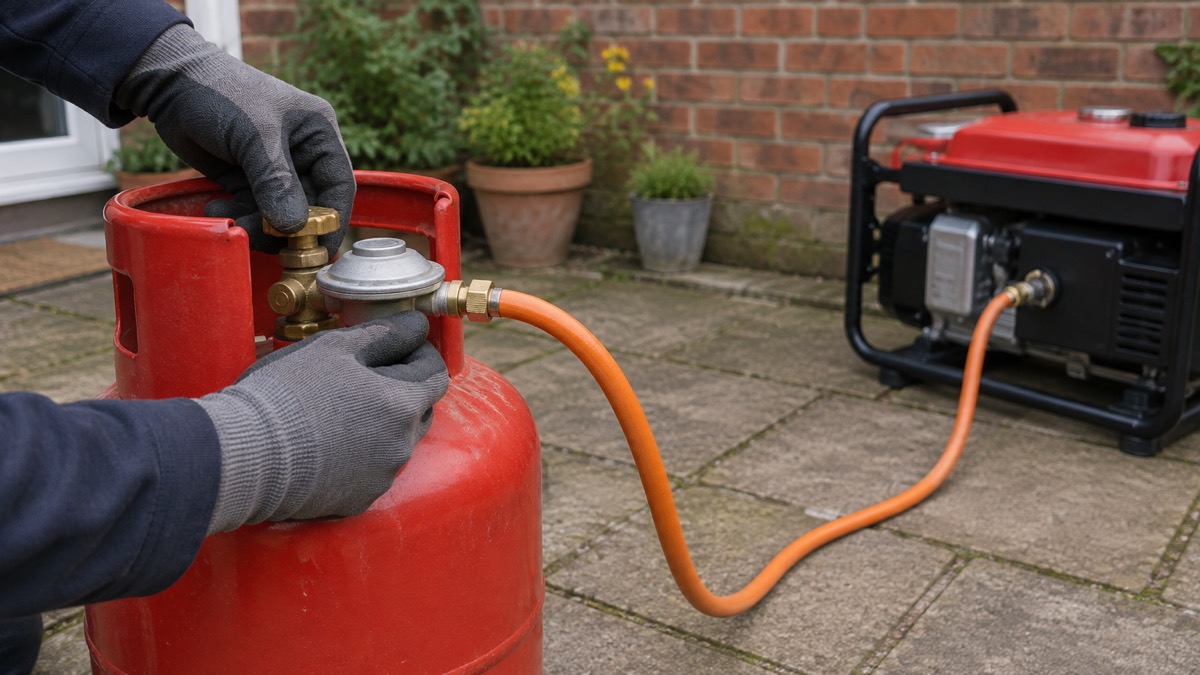
The basic rules are simple. Never tamper with regulators. When purchasing a new regulator, check that it is less than 3 years old from the date of manufacture. For domestic applications in the UK, a propane regulator is pre-set to 37 mbar. Protect the regulator from sea water spray unless it is designed for that environment or suitably protected. If you have an LPG boiler or gas appliance, Liquid Gas UK recommends it is serviced annually by a Gas Safe registered engineer.
Petrol machines need looking after too. Old or contaminated petrol can cause starting and running problems, so use fresh fuel of the type specified by the manufacturer8. The LPG cylinders and regulators guide covers canister and regulator choices in more depth, and the petrol storage guide covers how much petrol you can keep at home safely.
Sources (29)
- How to buy the best generator, Which?, 2026-01-20
- Champion 3500 Watt LPG Dual Fuel Inverter Generator, Champion Power Equipment, 2026-10-25
- Generators, Clarke International, 2026-10-25
- Flooding aftercare, Runnymede Borough Council, 2026-10-26
- Your planned power cut explained, SP Energy Networks, 2023
- Champion 3000 Watt Atom Fusion LPG Dual Fuel Inverter Generator, Champion Power Equipment, 2026-10-25
- Power cuts FAQs, Electricity North West, 2026-10-25
- Champion 2200 Watt Inverter Petrol Generator 110V, Champion Power Equipment, 2026-10-25
- Champion 3200 Watt Petrol Generator, Champion Power Equipment, 2026-10-25
- Champion 5500 Watt Petrol Generator With Remote Start, Champion Power Equipment, 2026-10-25
- Carbon monoxide, Health and Safety Executive, 2026
- Carbon monoxide, Health and Safety Executive, 2026
- Generators, Wiltshire and Swindon Prepared, 2026-10-25
- After a flood, London Fire Brigade, 2026-10-25
- Strong winds and heavy rain warning, nidirect, 2026-01-27
- Safety first, National Grid, 2026
- Power cut advice, Northern Ireland Electricity Networks, 2026-10-25
- Planned interruptions, National Grid, 2026
- Emergency power cuts FAQ, Northern Powergrid, 2025-03
- Planned interruption leaflet, National Grid, 2022-09
- Emergency power cuts, Electricity North West, 2026-10-25
- Restoration following a power cut, Electricity North West, 2026-10-25
- Priority Services Register, Kidney Care UK, 2026-07-29
- New warning about LPG regulators, CO-Gas Safety, 2024-05-24
- Old regulator on my LPG cylinder, Liquid Gas UK, 2026-10-25
- LPG regulator guidance, Liquid Gas UK, 2022-04
- Get ahead for winter 2026, Liquid Gas UK, 2026
- Champion 3500 Watt Inverter Petrol Generator, Champion Power Equipment, 2026-10-25
- Champion FAQ, Champion Power Equipment, 2026-10-25
 Power Station vs Generator
 Inverter vs Open-Frame Generator
 Power Bank vs Power Station