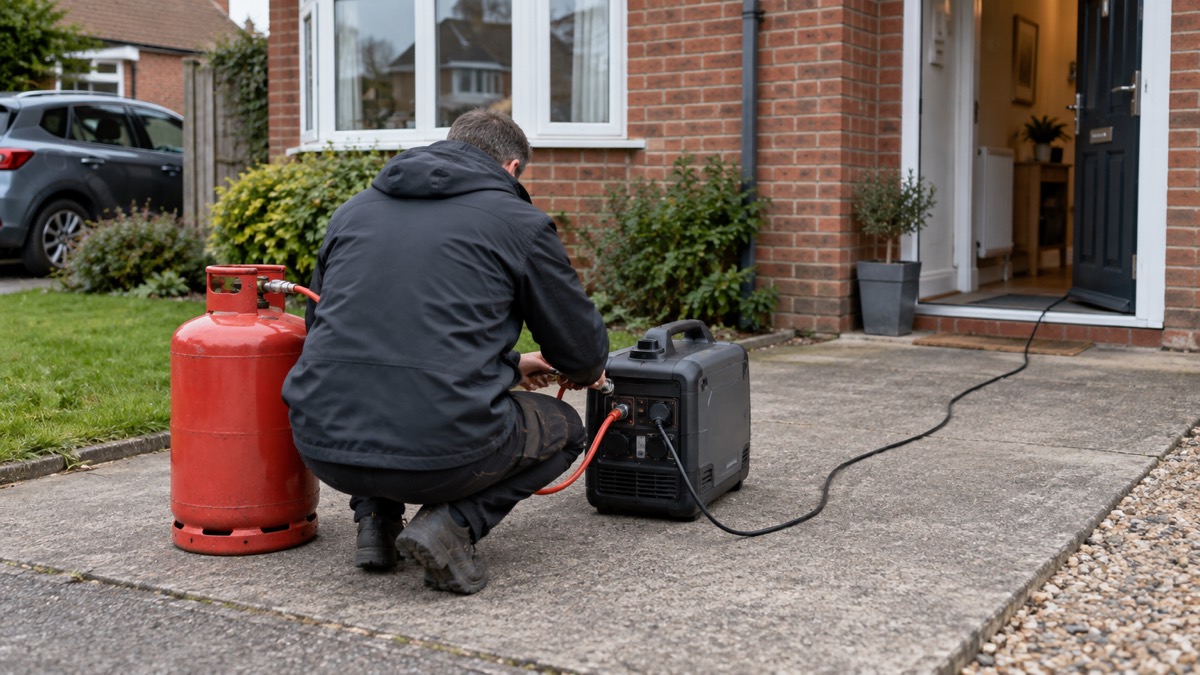
The Champion 3000W Atom Fusion is a dual fuel inverter generator: a petrol or propane machine that makes mains power for small household loads when the mains has failed. Champion rates it at 2800 watts running on petrol and 2520 watts on LPG, with 3000 watts maximum and 4500 watts of starting power on either fuel1. It is a recoil-start machine weighing 21.5 kg, and it carries CO Shield, which shuts the engine down if it detects unsafe levels of carbon monoxide1.
The point of a dual fuel machine is choice. Petrol is easy to buy and store in small quantities; propane comes in a cylinder that keeps for years and needs no pouring. Champion quotes up to 11.5 hours of run time on petrol or up to 34 hours on propane, the latter at 25% load from a 19 kg propane canister1. Those are maker figures at light load, and they fall as you ask more of the machine.
What it is not is a whole-house solution. It is for a fridge or freezer, lights, a router, a laptop, a phone charger or a power tool, run through its sockets with extension leads, outdoors, with the exhaust well away from any opening1. Everything below sets out what it can do, how to run it safely and what the maker expects of you afterwards.
What the Atom Fusion is, and who it suits
This is an inverter generator, which means it produces a true sine wave output that Champion describes as ideal for sensitive electronics such as computers, laptops and televisions1. That matters in a power cut, because the things people most want to keep running are often the delicate ones: the router, the laptop, the television, the phone chargers. An inverter machine also lets the engine speed follow the load, which is why the noise figure and fuel figures are quoted at part load.
Champion positions it for camping trips or for powering small household items such as fridges and freezers, power tools, lighting units and garden equipment1. Read that list as the maker's own description of its ceiling. It is a machine for carrying a handful of circuits, not for replicating a consumer unit. If you want to know how to decide which appliances matter most, our guide to deciding what to keep running when the mains fails sets out the order to think in, and watts, watt-hours and surge explained covers why a fridge needs more at start-up than it does running.
It suits a household that wants one machine that can run on whichever fuel is available, that values the CO cut-out, and that is prepared to wheel it out, start it by recoil and run extension leads to the things that matter. It does not suit anyone who wants to press a button indoors: this is an outdoor, engine-driven appliance and must be treated as one.
Specifications
Champion publishes a full specification for the model. The figures below are the maker's own, as listed on its product page1.
| Specification | Figure |
|---|---|
| Rated watts | 2800 (petrol), 2520 (LPG) |
| Maximum watts | 3000 (petrol), 3000 (LPG) |
| Starting watts | 4500 (petrol), 4500 (LPG) |
| Engine | 149 cc, 10.0 hp, 4600 rpm |
| Start type | Recoil |
| Fuel | Petrol or propane |
| Fuel tank | 4.5 L |
| Oil tank | 580 ml |
| Fuel use at 25% load | 0.9 L/hour (petrol), 0.483 kg/hour (LPG) |
| Fuel use at 50% load | 1.2 L/hour (petrol), 0.65 kg/hour (LPG) |
| Fuel use at 75% load | 1.6 L/hour (petrol) |
| Fuel use at 100% load | 2.0 L/hour (petrol), 0.917 kg/hour (LPG) |
| Noise | 58 dBA at 7 m |
| Weight | 21.5 kg |
| Dimensions | 450 x 440 x 292 mm (HxLxW) |
| IP rating | IP23M |
| Certification | CE, E10 Petrol Compliant, UKCA, EU Stage V |
| Power factor | 1.0 |
| Phase | Single |
The 75% load row has a petrol figure only; Champion does not list an LPG figure at that load. The IP23M rating is the maker's enclosure rating, not a licence to run the machine in driving rain. For the general rules on siting a generator in wet weather, see can you run a generator in the rain.
Sockets and outputs: one 16A, two 13A by adapter, 12V and USB
The machine has one 240 volt 16 amp outlet and two 240 volt 13 amp outlets provided by adapter, with a socket rating of 16 and 13 amps1. It also has a 12 volt DC output and a USB connection1. In practice that means the 16 amp outlet is the main one, and the 13 amp sockets come from the 16A to 13A adapter that Champion includes in the box1.
That arrangement shapes how you use it. Standard UK household plugs are 13 amp, so most of your appliances will run through the adapter or through extension leads. Keep the total load within the rated output for the fuel you are using, and remember that motor-driven appliances such as fridges and freezers draw a surge at start-up, which is what the 4500 watt starting figure is for1. Our guide to extension leads and overloading with backup kit explains why daisy-chaining leads and multi-way adapters is where people get into trouble.
The 12 volt and USB outputs are for small items: charging a phone, running a 12 volt device. The box includes a 12 volt DC battery charging cable and a 12 volt USB adapter for these1. For a fuller look at keeping phones alive, see power banks: keeping phones charged in an emergency.
Running it on LPG or petrol
Champion describes the engine as dual fuel, powered on either petrol or propane1. The two fuels behave differently in ways that matter to a household.
Petrol goes in the 4.5 litre tank1. At 25% load the engine uses 0.9 litres an hour, rising to 2.0 litres an hour at full load1. The engine is powered on either petrol or propane1. Petrol has a storage life and needs care in how it is kept; our guide to how much petrol you can store at home safely covers the rules.
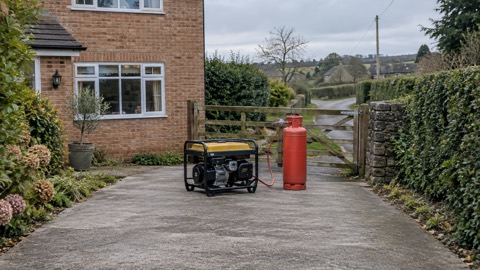
Propane comes from a cylinder through the LPG hose and adapter supplied1. Champion quotes up to 34 hours of run time on propane, and states that this figure is based on operation at 25% load from a 19 kg propane canister1. Fuel use on LPG is given in kilograms per hour: 0.483 at 25% load, 0.65 at 50% and 0.917 at 100%1. A larger cylinder therefore buys you a long, quiet stretch of running without refuelling, and propane does not go stale the way petrol does.
Which fuel to choose is a practical question about your storage, your supplier and how long you expect an outage to last. Our comparison of LPG or petrol for emergencies sets the trade-offs out, and LPG cylinders and regulators for dual-fuel generators covers the cylinder side. Champion notes that its dual fuel technology is factory fitted, which it says means the three year warranty is fully supported, unlike retrofit conversions1.
What it can power, and for how long
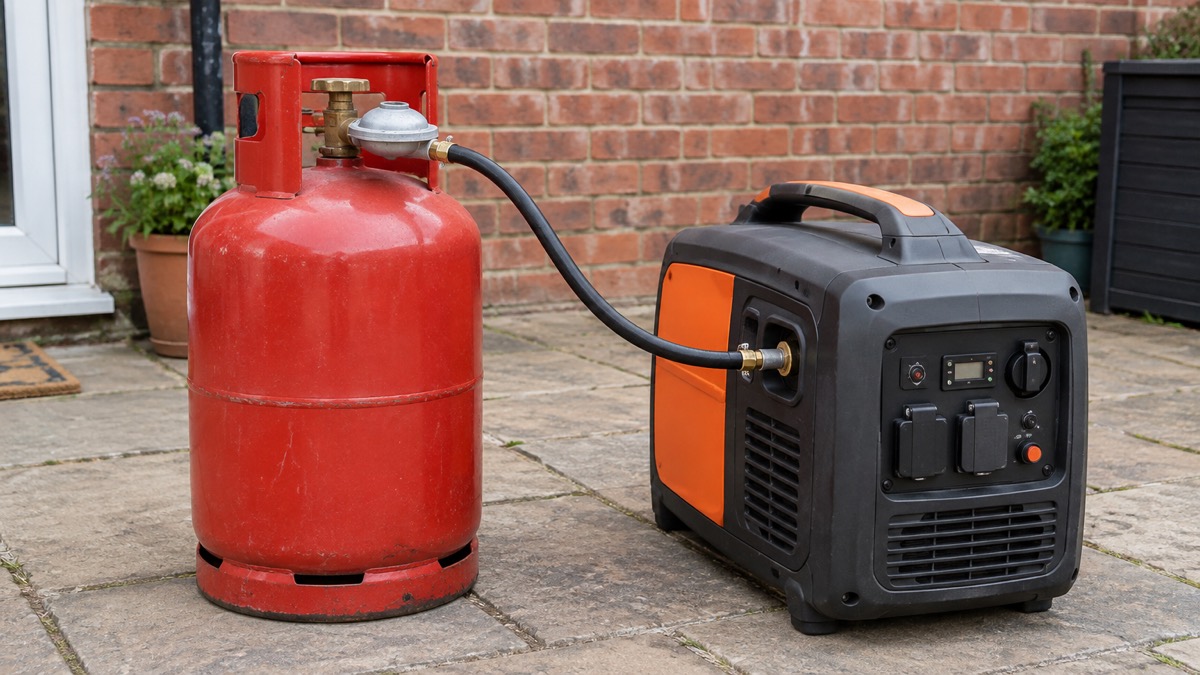
The honest answer is: small household loads, one or two at a time, within the rated figure for your fuel. Champion's own examples are fridges and freezers, power tools, lighting units and garden equipment1. A fridge or freezer is the classic use in a power cut, because it protects food; a lighting unit and a phone charger keep the household functioning after dark.
Work out your load before you buy, not during an outage. Add up the running watts of what you want to keep on, then check the start-up surge of anything with a motor. Our guide to what size generator you need for a power cut walks through the sum, and how long a generator will run on a tank of fuel explains how load changes run time.
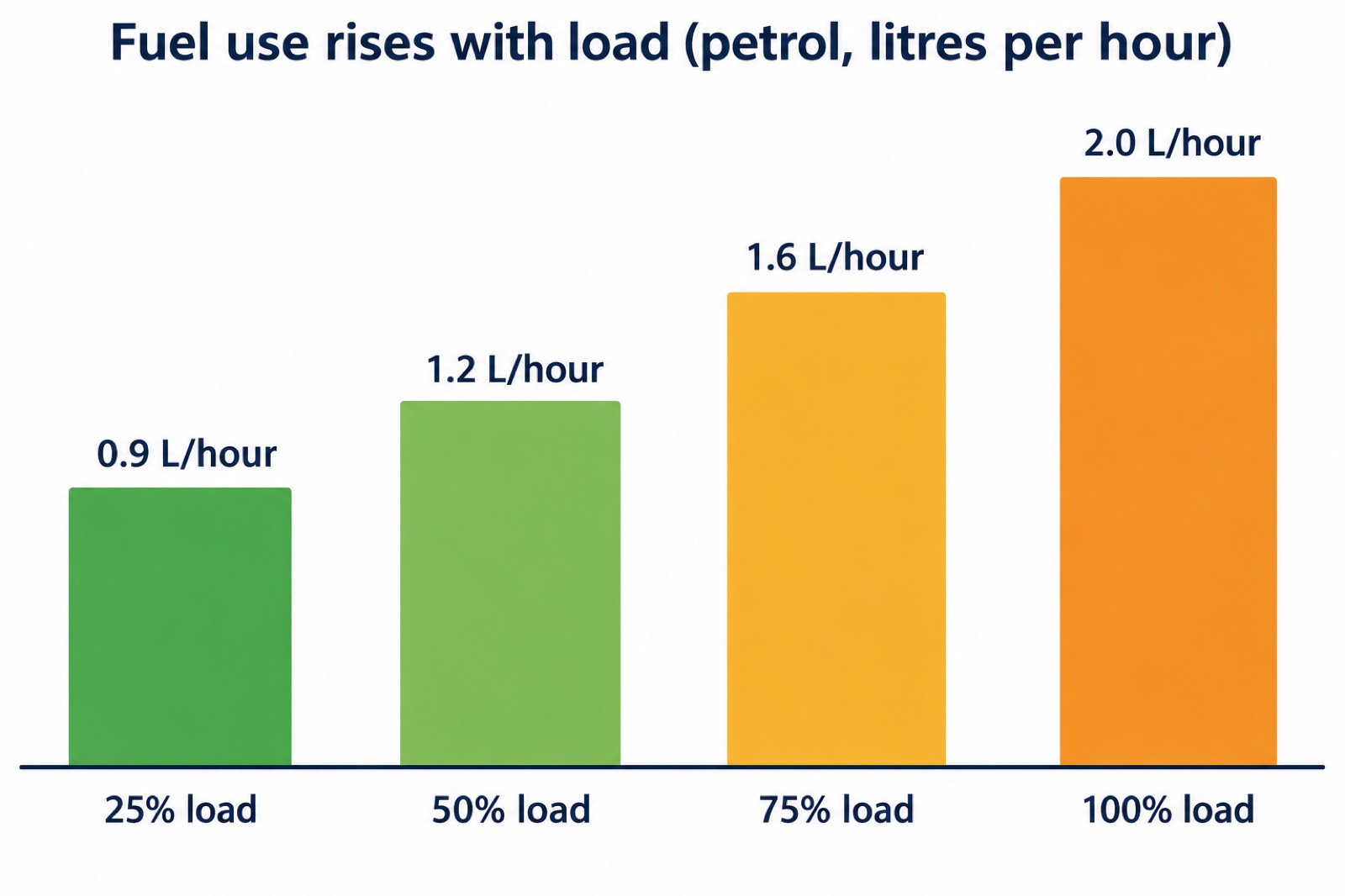
The pattern is the same on LPG: 0.483 kg/hour at 25% load, 0.65 at 50% and 0.917 at 100%1. Running fewer things for longer is almost always the better plan in an outage, and it keeps the noise and the fuel bill down.
CO Shield and the other safety cut-outs
Carbon monoxide is the danger that decides how a generator is used. It is a poisonous gas produced by engine exhaust, and CO Shield monitors for its accumulation; if unsafe elevated levels are detected it automatically shuts off the engine1. Champion lists it as a headline feature: it shuts down automatically if it detects unsafe levels of carbon monoxide1.
That cut-out is a backstop, not a substitute for siting the machine correctly. The CO Gas Safety case studies record deaths from carbon monoxide, including one case where the fuel is recorded as solid2, which is a reminder that this hazard is not confined to generators and that the gas gives no warning of its own. Run the generator outdoors, well away from doors, windows and air bricks, and never in a garage, shed, conservatory or vehicle. Our guides to whether you can run a generator indoors or in a garage and to carbon monoxide from generators: warning signs go through this in detail.
The other cut-outs are there to protect the machine and you. Champion lists low oil shutoff and overload protection as features1. Low oil shutoff stops the engine if the oil level falls, which is why the pre-use oil check in the service schedule matters. Overload protection trips when you ask for more than the machine can give, which is the moment to unplug something rather than to keep resetting it.
Servicing, from the first five hours to every three years
Champion publishes a service schedule for the model, and the first item comes sooner than most owners expect: change the oil in the first 5 hours, the break-in period1. After that the schedule runs on hours of use or on the calendar, whichever comes first.
| When | What to do |
|---|---|
| First 5 hours (break-in) | Change oil1 |
| Every 8 hours or before each use | Check oil level; clean around air intake and muffler; check the propane hose for leaks1 |
| Every 50 hours or annually | Clean air filter; change oil if operating under heavy load or in hot environments1 |
| Every 100 hours or annually | Clean and adjust spark plug; clean spark arrestor; clean fuel valve filter1 |
| Every 250 hours | Clean combustion chamber; check and adjust valve clearance1 |
| Every 3 years | Replace fuel line; replace LPG hose1 |
The three year items are consistent across Champion's guidance: the inverter service guide lists replacing the fuel line every three years2, the dual fuel service guide lists replacing the LPG hose at the same interval3, and the same three year fuel line item appears on other Champion dual fuel and frame-type models4. Champion's guidance on another dual fuel model notes that fuel line replacement should be done by knowledgeable, experienced owners or by a certified service centre4, so treat the starred items in the schedule as work for a service centre unless you are confident.
The pre-use checks are the ones that keep the machine safe between services. Checking the propane hose for leaks before each use is a maker instruction, not a suggestion1. If you are storing the machine between outages, our guide to how to store a generator after a power cut covers fuel and siting, and will a generator start in cold weather covers the cold months.
Warranty: three years for domestic use, and what voids it
Champion warrants the machine for up to 3 years for domestic usage, covering mechanical and electrical components for the original purchaser1. The structure is year one parts and labour, years two and three parts only, from the original date of purchase or 1000 hours, whichever comes first1. Industrial and commercial use gets a shorter deal: year one parts and labour and year two parts only, or 1000 hours, whichever comes first1. Champion's wider warranty page describes a standard 2 year warranty for Warrior diesel and selected Champion products and a 3 year warranty for Champion generator models6.
The exclusions are worth reading before you buy, because several of them are about how the machine is used rather than about faults. Champion excludes cosmetic defects, worn parts including piston and rings, spark plugs, filters, accessory parts, electrical components other than the main control unit, hoses, pipes, reducing valves and regulators, failures due to acts of God, problems caused by non-original parts, alterations by third parties and any third party electrical equipment1. Batteries supplied over one year old are excluded1.
The warranty is voided or not applied if the product is misused, neglected, involved in an accident, abused, overloaded beyond the generator's limits, modified (including exhaust extension and filtration), installed improperly in any outbuilding, shed, garage, confined space or vehicle, connected incorrectly to any electrical component, or used for hire purposes1. It applies only to the original purchaser and is not transferable1. Champion also provides free lifetime technical support from its customer service team1.
"Any MTS (Manual Transfer) & ATS (Automatic Transfer) systems other that ones supplied by ourselves under WARRIOR or CHAM"1
Read together, the warranty terms point the same way as the safety advice: run it outdoors, do not modify it, do not overload it, and talk to Champion before any transfer installation. The Champion brand page lists the rest of the range, and our guide to portable generators: petrol, diesel, dual-fuel and inverter types explains where a machine like this sits among the alternatives.
Sources (6)
- Champion 3000 Watt Atom Fusion LPG Dual Fuel Inverter Generator, Champion Power Equipment, 2026-10-25
- Service guide: inverters, Champion Power Equipment, 2026-10-25
- Service guide: dual fuel generators, Champion Power Equipment, 2026-10-25
- Champion 2200 Watt LPG Dual Fuel Inverter Generator 92001i-DF, Champion Power Equipment, 2026-10-25
- Champion 3750 Watt Frame Type Inverter CPG4000DHY, Champion Power Equipment, 2026-10-25
- Champion 3200 Watt Petrol Generator, Champion Power Equipment, 2026-10-25

 EcoFlow Dual Fuel Generator
 Honda EU70iS Generator
 Honda EU32i Generator
 Honda EG3600 Generator
 Pramac P3500i Generator
 Senci SC6000-II Home Generator
 Senci SC10000-II Generator
 Senci SC6600iED Generator
 Gorilla Power GP3800iE
 Gorilla Power GP6500E-DF
 Gorilla Power GP3500i
 Hyundai HY2250Si Generator