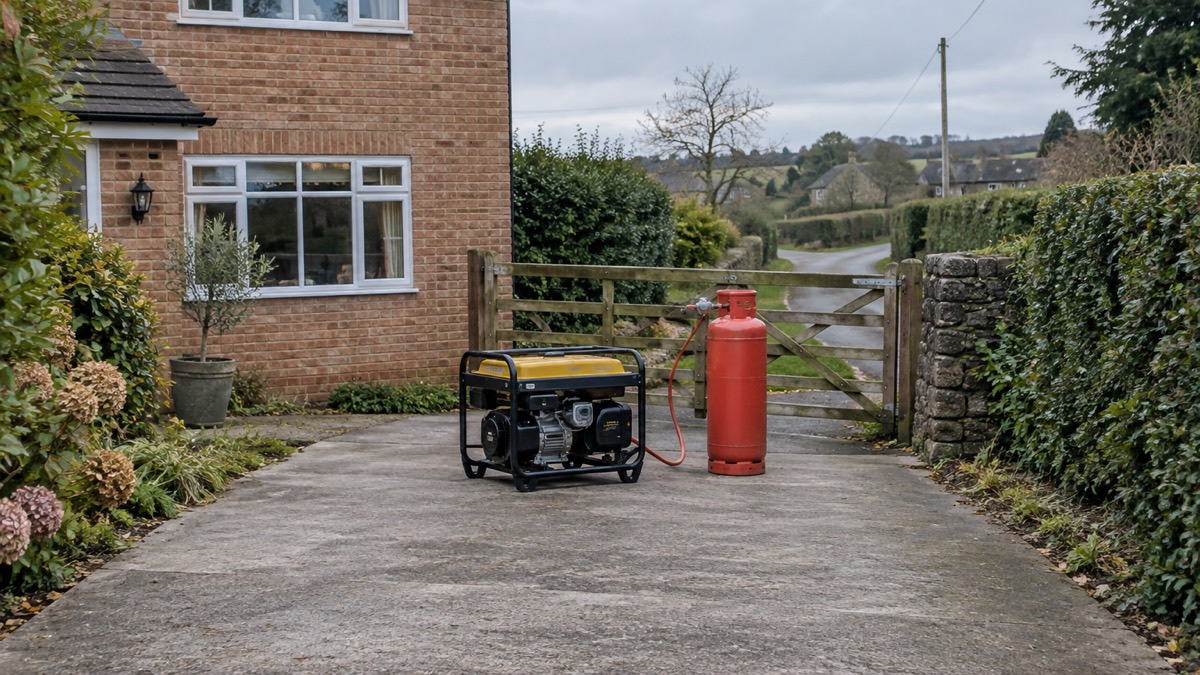
The Gorilla Power GP6500E-DF is a dual-fuel generator: it runs on petrol or on propane (LPG), and the output changes with the fuel. On petrol the distributor lists 6000W running and 6500W maximum; on LPG it is 5000W running and 5500W maximum1. That is enough to carry a household's essentials through a power cut, but it is a large, heavy machine, and it must stand outdoors while it runs.
What decides whether it suits you is not the headline wattage but three practical things: how you will fuel it, where it can safely stand, and what you actually need to keep running. A 19kg LPG bottle gives around 18 hours at 1.05 kg per hour1. The 110V sockets on the panel are for site equipment, not for your home appliances.
This page sets out the specifications as the distributor lists them, what the machine can power and for how long, and how to use, move and store it safely. For the wider picture, start with Backup Power at Home: A Household Guide.
What the GP6500E-DF is and who it suits
The distributor describes the GP6500E-DF as designed for home backup, construction and outdoor use1. That description tells you a lot about the machine. It is built to run power tools on a site as readily as it is to back up a house, which is why the panel carries 110V outlets alongside the 240V one.
For a household, the case for a dual-fuel machine of this size rests on two things. First, it can run on propane, so you are not dependent on storing petrol. Second, its output is large enough to carry several circuits' worth of load at once rather than one appliance at a time. The trade-off is noise: at 76 dB(A) at 7m it is a machine you will hear from the house1.
It suits a household that has somewhere outdoors and level to site it permanently or semi-permanently, a way to move it safely, and a plan for fuel. It does not suit someone who wants a unit to keep in a cupboard for occasional phone charging; a portable power station does that job without fuel or exhaust. If you are weighing the two approaches, Portable Power Station or Petrol Generator for a Power Cut sets out the differences.
If you are choosing between fuels rather than machines, LPG or Petrol Generator for Emergencies covers the trade-offs, and Portable Generators: Petrol, Diesel, Dual-Fuel and Inverter Types explains where a dual-fuel open-frame unit sits among generator types.
Specifications at a glance
The figures below are as the distributor lists them for this model1. Where a specification decides what you can run or how you site the machine, it is worth reading alongside the explanation that follows.
| Specification | Figure |
|---|---|
| Fuel type | Petrol or propane gas1 |
| Running output | 6000W petrol / 5000W LPG1 |
| Maximum output | 6500W petrol / 5500W LPG1 |
| Maximum kVA | 6.50 kVA petrol / 5.50 kVA LPG1 |
| Continuous kVA | 6.00 kVA petrol / 5.00 kVA LPG1 |
| Sockets | 1 x 240V 32A, 2 x 110V 32A1 |
| Fuel tank | 25.00L1 |
| Oil tank | 1.1 L1 |
| LPG consumption | 1.05 kg/h1 |
| Run time at 50% load | 12 hours (petrol)1 |
| Noise level at 7m | 76 dB(A)1 |
| Weight | 93.00kg1 |
| Dimensions (WxHxL) | 565 x 620 x 850mm1 |
| Starting method | Recoil, electric, remote start1 |
| AVR | Yes1 |
| Frequency | 50Hz1 |
| Warranty | 3 years1 |
Two entries deserve a word. The AVR, or automatic voltage regulator, is listed as fitted1; it holds the output voltage steadier as load changes, which matters for sensitive electronics. The 50Hz frequency is the UK standard1, so the machine's output matches what UK appliances expect.
What it can power, and for how long
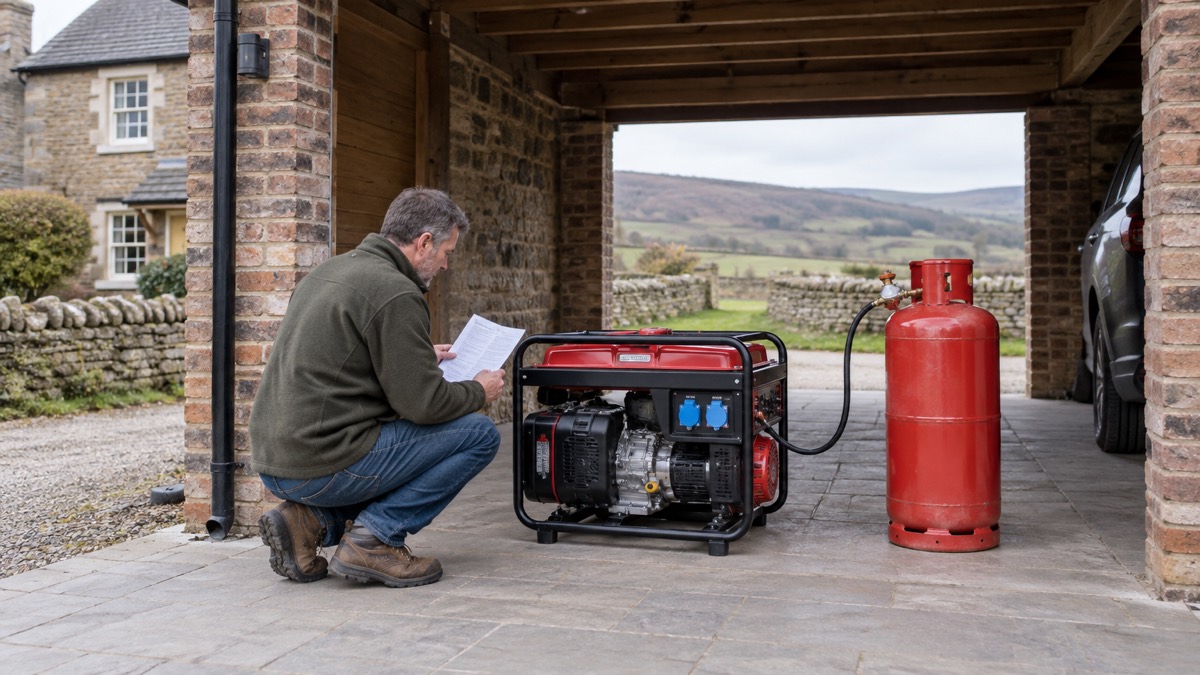
The machine's output is quoted two ways, and the difference matters. Running watts are what it sustains; maximum watts are the brief headroom for a surge. On petrol that is 6000W running and 6500W maximum; on LPG, 5000W running and 5500W maximum1. The same pattern appears in the kVA figures: 6.00 kVA continuous on petrol against 6.50 kVA maximum, and 5.00 kVA continuous on LPG against 5.50 kVA maximum1.
That surge headroom is there for motor starting. A fridge compressor, a freezer, a pump or a power tool draws a brief spike well above its running figure when it starts. The maximum rating covers that spike; the running rating is what the machine can carry continuously. Add up the running watts of everything you want on at once, then allow for the largest motor starting. Watts, Watt-Hours and Surge Explained walks through the arithmetic, and What Size Generator Do I Need for a Power Cut? helps you size a load. Deciding What to Keep Running When the Mains Fails is the place to start deciding what actually needs power.
Run time depends on load and fuel. The distributor quotes 12 hours on petrol at 50% load1. On LPG, consumption of 1.05 kg/h means a 19kg bottle lasts around 18 hours before it needs refilling or changing1. Note that the petrol figure is at half load: work the machine harder and you will refuel sooner. How Long Will a Generator Run on a Tank of Fuel? explains why load, fuel type and conditions all move the figure.
The 110V sockets, and what they mean for a home
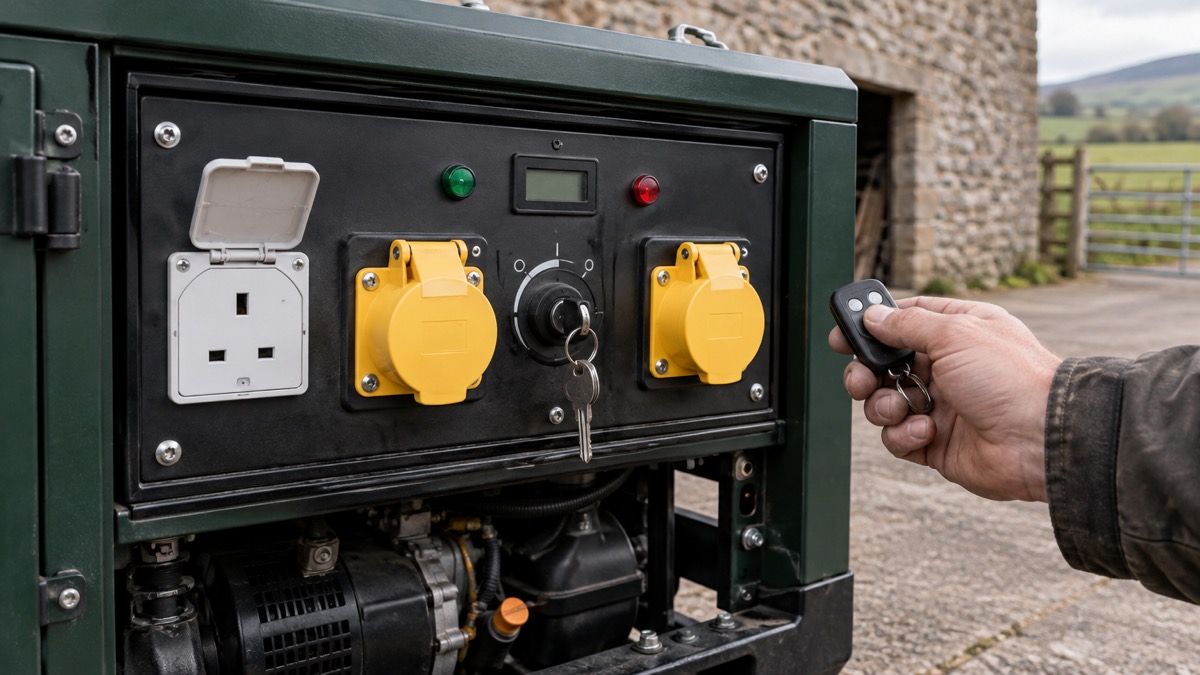
The panel carries one 240V 32A socket and two 110V 32A sockets1. For a household, the 240V outlet is the one that matters: it is the voltage your domestic appliances are built for. The 110V outlets are the site standard, used with yellow transformers and 110V tools on construction work, which is consistent with the distributor listing construction among the machine's intended uses1.
Do not assume a 110V socket will run a normal appliance through an adapter. Anything plugged into those outlets needs to be 110V equipment, or run through a suitable transformer designed for the job. For home backup, plan around the single 240V outlet and how you will distribute from it. Extension Leads and Overloading With Backup Kit covers how to spread the load without overloading a lead, and Connecting a Generator or Battery to Your Home's Wiring explains why plugging a generator into a house circuit is not a DIY job.
Fuel, oil and run time in practice
The petrol tank holds 25.00 litres and the oil tank 1.1 litres1. Check the oil before every run and keep it at the correct level; running low risks engine damage. Follow the maker's manual for oil grade and change intervals, and never overfill.
On fuel, the choice between petrol and LPG changes both the output and the routine. Petrol gives the higher rating, 6000W running against 5000W on LPG1. LPG gives less output but a long run from a single bottle: at 1.05 kg/h, a 19kg bottle lasts around 18 hours1. You will need a suitable regulator and hose to connect a bottle, and you should check the connection for leaks before starting. LPG Cylinders and Regulators for Dual-Fuel Generators covers bottles, regulators and safe connection in detail.
Storing petrol at home is regulated, and the limits are worth knowing before you buy fuel in bulk. How Much Petrol Can I Store at Home Safely? sets out the rules. Whichever fuel you use, store it away from the living space and away from any source of ignition.
Size, weight, noise and siting
At 565 x 620 x 850mm, the GP6500E-DF is a machine to site, not to carry1. Decide where it will stand before you need it: outdoors, on a hard level surface, clear of doors, windows and vents, and with room to reach the controls and the fuel connection. Moving it needs help or a suitable wheeled aid rather than a lift. How to Store a Generator After a Power Cut covers siting and storage between uses.
Noise is listed at 76 dB(A) at 7m1. That is a working machine, audible well beyond your boundary. Think about neighbours and timing, and about where you will stand while it runs. How Loud Is a Generator? Noise and Neighbours puts the figure in context.
Starting is by recoil, electric start or a wireless remote, which allows push-button starting from a distance1. The remote is convenient, but it does not change the safety rules: the machine still has to be outdoors and correctly set up before it starts. Cold weather can affect starting; Will a Generator Start in Cold Weather? covers what to expect, and Can You Run a Generator in the Rain? covers wet conditions.
Using it safely during an outage
The machine's job in a power cut is to carry selected loads, not the whole house. Run extension leads to the appliances you have chosen, keep the machine outdoors, and never feed power back into the house wiring yourself. Using Generators and Power Stations During an Outage sets out the routine step by step.
A sensible order is: site the machine outdoors and level; check oil and fuel; start it and let it settle; connect loads one at a time, starting with the largest motor so its surge is covered before other loads are added; and keep the total within the running rating for the fuel in use. On LPG that ceiling is 5000W, not 6000W1, so a load that fits on petrol may not fit on propane.
For the wider household picture, Power Cuts: A Household Guide covers what happens during an outage and Power Cut Backup Power Checklist lists what to have ready. If anyone in the household depends on powered medical equipment, read Powering CPAP, Oxygen and Other Medical Devices From a Battery before relying on any generator.
Warranty and UK availability
The GP6500E-DF carries a 3 year warranty1. Keep your proof of purchase and follow the maker's servicing instructions, since warranty terms generally depend on correct use and maintenance.
On availability, the distributor lists the model as in stock but warns of an extended lead time, with the possibility that you may not receive it next day1. If you are buying because a winter outage is forecast, order with that lead time in mind rather than assuming next-day delivery. Backup Power Checks Before Winter is a good prompt to test the machine and your fuel supply before the season turns.
Sources (1)
- Gorilla Power GP6500E-DF 6.50kW Dual Fuel Generator, Generators Direct, 2026-07-10
 EcoFlow Dual Fuel Generator
 Honda EU70iS Generator
 Honda EU32i Generator
 Honda EG3600 Generator
 Pramac P3500i Generator
 Senci SC6000-II Home Generator
 Senci SC10000-II Generator
 Senci SC6600iED Generator
 Gorilla Power GP3800iE
 Gorilla Power GP3500i
 Hyundai HY2250Si Generator
 Hyundai HY1000Si Generator