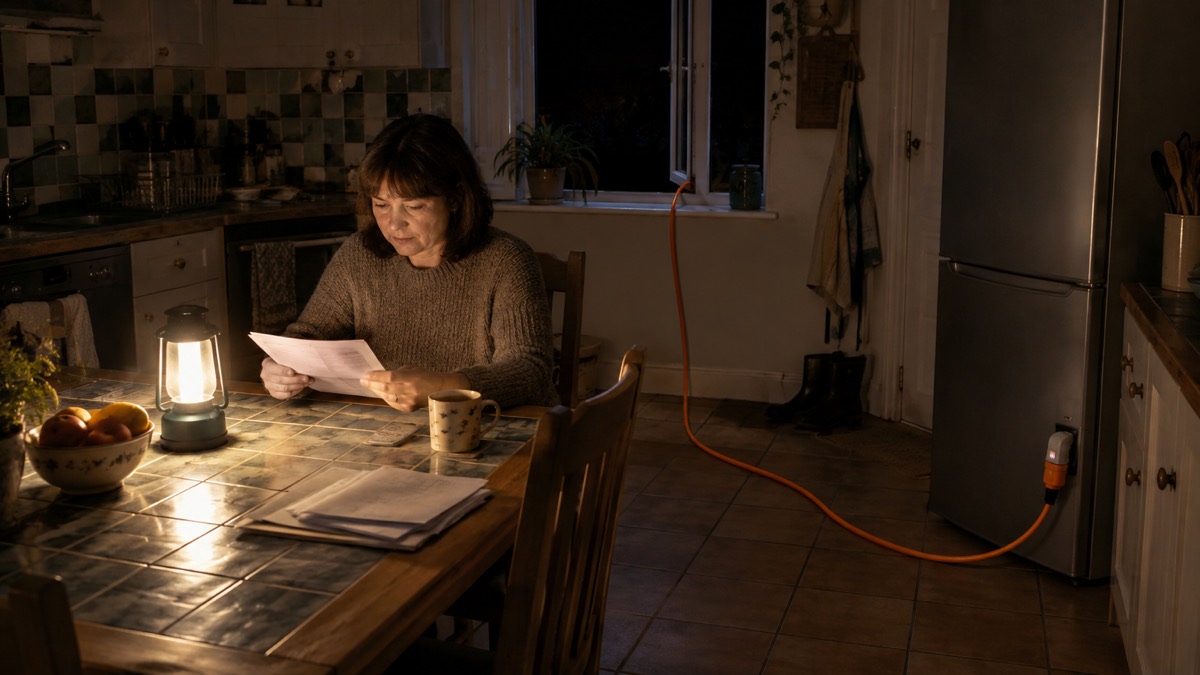
When the mains fails and you bring out a generator or a portable power station, the leads you connect them with become part of your household's electrical system. Most extension leads in UK homes are rated at 13A, though some older versions may be rated 10A, and overloading one is a recognised fire risk1. Fire and rescue services across the UK repeat the same core rules: check the rating, never plug one lead into another, keep heat-producing appliances on their own wall socket, and unwind cable reels fully before use2.
The stakes are real. The Northern Ireland Fire & Rescue Service has issued safety pleas after house fire fatalities, urging households only to buy from reputable retailers and to ensure electrical equipment and chargers comply with the required safety standards4. This page sets out, in the order you need them, the rules for using extension leads safely with backup power kit, how to protect yourself outdoors with an RCD, how to spot a lead that is failing, and what to do after a flood or fault.
Never plug a generator into a wall socket
The first rule of running backup power has nothing to do with the lead itself but with where you plug it in. A generator or power station should feed your appliances through its own sockets and suitable extension leads, never back into your home's wiring through a wall socket. Feeding power into a household circuit that way is not permitted under the regulations that govern household wiring, and doing it during an outage can create serious dangers for you and for anyone working on the network. If you want a generator or battery to supply your home's circuits properly, that is a job for a transfer switch and a qualified electrician, covered on connecting a generator or battery to your home's wiring.
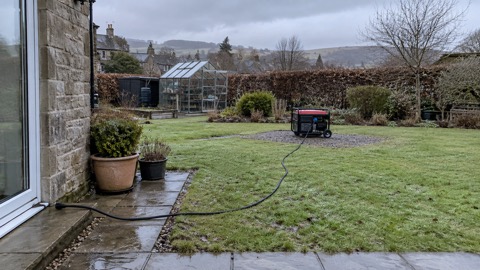
The leads you run from a generator are ordinary extension leads, and all the usual rules apply with extra force. Wiltshire and Swindon Prepared's guidance on generators points out that where you deploy the machine matters: it will need to be secure with good airflow10. That usually means the generator sits outdoors, away from the house, and the power reaches you through a long lead, which makes the rating, the RCD protection and the condition of that lead far more important than they are for a lead that never leaves the lounge.
Check the rating before you plug anything in
Every extension lead has a limit to how many amps it can take, and the fire and rescue services are blunt about why you must respect it: overloading an extension lead is a fire risk2. Electrical Safety First states that extension leads are rated at 13A apart from some older versions that may be rated 10A1. The documents do not disagree so much as describe two generations of lead: assume nothing and read the label.
Where to find the rating
The rating is printed on the lead itself, normally on the plug block or on a label along the cable. When you check it, also confirm the lead is fitted with a standard UK 3-pin plug and a fuse, which Electrical Safety First lists among the essentials for extension leads and cable reels1. A lead with a worn-away label, a missing fuse or a non-UK plug should not be used with backup kit.
Matching the lead to what you plug in
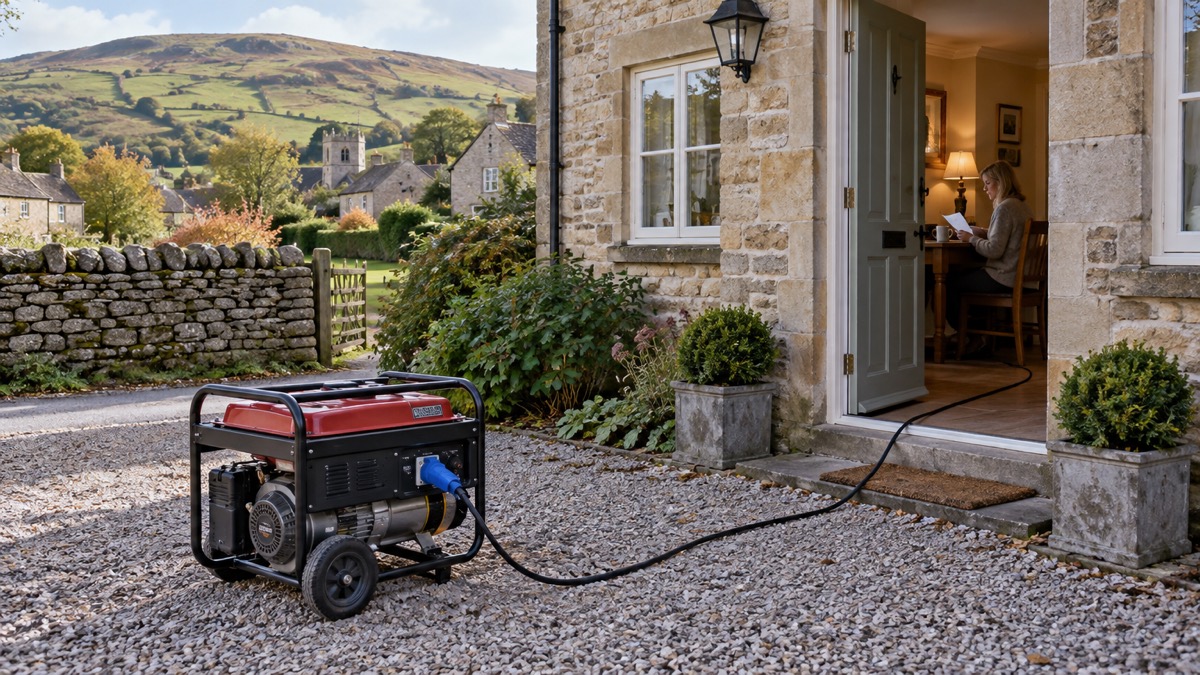
North Wales Fire and Rescue Service advises that extension leads and adapters have a limit on how many amps they can take, so be careful not to overload them, to reduce the risk of fire3. The practical approach during an outage is to add up what you are actually running. If you are working out how much each appliance draws and how that compares with a lead's rating, the page on watts, watt-hours and surge explains the arithmetic. As a rule of thumb, anything that makes heat or moves a lot of air deserves its own connection, and everything else can share.
| What you are running | Where it should go |
|---|---|
| Kettle, toaster, air fryer | Its own wall socket, never an extension lead6 |
| Electric heater | Plug directly into a wall socket, not an extension lead12 |
| Washing machine, dishwasher, tumble dryer | Never on a multi-plug extension lead14 |
| Phone chargers, lamps, router, radio | Fine to share a rated extension lead2 |
| Anything outdoors or on a generator | A rated lead plus RCD protection8 |
Never plug one extension lead into another
This is the single most common mistake households make, and every fire and rescue service in these islands says the same thing about it. Humberside Fire and Rescue Service warns that connecting more than one extension lead together can overload the socket and cause an electrical fault, and advises making sure cables are long enough to reach so leads do not need to be connected together5. Portsmouth's battery safety guidance for its council homes is equally direct: do not overload sockets or plug extension leads into each other15.
The reason is simple arithmetic. A 13A lead plugged into another 13A lead still draws everything through the one wall socket at the head of the chain, but the number of appliances you can attach has multiplied. Devon and Somerset Fire and Rescue Service's home fire safety checklist states plainly: never use powerful appliances such as dishwashers, washing machines or tumble dryers on a multi-plug extension lead14. The same service's advice to parents and guardians adds: never overload sockets or extension leads16. Fire Scotland's national guide goes further still, advising never to use more than one adaptor in each socket, never to overload an adaptor, and never to join adaptors together17.
If the cable you have is too short, the answer is a longer lead, not two short ones. Buy a single lead that reaches, or move the appliance closer to the socket. The London Fire Brigade's extreme weather guidance for households using extension leads in summer heatwaves makes the same point: if you use an extension lead, don't overload the sockets18.
The rule is simple: only use one socket extension lead per wall socket, and never plug an extension lead into another extension lead, as this risks overloading the socket15. If a cable will not reach, the safer answer is to buy a longer lead rather than join two together. Never use powerful appliances such as dishwashers, washing machines or tumble dryers on a multi-plug extension lead, and never overload sockets or adaptors.
Keep kettles, heaters and other power-hungry appliances apart
Devon and Somerset Fire and Rescue Service recommends that anything which produces a form of heat, such as a toaster, air fryer or kettle, should have its own wall socket6. Their kitchen safety guidance repeats the warning: don't overload extension leads, as this can cause fire19. The reason is that heat-producing appliances draw heavily and continuously, which is exactly the pattern that heats a lead up.
Portable heaters deserve special care, because during a power cut they are often the appliance people most want to run. North Yorkshire Fire and Rescue Service advises plugging electric heaters into a wall socket, not an extension lead, because they can easily be overloaded and cause fires12. The National Fire Chiefs Council's cost of living toolkit gives the same advice20. The Northern Ireland Fire & Rescue Service recommends plugging a heater directly into a socket rather than an extension lead, unplugging it when not in use, keeping at least one metre between the heater and combustible materials such as furniture, bedding or curtains, and buying heaters that conform to safety standards from reputable retailers13. Fire Scotland adds that a permanent safety guard should be fitted21.
The same principle applies to charging anything with a lithium-ion battery, which includes most power stations and power banks. Fire Scotland advises avoiding charging batteries near flammable materials, not overloading power sockets, not using unsuitable extension cords, and always using uncoiled extension leads that are properly rated for your devices22. The National Fire Chiefs Council's Charge Safe campaign, aimed at e-bike and e-scooter owners, puts it simply: don't overload sockets or use extension leads, it is safer to plug directly into the wall socket23.
Unwind a cable reel fully before you use it
Cable drum extension leads, the ones wound on a spool, are popular for generator use because they give you ten or twenty metres of reach in one package. The London Fire Brigade warns that cable drum extension leads should always be completely unwound to avoid overheating, and to be careful not to overload extension leads7. Fire Scotland's lithium-ion battery guidance makes the same point: always use uncoiled extension leads that are properly rated for your devices22.
A wound cable acts like the element in a heater: current flowing through coiled wire generates heat that has nowhere to go. Unwound, the same cable sheds its heat into the air and stays cool. The National Fire Chiefs Council's guidance on e-bikes and scooters, while written for battery charging, states the general rule: do not overload socket outlets or use inappropriate extension leads, use un-coiled extensions and ensure the lead is suitably rated for what you are plugging into it24.
During an outage, when a cable reel is likely to be carrying more current for longer than it ever does in normal life, this habit matters most. Unwind the whole drum every time, even for a few minutes of use, and lay the cable out flat rather than in a loose pile.
Use an RCD with every outdoor lead and generator
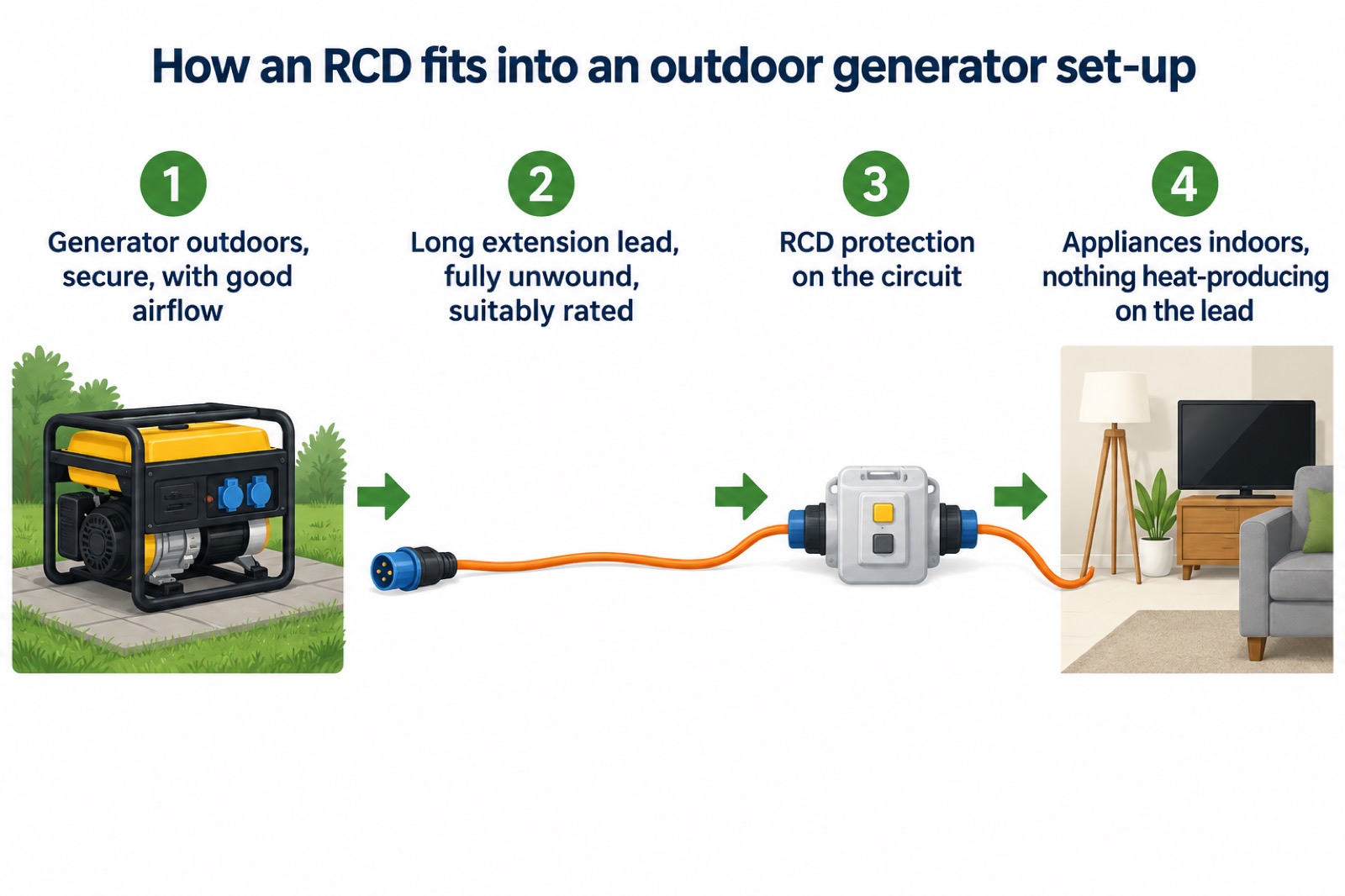
A residual current device, or RCD, is a lifesaving device designed to prevent fatal electric shock if you touch something live. Devon and Somerset Fire and Rescue Service explains that RCDs can be plugged into a wall socket, be part of the wall socket, or added to your fuse box25. North Wales Fire and Rescue Service states that RCD protection is particularly important when using electrical equipment outdoors3, and North Yorkshire Fire and Rescue Service's Christmas safety advice is that you should always use an RCD on outdoor electrical equipment, because this safety device can save lives by instantly switching off the power if there is a fault, and can be found in any DIY store8.
For generator users this is not optional housekeeping. A generator outdoors in British weather, feeding a long lead across wet ground to appliances inside, is the classic scenario in which someone touches something live. Electrical Safety First's guidance on outdoor lights, written for Christmas decorations but applying to any outdoor electrical use, advises that all outdoor lights be connected to a 30mA RCD protected mains, as the RCD will provide added protection against electric shock26.
If your fusebox has no built-in RCD protection, a plug-in RCD is one option: it sits between the wall socket and your lead's plug, and Electrical Safety First advises using an RCD plug on the socket where the product is plugged in if you don't have RCD protection in the consumer unit. If your generator is running standalone, its own sockets may include RCD protection, and the maker's manual will say so; check it before you rely on it. For more on the specific hazards of generators, see generator safety: carbon monoxide, fuel and electric shock.
How to test the RCD in your fusebox
Many UK homes now have RCD protection built into the fusebox, usually as one or two switches with a test button beside the main breaker. Electrical Safety First's answers to household questions address the case where the fusebox has no RCD protection at all: it would be recommended that you upgrade your fusebox so that it meets the latest standard, but it is not urgent27. In other words, an older fusebox without an RCD is not an emergency, but it is worth planning an upgrade with a qualified electrician, and in the meantime a plug-in RCD on any lead used outdoors covers the highest-risk situation.
Testing matters because an RCD that has sat untested for years may not trip when you need it. The test button on the fusebox simulates a fault: press it, and the RCD should switch off the circuits it protects. If it does not trip, or if it will not reset afterwards, contact a qualified electrician and rely on a plug-in RCD until the fault is found. Do this test before an emergency, not during one, so that you know your protection works before the night the power goes down.
Buying extension leads and cable reels you can trust
Electrical Safety First's advice on extension leads, cable reels and block adaptors is to buy from a reputable retailer rather than a third-party seller online, as the product may not have passed all the necessary safety checks1. The same organisation's guidance on lithium-ion battery products, echoed by the National Fire Chiefs Council, is to buy from reputable retailers, especially online, and to check that the devices meet British or European safety standards22. Devon and Somerset Fire and Rescue Service's education materials put it in words children can act on: make sure grown-ups buy chargers or cables from the manufacturer, as others are not always safe29.
The concern behind this advice is not theoretical. Devon and Somerset Fire and Rescue Service, in its guidance for carers, notes that heaters should be bought from a reputable supplier and that the service is aware of cheap but highly dangerous plug-in heaters bought online with fake safety marks30. The same pattern of counterfeit and low-quality electrical products sold through online marketplaces sits behind the wider warnings. For help telling genuine safety markings from fake ones, see UKCA, CE and battery safety markings explained, and for the marketplace question in general, are batteries and chargers from online marketplaces safe?.
When you buy, check three things before the lead goes into service:
- A standard UK 3-pin plug and a fuse1
- A clear rating label, normally 13A, so you know the limit1
- A length long enough to reach without joining leads together5
Once bought, register the product with the manufacturer. Electrical Safety First advises registering so you can be contacted easily if there is a safety recall, and notes it is also much easier to return a faulty item or order a repair if the product is registered1.
Warning signs, and what to do about them
Electrical Safety First lists the danger signs that mean a lead, plug or socket is in trouble. Do not ignore a smell of hot plastic or burning near an appliance or socket1. The same guidance warns against ignoring burn marks, 'arcing' sounds, described as buzzing or crackling, fuses blowing, circuit-breakers tripping, or a plug or lead that feels hot to touch1.
If you notice any of these, unplug the lead and contact the retailer, manufacturer, or a qualified repair technician1. Do not put the lead back into service on the strength that it seems to work: these signs mean damage has already happened inside.
The Northern Ireland Fire & Rescue Service's student fire safety advice adds a habit worth adopting in every household: don't leave electrics charging on soft surfaces, don't overload extension leads, and stay vigilant for signs of overheating or malfunction when charging31. Charging a phone, power bank or vape on a bed or sofa blocks the airflow that keeps the battery cool. Charge on a hard surface, and see safe battery charging at home for a fuller checklist.
After a flood or fault: wait for an electrician
If your home has been flooded, the rules change completely, and patience becomes the safety measure. The London Boroughs' flash flooding guidance is direct: do not turn on your electricity or gas supplies until they have been checked by a qualified electrician or engineer32. The London Fire Brigade's after-a-flood advice says the same in practice: until a competent tradesperson or your utility supplier has checked your electricity, you shouldn't turn it on, and the drying-out process means you'll need a generator to power any pumps, humidifiers, dryers or heaters you may decide to use9. In Northern Ireland, nidirect's clearing-up guidance advises getting an electrician to check electrical appliances and a Gas Safe-registered engineer to inspect the gas supply33.
This is the one situation in which a generator and extension leads are not just useful but necessary: they let you run drying equipment without switching on a supply that may be unsafe. Every rule on this page applies with extra force, because flood-damaged sockets and damp rooms raise the risk of both fire and shock. Keep the generator outdoors with good airflow10, keep every lead off wet surfaces where you can, use RCD protection on everything8, and have a qualified electrician check the installation before the mains comes back.
For the wider picture of what to run and what to leave off during an outage, see deciding what to keep running when the mains fails and using generators and power stations during an outage.
Sources (33)
- Extension leads, cable reels and block adaptors, Electrical Safety First
- Electrical safety at home, North Yorkshire Fire and Rescue Service
- Looking after the electrics, North Wales Fire and Rescue Service
- NIFRS issues safety plea following two house fire fatalities in one day, Northern Ireland Fire & Rescue Service, 2025-12-12
- Celebrate safely, Humberside Fire and Rescue Service
- Staying safe this season, Devon and Somerset Fire and Rescue Service, 2025-12-01
- Electrical items in the home, London Fire Brigade
- Don't let fire ruin your festive cheer this Christmas, North Yorkshire Fire and Rescue Service
- After a flood, London Fire Brigade
- Generators, Wiltshire and Swindon Prepared
- Student fire safety, London Fire Brigade
- Heating your home, North Yorkshire Fire and Rescue Service
- Home fire safety, Northern Ireland Fire & Rescue Service, 2026-10-14
- Home fire safety checklist, Devon and Somerset Fire and Rescue Service
- Battery safety, Portsmouth City Council
- Advice for parents and guardians, Devon and Somerset Fire and Rescue Service
- Your guide to fire safety, Fire Scotland, 2023-11-03
- Extreme weather summer guide, London Fire Brigade, 2024-05
- Kitchen safety, Devon and Somerset Fire and Rescue Service
- Cost of living toolkit, National Fire Chiefs Council, 2022
- Heating and gas, Fire Scotland, 2024-11-21
- Lithium-ion batteries, Fire Scotland, 2025-11-27
- Charge Safe campaign, National Fire Chiefs Council, 2026-10-09
- E-bikes and scooters guidance, National Fire Chiefs Council, 2022-01
- Battery fires, Devon and Somerset Fire and Rescue Service
- Britain's unsafe electrics could put an end to festive fun, Electrical Safety First
- Your questions answered, Electrical Safety First
- Lithium-ion batteries campaign, National Fire Chiefs Council, 2026-10-09
- Fire safety indoors, education resources, Devon and Somerset Fire and Rescue Service
- Home safety partnerships for carers, Devon and Somerset Fire and Rescue Service
- Student fire safety week sparks practising safe charging, Northern Ireland Fire & Rescue Service, 2025-09-22
- How to prepare for flash flooding, Greater London Authority
- After a flood: clearing up, nidirect, 2026-05-06
 Power Cut Backup Power Checklist
 Backup Power Before Winter
 Safe Battery Charging at Home
 What to Keep Running in a Cut
 Power During an Outage
 Watts and Watt-Hours
 Portable Power Stations
 Portable Generator Types
 Generator Safety
 LPG Cylinders and Regulators
 Connecting to Your Home's Wiring
 Home Battery Storage
 Portable Solar Panels
 12V Inverters
 Leisure and LiFePO4 Batteries