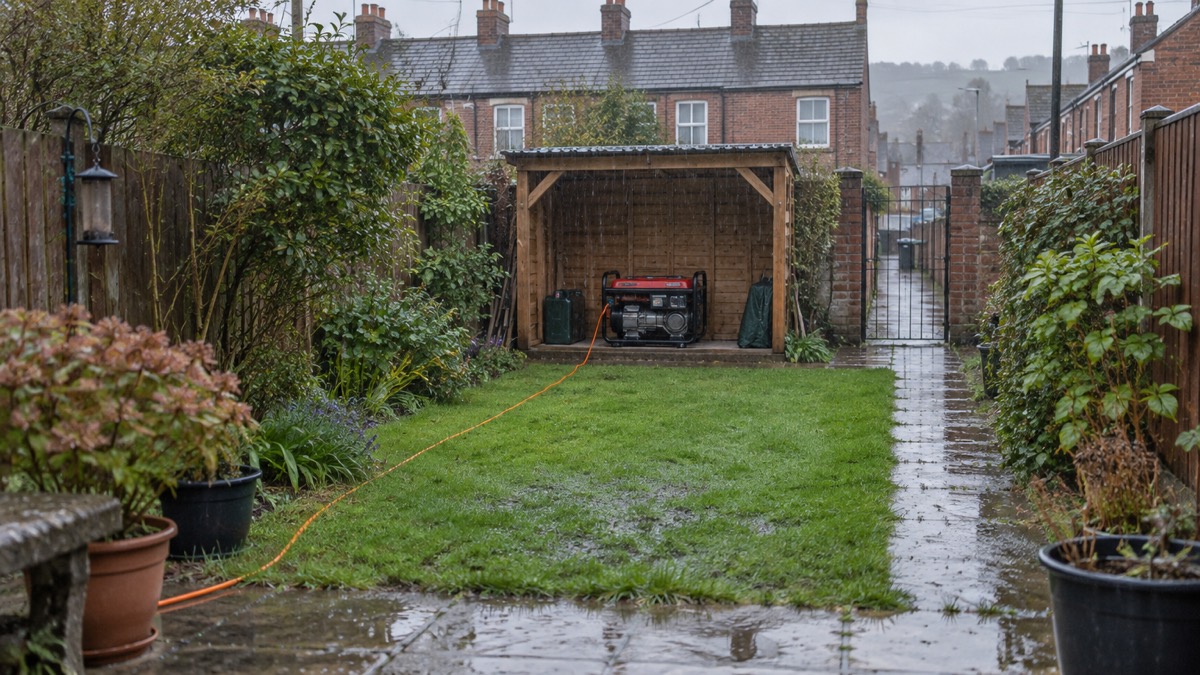
The short answer is no: most portable generators are not waterproof, and the maker's own instruction is not to use them in rain or standing water1. A generator should not be exposed directly to rain or standing water, and any protection you rig up must still let air in and let heat and exhaust gases out1. Running one in the wet adds electric shock and fire risk on top of the carbon monoxide danger that comes with any petrol or diesel set.
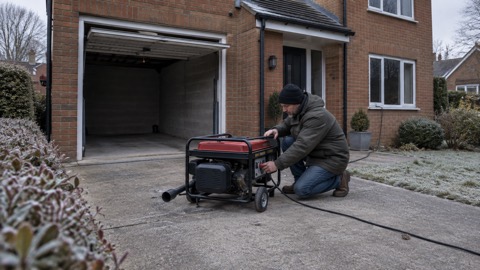
What you do instead depends on why you need it. If the power is off and you need a few lights, a phone charge or a fridge kept cold, a battery-based option avoids the weather problem entirely. If you must run a fuel generator, it goes outdoors, well away from doors, windows and vents, and never indoors or in a garage1. If the weather is too severe to site it safely, wait.
Most portable generators are not waterproof
A portable generator is a small engine driving an alternator, and the housing on a typical open-frame set is there to hold the parts together, not to keep weather out. Clarke, which sells generators, states the position for its own products without hedging: "Do not use it in rain or standing water"1. The same guidance explains what acceptable protection looks like, and it is stricter than most people expect: "A generator should not be exposed directly to rain or standing water. Any suitable protection must still provide proper ventilation and prevent heat or exhaust gases from building up"1.
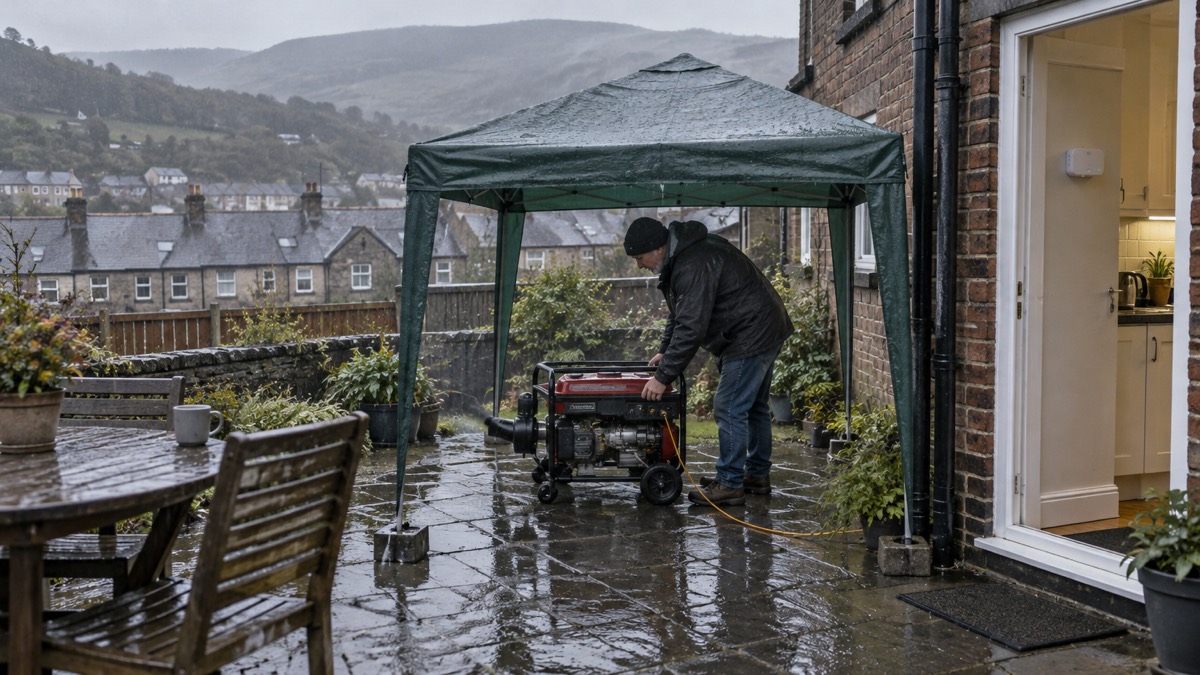
That combination is why a tarpaulin thrown over a running set is a bad idea. It keeps the rain off and traps the two things you most need to get rid of: heat from the engine and exhaust, and the exhaust gases themselves. Wiltshire and Swindon's preparedness guidance puts the same point positively: wherever you deploy a generator, it "will need to be secure with good airflow"4.
The electrical side matters just as much. Electrical Safety First is blunt about equipment and water: "Never use electrical equipment in wet conditions!"3. A generator running in the rain is exactly that situation, with mains-voltage sockets, plugs and leads exposed. Portable generators are not waterproof unless the manufacturer specifies it, and should not be left completely uncovered in heavy rainfall5. Some are at least weather-resistant but cannot be used in heavy rainfall5. A generator should not be exposed directly to rain or standing water, and any suitable protection must still provide proper ventilation and prevent heat or exhaust gases from building up1.
Weather-resistant generators are still not for heavy rainfall
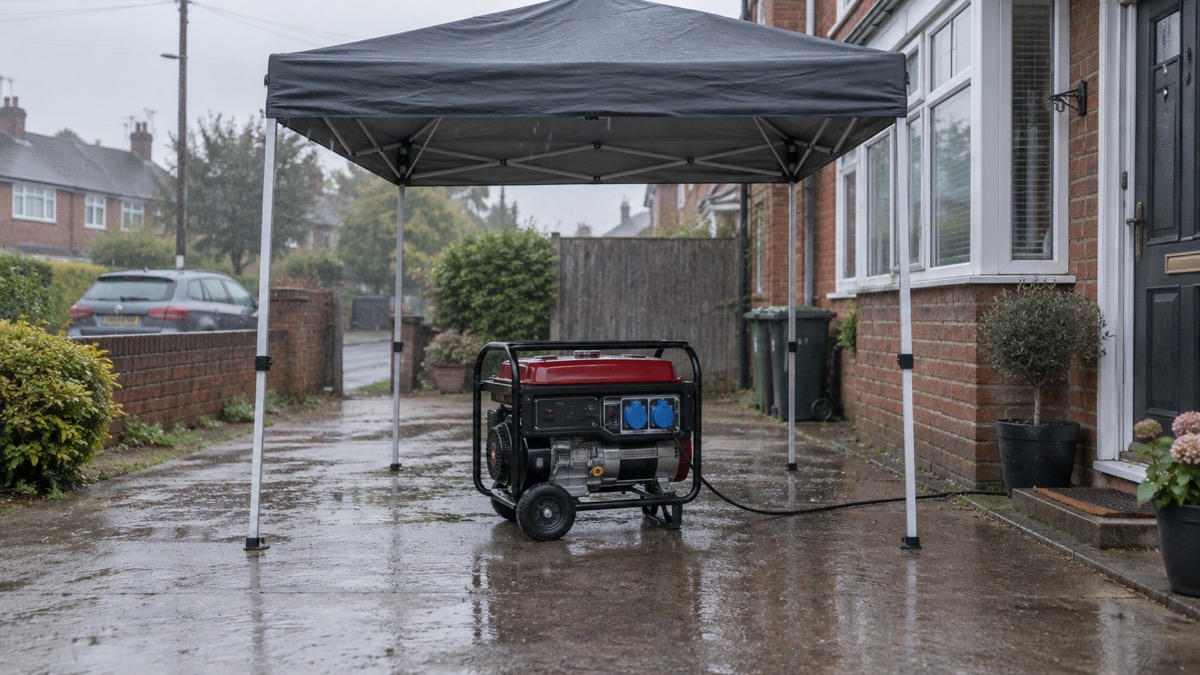
Some sets are sold with housings that resist splashes or light weather, and that is worth having: it reduces how much rain reaches the electrics while the set is running or stored. It does not turn a generator into something you can run in a downpour. The maker's instruction above applies to the range as a whole, and it draws no distinction between a bare frame and a covered one: no direct exposure to rain or standing water, and any protection must still ventilate1.
The practical reading is this. A weather-resistant housing buys you time if a shower starts while the set is running, and it protects the machine in storage. It does not license you to leave a generator out in heavy rain, and it does nothing about the two hazards that matter most in wet weather: water reaching live electrical parts, and exhaust gases pooling if you move the set somewhere sheltered to keep it dry.
There is also a limit on what anyone else will do for you. Northern Ireland Networks, which runs the electricity network in Northern Ireland, states on its Medical Customer Care Register page that "We will not provide a generator for your property during severe weather events"6. Ofgem's review of the network response to Storm Arwen records that some rural locations are unsuitable for large generator installation because of the difficulty of transporting large and heavy equipment in storm conditions7. In other words, the moment you most want a generator is the moment it is hardest to run one safely, which is why the planning has to happen before the storm.
Rain adds shock and fire risk to the carbon monoxide danger
Carbon monoxide is the hazard that kills people with generators, and wet weather makes the other risks worse without reducing this one. The London Fire Brigade's advice after a flood is unambiguous: "never run a petrol or diesel-powered generator indoors. They can produce fatal levels of carbon monoxide"2. Runnymede's flood guidance says the same: "Do not use petrol or diesel generators indoors because the exhaust gases contain carbon monoxide, which can kill"8. Northern Ireland's flood clearing guidance tells people to "put the generator outside to avoid carbon monoxide poisoning from the exhaust"9.
Carbon monoxide is produced by incomplete combustion of carbon fuels, for example a poorly ventilated or defective appliance10. The NHS lists using barbecues or camping stoves inside, and turning on vehicle or lawn mower engines in an enclosed space such as a garage, as causes of a build-up11. The Wales carbon monoxide page adds the same examples12, and the Health and Safety Executive for Northern Ireland notes that running a car in a garage can raise levels high enough to cause poisoning10. A generator is an engine, and the same logic applies.
The wet-weather additions are electric shock and fire. Water on a plug, socket or lead creates a path for current, and Electrical Safety First's guidance for gardens is to never use electrical equipment in wet conditions13. A generator standing in a puddle, or a lead lying in one, is the same problem at a larger scale. Keep the set on firm, dry ground, keep connections up off the floor, and stop using anything that has been soaked.
Where a generator must never go when it rains
The temptation in bad weather is to move the generator somewhere with a roof. Every one of those places is wrong. The table below sets out the options a household is likely to consider and what the guidance says about each.
| Place | Verdict | Why |
|---|---|---|
| Outdoors, uncovered, in heavy rain | Do not | Not to be exposed directly to rain or standing water1 |
| Outdoors under a tarpaulin or sheet | Do not | Cover must still ventilate and stop heat and exhaust building up1 |
| Garage, even with the door open | Never | Enclosed space; exhaust gases can kill2 |
| Shed, conservatory or porch | Never | Same carbon monoxide risk as any enclosed space2 |
| Indoors, near a window or door | Never | Fumes can be lethal; keep outdoors and away from openings1 |
| Outdoors, well away from doors, windows and vents | Yes, if conditions allow | The maker's stated siting rule1 |
Northern Ireland's strong wind and heavy rain warnings carry the same instruction for standby generators: "never use standby generators indoors, as the fumes from the engine can be lethal"14. The same warnings tell farmers and livestock owners to check and test backup generators and equipment ahead of severe weather14, which is the useful half of the message: test it in the dry, before you need it.
Petrol generators: built for portable, occasional use
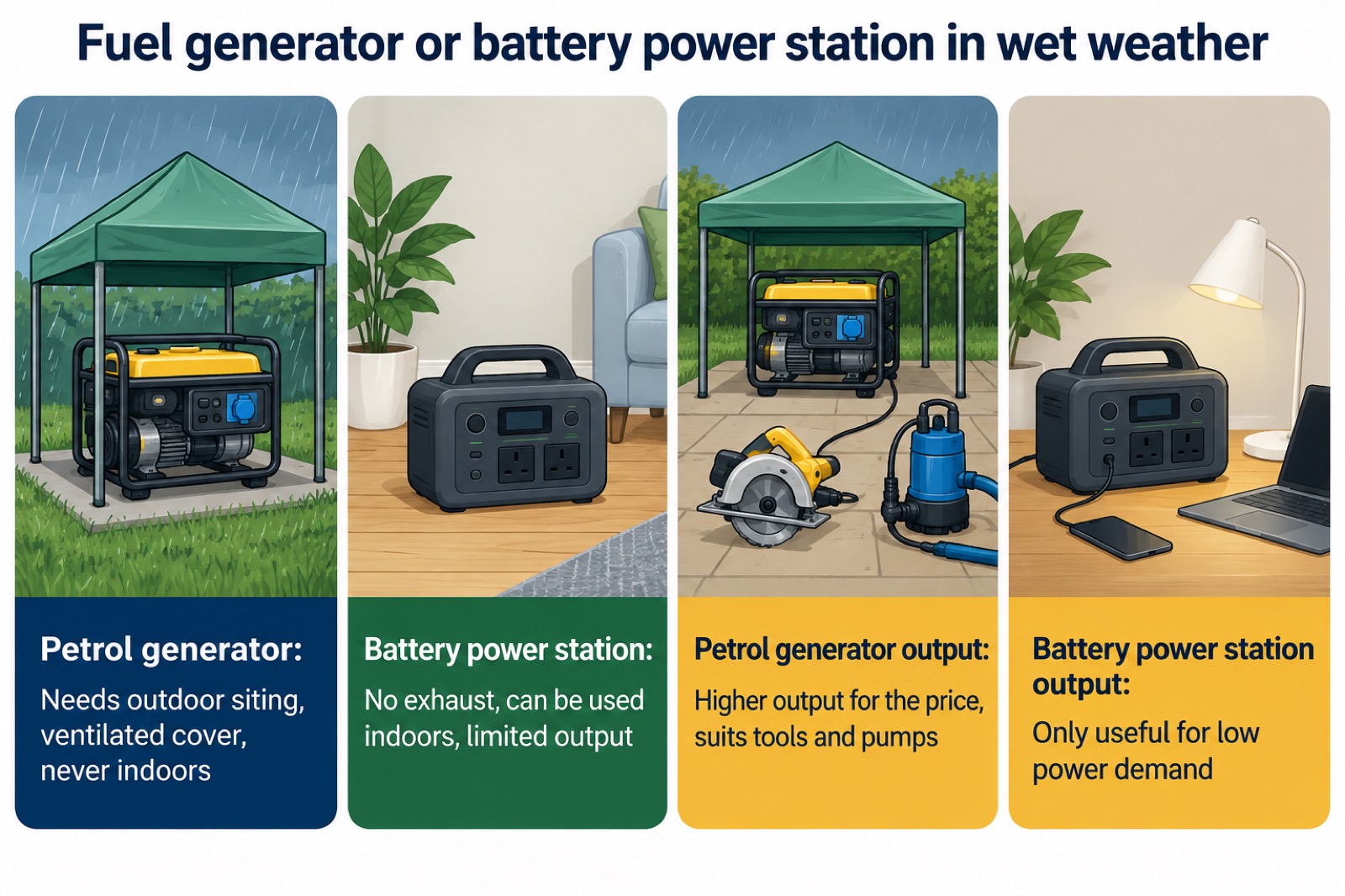
None of this means a petrol generator is the wrong choice. It means it is a fair-weather tool with a specific job. Conventional petrol generators use an engine to drive an alternator at a relatively constant speed, which makes them practical for tools, lighting, pumps, workshop equipment and general site use, and they often give a higher output for the price1. Which? notes that petrol is cheaper than diesel and quieter than diesel generators, and that petrol sets need regular maintenance17.
The trade-offs are worth knowing before you buy. Portable generators are small enough to carry and have labelled inputs, but their limited output capacity means some models will not power all appliances17. Battery-based alternatives are smaller and more portable than fuel-tank generators, but are only really useful if you have low power demand, and can sometimes be charged with solar panels17. For a household that wants lights, a phone charge and a fridge kept going through a storm, that trade-off often points away from petrol altogether.
If you do keep a petrol set, treat wet weather as a reason to leave it switched off unless you can site it properly. Petrol generators tend to be more portable, which makes them ideal as a backup for home use, camping, or even outdoor events and parties14. They are small, typically petrol-powered units designed for temporary use in remote locations or during power outages, and are ideal for powering essential appliances like refrigerators, fans and lights15. A battery powered or wind-up radio belongs in an emergency flood kit for exactly this reason18.
For the wider picture on choosing between the two, see Portable Power Station or Petrol Generator for a Power Cut, and for the safety rules that apply in any weather, Generator Safety: Carbon Monoxide, Fuel and Electric Shock. If you are weighing up where a set can go inside the home, Can You Run a Generator Indoors or in a Garage? covers that in detail, and Using Generators and Power Stations During an Outage walks through an outage step by step.
Sources (18)
- Generators, Clarke International, 2026-10-25
- Flooding advice: after a flood, London Fire Brigade, 2026-10-25
- Don't dabble with danger in the garden, Electrical Safety First, 2026-10-25
- Generators, Wiltshire and Swindon Prepared, 2026-10-25
- Electrical safety in the home and garden, Electrical Safety First, 2026-10-25
- I'm on your Medical Customer Care Register, so should I get a generator from you?, Northern Ireland Networks, 2026-10-25
- Final report on the review into the networks' response to Storm Arwen, Ofgem, 2022-06-09
- Flooding, Runnymede Borough Council, 2026-10-26
- After a flood: clearing up, nidirect, 2026-05-06
- Carbon monoxide, Health and Safety Executive for Northern Ireland, 2026
- Carbon monoxide poisoning, NHS, 2025-12-16
- Carbon monoxide poisoning, NHS 111 Wales, 2025-10-02
- Get smart in the garden, Electrical Safety First, 2026-10-25
- Strong winds and heavy rain warning: information and advice, nidirect, 2026-01-27
- Strong winds: weather warning information and advice, nidirect, 2026-10-24
- How to dry your home out after a leak or flood, Which?, 2025-12-01
- How to buy the best generator, Which?, 2026-01-20
- Preparing for a flood, nidirect, 2025-09-11
 Power Cut Backup Power Checklist
 Backup Power Before Winter
 Safe Battery Charging at Home
 Running a Generator Indoors
 Carbon Monoxide from Generators
 Generator Sizing for a Power Cut
 Generator Run Time on a Tank
 Storing Petrol at Home
 Diesel Storage at Home
 Storing a Generator
 Generators in Cold Weather
 Generator Noise and Neighbours
 Power Station Capacity Sizing
 Power Station Run Time
 Power Station for a Gas Boiler