
When a named storm is heading for the UK, a power cut becomes a real possibility, and the time to prepare is before the wind arrives. The Met Office issues wind warnings up to seven days ahead, coloured yellow, amber or red according to the expected impact1. A yellow wind warning already carries the words that matter to your household: there is a slight chance that power cuts may occur, with the potential to affect other services, such as mobile phone coverage2.
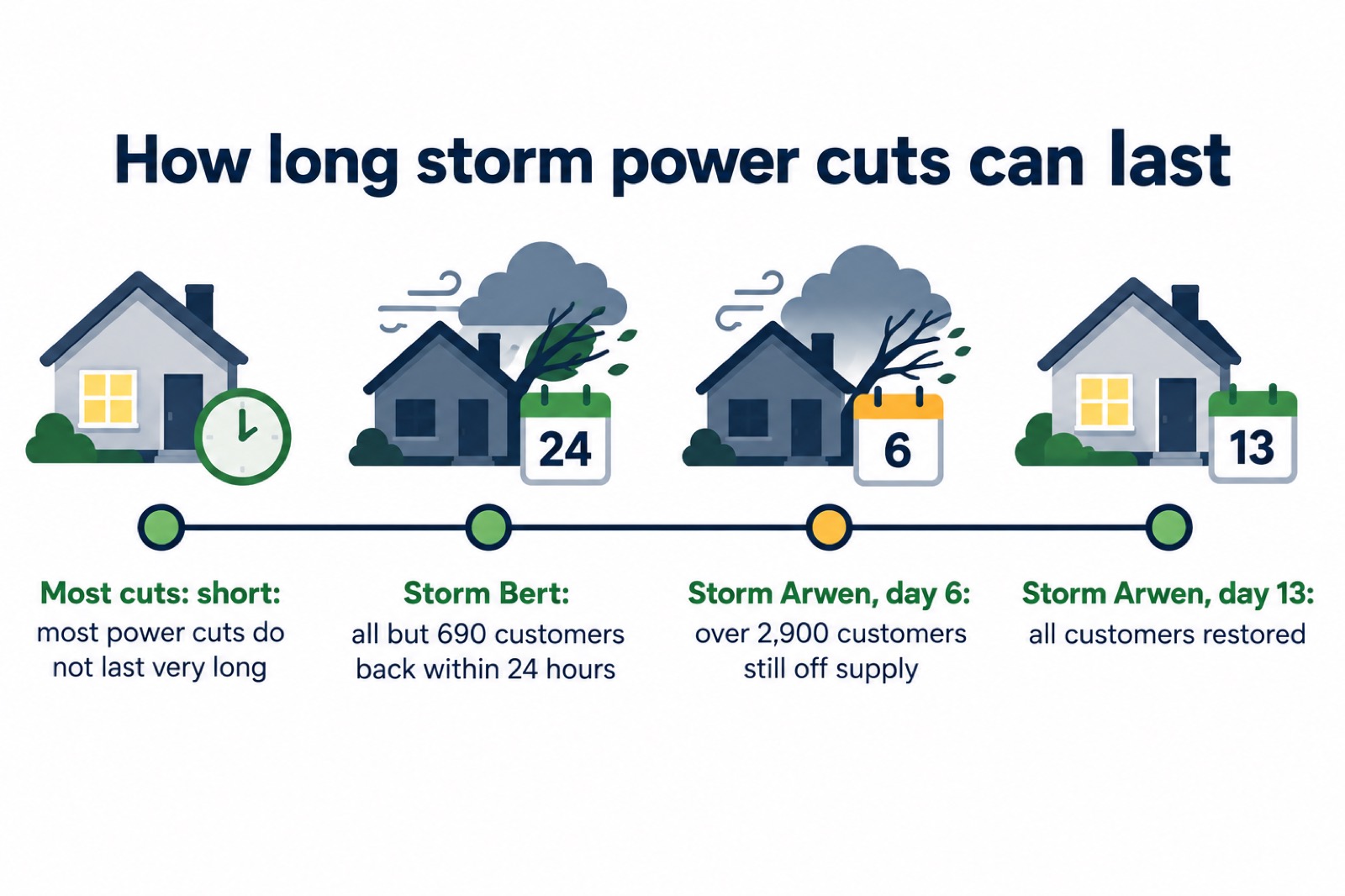
Most storm power cuts are short, and most homes are back within a day. But the biggest storms are different. Storm Arwen in 2021 left over 2,900 customers still off supply after six days, and the last customers were not restored until 13 days after the storm struck3. So the sensible approach is to prepare for at least 24 hours without electricity whenever a wind warning covers your area, and to know how to get help, report damage and claim compensation if the outage runs longer.
What yellow, amber and red warnings mean
The Met Office is responsible for issuing weather warnings, which warn of the impacts caused by severe weather7. Every warning is given a colour, yellow, amber or red, based on a combination of the impact the weather may have and the likelihood of that impact occurring1. The warnings are based on the impact of the UK weather rather than a threshold of the weather itself8: the same gust speed can produce a yellow warning in one place and an amber warning in another, depending on when it strikes and how exposed the area is.
For your electricity supply, the colours translate fairly directly. A yellow wind warning means there is a slight chance that power cuts may occur, with the potential to affect other services, such as mobile phone coverage2. An amber warning means an increased likelihood of severe weather affecting you, resulting in travel delays, power cuts, interruptions to utility services and even a danger to life9. Red is the highest level, reserved for the most severe cases where weather brings a danger to life1.
| Warning colour | What it means for your supply | What to do |
|---|---|---|
| Yellow | A slight chance of power cuts, possibly affecting mobile coverage2 | Prepare: torches, charged power packs, essentials gathered6 |
| Amber | Power cuts, damage to property and loss of water supplies are possible impacts2 | Full preparations; think about what steps you can take to minimise disruption2 |
| Red | The most severe cases can bring a danger to life, alongside power cuts and loss of utilities2 | Follow all official instructions; treat a power cut as certain |
Warnings are designed to let people, businesses, emergency responders and governments know what weather is in store and what the impacts could be10. Each warning carries four sections: a headline, what to expect, what should I do, and further details1. Read the "what should I do" section rather than relying on the colour alone, because it contains the specific actions for your area.
The Met Office has also introduced a new harmonised impact matrix for its warnings and flood guidance statements, working with the UK's four hydrological agencies and the Flood Forecasting Centre, which includes a change to the impact level terminology1. The colours and the principle of impact-based warnings are unchanged, but the wording around impact levels has been updated as of October 2026.
Warnings arrive up to seven days ahead, and they change
The National Severe Weather Warning Service provides warnings up to seven days ahead for rain, thunderstorms, wind, snow, lightning, ice, extreme heat and fog1. That gives you a genuine window to prepare, but the Met Office's own advice is blunt about how quickly things move: be prepared for weather warnings to change quickly11. A yellow warning issued on Saturday can be upgraded to amber by Sunday, or extended to a new area, or dropped entirely.
A live example shows how this works. On 24 October 2026 the Met Office issued a yellow warning for strong west to southwesterly winds covering Scotland, Northern Ireland and northern England, valid from 03:00 to 23:59 on Tuesday 27 October, with gusts of 50 to 60 mph widely and 70 mph or more in coastal or exposed areas12. Warnings are issued as required, so a single week can bring several of them, overlapping the same regions2. Two storms, two sets of warnings, overlapping areas, all within a few days.
The practical rule is simple: always check your latest local forecast to find out if there are any weather warnings in force for your local area10. Warnings are issued as required8, and the Met Office publishes them through its app and website, social media, TV and radio1. Check once when a storm is named, and check again on the day, because the detail may have changed.
Any warning issued should make you think about what steps you can take to minimise the chances of disruption for you13. The Met Office considers factors including the time of day, the time of year, how unusual the weather is, outdoor events and ongoing sensitivities to weather within the area when setting a warning level13. That is why the same storm can produce different warning levels in different places, and why your own circumstances, an exposed rural line, a coastal home, someone in the house who depends on powered medical equipment, should shape how seriously you take even a yellow warning.
How storms actually cut the power
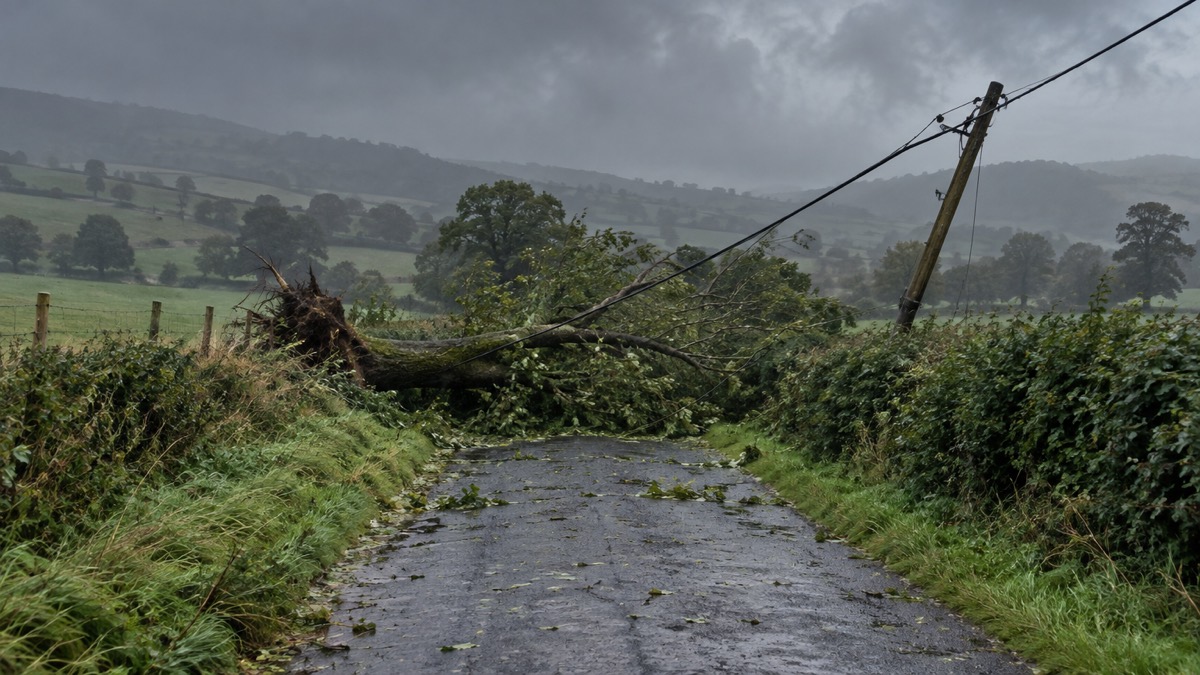
Storms cut electricity supplies in a handful of well-understood ways, and nearly all of them involve the overhead network. Strong winds and storms often result in tree damage and trees being brought down, which can be the catalyst for impacts such as loss of power when a tree falls onto power lines14. Power companies may be impacted by fallen trees in storms knocking out overhead cables, or by high-voltage underground cable faults15.
The mechanism is straightforward: severe weather warnings are based on the impact of the weather rather than a threshold of the weather itself2. Power cuts are among the impacts the National Severe Weather Warning Service warns of, alongside damage to property, travel delays and cancellations and loss of water supplies2. Wind does not need to destroy a pylon; it needs only to bring a branch or a length of debris into contact with a line, or to bring a whole tree down across it.
The other causes sit alongside the wind. Power cuts can have a number of causes including severe weather, which can lead to damaged infrastructure, or system faults16. Thunderstorms bring their own route to an outage: hail, difficult driving conditions, flooding, lightning strikes and power cuts are all possible under a thunderstorm warning17. Even heat can do it: during an amber extreme heat warning in August 2026, the Met Office noted that some heat-sensitive systems and equipment may be disrupted, with the potential for power cuts in places18.
Because the damage is physical and scattered, restoration is slower than after an ordinary fault. A single underground cable fault can be repaired by one crew in one place. A storm can produce thousands of separate faults across a whole region, each needing its own team, its own access and often its own tree surgeon before the repair even begins. That is the difference between a few hours off supply and a few days, and it is why storm warnings deserve real preparation.
How long you might be off supply
Most power cuts do not last very long15. In normal weather, network companies have 24 hours to restore your power if more than 5,000 homes are affected by a single fault19. For interruptions outside severe weather, the standard restoration time is 12 hours4. Even in storms, the majority of customers are usually back quickly: after Storm Bert, SSEN reported that all but 690 customers were back on within 24 hours of losing supply20.
But "most" is not "all", and the tail of a storm outage can be long. Storm Arwen in November 2021 caused damage that resulted in over 9,700 faults, primarily caused by strong winds and fallen or broken trees3. Over 2,900 customers were still off supply after six days, and all customers were restored within 13 days3.
Network operators grade storms into categories, based on how the storm has affected the electricity network and how many faults it has caused in a high-voltage area in one day, for example damage to pylons and overhead cables21. The category matters to you because it sets the restoration targets your operator works to, and the compensation thresholds:
| Storm category | Restoration target | Who says so |
|---|---|---|
| Outside severe weather | 12 hours | Ofgem4 |
| Storm category 1 | 24 hours | Ofgem21 |
| Storm category 2 | 48 hours | Ofgem21 |
For planning purposes, treat a storm outage as a full day at minimum, with food, lighting, warmth and information arranged for that long. If your area has taken heavy damage, or you are at the end of a rural spur line, plan for longer. Our page on how long until the electricity comes back goes into the detail of how operators prioritise reconnections.
What to do when a storm warning is issued
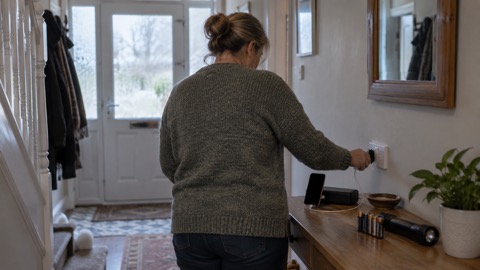
The government's storms guidance is direct about the sequence. When a storm is forecast, charge mobile phones, power banks and any back-up batteries for medical equipment in case there is a power cut5. Then work through the household preparations before the wind arrives, because once trees are down and lines are damaged, it is too late to charge anything.
- Charge everything. Charge mobile phones and power banks in case there is a power cut, and find your emergency plan and make sure it is up to date22.
- Gather your kit. People cope better with power cuts when they have prepared for them in advance. It is easy to do; consider gathering torches and batteries, a mobile phone power pack and other essential items2.
- Open electric gates and check powered access. Make sure electric gates are open before a storm, so you are not trapped in or out if the supply fails23.
- Prepare for a power cut in general. Make sure you are prepared in case there is a power cut, with lighting, food that needs no cooking and a way to stay warm23.
- Check on people who may need help. If someone nearby is on the Priority Services Register or depends on electricity for health or mobility, agree now how you will check on them.
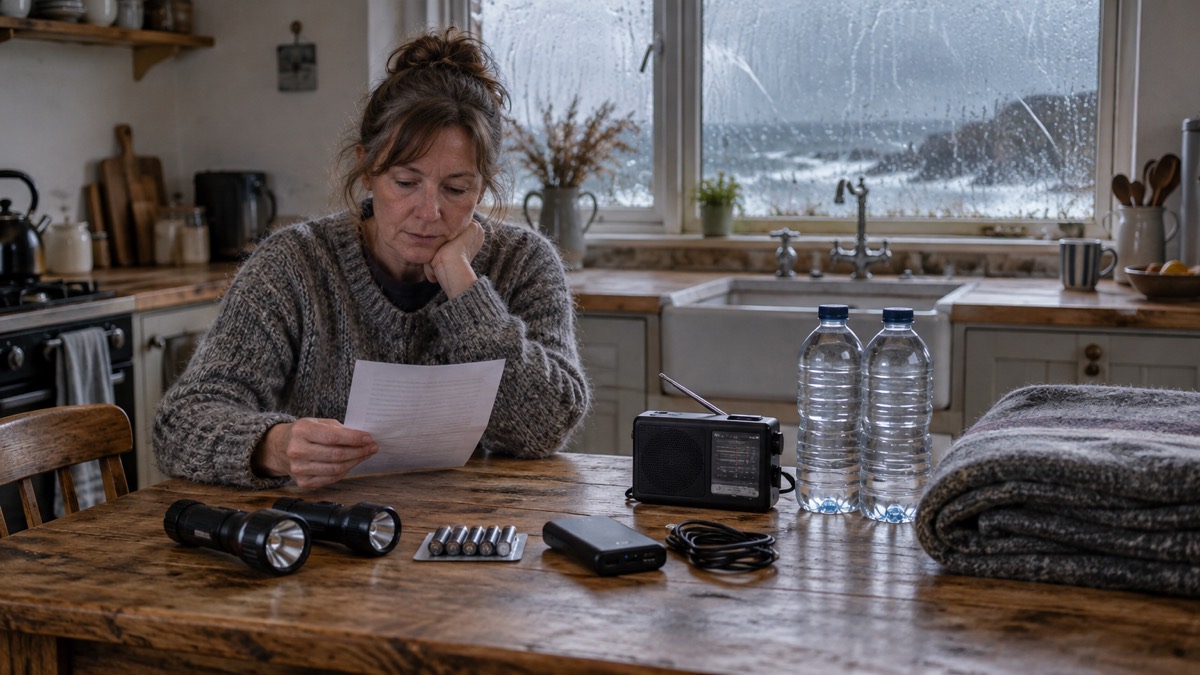
Two further points from the official guidance are worth fixing in mind before the storm, not during it. First, storms can cause water outages by fallen trees or flooding damaging the water network5, so keep some bottled water in the house. Second, if a building will not be used over the winter months, water supplies should be turned off and pipes drained24, which protects an empty property from burst pipes when heating fails.
Our power cut kit checklist and the page on what to do when the electricity goes off cover the full lists. If you rely on medical equipment, the checklist for households using medical equipment sets out what to have charged and what to arrange in advance.
Damaged power lines: keep away and ring 105
The danger does not end when the wind drops. After a storm, be careful not to touch any electrical or telephone cables that have been blown down or are still hanging23. A line lying still on the ground can be live, and high-voltage electricity can jump a gap to anyone who comes close enough. Keep children and animals well back, and do not assume a line is dead because it is quiet or because the area is already dark.
Report what you find. Call 105, free of charge, to report the problem and get updates on when your power will be restored22. The number 105 puts you through to your local electricity network operator4, and it works from any phone that has signal. In Scotland, the Ready Scotland guidance lists 105 as the number for a power cut25. Our page on fallen overhead lines covers this in full, including what to do if a vehicle touches a line.
Help from your network operator during a long outage
If the outage runs into hours or days, your network operator is the organisation to deal with, not your energy supplier. Visit your local network operator's website to report a power cut and track updates when there is a problem, or call 105 if you are unable to report online16. If your electricity or gas supply is cut off because of an unplanned power cut, you can report it directly to your local network operator using their website, or call 105 for free4.
Two pieces of practical help are worth knowing about in advance:
- The Priority Services Register. Sign up to your energy supplier's Priority Services Register to let them know that you need additional support during a power cut26. Our page on the Priority Services Register explains who can join and what it gives you.
- Landline back-up. If your landline will not work during a power cut, your landline provider might offer you a free solution, such as a back-up battery unit, for a minimum of one hour, that would enable you to call the emergency services during a power cut if you needed to26.
Be aware that your mobile phone might stop working if your local mast is in the affected area26, so do not rely on a single means of communication. Keep one phone charged and switched off as a reserve, and keep a power bank at full charge. The page on what to keep charged lists the devices worth topping up before any storm.
If you have elderly relatives or neighbours who might need help during a power cut, check up on them27. If you or someone you care for needs guaranteed extra help, the register is the mechanism that puts you on the operator's list. Our page on extra help from network operators during long outages sets out what that help can include.
Payments when you are off supply for more than 24 hours
You may be entitled to compensation if a storm keeps you off supply long enough, and the amounts depend on the storm category and how many properties were affected. The rules are set by Ofgem, the energy regulator, and operators pay automatically in many cases, though it is worth checking and claiming yourself.
| Situation | Payment | Source |
|---|---|---|
| Fewer than 5,000 properties off more than 12 hours, or more than 5,000 properties off more than 24 hours | A payment for homes and a larger one for businesses | Ofgem4 |
| Additional 12-hour periods without electricity | An extra payment for every additional 12-hour period | Ofgem4 |
| Storm category 1, first 24 hours | A payment after 24 hours, then an extra one for every 6 hours after | Ofgem21 |
| Storm category 1 or 2, severe weather | A payment for domestic customers, plus an additional amount for each further 6 hours, up to a capped total | Ofgem consumer advice19 |
| Power cut lasts more than 24 hours and is interrupted for 72 hours | 4 additional payments, one for each further period | Ofgem21 |
| Power off more than 4 times between 1 April and 31 March, each cut lasting at least 3 hours | An extra payment for homes and businesses | Ofgem4 |
The exact amounts change from time to time, so check Ofgem's current guidance before claiming.
Both are official Ofgem figures; if you are claiming, check the current position on Ofgem's payment eligibility page4 and quote your outage times.
Timing also differs by weather. In normal weather power cuts, payment is normally sent within 10 working days of the operator becoming aware of the failure; in severe weather, operators have up to 3 months19. Keep a note of when your supply went off and when it came back, and check whether you need to claim or whether the payment is automatic for your outage.
What past storms show
The record of recent named storms tells you what to expect, both the good news and the bad. Storm Arwen in November 2021 was the worst case in recent years: the damage resulted in over 9,700 faults, primarily caused by strong winds and fallen or broken trees, with over 2,900 customers still off supply after 6 days and all customers restored within 13 days3. Ofgem's review of the networks' response to Arwen led to changes in how operators prepare for and respond to storms3.
Storm Eunice in February 2022 affected far more customers, 1.7 million compared to 1 million affected by Storm Arwen, but power was restored much faster3. Scale and duration are different things: a storm that touches many homes briefly is less of a household problem than one that strands a few thousand homes for a week.
Storm Bert in late 2024 sits between the two. SSEN reported damage to its overhead electricity network from fallen trees, branches and other debris picked up by the wind, yet all but 690 customers were back on within 24 hours of losing supply20. That is the more typical storm pattern: widespread faults, fast restoration for the great majority, and a small tail of customers waiting longer.
The 2026/27 season has already shown the same shape. Coastal areas bear the brunt: Storm Dave in April 2026 brought a risk of power cuts, travel disruption and difficult conditions along coasts28. If you live on the coast, treat every wind warning seriously and stay back from the sea.
The lesson across all of them is consistent. Most households are back within a day. A minority wait days, and in the worst storms a small number wait more than a week. The preparations are the same either way, and they cost little: torches, batteries, a charged power pack, bottled water, and a place on the Priority Services Register if anyone in the house needs additional support.
Frequently asked questions
How do I get extra help during a storm power cut? Sign up to your energy supplier's Priority Services Register before any storm. It tells your supplier you need additional support during a power cut, and network operators use their own registers to prioritise customers during long restorations. If someone in your home relies on electricity for medical equipment, heating or mobility, join the register now rather than waiting for the lights to go out.
How long do power cuts after storms usually last? Most storm power cuts are short, and the majority of customers are usually reconnected within 24 hours. But big storms are different: after Storm Arwen in 2021, over 2,900 customers were still off supply after six days, and the last were not restored until 13 days had passed. Treat any storm outage as potentially lasting at least a full day, and prepare for longer if your area has suffered heavy damage.
Will my mobile phone work during a storm power cut? It might not. Your mobile phone can stop working if your local mast is in the affected area, because masts need mains electricity too. That is why the official advice is to charge mobile phones, power banks and any back-up batteries for medical equipment before or when a storm is forecast. Keep a charged power pack ready, and remember you can call 105 free from any working phone.
Can a storm cut off my water as well as my power? Yes. Storms can cause water outages when fallen trees or flooding damage the water network. Keep some bottled water in the house as part of your storm preparations. If a building will not be used over the winter months, water supplies should be turned off and pipes drained to prevent damage.
What should I do if I live on the coast during a storm? Coastal areas face the strongest gusts, large waves and difficult conditions, with a risk of power cuts and travel disruption. Stay away from the sea, sea walls and promenades when warnings are in force, and prepare for a power cut in the usual way: torches, charged phones and a way to get information. Follow the advice in any warning issued for your area.
What is a dual weather warning? A dual warning is one warning covering two different types of weather, such as rain and wind, which is the most likely combination. The combined effect of the two weather types is used to assess the level of impact forecast, and the warning carries a single colour. Treat a dual warning as seriously as two separate warnings, because rain and wind together can do more damage than either alone.
Do network operators provide hot food vans and warm hubs during long outages? During long storm restorations, operators and local responders work together to support affected communities, and your local authority may open warm spaces. The surest route to help is to be on the Priority Services Register, so your operator knows where people with additional needs are. Call 105 for updates on restoration, and check with your local council for community support in your area.
What do yellow, amber and red weather warnings actually mean for my electricity? A yellow wind warning means there is a slight chance power cuts may occur, with the potential to affect other services such as mobile phone coverage. An amber warning means an increased likelihood of severe weather affecting you, with travel delays, power cuts and interruptions to utility services possible. Red is the highest level, warning of a danger to life. Any warning is your signal to prepare for a power cut.
Sources (28)
- Met Office weather warnings guide, Met Office, 2026-10-25
- Met Office UK warnings page, Met Office, 2026-10-24
- Ofgem final report on the review into the networks' response to Storm Arwen, Ofgem, 2022-06-09
- Check if you can get payment for a power cut, Ofgem, 2026
- Prepare campaign: storms, UK Government Prepare campaign, 2026-10-19
- Met Office accessible UK warnings, Met Office, 2026-10-24
- Wiltshire and Swindon Prepared: weather warnings guide, Wiltshire and Swindon Prepared, 2026-10-25
- National Severe Weather Warning Service specification, Met Office, 2026-10-25
- nidirect: severe weather, storms, flooding and drought, nidirect, 2026-07-06
- Met Office community resilience, Met Office, 2026-10-25
- Met Office: stay safe in lightning, Met Office, 2026-10-25
- Met Office UK warnings, day 1, Met Office, 2026-10-24
- Met Office: when and why do we issue warnings, Met Office, 2026-10-26
- Met Office severe weather advice, Met Office, 2026-10-25
- Wiltshire and Swindon Prepared: generators, Wiltshire and Swindon Prepared, 2026-10-25
- Be Ready campaign: power cuts, UK Government Be Ready campaign, 2026-10-21
- nidirect: thunderstorms weather warning advice, nidirect, 2026-08-30
- Amber extreme heat warning issued by the Met Office, Met Office, 2026-08-11
- Ofgem energy domestic consumer advice, England and Wales, Ofgem, 2024-11
- Spotlight on SSEN and Storm Bert, Wiltshire and Swindon Prepared, 2026-10-25
- Ofgem: plan for a power cut, Ofgem, 2026
- Ready Scotland: storms and wind, Ready Scotland, 2026-03-24
- nidirect: strong winds weather warning information and advice, nidirect, 2026-10-24
- Llangattock Community Council: adverse weather events, Llangattock Community Council, 2026-10-25
- Ready Scotland: emergency plan, Ready Scotland, 2026-03-24
- Prepare campaign: power cuts, UK Government Prepare campaign, 2026-10-21
- Met Office community resilience services, Met Office, 2026-10-25
- Met Office: amber wind warning for Easter, Storm Dave, Met Office, 2026-04-04
 Power Cut Kit Checklist
 What to Keep Charged
 Household Emergency Plan
 Reporting a Power Cut
 What to Do in a Power Cut
 Getting Ready for a Power Cut
 Fridge and Freezer Food
 Keeping Warm Without Electricity
 Central Heating Without Power
 Cold Homes and Health
 Carbon Monoxide Risks
 Staying Safe in the Dark
 Smoke and Carbon Monoxide Alarms
 How Long Until Power Returns
 When the Power Comes Back