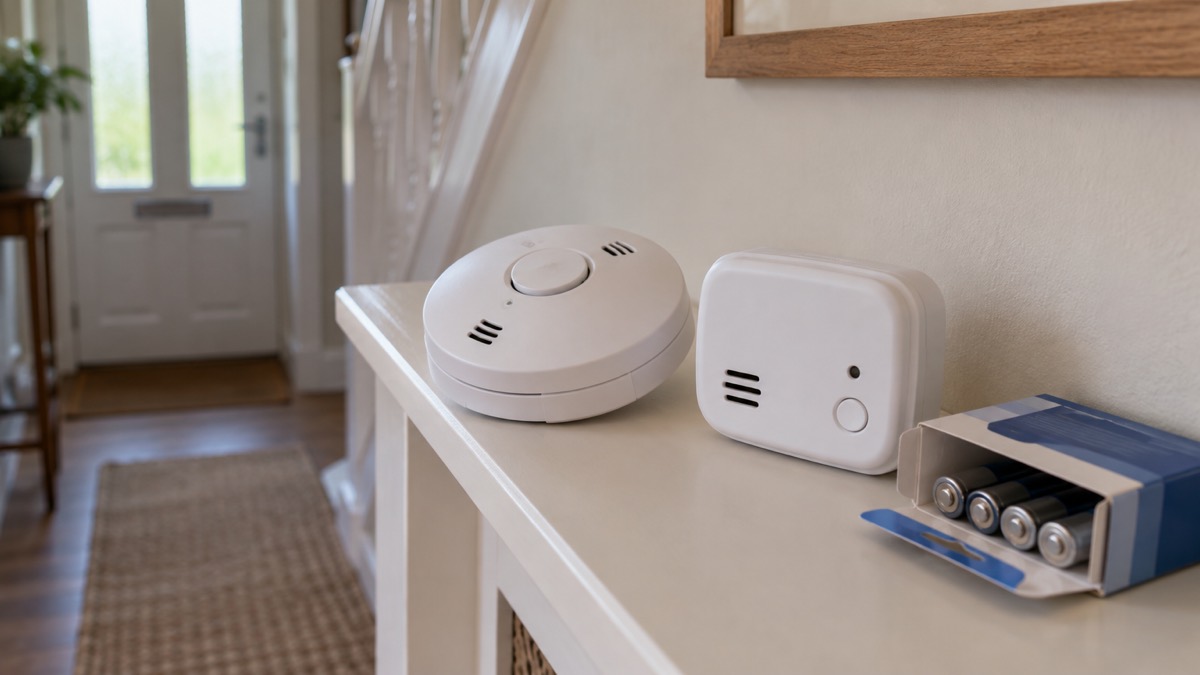
Yes, in almost every case. A power cut does not stop a working smoke alarm, because the alarms most UK households have either run on batteries alone or have a backup battery inside. Electric, mains-operated smoke alarms normally have a 9v backup battery in them in case of a power cut1, and a hard-wired alarm that beeps every minute or so is usually giving a low battery warning, not reacting to the cut itself2. Sealed 10-year battery alarms and ordinary battery alarms carry on exactly as before, because they never touched the mains in the first place3.
What a power cut does change is the risk around you. You will be reaching for candles, torches and perhaps a heater or camping stove, and it is dark. That is the moment your alarms must work, so this page sets out which alarms keep working and why, where each type belongs, what standards to look for when you buy, and what that chirping means when the supply comes back. If you are preparing for outages generally, start with our guide to power cuts and what to do when the electricity goes off.
Battery, sealed 10-year, or mains with backup
There are three kinds of smoke alarm in UK homes, and all three keep working in a power cut if they are maintained. The difference is how much looking-after each one needs.
| Alarm type | What powers it | In a power cut | What you must do |
|---|---|---|---|
| Standard battery alarm | Replaceable battery | Works as normal | Replace the battery every year7 |
| Sealed 10-year battery alarm | Sealed long-life battery, cannot be removed | Works as normal | Replace the whole alarm after 10 years3 |
| Mains (hard-wired) alarm | Home electrics, with a 9v backup battery | Switches to the backup battery | Change the backup battery every year1 |
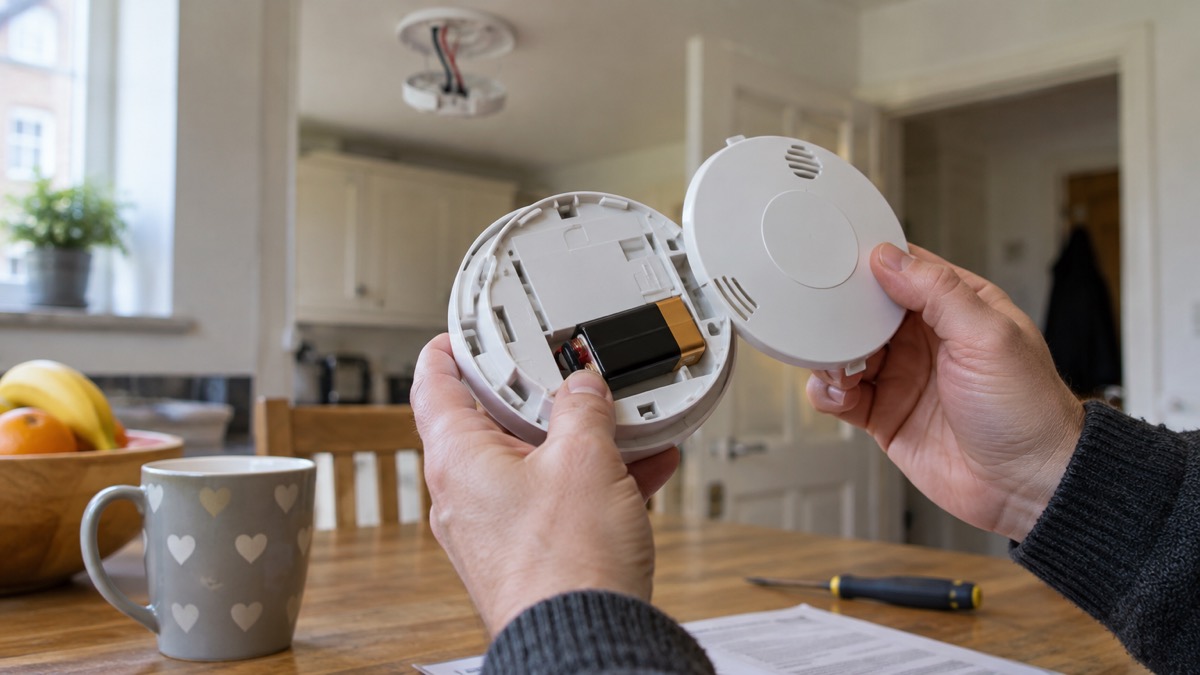
Fire and rescue services in Northern Ireland and elsewhere advise that if you are purchasing a battery alarm, you should consider one with a sealed long life 10-year battery3. The National Fire Chiefs Council's national guidance notes that ten-year sealed battery smoke alarms cost more to buy, but you avoid the cost of replacing batteries every year, while standard battery operated smoke alarms need their batteries replacing every year7. The alarms supplied by North Yorkshire Fire and Rescue Service, for example, have 10-year batteries that cannot be removed and come with a 10-year warranty8.
Mains alarms are the type most likely to surprise you after a cut. South Wales Fire and Rescue Service explains that electric alarms normally have a 9v backup battery in them in case of a power cut, and that this should be changed every year; a running-out backup battery can make the alarm beep1. Northern Ireland's fire safety guidance makes the same point: smoke alarms linked to the home mains electrics contain a nine volt backup battery that needs to be changed according to the manufacturer's instructions9. So a mains alarm that starts chirping after the supply returns is very often telling you its backup battery is tired, not that the alarm is faulty.
One rule applies to every type: never disconnect or take the batteries out of smoke alarms unless you intend to replace them immediately8. An alarm with no battery is the one thing worse than no alarm, because it looks fitted while doing nothing.
Where to fit smoke and heat alarms
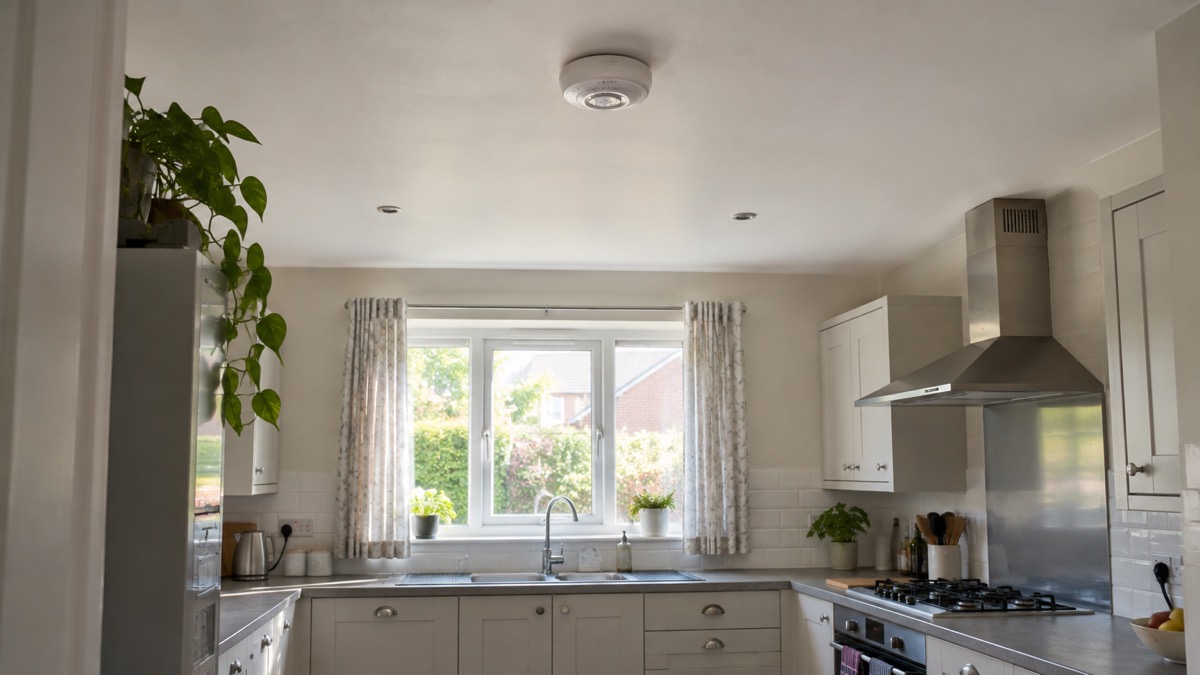
The minimum is one smoke alarm on every level of your home, fitted on the ceiling and at least 30cm away from the wall10. Devon and Somerset Fire and Rescue Service recommend a smoke alarm in your hallway and one at the top of your stairs, and suggest you could also have smoke alarms in bedrooms and other living areas11. nidirect's home fire safety advice adds that it is worth thinking about extra alarms in the most used rooms, such as living rooms and bedrooms12.
Mounting position matters as much as count. Smoke alarms should always be mounted on the ceiling, near the middle of the room or hall, and at least 30cm (one foot) away from a wall or light13. Smoke rises and spreads across a ceiling, so the middle of the ceiling is where an alarm senses it soonest.
Two rooms need a different alarm altogether. Do not fit smoke alarms in kitchens or bathrooms, where smoke or steam could set them off accidentally; install a heat alarm in the kitchen instead10. Heat alarms are best for kitchens14 because they respond to the sustained temperature rise of a real fire rather than the fumes of burnt toast or a steamy shower. A heat alarm in the kitchen is also standard advice in homes with telecare-linked detection, where smoke alarms are fitted in all areas where a fire can start, including bedrooms and lounges, and a heat alarm is installed in the kitchen15.
Interlinking is worth having if you can. Ideally alarms should be hardwired and interlinked, which is a legislative requirement for rented accommodation16. Some battery or mains alarms can be interlinked so that when one alarm detects a fire they all go off together, giving a warning wherever you are in the home; the fire and rescue service particularly recommends this for people with mobility issues that may prevent or delay escape13. Scottish Fire and Rescue Service advice is that all smoke and heat alarms should be ceiling mounted and interlinked17.
Carbon monoxide alarms: one in every room with a fuel-burning appliance
Carbon monoxide has no smell and no taste, and it kills without warning, which is why the NHS advises you to get one carbon monoxide alarm for each room of your home containing appliances that burn gas, oil, coal or wood5. Fire and rescue services say the same: have a carbon monoxide alarm in every room which has appliances that burn fossil fuels8, and fit a CO alarm in all rooms containing fuel burning appliances, ensuring the alarm is able to be heard throughout your home18. Devon and Somerset's carers guidance lists the rooms to cover: all rooms containing solid fuel appliances, any gas appliances or paraffin heaters19.
That list is longer than many households expect. A CO detector should be fitted in any room where there is a carbon-fuelled appliance, including boilers, fires including open fires, heaters, and stoves or a flue17. If you use a fireplace, a wood-burning stove, a gas boiler in a cupboard, a paraffin heater during a power cut, or a camping stove indoors in an emergency, each of those rooms needs its own alarm. Our page on carbon monoxide risks when the heating is off covers the dangers of bringing alternative heaters and stoves indoors.
In Northern Ireland the requirement is written into building regulations: carbon monoxide alarms are a mandatory requirement for all homes where a new fossil fuel appliance is installed, following a change to The Building Regulations (Northern Ireland) 2012 that came into operation on 31 October 201221.
Siting a CO alarm: 1 to 3 metres from the appliance
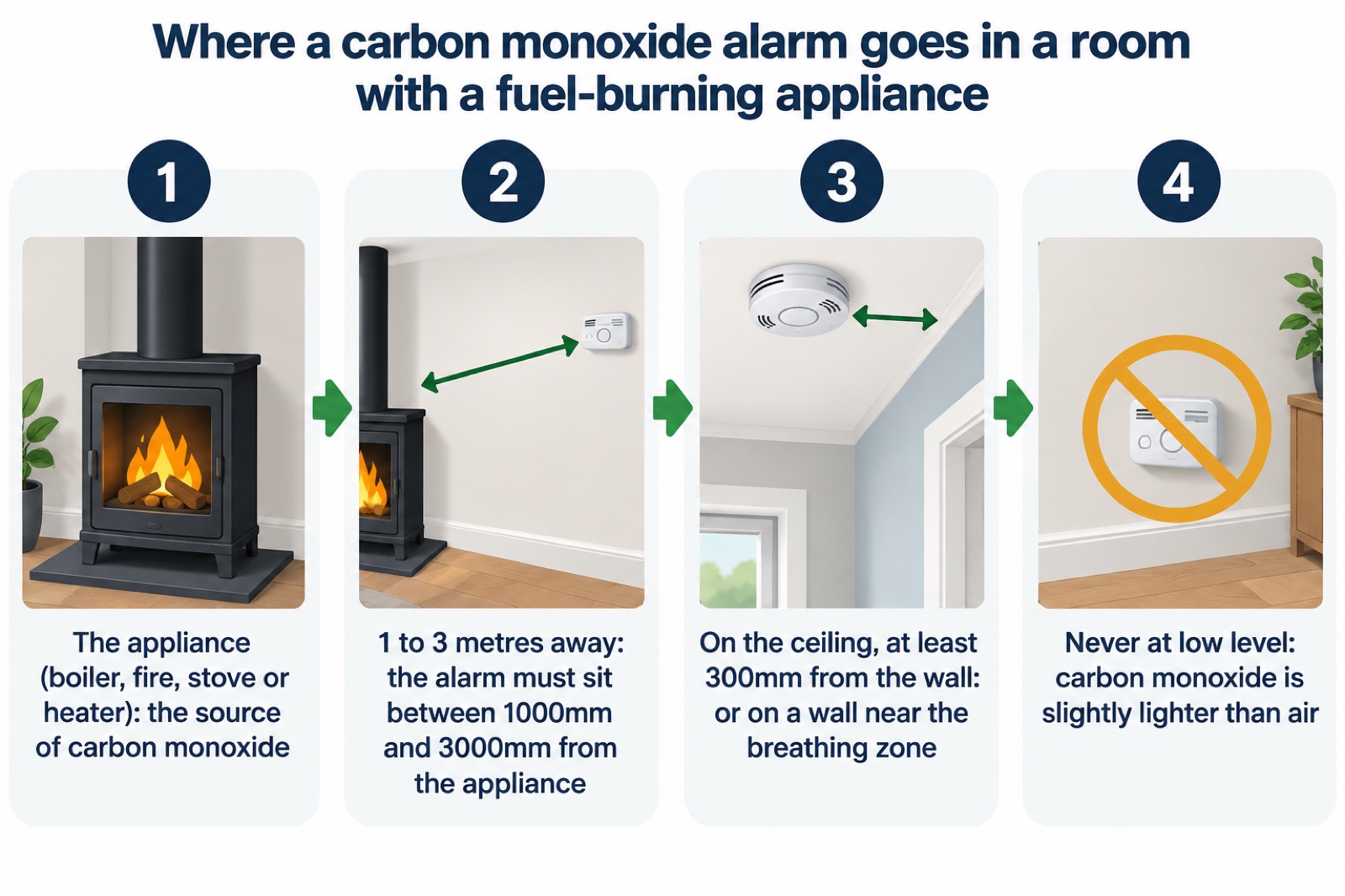
North Wales Fire and Rescue Service's alarm advice sheet gives the siting rules in plain figures. The alarm must be 1 to 3 metres away from the appliance: a minimum of 1000mm and a maximum of 3000mm6. If it is mounted on the ceiling, it must be a minimum of 300mm away from the wall6. Where alarms are located in sleeping rooms or rooms remote from the appliances, they should be located just below but relatively close to the breathing zone of the occupant, and between the occupant and the appliance6.
Do not fit a CO alarm at low level. The Health and Safety Executive for Northern Ireland notes that carbon monoxide is slightly lighter than air, therefore fitting carbon monoxide alarms at low level is not recommended21. This is the opposite of a popular myth that CO sinks to the floor, and it is the reason wall-mounting at breathing height or ceiling-mounting is the correct approach.
Standards to look for when you buy
An alarm is only trustworthy if it was built and tested to a recognised standard, and the marks are printed on the alarm or its packaging. Make sure any alarms you buy are marked with a current British Standards or European (CE) safety mark, which shows they are certified as effective22. London Fire Brigade gives the same advice for both smoke and heat alarms23.
For carbon monoxide alarms the standard to look for is BS EN 50291. Before purchasing a carbon monoxide alarm, always ensure it complies with British Standard EN 50291 and carries a British or European approval mark, such as a CE mark or Kitemark; this is the advice of the Health and Safety Executive24, the Health and Safety Executive for Northern Ireland21 and North Yorkshire Fire and Rescue Service8. North Wales Fire and Rescue Service is more specific still: for domestic dwellings only use BS EN 50291-1:2010 compliant alarms, and for boats, campers and caravans use BS EN 50291-2:2010 compliant alarms6.
For alarms for deaf and hard of hearing people there is a dedicated standard: British Standard BS5446-3:2005 specifies smoke alarm kits for deaf and hard of hearing people, and products made to this standard give deaf people assurance of quality smoke alarms designed to meet their needs25.
Smoke alarms can be purchased from most DIY stores and some supermarkets26, and carbon monoxide alarms are available from DIY and hardware stores20 as well as many retail outlets including online sellers and supermarkets21. Wherever you buy, check the standard before you pay, not after.
Testing, batteries and the chirp after a power cut
Test your smoke alarms at least monthly to ensure they are working27. In Northern Ireland the fire safety message is to test weekly9, and involving children in the monthly tests is recommended so they know what your smoke alarms sound like when they go off27. Devon and Somerset advise that when you do your smoke alarm testing, you also practise your escape plan with your child, which helps them get used to the sound, stay calm and know exactly what to do28.
Battery care depends on the alarm. If there is a battery, change the battery every year28, unless it is a ten-year alarm, in which case you change nothing until the decade is up13. Most smoke alarms need replacing after 10 years: check your warranty and replace your alarm every 10 years13.
The chirp that puzzles people most is the one that starts around a power cut. If an alarm beeps every minute or so, this could be a low battery warning, and this can also occur with hard-wired, mains-connected alarms, because there is often a battery backup in case of a power cut2. In other words, the cut did not cause the fault; it revealed a backup battery that was already near the end of its year. The fix is the routine one: replace the backup battery, and put the annual change in your calendar so it does not recur1.
If an alarm was fitted by your fire and rescue service and it is not working correctly, they will come and take a look and replace it if necessary2. North Yorkshire Fire and Rescue Service, for example, supplies alarms with a 10-year warranty and gives contact numbers for replacements during that period8.
Alarms for people who are deaf, hard of hearing or less mobile
A standard smoke alarm is no use to someone who cannot hear it, especially asleep. If you are deaf or hard of hearing and live alone, or with others who are also deaf or hard of hearing, you can get a smoke alarm that uses a strobe light and vibrating pads that are placed under your pillow at night29. London Fire Brigade's easy-read guidance confirms you can get a special alarm if you are deaf, hard of hearing or have a visual impairment30.
These specialist alarms can save lives: they alert the user to a fire in the home even if they have removed their hearing aid at night31. A vibrating pad is placed under a mattress or pillow at night; when smoke is detected, the pad vibrates and the strobe light flashes to alert the sleeper31. The Northern Ireland Fire and Rescue Service advises that for anyone with impaired hearing, there are sensory alarms available which include a vibrating pad and flashing light, and to contact your GP to arrange an assessment16.
For people with limited mobility, an alarm should be fitted where they sleep16. Interlinked alarms matter here too: because some battery or mains alarms can be interlinked so that when one alarm detects a fire they all go off together, someone with mobility issues gets the warning early wherever the fire starts, giving the most time to escape13.
Telecare and monitored detection
For people who may not be able to respond to a smoke alarm, for example due to mobility issues, memory loss or a learning disability, fire and rescue services recommend monitored smoke detection, often through telecare32. Standard telecare usually includes an emergency alarm unit with a red button pendant so help can be requested from a monitoring centre32. Linked smoke detectors are wired or wirelessly interlinked so if one alarm activates, all alarms activate32, and linking fire alarms to telecare limits delays in calling the fire brigade, reducing the likelihood of injury or death occurring as a result of a fire15.
If the person you care for has telecare fitted, check that it is linked to the smoke alarms33. Fire and rescue services can fit specialist fire or smoke detection and alarm equipment free of charge for people with impairments that need it, specified through the home safety visit request form34.
Booking a free home fire safety visit
Every fire and rescue service in the UK offers free home fire safety visits, and this is the single most useful thing a household can do short of fitting the alarms itself. Firefighters conduct home fire safety visits to prevent accidental dwelling fires and protect the public from being injured in them17. Fire and rescue service staff assess fire risk, install fire safety equipment such as smoke alarms, and give potentially life-saving fire safety advice to residents, as the National Fire Chiefs Council's position statement sets out35.
What a visit involves and who gets one varies by service, so check your own:
| Service | What is offered |
|---|---|
| London Fire Brigade | Free visits, available 24/7, with free smoke alarms fitted during the visit if needed; start with the online Home Fire Safety Checker31 |
| Devon and Somerset | Visits usually take around 45 minutes, offered Monday to Friday, 9am to 5pm, with morning (9.30am to 1pm) or afternoon (1pm to 5pm) slots30 |
| Scottish Fire and Rescue Service | Home Fire Safety Visits for people at the highest risk of experiencing a fire in the home32 |
| South Wales Fire and Rescue Service | Free smoke alarms and heat detectors installed where risk is identified, including alarms for people who are Deaf or hard of hearing33 |
| Northern Ireland | An online Home Fire Safety Check for anyone, with referral for an in-person visit by NIFRS where greater risk is identified36 |
A visit covers checking smoke alarms are set up correctly, making a fire escape plan, electrics and charging safely, cooking safely, heaters and heating, bedtime checks, and identifying any further support, and may include fitting specialist fire safety equipment where required30. Enhanced visits can also give advice about health and wellbeing, including support on giving up smoking, avoiding falls, keeping your home warm and living with dementia30. British Sign Language and some foreign language translations can be provided during visits if you ask when booking30.
Eligibility is targeted at those who need it most. Services determine eligibility using information gathered from various sources, including personal factors, lifestyle factors and home environment, plus incident data and partner agencies, and criteria may change to manage demand and consider appropriate use of public money30. If you or anyone you live with is a vulnerable person, get in touch and organise a free home fire safety visit23. You may not need a visit at all: some services will instead give up to date guidance on reducing fire risk and free smoke alarms if required33.
One household in Devon and Somerset described the outcome plainly: the service gave him equipment that would wake him if there is a fire when he takes his hearing aid out at night30.
Checking the visitor is genuine
Home fire safety visits are free, and no one from a fire and rescue service will ask you for money. If you have any concerns about the identity of someone visiting you, call the number your service publishes: Devon and Somerset Fire and Rescue Service ask residents to ring 0800 05 02 99930. Look up your own service's verification number on its website before the visit so you have it to hand. The same caution applies to callers claiming to be from the electricity network, which we cover in our page on checking a caller from the electricity network is genuine.
Children, alarms and escape plans
Government fire safety advice is blunt on one point: do not assume that everyone has heard the smoke alarm, particularly at night, because some children may not be woken by smoke alarms27. Act quickly and get everyone out as soon as possible27. That makes two habits worth building:
- Get your children involved in testing your smoke alarm and talk to them about what to do if the smoke alarm sounds28
- Make sure children know what your smoke alarms sound like when they go off, by involving them in your monthly tests27
- Practise your escape plan with your child when you test, so they get used to the sound, stay calm and know exactly what to do28
If a child in the household has additional needs, this practice matters even more, as the fire and rescue service recommends it particularly for children with additional needs28. For lighting that children can use safely in an outage, see our guide to emergency lighting at home, and for the wider routine, our page on staying safe in the dark.
Sources (36)
- Smoke alarms, South Wales Fire and Rescue Service
- Problems with smoke alarms, Devon and Somerset Fire and Rescue Service
- Other safety advice, Northern Ireland Fire and Rescue Service
- Stay fire safe leaflet, National Fire Chiefs Council, 2023
- Carbon monoxide poisoning, NHS, 2025
- Alarm advice sheet, North Wales Fire and Rescue Service, 2024
- Smoke and carbon monoxide alarms, North Yorkshire Fire and Rescue Service, 2026
- Fire safety and prevention, nidirect, 2025
- Advice for parents and guardians, Devon and Somerset Fire and Rescue Service
- Domestic fire, Prepare (UK government campaign), 2026
- Smoke alarms, Devon and Somerset Fire and Rescue Service
- Avoiding accidental fires in the home, nidirect, 2025
- Smoke alarms for vulnerable people, Devon and Somerset Fire and Rescue Service
- Carers and support workers: alarms, London Fire Brigade, 2026
- Home fire safety, Northern Ireland Fire and Rescue Service, 2026
- Chimney fire safety, Scottish Fire and Rescue Service, 2026
- Carbon monoxide: the silent killer, Wiltshire and Swindon Prepared, 2026
- Fire safety for carers, Devon and Somerset Fire and Rescue Service
- Deaf awareness, Scottish Fire and Rescue Service, 2024
- Carbon monoxide, Devon and Somerset Fire and Rescue Service
- Carbon monoxide alarms, Health and Safety Executive for Northern Ireland, 2026
- Smoke alarms and heat alarms, London Fire Brigade, 2026
- Gas safety: frequently asked questions, Health and Safety Executive
- Fire safety for people with hearing difficulties, Devon and Somerset Fire and Rescue Service, 2026
- Digital easy read fire safety booklet, London Fire Brigade
- Frequently asked questions, North Yorkshire Fire and Rescue Service, 2026
- Equipment for carers, Devon and Somerset Fire and Rescue Service, 2026
- Talk to your children about fire safety, Devon and Somerset Fire and Rescue Service, 2026
- Home safety partnerships, Devon and Somerset Fire and Rescue Service
- Home safety visits, Devon and Somerset Fire and Rescue Service, 2026
- Home fire safety visits, London Fire Brigade, 2026
- Home fire safety visits, Scottish Fire and Rescue Service, 2026
- Request a home safety visit, South Wales Fire and Rescue Service, 2026
- Caring for smokers, London Fire Brigade, 2026
- Home safety position statement, National Fire Chiefs Council, 2025
- Home fire safety check, Northern Ireland Fire and Rescue Service, 2026
 Power Cut Kit Checklist
 What to Keep Charged
 Household Emergency Plan
 Reporting a Power Cut
 What to Do in a Power Cut
 Getting Ready for a Power Cut
 Fridge and Freezer Food
 Keeping Warm Without Electricity
 Central Heating Without Power
 Cold Homes and Health
 Carbon Monoxide Risks
 Staying Safe in the Dark
 How Long Until Power Returns
 When the Power Comes Back
 Fallen Overhead Lines