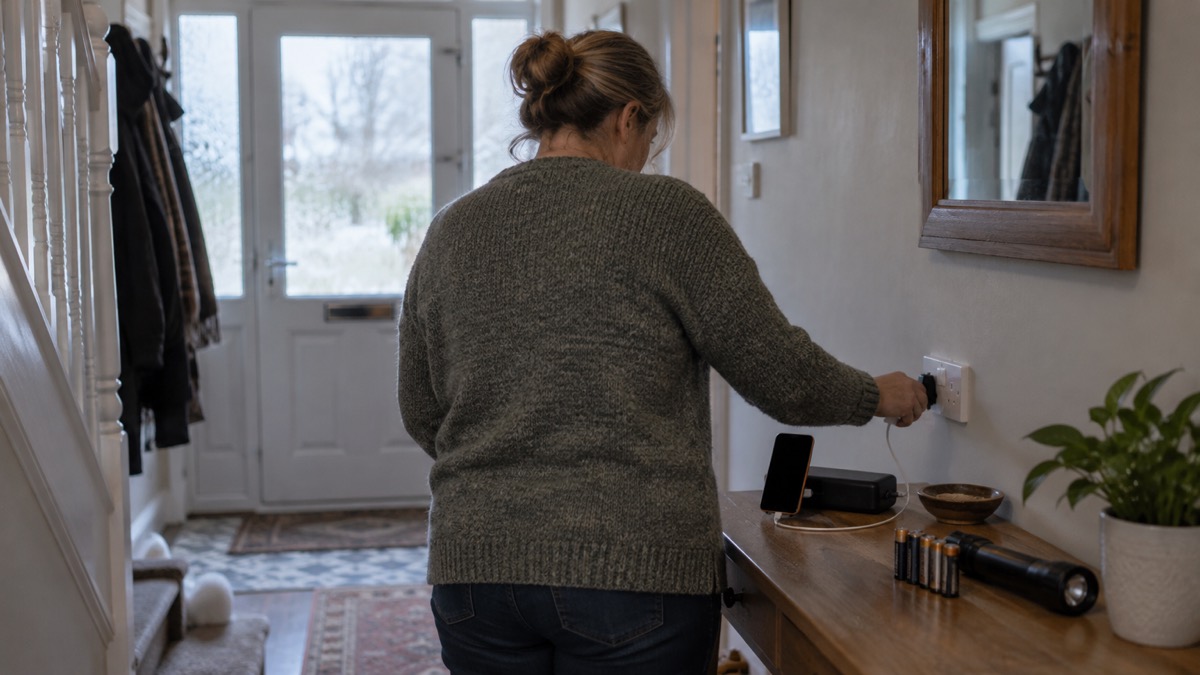
When the electricity goes off, the things that keep you in touch and lit are only as good as their charge. The single most useful habit is to keep your mobile phone, a power bank, your torches and their spare batteries topped up and in one known place, so that a power cut finds you ready rather than searching in the dark. The government's Prepare campaign puts it plainly: charge mobile phones, power banks and any back-up batteries for medical equipment in case there is a power cut1.
That advice is repeated across the UK's official guidance because it works. The Met Office says to make sure you keep your mobile phone charged so you can make calls in case of an emergency2, and councils from Carmarthenshire to Anglesey say the same: keep phones, laptops or tablets fully charged so you have battery power for a short time at least3. A power bank, a torch and a written list of numbers cover the three things a power cut takes away: contact, light and information.
The charging list: what to keep ready
Work through this list now, while the power is on. Each item takes minutes to sort and covers a different part of an outage.
Keep your mobile phone fully charged
Your phone is the item you will reach for first, and the one most likely to be flat. Official guidance is consistent: keep it charged so you can make calls in case of an emergency2. Carmarthenshire council adds the reason: a full battery gives you use of battery power for a short time at least if there is a power cut3. The same advice appears in Northern Ireland's severe weather warnings, which tell households to keep mobile phones, laptops, tablets and power banks fully charged14.
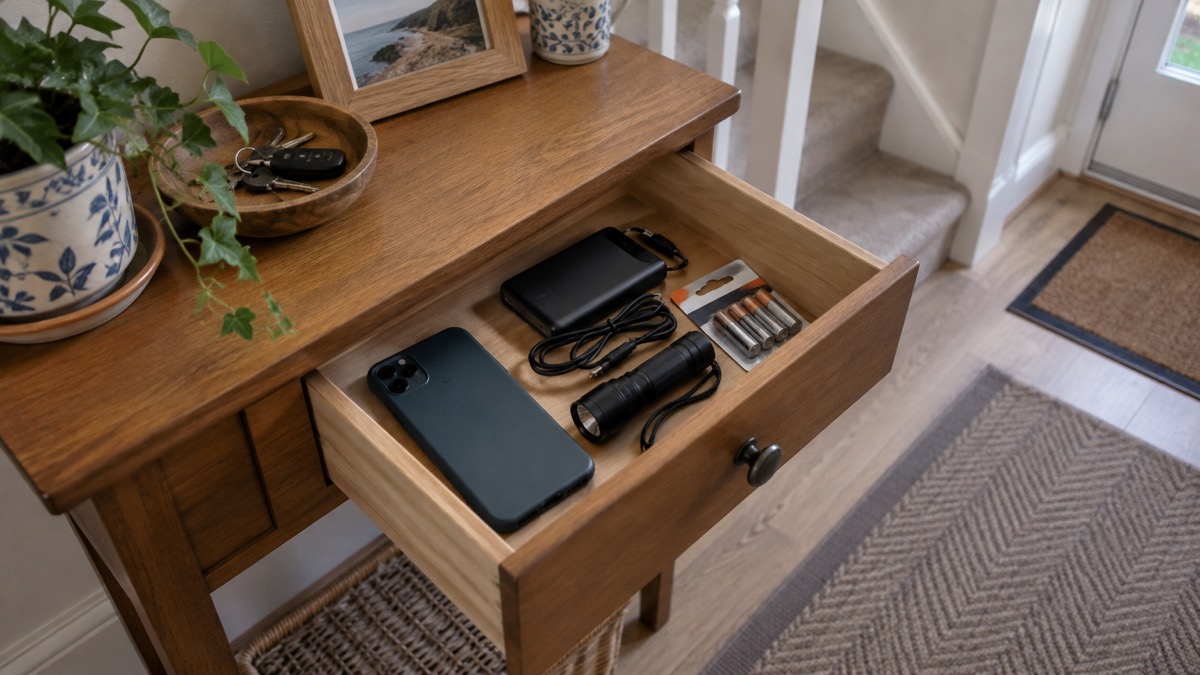
There is a second layer to phone readiness that people often miss. Keep some mobile data available in case Wi-Fi is down6, because a home broadband router loses power in an outage even when the mobile network keeps working. Store key information such as the power cut helpline number, 105, on your phone so it is there when you need it8.
If someone in your household depends on a phone for reassurance or for care, check their phone too. The Scottish Government's Ready campaign, giving advice on looking out for others, says to make sure they have important phone numbers written down15. A charged phone with no numbers in it, or a phone that dies because nobody checked it, helps nobody.
A charged power bank keeps your phone going
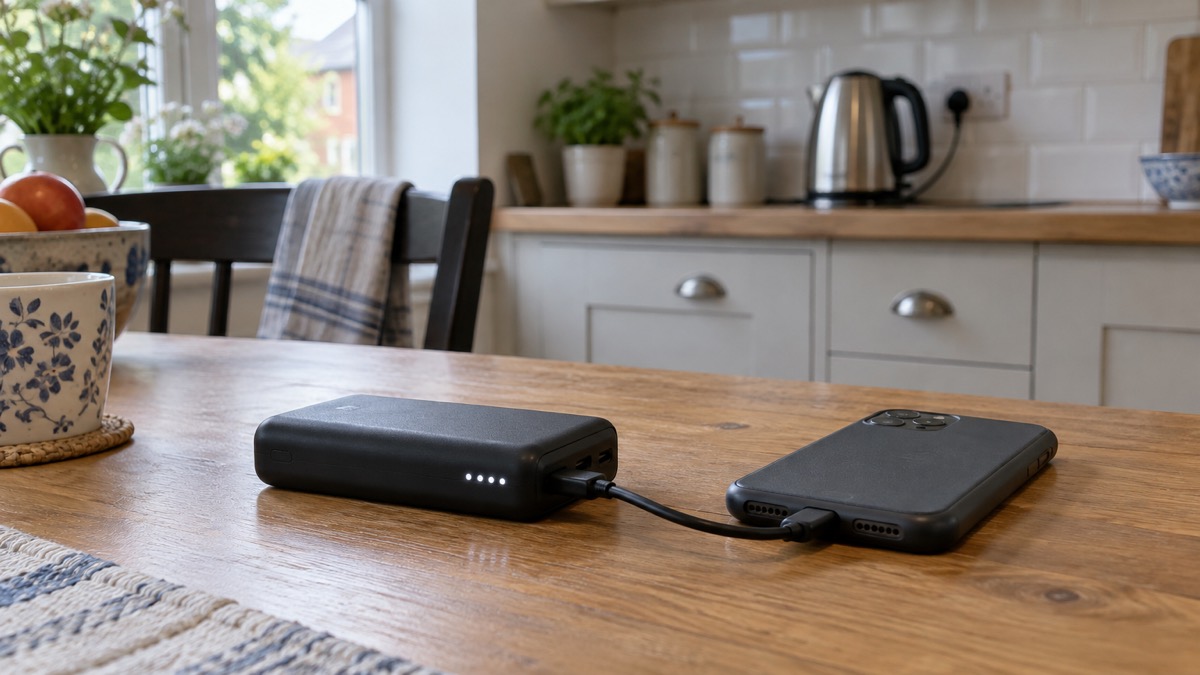
A power bank is a simple safeguard against a flat phone. Wiltshire and Swindon's preparedness guidance is direct: having a power pack that is charged can be very helpful in an emergency or power cut, and even if it just charges a phone, it helps you stay in contact with loved ones5. The Met Office lists a mobile phone power pack among the essentials that could help you cope with a power cut, alongside battery candles, torches and batteries16.
How much a power bank gives you depends on its capacity and your phone, and no official figure covers every combination. What matters for a household is the routine: charge it after every use, check it before storm season, and keep it with the rest of the kit rather than in a bag you take to work. A power bank that has sat unused for months may hold little charge when you reach for it.
The same principle applies to anything with a battery that matters to you. For a planned power cut, charge fully any equipment with batteries; for an unplanned one, make sure items not in use are charging or charged13. That advice comes from NHS guidance for households with technology-dependent children, but the habit suits any home with a battery-powered device it relies on.
Torch and spare batteries for light without mains power
Light is the item people most often get wrong, because a torch with a flat battery is worse than no torch: it creates the false confidence that sends someone up a dark staircase. The guidance is to keep torches and spare batteries to hand in case the power cut happens when it is dark outside, and to make sure everyone in your home knows where they are kept6. Surrey County Council adds the obvious but easily forgotten point: make sure you have spare batteries if the torch is battery operated9.
Fire and rescue services are clear about what to use. During a power cut, use battery-operated lights or torches as an alternative light source17. The Met Office's car kit advice makes the same case for a vehicle: a large torch with spare batteries, or a wind-up torch which does not require battery power, is essential10. A wind-up torch is worth having at home for the same reason: it cannot be flat when you need it.
There is one more light habit worth adopting. Northern Ireland's severe weather guidance suggests leaving one light on when your electricity goes off19. A lamp left switched on tells you the moment the supply returns, and saves you checking the fuse board in the dark.
Important numbers written down, not only on your phone
A phone is a single point of failure for every number you know. The Prepare campaign's advice is to write down important phone numbers on paper and store them somewhere easy to find in a power cut7. Its guidance on phone and broadband outages is more specific: keep a paper copy of important phone numbers, including family, neighbours, doctor and utilities, and other essential information, in case your mobile phone loses power or you cannot access your contacts12. Wiltshire and Swindon's guidance adds insurance details to the list, written down somewhere safe in case you cannot access them on your phone or online20.
The number to write first is 105, the power cut helpline8. Keep it on the phone as well, but on paper it survives a flat battery.
| What to write down | Why it matters in a cut |
|---|---|
| 105, the power cut helpline | Report a loss of supply without needing your contacts8 |
| Family and neighbours | Stay in contact when the phone is your only line12 |
| Doctor and utilities | Essential information if the phone dies12 |
| Insurance policy details | Accessible when you cannot get online20 |
Will a digital landline work in a power cut?
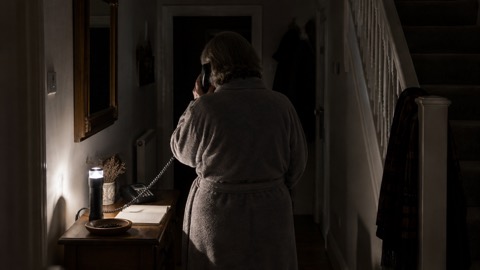
Often not, and this catches households out because the old phone in the hall always worked before. Ofcom explains that digital landlines need mains electricity and will not work in a power cut unless there is a battery back-up21. A cordless landline may not work during a power cut because the base station needs power to operate and may not have a back-up battery22.
There are two protections. First, a corded landline phone might still work in a power cut23, so keeping one is worthwhile if your line supports it. Second, if you depend on your landline, your provider must make sure you can contact the emergency services during a power cut21. If your landline will not work during a cut, your provider might offer a free solution such as a back-up battery unit, for a minimum of one hour, to enable emergency calls23. The Prepare campaign says vulnerable customers with an analogue landline can get a free back-up battery unit, meaning the landline would work for at least an hour, and many batteries now last much longer12.
If you are unsure whether your line is digital, or whether you qualify for a back-up unit, ask your provider before the next storm rather than during one.
Keeping the kit together and ready
The best charging kit is useless if nobody can find it. Keep the whole set together in one place: phone charger, power bank, torches, batteries and the paper list. A single box in a hall cupboard or a drawer everyone can reach does the job.
Build the habit around the weather. When a storm is forecast, charge mobile phones and power banks in case there is a power cut, and check your emergency plan is up to date24. Before Storm Eunice in February 2022, fire services advised households to safely charge their phone and laptop and check they had batteries for torches in case of a power cut25. That is the routine in one sentence.
For the wider kit, see the power cut kit checklist, and for the numbers themselves, the emergency numbers to keep at home page. If someone in your household relies on powered medical equipment, the medical equipment checklist sets out what to charge and plan for.
Sources (25)
- Storms, Prepare campaign (UK Government), 2026
- What to do in a power cut, Met Office, 2026
- Get prepared, Carmarthenshire County Council, 2026
- Winter ready, Isle of Anglesey County Council, 2026
- Yourself, Wiltshire and Swindon Prepared, 2026
- 12 tips to prepare for a power cut, Horsted Keynes Parish Council, 2026
- Get prepared for emergencies, Prepare campaign (UK Government), 2026
- 10 things you should do now to prepare for winter, Met Office, 2026
- How to prepare for the loss of electricity, Wiltshire and Swindon Prepared, 2026
- Winter car kit, Met Office, 2026
- Top tips to be weatherready, Met Office, 2026
- Phone and broadband outages, Prepare campaign (UK Government), 2026
- Parental letter re power shortages, North West Children's Operational Delivery Network (NHS), 2022
- Strong winds weather warning information and advice, nidirect, 2026
- Hot weather, Ready Scotland, 2026
- Stay safe in lightning, Met Office, 2026
- Power cuts, Scottish Fire and Rescue Service, 2026
- Button batteries safety notice, Wrightington, Wigan and Leigh Teaching Hospitals NHS Foundation Trust, 2026
- Strong winds and heavy rain warning information and advice, nidirect, 2026
- Yourself, Wiltshire and Swindon Prepared, 2026
- Future of landline calls, Ofcom, 2026
- Keep Safe Keep Well Winter Safety Campaign 2024-2025, NHS Western Isles, 2024
- Power cuts, Be Ready campaign (UK Government), 2026
- Storms and wind, Ready Scotland, 2026
- Safety storm Eunice: how you can stay safe, Devon and Somerset Fire and Rescue Service, 2022
 Power Cut Kit Checklist
 Household Emergency Plan
 Emergency Numbers to Keep