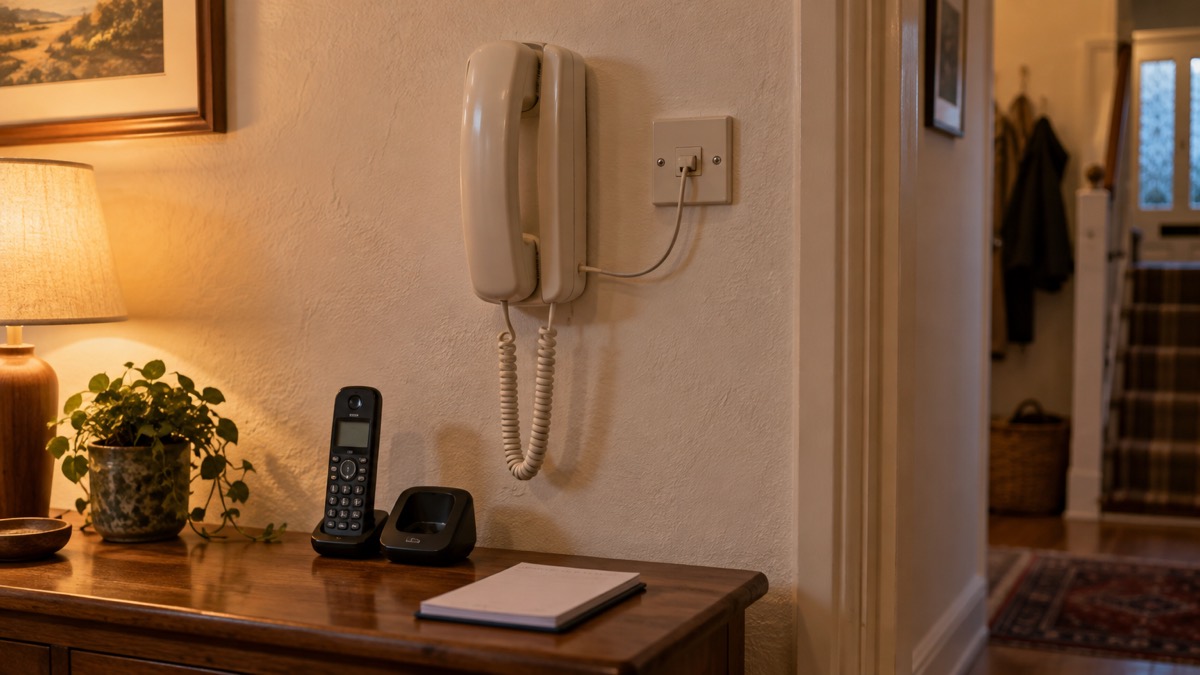
If your home phone is cordless, it will almost certainly stop working the moment the power goes off. The handset takes its power from the mains through its base station, and most base stations have no battery back-up1. A corded phone is different: it draws what it needs from the telephone line itself, so it can keep working in a local power cut2. The practical answer for most households is to keep one corded phone plugged in, or at least ready to plug in, and to keep a mobile phone charged as a second line of defence1.
That advice matters more now than it used to. As the UK moves from analogue to digital landlines, many homes are being moved onto a service where the phone plugs into the broadband router. Digital landlines cannot carry an electrical power connection, so in a power cut they will not work4. If your phone depends on the router, the corded handset in the cupboard will not save you on its own. You need to know which kind of line you have, and what your provider will do to keep you connected.
This page sets out what stops working and why, how to keep a corded phone ready, what changes with Digital Voice, how to call for help when the power is off, and where to get support if a landline is your only way of reaching the emergency services.
Why a cordless phone goes dead when the power does
A cordless phone is really two pieces of equipment: a handset with a rechargeable battery, and a base station plugged into the mains and the phone socket. The base station is what connects to the line, and it is what fails when the electricity stops. Most base stations have no battery back-up, so the handset has nothing to talk to1. The Scottish winter safety campaign makes the same point: a cordless landline may not work during a power cut because the base station needs power to operate, and a non-mains-powered landline telephone will help you stay in touch during any disruption to your supply7.
A traditional corded phone works differently. On an analogue line it draws a low voltage from the telephone exchange down the line itself, enough to power a basic handset without plugging it into the wall. That is why these corded handsets continue to function in a local power cut, as long as the exchange still has power2. It is also why an old-fashioned corded telephone that plugs into the wall will keep working for some time even after a power cut, which is why councils advise keeping one at home8.
The catch is that this only holds on an old-style analogue line. Once your line is digital, the power-from-the-exchange trick no longer applies, because the line runs through your router and your broadband connection. That is the change covered further down this page, and it is the reason the digital switchover matters to anyone who has relied on a corded phone for years.
Keep a corded phone plugged in, or ready to use
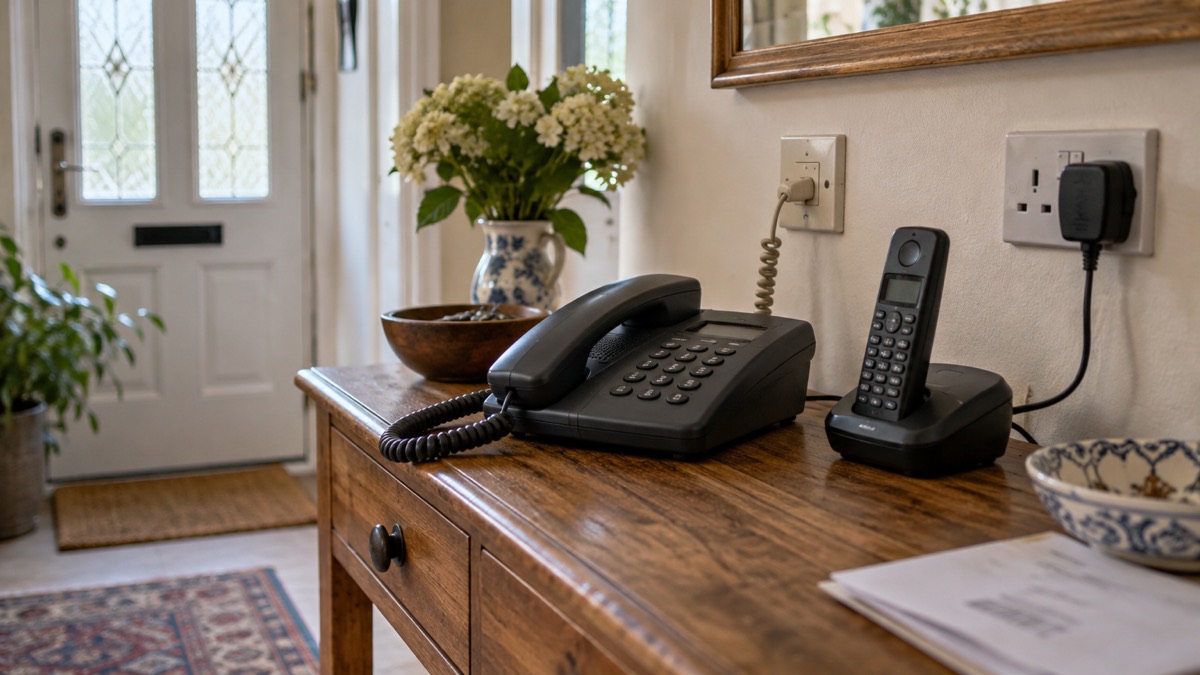
The advice from electricity network operators is consistent and simple: cordless phones will not work during a power cut, so keep a corded phone plugged in or have one ready to use1. Councils repeat it. Write down important telephone numbers, and try to get a corded (old-style) phone which will continue to work even when the power goes off9. A household emergency plan from Carmarthenshire makes the same recommendation, noting that an old-fashioned corded telephone that plugs into the wall will keep working for some time after a power cut8.
"Plugged in" is better than "ready to use" if you can manage it. In the dark, with no lights and possibly no heating, finding a handset, its lead and the right socket is harder than it sounds. Leaving one corded phone connected all the time means there is nothing to set up when you need it. If you prefer to keep it stored, keep the lead with it and know exactly which socket it goes into.
What to have ready:
- One corded phone connected to a working socket, so calls are possible without any setup1.
- A written list of important numbers, because a cordless handset's stored contacts may be unreachable9.
- A charged mobile phone, as a second way to call10.
- A separate battery charger for the mobile, so a long outage does not leave you with a flat phone11.
- The power cut number, 105, stored on the phone and written down11.
Corded phones on Digital Voice
The UK is moving from analogue to digital landlines, and this changes the power cut picture completely. Digital landlines cannot carry an electrical power connection, which means handsets and routers must be powered from your home power supply and will not function in a power cut unless you have a backup power system such as a battery or generator2. Argyll and Bute Council states it just as plainly: digital landlines cannot carry an electrical power connection, so in the event of a power cut they will not work4.
For a household, the practical test is where the phone plugs in. If it goes into a telephone wall socket on its own, you are probably still on an analogue line, and a corded phone is your friend. If it goes into the broadband router or hub, you are on a digital service, and the phone depends on mains power for the router and for the handset. In that case a corded handset plugged into the router will not help when the power fails.
This is not only a convenience issue. The government's guidance notes that digital phone lines will not work in a power cut without a source of backup, meaning that vulnerable individuals may be left without a working telecare device12. If you or someone you care for relies on a pendant alarm or telecare kit connected to the landline, that is the moment to act, not after the next storm.
The switchover is covered in more detail in The Digital Landline Switchover: What Changes for Your Home Phone, and the specific question of whether a handset survives the change is answered in Will an Old Phone Handset Work on a Digital Line?.
| Line type | What the phone plugs into | Works in a power cut? |
|---|---|---|
| Analogue line with a corded phone | Telephone wall socket | Can keep working, powered from the exchange2 |
| Analogue line with a cordless phone | Mains-powered base station | Usually not, as most base stations have no back-up1 |
| Digital line (Digital Voice) | Broadband router or hub | Not without backup power for the router and handset2 |
Big button phones and the Digital Voice trap
Big button phones are bought for a reason: a large keypad and a loud earpiece make a call possible for someone whose sight or hearing is failing. The problem is that many of these phones are cordless, or are designed for a digital line, and the general rule applies to them as much as to any other handset. Many modern telephones, especially digital or cordless ones, will not work in a power cut, so keep an old analogue phone to use.
That leaves two questions for anyone buying or inheriting a big button phone for an older relative. First, is it corded or cordless? A corded big button phone on an analogue line is the combination that keeps working. A cordless one will not. Second, what kind of line is it going onto? If the household has already moved to Digital Voice, no corded handset will work in a power cut without backup power for the router.
For households where the landline is the only way to call for help, the provider has a role. If your landline will not work during a power cut, your landline provider might offer you a free solution, such as a back-up battery unit, for a minimum of one hour, that would enable you to call the emergency services during a power cut if you needed to5. Suffolk's telecare guide says the same: your telephone provider can offer a free solution such as a battery back-up unit that lets you contact emergency services, for people who depend on their landline, have additional needs, or cannot use a mobile13.
Telecare alarms deserve their own check, because a pendant that silently stops working is worse than no pendant at all. Telecare and Personal Alarms When Phone Lines Go Digital covers what to ask and what to expect, and Getting a Free Battery Backup for a Digital Landline explains the backup unit itself.
Using a mobile phone when the power is off
For most households the mobile phone is the fallback that actually gets used, so it is worth preparing properly. Keep your mobile phone charged so you can make calls in case of an emergency10. Keep a mobile phone handy so you can still make an emergency call if there is a power cut14. Consider a separate battery charger, and store key information such as the power cut helpline number, 105, on your phone11.
If the power is already off and you need to report it or find out what is happening, use a mobile phone, tablet or another device that runs from battery power to visit your power cut page15. That keeps you informed without relying on the equipment that has just failed.
There is a limit to how far a mobile can be trusted, though. Mobile masts and the networks behind them can be affected in a long outage, which is why an analogue phone that can be connected in your house is worth having, as it will still work if a power cut impacts the mobile network16. The two together cover more ground than either alone.
If you have no back-up power to your landline and no corded phone, and you have a life-threatening emergency, attempt to call 999 or 112 using a mobile. You might receive signal from a nearby area that is not affected, because emergency calls automatically roam onto all available networks5. That roaming behaviour is the reason a mobile with no apparent signal of its own can still get through.
Calling for help and getting support
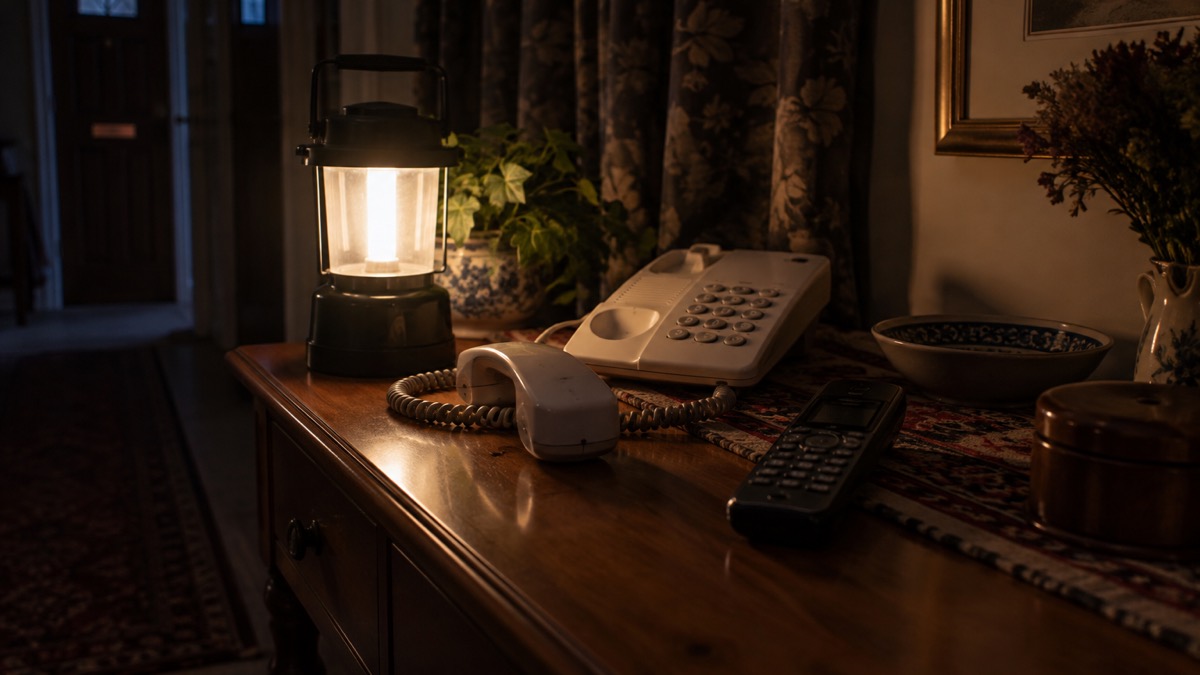
If you have a corded landline phone, it might still be working in a power cut, so try it first if it is to hand5. If it is not, or it is dead, go to the mobile. For the power cut itself, call 105 from your mobile or landline; it is the free national number for reporting and checking a supply failure6. Storm damage and fallen lines are a matter for the network operator rather than the emergency services, and 105 is the route to them17.
For a life-threatening emergency, the rule is the same as always: 999 or 112. The difference in a power cut is how you reach it. With no back-up power to your landline and no corded phone, attempt the call from a mobile, and remember that emergency calls roam onto all available networks5. If you cannot speak, there are established ways to signal that, covered in What to Do If You Dial 999 but Cannot Speak.
Where the landline is your lifeline, the provider is the first call, not the last. If you do not have a mobile, or live somewhere with no signal, your landline provider should offer you a solution such as a battery back-up unit so you can still make emergency calls during a power cut2. The same offer is described by the government's preparedness campaign: your landline provider might offer you a free solution, such as a back-up battery unit, for a minimum of one hour5. Ask specifically whether your phone will work in a power cut, and ask what happens to any telecare kit connected to it5.
A few practical points for the call itself. Have your postcode and the number on your electricity meter to hand if you can, and write down what you are told. If your phone is the only one in the household, tell the provider that when you ring, because it changes what they are obliged to offer. And if a neighbour or relative depends on a landline, check their setup now rather than during the next outage: the arrangements are the same across England, Scotland, Wales and Northern Ireland, since the digital switchover and the 105 number are UK-wide.
For the wider picture, Will Your Landline Work in a Power Cut? goes through the line types in more detail, Extra Help From Phone and Broadband Providers covers what providers offer, and Power Cuts: A Household Guide sets the phone question in the context of the whole outage.
Sources (17)
- Tips to prepare for a power cut, Electricity North West, 2026
- UK transition from analogue to digital landlines, GOV.UK, 2023
- What to do in a power cut, SP Energy Networks, 2026
- Digital phone switchover, Argyll and Bute Council, 2026
- Be informed about hazards: power cuts, Prepare campaign, UK government, 2026
- Protect yourself and your family, Dorset Prepared, 2026
- Keep Safe Keep Well Winter Safety Campaign 2024-2025, NHS Western Isles, 2024
- Household emergency plan, Carmarthenshire County Council, 2026
- Winter weather: be prepared, Argyll and Bute Council, 2026
- What to do in a power cut, Met Office, 2026
- 10 things you should do now to prepare for winter, Met Office, 2026
- Identifying and supporting persons who are vulnerable in an emergency, GOV.UK, 2025
- Digital switchover telecare guide, Suffolk County Council, 2025
- Stay safe this winter, North Wales Fire and Rescue Service, 2026
- Power outages, Dorset Prepared, 2024
- Community Risk Register, West Yorkshire Prepared, 2025
- Who to call for storm damage, Dorset and Wiltshire Fire and Rescue Service, 2026
 Satellite Messenger vs Phone SOS
 Wind-Up and Battery Radios
 DAB or FM Radios