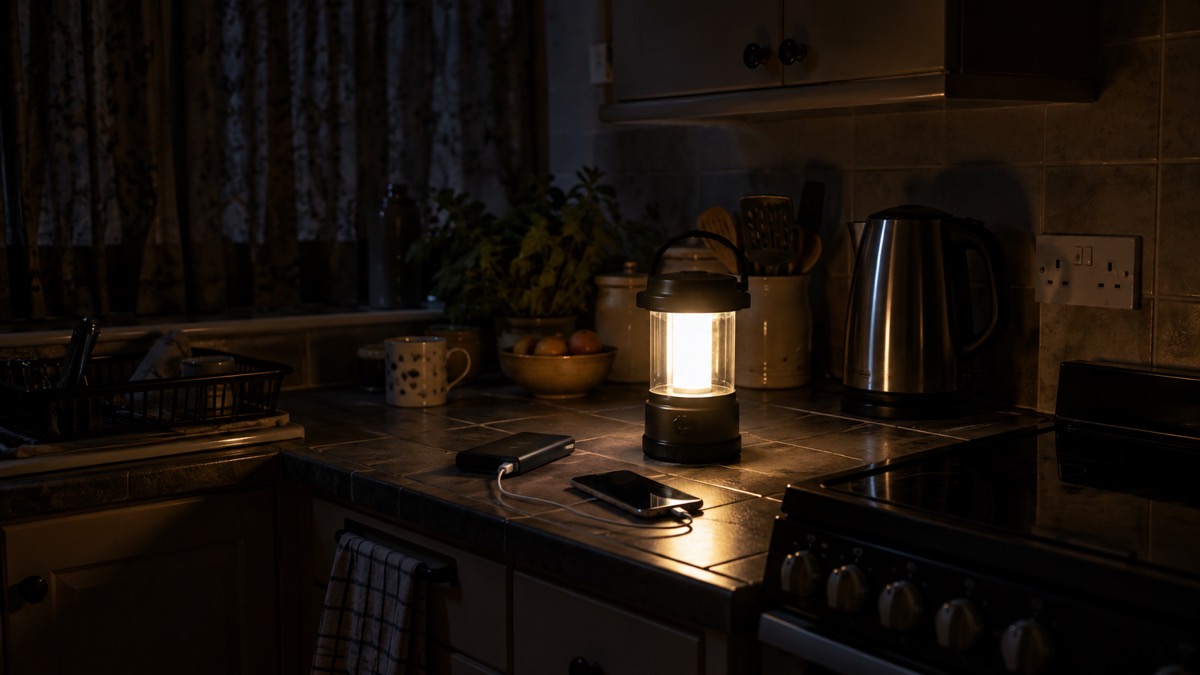
When the power goes off, almost everything in the house stops: the heating, the cooker, the broadband, often the landline. What keeps working is whatever has a battery in it, and only for as long as that battery lasts. That is why the single most repeated piece of official advice before a power cut is to keep your mobile phone fully charged, so you can go online for updates or call if you have a power cut1. Network operators, the Met Office and councils across the UK say the same thing in almost the same words2.
The second thing to keep charged is a backup for the phone: a power bank, kept topped up, so a flat phone does not leave you cut off from information and help5. Beyond that, a torch and a battery or wind-up radio cover the hours when the phone is best kept for emergencies7.
This page is a checklist. Work through it now, while the power is on, then read the sections below on why each item matters, how to make a phone battery last, how to report a cut and how to stay safe near damaged equipment.
The checklist: what to keep charged and ready
Work through this list before the next storm, and again whenever a warning is issued. Each item earns its place because it does something the others cannot.
Why the phone comes first
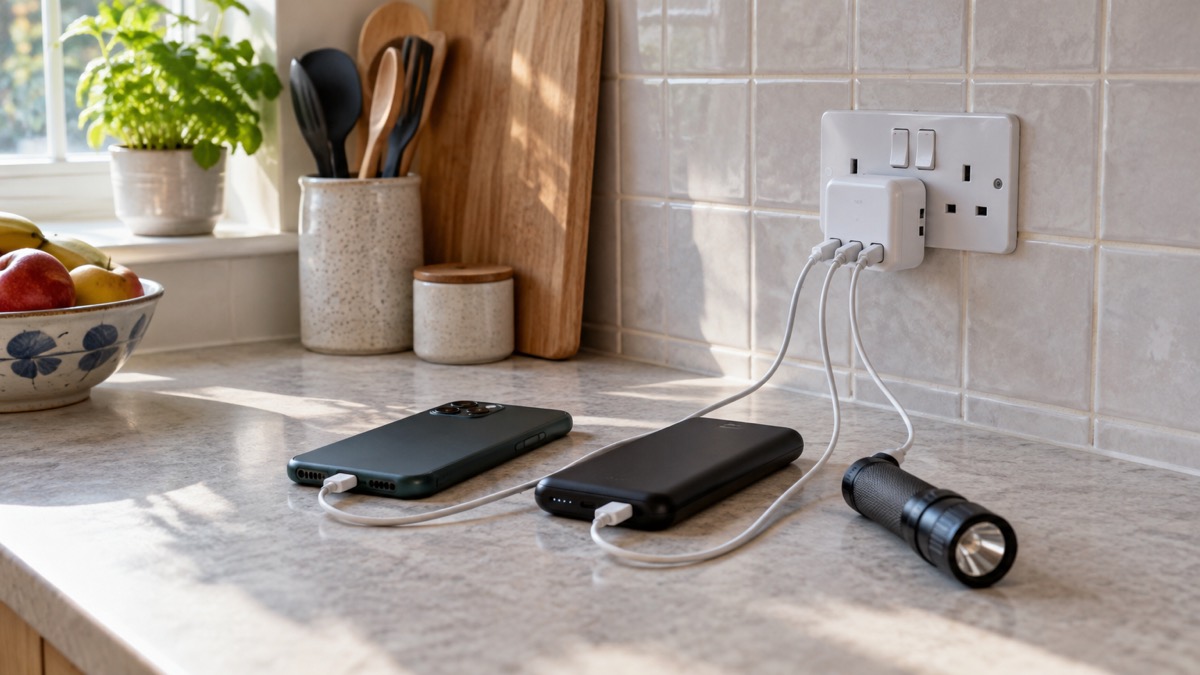
The phone is the one device that does several jobs at once: it is your link to updates, your way of calling for help, and your contact with family. Official guidance is consistent that it should be kept charged so you can make calls in case of an emergency2, and so you can use it to go online for updates or call if you have a power cut1. Northern Ireland's guidance puts it in terms of support: keep your mobile charged so you can call for support if needed16.
The limit is time. Charging phones, laptops, tablets and power banks gives you use of battery power for a short time at least, not indefinitely3. That is why the advice is to charge everything, not just the phone, and to have a power bank as a backup5. A power bank bought and left uncharged is no help at all, which is why the guidance is to charge it regularly14.
There is a second reason to keep the phone ready: information. During a cut, your network operator's website and social media carry updates on the incident, and a charged phone is how you reach them1. For more on what happens to mobile networks in a cut, see Mobile Networks in a Power Cut: Masts, Backup Batteries and Signal.
Making a phone battery last through a cut
A full phone battery does not last forever when it is working hard, and in a cut it will be working hard: searching for signal, refreshing pages, lighting the screen. The main official and independent advice is simple: cut apps running in the background1. Those are the apps that quietly use power while the screen is off.
A few habits make a difference:
- Carry a charged power bank as a backup5.
If you rely on a phone for a medical device, a telecare alarm or a monitored service, treat charging as a daily task rather than an occasional one. The guidance for households with technology-dependent children is to charge fully any equipment with batteries for a planned power cut, and for unplanned cuts to make sure any items not in use are charging or charged11. The same discipline suits anyone with a powered medical device at home. For more detail, see How to Save Your Phone Battery in a Power Cut and Getting Your Mobile Phone Ready for an Emergency.
Reporting a power cut and getting updates
Call 105 to report a power cut. It is the national power cut line, and you can also call it if you spot damage to electricity power lines and substations that could put you or someone else in danger18. Store the number on your phone before you need it10.
While the cut lasts, updates come from your network operator. A battery-powered radio and fresh batteries matter because you may be able to receive updates on the incident that way13. Keep a mobile phone charged to receive updates, and follow your operator's social media feed where you can19.
| What you need | Why it matters | Source |
|---|---|---|
| A charged mobile phone | To report the cut and receive updates | 20 |
| The 105 number, stored and on paper | To report a cut or damage to lines and substations | 9 |
| A battery-powered radio and fresh batteries | Updates on the incident when other networks are down | 18 |
| Your operator's website or social feed | Incident updates during the cut | 21 |
For the wider picture on official warnings, see Where to Get Official Warnings and News in an Emergency and Which Radio Stations to Tune Into During a Power Cut.
Getting through a power cut safely: stay back from damaged equipment
The message from network operators after a storm is blunt: "please stay back, don't touch it"22. Stay well clear of any fallen power lines or damaged equipment23. If a line comes down on a fence, a car or a puddle, treat everything nearby as live and keep others away until the operator arrives.
Inside the house, the risk is different but real. Switch off appliances and equipment to help prevent damage when the power returns20. Do not leave electrical appliances switched on at the socket, particularly heating or cooking appliances, as power could be restored at any time and cause a safety hazard11. Turn off big appliances, especially cookers and electric fires, until the power is back on24. The British Red Cross puts it plainly: protect your electrical appliances by switching them off and unplugging them25.
Leave a light on so you know when your power comes back on21. If the cut is localised, stay with friends or relatives until your power is back on21. Check on vulnerable neighbours or family21. For the full household routine, see Power Cuts: A Household Guide.
A household power cut plan in four steps
A plan is not a document; it is a set of habits that mean nobody has to think in the dark.
- Before: keep phones, laptops, tablets and power banks fully charged3. Keep torches, batteries and a battery or wind-up FM radio ready7. Write important numbers on paper6.
- When the power goes: stay calm, and remember the power companies will be working to restore power25. Switch off appliances at the socket, especially heating and cooking appliances11. Leave a light on so you know when power returns26.
- During: use the radio and a charged phone for updates18. Check on vulnerable neighbours or family26. Keep the fridge and freezer closed: don't open your freezer, and if food has defrosted by the time power is back, throw it away24.
- After: check the freezer and fridge food before using it24, and switch appliances back on only when you are ready11.
For households that need extra help, the Priority Services Register is the route to support from your network operator during a cut. For the wider kit list, see Emergency Kit: What a UK Household Should Keep Ready and Backup Power at Home: A Household Guide.
Sources (26)
- Power cut, Energy Networks Association, 2026-10-25
- What to do in a power cut, Met Office, 2026-10-25
- Strong winds: weather warning information and advice, nidirect, 2026-10-24
- Get prepared, Carmarthenshire County Council, 2026-10-25
- What to do in a power cut, Northern Powergrid, 2026-10-25
- Prepare yourself, Wiltshire and Swindon Prepared, 2026-10-25
- The Pillowcase Project: thunderstorms, British Red Cross, 2026
- Top tips to be WeatherReady, Met Office, 2026-10-25
- Top tips to be WeatherReady, Met Office, 2026-10-25
- What to do in a storm, Powercut105, 2026-10-26
- Parental letter re power shortages, North West Children's Operational Delivery Network, 2022-11-25
- Be more resilient in 30 simple ways in 30 days, Scottish Borders Council, 2026-10-29
- Being prepared for a power cut, SP Energy Networks, 2026-10-26
- Be Ready: Household Emergency Plan, UK Government, 2026
- 10 things you should do now to prepare for winter - Met Office, Met Office
- Winter ready, Isle of Anglesey County Council, 2026-10-25
- Strong winds and heavy rain: warning information and advice, nidirect, 2026-01-27
- Utilities failure, London Borough of Richmond upon Thames, 2026-05-22
- What happens during an energy shortage?, Energy Networks Association (ENA), Energy Networks Association (ENA)
- Stay safe in a thunderstorm, Met Office, 2026-10-25
- Power cuts, West Yorkshire Prepared, 2026-10-29
- Power restored to customers affected by Storm Bert, SSEN Distribution, 2024-11-25
- Power cut plan.pdf, Northern Powergrid
- Weather and health, Public Health Wales, 2026-07-16
- Advice and support: FAQs, Electricity North West, 2026-10-25
- Repeat power cuts, SSEN Distribution, 2026-10-25
 Free Alert Services
 Emergency Apps
 Digital Switchover Checklist