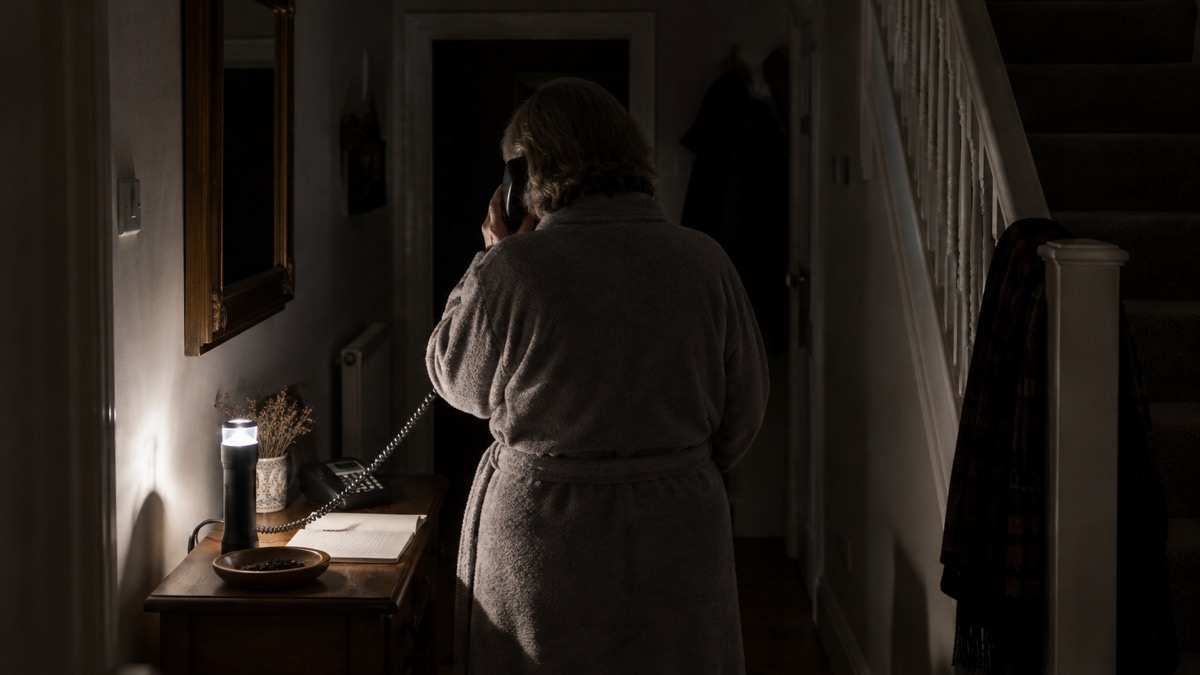
When the power goes off, the first thing most households reach for is a phone. That is exactly when the numbers you need are hardest to find: the mobile may be low on charge, the landline may depend on mains power, and the broadband router is dead. The answer is a short written list, kept in two places, that you can read by torchlight.
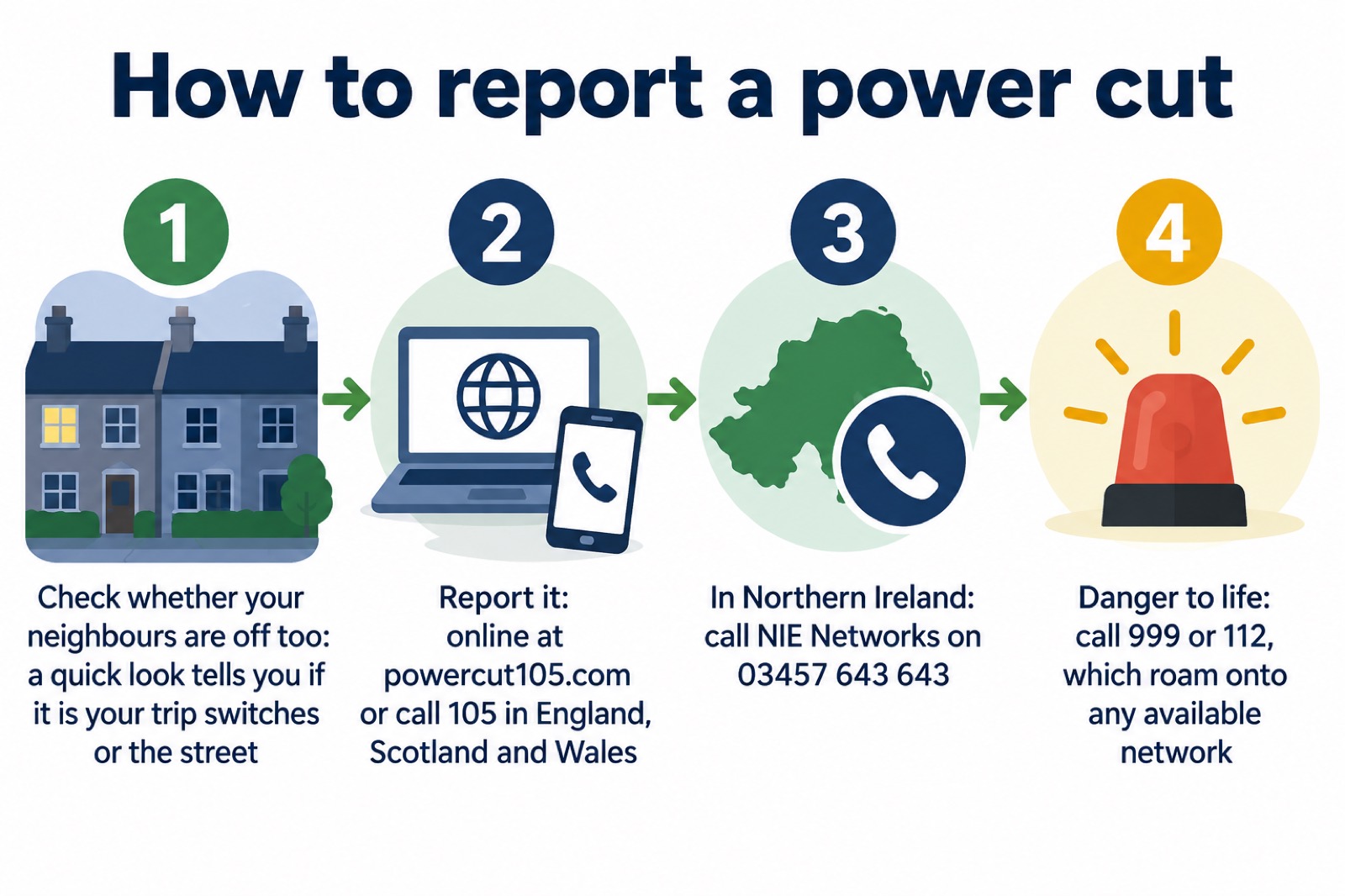
The number that matters most is 105, the free power cut line for England, Scotland and Wales, which puts you through to your local electricity network operator for help and advice1. In Northern Ireland the number is 03457 643 643, the NIE Networks customer helpline for reporting a power cut or a damaged power line4. For danger to life, fire or a serious medical emergency, it is still 9997.
Everything else on the list is about the people and services you would want to reach if the cut lasted longer than an evening: family, neighbours, your doctor, your utility suppliers and your insurer. Write them down on paper, keep a copy by the phone and a copy in your grab bag, and add your meter and account details so you are not hunting for them in the dark8.
The numbers to keep by the phone and in your grab bag
Start with a single sheet of paper. The government's Be Ready campaign is direct about it: write down important phone numbers on paper and store them somewhere easy to find in a power cut, including emergency contacts, your medication list, radio frequencies and insurance policy details9. The same advice appears across the national campaigns: keep a paper copy of important phone numbers for family, neighbours, doctor and utilities in case your mobile loses power or you cannot reach your contacts8.
A sensible list covers more than the emergency services. Ready Scotland suggests your household plan should include your GP surgery, school or childcare provider, care providers and home assist services, insurance provider and policy number, vet, local council, and close family members or friends12. If you care for someone, keep a list of phone numbers and addresses of the people who need to know there has been an emergency13.
| Number or contact | What it is for | Where to keep it |
|---|---|---|
| 105 | Power cut in England, Scotland and Wales1 | Fridge door and phone contacts11 |
| 03457 643 643 | Power cut or damaged line in Northern Ireland4 | Fridge door and phone contacts |
| 999 or 112 | Danger to life, fire, medical emergency7 | Phone, and written on the sheet |
| Family and neighbours | Checking on each other, borrowing kit | Written sheet and grab bag8 |
| GP, care provider, school | The people who need to know | Written sheet12 |
| Supplier and insurer | Account, policy number, supply questions | Written sheet9 |
Keep one copy by the phone and one in your grab bag, and put 105 on the fridge or saved in your mobile contacts so it is there before you need it11. A phone in the bedroom is worth having too, in case you need to make an emergency call at night, and if it is a mobile, keep it charged14.
Power cut line in Northern Ireland: 03457 643 643
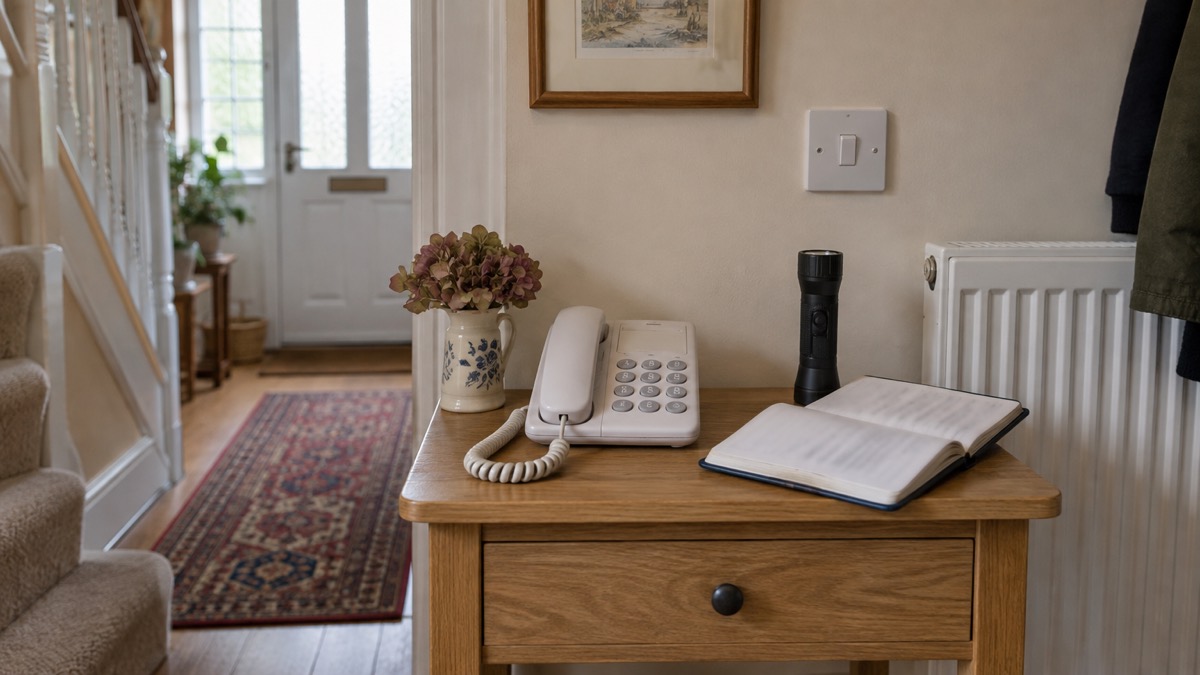
If you live in Northern Ireland, the reporting number is different and worth learning. NIE Networks runs a customer helpline on 03457 643 643 for reporting a power cut or a damaged power line5. The same number appears in the Northern Ireland household emergency kit guidance, listed as Northern Ireland Electricity's contact number4, and in weather warnings issued by the Northern Ireland Executive15.
Northern Ireland has had recent, practical reminders of why the number matters. During Storm Boelo, NIE Networks asked customers to report a power cut or damaged equipment on 03457 643 643 or through its Powercheck app17. That is the kind of event where a written number and a charged phone earn their place.
The Northern Ireland guidance also covers what to do about damage. Report anything that looks dangerous to NIE Networks on 03457 643 643, and never touch damaged electricity equipment6. If your home has been flooded, one source lists a separate number for flooded homes in Northern Ireland, 0345 7643 64318.
Ways to report a power cut without phoning
You do not have to ring to report a cut. You can report it online at powercut105.com, or call 105, which is a free service in Scotland, England and Wales2. Ofgem's guidance for unplanned cuts is the same: report it directly to your local network operator using their website, or call 105 for free3.
Whichever route you use, do not assume the company already knows. Official guidance is blunt: don't assume that the power company know you have no power, and ring them as soon as possible19. A single call or online report helps the operator build an accurate picture of who is off and where the fault lies.
If your phone service depends on the internet, plan for the possibility that it fails with the power. In the most serious circumstances your mobile phone, landline and broadband connection could all be down, so you may not be able to contact emergency services on 99920. If you have no back-up power to your landline and a life-threatening emergency, attempt to call 999 or 112 using a mobile: you might get overlapping signal from a nearby area that is unaffected, because emergency calls automatically roam onto all available networks1.
A non-mains powered landline telephone will help you stay in touch during any disruptions to your power supply22. A cordless landline may not work in a power cut, because the base station needs power and may not have a back-up battery23. Ofcom confirms that moving to a digital landline does not change your number: you keep it and continue to make and receive calls in much the same way24.
What the network operator will and will not do for you
The operator's job is to find the fault, fix it and tell you what is happening. When you call 105 you are put through to your local electricity network operator, who can give you help and advice26. That is the right call for a cut, a damaged line or a question about restoration.
What the operator will not do is know automatically that your particular home is off. That is why the guidance tells you to ring rather than wait25. It also will not replace the emergency services: if there is a fire, a medical emergency or a risk to life, call 999 as soon as you are safe to do so7. A personal emergency evacuation plan does not change that; the resident should still phone 999 in an emergency27.
There are limits to what any phone line can do in the worst cases. If mobile, landline and broadband are all down, you may not be able to reach 999 at all20, which is why the written list and a charged phone matter. Emergency Alerts are a separate channel: they do not track your location, need your phone number or collect personal data, and those without a mobile will still be made aware through the news and local emergency services28.
If a national shortage is likely to last a few days, an emergency power cut rota will be published. You enter your postcode to see when you will have a power cut the next day and a timetable of risk for the days after, and you should keep checking the rota every evening25. Save that web address with your other numbers so you can find it without searching.
Keeping your numbers and meter details ready
A list is only useful if it survives the event. Keep a paper copy of important phone numbers and other essential information in case your mobile loses power or you cannot access your contacts8. Keep important numbers such as family or insurance written down somewhere safe in case you cannot access them on your phone or online29. Store one or more emergency contact numbers on your mobile or keep a written copy in your wallet or purse, using the ICE or Medical ID feature if your phone has one30.

Add the details that identify you to your supplier: your account number, your meter details and your policy number. Ready Scotland's household plan guidance suggests including your insurance provider and policy number alongside your other contacts12. All utilities have a 24-hour operation call line, so have the telephone number of your power provider easy to hand so you can make that call31.
Keep the phone itself ready. The Met Office advises considering a separate battery charger and storing key information such as the power cut helpline number (105) on your phone32. A mobile phone charger belongs in the household emergency kit33, and if you have a mobile phone, keep it with you at all times in case you need to make an emergency call13. Keep people's email addresses in your phone too, as they may be handy when calls will not connect29.
On generators, official guidance is cautious. The expense of installing a generator for a household may not be worth the cost, and having torches and lanterns is a suitable alternative for the few hours you may be without power34. If you do keep one, follow the maker's instructions and the fire service's advice on siting and carbon monoxide, and never run one indoors or in a garage.
Sources (34)
- Power cuts, Be Ready campaign, 2026-10-21
- Power cuts at home, Scottish Fire and Rescue Service, 2026-10-25
- Check if you can get payment for a power cut, Ofgem, 2026
- Household emergency kit, nidirect, 2026-07-06
- Strong winds and heavy rain warning: information and advice, nidirect, 2026-01-27
- Strong winds weather warning: information and advice, nidirect, 2026-10-24
- Home fire escape plan, Scottish Fire and Rescue Service, 2024-02-06
- Phone and broadband outages, Prepare campaign, 2026-10-25
- Get prepared for emergencies, Prepare campaign, 2026-10-21
- Stay connected in severe weather, Ofcom, 2026-10-13
- Winter ready, Isle of Anglesey County Council, 2026-10-25
- Emergency plan, Ready Scotland, 2026-03-24
- Easy read: disabled persons and carers, Prepare campaign, 2024-07
- Fire safety for people with hearing difficulties, Devon and Somerset Fire and Rescue Service, 2026
- Strong winds and heavy rain warning: information and advice, nidirect, 2026-01-27
- Ice weather warning: information and advice, nidirect, 2026-02-16
- Storm Boelo update, Sunday 25 October, NIE Networks, 2026-10-25
- Preparing for flood, nidirect, 2025-09-11
- Adverse Weather Events - Llangattock Community Council, Llangattock Community Council
- Planning for phone and broadband outages, Wiltshire and Swindon Prepared, 2026-10-25
- Power cuts, Prepare campaign, 2026-10-21
- Get prepared, Carmarthenshire County Council, 2026-10-25
- Keep Safe Keep Well winter safety campaign 2024-2025, NHS Western Isles, 2024-10
- Future of landline calls, Ofcom, 2026-08-26
- What are electricity rota loads, Wiltshire and Swindon Prepared, 2026-10-25
- LFB Extreme weather, summer guide, London Fire Brigade
- Residential personal emergency evacuation plans, North Yorkshire Fire and Rescue Service, 2026-03-30
- Emergency alerts, Denbighshire County Council, 2026-10-26
- Yourself, Wiltshire and Swindon Prepared, 2026-10-25
- Travel advice, Prepare campaign, 2026-10-06
- Failure of national electricity, Wiltshire and Swindon Prepared, 2026-10-25
- Top tips to be weather ready, Met Office, 2026-10-25
- Emergency kit, Ready Scotland, 2026-10-22
- Generators, Wiltshire and Swindon Prepared, 2026-10-25
 Power Cut Kit Checklist
 What to Keep Charged
 Household Emergency Plan