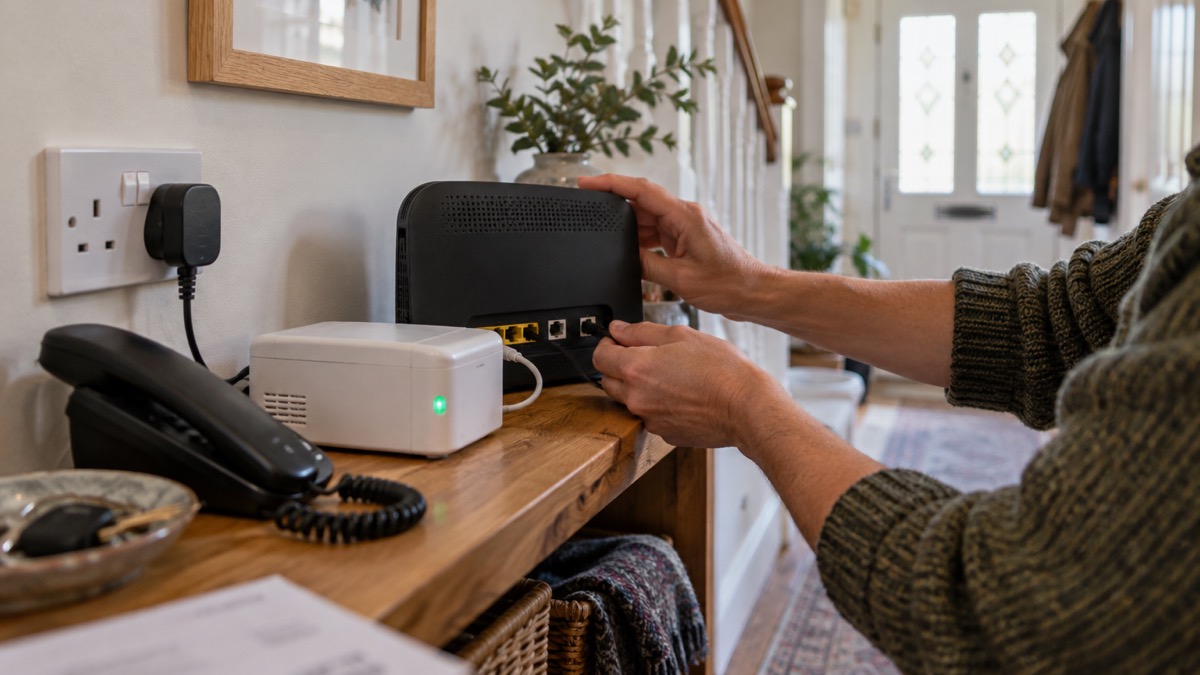
If your home phone plugs into your broadband router or hub, it stops working the moment the power goes off. Digital landlines need mains electricity and will not work in a power cut unless there is a battery back-up1. That is the single most important change the digital switchover brings to an ordinary household, and it is why your router now matters as much as your phone.
The good news is that help exists and, for many people, it is free. If you depend on your landline, your provider must make sure you can contact the emergency services during a power cut2. If your landline will not work in a power cut, your landline provider might offer you a free solution, such as a back-up battery unit, for a minimum of one hour3. If you have no mobile phone, or no signal where you live, your provider should offer you a solution such as a battery back-up unit so you can still make emergency calls4.
The deadline adds urgency. The old analogue network, the Public Switched Telephone Network, is being switched off, and most customers are expected to have made the switch by the end of January 20274. After that, the old-style corded phone that used to keep working through a power cut will not save you, because the line it plugs into no longer exists. This page explains what changes, what to do now, and how to keep a household connected when the power goes.
Why your home phone now runs through your router

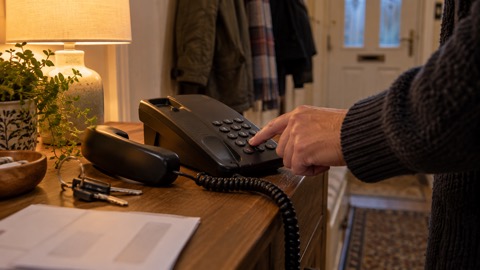
For decades, a landline phone carried its own tiny power supply. The analogue landline carries a low voltage power connection directly from the telephone exchange, enough to power some basic corded handsets without plugging them into the wall, so they kept working in a local power cut as long as the exchange still had power4. That is why the old advice, to keep a corded phone in a drawer, worked for so long.
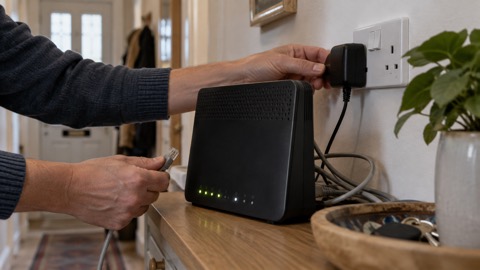
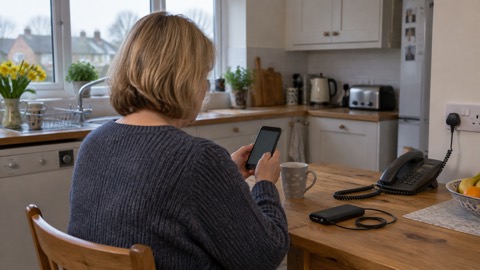
The switchover breaks that link. Digital phone lines work over your broadband connection, which means plugging your phone into your broadband router instead of a wall socket7. The router needs mains electricity, and the digital line cannot carry power to your handset. Digital landlines cannot carry an electrical power connection, so in the event of a power cut they will not work8. The move to fibre broadband means that in the event of a power cut you will not be able to use an analogue telephone on your landline connection9.
This is not a theoretical risk. The way your phone connects has changed: instead of plugging your phone into a wall socket, your service will usually connect through your broadband router10. That means the phone on your hall table now depends on the same electricity supply as your router, your broadband and everything else in the house. Households that had never thought about their router suddenly have a single point of failure: if the power goes, the phone line goes with it.
The same point applies to Wi-Fi. Does Wi-Fi work in a power cut? No: your router, and the broadband equipment in your street or cabinet, needs electricity, and a power cut removes exactly what Wi-Fi depends on. Our page on Wi-Fi Calling: How It Works and When It Helps explains the limits, and What to Do When Phones and the Internet Go Down covers the wider picture.
The analogue network switches off at the end of January 2027
The technology underpinning the landline network, the Public Switched Telephone Network (PSTN), is being switched off11. The telecommunications industry announced the retirement of legacy telephone networks back in November 201711, and the migration has been running ever since. Most customers are expected to have made the switch by the end of January 20274, and most telephone providers will be moving their customers from old analogue landlines over to digital services between now and that date8.
| What | When | Source |
|---|---|---|
| Industry announces retirement of legacy telephone networks | November 2017 | 11 |
| Most customers expected to have switched to digital | End of January 2027 | 4 |
| PSTN, the technology behind analogue landlines, switched off | January 2027 | 11 |
The government sets out why the change is happening. New digital phone lines will allow communications providers to offer clearer and higher quality phone calls. They will also offer greater reliability, more secure and energy efficient networks, promote economic growth, and can block tens of thousands of calls from scammers every day11. The old copper network is reaching the end of its life, and digital services are the replacement.
What the benefits do not change is the power problem. The government's own guidance is blunt: telecare devices connected to a digital landline network may not work during a power cut [S46]. If your line has already been switched, that risk is live in your home today.
If you want the fuller story of the switchover itself, read The Digital Landline Switchover: What Changes for Your Home Phone and When Does the Analogue Phone Network Switch Off?.
Will your landline work in a power cut?
The answer depends on which kind of line and which kind of phone you have, and the two are often confused.
On an analogue line that has not yet been switched: a corded landline phone might still work in a power cut12, because the line itself carries power from the exchange4. A cordless phone will not: a cordless landline may not work during a power cut because the base station needs power to operate and may not have a back-up battery13. Westminster's long-standing advice is to have at least one standard landline telephone in the house, as cordless telephones will not work in a power cut14.
On a digital line: nothing works without power. Digital landlines need mains electricity and will not work in a power cut unless you have a battery back-up1. Digital landlines do not work during power cuts7. There is no handset you can buy that gets around this, because the problem is not the phone, it is the router and the line.
| Phone set-up | Works in a power cut? | Why |
|---|---|---|
| Corded phone on an analogue line | Possibly, if the exchange has power | The analogue line carries low voltage power from the exchange4 |
| Cordless phone on an analogue line | No | The base station needs mains power13 |
| Any phone on a digital line | No, unless there is battery back-up | Digital lines cannot carry power8 |
| Digital line with a back-up battery unit | Yes, for at least one hour | The battery powers the router and phone3 |
The practical steps follow from this. Write down important telephone numbers, and try to get a corded (old-style) phone, which will continue to work even when the power goes off, for as long as your line is still analogue15. If possible, have an analogue phone that can be connected in your house, as this will still work if a power cut impacts the mobile network15. But treat the corded phone as a stopgap: once your line goes digital, it loses its magic, and the battery back-up becomes the thing that matters. Our comparison page Corded or Cordless Home Phones in a Power Cut works through the handset choices.
What to do now: speak to your provider
The single most useful action is a phone call or a website visit to your landline provider, and it is worth doing before you need it.
If your only way of making emergency calls is through a landline phone, or if you have a telecare kit connected to your landline, contact your landline provider to understand whether your phone will work during a power cut16. Ofcom, the telecoms regulator, puts an obligation behind the question: if you depend on your landline, your provider must make sure you can contact the emergency services during a power cut2. If your landline will not work during a power cut, your landline provider might offer you a free solution, such as a back-up battery unit, for a minimum of one hour, that would enable you to call the emergency services if you needed to3. If you don't have a mobile or live somewhere with no signal, your landline provider should offer you a solution such as a battery back-up unit so you can still make emergency calls during a power cut4.
For vulnerable customers with an analogue landline, the provider must provide a free back-up battery unit, meaning the landline would work for at least an hour during a power cut, and many batteries now last much longer5. Suffolk's telecare guide gives the same instruction from the other end: check with your device provider for backup solutions in the event of a power cut17.
A numbered list of what to do:
- Contact your landline provider and ask directly whether your phone will work in a power cut, especially if it is your only way of calling 99916.
- Ask about the free back-up battery unit if you depend on your landline, have no mobile, or have no signal at home4.
- Tell the provider about anything connected to your line, including personal alarms, telecare devices and fax machines, as you might need to take additional actions or purchase replacement devices or adaptors4.
- Keep a mobile phone charged and write down important phone numbers15.
- Keep a corded phone for as long as your line remains analogue18.
- Keep a battery or wind-up FM radio to get updates during a power cut19.
If you have specific requirements, for example if you are a vulnerable consumer or you have other devices connected to your telephone line, you might need to take additional actions or purchase replacement devices or adaptors4. Our page Getting a Free Battery Backup for a Digital Landline walks through that process, and Extra Help From Phone and Broadband Providers sets out the wider support providers offer.
Personal alarms and telecare need upgrading for digital lines
Telecare is the umbrella term for personal alarms, diabetes sensors and other connected equipment that monitors your health or summons help at the press of a button [S31]. The digital switchover affects every one of these devices, so speak to your device provider or manufacturer to understand how they will function during a power cut [S33].
The warning is stark. The NHS telecare information page states: "Important: an analogue telecare alarm system may not work properly if you have an internet connection or if you have a digital landline instead of an analogue landline at home. Consider buying a digital alarm if you're unsure." [S41]
"Important: an analogue telecare alarm system may not work properly if you have an internet connection or if you have a digital landline instead of an analogue landline at home. Consider buying a digital alarm if you're unsure."
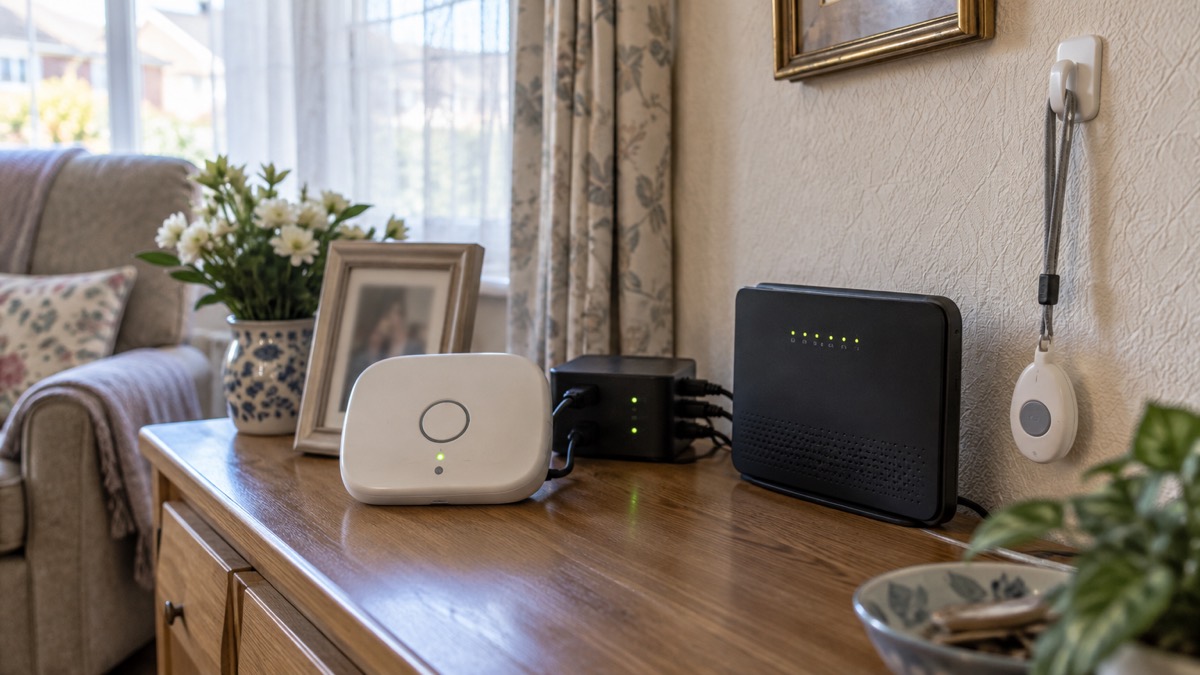
There are three ways a telecare alarm fails in a power cut: the alarm does not have an internal battery; the battery runs out of power; or the alarm is connected via a router that does not have a battery back-up [S41]. Knowing which of these applies to your device, or your relative's, is the whole task.
The instructions from official guidance are consistent. If you have a personal alarm or diabetes sensor or other connected equipment monitoring your health, speak to your device provider or manufacturer to understand how they will work during a power cut16. If you have medical or personal alarm devices that use phone or internet connections, check with the provider or manufacturer how they work if the network is down, for example how your personal alarm or diabetes sensor would function if mobile or broadband service is lost5.
There is better news on the digital side. Many digital telecare alarms have an in-built roaming SIM, meaning they will connect to a mobile phone mast in the event of a mains power cut [S41]. And most telecare alarm providers will have upgrade plans, so let your communication provider know if your phone line has been, or is due to be, upgraded8.
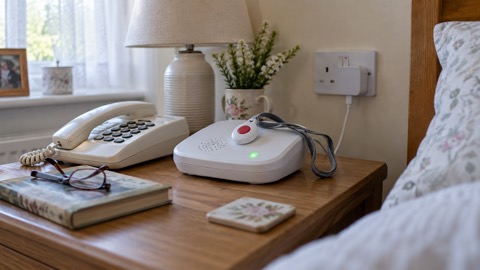
*A personal alarm and its base unit: after the switchover, its reliability in a power cut depends on batteries and back-up power.
For the full picture, read Telecare and Personal Alarms When Phone Lines Go Digital.
Keeping the router running, and staying reachable without it
The back-up battery unit your provider can supply is the first line of defence for the router itself, because the router, not the handset, is now the piece of kit that has to stay powered: instead of plugging your phone into a wall socket, your service will usually connect through your broadband router5. Households that want to keep a router and other essentials running for longer can look at the options in Backup Power at Home: A Household Guide, which covers power stations and other battery options and how to size them. Whatever you choose, the principle is the same: keep the hub alive and the phone plugged into it stays alive too.
While the router is down, a mobile phone is usually the fallback, and it is worth preparing it. Keep a mobile phone charged and write down important phone numbers15. If your mobile network is down but you have a working internet connection, you may still be able to make calls over Wi-Fi by enabling Wi-Fi Calling on your device5, though this needs the router running. Mobile Networks in a Power Cut: Masts, Backup Batteries and Signal explains how long masts themselves keep going.
To report the power cut itself, call 105 for free, which puts you through to your electricity network operator6. You can also report a power cut and track updates via your local network operator's website12. If the supply is cut off because of a faulty energy meter, contact your energy supplier instead20. In a severe, planned shortage, an emergency power cut rota may be published: enter your postcode to see when you will have a power cut the next day and a timetable of risk for days after, and keep checking the rota every evening21.
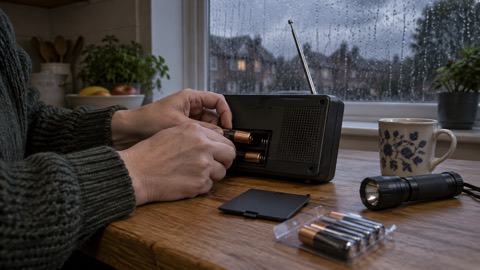
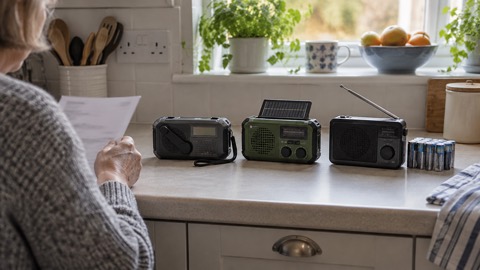
For news and warnings while the broadband is down, keep an FM radio, battery or wind-up, to get updates during a power cut19. Our pages on Emergency Radios: Wind-Up, Solar and Battery Types and How to Choose and Which Radio Stations to Tune Into During a Power Cut cover the choices, and Where to Get Official Warnings and News in an Emergency lists the sources worth knowing in advance.
Talking to older relatives and neighbours
Many households reading this will be fine in a power cut, with a charged mobile and a torch in a drawer. The person who may not be fine is a parent or neighbour whose only phone is a landline and whose personal alarm is ten years old. Official guidance across the UK keeps returning to this point.
Look out for elderly neighbours and ensure they are prepared for a possible power cut22. During an outage, visit elderly neighbours or family to make sure they are coping, and encourage them to stay warm with extra layers and blankets23. If it is a localised power cut, stay with friends or relatives until your power is back on, leave a light on so you know when the power returns, switch off appliances that could pose a hazard, and check on vulnerable neighbours or family15.
A practical conversation with an older relative covers four things:
- Their phone set-up: has their line been switched to digital yet, and is the phone now plugged into the router?7
- Their back-up: have they asked their provider about a free battery back-up unit, especially if they have no mobile or no signal?4
- Their alarm: is their personal alarm analogue or digital, and has the provider confirmed how it works in a power cut?5
- Their numbers: do they have important phone numbers written down, and a mobile kept charged?15
BT is hosting webinars to help guide customers through what the digital switchover means, why acting now is essential and how to ensure services continue without disruption7, which can be a gentle way in for a BT customer who is unsure what any of this means. For households that need more support generally, Extra Help in an Emergency: Older, Disabled and Medically Dependent Households sets out the wider arrangements, and the government's advice for disabled persons and carers covers the landline back-up question directly3.
Sources (23)
- Stay connected in severe weather, Ofcom, 2026-10-13
- Future of landline calls, Ofcom, 2026-08-26
- Advice for disabled persons and carers, Be Ready Campaign, 2026-10-20
- UK transition from analogue to digital landlines, GOV.UK, 2023-01-06
- Phone and broadband outages, Prepare Campaign, 2026-10-12
- Help in a power cut, Ofgem, 2026
- Switchover to digital landlines, South Gloucestershire Council, 2026
- Digital phone switchover, Argyll and Bute Council, 2026
- West Midlands Local Resilience Forum Community Risk Register, March 2024, Dudley Governance and Finance Trust NHS, 2024-03
- Customer Experiences of Storm Arwen, Ofgem, 2022-06-09
- Moving landlines to digital technologies, GOV.UK, 2025-05-28
- Power cuts: be informed about hazards, Prepare Campaign, 2026-10-21
- Keep Safe Keep Well Winter Safety Campaign 2024-2025, West Midlands Integrated Care Board, 2024-10
- Prepare your household for emergencies, Westminster City Council, 2014-04
- Power cuts, West Yorkshire Prepared, 2026-10-29
- Loss of essential services, Greater Manchester Combined Authority, 2026-10-29
- Digital switchover telecare guide, Suffolk County Council, 2025
- Winter weather: be prepared, Argyll and Bute Council, 2026
- Be Ready Household Emergency Plan, Be Ready Campaign, 2026
- Plan for a power cut, Ofgem, 2026
- What are electricity rota loads, Wiltshire and Swindon Prepared, 2026-10-25
- What to do in a power cut, Met Office, 2026-10-25
- Loss of essential services, Lancashire Prepared, 2026-10-29
 Free Alert Services
 Emergency Apps
 Digital Switchover Checklist
 When Phones and Internet Fail
 Official Warnings and News
 Emergency Radios
 Telecare on Digital Phone Lines
 Mobile Networks in Power Cuts
 Broadband Outages
 Wi-Fi Calling
 Satellite Messaging and SOS
 Satellite Messengers
 Calling 999 and 112
 Non-Emergency Numbers
 Getting Your Phone Ready