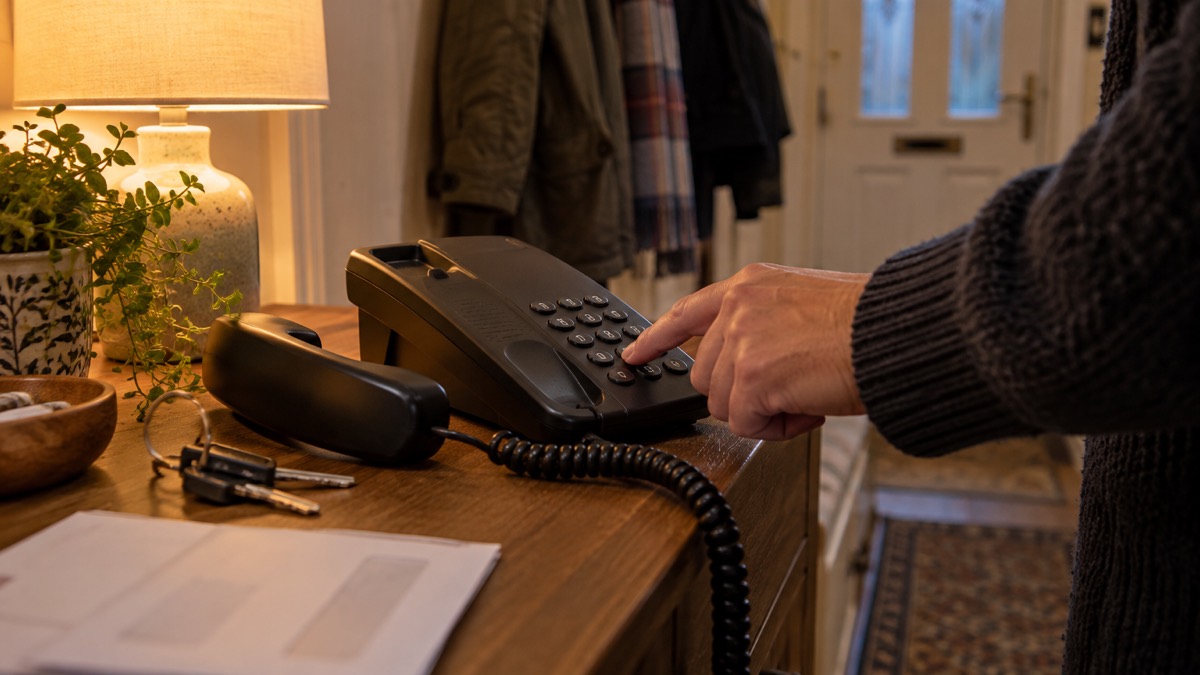
Dial 999, or 112, when someone is seriously ill or injured and their life is at risk1. Both numbers are the national emergency response service in the UK, with 112 the pan-European equivalent that can be used here as well2. The call is free, it works from mobiles and landlines, and the service is open all day and all night3.
When you ring, the first person you speak to is an operator who asks which service you need: ambulance, police, fire, or coastguard4. Say which one you want, and you are put through to that service's control room, where a call handler asks a short series of questions and arranges help while you are still on the line5. Answering those questions does not delay the response: help is being arranged while you talk6.
This page walks through the whole call: when 999 is the right number, exactly what happens step by step, what to do if you cannot speak or you hang up by mistake, how the call finds the right control room, and how the arrangements differ in Scotland, Wales and Northern Ireland.
When to call 999: a life at risk
The rule every UK ambulance service gives is the same: call 999 in a medical emergency, when someone is seriously ill or injured and their life is at risk1. South Western Ambulance Service puts it plainly: "Please always call 999 if someone is seriously ill or injured and their life is at risk"1. North West Ambulance Service uses almost identical words, and the Scottish Ambulance Service advises the same for Scotland10.
The test is whether you think the person could die. 999 is for life-threatening emergencies, when someone is seriously ill or injured12. If you are unsure, the balance of official advice is to call rather than wait, because the call handler can tell you whether an ambulance is needed and, if it is not, what to do instead14.
The same principle applies beyond medical emergencies. West Midlands Ambulance Service's major incident advice is to call 999 if someone is seriously ill, injured or in immediate danger15. Local authority emergency guidance across England says the same: if lives are in danger or there is a risk of injury, contact the emergency services as soon as possible16, and if people are injured or there is a threat to life, call 999 or 11217. Belfast City Council's emergency planning advice for Northern Ireland matches it18.
Mental health crises can also be 999 emergencies. The Welsh Ambulance Service lists reasons people call 999 that include someone's life being in immediate danger, a serious risk of suicide or self-harm, or a person who is extremely distressed, confused, or behaving in a way that puts themselves or others at risk18. If you are unsure whether a situation counts, our page on when you should call 999 goes into more detail.
What counts as a 999 emergency
Ambulance services publish lists of genuine emergencies, and they are strikingly consistent. South Central Ambulance Service includes someone who is unconscious, not breathing, bleeding severely, has fallen from height, has a traumatic head or other injury, serious burns, severe chest pains or symptoms of stroke6. North West Ambulance Service's list adds cardiac arrest, a confused state, fits that are not stopping, breathing difficulties, severe allergic reactions, burns and scalds, suspected heart attack, stabbing, shooting and serious road traffic incidents12.
The Welsh Ambulance Service's list for serious emergencies covers chest pain, difficulty in breathing, loss of consciousness, severe loss of blood, choking, fitting or convulsions, and severe allergic reactions19. Heat-related illness belongs on the list too: North East Ambulance Service advises calling 999 if someone is unconscious, having difficulty breathing, or has symptoms of heat stroke20.
| Service | Examples of when to call 999 |
|---|---|
| Ambulance | Cardiac arrest, loss of consciousness, chest pain, difficulty breathing, severe bleeding, choking, fits that are not stopping, severe allergic reactions, suspected stroke or heart attack, serious burns, fall from height, serious head injury, stabbing, shooting, serious road incident12 |
| Fire and rescue | Any fire in the home, smoke, danger from bonfires or open fires: get out if safe, stay out, dial 99921 |
| Police | A crime happening now, a suspect nearby, someone injured, threatened or in danger22 |
| Coastguard | Involved in an emergency at sea or on the coast, or a witness to one23 |
For fire, the advice from the Northern Ireland Fire & Rescue Service is to call at any sign of danger, not only when flames are visible: "At any sign of danger or in the event of an emergency, dial 999 and ask for the Fire & Rescue Service"21. If a fire breaks out in your property, get out if it is safe to do so, stay out, and dial 999 and ask for the Northern Ireland Fire & Rescue Service21. The same get out, stay out, call out principle applies across the UK.
You do not need to be the person involved. Essex Prepared's guidance is that if you are involved in an emergency or a witness to it, you should dial 999 and alert the police, fire, ambulance or coastguard service23. Bystanders calling promptly are often the reason help arrives in time.
What happens when you ring: step by step
The first person you speak to when you call 999 is the BT operator, who will ask "Emergency, which service?"4. Your call is then connected to the emergency operations centre of the service you asked for4. North West Ambulance Service describes the same sequence: when you dial 999, a BT operator will ask you what service you need13.
In a life-threatening medical emergency, ask for the ambulance service24. North East Ambulance Service's guidance is explicit: when you call 999, an operator will ask which emergency service you need, and in a life-threatening medical emergency you should ask for the ambulance service24. The Welsh Ambulance Service describes being put through to a 999 call handler once you ask for an ambulance19.
Once connected, the call handler asks a short set of questions. East of England Ambulance Service lists what they will ask: whether the patient is conscious and breathing; what exactly has happened; the address of the emergency; and patient details including name, age and medical history if you know them4. North West Ambulance Service adds that you should give the location of the emergency, including the house number and street name if you are at home25.
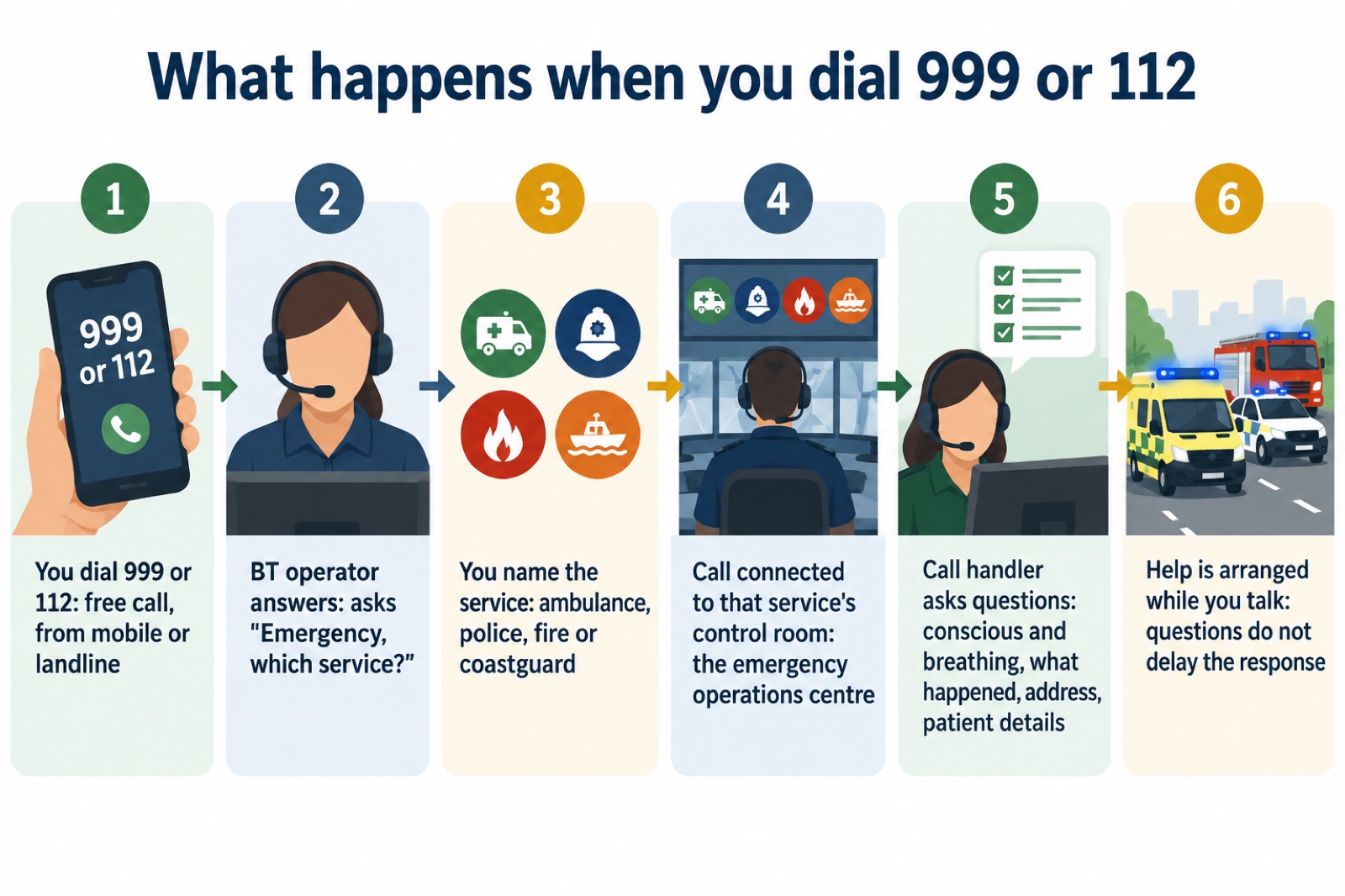
A point that worries many callers is worth stating clearly: the questions will not delay the help you need. South Central Ambulance Service's reassurance is that while you are talking to the control team, they will already be arranging help6. The Welsh Ambulance Service's easy-read guide to the call describes the same process: you are asked which service you want, you say ambulance, the call handler asks questions, and if it is an emergency they will send an ambulance14. If it is not an emergency, the call handler will tell you what to do14.
If you need an ambulance to get someone to hospital in an extreme emergency, that transport is free of charge, but it should only be used in an emergency2. For everything less than an emergency, the non-emergency numbers page covers 101, 105 and NHS 111.
Staying calm and answering the questions
The single most repeated piece of advice from ambulance services is to keep calm and listen carefully to the questions. North West Ambulance Service's guidance for young people explains why: the questions are very important and will help you look after the person who is hurt or ill25. Staying calm while you answer them helps the call handler get the information they need quickly.
Answer as best you can. The Welsh Ambulance Service's guide advises trying to answer the call handler's questions as best you can, and staying calm14. If you do not know an answer, say so: the handler would rather hear "I don't know" than a guess.
While you wait for the ambulance, there are practical steps that genuinely help the crew:
- Stay with the patient until help arrives, and call back if the patient's condition or location changes24
- Ask someone to open the doors and signal to the crew where you are24
- Write down the patient's GP details and collect their medication24
- Tell the service about any allergies the patient has24
- Phone 999 again if the person becomes more ill14
If English is not your first language, stay on the line: the phone line may go quiet when the operator is connecting you to a translator, and you should not end the call3. London Ambulance Service gives this advice in its guide to local 999 and 111 services3.
If you are on the phone to someone making a threat, the Police Service of Northern Ireland's personal safety booklet advises staying calm, listening carefully, keeping the caller talking and alerting someone nearby to dial 999, and noting details immediately. If the threat comes by text message, do not reply to, forward or delete it26.
If you hang up, cannot speak, or cannot hear
The 45-second rule on landlines
If you call 999 from a landline and replace the handset, the landline may remain connected for 45 seconds, in case you pick it up again7. The Independent Office for Police Conduct's guide to the Silent Solution gives the same figure, and adds what happens next: if you pick up again during those 45 seconds and the BT operator is concerned for your safety, the call will be connected to the police27. So if you hang up in error, or circumstances change, pick the handset back up quickly.
Because it is less likely that 999 calls are made by accident from landlines, the Silent Solution system is not used for landline calls7. When 999 calls are made from landlines, information about where you are calling from should be automatically available to the call handlers to help provide a response7.
Silent calls from mobiles: press 55
On a mobile, if you cannot speak, it is always best to speak to the operator if you can, even by whispering7. You may also be asked to cough or tap the keys on your phone in response to questions7. If you cannot do any of these and you do not press 55, the call will be terminated7. Our page on what to do if you dial 999 but cannot speak covers this in full.
Texting 999
People who find it hard to hear or speak can send a text message to 999 to get help from the emergency services, using the emergencySMS service28. The Scottish Ambulance Service's guidance on the service sets out one timing rule worth knowing: if no reply comes within 3 minutes, send the text again and try to find another way of getting help, such as asking someone near you, a friend or someone in your family28. Registration is required in advance, which our emergencySMS guide explains, and deaf callers can also use 999 BSL and Relay UK.
Calling with no signal, or during a network outage
Even if you have no signal on your usual mobile network, calling 999 will automatically connect through another network if one is available8. Ofcom, the communications regulator, explains that if your own mobile provider is experiencing an outage, you will be able to automatically use another provider's network to call 999 or 112 free of charge8. Your phone shows this as "emergency calls only" on Android or "SOS only" on iOS8.
This is why a mobile with no credit or no signal is still worth keeping charged: it can still reach the emergency services. Our pages on how to call 999 when your mobile network is down and mobile networks in a power cut cover the limits of this, and Wi-Fi calling and 999 explains what happens on that route.
Where your call goes, and who runs the service
Behind the scenes, calls made using 999 or 112 are identified and prioritised by the communications providers and forwarded to, and then answered by, call handling agents in one of 7 call-handling centres9. This is set out in the UK government's official guidance on the national emergency numbers9. From there, the geographic location of the caller, which is normally automatically available, enables the call to be transferred to the relevant geographically located emergency service control room9. That is why a 999 call made in Cardiff reaches the Welsh services and one made in Inverness reaches the Scottish ones.
Oversight is split. Ofcom, the independent communications regulator, oversees regulation of the telecommunications aspects of the 999-112 service through the General Conditions of Entitlement9. Technical and operational oversight is provided by the 999-112 Liaison Committee, hosted by the Department for Science, Innovation and Technology, previously the Department for Digital, Culture, Media and Sport9. The Committee's members include the Home Office, the Department for Health and Social Care, the emergency services, Ofcom, and the fixed and mobile communications providers9. It also has responsibility for the Code of Practice for the Public Emergency Call Service between communications providers and the emergency services9.
None of this changes what you do: you dial, you answer, help is arranged. But it explains two things callers notice. First, the first voice you hear is a BT operator rather than the service itself, because the initial answering is done at the call-handling stage before transfer4. Second, the Committee oversees sub-groups responsible for specific areas such as access to the service by vulnerable members of society, including those with hearing impairments, and emergency calls activated by smartphones9, which is why services like emergencySMS and smartphone SOS features exist and continue to develop.
When not to call 999
Do not call 999 if it is not an emergency, because doing so could delay helping someone who needs urgent assistance24. The Welsh Ambulance Service makes the consequence explicit: calling 999 for a problem that is not a genuine emergency can delay crews from reaching someone who is in a life-threatening situation19.
Hoax calls are a separate matter entirely. North West Ambulance Service warns that prank or hoax calls can get someone into a lot of trouble, and above all it is against the law and could risk someone else not getting help25. If you dial 999 by mistake, stay on the line and say so: that is far better than hanging up, and it takes seconds to resolve.
For urgent but not life-threatening medical problems, NHS 111 is the right service, and for non-emergency police matters it is 101. Police Scotland's guidance is that 101 is the number to contact the force for matters less urgent than 99922. Our non-emergency numbers page sets out which number to use for what. If 111 is busy, keep trying or use online alternatives, but if the person's condition worsens towards a life-threatening one, call 999.
How the four nations differ
The numbers and the basic process are the same across the UK, but the services that answer are organised separately in each nation, and it helps to know who you are talking to.
In Scotland, ambulance calls go to the Scottish Ambulance Service, which advises calling 999 in a medical emergency when someone is seriously ill or injured and their life is at risk11. For police, the advice from Argyll and Bute Council's emergency contact guidance, reflecting Police Scotland's own, is to phone 999 when an immediate response is needed because a crime is happening, someone suspected of a crime is nearby, or someone is injured, being threatened or in danger22.
In Wales, the Welsh Ambulance Service answers 999 calls, and its guidance describes the same sequence as England: a telephone operator asks which emergency service you need, and in a medical emergency you should ask for an ambulance and be put through to a 999 call handler19.
In Northern Ireland, the Northern Ireland Ambulance Service explains that when you make a 999 call you will be asked a series of questions that help dispatchers categorise your call, and there are many different responses to 999 calls which can vary depending on the situation29. Fire calls go to the Northern Ireland Fire & Rescue Service21, and police calls to the Police Service of Northern Ireland, which also advises contacting it on 101 or 999 where there are concerns about exploitation, trafficking or safeguarding of children2. The nidirect government service confirms that 999 and 112 are the national emergency response numbers in the UK, with 112 the pan-European equivalent usable here2.
| Nation | Ambulance | Police | Fire |
|---|---|---|---|
| England | Regional NHS ambulance trusts6 | Local police forces | Local fire and rescue services |
| Scotland | Scottish Ambulance Service11 | Police Scotland22 | Scottish Fire and Rescue Service |
| Wales | Welsh Ambulance Service19 | Local police forces | Local fire and rescue services |
| Northern Ireland | Northern Ireland Ambulance Service29 | Police Service of Northern Ireland2 | Northern Ireland Fire & Rescue Service21 |
Getting ready before you ever need to call
A 999 call goes better with a little preparation, and most of it takes minutes:
- Register for emergencySMS if anyone in your household finds it hard to hear or speak28
- Keep a written list of emergency and non-emergency numbers where it can be seen without power or a phone
- Know your exact address as it would be given to a call handler, and read our guide to giving emergency services your exact location
- Add medical and emergency contacts to your phone's lock screen so a stranger can help you
- Keep a phone charged: a mobile with no signal can still connect to 999 through another network8
- If you rely on a landline, understand whether it will work in a power cut
These steps sit within the wider task of staying informed and in touch in an emergency, and of getting your household prepared for the kinds of event that lead to a 999 call in the first place.
Sources (29)
- When to call 999, South Western Ambulance Service NHS Foundation Trust, 2026
- Emergency situations and keeping safe, nidirect (Northern Ireland government), 2025
- Your local 999 and 111 services, London Ambulance Service NHS Trust, 2026
- Using 999, East of England Ambulance Service NHS Trust, 2026
- What happens when you call 999, North West Ambulance Service NHS Trust, 2025
- 999 emergency, South Central Ambulance Service NHS Foundation Trust, 2026
- If you can't speak when you call 999, Bath and North East Somerset Council, 2026
- Stay connected in severe weather, Ofcom, 2026
- 999 and 112: the UK's national emergency numbers, GOV.UK, 2021
- Urgent and emergency care (999), North West Ambulance Service NHS Trust, 2019
- When should you call 999?, Scottish Ambulance Service, 2026
- When to call 999, North West Ambulance Service NHS Trust, 2023
- 999 urgent and emergency service, North West Ambulance Service NHS Trust, 2024
- What happens when you call 999, Welsh Ambulance Service NHS Trust, 2022
- Major incidents, West Midlands Ambulance Service University NHS Foundation Trust, 2026
- Flooding emergencies, Derbyshire County Council, 2026
- Emergency planning, Belfast City Council, 2026
- Some of the reasons people call 999, Welsh Ambulance Service NHS Trust, 2026
- 999 service, Welsh Ambulance Service NHS Trust, 2026
- Summer safety advice, North East Ambulance Service NHS Foundation Trust, 2026
- Other safety: open fires, stoves and chimneys, Northern Ireland Fire & Rescue Service, 2026
- Emergency contact numbers, Argyll and Bute Council, 2026
- Protecting your family, Essex Prepared, 2026
- 999 service, North East Ambulance Service NHS Foundation Trust, 2026
- When to call 999, North West Ambulance Service NHS Trust, 2024
- Protect Yourself booklet, Police Service of Northern Ireland, 2024
- Silent Solution guide, Independent Office for Police Conduct, 2023
- About sending a text to 999, Scottish Ambulance Service, 2013
- Calling 999: who will treat you, Northern Ireland Ambulance Service, 2026
 Free Alert Services
 Emergency Apps
 Digital Switchover Checklist
 When Phones and Internet Fail
 Official Warnings and News
 Emergency Radios
 Telecare on Digital Phone Lines
 Mobile Networks in Power Cuts
 Broadband Outages
 Router and Hub Power Cuts
 Wi-Fi Calling
 Satellite Messaging and SOS
 Satellite Messengers
 Non-Emergency Numbers
 Getting Your Phone Ready