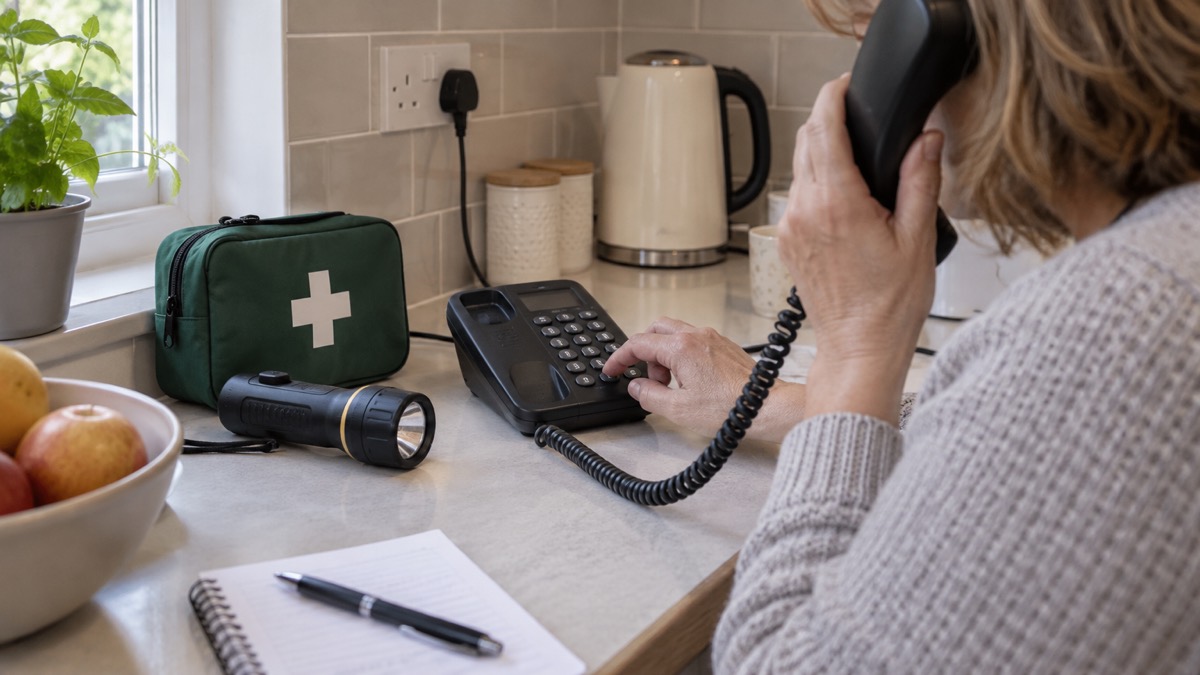
Most emergencies are not emergencies. A child who is unwell at midnight, a power cut that has darkened the whole street, a shed break-in discovered in the morning: none of these needs 999, and ringing 999 for them can delay help for someone whose life is at risk. The UK has three free numbers that cover the urgent-but-not-life-threatening middle ground, and knowing which to use before you need it is one of the simplest pieces of preparation a household can do.
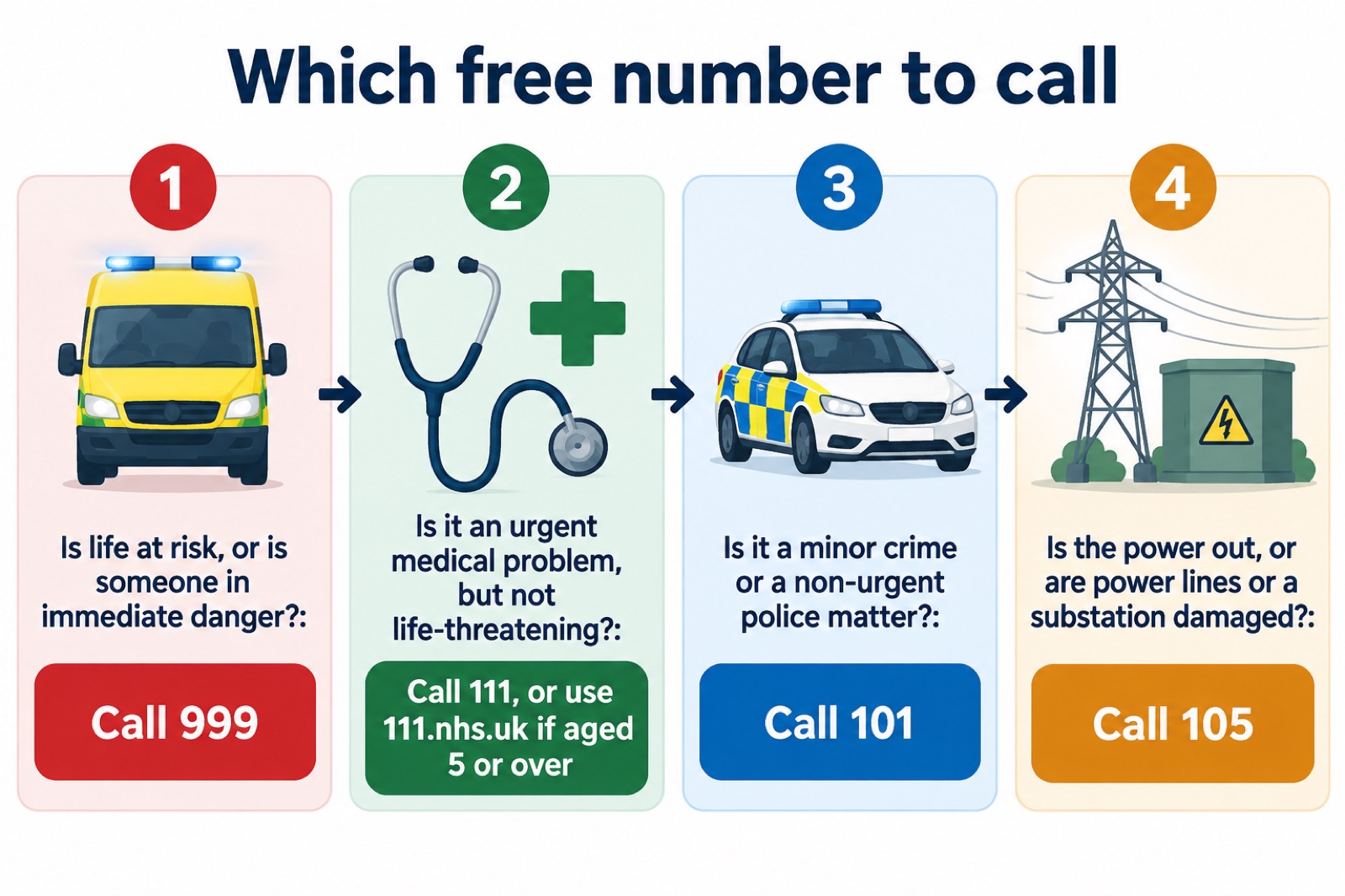
NHS 111 gives urgent medical help and advice, 24 hours a day, 7 days a week, free from any landline or mobile1. 101 is the police non-emergency number, used across the UK to report minor crimes and incidents that do not need an immediate response2. 105 connects you to your local electricity network operator to report a power cut or get outage information, anywhere in England, Scotland and Wales3. All three are free to call, and all three are covered in full on this page, including how 111 works in Scotland and Wales, how to reach it if you are deaf or use British Sign Language, and what to do about damaged power lines.
Which number to call: 999, 101, 105 or 111
The rule is simple: if life is at risk, ring 999. If it is not, one of the three non-emergency numbers will get you to the right service, and each one routes you to the people who can actually act.
| Number | What it is for | Who answers | Where it works |
|---|---|---|---|
| 999 | Life-threatening emergencies and immediate danger2 | Emergency services | UK-wide, along with 1122 |
| 111 | Urgent medical help or advice that is not life-threatening1 | Trained health advisers, supported by clinicians6 | England and Scotland7 |
| 101 | Reporting minor crimes and non-urgent police matters2 | The police | UK-wide2 |
| 105 | Reporting power cuts, getting outage updates, reporting damaged power lines or substations3 | Your local electricity network operator8 | England, Scotland and Wales3 |
Two habits make this easier in a real incident. The first is to keep the numbers on paper where you can find them without power or internet, which is the whole point of our emergency numbers checklist. The second is to think in advance about who in your household would make each call, and to make sure everyone, including older children, knows the difference between 999 and the rest. A household contact plan is a good place to write this down.
If you are unsure whether a medical problem is life-threatening, NHS guidance is consistent: 999 is for serious or life-threatening illness or injury9, and 111 is for everything urgent short of that1. When the position is borderline, the 111 service exists precisely to sort it out, and can send an ambulance if one turns out to be needed10.
999 is only for life-threatening emergencies and immediate danger
Every ambulance service and council contact page in the country makes the same request: keep 999 clear for genuine emergencies. The South Western Ambulance NHS Foundation Trust asks people to "remember to only call 999 for life-threatening or serious emergencies that need urgent care"11. The same boundary appears across NHS guidance: 999 is for a serious or life-threatening emergency where help is needed now.
The Northern Ireland direct government services page sets out what counts as a real emergency: danger to life, someone using or immediately threatening serious violence, serious injury to a person or their property, and situations such as road traffic collisions where life is at risk, the road is blocked, or a crime such as a burglary or robbery is in progress2. The same page notes that 999 and 112 are the national emergency response numbers in the UK, so 112 works as an alternative, particularly for callers used to the European number2.
In Scotland, NHS 24 gives a concrete medical list for 999 or A&E: life or limb threatening emergencies, signs of a heart attack or stroke, difficulty breathing, severe bleeding, severe injury, seizures, a severe allergic reaction, or if you have tried to end your life12. If none of those apply but you still need urgent help, that is the moment to move down to 111 rather than up to 999.
The reason the boundary matters is practical. The ambulance service's own instruction is to remember to only call 999 for life-threatening or serious emergencies that need urgent care11, which is why the number is kept for the situations where it truly counts. If you want more detail on how a 999 call is handled, see what happens when you ring 999, and if you cannot speak safely, read our page on silent 999 calls.
NHS 111: urgent medical help, 24 hours a day
NHS 111 is a free service that provides urgent medical advice and support13. It is available 24 hours a day, 7 days a week, by phone or online1, and NHS England describes its purpose as making it easier and quicker for patients to get the right advice or treatment they need, for their physical or mental health1. The London Ambulance Service's plain summary is the one to remember: "NHS 111 helps you when you need medical help or advice, but it is NOT an emergency"14.
Use it when you or someone in your household is unwell and you need medical help fast, but the situation is not life-threatening15. It is also the right number when your GP surgery is closed and you cannot wait for it to reopen16, which is why so many council and fire service leaflets list it as the out-of-hours route to a doctor17. Cheshire Fire and Rescue Service's home safety booklet puts it simply: call 111 for non-emergency help or GP advice out of hours17.
NHS 111 should be used by anyone with an urgent medical need, rather than calling 999 or going straight to A&E18. That is not a request to avoid A&E at all costs: it is a way of being seen in the right place, at the right time, without a wait in an emergency department that was never the right destination for your problem.
What happens when you call 111
Calls are answered by trained health advisers, supported by experienced clinicians, who assess your needs and work out what help you require6. Where it is appropriate, your call may be referred to a clinician, a trained nurse or paramedic, for further assessment of your condition or for medical advice6. If the assessment finds you need an ambulance, they will send one10.
Whether you use the phone or the online assessment at 111.nhs.uk, you answer the same few questions about your main symptoms to get the right information and advice18. That symmetry is worth knowing: the online service is not a lesser route, it is the same triage delivered by keyboard, and it can be faster when phone lines are busy.
Be aware that calls to 111 are recorded, and that the records are maintained securely and only shared with others directly involved with your care19. This is standard practice and no reason to hold back information: the more accurate your answers, the better the triage.
NHS 111 online, and the age limit
The online service at 111.nhs.uk is for people in England aged 5 and over who need urgent health care advice in a non-life-threatening situation4. The age limit is a firm one for the online assessment, not a matter of judgement. If the person unwell is under 5, use the phone line instead, where advisers can assess any age.
Mental health help on 111
If you are in mental health crisis, call 111 and press option 2 to speak to a mental health professional20. South West London and St George's Mental Health NHS Trust states this directly, and adds that NHS 111 can also be accessed online20. South Western Ambulance NHS Foundation Trust gives the same instruction: select the mental health option and speak to a trained mental health professional11.
Some areas run additional services alongside it. NHS Somerset lists a 24/7 NHS mental health telephone support helpline on 0800 038 5300 for advice and triage, available to anyone regardless of age, all day every day9. Derbyshire's flooding and community support pages direct people to 111 and the mental health option, option 2, 24 hours a day, 7 days a week21. In Scotland, NHS 24 says its 111 service can also help if you are in mental distress22. If life is at risk, or someone has tried to end their life, that moves to 99912.
Busy periods and bank holidays
NHS 24 in Scotland has published specific warnings that calls to 111 may take longer to answer over the festive public holiday weekends, covering 22 to 26 December and 30 December to 2 January, and advises on alternatives during those periods. The practical response is patience: if the problem is urgent but not life-threatening, the online assessment at 111.nhs.uk is an alternative to waiting on the phone line, and it asks the same few questions about your main symptoms as the telephone service does.
Council out-of-hours arrangements follow the same pattern, which is worth knowing if your problem is not medical. Derbyshire's emergency contacts page, for example, defines out-of-hours as before 9am or after 5pm Monday to Friday, at weekends and on bank holidays, and routes out-of-hours highway emergencies to the police on 101 and suspected gas leaks to the 0800 111 999 gas emergency line during those times23. Check your own council's equivalent page and note the numbers before you need them.
NHS 111 in Scotland and Wales
The number 111 works in both Scotland and Wales, but the services behind it differ, and knowing the difference saves a wasted call.
In Scotland, 111 is answered by NHS 24. Phone 111 if you think you need A&E but it is not life or limb threatening, if you need support with mental health distress, or if you need urgent care and your GP, pharmacy or dental practice is closed12. NHS 24 is explicit about one limit: the 111 service cannot arrange appointments at your GP, and during normal working hours you should always contact your own GP for urgent advice and treatment12. That is a firmer boundary than in England, where 111 covers the urgent-help gap including when your surgery is closed16.
In Wales, if you are not sure which NHS service you need, call 11124. The 2017 National Risk Register recorded the then Welsh non-emergency medical number as 0845 4647, with 111 covering England and Scotland7; the current position is that 111 and the NHS 111 Wales service are the route for urgent, non-life-threatening advice in Wales24. If you are unsure which applies in your area, the phone number 111 itself is safe to dial from anywhere in Great Britain and will reach the local service.
Reaching 111 if you are deaf, hard of hearing, or use another language
There are several routes into NHS 111, and the alternatives matter most for exactly the households that emergencies hit hardest.
If you have difficulty hearing, NHS England states you can access NHS 111 using the British Sign Language interpreter service1. North West Ambulance Service NHS Trust gives the same guidance for its own area: use the NHS 111 British Sign Language (BSL) interpreter service if you are deaf and want to use the phone service25. BSL users in Wales can access NHS 111 Wales via SignVideo26.
For text phone users, call 18001 11125. North Yorkshire's community risk register records the same access route for individuals with hearing loss27, and Essex's integrated care board adds 18001111 using text relay13. If you cannot use any phone route, the online assessment at 111.nhs.uk is there for anyone aged 5 and over4.
For callers who speak another language, the phone service can arrange interpreters: the assessment is the same few questions about your main symptoms whether you answer them by phone or online18, and the health advisers who answer calls are supported by experienced clinicians6, so interpretation is built into the call rather than something you must arrange yourself. Our page on 999 BSL and Relay UK covers the equivalent access routes for the emergency number itself.
Reporting a power cut on 105
105 is a free service for people in England, Scotland and Wales, and you can call it from most landlines and mobiles3. It does not matter who you choose to buy your electricity from: anyone can call 1053. That last point is the one most people get wrong, and it is the reason the number exists. Before 105, households in a power cut tended to ring their electricity supplier, the company they pay their bills to, when the organisation that actually restores power is the local network operator8.
Calling 105 connects you to your local distribution network operator, who is responsible for restoring power8. West Yorkshire Prepared describes it as "a free service that will put you through to your local network operator who can give you help and advice"28. The National Energy System Operator confirms the number is free and available nationwide, and that you can call it if you need updates about outages in your area, want to report a power cut, or want to report damage to power lines or substations8. You can also call 105 or use the online postcode checker to find out who your distribution network operator is8, and the website powercut105.com carries the same information28.
In Northern Ireland, the number is different: the power cut reporting line there is 03457 6436435.
Damaged power lines and substations: stay back and call 105
You can also call 105 if you spot damage to electricity power lines and substations that could put you, or someone else, in danger3. Warwickshire's emergency advice for residents adds the important companion instruction: if there is a serious immediate risk, call the emergency services too3.
The Priority Services Register
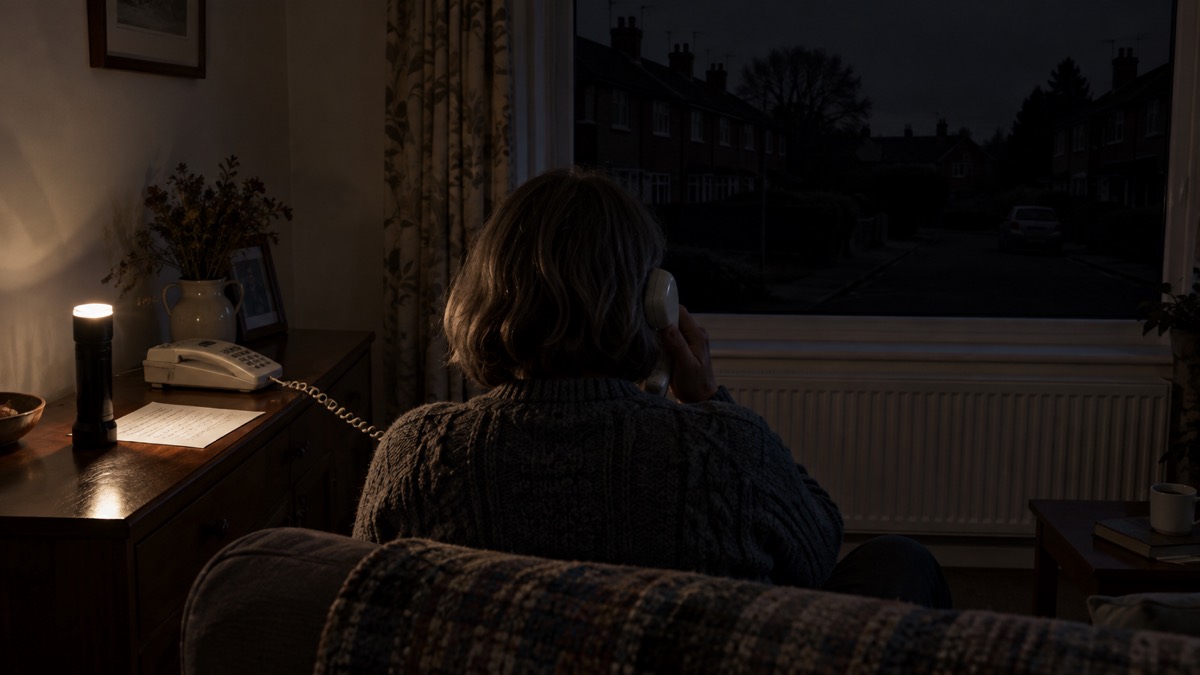
If someone in your household depends on electricity for medical equipment, or is older, disabled or less able to answer the door, register in advance with your network operator's Priority Services Register. It is the mechanism by which the network knows to prioritise and keep in touch with you during an outage. To take one operator's example, Western Power's warm and well advice for Nottinghamshire residents gives 0800 096 3080 and www.westernpower.co.uk/psr for information or to register29. Registration is free, and you can confirm your details by the same route. Our extra help in an emergency section page covers what else to arrange in advance.
For the wider picture of what to do when the power goes, including food safety, heating and lighting, see our power cuts guide, and for keeping your phone alive through an outage, what to keep charged before a power cut.
Police non-emergency: 101
101 is the police non-emergency number, used across the UK. Wiltshire and Swindon's community resilience plan lists 101 for non-emergency police reporting30, and Surrey's household emergency plan template carries "Police non-urgent 101"31. The same number appears in police forces' own contact information, which directs non-emergency calls to 101.
The Northern Ireland direct government services page frames the purpose: report online or call 101 if you want to report a minor crime or incident2. Typical uses include reporting a burglary discovered after the event, criminal damage, a stolen vehicle, or suspicious behaviour that is not unfolding at that moment. If a crime is in progress, or there is danger to life or a threat of serious violence, that is 999 territory2.
101 also picks up work the emergency line should not carry. Derbyshire routes out-of-hours highway emergencies, before 9am or after 5pm Monday to Friday, at weekends and on bank holidays, to the police on 10123. Basingstoke's emergency page lists the emergency services on 999 where life is at risk, with 101 as the non-urgent alternative32. Calls to 101 are treated as police contact, so expect to give your location and details in full, exactly as you would in person.
Keeping the numbers where you can find them
The common thread in every official contact page is that these numbers only help if you have them when you need them. A power cut takes out your internet router and, with a cordless phone, your landline too. A medical scare at 3am is not the moment to search for the right service. Write 999, 111, 101 and 105 on paper, keep a copy with a torch and a charged power bank, and make sure everyone in the house knows where it is.
Our phone numbers checklist gives you a printable version, and getting your mobile phone ready for an emergency covers the rest of the groundwork. If a storm is forecast, what to keep charged before a power cut and the storms and snow guide pick up from there.
Sources (32)
- NHS 111: urgent and emergency care, NHS England
- Emergency situations and keeping safe, nidirect (Northern Ireland government services), 2025-01-08
- Emergency advice for residents, Warwickshire County Council, 2026-10-29
- NHS 111 online, NHS Digital, 2026-10-29
- Be Ready household emergency plan, UK government Be Ready campaign, 2026
- NHS 111 service, Yorkshire Ambulance Service NHS Trust, 2026-10-29
- UK National Risk Register 2017, Cabinet Office, 2017-09
- Energy outages, National Energy System Operator, 2026
- Which NHS service should I use?, NHS Somerset, 2026-01-13
- 111 non-emergency service, South Western Ambulance NHS Foundation Trust, 2026-10-29
- Get the right help and support, South Western Ambulance NHS Foundation Trust, 2026-10-29
- NHS 24 111 service, NHS 24, 2026-02-09
- NHS 111 support, NHS Essex Integrated Care Board, 2026-08-19
- Your local 999 and 111 services, London Ambulance Service NHS Trust, 2026-08-10
- Winter top tips and advice, South Western Ambulance NHS Foundation Trust, 2026-10-29
- Storm preparation advice, Cornwall Council, 2026-10-29
- Safe and well booklet, Cheshire Fire and Rescue Service, 2026-04
- Alternatives to 999, South Central Ambulance Service NHS Foundation Trust, 2026-10-29
- NHS 111: your local services, NHS Lancashire and South Cumbria Integrated Care Board, 2026-10-29
- Urgent help, South West London and St George's Mental Health NHS Trust, 2026-10-29
- Communities affected by flooding, Derbyshire County Council, 2026-10-29
- Your Health Guide, Winter 2025, NHS Western Isles Integration Joint Board, 2025-12
- Emergency contacts, Derbyshire County Council, 2026-10-29
- Summer safety advice, Welsh Ambulance Services NHS Trust, 2026-10-29
- Alternative access to NHS 111, North West Ambulance Service NHS Trust, 2024-08-01
- Additional support when accessing 999, Welsh Ambulance Services NHS Trust, 2026-10-29
- Community Risk Register 2025, North Yorkshire Local Resilience Forum, 2025-02
- Power cuts, West Yorkshire Prepared, 2026-10-29
- Top tips for keeping warm, Nottinghamshire County Council, 2023
- Community resilience plan, Wiltshire and Swindon Prepared, 2025
- ICE template, Surrey Prepared, Surrey County Council, 2026-10-29
- Emergency information, Basingstoke and Deane Borough Council, 2026-10-29
 Free Alert Services
 Emergency Apps
 Digital Switchover Checklist
 When Phones and Internet Fail
 Official Warnings and News
 Emergency Radios
 Telecare on Digital Phone Lines
 Mobile Networks in Power Cuts
 Broadband Outages
 Router and Hub Power Cuts
 Wi-Fi Calling
 Satellite Messaging and SOS
 Satellite Messengers
 Calling 999 and 112
 Getting Your Phone Ready