A household emergency plan is a single sheet of paper that tells everyone in your home what to do, who to ring and where the shut-offs are when something goes wrong. You do not need a special form to start one: a handwritten sheet with the right headings does the same job, and the government's Prepare campaign publishes a fill-in plan you can use as a starting point1.
Fill in four things first: contact numbers, including 999, 101, 111 and your utility providers; how to turn off the gas, electricity and water; at least three days of food and water; and where the printed copy lives so everyone can find it2. Then keep it current, because a plan nobody has checked since last winter is a plan with the wrong phone numbers on it.
The sections below take each part in turn, with the wording the official guidance uses, so you can copy the headings straight onto your own sheet.
The checklist: what goes on the plan
Work through this list and write each answer on your sheet. If an item does not apply to your household, write "not applicable" rather than leaving a blank, so you know it was considered.
Contact numbers to write down
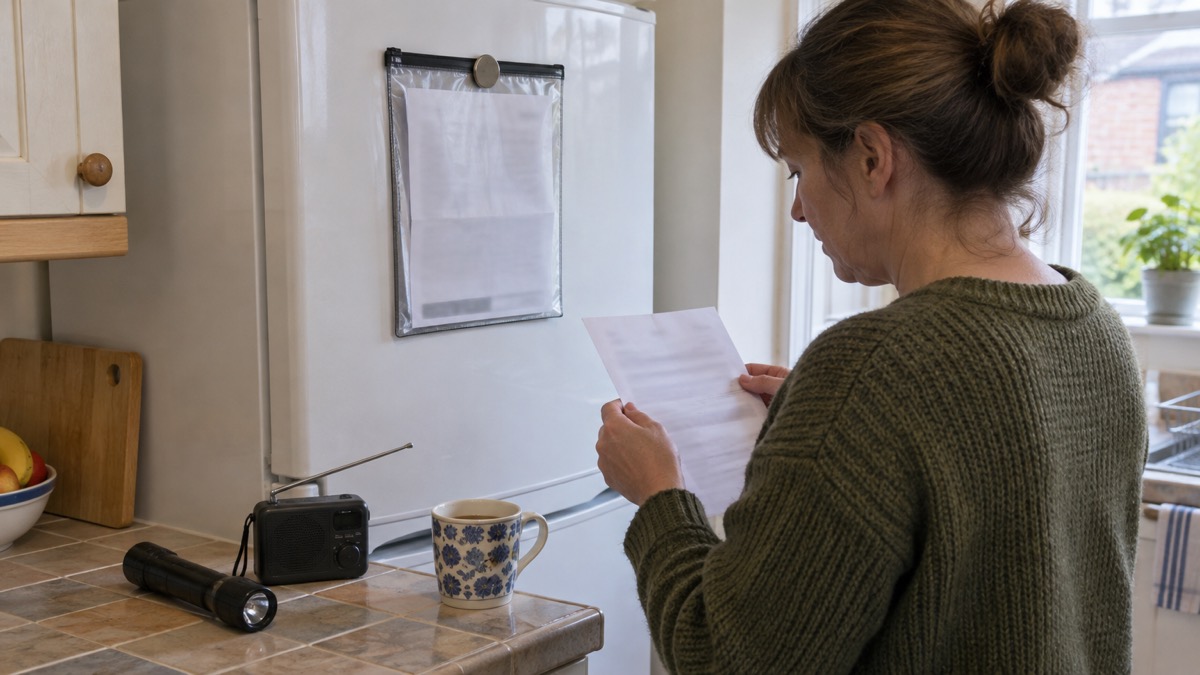
The core of any plan is a list of numbers that works when your phone does not. Surrey County Council's guidance makes the point plainly: keep a physical copy of key information such as telephone numbers and insurance details, because you may not be able to reach them on a phone or online12. London Resilience Partnership advises the same: a household plan should contain emergency contact details for your family or the people you live with, plus details of your insurance and utility providers11.
Write down the numbers you would actually ring, in this order:
- 999 for a threat to life, including a fire. The fire and rescue services are consistent: get out, stay out and call 9995. When you call, speak slowly and clearly18.
- 101 for the police when it is not an emergency4.
- 111 for NHS advice, listed in Scotland as NHS 244.
- 105 for a loss of power4.
- 0800 111 999 for a gas emergency4.
- 0345 988 1188 for Floodline Scotland, if you live in Scotland4.
- Your own utility providers, insurer and doctor, so you are not hunting for account numbers in the dark11.
The Scottish home emergency plan sets these out as a ready-made list, which is a sensible model for any household to copy4. If you want the wider picture of who to ring and when, see Staying Informed and in Touch in an Emergency.
Know how to turn off gas, electricity and water
Every set of official guidance says the same thing: find out how to turn off your home's gas, electricity and water supplies before an emergency, not during one8. The Be Ready campaign explains why it matters: you will need to turn these off if you have to leave your home because of flooding or a leak19. Northern Ireland's flood guidance singles out knowing where to turn off your electricity or gas supply as part of flood preparation20.
Walk round your home now and record three things on the plan: where the stopcock is, where the gas valve is, and where the fuse box is. Then write down how each is turned off, in your own words, so anyone in the house can follow it. Our guide to finding your stopcock, gas valve and fuse box covers the search room by room.
That single rule is the most important line on the whole plan. Write it next to the gas valve entry so nobody is tempted to try it themselves.
Supplies the plan should cover: at least three days
The plan should record what you hold, and how much, so you can see at a glance whether you would actually get through a few days without power or a trip to the shops. The Be Ready household plan asks for non-perishable food to last at least three days that does not require cooking or refrigerating, such as tinned meat, fruit or vegetables, plus a tin opener2. Ready Scotland's emergency kit list says the same: a 3 days' supply of bottled water and food that does not need cooking and will not go off, or that you rely on7. Dumfries and Galloway's guidance adds enough emergency food for three days and a can opener21.
Write on the plan:
- Water: how much you hold, and where7.
- Food: what you have that needs no cooking, and when it expires2.
- Medicines: what each person takes and how much is in the house22.
- Pet and baby supplies: kept at home for an emergency15.
- A tin opener, because a cupboard of tins is no use without one2.
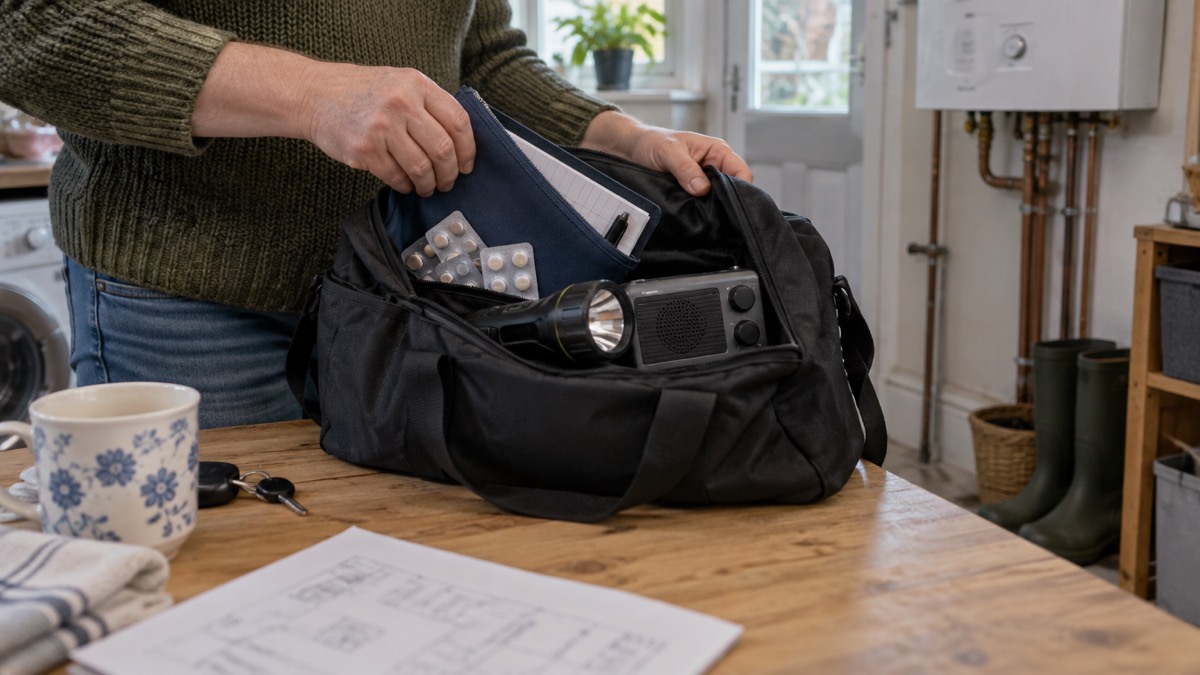
The plan is also the place to note the things you would grab: important documents such as birth certificates and insurance policies, spare glasses or contact lenses, spare keys to your home and car, and a battery or wind-up torch with spare batteries23. Our Emergency Kit section covers the full list, and Emergency Food and Water in an Emergency go into stores and quantities in detail.
Keep a printed copy where everyone can find it
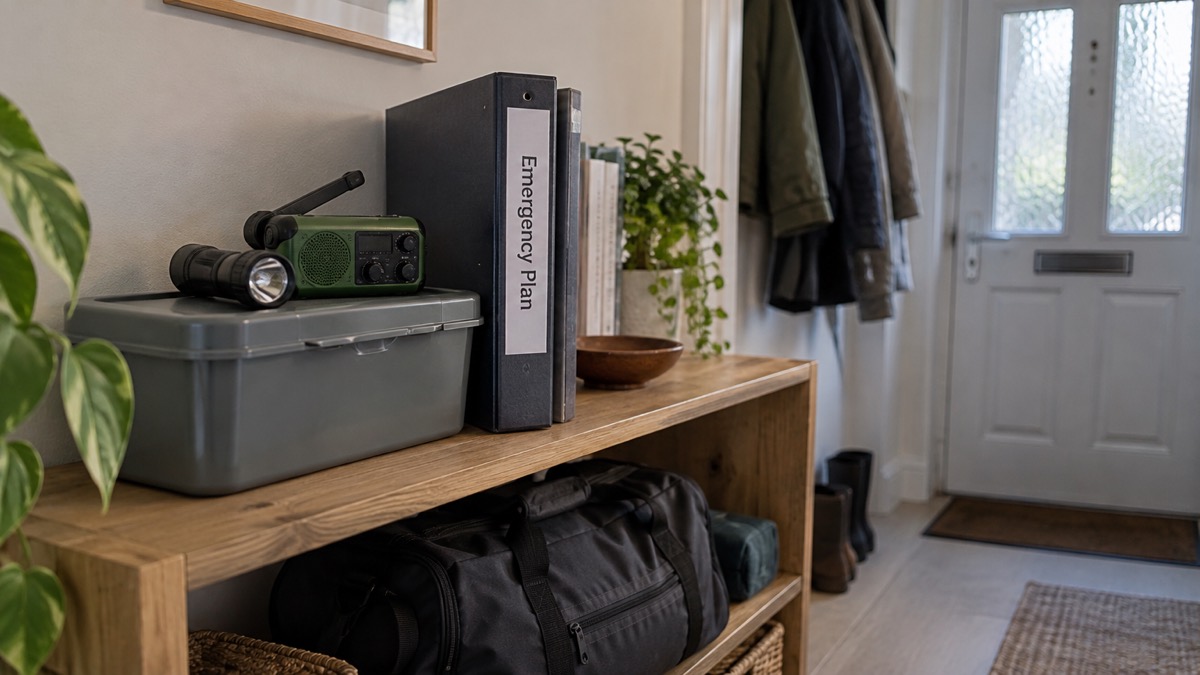
Ready Scotland's advice is short and worth copying word for word: keep a printed or handwritten copy somewhere handy and make sure everyone in your home knows where it is3. The reason is simple. The moment you need the plan is the moment the phone is flat, the broadband is down or you have left the house in a hurry.
A few practical points from the guidance:
- Print it, or write it by hand. Either is acceptable; what matters is that it does not depend on power or a signal3.
- Put a copy in your emergency kit, alongside the contact numbers21.
- Keep it somewhere handy and make sure everyone in your home knows where it is3.
- Keep a second copy in the car if you have one, with the blanket and warm clothes Ready Scotland and Newport City Council advise keeping there7.
Where to get a template, and which one to use
You do not have to design the sheet yourself. Several official versions exist, and they differ mainly in length and in which nation they are written for.
| Template | Where it comes from | What it covers |
|---|---|---|
| Be Ready household emergency plan | UK government Be Ready campaign, 2 page PDF, 165.1 kB2 | Contact details, food and water for 3 days, shut-offs2 |
| Ready Scotland home emergency plan | Scottish Government Ready Scotland3 | Emergency numbers including 105 and Floodline Scotland, staying indoors, printed copy4 |
| Council and resilience forum templates | Local councils and resilience forums, for example Argyll and Bute and North Yorkshire24 | Household plan plus local skills and resources sections24 |
Argyll and Bute's guidance describes its household emergency plan template as a way for individuals and families to plan how they would cope in an emergency25. Greater Manchester's resilience team points households to the template on the government's Prepare website26. If you live in Scotland, start with the Ready Scotland version, which lists the Scottish emergency numbers you will need4; our Scotland: Ready Scotland and Household Planning page explains the differences.
There is no separate Word version listed in the official guidance. The published templates are PDFs, which you can print and fill in by hand or type into if your software allows. A handwritten plan is explicitly acceptable3.
Extra details worth adding: ICE, bottles and pets
Beyond the core headings, a few additions make the plan work harder.
ICE contacts. Store the people you would want contacted if you were taken ill under ICE on your phone, numbering them ICE 1, ICE 2 and so on if there is more than one27. North West Ambulance Service also publishes a printable ICE card with space for a name, telephone number and full address, which helps if your phone is locked or out of power28.
Message in a Bottle. This is a free way to store vital information in your home where emergency services can find it29. Your details go in a plastic bottle with a push-fit lid, kept in the fridge, where crews expect to look29. Two green cross labels show you take part: one inside your front door, one on the fridge door29. It is run by the Lions Club of Paignton with Torbay and Southern Devon Health and Care NHS Trust29. It suits anyone who might not be able to answer questions in an emergency, and it is worth noting on the plan that the bottle is there.
Pets. If you are a pet owner, your plan must include your pets, because being prepared can save their lives14. Keep pet supplies at home as part of your kit15. Plan ahead for where animals would go: some emergency shelters cannot accept pets, and it may be difficult, if not impossible, to find shelter for your animals in the middle of a disaster14. Our Pets and Animals in an Emergency guide covers this in full.
Scams and false information. Ready Scotland warns that criminals may take advantage of emergencies by sharing scams or false information, so keep your devices and personal information secure3. Write down which official source your household will check for updates, so nobody acts on a forwarded message.
When to stay indoors, and what the plan should say
Some emergencies are best met by staying put rather than leaving. Ready Scotland's home emergency plan gives the instruction plainly: if it is not safe to go out, go indoors and close all windows and doors, stay indoors, and stay up to date using radio, TV or online4.
Your plan should record three things for that situation: which room you would use, how you would hear official updates if the power is out, and who checks on anyone in the household who might not hear an alert. Our Sheltering in Place guide covers the detail, and Staying Put or Leaving: How to Decide helps with the judgement call.
Sources (29)
- Get prepared for emergencies, UK Government, 2026
- Be Ready Household Emergency Plan, Be Ready campaign, 2026
- Prepare: emergency plan, Ready Scotland, 2026
- Home emergency plan, Ready Scotland, 2026
- Home fire action plan, Surrey County Council, 2026
- Fire safety, Greater Manchester Fire and Rescue Service, 2026
- Emergency kit, Ready Scotland, 2026
- Preparing for an emergency, Nottinghamshire County Council, 2026
- Emergency advice for residents, Warwickshire County Council, 2026
- Community Emergency Plan template, North Yorkshire Local Resilience Forum, 2025
- Preparing yourself for emergencies, London Resilience Partnership, 2026
- Risks and emergency information, Surrey County Council, 2026
- Step 1: preparation, Essex Prepared, 2026
- You prepare for an emergency, Slough Borough Council, 2026
- Emergency kit checklist, Neath Port Talbot Council, 2026
- Emergency information leaflet, Surrey County Council, 2026
- Home fire safety guide, West Cheshire and Chester NHS, 2025
- Making a home escape plan, Warwickshire County Council, 2026
- Be ready for emergencies, Be Ready campaign, 2026
- Preparing for a flood, nidirect, 2025
- Prepare for emergencies, Dumfries and Galloway Council, 2026
- Household Emergency Plan template, Wyre Forest District Council, 2017
- Get Prepared - Carmarthenshire County Council, Carmarthenshire County Council
- Prepare yourself, Greater Manchester Combined Authority, 2026
- Making your plan | Argyll and Bute Council, Argyll and Bute Council
- Preparing for a flood, London Fire Brigade, 2026
- Preparing for emergencies, North Hertfordshire District Council, 2026
- In case of emergency (ICE) card, North West Ambulance Service, 2019
- Message in a Bottle scheme, Torbay and South Devon NHS Foundation Trust, 2019
 30-Day Household Checklist
 Supply Interruption Checklist
 Boil Notice Checklist