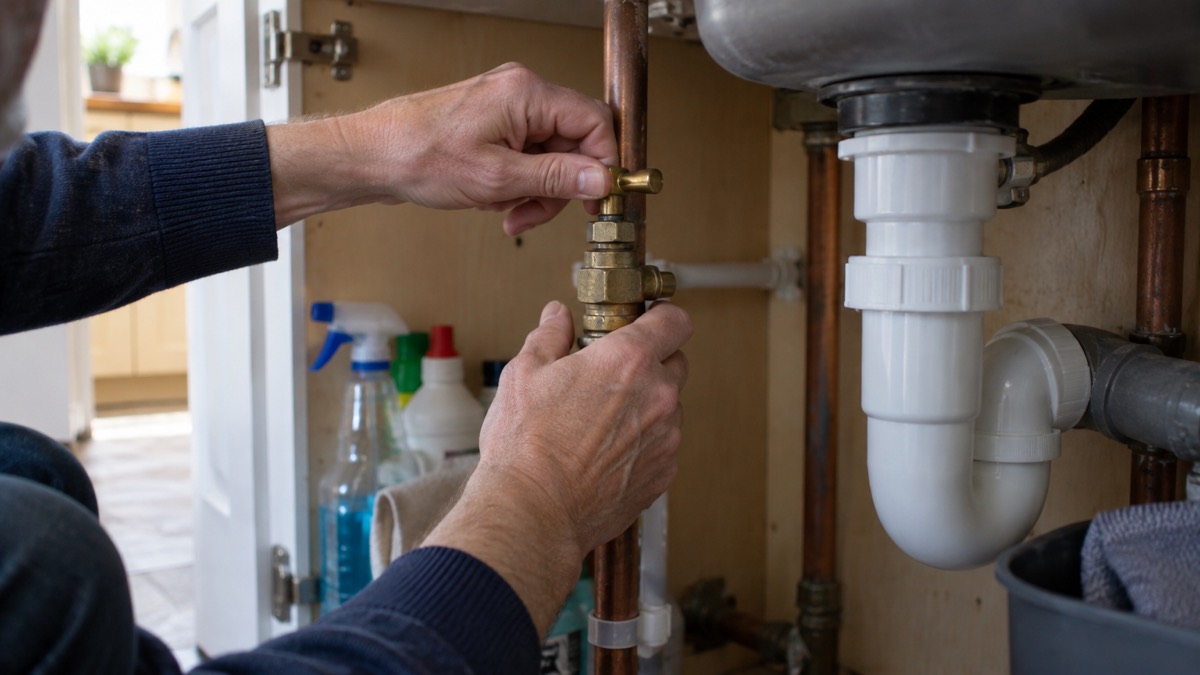
Your stop tap is the valve that shuts off the water supply to your home. Every property has one inside, and most have a second one outside near the boundary. In most homes the inside stop tap is under the kitchen sink, and you close it by turning it clockwise, which is the same direction as tightening a screw1. It may take a few turns to stop the water, and a few minutes for the flow to stop altogether1.
Knowing where this valve is and how to use it can save you from major water damage in an emergency, such as a leak or a burst pipe1. It is also the first thing you need when carrying out plumbing or building work2. The Met Office's advice for frozen and burst pipes is blunt on the point: "Make sure you know where your stop tap is and check it's working every six months"3.
This page covers where to find both valves, how to turn the water off and back on, what to do about a stiff or leaking stop tap, who owns which valve, and the extra complications of flats and shared supplies. If a pipe has already burst, see what to do if a pipe bursts for the full emergency steps.
What a stop tap is, and what it looks like
A stop tap, also called a stopcock or stop valve, is the point where you can shut off the water supply to your home1. The Met Office uses the same three names in one breath: "It's also important to know where your stoptap (also called stopcock or stop valve) is"7. There are two types: internal stop taps, inside your home, and external stop taps, outside it6.
The inside stop tap is easy to recognise once you know what you are looking at. It looks like a spout-less tap or lever, and it sits between two lengths of pipe, acting as a connector1. Rather than a spout pointing down into a sink, it has a brass or metal head with a handle, or a lever, in line with the pipework. Turning that handle or lever is what stops the water flowing past it into the rest of your house.
A typical property has both an inside stop tap, which is the responsibility of the owner or landlord, and an outside stop tap, which is usually the water company's8. The inside valve controls everything within your home. The outside valve controls the supply reaching your property from the main in the street, and it is the one to reach for if the inside tap is broken, seized or unreachable.
Finding your inside stop tap
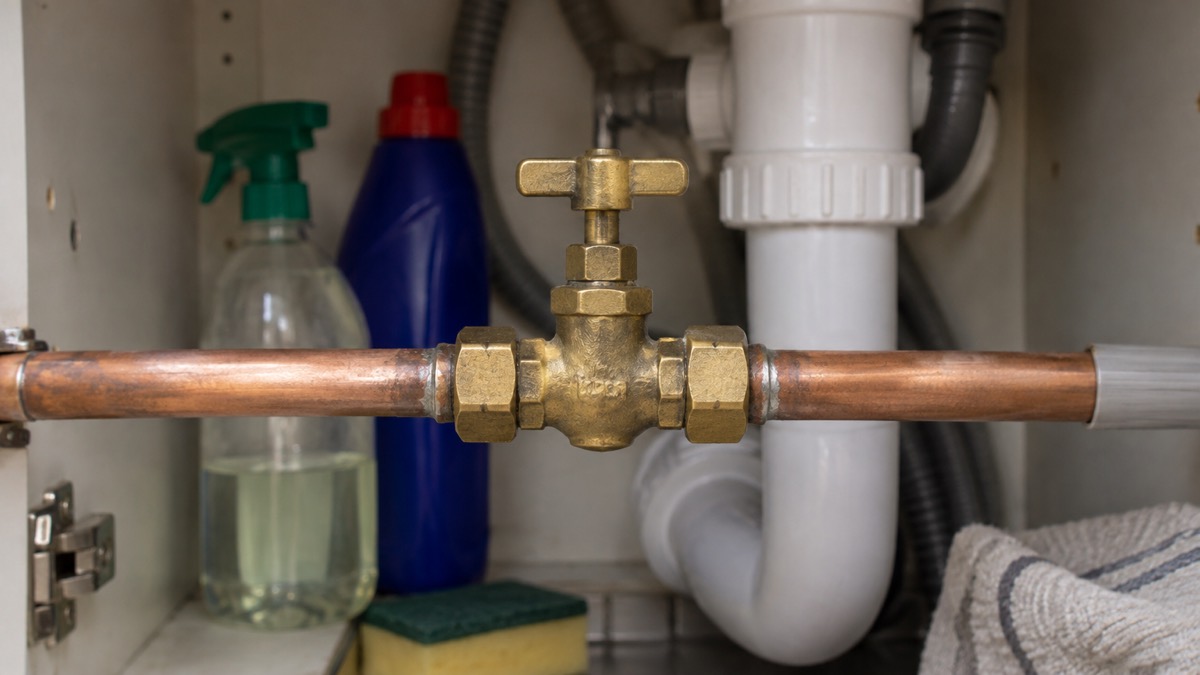
Start under the kitchen sink. In a home, the inside stop tap is usually located there, because it sits just after the water pipe enters the house1. Government guidance for Northern Ireland gives the same answer for the whole UK: know where the internal stop valve is, usually under the kitchen sink, and how to turn it off9.
Not every home keeps it there, so if it is not under the sink, work through the other common locations. WaterSafe, the national register of approved plumbers, lists utility rooms, downstairs cupboards and basements10. The Met Office adds downstairs bathrooms, kitchen cupboards, garages, cellars and under the stairs3. Northumbrian Water notes that some are in the bathroom or in the boiler cupboard11. Richmond Council's utilities failure guidance gives another spot worth checking: under the floorboards by the front door, alongside the airing cupboard12.
- Under the kitchen sink, or inside a kitchen cupboard6
- Downstairs bathroom, toilet or cloakroom3
- Garage or utility room10
- Cellar or basement10
- Under the stairs3
- Airing cupboard or under the floorboards by the front door12
The rule of thumb behind all of these: the stop tap sits close to where the water pipe enters the building2. If you are hunting for it, think about which outside wall your supply most likely comes through, often the kitchen wall nearest the street, and search the rooms and cupboards on the other side of it.
If you cannot find it at all, contact a plumber, who can attempt to locate it or advise you of other options for turning off your water supply internally13. Your water company may also help: Affinity Water, for example, offers an online form and will get in touch if you still cannot find your stop tap14.
Turning the water off, and back on again
Turning the tap is simple, and the direction is the same for standard water fittings everywhere: clockwise to close, anti-clockwise to open13. Affinity Water's instruction is typical: "Turn the stop tap clockwise (to the right) to turn the water off, and anticlockwise (to the left) to turn it on"4.
To shut off your water:
- Turn the stop tap clockwise, to the right. It may take a few turns to stop the water2.
- Wait. It may take a few minutes for the water to stop altogether, as the water already in your pipes drains out through open taps1.
- To turn the water back on, turn the valve anti-clockwise, slowly1.
Two cautions apply. First, go slowly and never force it. WaterSafe warns: "Turn it on and off slowly, never force it. If you over tighten or use excessive force you may damage the stop tap"1. Second, some stop taps only need a quarter turn. Affinity Water advises: "Go carefully, as some of our stop taps only require a quarter turn, don't over tighten them"15. If the handle stops turning, it has done its job; wrenching it further can damage the valve and leave you with a leak at the very fitting you depend on in an emergency.
Clearing airlocks when the water comes back on
After you turn the supply back on, taps may splutter or run weakly because air is trapped in the pipes. South Staffs Water gives a simple method for freeing it: turn on the cold tap nearest to the stop tap, then carefully turn the stop tap anti-clockwise to open and clockwise to turn off, a few times. This should free any airlocks or blockages in the pipes16. Run the taps until the water flows steadily and quietly.
If the problem persists, or if no water comes through at all, the valve may not be fully open. Richmond Council's guidance for water supply failures is to check your inside stop valve is fully open and turn it anti-clockwise to ensure it is12. Beyond that, contact a plumber.
The outside stop tap: under a small cover in the pavement
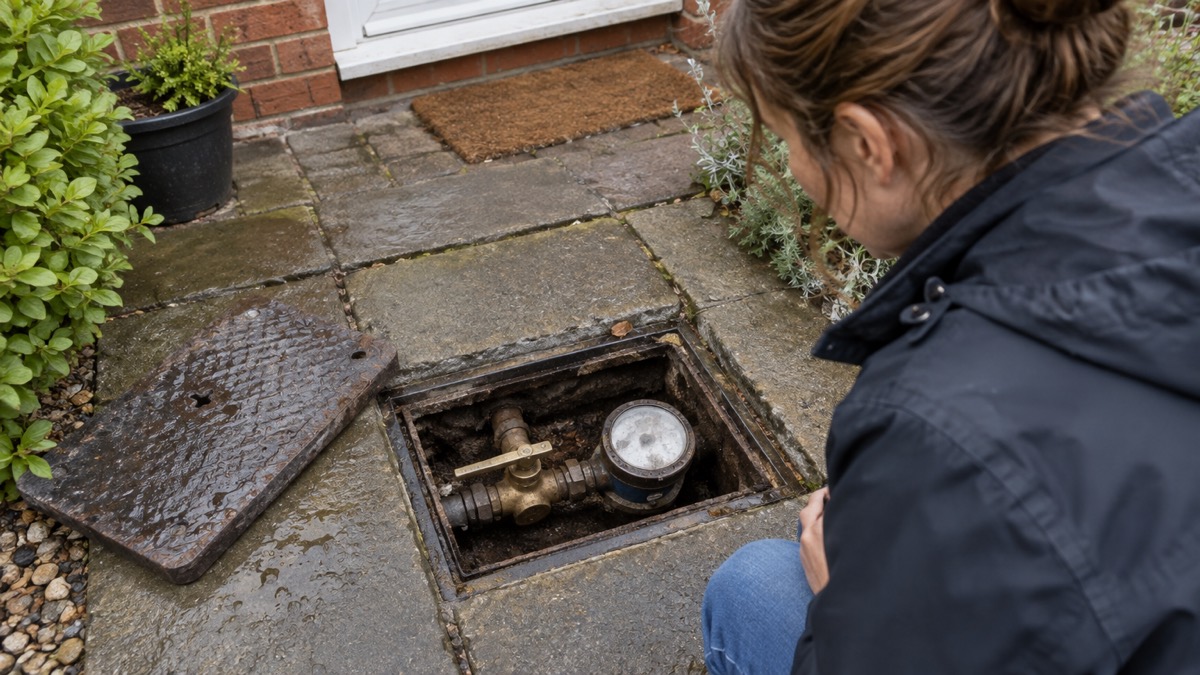
The outside stop tap is found outside, near the boundary of your property, under a small cover about the size of a CD case5. Wessex Water lists the places to look: a meter chamber, the footpath or verge, under a plastic or metal cover17. South West Water says its external stop taps are typically located under covers in the footpath or pavement6. If you have a water meter, the outside stop tap will generally be in the same pit or chamber as the meter5.
To operate it, the direction is the same as inside: turn the valve clockwise to close, anti-clockwise to open5. Some external valves have a plastic lever rather than a metal head. If it appears to be made of a plastic type material, it may only require a quarter of a turn to turn off the water. When the lever is in line with the pipe the supply is on; when it is across the pipe, the supply is off5.
Meter covers and specialist keys
Some water meter housings need a specialist key to open, and if the stop tap is not in the meter box you will need to contact your water supplier5. Do not force a cover that will not lift. If you cannot find your outside stop valve at all, WaterSafe's advice is to contact your local water supplier, who can help locate it18. Not all properties will have an outside stop valve fitted, and this is quite common in older homes, or where the incoming water supply serves both your home and one or more of your neighbours18.
When to leave the outside tap to a plumber or the water company
The outside stop tap is the water company's valve, and it should be treated differently from the one under your sink. WaterSafe is clear: "Ideally it should only be used by a qualified plumber or by the water supplier"19. The same register warns that not all water suppliers will give permission to use the external stop tap, and that if you operate it and damage it, you may be liable for the repairs19.
So the outside stop tap is a backstop, not your first move. Use the inside tap for anything inside your home. Reach for the outside valve when the inside one is broken, seized or will not shut off the flow, and if you can, have a plumber do it or call your water company first19. If your plumber cannot operate the external stop tap, or you cannot locate it, contact your local water supplier20.
One check comes before any of this. Affinity Water advises: "Before you turn off your external stop tap, check that you're not on a shared supply, that is, one stop tap serving more than one property"21.
Shared supplies, flats and terraces
In older terraced properties, one outside stop tap can sometimes control the water supply of several properties17. If your supply is shared, the outside stop tap could be outside your property or further along the street, and using it could also turn off your neighbours' water2. On a shared supply, turning off the external stop tap shuts off water to every property on that same supply, so let your neighbours know first20.
Flats have their own arrangement. A communal stop tap will generally be found where the water supply enters the building, and an additional stop tap should also be found where the water supply enters your individual flat2. The one inside your flat is the one to use for work or an emergency in your home; the communal one affects every flat in the block.
Who is responsible for each stop tap
The split is straightforward, and it is the same principle across water companies. The external stop tap is usually the water company's responsibility, while the internal stop tap is yours to maintain6. Cambridge Water puts it plainly: the owner or landlord of the property is responsible for all inside stop taps2.
South Staffs Water gives the boundary in more detail. It is responsible for stop taps located outside the boundary of a property, which includes the outside stop tap usually found in the road or footpath. All stop taps located either in your garden or inside your house are the property owner's8.
The Drinking Water Inspectorate, the regulator for water quality in England and Wales, extends the same logic to the pipework: the part of the service pipe leading from the stop valve outside your property to the point where it enters your home is the owner's responsibility, as is all plumbing inside the home to the kitchen tap24.
| Valve or pipe | Who maintains it |
|---|---|
| Inside stop tap | You, as owner or landlord2 |
| Stop tap in your garden | You, as property owner23 |
| Outside stop tap beyond the boundary | The water company8 |
| Supply pipe from the outside valve into your home | You, as owner24 |
| Communal stop tap in a block of flats | Generally the building's owner or managing agent, via the supply entry point2 |
If you are a tenant and do not know where your main stop tap is, your landlord should be able to help you11. Report a leaking or seized valve to your landlord promptly: it is their fitting to maintain, but a flood damages your home first.
A stiff, stuck or leaking stop tap
Stop taps that are never used seize up, which is exactly why the six-monthly check matters. If your internal stop tap is not turning or shutting off, you will need to contact a plumber to fix this1. Cambridge Water's advice is the same: if you are having problems operating your inside stop tap, contact an approved plumber2. Do not force it, and do not work on fragile or corroded pipework around it yourself22.
If you cannot turn the water off at all, the outside stop tap is the fallback, used ideally by a qualified plumber or the water supplier19. If neither valve works, your water supplier is the call to make.
Water leaking around the stop tap itself is a common fault with a simple cause. Water around the joints is usually caused by loose or worn nuts and seals22. It is not a plumbing job for an emergency attempt at home: turn the supply off if you can, and get a plumber, who can replace the washers or the valve. While you wait, a leaking stop tap is one more reason to know where your outside valve is.
Check your stop tap works every six months
The Met Office's winter advice is to check your stop tap is working every six months3. North Wales Fire and Rescue Service, writing on ice and burst pipes, says the same: make sure you know where your stop tap is and check regularly that you can turn it off easily in an emergency25. Affinity Water suggests turning it on and off two to three times a year4.
The check takes a minute:
- Find the tap and clear anything stacked in front of it.
- Turn it clockwise until the water stops running at a tap.
- Turn it anti-clockwise to open it again, slowly.
- If it will not turn, or it leaks when you move it, book a plumber now, not during the next cold snap.
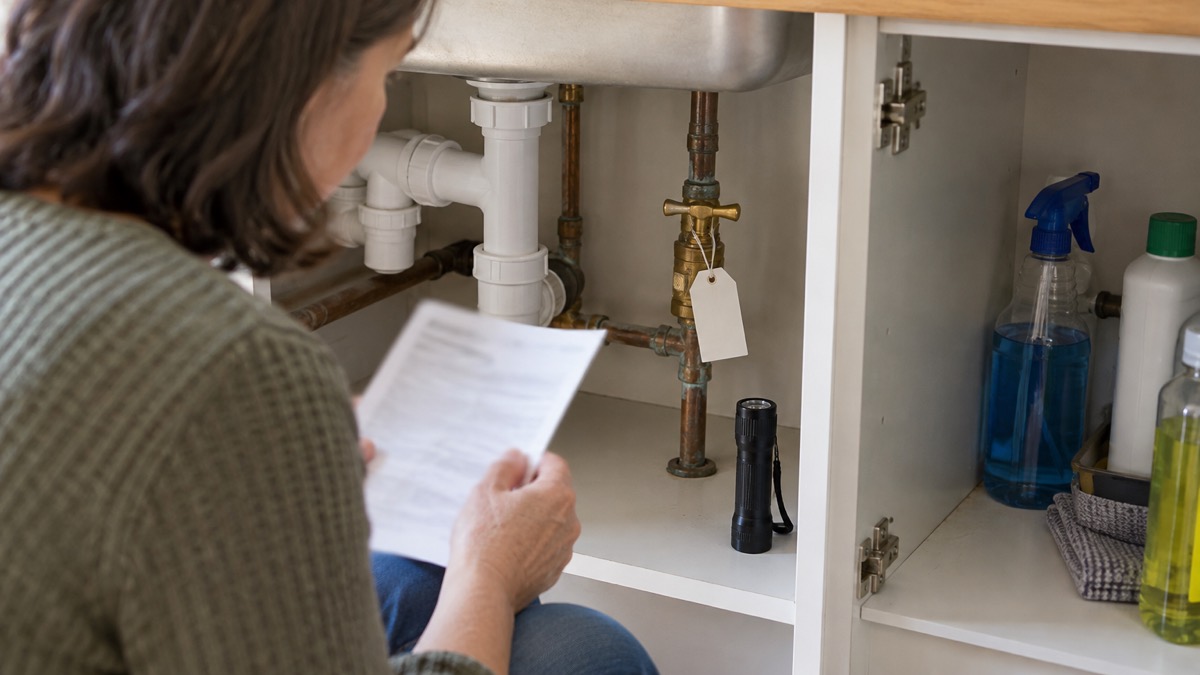
Two habits make the valve easier to live with. First, keep the cupboard under the sink clear enough to reach the tap in a hurry, with a torch nearby if the cupboard is dark. Second, label it. The Met Office suggests making your stop tap easy to find in a plumbing emergency by tagging it with a spare gift label carrying the number of a WaterSafe registered plumber10. Anyone in the house, including a babysitter or a visitor, can then shut off the water without hunting for you first.
While you are at it: the gas valve and the fuse box
The stop tap belongs to a set of three shut-off points every household should be able to find in the dark. Greater Manchester's resilience guidance lists knowing your water stop tap, where the water supply comes into your home or outside near the property's boundary, alongside the same preparation for gas and electricity26. The gas shut-off is at the meter, and the electricity is isolated at the consumer unit or fuse box.
If you are mapping all three for your household, the getting started guide walks through them together, and the home emergencies guide covers what to do when each one fails. For the water side specifically, see frozen pipes, burst pipes and water leaks on your property.
Sources (26)
- Locate your internal stop tap, WaterSafe
- Stop taps, Cambridge Water
- Frozen or burst pipes, Met Office
- How to turn off your inside stop tap, Affinity Water
- How do I turn off the water to carry out work in my property?, WaterSafe
- Stop taps and water pipe responsibility, South West Water
- 10 things you should do now to prepare for winter, Met Office
- Stop taps, South Staffs Water
- Steps to reduce the risk of burst pipes, nidirect
- WeatherReady weather hacks, Met Office
- Where is my stop tap?, Northumbrian Water
- Utilities failure, London Borough of Richmond upon Thames
- Where is my stop tap?, United Utilities
- Stop tap and metering, Affinity Water
- Inside stop tap, Affinity Water
- Water pressure, South Staffs Water
- Finding your stop tap, Wessex Water
- I can't find my external stop valve, what should I do?, WaterSafe
- What should I do if I can't turn off my water supply?, WaterSafe
- What should I do if my external stop tap is not working?, WaterSafe
- Outside stop tap, Affinity Water
- What should I do if my internal stop tap is leaking or broken?, WaterSafe
- Pipe responsibility, South Staffs Water
- Lead in drinking water, Drinking Water Inspectorate
- Ice and burst pipes, North Wales Fire and Rescue Service
- Prepare yourself, Greater Manchester Combined Authority
 Home Fire Safety Checklist
 Bedtime Fire Safety Checks
 Fire Risk Checks for Carers
 What to Do If Fire Starts
 How to Make a Fire Escape Plan
 Fire in a Block of Flats
 Kitchen Fires and Cooking Safety
 Electrical Fires and Sockets
 Smoking, Matches and Lighters
 E-bike Charging Safety
 Hoarding and Fire Risk
 Thatched Properties Fire Risk
 Fireworks and Bonfire Safety
 What to Do After a House Fire
 How Fire Services Respond