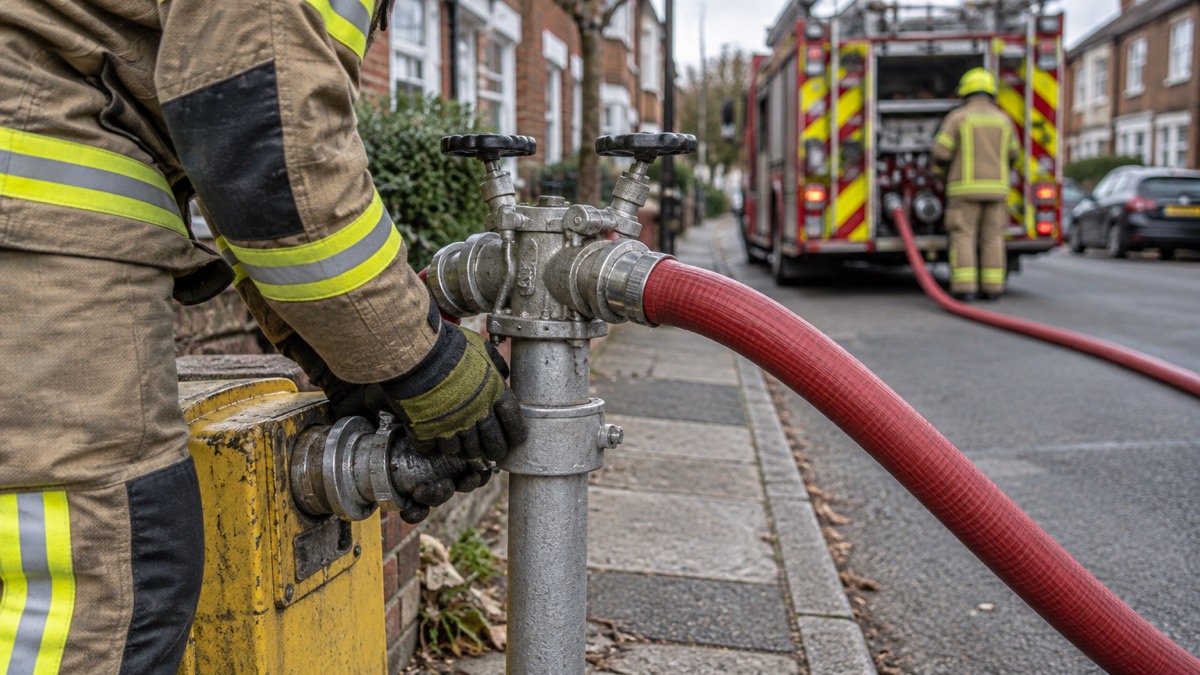
If there is a fire, the advice from every fire and rescue service in the UK is the same three steps: get out, stay out, and call 9991. Once you are safely outside, dial 999 from your mobile, a neighbour's house or a phone box, ask for the fire brigade, and give the address of the fire3. Fire engines are sent the second the control operator has an address, so you do not need to have every detail ready before you call3.
This page explains what happens behind that call: how the 999 system connects you, what the control operator will ask, how quickly a fire engine is mobilised, and what to do in the situations households most often face, from a pan fire to a wildfire or someone in trouble in the water. Knowing how the system works helps you make the call quickly and give the right information, which gets firefighters to you sooner.
Call 999 and ask for the Fire and Rescue Service
The first thing every fire and rescue service teaches is the sequence: get out, stay out, call 999. North Wales Fire and Rescue Service puts it as a single instruction, "Call 999 and ask for the fire and rescue service"1, and its home safety page repeats the same message2. London Fire Brigade's easy-read fire safety booklet tells you to use your mobile phone once you are safely outside, ask for the fire brigade, give the address, and not go back inside7. Mid and West Wales Fire and Rescue Service adds that you can call from a neighbour's house or a phone box if you cannot use your own phone4.
The order matters. People, then the call, then nothing else. If you have a fire, get everyone out of the property, close any doors you pass, and then call the fire service8. Closing doors slows the spread of fire and smoke, which gives firefighters a better building to work with when they arrive. Devon and Somerset Fire and Rescue Service gives the same core instruction: "Call 999 and ask for the fire service"9.
One point is made repeatedly and worth taking seriously: never assume somebody else has called. North Yorkshire Fire and Rescue Service tells residents of high-rise buildings to call the fire service on 999 and never assume that somebody else has called10, and North Wales Fire and Rescue Service gives the same advice for fires elsewhere in your block11. Multiple calls about the same incident do not waste the service's time; a call that is never made does.
If someone is still inside when you get out, do not go back for them. Wait for the fire and rescue service to arrive, tell them about the person, and they will be able to find them quicker than you could1.
How your 999 call is connected
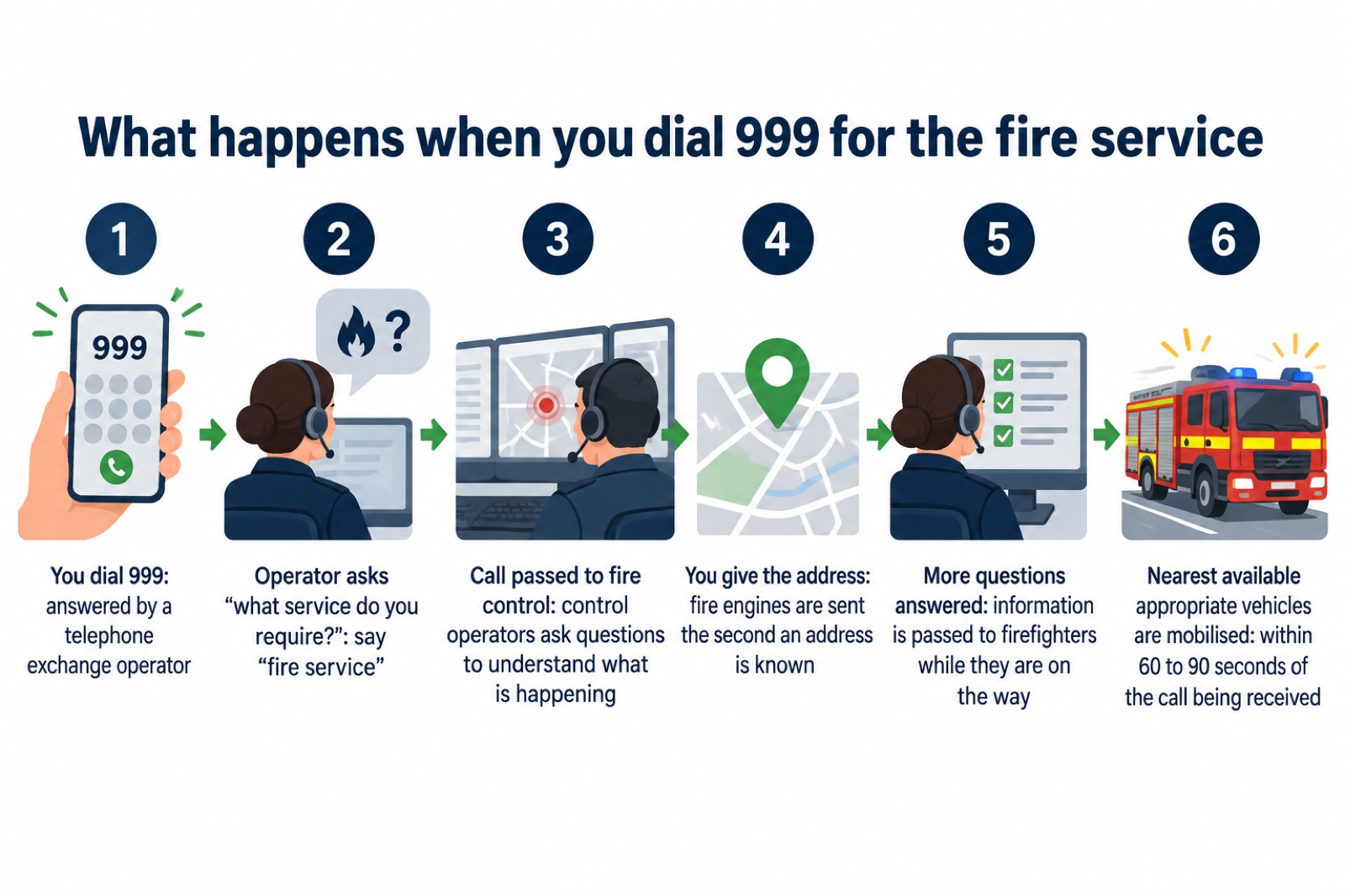
When you dial 999, you are answered by a telephone exchange operator, not by the fire service directly. Devon and Somerset Fire and Rescue Service describes the process: the BT operator asks "what service do you require?" and if you say "fire service", the operator passes your call to fire control operators12. North Yorkshire Fire and Rescue Service explains that you are then connected to the fire control room, in its case the one in Northallerton, and not to your local fire station5.
This is why fire services are firm on one point: do not try to contact your local fire station or fire safety team in an emergency3. Fire stations are not staffed to receive emergency calls, and the crew may be out on another incident. The control room is staffed around the clock, can see where every appliance is, and sends the nearest available one to you.
Once connected, the fire control operator asks questions to understand what is happening and sends the nearest available appropriate vehicles12. Crucially, the questions do not delay the response. As London Fire Brigade puts it: "We send fire engines to your location the second we have an address"3. Everything you are asked after that is gathered while the engines are already on their way, so the firefighters arrive knowing what they are facing.
What the control operator will ask you
North Yorkshire Fire and Rescue Service lists the questions its Fire Control Operator will ask5:
- What is the full address?
- What is on fire?
- Is there anybody trapped?
- Are there any nearby landmarks?
- What telephone number are you dialling from?
You may also be asked for your name and address5. None of this is a test, and none of it holds up the response. The address comes first because it is what gets the fire engine moving; the rest equips the crew. Knowing what is on fire tells them what equipment to bring, and knowing whether anybody is trapped changes how they approach the incident on arrival.
Some situations call for extra detail. If you live in a caravan or mobile home, Devon and Somerset Fire and Rescue Service advises telling the operator if access to the fire will be difficult for fire engines, or if a four-wheel drive vehicle will be needed13. If you live in a flat, give your flat and floor number10. If you are reporting a fire in the countryside, give clear details about the location and the size of the fire14.
Answer the operator's questions as directly as you can, and stay on the line if asked to. The operator is building a picture for the crew, and anything you can see from a safe position helps.
Mobilising a fire engine: within 90 seconds of your call
Fire services publish targets for how quickly they handle emergency calls, and the figures are reassuringly fast. Dorset and Wiltshire Fire and Rescue Service states that it endeavours to handle emergency calls within 90 seconds from receipt of the initial call to mobilising the fire appliance6. North Yorkshire Fire and Rescue Service states a tighter target of 60 seconds from receipt of the initial call to mobilising the fire engine5. The two services state different figures, so the exact target varies between services, but both are measured in seconds, not minutes.
What this means for you is simple: the call itself is the shortest part of the response. From the moment the exchange operator connects you, the system is designed to have a fire engine on the road within about a minute to a minute and a half. Your job is to make that possible: give the address first, clearly, and answer what follows.
There is one situation in which the call handling works differently. Warwickshire County Council describes how some services handle calls from automatic fire alarm systems overnight. Between 20:00 and 07:00, where confirmation of a fire cannot be given, the caller is told the fire service is on its way and asked to re-contact if a fire or false alarm is confirmed15. This applies to alarm signals rather than calls from people who have seen a fire, and it exists because automatic alarms are often false. If you have seen an actual fire, say so plainly.
Call even if you are not sure there is a fire
Fire services are explicit that you should not hesitate. North Yorkshire Fire and Rescue Service advises: "Don't be afraid to dial the fire service in an emergency, even if you're not sure if there is a fire. It's better to be safe than sorry"5. Dorset and Wiltshire Fire and Rescue Service says the same: "Don't be afraid to dial 999 in an emergency, even if you're not sure if there is a fire, small or large"6.
The reason is that small fires grow. North Yorkshire Fire and Rescue Service tells you to dial 999 and ask for the fire service no matter how small the fire is, because small fires can quickly spread into larger fires5. The same service says not to be afraid to dial 999 in an emergency even if you are not sure there is a fire, small or large, because it is better to be safe than sorry5. A fire service would far rather attend a pan fire that has already gone out than arrive at a house fire that started as one.
The same applies when you are investigating an alarm rather than seeing flames. Warwickshire County Council's advice on fire alarm systems is to remember that you are looking for signs of a fire, not a fire itself, and that at any time, if you suspect or find a fire, you should get out and call the Fire and Rescue Service on 99915. If your alarm sounds and you cannot find the cause, treat it as real.
Your number is shown even if you have withheld it
If you have barred the calling line identity facility on your phone, your telephone number is still displayed to the telephone exchange operator when you dial 999. This happens even when you have taken steps to withhold your number, so you cannot rely on barring the facility to keep your number private during an emergency call.
This matters if you are worried about calling, or if you have withheld your number for everyday privacy reasons. The emergency system is built so that a call can be traced back to an approximate location even when the caller cannot give an address, for example if a child is calling, or if you are cut off before you can speak. Withholding your number does not prevent that.
It also means you should not hang up hoping to stay anonymous. If you have called 999 in error, stay on the line and say so; that is a quick call for the operator to close, and far better than a trace-back to a silent call.
If you are trapped, the operator stays on the line
If your escape route is blocked by fire or smoke, South Wales Fire and Rescue Service advises staying inside a room that is clear of smoke, ideally with a window that opens, and calling 99916. The NHS home fire safety guide gives the fuller sequence: if your escape is blocked by fire, it may be safer to stay put until the fire brigade arrives. Close the door, block gaps around it with soft materials such as bedding or cushions, call 999, go to the window and shout "HELP, FIRE"17.
Essex Prepared adds what to do at the window: open it, and if you feel in serious danger, wave a sheet out of the window so the firefighters know you are there18. If you cannot reach a phone, shout for help so that someone can call the Fire and Rescue Service for you18, or phone 999 for the Fire and Rescue Service or shout for help so that someone can phone for you4.
The same advice applies in purpose-built flats and maisonettes. If there is fire or smoke inside your flat and your escape route is not clear, it may be safer to stay until the fire brigade arrives: find a safe room, close the door, block the gaps with soft materials, go to the window, shout "HELP, FIRE" and call 99917. Our page on what to do if you cannot escape a fire covers this in detail.
While you are on the line, the control operator keeps talking to you. Fire control operators ask questions to understand what is happening and send the nearest available appropriate vehicles12, and for a trapped caller that conversation continues so the operator knows where you are in the building and what stands between you and the crew. Answer as calmly as you can, and follow any instruction the operator gives.
When to call: house fires, pan fires, caravans, fuel and wildfires
The same number serves every kind of fire emergency, but the details you give differ. The table below sets out the common situations and what each involves.
| Situation | What to do | What to tell the operator |
|---|---|---|
| Fire in your home | Get out, stay out, call 99919 | Full address, what is on fire, whether anyone is trapped5 |
| Pan fire | Go outside and call 9997 | What is burning and whether it is a chip pan or oil fire |
| Caravan or mobile home | Get out, stay out and call 99913 | Whether access is difficult or four-wheel drive is needed13 |
| Bonfire out of control | Dial 999 and ask for the Fire and Rescue Service at any sign of danger20 | Location and size of the fire14 |
| Wildfire in the countryside | Move to a place of safety and call 999 immediately21 | Location, size, and any nearby landmarks5 |
| Someone in danger near inland water | Call 999, ask for Fire and Ambulance21 | Exact location, whether the person is still visible |
| Flooding with a threat to life | Call 999 and ask for Fire and Rescue22 | Location and what the water is doing |
A pan fire is the classic case where people delay calling. London Fire Brigade's easy-read booklet is blunt: go outside and call 9997. Do not stay in the kitchen trying to deal with it. Our pages on kitchen fires and chip pan fires cover prevention and what to do in the first seconds.
For wildfires, the advice is consistent across all four nations. The Scottish Government's Ready Scotland campaign says that once you are safe, call 999 and ask for the fire service23. Devon and Somerset Fire and Rescue Service says that if you spot a wildfire, move to a place of safety and call 999 immediately21. North Yorkshire Fire and Rescue Service, reporting a fire in the countryside, says always to report a fire immediately when you see it24. The Northern Ireland Fire and Rescue Service says that if you see a fire in the countryside, dial 999, report it to the Fire and Rescue Service and leave the area as quickly as possible20. Suffolk Fire and Rescue Service asks people to report any signs of fire immediately by calling 999 and asking for the Fire and Rescue Service during warm weather25.
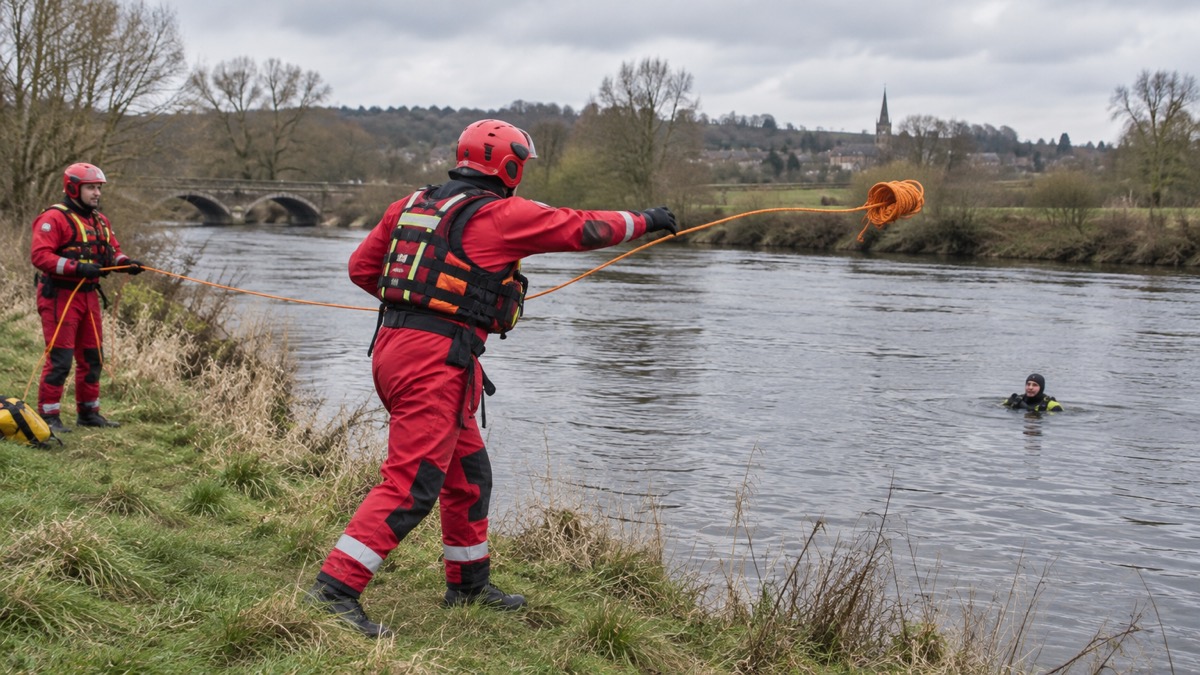
For water emergencies, the distinction is inland or coastal. Dorset and Wiltshire Fire and Rescue Service advises calling 999 and asking for the fire and rescue service if inland, or the coastguard if by the sea26. Never go into the water yourself: tell the person to float on their back and, if possible, throw them something that floats they can hold on to19. The same applies to dogs: if your dog cannot get out of the water, do not enter the water yourself, as you could be putting yourself in danger; call 999 and ask for the Fire and Rescue Service inland or the Coastguard at the sea, as the emergency services are trained and ready to rescue your dog26.
Flats and high-rise buildings: stay put and when to leave
If you live in a flat, the fire service's advice depends on where the fire is and what your building's evacuation strategy says. Manchester Fire and Rescue Service explains that some blocks operate a "stay safe" policy. Under it, you should always evacuate if asked to do so by firefighters, and you should get out if you can and call 999 if your flat is affected by heat or smoke or you feel unsafe27. South Wales Fire and Rescue Service puts the general rule: if your building's procedure is to stay put, remain in your flat unless there is smoke or flames entering, and if you need to escape, call 999 and wait for directions16.
If the fire is elsewhere in your building, close your doors and windows and stay in your flat unless advised otherwise by the fire service10. North Wales Fire and Rescue Service gives the same sequence for fires elsewhere in your block: close your windows and doors, call 999, and never assume someone has called11. If a fire starts in your own flat, evacuate the building immediately and calmly28.
Once you are out of a high-rise building, Greater Manchester Fire and Rescue Service's resident leaflet advises standing at the main entrance in a safe place and waiting for the fire service to arrive. When firefighters arrive, tell them where your flat is in the building, where in your flat the fire started, and what is on fire29. When you are out of the building, find a phone and call 999, keeping calm and speaking clearly30.
The Scottish Government published an information leaflet for residents of high rise buildings in December 2019, giving information on how to prevent fires and what to do if there is a fire31. Scottish Fire and Rescue Service also describes the external premises information plate that high-rise buildings carry, which shows details such as building height, number of floors, stair and lift locations, hydrants, and rising mains, to assist firefighters before or during an emergency32. North Wales Fire and Rescue Service also invites residents to contact it directly to report a safety risk in their home or building11.
Our page on what to do if there is a fire in your block of flats covers this in full, and the fire safety checklist for flats lists what to check before anything happens.
Northern Ireland: the same number, its own service
Northern Ireland has its own fire and rescue service, the Northern Ireland Fire and Rescue Service. The emergency number is unchanged. The Northern Ireland Fire and Rescue Service advises that should a fire break out in your property, you get out if it is safe to do so, stay out, and dial 999 and ask for Northern Ireland Fire and Rescue Service20. Its countryside advice follows the same pattern as the rest of the UK: dial 999, report it to the Fire and Rescue Service, and leave the area as quickly as possible20.
So the practical difference for a household in Northern Ireland is only the name you ask for after "999". Everything else in this page, from the get out, stay out, call 999 sequence to the advice on bonfires and wildfires, applies. Our page on Wales and Northern Ireland: alarm rules and fire services sets out the differences in that nation's arrangements in more detail.
Calling more than one service at once
You do not need to work out which emergency service a situation belongs to before you call. Tell the exchange operator what is happening and ask for the service you need; the operator connects you, and the services coordinate at the scene. For a person in danger near inland water, Devon and Somerset Fire and Rescue Service says to ask for Fire and Ambulance21, so two services can be requested in a single call.
If someone is suffering a heart attack or cardiac arrest, the London Ambulance Service is clear that you need to call 999 for an ambulance immediately33. If a fire has also started, say so when the operator answers, or make a second call once the ambulance is on its way. For flooding, Surrey's emergency planning advice is that if you think there is a threat to life, you call 999 and ask for Fire and Rescue22.
One thing to never do is make a hoax call. Greater Manchester Fire and Rescue Service warns: "Never make a hoax call to the emergency services. When firefighters attend a hoax call, they can't be at a real emergency, which can put lives in danger"34.
The fire service's prevention work, and how it helps you
Fire and rescue services do far more than respond to 999 calls, and some of that work changes what you should do before an emergency. Devon and Somerset Fire and Rescue Service asks anyone planning a controlled burn or bonfire in hot, dry weather to let the fire service know in advance, so it can check in with you if it receives 999 calls reporting a fire in your area, which stops firefighters being sent out to bonfires when they are not needed35. North Yorkshire Fire and Rescue Service gives similar countryside and controlled burning guidance24. If you are planning a bonfire, telling your fire service first means a neighbour's well-meaning 999 call does not summon an engine to your garden.
Services also run safety campaigns timed to the seasons. North Yorkshire Fire and Rescue Service's Light Nights campaign covers what to do if there is a fire, signs of a wildfire, or someone in danger near inland water: do not put yourself at risk, get to a safe place, act quickly, and get help14. Greater Manchester Fire and Rescue Service's Safe4Summer campaign covers staying safe around water and the dangers of hoax calls34.
For your own household, the starting points are a working smoke alarm and a plan. Our fire safety checklist and how to make a fire escape plan pages walk through both. If a fire does start, you now know what happens when you call: an exchange operator, a control room, an address, and a fire engine on its way within seconds.
Sources (35)
- Get out, stay out and call 999, North Wales Fire and Rescue Service
- Get out, stay out and call 999, at home, North Wales Fire and Rescue Service
- Calling 999, London Fire Brigade
- Protecting your home, Mid and West Wales Fire and Rescue Service
- Making a 999 call, North Yorkshire Fire and Rescue Service
- Fire Control: making a 999 call, Dorset and Wiltshire Fire and Rescue Service
- Fire safety booklet, easy read, London Fire Brigade
- Safe at home: frequently asked questions, North Yorkshire Fire and Rescue Service
- Top ways to reduce your risk of having a fire at home, Devon and Somerset Fire and Rescue Service
- High rise building safety, North Yorkshire Fire and Rescue Service
- High rise living, North Wales Fire and Rescue Service
- How we respond to emergency calls, Devon and Somerset Fire and Rescue Service
- Caravans and mobile homes, Devon and Somerset Fire and Rescue Service
- Light Nights campaign, North Yorkshire Fire and Rescue Service
- Fire alarm systems, Warwickshire County Council
- In the event of a fire, South Wales Fire and Rescue Service
- Home fire safety guide, information leaflet, Wales and West Housing NHS resource, 2025-01-24
- If you are trapped by fire, Essex Prepared
- Back to school safely, Dorset and Wiltshire Fire and Rescue Service
- Other safety, community safety, Northern Ireland Fire and Rescue Service
- How to stay safe during a heatwave, Devon and Somerset Fire and Rescue Service
- Flooding, Surrey County Council
- Wildfires, Ready Scotland, Scottish Government
- Countryside and controlled burning, North Yorkshire Fire and Rescue Service
- Warm weather safety, Suffolk Fire and Rescue Service
- Water safety, Dorset and Wiltshire Fire and Rescue Service
- Fire safety information for residents living in flats operating a stay safe policy, Greater Manchester Fire and Rescue Service
- Fire safety advice for residents in high rise buildings, Warwickshire County Council
- Flat fire safety, stay safe leaflet for residents, over 18m, Greater Manchester Fire and Rescue Service
- Fire safety in high rise flats, Mid and West Wales Fire and Rescue Service
- Home fire safety policy, Scottish Government
- High rise, Scottish Fire and Rescue Service
- Emergency heart care, London Ambulance Service
- Safe4Summer: staying safe, Greater Manchester Fire and Rescue Service
- Reducing the risk of wildfires during hot and dry weather, Devon and Somerset Fire and Rescue Service
 Home Fire Safety Checklist
 Bedtime Fire Safety Checks
 Fire Risk Checks for Carers
 What to Do If Fire Starts
 How to Make a Fire Escape Plan
 Fire in a Block of Flats
 Kitchen Fires and Cooking Safety
 Electrical Fires and Sockets
 Smoking, Matches and Lighters
 E-bike Charging Safety
 Hoarding and Fire Risk
 Thatched Properties Fire Risk
 Fireworks and Bonfire Safety
 What to Do After a House Fire
 Alarms for Deaf People