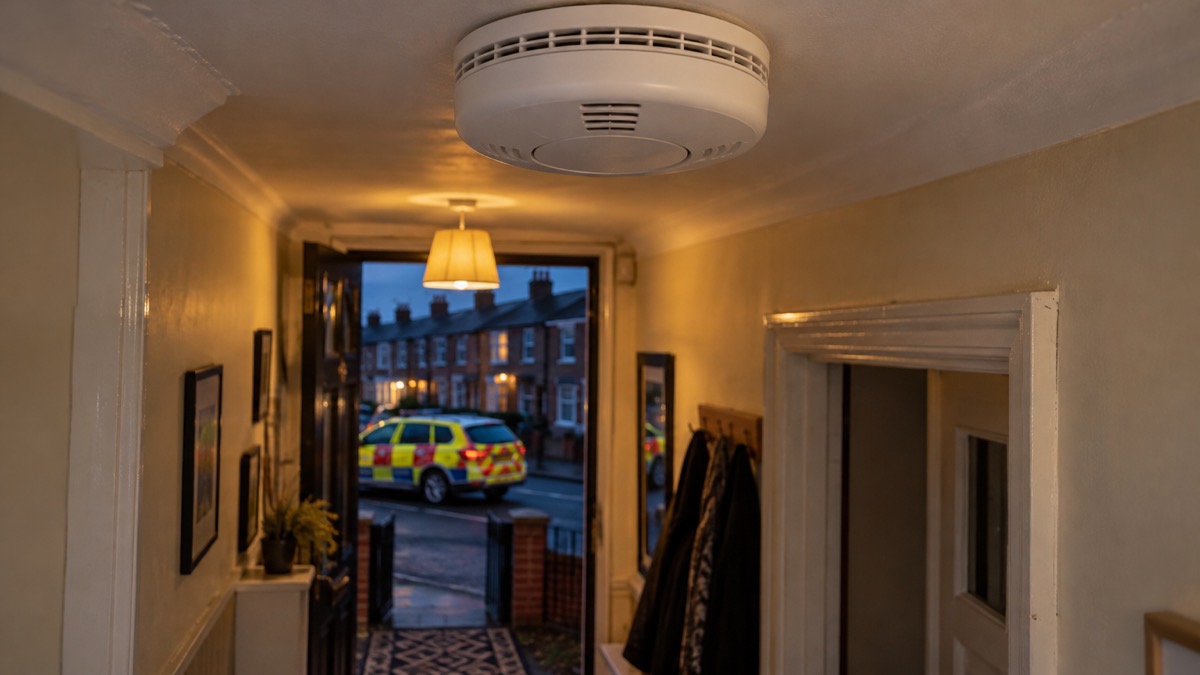
If you live in Wales or Northern Ireland, the fire safety basics are the same as anywhere in the UK: fit at least one smoke alarm on every level of your home, on the ceiling, and test it every week. The Northern Ireland Fire and Rescue Service puts the minimum plainly: one smoke alarm on every level, on the ceiling at least 30cm away from the wall1. Mid and West Wales Fire and Rescue Service says the same, adding that the ideal position is the middle of a room, or the hallway or landing, and away from kitchens and bathrooms where steam can set the alarm off by accident2.
What differs in Wales and Northern Ireland is the help you can get. Every fire service in both countries will visit your home for free, check your fire risks and, in most cases, fit free smoke alarms where you need them. In Wales this is called a Safe and Well visit or Safe and Well Check; in Northern Ireland it is a Home Fire Safety Check. This page explains where alarms should go, how to arrange a visit, which service covers you, and what your fire service will and will not do when floods and storms hit.
Where smoke alarms go: one on each level, on the ceiling
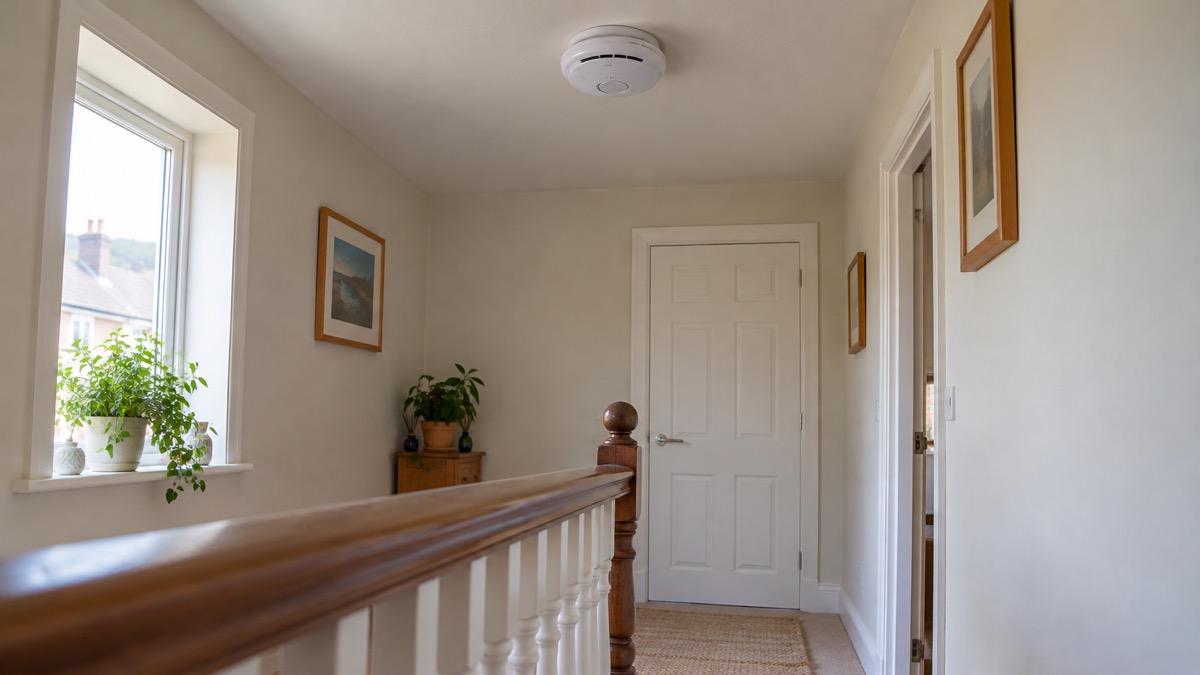
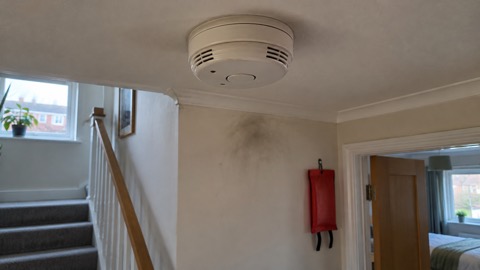
Every fire service in Wales and Northern Ireland gives the same core advice. The Northern Ireland Fire and Rescue Service states that a minimum of one smoke alarm should be fitted on every level of your home, and on the ceiling at least 30cm away from the wall1. Mid and West Wales Fire and Rescue Service, in its advice for older people, says you should have one on each level of your home, ideally on the ceiling in the middle of a room or on the hallway or landing, and not in or near kitchens or bathrooms where smoke or steam can set them off by accident2.
The reason for the ceiling position is simple: smoke rises, so a ceiling alarm in the circulation route of your home, the hallway or landing, detects a fire on that floor before it blocks your way out, and the 30cm gap from the wall is part of the standard fitting guidance1. If your home has more than one level, one English fire service adds a useful detail on placement: fit one alarm at the bottom of the staircase and further alarms on each landing, so the smoke from a fire downstairs is caught as it travels upstairs. For more on positioning, see where to fit smoke alarms and how many alarms your home needs.
Testing is the habit that makes any of this worthwhile. South Wales Fire and Rescue Service advises making sure you have a working smoke alarm and testing it regularly10, and Northern Ireland Fire & Rescue Service says to test your alarms so you know they work3. A working alarm only protects the household if it still sounds when it needs to, so build the test into a routine you will not forget. If someone in your household is deaf or hard of hearing, specialist alarms exist: see smoke and CO alarms for deaf and hard of hearing people.
For comparison, if you are reading this from Scotland: the Scottish standard is stricter, requiring one smoke alarm on each floor plus the living room in multi-level homes, and at least two smoke alarms in flats and bungalows11. Wales and Northern Ireland do not have that same statutory standard set out in the sources here, but the fire services' own advice, one on every level, is the practical minimum to work to. On choosing between alarm types, see smoke alarms: types and how to choose one and heat alarms: what they do and where they go.
Free smoke alarms and Safe and Well visits in Wales
The single most useful thing a Welsh household can do is book a free visit. Mid and West Wales Fire and Rescue Service provides a free Safe and Well Check and free smoke alarm installation, if required, and the provision of smoke alarms and other home safety items by the service is supported by funding from the Welsh Government4. In other words, the alarms are paid for, and you do not need to be elderly or vulnerable to ask, though the service gives particular attention to those groups2.
To arrange a visit, call Mid and West Wales Fire and Rescue Service on 0800 169 123412. The service says the same number is the contact for problems with your smoke alarms or for general advice on Safe and Well visits3. If you live in Wales but outside the Mid and West Wales area, the service says to contact North Wales Fire and Rescue Service or South Wales Fire and Rescue Service instead4.
North Wales Fire and Rescue Service offers free Safe and Well Checks, available free of charge, and you can register by calling 0800 169 1234 between 9am and 5pm, Monday to Friday13. South Wales Fire and Rescue Service offers a home fire safety check on request, which you can ask for through its website, and describes its prevention work as helping you identify and understand how to reduce risk in your home10.
| Service | What is free | How to arrange it |
|---|---|---|
| Mid and West Wales Fire and Rescue Service | Safe and Well visit, smoke alarms and other home safety items, supported by Welsh Government funding4 | Call 0800 169 1234, or text 0775684712312 |
| North Wales Fire and Rescue Service | Safe and Well Check and free smoke alarm installation, if required5 | Call 0800 169 1234, 9am to 5pm, Monday to Friday13 |
| South Wales Fire and Rescue Service | Home fire safety check on request10 | Request through the service's website10 |
If you have a fire safety concern about a high rise building, Mid and West Wales Fire and Rescue Service asks you to contact its Fire Safety team on 0370 606069912. For fire in a block of flats generally, see what to do if there is a fire in your block of flats.
Which Welsh fire service covers your home
Wales is covered by three fire and rescue services: Mid and West Wales, North Wales, and South Wales. Which one is yours depends on where you live, and the simplest way to find out is to look at which service's area your county falls in, then use that service's contact details above. Mid and West Wales Fire and Rescue Service covers a large swathe of mid and south-west Wales and runs 58 fire stations15; if you are outside its area, its own advice is to contact North Wales or South Wales Fire and Rescue Service4.
The reason it matters is practical. The free visits, the free alarms and the follow-up support all come from your local service, and each service runs its own booking line and referral routes. South Wales Fire and Rescue Service, for example, asks households with smoke alarms it has installed to use its troubleshooting guides first, which include the manufacturer's contact details, and to email CFS@southwales-fire.gov.uk or call 0800 169 1234 only if the guides and the manufacturer do not resolve the issue16. Mid and West Wales Fire and Rescue Service takes alarm problems and Safe and Well questions on 0800 169 1234 or by text on 077568471233.
One further piece of help worth knowing about: Mid and West Wales Fire and Rescue Service operates Safe Havens at its 58 fire stations, which any member of the public can use if they feel unsafe in any situation15. The service also works closely with partner agencies, including Live Fear Free, Dyfed Powys Police and South Wales Police, to ensure quick referrals for people who need wider support15. For broader help in an emergency, see extra help in an emergency.
Free Home Fire Safety Checks in Northern Ireland
Northern Ireland has a single fire service, the Northern Ireland Fire and Rescue Service (NIFRS), and it offers a free home fire safety check service7. Belfast City Council's home safety page confirms this and gives the contact routes: visit www.nifrs.org or call 028 9266 42217. The check is referred through the NIFRS website6.
NIFRS actively encourages referrals for other people. Its advice is that if you are concerned about an elderly relative, neighbour or someone who may be vulnerable, you should consider referring them for a Free Home Fire Safety Check through the website6. You do not need to be the person themselves, or a family member, to make the referral. This is the same principle behind the Welsh services' Safe and Well visits, and behind the general advice from one English service to check in on your neighbours, help them check their smoke alarms are in good working order, and make sure they have clear escape routes and emergency plans17.
The check itself covers the same ground as a Welsh Safe and Well visit: where your alarms are, whether they work, what your escape routes are, and the specific risks in your home. NIFRS's student fire safety campaign gives a flavour of the advice it gives households: check you have working smoke alarms and carbon monoxide alarms, and know your escape routes9. If there is a fire, its instruction is blunt: get out, stay out and call 9999. For what to do in the moment, see what to do if a fire starts in your house and how to make a fire escape plan.
When an alarm keeps going off while you cook
A smoke alarm that sounds every time you make toast tempts people to take the battery out. Do not. Mid and West Wales Fire and Rescue Service is explicit: if your smoke alarm keeps going off accidentally while you are cooking, do not remove the batteries. Instead move the alarm, or change it for one with a silencer button2. An alarm without a battery cannot warn you, and the times you are most likely to remove it, during cooking, are the times most fires start.
The better fixes are positional and technical. Move the alarm further from the kitchen, or fit a heat alarm in the kitchen itself, which responds to the temperature of a real fire rather than the steam and cooking fumes that set smoke alarms off. See heat alarm or smoke alarm: which goes where and how to stop smoke alarm false alarms.
If the alarm was fitted by the fire service, use its troubleshooting help before assuming it is faulty. South Wales Fire and Rescue Service publishes troubleshooting guides for the alarms it installs, including the manufacturer's contact details to ring for advice, and asks households to email CFS@southwales-fire.gov.uk or call 0800 169 1234 only if those do not resolve the issue16. Mid and West Wales Fire and Rescue Service takes alarm problems on 0800 169 1234 or by text on 077568471233. The alarms provided by Mid and West Wales Fire and Rescue Service have a 10-year battery life3, so a chirping alarm is more often a positioning or maintenance issue than a dead battery, though an alarm that has passed its stated life should be replaced: see when to replace a smoke, heat or CO alarm.
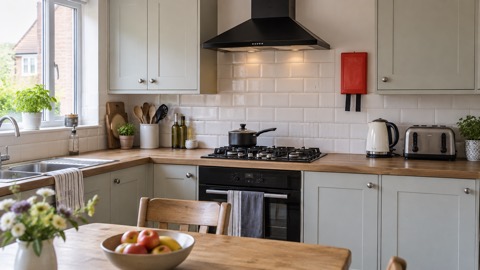
Most home fires start in the kitchen
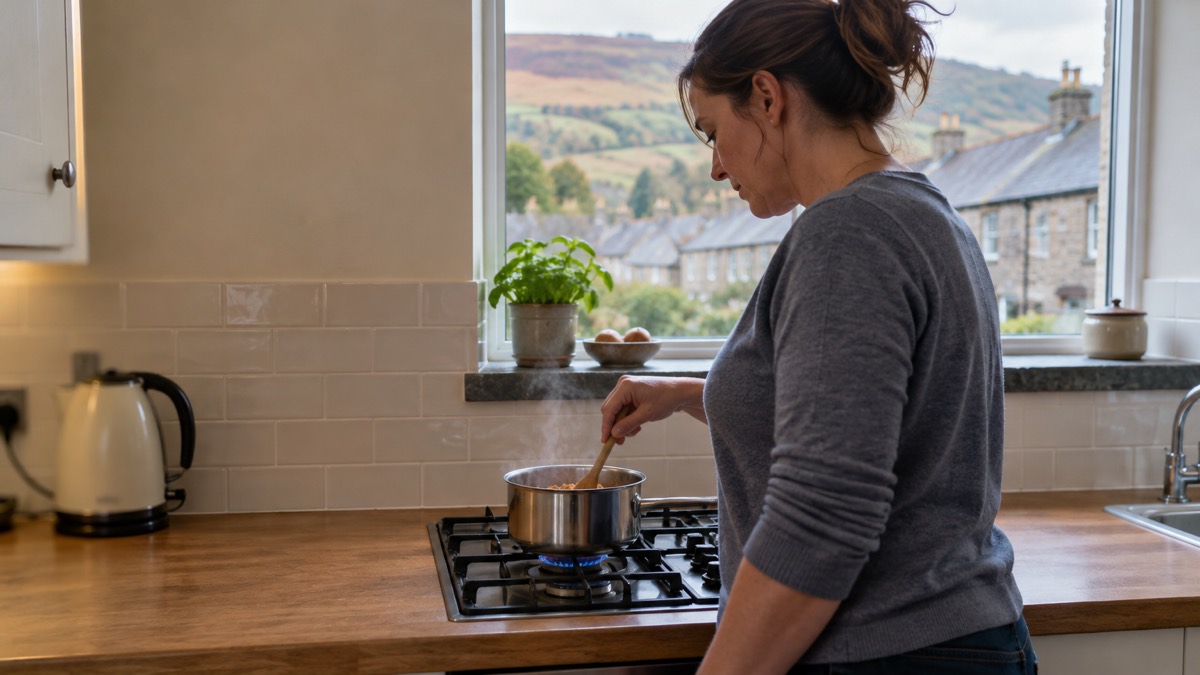
The kitchen is where the risk concentrates, and every service in this page says so. North Wales Fire and Rescue Service reports that over the last few years, the majority of property fires it attended started in the kitchen, and that 99% of these fires were accidental and could have been prevented18. South Wales Fire and Rescue Service states that cooking is the leading cause of house fires in South Wales10. Mid and West Wales Fire and Rescue Service calls the kitchen the area where the majority of house fires start2, and North Wales Fire and Rescue Service says accidents while cooking account for over half of fires in homes5.
The practical point behind those figures is that kitchen fires are almost all preventable, and prevention is mostly attention: not leaving cooking unattended, keeping flammables away from the hob, and keeping the alarm working. Manchester Fire and Rescue Service puts it simply: most fires in the home start when people are cooking19. For the detail, see kitchen fires: cooking safety and prevention and how to put out a chip pan or saucepan fire.
Two further habits reduce the risk in any UK home. First, register your appliances: Cheshire Fire and Rescue Service advises registering appliances at registermyappliance.org.uk to receive free recall alerts if there is a problem with your appliance20, and Manchester Fire and Rescue Service gives the same advice, to register electrical appliances with the manufacturers or at registermyappliance.org.uk to receive updates or safety information19. Recalled appliances, from dehumidifiers to gas cylinders, are a recurring cause of house fires, and registration is the only way you will hear about a recall affecting something you own. See how to check if an electrical product has been recalled. Second, if you charge e-bikes, e-scooters or other devices with lithium batteries, NIFRS's student safety campaign on safe charging is a reminder that charging habits matter; see e-bikes and e-scooters: charging and storing them safely.
What fire services do in floods and storms
When flooding hits, it helps to know what the fire service's job actually is, because it is narrower than many people assume. Mid and West Wales Fire and Rescue Service states that in flooding situations it has a duty where there is a risk to life or a risk of fire21. Councils, the emergency services and Natural Resources Wales will help where they can, but primarily you are responsible for protecting your own property21. When flooding is widespread, it is not possible to respond to every call for assistance at once, and the service's priority will be to save lives21.
North Wales Fire and Rescue Service says the same about pressure on its own resources: in busy periods it will prioritise calls to those where it is believed life is at risk8. That is not a refusal to help; it is a statement about ordering. If your flooding is a soaked carpet, you will wait; if someone is trapped or the water is rising towards people, you will not.
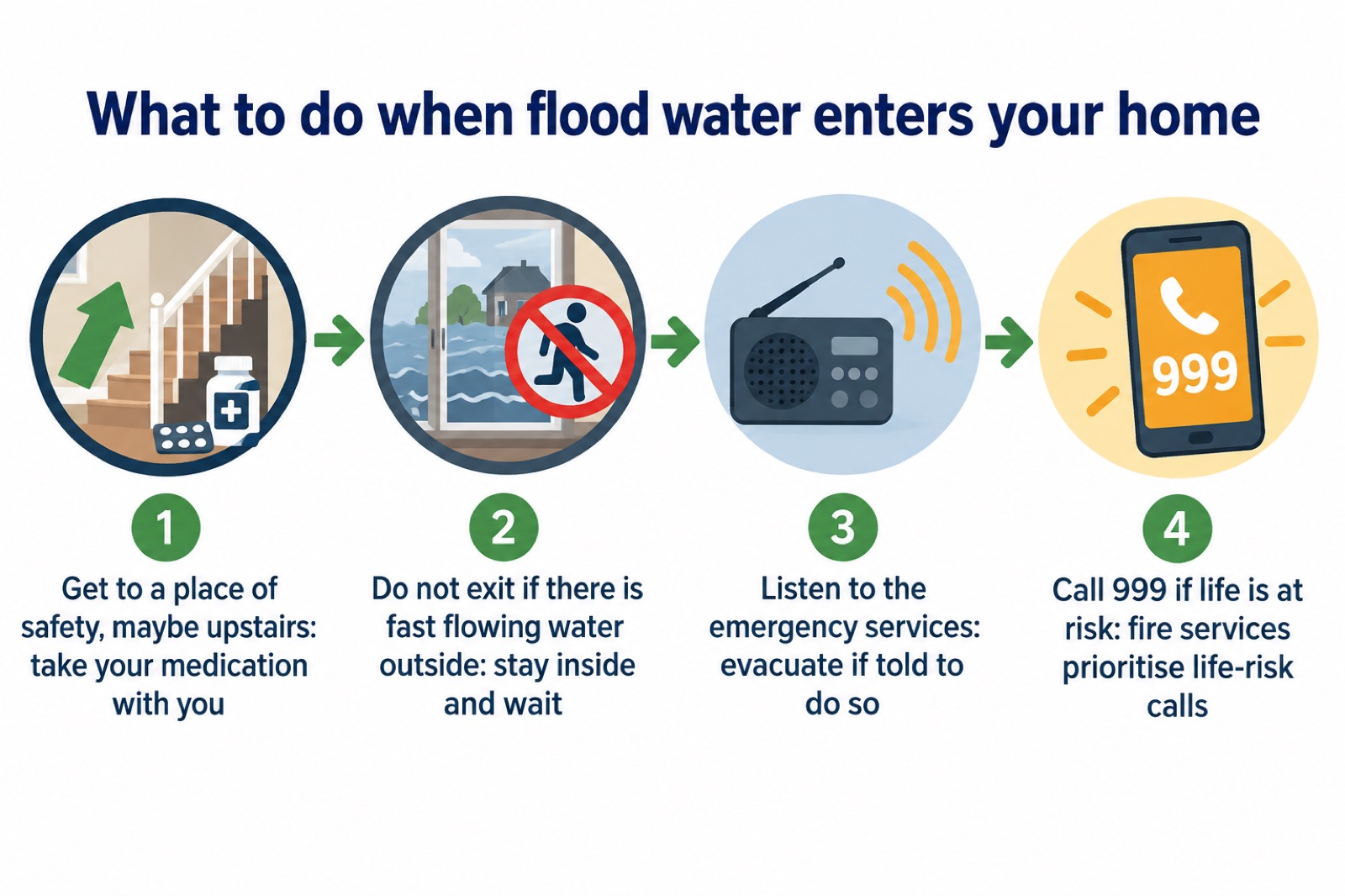
What you should do when flood water enters your home comes from North Wales Fire and Rescue Service: get yourself to a place of safety, maybe upstairs, and take any medication with you. Do not exit your property if there is fast flowing water outside. Stay safe, listen to the advice of the emergency services, and evacuate if told to do so22. If you are driving, puddles may be deeper than they appear, so do not take unnecessary risks22. For the full picture, see flooding: a household guide.
The warning side is handled by Natural Resources Wales. The Flood Warning Information Service for Wales is managed by Natural Resources Wales, which monitors rainfall, river levels and sea conditions to provide 24/7 flood forecasting23. Its flood warning service covers floods from rivers and the sea, and reaches around 90% of the properties at risk of flooding from rivers or the sea in Wales23. A flood alert means "be prepared"24, and flood alerts are issued earlier and more often than flood warnings; some locations will only receive flood alerts, not flood warnings, and alerts cover large areas23. A warning tells you the type of flood warning, the location affected, the expected timing and the action to take23. Sign up for the service so the warnings reach you: see staying informed in an emergency.
In high winds, the advice from North Wales Fire and Rescue Service is to secure any loose objects such as ladders, garden furniture or anything else that could be blown over and cause damage, and if you experience any damage, do not go outside to make repairs; wait until the weather has improved22. Be careful not to touch any electrical or telephone cables that have been blown down or are still hanging8. If you are driving, slow down and be aware of side winds, taking particular care if you are towing or driving a high-sided vehicle22. The Met Office will usually name a storm when it has the potential to cause disruption or damage that requires an amber or red weather warning25, so a named storm is a signal to act on this list. See storms, snow and ice: a household guide.
Sandbags come from your council, not the fire service
This is the point most households get wrong, and it costs time at exactly the moment there is none. North Wales Fire and Rescue Service states it directly: if you require sandbags, please contact your local council rather than your local fire and rescue service8. Natural Resources Wales does not supply sandbags either; its advice is to contact your local authority, which may have some available during a flood, or to buy your own from DIY stores and builder's merchants24.
Councils, for their part, set limits on what they will supply. One English borough council's policy, typical of the genre, states that it does not supply bags to protect garages, garden sheds, outbuildings or gardens, that sandbags will not be collected after the event and householders are advised to keep them for future use, and that it cannot accept any liability for failure to supply sandbags or for their late delivery26. Read together with the Welsh advice, the practical position for a household is this: the council is the right first call, supply is not guaranteed, protection is aimed at the home rather than outbuildings, and buying your own in advance is the reliable option.
The time to act on that is before the flood alert, not after. When an alert arrives, "be prepared"24 is the instruction, and being prepared means knowing where you would get sandbags or flood boards, how you would move valuables and electrical items upstairs, and how you would keep people and pets safe. See flooding: a household guide for the fuller preparation list.
Wildfire risk in summer, and barbecues
Wales has a specific and growing summer fire risk. The Welsh Government's resilience assessment for Wales states that the wildfire risk is increasing, the wildfire season is getting longer, and more wildfires are occurring simultaneously, especially during summer heatwave conditions25. Mid and West Wales Fire and Rescue Service says everyone should be aware of the heightened risk of wildfires and grassland fires at this time of year27. A Wales Wildfire Board takes a multi-agency approach to better understand and manage the risk of wildfire on the environment and the communities of Wales28.
That risk has already reached the level of national alerts. On 14 August 2026 an official emergency alert for England and Wales warned of a very high risk of wildfires nationally, and told residents, landowners and visitors not to undertake any activity that could start a fire, including disposable barbecues, firepits, garden incinerators or fireworks29. If an alert like that is active, or conditions are hot and dry, the safe course is to treat every open flame outdoors as off the menu.
"Residents, landowners and visitors should not undertake any activity that could start a fire, including disposable barbecues, firepits, garden incinerators or fireworks."
Outside alert periods, Mid and West Wales Fire and Rescue Service's summer advice is to follow its safety advice to avoid injuries, damage to property or the countryside when you barbecue, and the same advice covers firepits, chimineas and incinerators27. Deliberate fire setting is a crime: the Wales Wildfire Board's task force appeals for information on anyone deliberately setting fires, to be reported by calling 101, or anonymously to CrimeStoppers on 0800 555 111, and those caught will be prosecuted28. For rural households, controlled burning on farmland must follow the regulations set out in the Heather and Grass Burning Code for Wales 2008; Mid and West Wales Fire and Rescue Service warns that burning illegally could result in penalties being applied to any rural payments received as well as criminal offences30. See also fireworks, sparklers and bonfires: staying safe and heatwaves and drought: a household guide.
Sources (30)
- Home fire safety, Northern Ireland Fire and Rescue Service, 2026
- Older person safety, Mid and West Wales Fire and Rescue Service, 2026
- Smoke alarm maintenance and problems, Mid and West Wales Fire and Rescue Service, 2026
- Safe and Well visit, Mid and West Wales Fire and Rescue Service, 2026
- At home, North Wales Fire and Rescue Service, 2026
- Crack down on fire risks this Easter, Northern Ireland Fire and Rescue Service, 2026
- Home safety, Belfast City Council, 2026
- Flooding and high winds, North Wales Fire and Rescue Service, 2026
- Student Fire Safety Week: practising safe charging, Northern Ireland Fire and Rescue Service, 2025
- Cooking safety, South Wales Fire and Rescue Service, 2026
- Your guide to fire safety | Scottish Fire and Rescue Service, Scottish Fire and Rescue Service
- Fire safety in high rise flats, Mid and West Wales Fire and Rescue Service, 2026
- Hearing and sight impairments, North Wales Fire and Rescue Service, 2026
- Prevention and protection, South Wales Fire and Rescue Service, 2026
- Safe Havens, Mid and West Wales Fire and Rescue Service, 2026
- Smoke alarms, South Wales Fire and Rescue Service, 2026
- Staying safe this season | Devon and Somerset Fire and Rescue Service, Devon and Somerset Fire and Rescue Service
- Cooking, North Wales Fire and Rescue Service, 2026
- Stay fire safe, Manchester Fire and Rescue Service, 2026
- Safe and Well booklet, Cheshire Fire and Rescue Service, 2026
- Flooding advice, Mid and West Wales Fire and Rescue Service, 2026
- Seasonal safety: flooding and high winds, North Wales Fire and Rescue Service, 2026
- Sign up to receive flood warnings, Natural Resources Wales, 2026
- What to do in a flood, Natural Resources Wales, 2026
- Resilience: risks in Wales, Welsh Government, 2026
- Flood support, Ashford Borough Council, 2026
- Summer safety, Mid and West Wales Fire and Rescue Service, 2026
- WildfireWise, Mid and West Wales Fire and Rescue Service, 2026
- Emergency Alert, 14 August 2026, UK Government, 2026
- Farm fire safety, Mid and West Wales Fire and Rescue Service, 2026
 Home Fire Safety Checklist
 Bedtime Fire Safety Checks
 Fire Risk Checks for Carers
 What to Do If Fire Starts
 How to Make a Fire Escape Plan
 Fire in a Block of Flats
 Kitchen Fires and Cooking Safety
 Electrical Fires and Sockets
 Smoking, Matches and Lighters
 E-bike Charging Safety
 Hoarding and Fire Risk
 Thatched Properties Fire Risk
 Fireworks and Bonfire Safety
 What to Do After a House Fire
 How Fire Services Respond