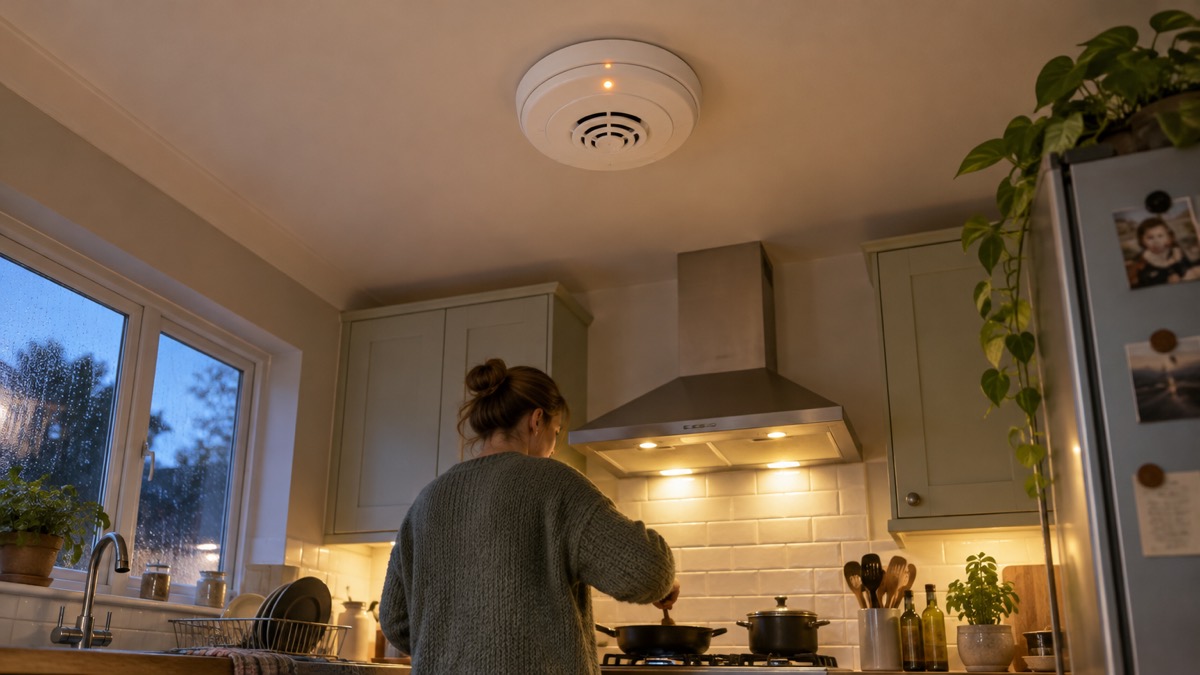
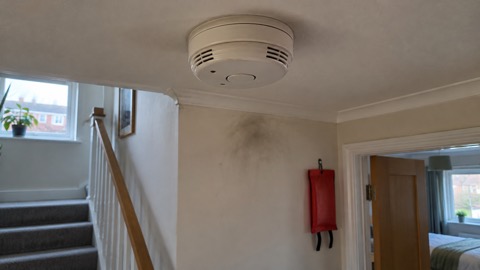
A heat alarm is the fire alarm that belongs in the rooms where a smoke alarm would constantly go off. Manchester Fire and Rescue Service defines it plainly: "A heat alarm is a warning device that detects an increase in temperature from a fire but is insensitive to smoke"1. Where a smoke alarm sounds when particles of smoke reach its sensor, a heat alarm sounds when the air around it gets hot enough, and it ignores the smoke, steam and dust of ordinary life. Devon and Somerset Fire and Rescue Service make the same distinction: heat detectors "activate when there is a change in temperature caused by a fire, unlike a standard smoke alarm which sounds when it detects smoke"2.
That difference decides where each alarm goes. Heat alarms are required for homes in Scotland, but they are a great choice for those living in England, Wales and Northern Ireland, too3. In Scotland this is not just advice but law, since February 2022 every home must have a heat alarm in the kitchen, ceiling mounted and interlinked with the rest4. This page explains what a heat alarm does, the rooms it suits, the temperature at which it triggers, how to fit and space it, and the standard to look for when you buy one.
Why a heat alarm and not a smoke alarm in the kitchen
The kitchen is the one room in the house where a smoke alarm is the wrong tool. Lincolnshire Fire and Rescue puts it directly: "Smoke alarms are not suitable for kitchens, but heat alarms are. Fitting a heat alarm in your kitchen will give you warning of an increase in temperature caused by a fire but will not be set off by cooking fumes"3. Staffordshire Fire and Rescue Service goes further and makes it a rule: "An alarm installed inside the kitchen must be a heat alarm rather than a smoke alarm"10.
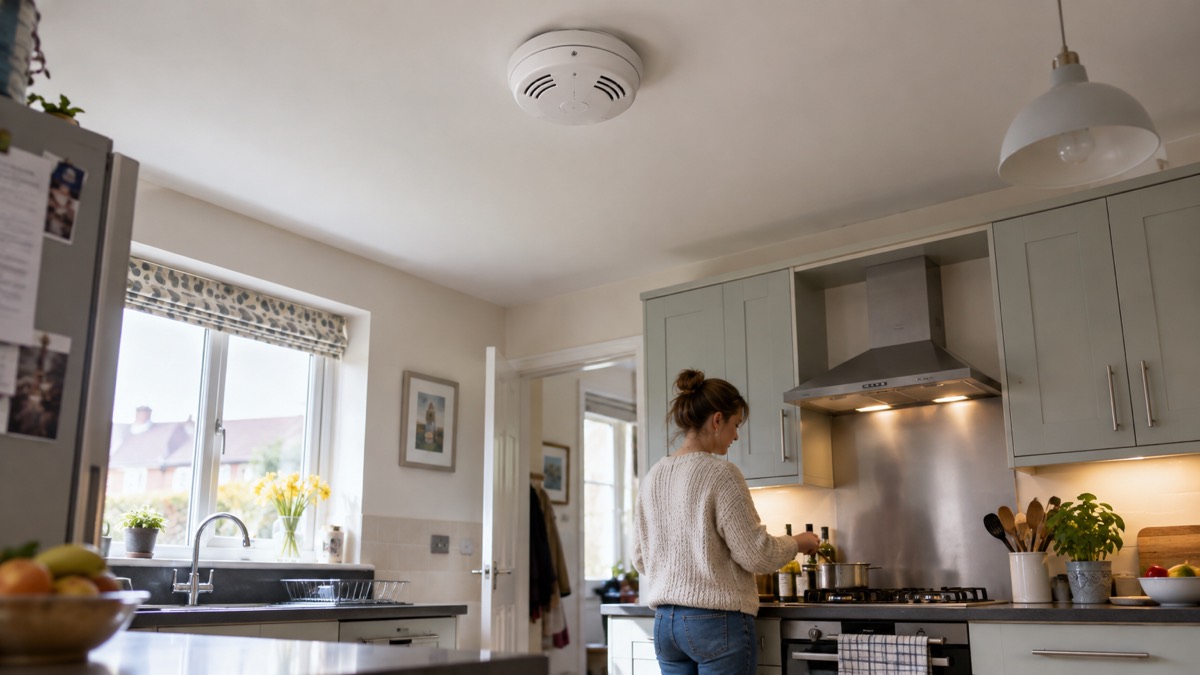
The reason is false alarms. Steam and cooking fumes are the most common cause of false alarms in smoke alarms, which is why the Scottish Fire and Rescue Service tells you not to fit a smoke alarm too close to the kitchen door11. A smoke alarm that goes off every time you fry an egg tends to get disabled, and a disabled alarm protects nobody. A heat alarm solves the problem at the source: it simply does not respond to smoke or steam, so it stays silent through normal cooking and sounds only when the temperature climbs to a level that means fire.
Every fire and rescue service that has published guidance on this says the same thing. Devon and Somerset Fire and Rescue Service advises: "Do not fit smoke alarms in kitchens or bathrooms where smoke or steam could set them off accidentally. Install a heat alarm in the kitchen instead"12. The reason is that a heat alarm reacts to heat rather than smoke, so cooking fumes will not set it off13. If you already have a smoke alarm inside your kitchen, the guidance in the Scottish Tolerable Standard notes that BS 5839-6:2019, Clause 12.2(f) states that only heat alarms should be used in kitchens, though an existing smoke alarm in a kitchen need not be replaced until the end of its manufacturer's recommended lifespan9.
If you have a large kitchen, fit more than one. The Scottish Fire and Rescue Service advises: "If you have a large kitchen, install multiple heat alarms"5. The baseline is one heat alarm in every kitchen14, but a long, L-shaped or open plan kitchen may leave corners too far from a single detector. For open plan areas, the Scottish guidance gives a working distance: one alarm is enough, but it should be no more than 7.5 metres from any point in the room, and if the area includes a kitchen, that alarm should be a heat alarm15.
The other rooms where a heat alarm helps
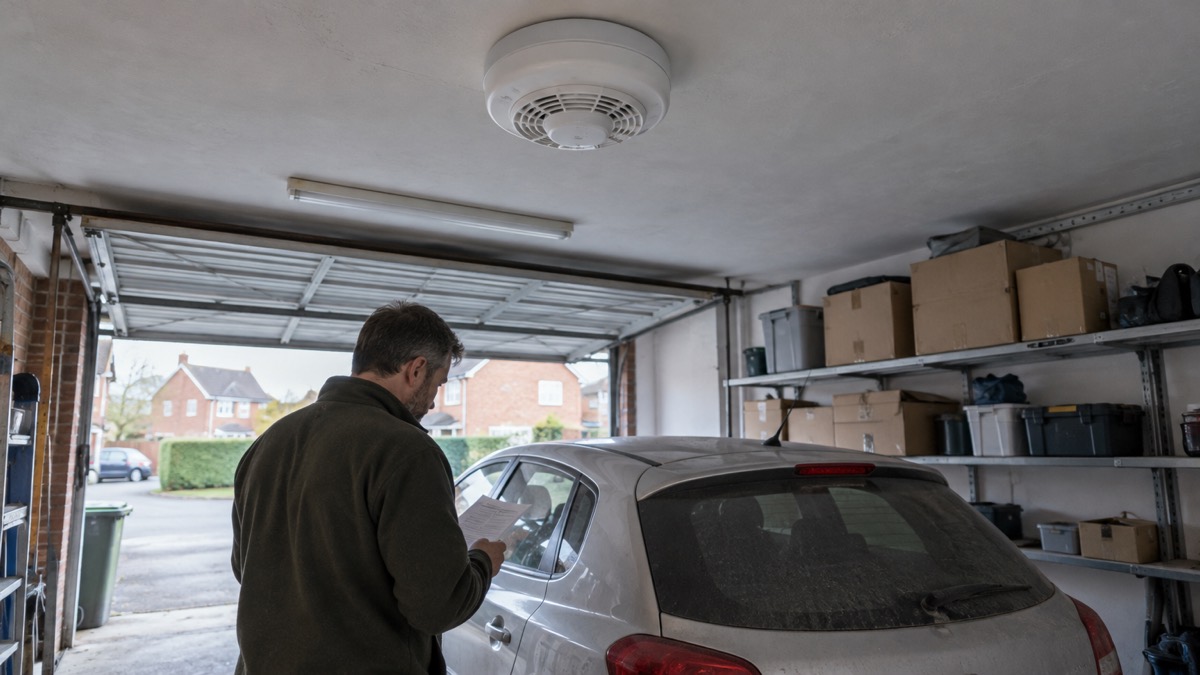
The kitchen is the obvious case, but the same logic applies to any room where the air is routinely full of fumes, dust or steam. The Scottish Fire and Rescue Service advises that "Heat alarms are useful in any room where there are high levels of fumes, smoke or dust, such as garages, lofts and boiler rooms"5. Warwickshire County Council's fire safety guidance lists the kitchen and garage as the rooms for heat alarms16. Devon and Somerset Fire and Rescue Service adds bathrooms to the list, recommending heat alarms "for fitting in smoky or steamy rooms such as kitchens or bathrooms"2.
| Room | Why a heat alarm suits it |
|---|---|
| Kitchen | Cooking fumes and steam would set off a smoke alarm; a heat alarm ignores them3 |
| Garage | Dust, exhaust fumes and paint or solvent vapours make smoke alarms unreliable5 |
| Loft | Dust and still air cause nuisance alarms in smoke detectors5 |
| Boiler room | A fixed combustion appliance sits alongside dust and fumes5 |
| Utility room | Tumble dryers and washing machines are a fire risk, and the air carries lint and steam5 |
| Bathroom | Steam from bathing sets off smoke alarms unnecessarily2 |
The utility room and garage deserve a word on fire risk as well as false alarms. Devon and Somerset Fire and Rescue Service has warned people not to use washing machines and tumble dryers overnight, precisely because a fire in an unattended appliance can take hold before anyone notices17. A heat alarm in the same room as those appliances gives you the earliest warning that does not depend on someone being awake to smell smoke. The same applies to a garage where a car, e-bike or stored chemicals sit behind a closed door for hours at a time.
Where a heat alarm must never replace a smoke alarm
A heat alarm is a specialist tool, not a general one. Because it is insensitive to smoke, it will not respond to a smouldering fire that produces smoke long before it produces heat: a slow electrical fault in a sofa or bedding, a cigarette dropped on upholstery, a cable overheating inside a wall. That is exactly the kind of fire a smoke alarm is built to catch early. North Wales Fire and Rescue Service's dementia fire safety guidance states the rule from the other direction: "Smoke alarms should not be in the kitchen and bathroom as heat and vapour from cooking and bathing can set them off unnecessarily"18. The two alarm types cover different fires, and your home needs both.
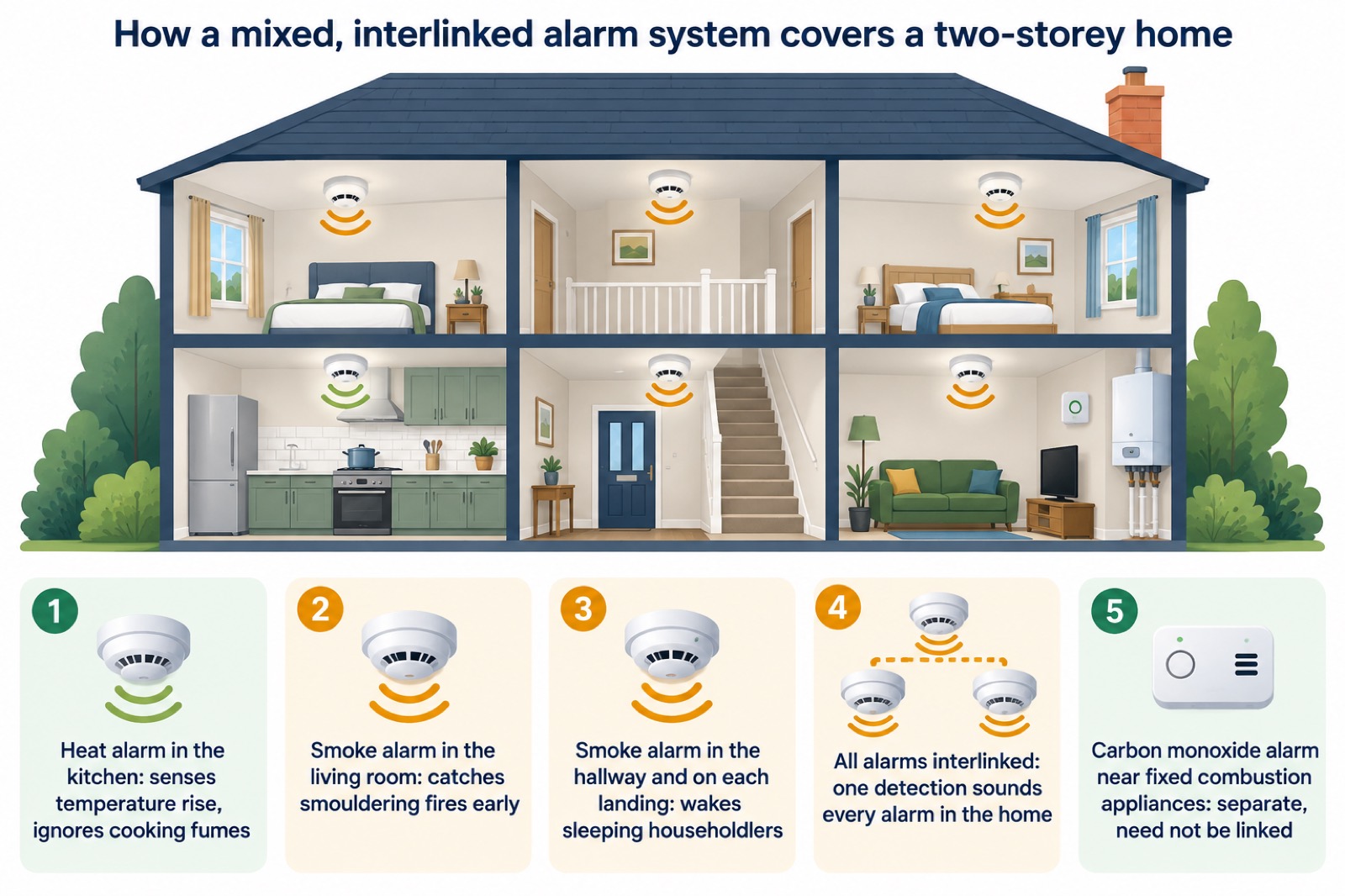
The standard arrangement, repeated across UK fire service guidance, is a minimum of one smoke alarm on every floor of the home plus a heat alarm in the kitchen13. nidirect's home fire advice adds that you should think about extra smoke alarms in the most used rooms, such as living rooms and bedrooms19. Manchester Fire and Rescue Service's smoking safety page is typical: "Fit a minimum of one smoke alarm on every floor of your home and a heat alarm in your kitchen", with an extra smoke alarm in any room where you smoke13.
One habit to avoid with any alarm, heat or smoke: never take the batteries out to use in another electrical item. Manchester Fire and Rescue Service warns that "An alarm without batteries cannot warn you if a fire starts"1. If your alarms are chirping, replace them rather than silencing them; a heat alarm with a dead battery is as useless as no alarm at all.
The trigger point: 58°C and above
A heat alarm is not a thermometer that sounds at a comfortable warmth. It waits until the air temperature at the ceiling reaches a level that only a fire produces. The maker Aico states that its Ei3014 Heat Alarm is set off "at temperatures of 58°C and above"6. That is far above anything normal cooking, a hot summer's day or a central heating boiler will produce at ceiling level, which is why day-to-day heat does not cause false alarms.
For comparison, a domestic sprinkler head operates at a similar order of temperature: Manchester Fire and Rescue Service explains that sprinklers activate "at a specific temperature (usually about 68 deg. C)" when hot gases from a fire reach the head20. Both devices are waiting for the same thing, the hot gas layer that builds up at ceiling level as a fire grows, and both are designed to stay silent through anything less.
The sensor that does this is a thermistor, an electrical component whose resistance changes with temperature. The alarm measures that resistance continuously and sounds when it corresponds to the trigger temperature. Aico states that the thermistor in the Ei3014 has a small thermal mass, which means it can trigger an alarm response faster6. A small thermal mass simply means the sensor itself heats up quickly with the surrounding air, so it does not lag behind the fire.
Fitting it: ceiling, centre of the room, clear of walls
Fire and rescue services are unanimous that alarms of either type go on the ceiling, not on a wall. Devon and Somerset Fire and Rescue Service advises that alarms "should always be mounted on the ceiling, near the middle of the room or hall, and at least 30cm away from a wall or light"12. Staffordshire Fire and Rescue Service gives the same figure: fitted as close to the centre of the room as possible, but at least 30 centimetres (12 inches) away from any wall or light fitting10. The Suffolk Fire and Rescue Service factsheet adds that alarms should be screwed into the ceiling rather than simply stuck up21.
The 30cm rule exists because air does not circulate cleanly in the corners and edges of a room. In a fire, the hot gases and smoke rise and spread across the ceiling, and near a wall or a light fitting the flow is disturbed, so an alarm there may respond late or not at all. The centre of the ceiling is where the hot layer arrives first and most reliably. The same logic applies to a heat alarm's thermistor as to a smoke alarm's chamber: it can only measure the air that actually reaches it.
Follow the maker's fitting instructions for the specific model, and test the alarm once it is up. When a heat alarm detects a fire, it makes the same piercing noise as a smoke alarm to alert or wake you1. If you are fitting alarms for someone whose escape might be delayed, or who might not hear an alarm, see smoke and CO alarms for deaf and hard of hearing people.
Spacing and coverage in larger rooms
For most rooms, one alarm near the centre of the ceiling is enough. The distance rule that matters comes from the Scottish guidance on open plan areas: a single alarm should be no more than 7.5 metres from any point in the room15. In a large kitchen, the Scottish Fire and Rescue Service's advice to install multiple heat alarms5 is the practical answer: two detectors, each near the centre of its own half of the room, will cover a space one alarm cannot.
Keep smoke alarms away from the kitchen door as well as out of the kitchen itself. The Scottish Fire and Rescue Service notes that steam and cooking fumes drifting through a doorway are the most common cause of false alarms, so a hallway smoke alarm directly outside the kitchen is better placed further along the hall11. For a fuller treatment of smoke alarm positions, see where to fit smoke alarms.
Interlinking heat alarms with smoke and carbon monoxide alarms
Interlinked alarms are alarms that communicate: when one detects a fire, every alarm in the home sounds. The Scottish guidance states the requirement plainly: "All smoke and heat alarms should be attached to the ceiling and be interlinked"22. The Scottish Fire and Rescue Service confirms that the requirement is to have all smoke and heat alarms interlinked, including in homes whose existing alarms are not linked23. The Tolerable Standard guidance repeats the same rule9.
The reason is simple and it matters most at night. A heat alarm in the kitchen cannot wake someone sleeping two floors above unless it is linked to an alarm in the hallway outside their bedroom. London Fire Brigade notes that interlinked alarms are particularly important where a person has any issues that may prevent or delay their escape, to ensure they are alerted wherever the fire starts8. If you care for someone who moves slowly, uses a mobility aid or would need help to get out, interlinking is not optional in Scotland and is strongly advised everywhere.
Carbon monoxide alarms are a separate matter. The Scottish Fire and Rescue Service advises that carbon monoxide alarms should be used if you have heating or cooking appliances fuelled by gas, coal, wood or oil, and that a carbon monoxide alarm does not need to be linked to the fire alarms11. Scottish policy puts a carbon monoxide alarm where there are fixed combustion appliances such as boilers and wood burners24. Specialist alarms, for example for deaf people or Telecare systems, must be fitted in addition to any smoke, heat and carbon monoxide alarms15.
Makers support this in their products. Aico states that its Ei3014 Heat Alarm is compatible with hard-wired, RadioLINK and hybrid interconnecting systems, and with all other Aico alarms and accessories6. South Lanarkshire Council's sensory support guidance names the Aico Ei603RF as a battery interlinked radioLINK+ heat alarm, an example of a wireless-linked model where running cables between rooms is impractical25. To understand the options, see interlinked alarms: how linking works and wireless or wired interlinked alarms.
The standard to look for: BS 5446-2
When you buy a heat alarm, check the marking. The Scottish Tolerable Standard guidance states: "Heat alarms should conform to BS 5446-2"9, and the Scottish Fire and Rescue Service gives the full designation as BS 5446-2:20034. London Fire Brigade's general advice is to make sure any alarms you buy are marked with a current British Standards or European (CE) safety mark, which shows they are certified to recognised standards8. For smoke alarms, the Suffolk factsheet specifies British Standard BS 5446 Part 1 with the Kitemark21; the Part 2 of that standard is the heat alarm equivalent.
The Tolerable Standard guidance also sets out how alarms can be graded: the Scottish Standard can be met by Grade A or Grade C alarms installed in compliance with BS 5839-6, where Grade A covers smoke, heat and multi-sensor detectors and Grade C systems also include fire alarm sounders and visual or vibrating alarm devices14. For most ordinary homes, a heat alarm marked BS 5446-2 is the straightforward answer. The grading system is explained in more detail in alarm standards: BS 5839-6, BS EN 50291 and system grades.
Scotland: the legal requirement
Scotland is the one UK nation where heat alarms are a legal requirement in every home. Since February 2022, every home in Scotland must have one smoke alarm in the living room or the room you use most, one smoke alarm in every hallway and landing, and one heat alarm in the kitchen, all mounted on the ceiling and interlinked4. Scottish Government policy summarises the standard as a smoke alarm in the living room and in circulation spaces such as hallways and landings, a heat alarm in every kitchen, all alarms ceiling mounted and interlinked, and a carbon monoxide alarm where there are fixed combustion appliances such as boilers and wood burners24.
The legal basis is the Housing (Scotland) Act 1987, which the Scottish Government states will be amended to reflect the requirements24. The legislation was introduced in January 2019 with the aim of ensuring that everyone in Scotland has the same level of protection whether they own or rent their home23. Responsibility for meeting the standard sits with the property owner26. The Tolerable Standard guidance adds the detail that one heat alarm must be installed in every kitchen9.
In England, Wales and Northern Ireland heat alarms are not a legal requirement for existing homes, but they remain a great choice for households there3. The arrangements in Wales and Northern Ireland are covered in Wales and Northern Ireland: alarm rules and fire services.
The Aico Ei3014 recall
If you own an Aico Ei3014 heat alarm, check its batch number. Batches Ei3014-25W08C002-00223, Ei3014-25W08C002-00196 and Ei3014-25W08C002-00150 of the Aico Ei3014 Heat Detector have been recalled from end users27. The recall was notified by Local Authority Trading Standards under PSD notification number 2504-028527.
The Ei3014 itself, outside the recalled batches, is a mains powered heat alarm with a 10-year rechargeable lithium cell back-up, a high-performance thermistor heat sensor, AudioLINK+ data extraction technology, compatibility with other Aico mains powered devices, and a 10-year guarantee, all as stated by the maker6. The recall concerns the labelling of a small production batch, not the heat detection function of the product as a whole27. For how to check any electrical product for a recall, see how to check if an electrical product has been recalled.
Choosing and living with a heat alarm
Bring the requirements together and the choice is straightforward. Buy an alarm marked BS 5446-29. Fit it on the ceiling, near the centre of the room, at least 30cm from any wall or light fitting, screwed rather than stuck12. Put it in the kitchen, and in the garage, loft, boiler room or utility room if you have them5. Keep smoke alarms on every floor and in the living room and circulation spaces, and never let the heat alarm stand in for them13. In Scotland, interlink everything and treat it as law22. Elsewhere, interlinking is still the arrangement fire and rescue services describe, and it is what makes the kitchen heat alarm able to wake the whole house8.
Test your alarms regularly and replace them at the end of their lifespan. Never take the batteries out of your alarm to use in another electrical item; an alarm without batteries cannot warn you if a fire starts1. And if you have never drawn up how your household would get out at night, see how to make a fire escape plan and the fire safety checklist for your home.
Sources (28)
- Smoke and heat alarms, Manchester Fire and Rescue Service
- Equipment for carers, Devon and Somerset Fire and Rescue Service
- Fire alarms and carbon monoxide detectors, Lincolnshire Fire and Rescue
- Alarms, Scottish Fire and Rescue Service, 2022
- Kitchen safety, Scottish Fire and Rescue Service, 2024-11-11
- Ei3014 Heat Alarm, Aico, 2026-10-28
- Smoke alarms and vulnerable people, Devon and Somerset Fire and Rescue Service
- Smoke alarms and heat alarms, London Fire Brigade, 2026-10-25
- Tolerable Standard guidance: satisfactory fire and carbon monoxide detection, Scottish Government, 2023-06-20
- Smoke alarms, Staffordshire Fire and Rescue Service, 2026-10-29
- Smoke and heat alarms, Scottish Fire and Rescue Service, 2025-04-14
- Advice for parents and guardians, Devon and Somerset Fire and Rescue Service
- Smoking, Manchester Fire and Rescue Service, 2026-10-29
- Tolerable Standard guidance, Chapter 16: satisfactory fire detection, Scottish Government, 2023-06
- Fire and smoke alarms in Scottish homes, Scottish Government, 2024-08-14
- Fire safety at home: alarms and sprinklers, Warwickshire County Council, 2026-10-29
- Why you shouldn't use washing machines and tumble dryers at night, Devon and Somerset Fire and Rescue Service, 2022-11-18
- Dementia fire safety, North Wales Fire and Rescue Service, 2026-10-29
- Avoiding accidental fires in the home, nidirect, 2025-10-16
- Information for high rise residents, Manchester Fire and Rescue Service, 2026-10-29
- Smoke alarms factsheet, Suffolk Fire and Rescue Service, 2014-01-09
- Fire and smoke alarms in Scottish homes: what each home needs, Scottish Government, 2024-08-14
- Your guide to fire safety, Scottish Fire and Rescue Service, 2023-11-03
- Home fire safety policy, Scottish Government, 2026-10-29
- Sensory support, South Lanarkshire Council, 2026-10-29
- Keep Safe, Keep Well winter safety campaign 2024 to 2025, NHS West of Scotland Innovation Hub, 2024-10
- Product recall: Aico Ei3014 Heat Detector, 2504-0285, Office for Product Safety and Standards, 2025-05-29
- Aico Ei3014 Heat Detector recall notice, London Borough of Bromley, 2025-06-02
 Home Fire Safety Checklist
 Bedtime Fire Safety Checks
 Fire Risk Checks for Carers
 What to Do If Fire Starts
 How to Make a Fire Escape Plan
 Fire in a Block of Flats
 Kitchen Fires and Cooking Safety
 Electrical Fires and Sockets
 Smoking, Matches and Lighters
 E-bike Charging Safety
 Hoarding and Fire Risk
 Thatched Properties Fire Risk
 Fireworks and Bonfire Safety
 What to Do After a House Fire
 How Fire Services Respond