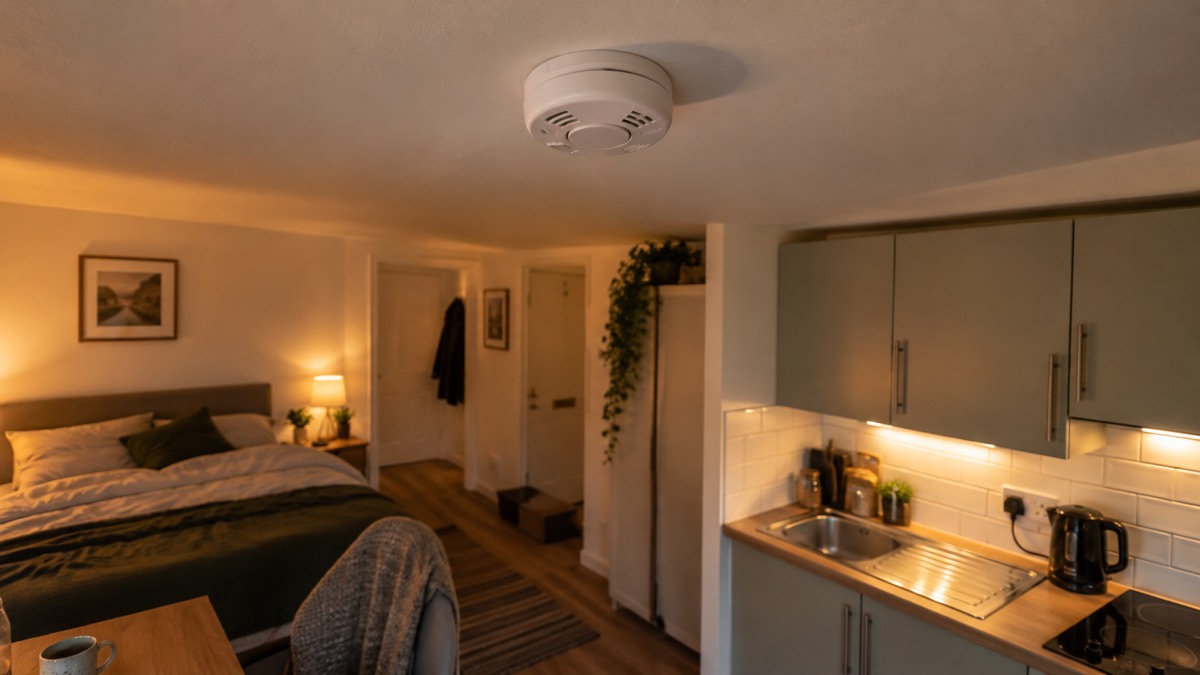
The short answer for most homes is at least one working smoke alarm on every floor, plus a heat alarm in the kitchen. Manchester Fire and Rescue Service puts it plainly: every home should have a minimum of one working smoke alarm per floor, and a heat alarm in the kitchen1. That covers a two-storey house with two smoke alarms and a heat alarm, and a three-storey house with three smoke alarms and a heat alarm.
Where you put them matters as much as how many. Fire services want the alarms in the places a fire would spread through first: the hallway, the landing and the top of the stairs. Smoke alarms should not go in kitchens or bathrooms, because cooking fumes and steam set them off, and an alarm that goes off every time you make toast is an alarm someone eventually silences for good2.
Scotland has its own, higher standard, which applies to every home in Scotland rather than just to new builds or rented property. If you live in England, Wales or Northern Ireland, the "one per floor plus a kitchen heat alarm" rule is the baseline, and you can add to it where your home or your household makes a fire more likely.
At least one smoke alarm on every floor
The "one per floor" rule is the one every fire service in the UK agrees on, and it is the figure to work from when you are counting. The reasoning is simple: smoke rises and spreads through the vertical spaces in a house, so a fire that starts downstairs can fill an upstairs landing before anyone smells it. An alarm on each level gives you a warning wherever you are and wherever the fire is.
Different services phrase the same minimum in slightly different ways, which can make it sound as though the numbers vary. They do not. The differences are about how much extra protection each service suggests on top of the minimum.
| Source | Minimum advised | Extra suggested |
|---|---|---|
| Manchester Fire and Rescue Service | One working smoke alarm per floor, plus a heat alarm in the kitchen1 | None stated |
| Dorset and Wiltshire Fire and Rescue Service | At least one smoke alarm on each level of your home2 | None stated |
| Electrical Safety First | One smoke alarm per floor, plus a heat detector in the kitchen7 | Fit enough alarms to cover all areas where a fire could start7 |
| Northern Ireland Fire and Rescue Service | A working smoke alarm on each floor8 | Consider additional alarms in the most used rooms, such as living rooms and bedrooms8 |
| Staffordshire Fire and Rescue Service | One alarm on each level for a home of more than one floor9 | For maximum protection, an alarm in every room except bathrooms9 |
The pattern is consistent: one per floor is the floor, not the ceiling. If you have a spare alarm, or you are buying for a home where someone smokes indoors, sleeps with the bedroom door shut, or has trouble waking to an alarm, the extra alarms go in the rooms where people sleep and spend their evenings.
For a household that wants to go further, Staffordshire Fire and Rescue Service sets out the maximum position: for maximum protection an alarm should be fitted in every room, except bathrooms9. That is a choice, not a requirement, and it brings its own work, because every alarm needs testing and every battery needs changing.
Where to put them: hallways, landings and the top of the stairs
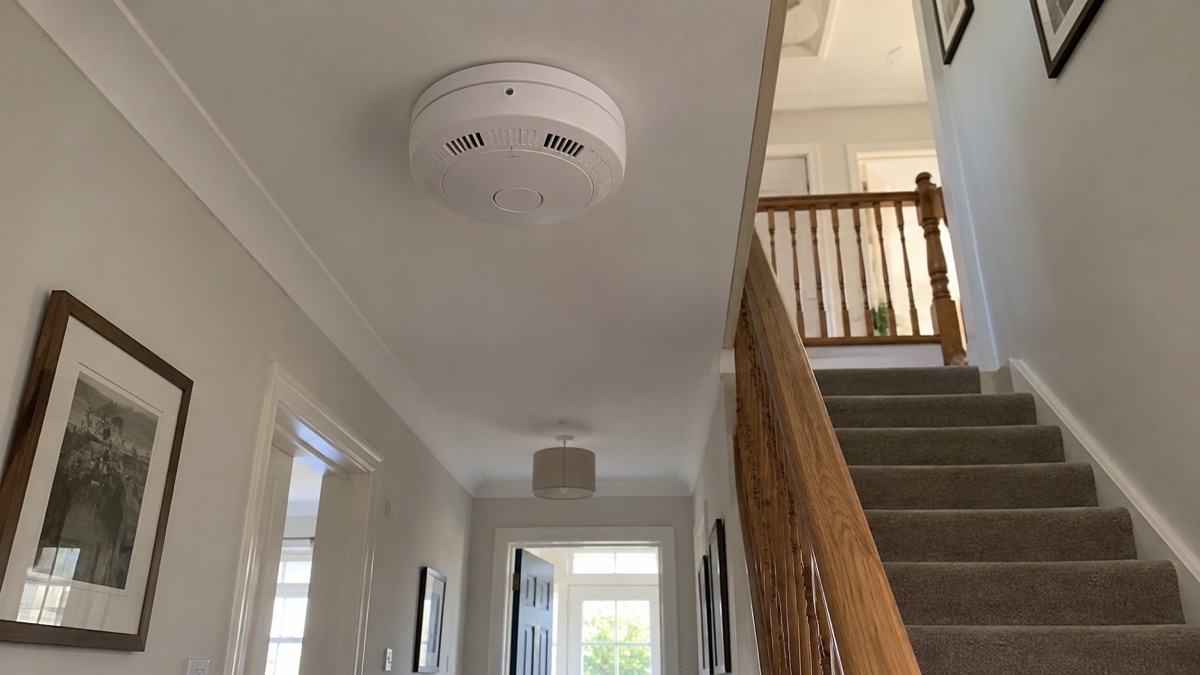
The number of alarms is only half the question. A smoke alarm in the wrong place either fails to wake you or goes off so often that it gets disabled. Fire services are specific about the right places.
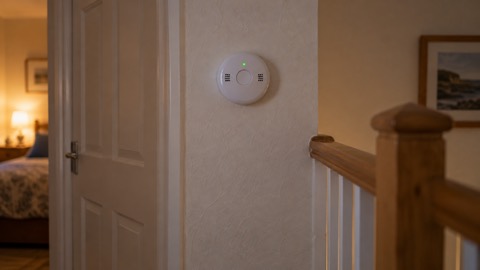
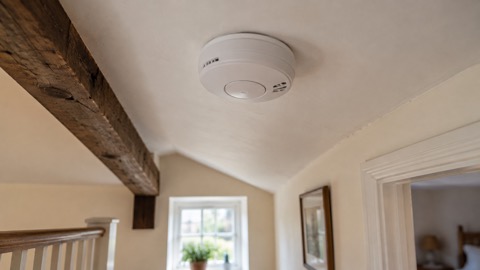
Dorset and Wiltshire Fire and Rescue Service recommends a smoke alarm in your hallway and also one at the top of your stairs, and suggests you could also have smoke alarms in bedrooms or sleeping areas2. Manchester Fire and Rescue Service advises a minimum of one working smoke alarm on every level of your home, preferably in a circulation space such as a hallway or landing1. Oxfordshire County Council goes further for homes with more than one level: fit one alarm at the bottom of the staircase and further alarms on each landing10.
For a home on one level, Oxfordshire's advice is to fit the alarm in the hallway between the living and sleeping areas10. That single position covers the route between the rooms where a fire is most likely to start and the rooms where people are asleep.
Height matters too. Northern Ireland Fire and Rescue Service advises fitting alarms on the ceiling at least 30cm away from the wall2. That keeps the alarm in the layer of smoke that collects at ceiling level, rather than in the dead air close to a wall where smoke may not reach it.
If you rent, the alarm provision is the landlord's responsibility, but the testing is yours. In England, at least one smoke alarm should be installed on every storey used as living accommodation, fixed to the ceiling in a circulation space such as a hall or a landing11. If your rented home does not have that, raise it with your landlord.
A heat alarm in the kitchen, not a smoke alarm
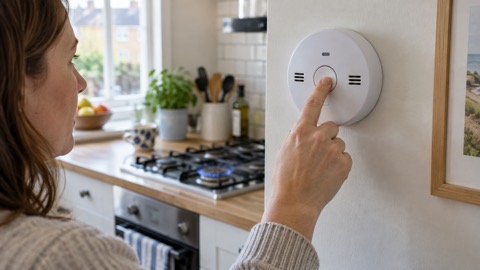
The kitchen is the one room where a standard smoke alarm is the wrong tool. London Fire Brigade explains why: kitchens are different as they can be smoky and steamy rooms, therefore a heat alarm is recommended12. A heat alarm responds to the rapid rise in temperature a fire causes, and ignores the steam from a kettle or the smoke from burnt toast.
"Fitting a heat alarm in your kitchen will give you warning of an increase in temperature caused by a fire but will not be set off by cooking fumes."
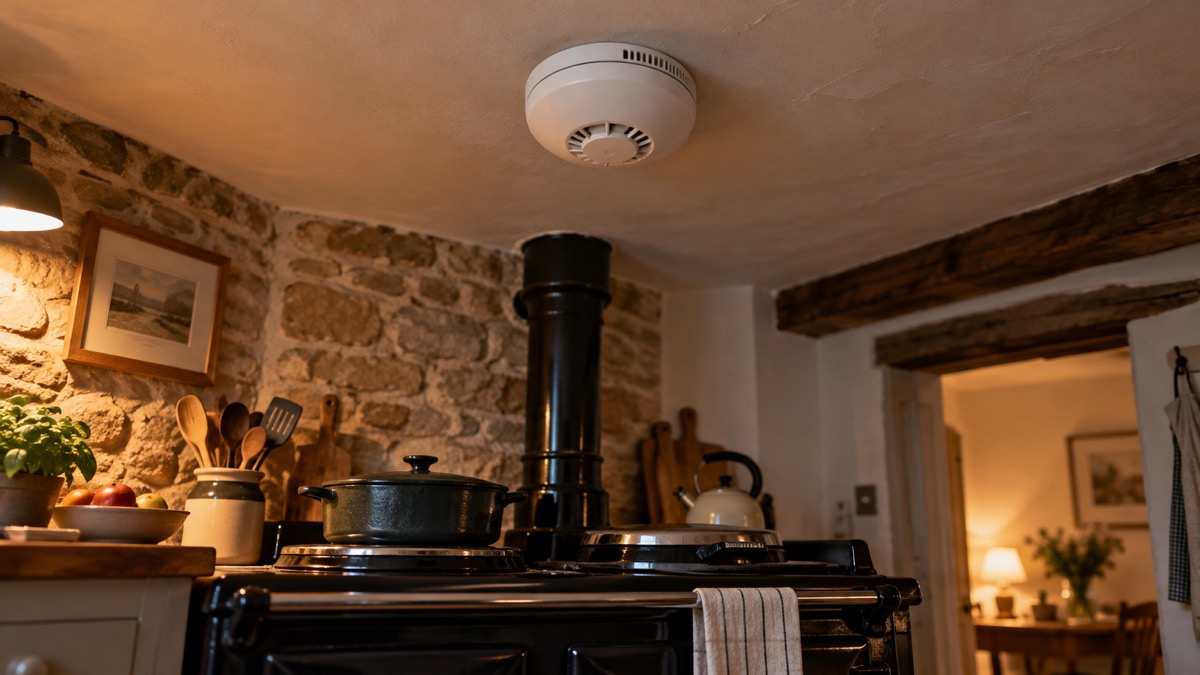
That resistance to false alarms is the whole point. An alarm that shrieks every time you fry something trains everyone in the house to ignore it, and the usual fix people reach for is taking the battery out. A heat alarm removes that temptation.
There are limits to what a heat alarm can do. Staffordshire Fire and Rescue Service notes that heat alarms are insensitive to smoke and can be installed in kitchens, but only cover a relatively small area of a room9. In a large open-plan kitchen and dining room, one heat alarm may not cover the whole space, so think about where a fire would most likely start, usually at the hob, and position it accordingly.
Dorset and Wiltshire Fire and Rescue Service gives the paired rule directly: do not fit smoke alarms in kitchens or bathrooms where smoke or steam could set them off accidentally, and install a heat alarm in the kitchen instead2. The same logic applies to the bathroom, where a shower produces the steam that triggers a smoke alarm. Keep smoke alarms out of both rooms.
For the detail on choosing between the two types, see Heat Alarm or Smoke Alarm: Which Goes Where, and for the kitchen fire risks themselves, Kitchen Fires: Cooking Safety and Prevention.
Flats and bungalows: one level, at least two alarms in Scotland
A single-level home changes the count, because there is no "one per floor" to work with. In England, Wales and Northern Ireland, the guidance for a bungalow or a single-level flat is to fit the alarm in the hallway between the living and sleeping areas10. One well-placed alarm can be enough for a small single-level home, though a heat alarm in the kitchen is still advised alongside it1.
Scotland is different, and the difference is legal rather than advisory. The Scottish Fire and Rescue Service states that if your home is on one level, a flat or bungalow, you need to fit at least two smoke alarms5. That is a higher minimum than the rest of the UK, and it applies to every home in Scotland, not only to social housing or new builds.
For a flat on more than one level, the rule returns to one per floor. Manchester Fire and Rescue Service advises that all homes should have at least one smoke detector, and if your flat is on more than one level you should have a smoke detector on each floor13. A maisonette with a living room downstairs and bedrooms upstairs therefore needs two smoke alarms, plus a heat alarm in the kitchen.
If you rent in Scotland, the landlord has duties too. Private landlords must provide a smoke alarm on each floor of a property15. That sits alongside the wider standard that applies to the home itself, so a rented flat should meet the same alarm requirements as an owner-occupied one.
Three-storey houses and larger homes
A three-storey house is where the counting gets easy to get wrong, because people often fit two alarms and stop. The guidance is one per floor, so a three-storey house needs three smoke alarms, plus the kitchen heat alarm.
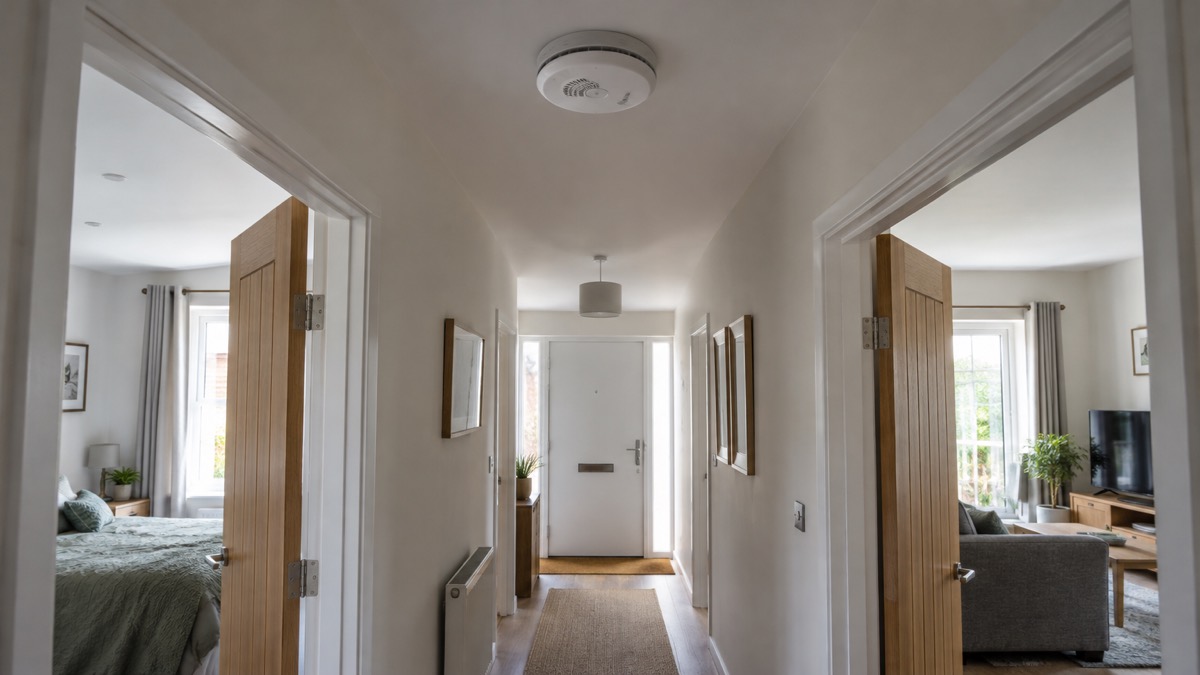
Electrical Safety First sets this out for a three-floor property: there should be a minimum of one smoke alarm per floor with a heat detector in the kitchen, and you should fit enough alarms to cover all areas where a fire could start7. The same organisation repeats the figure in its guidance for students and shared households, adding that alarms should be tested regularly, ideally every week16.
The "cover all areas where a fire could start" line is the one that matters in a larger house. A three-storey home often has a loft conversion, an extension or a converted cellar, and each of those adds a space where a fire could begin away from the main staircase. If a floor is split into separate sections with no shared landing, one alarm on that floor may not be heard from every room.
For a house of this size, the practical approach is:
- One smoke alarm on each of the three floors, in the hallway or landing7
- One heat alarm in the kitchen7
- Extra alarms in any bedroom or living room that sits far from the landing alarm8
- A test of every alarm once a week16
If the house is rented, the landlord should have fitted at least one alarm on every storey used as living accommodation, on the ceiling in a hall or landing11. Check that each one works when you move in, and keep testing.
The Scottish standard: what every home in Scotland must have
Scotland's alarm standard is the most detailed in the UK, and it applies to all homes rather than to a particular tenure. The Scottish Government introduced new standards for heat and smoke alarms in all homes from February 202218. The requirements are specific enough to work through room by room.
Every home in Scotland must have:
- One smoke alarm in the living room or the room you use most18
- One smoke alarm in every hallway and landing18
- One heat alarm in the kitchen18
- A carbon monoxide alarm where there are fixed combustion appliances such as boilers and wood burners18
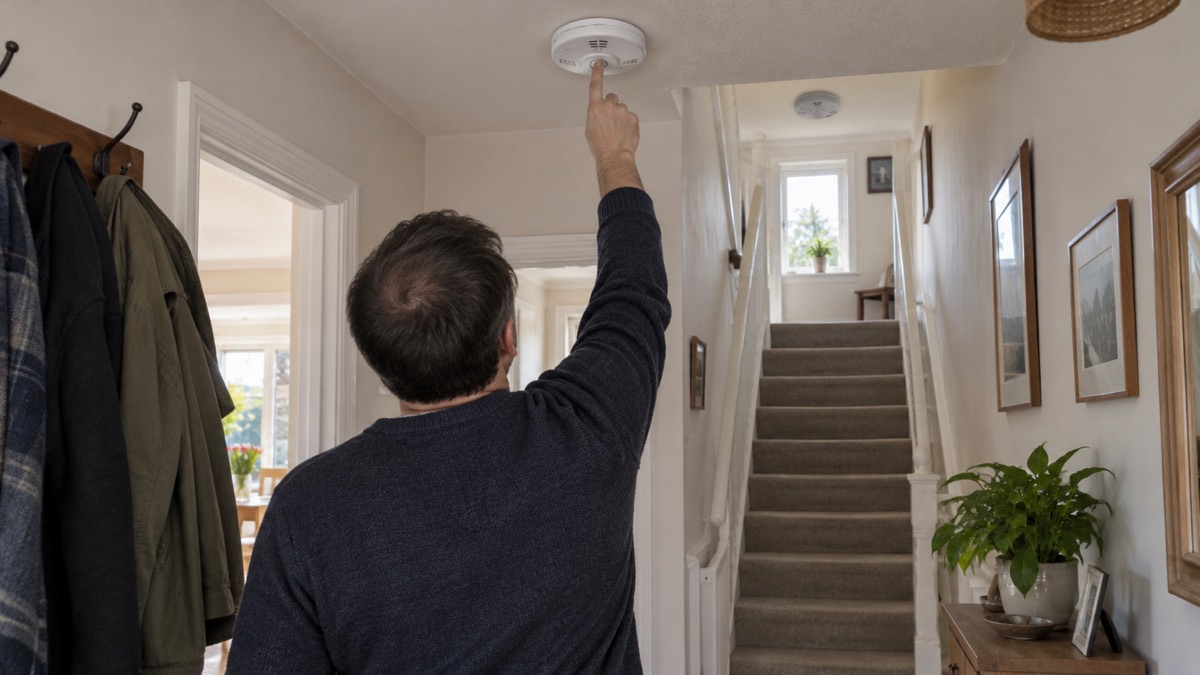
All of these alarms must be ceiling mounted and interlinked, so that when one sounds they all sound18. Interlinking matters most at night: an alarm in the hall will wake someone sleeping in a bedroom at the back of the flat, where a standalone alarm might not be heard.
There is a specific rule for open-plan living. If you have an open plan area, for example a combined hall and living room, you only need one alarm, but it should be no more than 7.5 metres from any point in the room, and if the area includes a kitchen, it should be a heat alarm19. That distance is the figure to measure if you are deciding whether one alarm covers an open-plan space.
The Scottish Fire and Rescue Service summarises the multi-level rule as one alarm on each floor, plus the living room5. For a two-storey house, that means a living room alarm, a hall or landing alarm on each floor, and a kitchen heat alarm.
For how interlinking works in practice, see Interlinked Alarms: How Linking Works. For the rules in Wales and Northern Ireland, see Wales and Northern Ireland: Alarm Rules and Fire Services.
Keeping them working: batteries, testing and replacement
An alarm that is not working is worse than no alarm, because it gives a false sense of protection. The maintenance routine is short, and the figures are worth knowing.
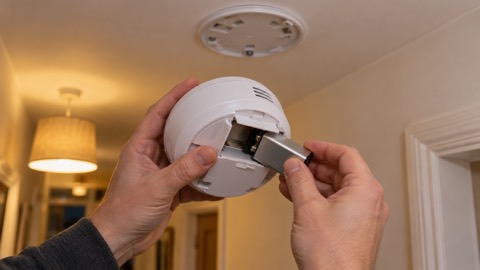
Basic smoke alarms run off nine volt batteries, which should be replaced on a regular basis10. In a standard smoke alarm, the battery will need to be replaced every 12 months9. If any of your smoke alarms have a one-year battery, you must change them every year, and only take the battery out when you need to replace it13.
When an alarm starts beeping to warn of a low battery, the advice is not to wait. Replace your alarm or its battery immediately, and certainly within seven days, as your alarm may not have enough power to warn you of a real fire after this time6. That seven-day window is the outer limit, not a target.
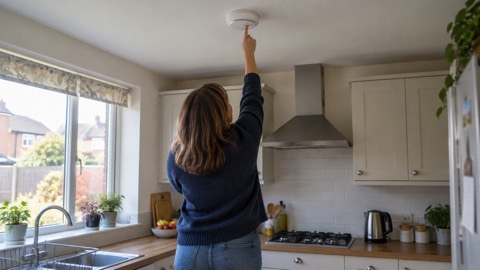
Testing is the other half. Electrical Safety First advises testing alarms regularly, ideally every week16. A weekly test takes seconds and catches a failed alarm before it matters. For the detail, see How Often to Test Smoke and CO Alarms and Why Does My Smoke Alarm Keep Chirping?.
If an alarm keeps sounding falsely even after you have moved it away from steam and cooking, the fault may be the alarm itself. See How to Stop Smoke Alarm False Alarms and When to Replace a Smoke, Heat or CO Alarm.
High-rise flats and homes where fire risk is higher
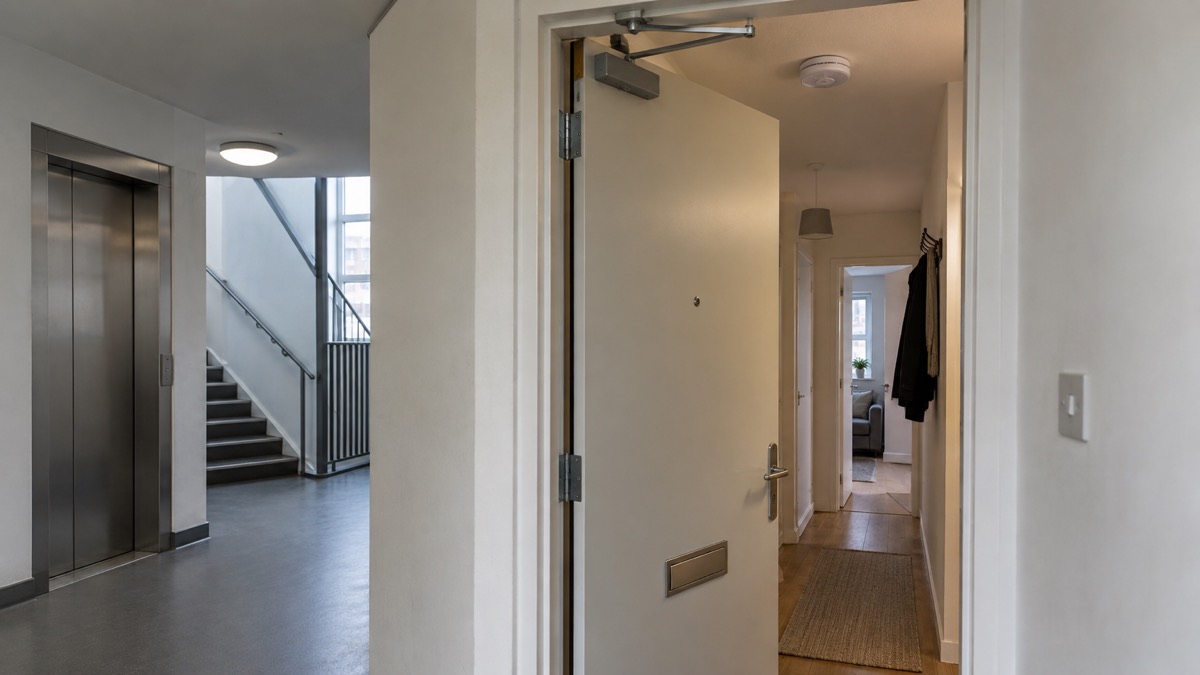
In a high-rise flat, the alarm advice is the same as anywhere else, but the escape advice that goes with it is more specific. Warwickshire Fire and Rescue Service advises fitting at least one smoke alarm in your flat, fitting a heat alarm in your kitchen and nothing in your bathroom due to false alarms, testing your alarms once a week, never taking the batteries out and always following the manufacturer's advice21.
What to do when the alarm sounds is the part that differs from a house. If the smoke alarm sounds, alert everyone else and leave the flat, closing the door behind you22. Closing the door contains the fire and keeps the escape route clearer for everyone else in the building. For the full picture, see What to Do If There Is a Fire in Your Block of Flats and Fire Safety Checklist for Flats.
Some households should fit more alarms than the minimum, because their risk of a fire, or of sleeping through one, is higher:
- People who smoke indoors: fit a minimum of one smoke alarm on every floor and a heat alarm in your kitchen, and if you smoke indoors, fit a smoke alarm in the rooms where you smoke23
- Households where someone uses emollient creams: in a domestic property, there should be a minimum of one working smoke alarm on every floor of the home, with additional alarms depending on risk24
- Homes where someone has dementia: smoke alarms are not needed in every room and are best fitted in hallways and at the top of stairs, so the sound reaches the person wherever they are likely to be25
- Shared and student households: one alarm per floor plus a kitchen heat alarm, tested weekly, with enough alarms to cover all areas where a fire could start16
For households where someone is deaf or hard of hearing, standard alarms may not be enough on their own. See Smoke and CO Alarms for Deaf and Hard of Hearing People.
Sources (24)
- Smoke and heat alarms, Manchester Fire and Rescue Service, 2026
- Smoke alarms, Dorset and Wiltshire Fire and Rescue Service, 2026
- Smoke alarms and heat alarms, London Fire Brigade, 2026
- Keep-Safe-Keep-Well-Winter-Safety-Campaign-2024-2025-FINAL-DRAFT.pdf, Comhairle nan Eilean Siar
- Your guide to fire safety, Scottish Fire and Rescue Service, 2023
- Home office, Electrical Safety First, 2026
- NIFRS calls on community to prioritise fire safety in the home this winter, Northern Ireland Fire and Rescue Service, 2022
- Smoke alarms, Staffordshire Fire and Rescue Service, 2026
- Smoke alarms, Oxfordshire County Council, 2026
- Housing standards, Cherwell District Council, 2026
- Cooking, London Fire Brigade, 2026
- Fire safety advice in your flat, Manchester Fire and Rescue Service, 2026
- Fire safety advice in your flat, Manchester Fire and Rescue Service, 2026
- Rented accommodation, Scottish Fire and Rescue Service, 2024
- Students, Electrical Safety First, 2026
- RCDs explained, Electrical Safety First, 2026
- Heat and smoke alarm standards for Scottish homes, Scottish Government, 2026
- Fire and smoke alarms in Scottish homes, Scottish Government, 2024
- Fire safety advice for parents and guardians | Devon and Somerset Fire and Rescue Service, Devon and Somerset Fire and Rescue Service
- High rise, Warwickshire Fire and Rescue Service, 2026
- Fire safety in high rise flats, Mid and West Wales Fire and Rescue Service, 2026
- Smoking safety, Manchester Fire and Rescue Service, 2026
- Caring for an emollient user, Manchester Fire and Rescue Service, 2026
- Dementia fire safety, North Wales Fire and Rescue Service, 2026
 Home Fire Safety Checklist
 Bedtime Fire Safety Checks
 Fire Risk Checks for Carers
 Why a CO Alarm Is Beeping
 Smoke Alarm Keeps Chirping
 Testing Smoke and CO Alarms
 Replacing Smoke and CO Alarms
 Where to Fit Smoke Alarms
 Where to Put a CO Alarm
 Do I Need a CO Alarm
 Can a CO Alarm Detect a Gas Leak
 Trapped by Fire What to Do
 Putting Out a Chip Pan Fire
 Electrical Fire Safety
 Appliances Left On Overnight