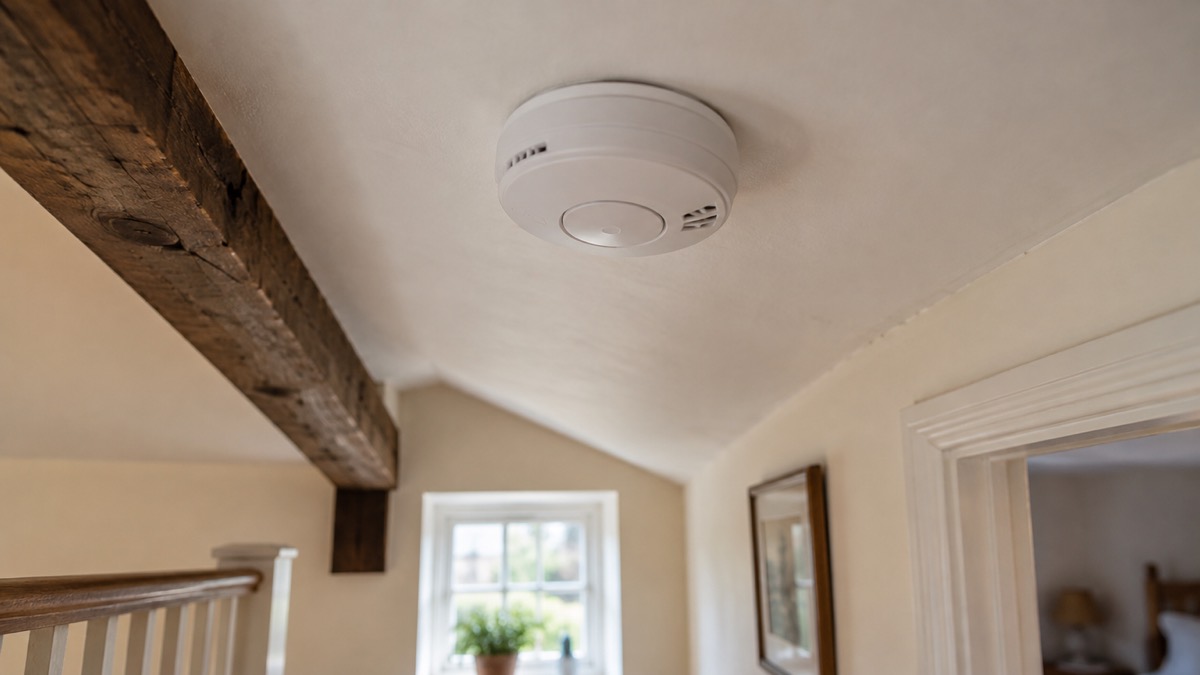
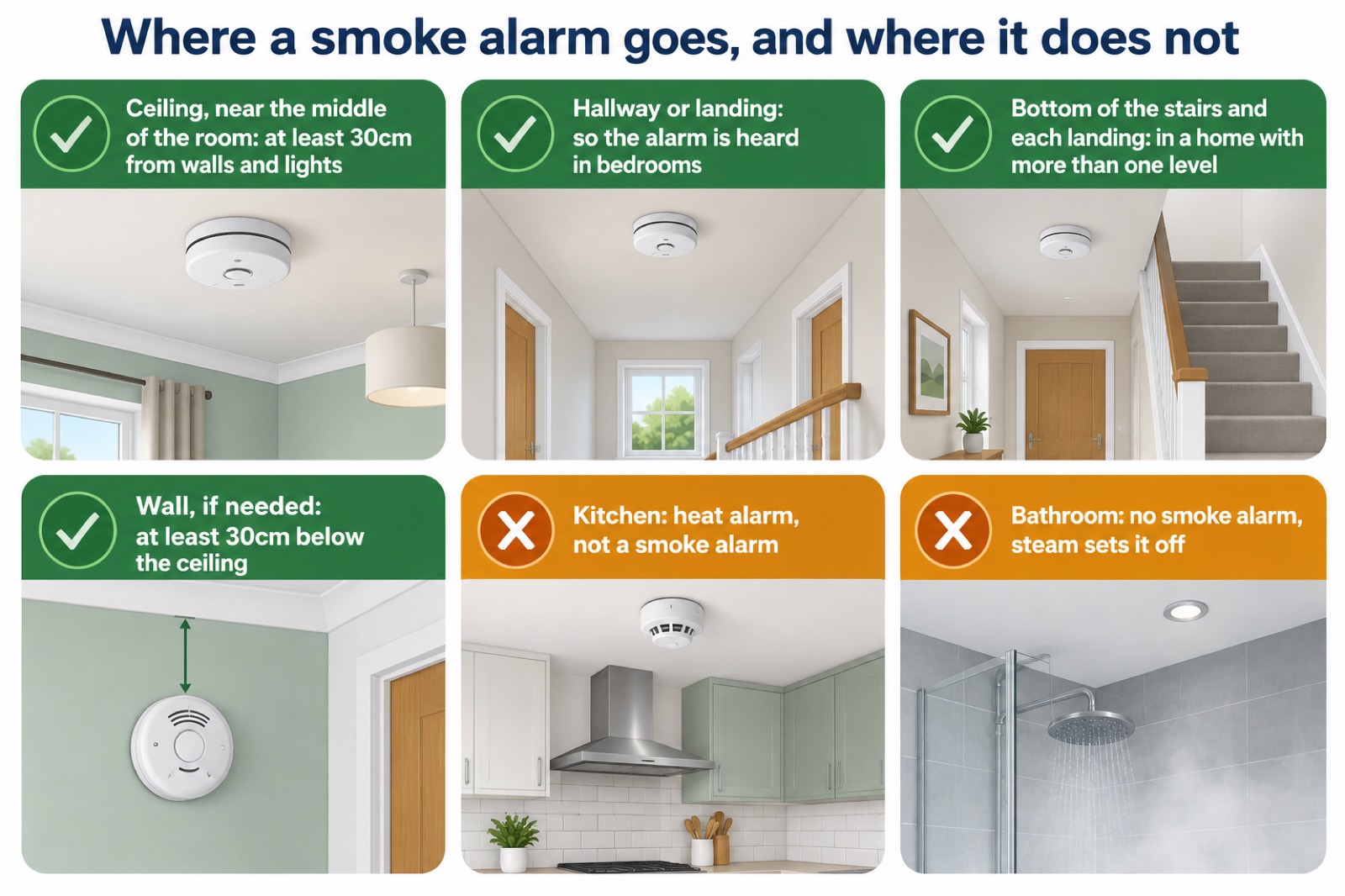
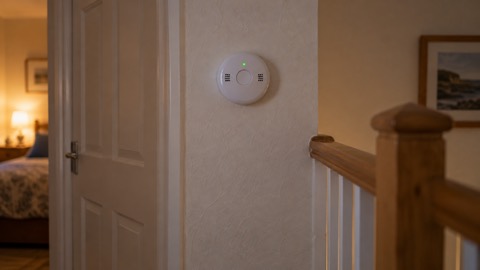
The short answer is one working smoke alarm on every level of your home, fitted on the ceiling near the middle of the room and at least 30cm from any wall or light fitting1. Put it where you will hear it, preferably in a hallway or landing, and keep smoke alarms out of kitchens and bathrooms, where cooking smoke and steam set them off by accident1.
That single rule covers most homes. The detail that follows is about the exceptions: a kitchen that needs a heat alarm instead, a wall position when the ceiling will not take a fixing, a sloping ceiling, and the different standard that applies to every home in Scotland. It also covers rented homes, where the landlord carries the duty, and the extra alarms that help an older or hard of hearing person.
Get the position right and an alarm does its job: it gives the household the earliest possible warning, which is what buys the time to get out. Get it wrong, in a bathroom or too close to a wall, and it either stays silent when it should not or sounds when nothing is wrong, which is how people come to disconnect them.
One working alarm on every level, in the place you will hear it
Start with coverage. Fire and rescue services advise a minimum of one working smoke alarm on every level of your home, preferably in a circulation space such as a hallway or landing1. The reason for the hallway is simple: it is usually between the rooms where people sleep and the rooms where fires start, and it is where the sound carries to bedrooms.
The layout changes with the shape of the home. If you live on one level, fit the alarm in the hallway between the living and sleeping areas7. If your home has more than one level, fit one alarm at the bottom of the staircase and further alarms on each landing7. Guidance for parents and guardians puts it the same way: a smoke alarm in your hallway and one at the top of your stairs, and you could also have alarms in bedrooms or sleeping areas2.
A few households need more than the minimum. Where someone uses home oxygen therapy, the advice is still a minimum of one working alarm on every level, preferably in a circulation space such as a hallway or landing8. Where a person smokes indoors, fire services advise a smoke alarm in the rooms where they smoke, as well as the minimum on every floor and a heat alarm in the kitchen9. For a person living with dementia, guidance says alarms are not needed in every room and are best fitted in hallways and at the top of stairs10.
On the ceiling, near the middle, 30cm clear of walls and lights
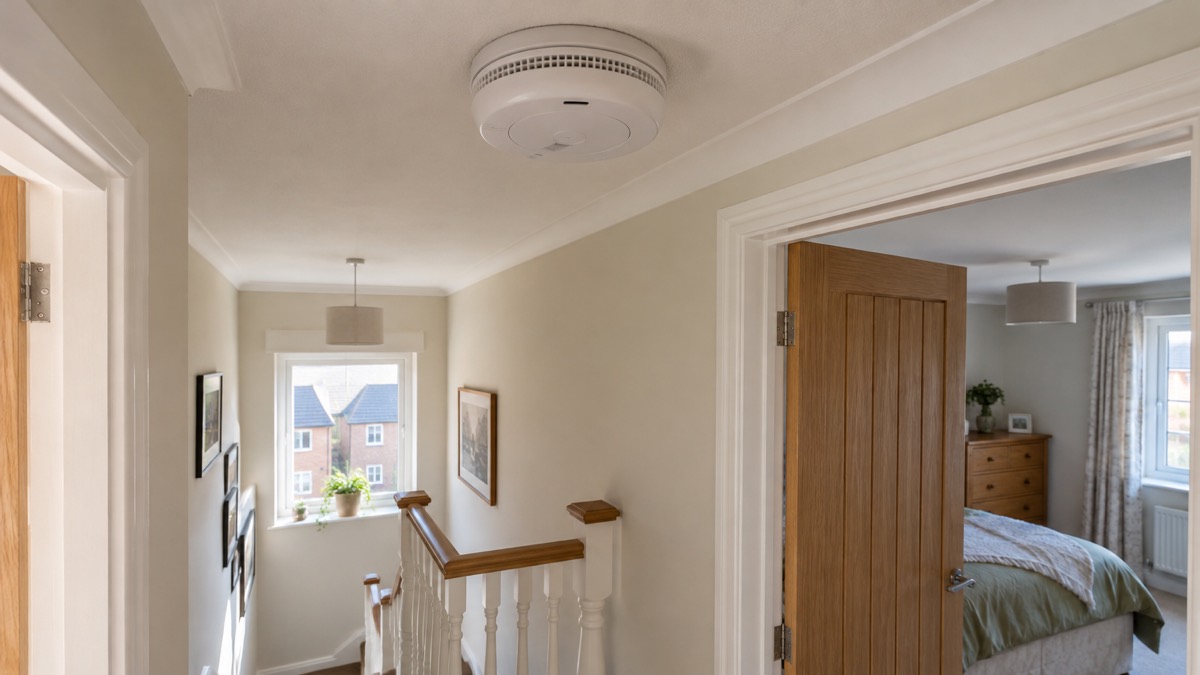
The standard position is on the ceiling, near the middle of the room, at least 30cm away from a wall or light2. Several fire services give the same figure in both metric and imperial: at least 30 centimetres, or 12 inches, from any wall or light fitting3. The reason for the clearance is air. Smoke gathers in the still layer where the ceiling meets the wall, and an alarm tucked into that corner can take longer to respond. Light fittings and other obstructions create the same problem.
Fit the alarm as close to the centre of the room as possible, subject to that 30cm clearance3. The fixing itself can be screws or a specialist sticky pad3.
Where a smoke alarm must not go: kitchens and bathrooms
Do not fit smoke alarms in kitchens or bathrooms, where smoke or steam could set them off accidentally2. Staffordshire Fire and Rescue Service puts the bathroom case plainly: do not fit an alarm in the bathroom, as steam may trigger the alarm4. Guidance for people living with dementia says the same of both rooms, because heat and vapour from cooking and bathing can set them off unnecessarily10.
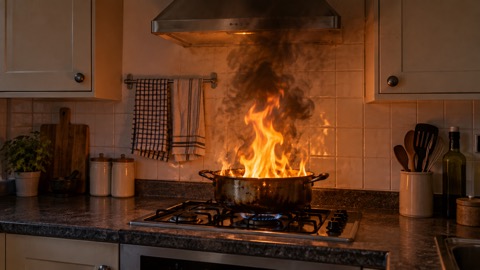
The kitchen still needs cover, just of a different kind. Install a heat alarm in the kitchen instead2. Heat alarms are more suitable for detecting fires in kitchens or other rooms where steam, fumes or moisture could cause nuisance alarms in smoke alarms1. Surrey Fire and Rescue Service advises heat alarms in kitchens, garages and immediately outside a bathroom, as these will not be triggered by steam and dust11. Lincolnshire Fire and Rescue suggests considering a heat alarm in the kitchen12, and guidance for carers says a heat alarm should be installed in the kitchen13.
There is a further reason to keep smoke alarms out of the kitchen in some homes. Guidance for thatched properties says not to install a smoke alarm in the kitchen where it can be set off accidentally14. If you want the detail on how heat alarms differ, see Heat Alarms: What They Do and Where They Go and the comparison Heat Alarm or Smoke Alarm: Which Goes Where.
Wall mounting, sloping ceilings and awkward rooms
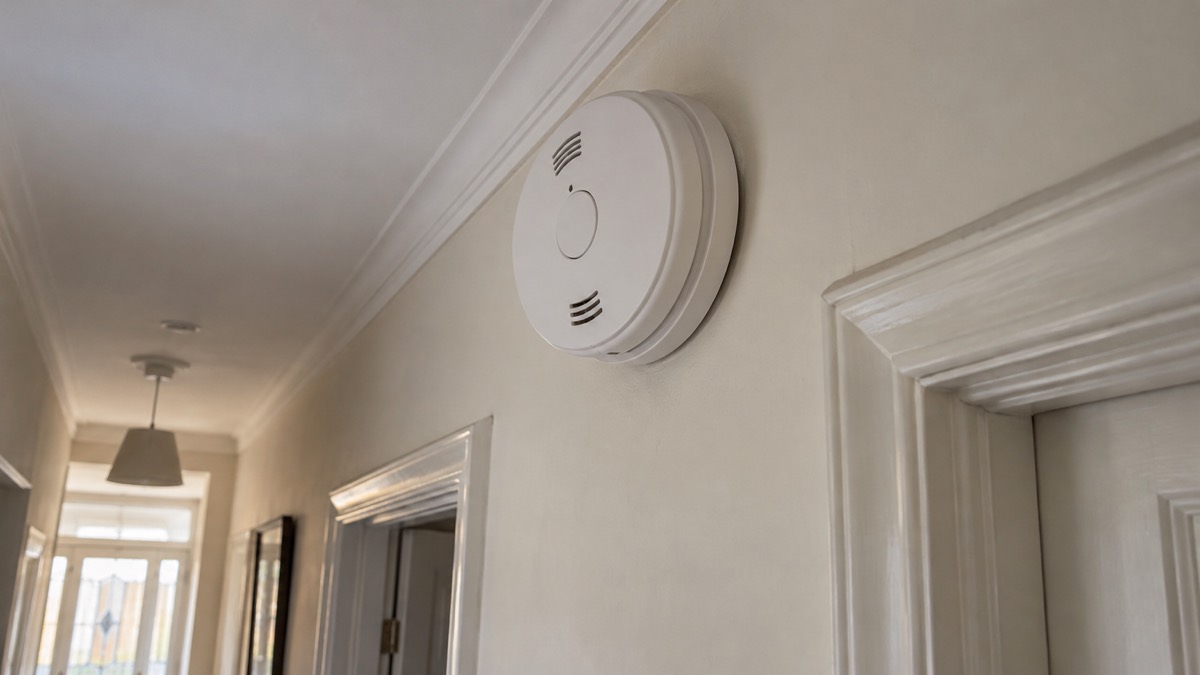
A ceiling fixing is the default, but it is not always possible. As an alternative, mount the alarm on a wall, at least 30 centimetres below the ceiling5. Scottish guidance for the tolerable standard sets the wall rule from the other direction: alarms on walls should be located within 30cm of the ceiling at its highest end15. It allows a wall position where the manufacturer indicates the alarm is suitable, in spaces of limited area such as hallways16.
Sloping ceilings have their own rule. Alarms in rooms with sloping ceilings should be sited at the highest point of the ceiling17. That is where the smoke will collect. Keep the 30cm clearance from walls and lights where the shape of the room allows it.
Some rooms are simply difficult. A narrow hall, a ceiling with a light fitting in the centre, or a ceiling that cannot be drilled all push the alarm away from the ideal spot. In those cases, work through the order of preference: ceiling near the middle first, then ceiling clear of the obstruction, then a wall position within 30cm of the ceiling where the maker allows it15. What matters is that the alarm is on every level and that you can hear it.
Rented homes: what the landlord must provide
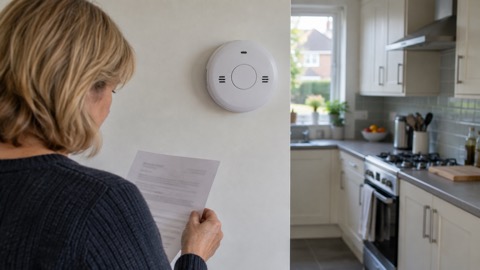
If you rent, the alarm layout is not yours to arrange alone. In the private rented sector, landlords have been required since 2015 to install at least one smoke alarm on every floor of the property where there is living accommodation18. Guidance for rented homes says at least one smoke alarm should be installed on every storey used as living accommodation, fixed to the ceiling in a circulation space, such as a hall or a landing19.
The same guidance says landlords should choose the type of alarm based on the needs of the building and their tenants, and that alarms should comply with British Standards BS 5839-619. For tenants in private rented accommodation, smoke alarms should be fitted by your landlord on each level of the property, which may differ for a block of flats and should be outlined in your tenancy agreement20.
So the practical steps for a tenant are these:
- Check that there is a working alarm on every level, including the hall or landing19.
- Check the tenancy agreement for what the landlord has agreed to provide20.
- Report a missing or failed alarm to the landlord rather than leaving it.
- Test the alarms regularly, as you would in any home21.
If you live in a flat, the arrangements for the building as a whole are different from those inside your own front door. What to Do If There Is a Fire in Your Block of Flats covers that, and Fire Safety Checklist for Flats sets out what to check.
Scotland: ceiling mounted, interlinked, and a heat alarm in the kitchen
Every home in Scotland has had to meet a fire and smoke alarm standard since February 20226. The standard is more prescriptive than the minimum elsewhere in the UK, and it is worth knowing even if you live south of the border, because it shows what a full layout looks like. Heat alarms are more suitable for detecting fires in kitchens or other rooms where steam, fumes or moisture could cause nuisance alarms in smoke alarms1.
All smoke and heat alarms should be attached to the ceiling and be interlinked22. The layout is one smoke alarm in the living room or the room you use most, smoke alarms in circulation spaces such as hallways and landings, and one heat alarm in the kitchen6. All alarms must be ceiling mounted and interlinked6. Heat alarms are more suitable for detecting fires in kitchens or other rooms where steam, fumes or moisture could cause nuisance alarms in smoke alarms1.
Open plan living has its own rule. If you have an open plan area, for example a combined hall and living room, you only need one alarm, but it should be no more than 7.5 metres from any point in the room; if the area includes a kitchen, then it should be a heat alarm22.
| Requirement | Scottish standard |
|---|---|
| Fixing | All alarms ceiling mounted6 |
| Linking | All alarms interlinked6 |
| Living space | One smoke alarm in the living room or the room you use most22 |
| Halls and landings | Smoke alarms in circulation spaces6 |
| Kitchen | One heat alarm22 |
| Open plan | One alarm, no more than 7.5 metres from any point, a heat alarm if the area includes a kitchen22 |
For England, Wales and Northern Ireland, the minimum on every level applies, and the Wales and Northern Ireland: Alarm Rules and Fire Services page covers where the arrangements differ. If you are choosing between linked and standalone alarms, Interlinked Alarms: How Linking Works explains the options.
Extra alarms for older people, carers and anyone hard of hearing
Age and hearing change what an alarm needs to do, not where it goes. For older people, the advice is to fit and maintain a smoke alarm on each level of the home, ideally on the ceiling in the middle of a room or in the hallway or landing, and not in or near kitchens or bathrooms where smoke or steam can set them off by accident23. That is the same layout as for anyone else, with the emphasis on keeping it working.
Hearing loss is the point at which the equipment changes. If you are deaf or hard of hearing, the local fire and rescue service can advise on specialist alarms, such as vibrating pads and strobe lights, that warn you in other ways24. The detail is on Smoke and CO Alarms for Deaf and Hard of Hearing People.
For a person living with dementia, the layout is deliberately simpler: alarms are not needed in every room and are best fitted in hallways and at the top of stairs10. For carers and support workers, the guidance is to fit smoke alarms in all areas where a fire can start, including bedrooms and lounges, with a heat alarm in the kitchen25.
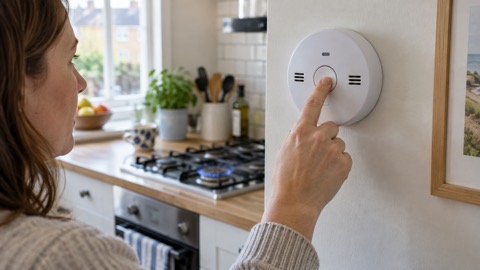
Testing is part of the routine. Ask a friend, family member or neighbour to test your smoke alarm every week24. How Often to Test Smoke and CO Alarms sets out a schedule, and Fire Risk Checks for a Vulnerable Person's Home is a checklist for anyone supporting someone else.
Screws or a sticky pad, and the carbon monoxide alarm alongside
The fixing is a practical choice. Fire service guidance describes fitting the alarm screwed to the ceiling or with a specialist sticky pad3. Screws hold firm and suit a ceiling where the alarm sits above your head. A pad avoids drilling and suits a rented home or a ceiling that will not take a fixing, provided it is a pad made for the purpose and fitted as the maker instructs. Whichever you use, the position rules above still apply.
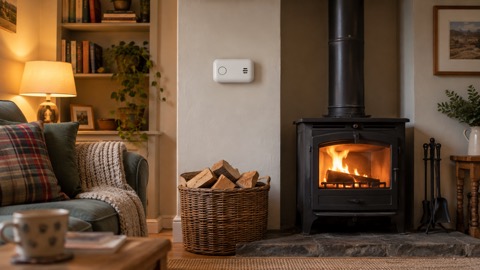
Smoke alarms are only part of the picture. A carbon monoxide alarm belongs in every room with a fixed fuel-burning appliance, such as a gas fire, gas boiler, log burner or open fireplace26. Guidance for rented homes puts them at head height, on a wall or shelf, about 1 to 3 metres from a potential source19. Place them near the sleeping areas and on every level of your home, and test and maintain them regularly21. Fit one in all rooms containing fuel-burning appliances, make sure the alarm can be heard throughout your home, and consider keeping one in the bedroom27. In a room with a sloping ceiling, site it at the highest point17.
Where to Put a Carbon Monoxide Alarm covers the detail, and Carbon Monoxide Alarms: What They Do and How to Choose covers the equipment. If you are fitting alarms as part of a wider plan, Smoke Alarms: Types and How to Choose One and the Fire Safety Checklist for Your Home put the positions in context, and How Many Smoke Alarms Does a House or Flat Need? works through the count room by room.
Sources (27)
- Smoke and heat alarms, Manchester Fire and Rescue Service, 2026
- Advice for parents and guardians, Devon and Somerset Fire and Rescue Service, 2026
- Smoke alarms, Warwickshire County Council, 2026
- Smoke alarms, Staffordshire Fire and Rescue Service, 2026
- Smoke alarms and CO detectors, Warwickshire County Council, 2026
- Home fire safety, Scottish Government, 2026
- Smoke alarms, Oxfordshire County Council, 2026
- Home oxygen, Manchester Fire and Rescue Service, 2026
- Smoking, Manchester Fire and Rescue Service, 2026
- Dementia fire safety, North Wales Fire and Rescue Service, 2026
- Detectors, Surrey County Council, 2026
- Kitchen safety, Lincolnshire Fire and Rescue, 2026
- Fire safety for carers, Devon and Somerset Fire and Rescue Service, 2026
- Thatched property safety guide, Suffolk County Council, 2023
- Tolerable Standard guidance: satisfactory fire detection, Scottish Government, 2023
- Tolerable Standard guidance: satisfactory fire and carbon monoxide detection, Scottish Government, 2023
- Alarm advice sheet, North Wales Fire and Rescue Service, 2024
- Smoke alarms, Cheshire Fire and Rescue Service, 2026
- Housing standards, Cherwell District Council, 2026
- Student and rented accommodation, North Yorkshire Fire and Rescue Service, 2026
- Safe home heating, Warwickshire County Council, 2026
- Fire and smoke alarms in Scottish homes, Scottish Government, 2024
- Older person safety, Mid and West Wales Fire and Rescue Service, 2026
- Hearing and sight impairments, North Wales Fire and Rescue Service, 2026
- Advice for carers and support workers - Alarms | London Fire Brigade, London Fire Brigade
- Carbon monoxide, Manchester Fire and Rescue Service, 2026
- Fire alarms and carbon monoxide detectors, Lincolnshire Fire and Rescue, 2026
 Home Fire Safety Checklist
 Bedtime Fire Safety Checks
 Fire Risk Checks for Carers
 Why a CO Alarm Is Beeping
 Smoke Alarm Keeps Chirping
 Testing Smoke and CO Alarms
 Replacing Smoke and CO Alarms
 How Many Smoke Alarms
 Where to Put a CO Alarm
 Do I Need a CO Alarm
 Can a CO Alarm Detect a Gas Leak
 Trapped by Fire What to Do
 Putting Out a Chip Pan Fire
 Electrical Fire Safety
 Appliances Left On Overnight