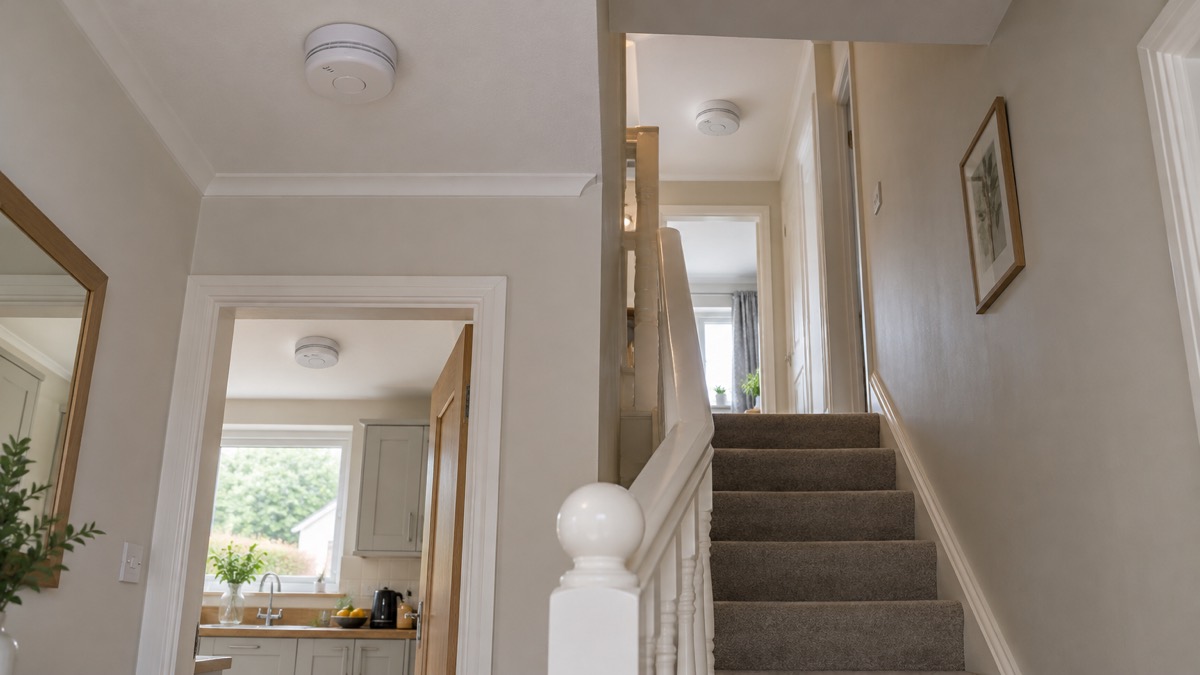
When you buy a smoke alarm, heat alarm or carbon monoxide alarm in the UK, you are buying a product built to a written standard. The two you will see most often are BS 5839-6, the British Standard for fire detection and alarm systems in domestic premises, and BS EN 50291, the standard for carbon monoxide alarms. Between them they answer three practical questions: how many alarms your home should have, how each one is powered, and how you can tell a properly tested alarm from one that is not.
The starting point is simple. Fire and rescue services across the UK say you need at least one smoke alarm on each level of your home1, and Manchester Fire and Rescue Service adds that every home should also have a heat alarm in the kitchen2. The standards then describe the systems behind that minimum: BS 5839-6 sorts alarm systems into grades, from Grade A down to Grade F2, according to how they are powered and how they are put together3. Local authority housing guidance recommends a specific combination for rented homes: mains-powered alarms with battery back-up, interlinked, installed to BS 5839-6:2019 Grade D at level LD24.
What BS 5839-6 asks of a home
BS 5839-6 is the British Standard for fire detection and fire alarm systems in domestic premises. For an ordinary household it sets a floor beneath which no home should fall, and that floor is a working smoke alarm on every floor of the house.
Every fire and rescue service that publishes guidance on this says the same thing. Devon and Somerset Fire and Rescue Service states plainly: "You need at least one smoke alarm on each level of your home"1. Staffordshire Fire and Rescue Service tells households to install working smoke alarms on every floor8. The Northern Ireland Fire and Rescue Service, in a winter safety appeal, asked every household to have a working smoke alarm fitted on each floor of the property9, and in earlier guidance it added that you should consider additional alarms in the most used rooms, such as living rooms and bedrooms9. Manchester Fire and Rescue Service, in guidance for people caring for others, says there should be a minimum of one working smoke alarm on every floor of the home, with additional alarms depending on risk10.
So the standard's minimum, as the fire services present it, is a per-floor rule, not a per-house rule. A two-storey house with a loft conversion used as a room needs alarms on each level where people live. Beyond that minimum, the amount of protection rises with the level of detection the system provides, which is where the LD levels and the system grades come in. If you are working out how many alarms your own home needs, our page on how many smoke alarms a house or flat needs breaks it down room by room.
System grades from A to F2: how each one is powered
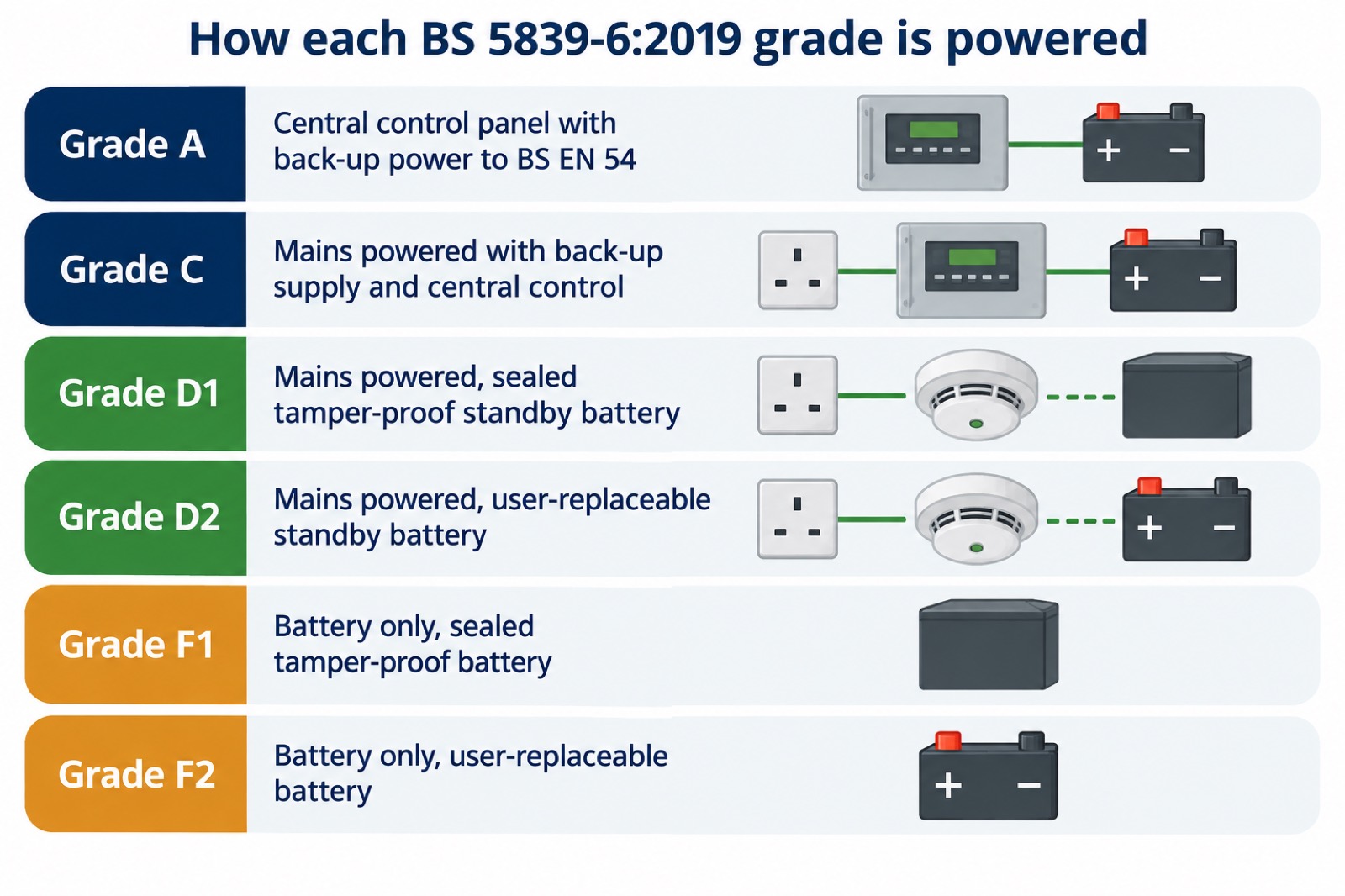
The grade of an alarm system describes how it is built and powered. BS 5839-6:2019 defines six grades, and the differences between them matter when you are choosing alarms or checking what a landlord has installed3.
| Grade | What it is | How it is powered |
|---|---|---|
| A | Separate detectors, sounders and central control and indicating equipment | Central control equipment with a back-up power supply conforming to BS EN 543 |
| C | Separate detectors and sounders with central control equipment | Mains powered with back-up power supply3 |
| D1 | One or more mains-powered detectors | Tamper-proof standby battery or batteries3 |
| D2 | One or more mains-powered detectors | User-replaceable standby battery or batteries3 |
| F1 | One or more battery-powered detectors | Tamper-proof primary battery or batteries3 |
| F2 | One or more battery-powered detectors | User-replaceable primary battery or batteries3 |
Grade A is the most elaborate: a full system with its own control panel, closer to what you would find in a large building than in a family house. The Scottish Government's guidance on the tolerable standard notes that Grade A systems use smoke, heat and multi-sensor detectors, and that Grade C systems also include fire alarm sounders and visual or vibrating alarm devices, and that either grade can be used to meet the standard if installed in compliance with BS 5839-65. For most ordinary homes, though, the grades that matter in practice are D and F, because they cover the alarms you buy yourself or find fitted in a rented property.
Grade D1 or D2: sealed battery backup or one you replace
Grade D covers mains-powered alarms, and the 2019 edition of the standard splits it into two. Grade D1 is defined as "a system of one or more mains powered detectors, each with a tamper-proof standby supply consisting of a battery or batteries"3. Grade D2 is "a system of one or more mains-powered detectors, each with an integral standby supply consisting of a user-replaceable battery or batteries"3. The difference is one sentence, but it changes what you do for the next ten years: with a D1 system you leave the battery alone, and with a D2 system you replace it when it runs down.
The practical case for the sealed battery is set out by the fire services. Manchester Fire and Rescue Service advises that "buying an alarm with a sealed battery compartment will help to prevent tampering or removal of the battery"11. Suffolk Fire and Rescue Service's home fire safety guidance goes further on battery alarms generally: "Ten-year sealed battery smoke alarms are the best option"12. On the other side of the choice, Cheshire Fire and Rescue Service notes that many hard-wired smoke alarms have a back-up battery that will need to be replaced when it fails13, which is the D2 arrangement.
One warning applies whichever you have. Westminster City Council's fire safety guidance states: "Some alarms are fitted with 10 year or long-lasting sealed batteries, these should not be removed or replaced as doing so will damage the alarms beyond repair"14. So if your alarm has a sealed battery, the whole unit is replaced at the end of its life, not the battery. Our comparison of sealed 10-year or replaceable battery alarms works through the trade-offs, and battery or mains smoke alarms covers the wider choice.
Grade F1 and F2 battery-only alarms
Grade F covers alarms that run on batteries alone, with no connection to the mains, and it is split in the same way as Grade D. Grade F1 is "a system of one or more battery-powered detectors powered by a tamper-proof primary battery or batteries"3. Grade F2 is "a system of one or more battery-powered detectors powered by a user-replaceable primary battery or batteries"3. FireAngel lists its ST-750 alarm as an example of a Grade F1 product and its SB1 as an example of Grade F23.
The older style of battery alarm is the F2 pattern. Dorset and Wiltshire Fire and Rescue Service describes the basic type: "Basic smoke alarms run off nine volt batteries, and these should be replaced on a regular basis"15. The same nine-volt battery appears inside some mains-linked alarms: nidirect, the Northern Ireland government service, notes that smoke alarms linked to the home mains electrics can contain a nine-volt back-up battery that needs to be changed according to the manufacturer's instructions16. The lesson from both is the same: an alarm with a replaceable battery is only protecting you if someone in the household actually replaces it, which is why the fire services now point households towards sealed long-life batteries and weekly testing.
Grades B and E no longer exist, and D and F have been split
If you have read older advice about alarm grades, you may see grades mentioned that no longer apply. The 2019 edition of BS 5839-6 changed the list. As FireAngel's product documentation puts it, the update removed Grade B and Grade E, while "Grade D and Grade F have been split into Grade D1 / Grade D2 and Grade F1 / Grade F2 respectively, and Grade C has been revised and its recommendations expanded"3. The same document states it plainly: "Grades B and E are no longer defined in BS 5839-6:2019"3.
For a household, this matters in two situations. First, if you are checking an older installation or an old report that refers to a Grade B or Grade E system, those labels describe arrangements the standard no longer recognises, and the system should be judged against the current grades instead. Second, when you buy a new alarm, the grade printed on the box or the maker's page should be one of the six current grades: A, C, D1, D2, F1 or F2. A product described only as "Grade D" or "Grade F" without the number is using the pre-2019 labels, and it is worth checking with the maker which of the split grades it now falls into.
Levels of protection: how much of the home is covered
Alongside the grades, BS 5839-6 uses levels of detection, written as LD levels, to describe how much of the home the alarm system covers. The grade tells you how the system is powered; the LD level tells you where the detectors sit and how much warning they give.
The level that appears in official housing guidance is LD2. Cherwell District Council's housing standards recommend that all rented homes be equipped with smoke alarms and heat detectors that are "mains-powered with integral battery back-up, wirelessly interlinked and installed by a competent electrician to British Standard BS 5839-6:2019 Grade D LD2"4. That combination, Grade D at LD2, is the arrangement English local authority guidance treats as the benchmark for rented housing: mains power, a battery that keeps working in a power cut, alarms that sound together, and coverage of the escape routes and the main rooms.
Scotland sets its own benchmark through the tolerable standard, and it is more specific about numbers. The Scottish Fire and Rescue Service says: "If your home is on one level, a flat or bungalow, you need to fit at least two smoke alarms"17. Its guide for carers adds that if your home has more than one level, you will need one on each floor, plus the living room, and that all alarms should be ceiling mounted and interlinked18. The Scottish Government's guidance on the tolerable standard confirms the standard can be met by Grade A or Grade C alarms installed in compliance with BS 5839-619, and that smoke alarms should conform to BS EN 1460419. If you rent in Scotland, or you are a landlord there, these are the numbers to work to; our page on Wales and Northern Ireland alarm rules covers the arrangements in the other nations.
Where alarms go: hallways, landings and the ceiling
The standard's placement rules aim to put alarms where a fire will be detected early and where the sound will reach sleeping people. The fire services' guidance gives the practical detail.
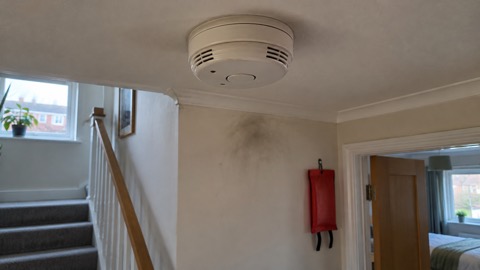
- Fit a minimum of one working smoke alarm on every level, preferably in a circulation space such as a hallway or landing20
- Put a smoke alarm in every circulation space on each storey, such as hallways and landings21
- Mount alarms on the ceiling, near the middle of the room or hall, and at least 30cm away from a wall or light fitting22
- If you live on one level, fit the alarm in the hallway between the living and sleeping areas23
- Consider alarms in bedrooms and other sleeping areas as extra protection1
The 30cm rule matters more than it looks. Devon and Somerset Fire and Rescue Service, in guidance for vulnerable people, advises that a smoke alarm should be on the ceiling at least 30cm away from the wall, and near the middle of the room or hall22. Oxfordshire Fire and Rescue Service adds a useful detail for anyone hard of hearing: choose an alarm with an emergency light that comes on when the alarm is triggered23. For room-by-room positioning, see where to fit smoke alarms.
Kitchens need a heat alarm, not a smoke alarm
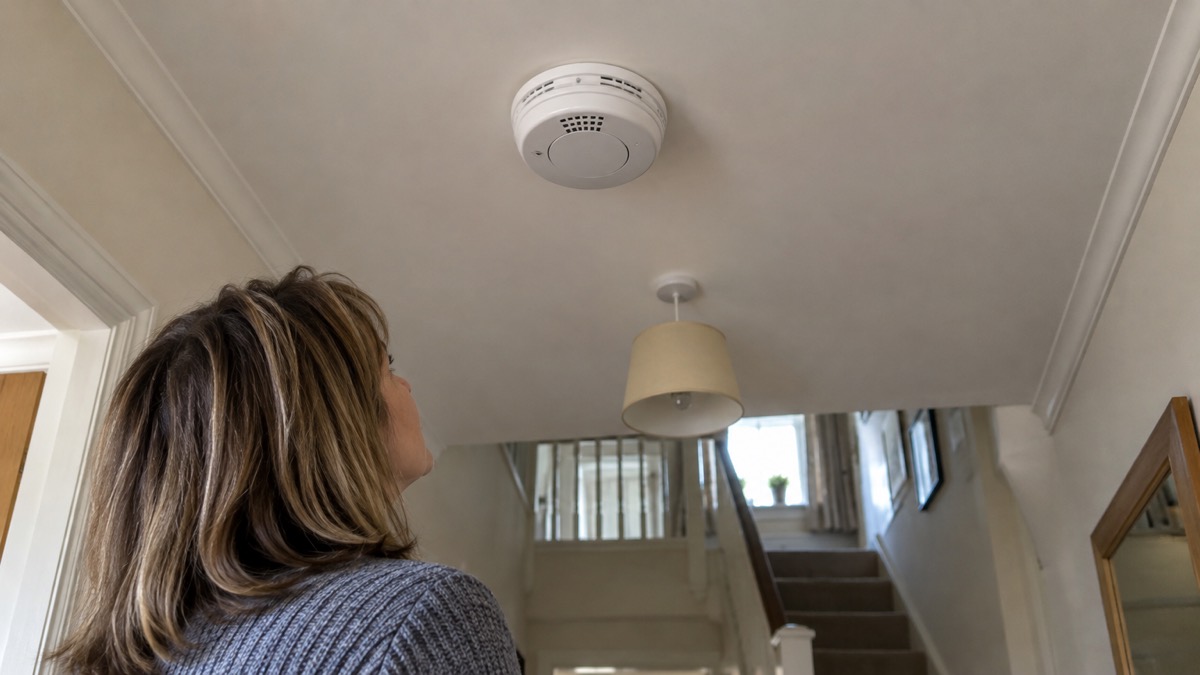
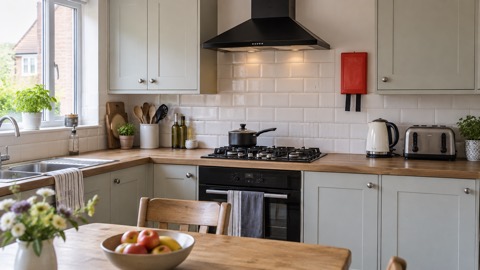
The kitchen is the one room where the standard rules out smoke alarms. The Scottish Government's guidance on the tolerable standard cites the standard directly: "BS 5839-6:2019, Clause 12.2(f) states that only heat alarms should be used in kitchens"5. The same guidance adds a concession for existing homes: an existing smoke alarm in a kitchen need not be replaced until the end of its manufacturer's recommended lifespan5.
The reason is nuisance alarms. Devon and Somerset Fire and Rescue Service advises: "Do not fit smoke alarms in kitchens or bathrooms where smoke or steam could set them off accidentally. Install a heat alarm in the kitchen instead"1. London Fire Brigade explains what the heat alarm does: "Heat alarms go off when the room reaches a certain temperature and should be placed in the kitchen instead of a smoke alarm"24, and fitting one "will give you warning of an increase in temperature caused by a fire but will not be set off by cooking fumes"24.
So a kitchen protected to the standard has a heat alarm on the ceiling, and the smoke alarms stay in the hall, landing and living rooms. If your kitchen currently has a smoke alarm that goes off every time you make toast, the standard's answer is to replace it with a heat alarm when it reaches the end of its life, not to disconnect it. Our pages on heat alarms and on heat alarm or smoke alarm explain the choice, and kitchen fires covers preventing the fires the alarms are there to detect.
BS EN 50291: the carbon monoxide alarm standard
Carbon monoxide alarms have their own standard, BS EN 50291, and it comes in two parts that are easy to confuse. Part 1 covers alarms for use in domestic dwellings. North Wales Fire and Rescue Service's advice is direct: "For domestic dwellings only use BS EN 50291-1:2010 compliant alarms"6. Part 2 covers alarms for use where conditions are different: Lincolnshire County Council notes that "if purchasing an alarm for a houseboat or caravan, please note that they need to comply with a different British standard: BS EN50291-2"7.
The reason for the split is that caravans, motorhomes and boats experience vibration, temperature swings and damp that a house does not. Humberside Fire and Rescue Service, in its caravan and motorhome safety guidance, says to "ensure there is a carbon monoxide (CO) alarm that is tested to BS EN50291-2 and kitemarked"25, and to have smoke and CO alarms in place and test them regularly25. Dorset and Wiltshire Fire and Rescue Service, in its boat safety guidance, says to "fit alarms that meet BS EN 50291-2; these are best suited for boats, choose only those with a BSi or LPCB certification mark"26.
Placement in the home follows the appliance rather than the room count. Cadent's carbon monoxide leaflet, published through Bedfordshire Fire and Rescue Service, advises that "any room with a fuel-burning appliance should have a CO alarm placed at door height, between 1-3 metres away from the appliance"27. North Wales Fire and Rescue Service gives the same distances in millimetres: minimum 1000mm from the appliance, maximum 3000mm6. Northamptonshire Fire and Rescue Service adds that before purchasing you should make sure the alarm is officially approved to BS:EN50291:2001 or BS:EN50291:2010 and carries a British or European approval mark such as a Kitemark28. For choosing an alarm, see carbon monoxide alarms; for where to put it, where to put a carbon monoxide alarm.
Checking an alarm's standard marking
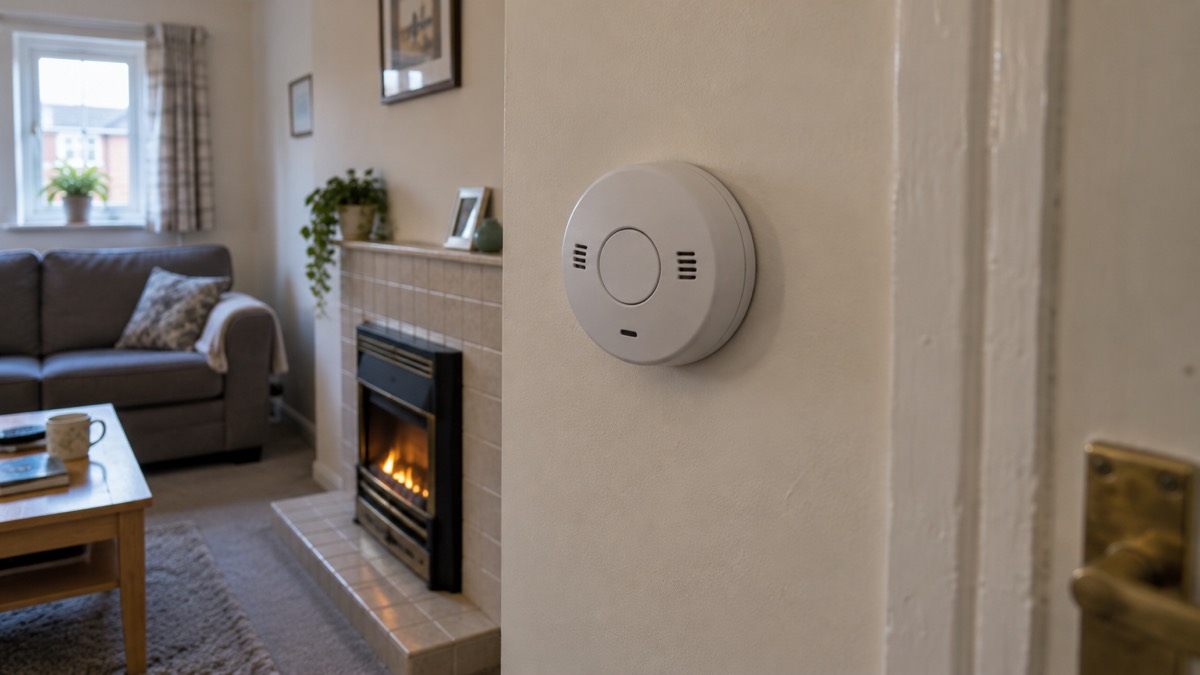
Whatever you are buying, the marks on the alarm are how you know it has been tested. Lincolnshire County Council's fire safety guidance says to "look out for the British Standard Kitemark and Loss Prevention Certification Board (LPCB) symbols, which shows the alarm is approved and safe"7. Manchester Fire and Rescue Service says the same for smoke alarms: "Whichever model you choose, look out for one which has a British Standard Kitemark symbol"11. London Fire Brigade advises: "Make sure any alarms you buy are marked with a current British Standards or European (CE) safety mark"24.
For smoke alarms specifically, the Scottish Government's guidance states that smoke alarms should conform to BS EN 1460419. For carbon monoxide alarms, Bedfordshire Fire and Rescue Service, publishing Cadent's guidance, says to "make sure your CO alarm complies with British Standards BS EN50291-1. Look for the BSI Kitemark logo"27. On boats, Dorset and Wiltshire Fire and Rescue Service says to look for a BSi, LPCB, or the German VdS certification mark on smoke alarms26.
A checklist before you buy or check an alarm:
- Smoke alarm: BS EN 14604 conformity, and the Kitemark or LPCB symbol7
- CO alarm for a house: BS EN 50291-1:2010, with the BSI Kitemark6
- CO alarm for a caravan, motorhome or boat: BS EN 50291-2, kitemarked, with a BSi or LPCB mark25
- Any alarm: a current British Standards or European (CE) safety mark24
Does your home need a Grade D1 system?
Whether your home needs a Grade D1 system, with mains power and a sealed standby battery, depends mostly on whether you own or rent, and where in the UK you live.
In England, the legal floor for private rented homes is lower than the standard's recommendations: landlords have been required since 2015 to install at least one smoke alarm on every floor where there is living accommodation13. Cherwell District Council's housing standards recommend the fuller arrangement for all rented homes: mains-powered smoke alarms and heat detectors with integral battery back-up, wirelessly interlinked, installed by a competent electrician to BS 5839-6:2019 Grade D LD24. Dorset and Wiltshire Fire and Rescue Service's landlord guidance likewise tells landlords to install a smoke alarm on every floor of their property29. If you rent, that Grade D LD2 recommendation is the benchmark to raise with your landlord; if you own, it is the arrangement worth aiming for when you next replace your alarms, and interlinked alarms explains how the linking works.
In Scotland, the tolerable standard applies to all homes, not just rented ones, and it is met through alarms installed in compliance with BS 5839-619. The Scottish Fire and Rescue Service's numbers apply: at least two smoke alarms for a single-level home, one on each floor plus the living room for a multi-storey home, all ceiling mounted and interlinked17. The Scottish Government's guidance also allows the standard to be met by Grade A or Grade C systems19, which is where the visual and vibrating alarm devices of a Grade C system can matter for a deaf or hard of hearing household.
For an owner-occupied home in England or Wales, no law compels you to fit a Grade D1 system, but the fire services' advice points the same way: alarms on every floor, a heat alarm in the kitchen, sealed long-life batteries, and weekly testing. The Northern Ireland Fire and Rescue Service frames the whole thing in four letters: smoke alarms on every floor, test weekly, be aware of obvious dangers, and plan your escape route30. Our fire safety checklist and fire escape plan pages take those last two steps further.
Alarms for people with impaired hearing
A standard alarm is useless to someone who cannot hear it, and the standards and the fire services have an answer for that too. The Northern Ireland Fire and Rescue Service says: "For anyone with impaired hearing, there are sensory alarms available which include a vibrating pad and flashing light", and suggests contacting your GP to arrange an assessment30. Lincolnshire County Council lists the range: smoke alarms, heat alarms and specialist alarms like strobe lights and vibrating pad alarms for people with hearing impairments, linked alarms, and monitored alarms connected to Telecare7.
The relevant product standard is BS 5446-3. Cheshire Fire and Rescue Service advises: "Choose products that meet British Standard BS5446-3:2015"13. The Scottish Fire and Rescue Service's deaf awareness guidance explains what the standard covers: "British Standard BS5446-3:2005 specifies smoke alarm kits for deaf and hard of hearing people. Products made to this standard give deaf people assurance of quality smoke alarms designed to meet their needs", with features ranging from strobe lighting to vibrating alarms31. Note that the two services cite different editions of the standard, 2015 and 2005; the newer edition is the one to look for. Northamptonshire Fire and Rescue Service confirms that strobe lighting and vibrating pad alarms are available for those who are deaf or hard of hearing28. Our dedicated page on smoke and CO alarms for deaf and hard of hearing people goes into the kits in detail.
Frequently asked questions
What alarms does a landlord have to provide in a rented home? Landlords in the private rented sector have had to install at least one smoke alarm on every floor with living accommodation since 201513. Local authority housing guidance goes further and recommends mains-powered smoke alarms and heat detectors with integral battery back-up, wirelessly interlinked and installed by a competent electrician to BS 5839-6:2019 Grade D, LD24. Carbon monoxide alarms in rented homes should be compliant with BS 502914. If you rent and are unsure what your home has, ask your landlord or letting agent.
Are there alarms for people who cannot hear a standard alarm? Yes. Sensory alarm kits are available with a vibrating pad that goes under a pillow and a flashing strobe light30. Cheshire Fire and Rescue Service advises choosing products that meet British Standard BS 5446-3:2015, which specifies smoke alarm kits for deaf and hard of hearing people13. The Northern Ireland Fire and Rescue Service suggests contacting your GP to arrange an assessment30, and some fire and rescue services can help through home fire safety visits.
How far should a heat alarm be from the cooker? BS 5839-6:2019 states that only heat alarms should be used in kitchens, because cooking fumes would set off a smoke alarm5. A heat alarm responds to a rise in temperature rather than smoke, so it can sit in the kitchen without nuisance alarms24. Fire and rescue services advise mounting alarms on the ceiling, near the middle of the room or hall, and at least 30cm away from a wall or light fitting22.
Do caravans and boats need a different CO alarm standard? Yes. A carbon monoxide alarm for a houseboat or caravan needs to comply with BS EN 50291-2 rather than the BS EN 50291-1 standard used in houses7. Humberside Fire and Rescue Service says to ensure the alarm is tested to BS EN 50291-2 and kitemarked25, and Dorset and Wiltshire Fire and Rescue Service advises choosing only those with a BSi or LPCB certification mark for boats26.
How do I check an alarm meets the right standard? Look on the alarm body and the packaging for the British Standard Kitemark and the Loss Prevention Certification Board (LPCB) symbol, which show the alarm has been approved and tested7. Smoke alarms should conform to BS EN 1460419. London Fire Brigade also advises checking for a current British Standards or European (CE) safety mark24. If the marking is unclear, check the manufacturer's product information before buying.
Should I put alarms in lofts and cupboards? The guidance for homes concentrates on circulation spaces: a smoke alarm in every hallway and landing on each storey, plus the rooms you live and sleep in21. Lofts and cupboards are not among the recommended locations. What matters most is that every alarm you have is working, so test weekly and never disconnect an alarm because of nuisance alarms.
Sources (31)
- Home safety advice for parents and guardians, Devon and Somerset Fire and Rescue Service
- Home Fire Safety Assessment, Manchester Fire and Rescue Service
- SCB10-R smoke and carbon monoxide alarm product page, FireAngel, 2026
- Housing standards, Cherwell District Council, 2026
- Tolerable standard guidance: satisfactory fire and carbon monoxide detection, Scottish Government, 2023
- Alarm advice sheet, North Wales Fire and Rescue Service, 2024
- Fire alarms and carbon monoxide detectors, Lincolnshire County Council, 2026
- Home fire safety visits, Staffordshire Fire and Rescue Service, 2026
- NIFRS calls on community to prioritise fire safety in the home this winter, Northern Ireland Fire and Rescue Service, 2022
- Caring for an emollient user, Manchester Fire and Rescue Service, 2026
- Smoke and heat alarms, Manchester Fire and Rescue Service, 2026
- Fire safety in the home, Suffolk Fire and Rescue Service, 2021
- Smoke alarms, Cheshire Fire and Rescue Service, 2026
- Fire safety in the home, Westminster City Council, 2017
- Smoke alarms, Dorset and Wiltshire Fire and Rescue Service, 2026
- Fire safety and prevention, nidirect, 2025
- Your guide to fire safety, Scottish Fire and Rescue Service, 2023
- Supporting fire safety at home: carers guide, Scottish Fire and Rescue Service, 2021
- Tolerable standard guidance: satisfactory fire and carbon monoxide detection, Scottish Government, 2023
- Hanukkah fire safety, Manchester Fire and Rescue Service, 2026
- Chimney fire safety, Scottish Fire and Rescue Service, 2026
- Smoke alarms for vulnerable people, Devon and Somerset Fire and Rescue Service, 2026
- Smoke alarms, Oxfordshire County Council, 2026
- Smoke alarms and heat alarms, London Fire Brigade, 2026
- Caravan, motor home and campervan safety, Humberside Fire and Rescue Service, 2026
- Smoke and carbon monoxide alarms on boats, Dorset and Wiltshire Fire and Rescue Service, 2022
- Carbon monoxide leaflet, Cadent, published via Bedfordshire Fire and Rescue Service, 2026
- Smoke and carbon monoxide alarms, Northamptonshire Fire and Rescue Service, 2026
- Smoke alarms for landlords, Dorset and Wiltshire Fire and Rescue Service, 2019
- Home fire safety, Northern Ireland Fire and Rescue Service, 2026
- Deaf awareness, Scottish Fire and Rescue Service, 2024
 Home Fire Safety Checklist
 Bedtime Fire Safety Checks
 Fire Risk Checks for Carers
 What to Do If Fire Starts
 How to Make a Fire Escape Plan
 Fire in a Block of Flats
 Kitchen Fires and Cooking Safety
 Electrical Fires and Sockets
 Smoking, Matches and Lighters
 E-bike Charging Safety
 Hoarding and Fire Risk
 Thatched Properties Fire Risk
 Fireworks and Bonfire Safety
 What to Do After a House Fire
 How Fire Services Respond