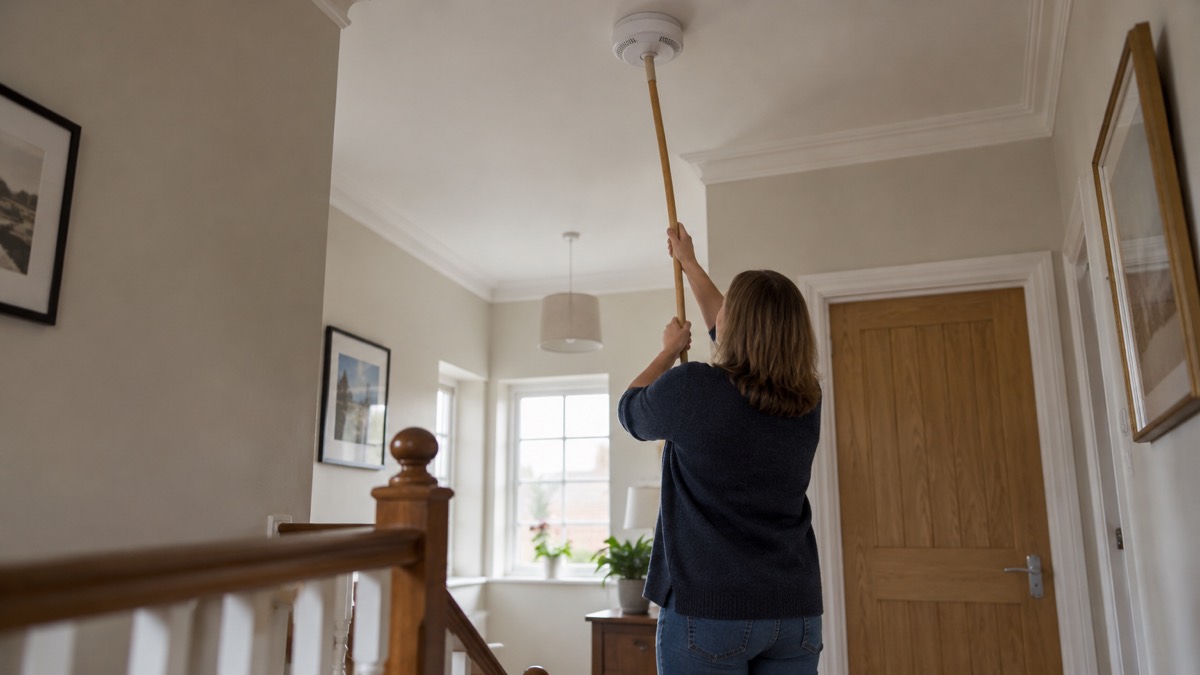
The FireAngel SB1 is a battery powered optical smoke alarm. It runs on one 9V (PP3) battery and is designed to pick up slow, smouldering fires, the kind that produce thick smoke before flames1. If you have one on your ceiling, the routine is simple: test it every month by holding the test button for 5 seconds, vacuum it every 3 months, and replace the battery when it starts to chirp1.
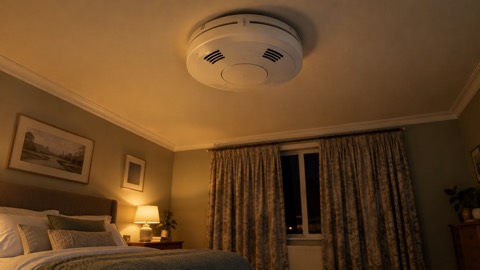
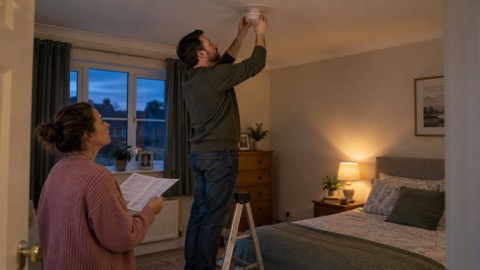
Fitting it is a household job. The alarm fixes to a base plate with two screws, with no electrician needed, and it should sit at least 300mm from walls and light fittings1. It is a standalone alarm, so it does not link to other alarms in the house3. That matters when you plan where to put it: each alarm protects the area around it, and a closed door between you and the alarm will muffle the sound.
The alarm has a 10 year product life, and the maker says to replace it every 10 years1. The battery is not the same as the alarm: it lasts about a year under normal use and is replaceable1. Keep a spare 9V battery in the house so a chirping alarm is a five minute job rather than a night's lost sleep.
What the FireAngel SB1 is and what it detects
The SB1 is an optical smoke alarm. Optical sensors look for smoke scattering light inside the chamber, which makes them good at catching slow smouldering fires, the sort that can smoulder in a sofa or a pile of bedding for a long time before flames appear1. The maker describes the optical alarm as responding quickly to slow, smouldering fires4. That is the fire type most likely to give a household time to get out, provided the alarm is working and in the right place.
It is certified to EN 14604:2005 +AC:2008, the standard for smoke alarm devices, and the maker lists BSI Kitemark independent certification across its alarm range1. The alarm sounds at 85dB(A) at 3m minimum, and when it senses smoke the red operational LED behind the plastic surface flashes every second while the alarm sounds continuously6. In normal standby the LED flashes about once every 32 seconds to show it is active7.
The SB1 is a standalone alarm with no interlink options3. If you want alarms that all sound together when one detects smoke, that is a different product and a different decision; our guide to interlinked alarms explains how linking works. For a single room, a hallway or a caravan, a standalone optical alarm does the basic job.
Where to fit it: at least 300mm from walls and light fittings
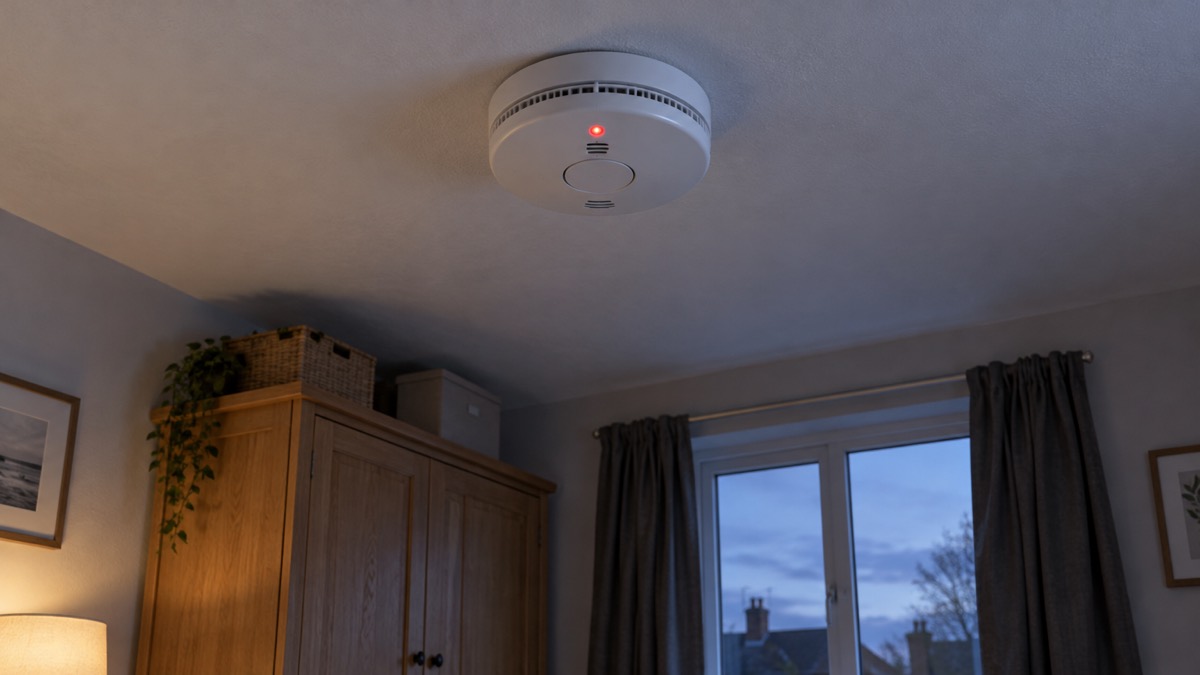
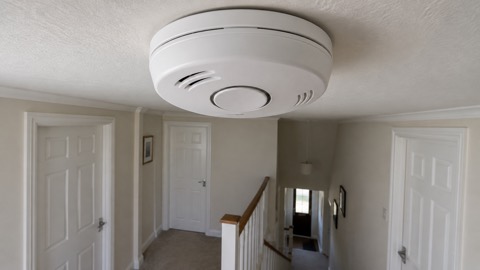
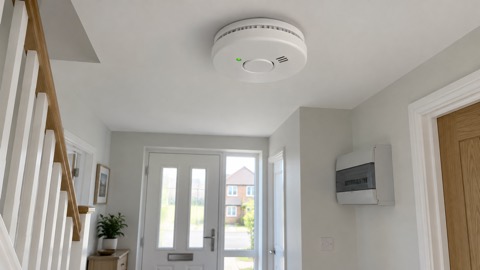
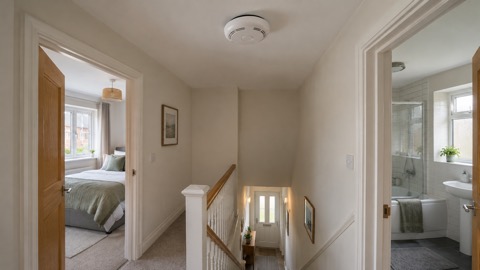
Fit the alarm on the ceiling, at least 300mm from light fittings and walls1. That distance keeps the sensor out of the dead air that gathers in corners, where smoke may not reach it quickly. The same 300mm rule appears in the maker's guidance for its heat alarms, so it is a consistent siting principle across the range8.
The maker recommends fitting smoke alarms in all rooms where the temperature stays between 0°C and 40°C1. Prolonged exposure outside that range will reduce the product's life7. That rules out a freezing loft or a hot conservatory in summer, and it is worth checking a garage or outbuilding before you fit one there.
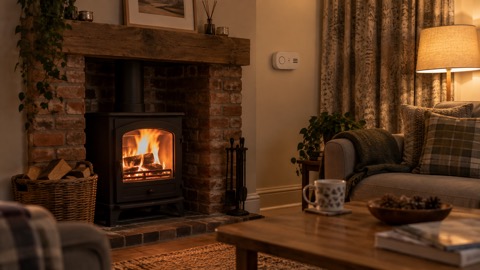
Optical alarms can be set off by steam and should not be placed near bathrooms1. Keep them out of the immediate path of a shower or a boiling kettle. The maker also advises against fitting a smoke alarm in a kitchen, attic or garage, and recommends a heat alarm in those places instead2. Our guide to heat alarms covers what they do and where they go.
The SB1 is suitable for use in mobile homes and caravans1. In a caravan the ceiling space is small, so site the alarm centrally and away from the door and any cooking area. Test it before each trip, the same as you would at home.
| Location | Suitable for the SB1? | Why |
|---|---|---|
| Hallway and landing | Yes | Early warning on the escape route2 |
| Bedroom and living space | Yes | Maker lists these as recommended locations2 |
| Near a bathroom | No | Steam causes nuisance alarms1 |
| Kitchen, attic or garage | No | Use a heat alarm instead2 |
| Caravan or mobile home | Yes | Maker states it is suitable1 |
Fitting the alarm with two screws and a base plate
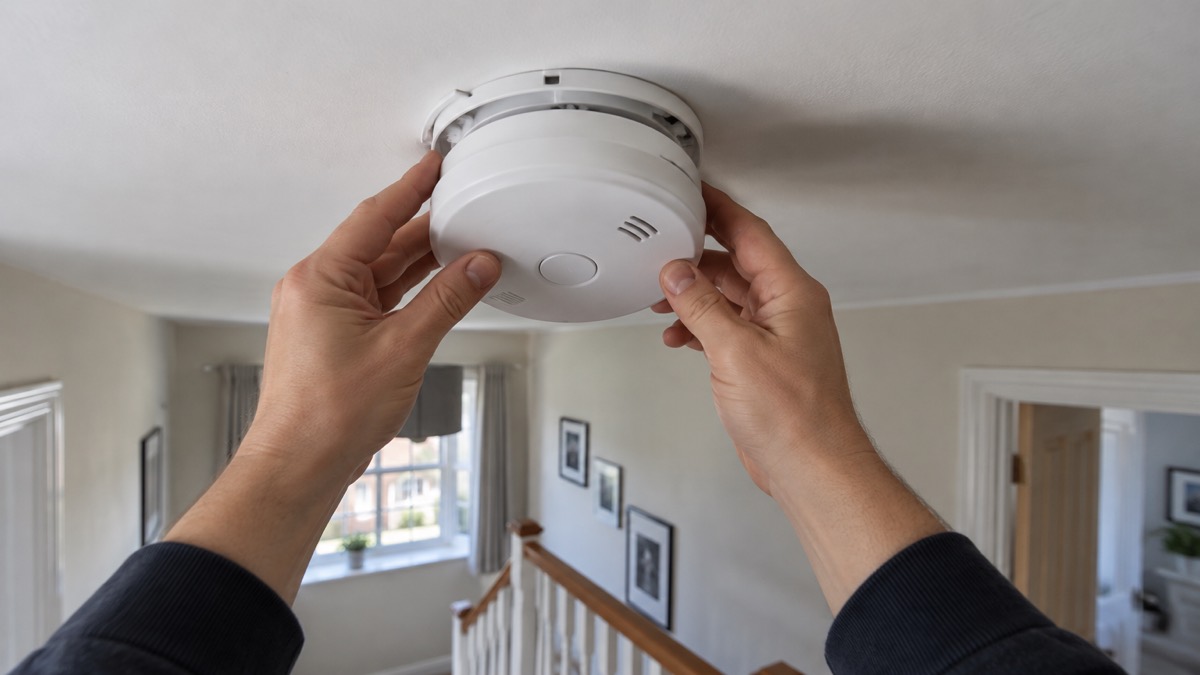
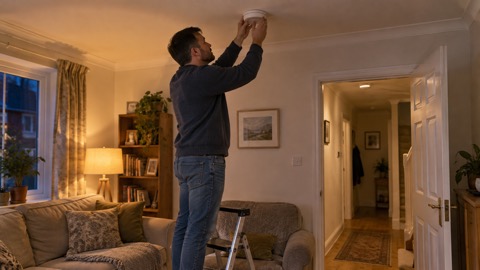
The SB1 fixes with the two screws and base plate provided, and the maker states it does not require an electrician2. The sequence is straightforward: fit the mounting plate to the ceiling using the screws provided, then twist the alarm onto the plate9. The maker's fitting advice is to turn the alarm as far as possible on the baseplate to ensure it is engaged and secure, and notes that a snug baseplate needs extra force10.
Manchester Fire and Rescue Service's advice is the same in plain terms: if the alarm has a base plate, ensure that the unit is attached firmly to the baseplate11. A alarm that is not fully twisted home can sit loosely, and a loose alarm may not sit correctly over its sensor openings.
Before you drill, check the ceiling for cables and pipes, and use the screws supplied rather than longer ones that could reach a cable. If you are fitting an alarm in a rented home, check with your landlord first; the fitting itself is minor and does not need a qualified electrician.
Test it every month by holding the button for 5 seconds
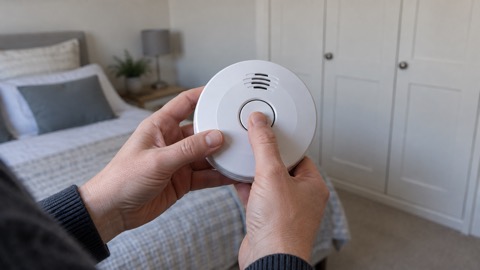
Test the alarm every month1. Press and hold the test button for 5 seconds and the alarm will sound1. That is the whole routine: one press, one loud burst, once a month. Pick a fixed day, such as the first of the month, so it does not get forgotten.
The test button is also the silence button. Press and hold it for 5 seconds and the alarm will silence for 8 minutes1. That gives you time to clear the smoke or steam that set it off without taking the battery out. Never remove the battery to stop an alarm: the maker's manual is explicit that you should never ignore any alarm, and if you are not absolutely certain of the source of smoke, get everyone out of the house immediately7.
If the alarm will not sound when you test it, work through the checks in order. Check the battery is connected, allow a few seconds for the alarm to settle after first installation, and push and hold the centre of the test button firmly1. If the alarm has been silenced and is in low sensitivity mode it may not test, so wait 15 minutes and try again1. If it still does not sound, replace the battery7. If it still fails after a fresh battery, the alarm may be at the end of its life and need replacing12.
The 9V battery lasts about a year: replacing it and the low battery chirp
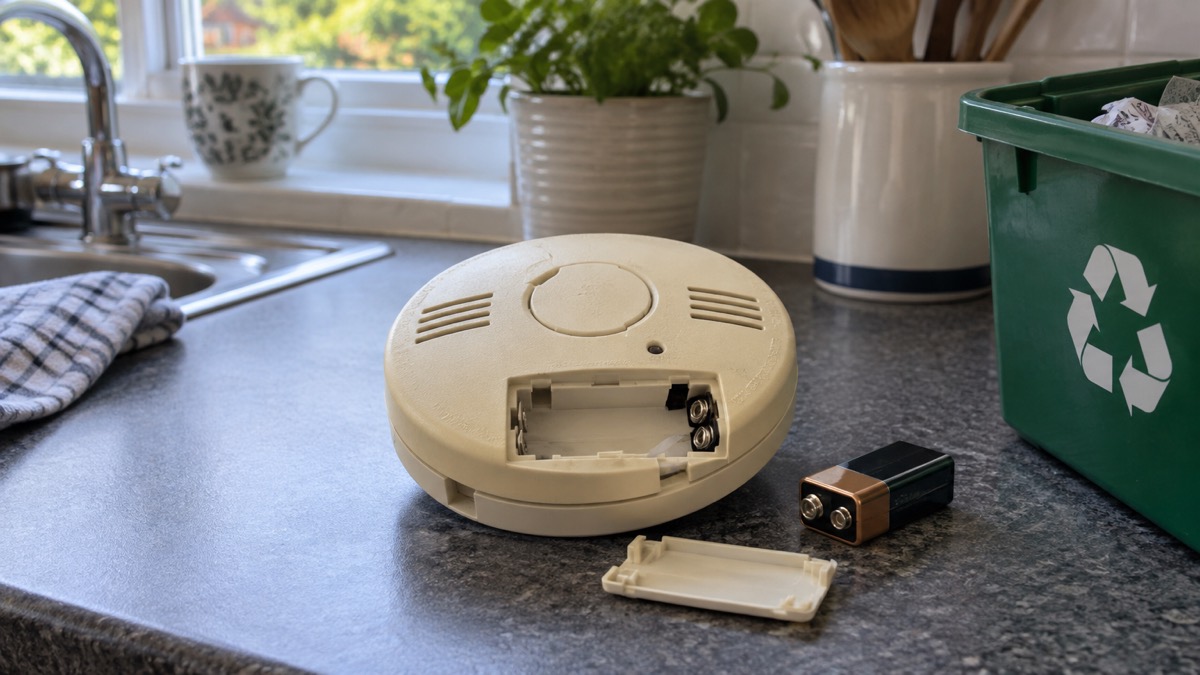
The SB1 takes 1 x 9V (PP3) battery1. Under normal use the battery should last approximately one year1. The maker's datasheet gives the same figure, approximately 1 year6. When the battery runs low the alarm chirps, and the maker's instruction is to replace the batteries once you hear the low battery chirp2.
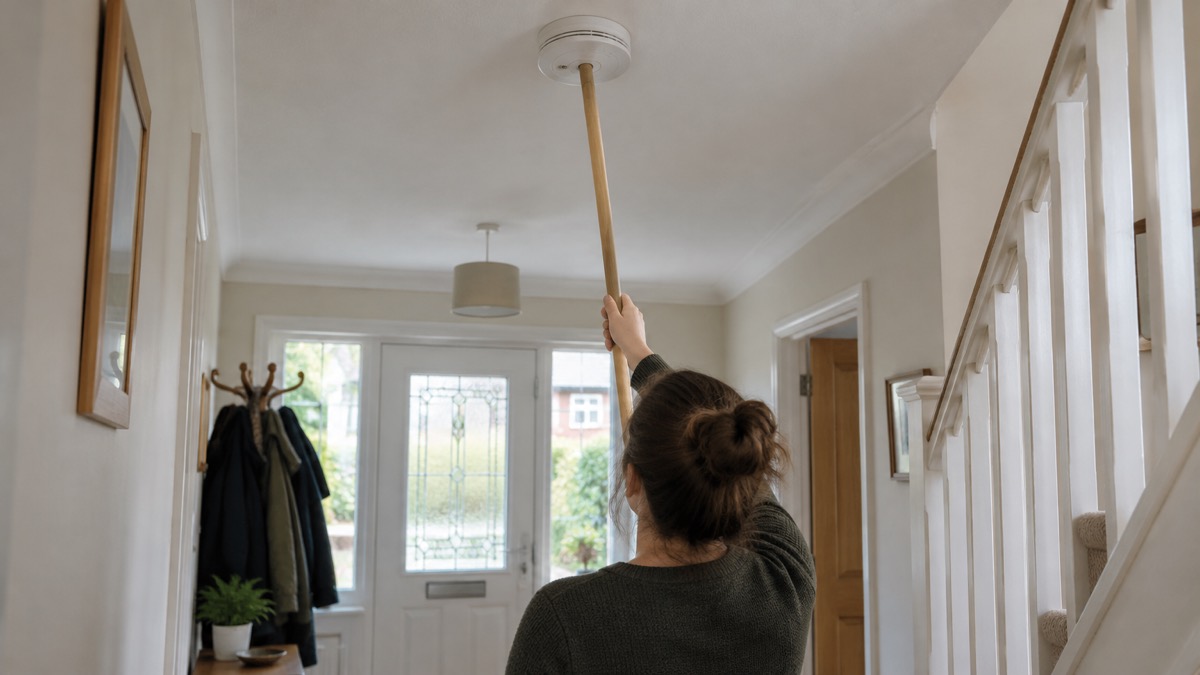
Replace the battery immediately when it chirps, and always test the alarm after replacing the batteries7. Use only the batteries the maker recommends: DC9V Gold Peak GP1604S or Raymax 6F221. The manual warns that use of a battery other than those recommended may have a detrimental effect on the alarm1. Keep a spare of the recommended type in a drawer so the chirp never waits for a shopping trip.
Some FireAngel alarms have a Sleep Easy feature that silences a low battery chirp for 8 hours, usable up to 10 times, so it does not keep you awake at night13. The alarm will still sound in full if it detects danger2. Treat it as a delay, not a fix: replace the battery the next morning.
| Battery fact | Detail |
|---|---|
| Type | 1 x 9V (PP3)1 |
| Recommended brands | DC9V Gold Peak GP1604S, Raymax 6F221 |
| Expected life | Approximately one year under normal use1 |
| Low battery signal | Chirp; replace the battery immediately2 |
| After replacement | Always test the alarm7 |
Steam, nuisance alarms and keeping it clean
Most false alarms come from the alarm's surroundings rather than a fault. Steam is the common cause, which is why the maker says optical alarms should not be placed near bathrooms1. Cooking smoke, a toaster, a candle or a hot shower can all set one off. If you experience frequent unwanted alarms, the manual's advice is to check the location of your smoke alarm and clean the smoke alarm1.
Cleaning is simple and should be done regularly. Vacuum your alarm every 3 months1. Do not use cleaners or solvents, and do not paint the alarm1. Do not use any other test method and do not tamper with the alarm1. A soft brush attachment on a vacuum cleaner is enough to clear dust from the vents.
If a false alarm happens, press and hold the test button for 5 seconds to silence it for 8 minutes1. Open a window and clear the source of the smoke or steam. If the alarm keeps sounding and you cannot find a cause, do not assume it is faulty: the maker's advice is never to ignore any alarm, and to get everyone out if you are not certain of the source of smoke7. Our guide to stopping smoke alarm false alarms goes further into causes and fixes.
Children, escape plans and what to do when it sounds
A working alarm is only half the plan. The maker's manual warns that experience has shown children may not be woken by fire alarm tones, and that children should never be left alone in a house1. Rehearse a fire escape plan with everyone in the household, including children, so they know the route out and where to meet1. Our guide to making a fire escape plan sets out how to do it room by room.
When the alarm sounds, the instruction is direct: if you are not absolutely certain of the source of smoke, get everyone out of the house immediately7. Do not stop to investigate, and do not go back in. Call 999 from outside. Our guide to what to do if a fire starts in your house covers the sequence in full.
For households with a deaf or hard of hearing person, a standard sounder may not be enough. Our guide to smoke and CO alarms for deaf and hard of hearing people explains the alternatives. The SB1 has a quiet self-test function that checks the alarm without the full loud sound, which is useful in a bedroom or at night2.
Warranty, support and replacing the alarm after 10 years
Replace the alarm every 10 years1. The maker's product page repeats the point: replace after 10 years to ensure your home is protected2. The 10 year figure is the alarm's life, not the battery's; the battery still needs changing about once a year1. Write the fitting date on the back of the alarm with a marker so you know when the 10 years are up.
The warranty runs for 3 years from the date of purchase and does not include the replaceable battery1. It applies to the original retail purchaser, is not transferable, and requires proof of purchase1. The maker's product page lists a 3 year manufacturer's warranty2. Keep the receipt or a photo of it with your household paperwork.
FireAngel's customer support specialists are based in the UK and can help with product advice, installation queries and troubleshooting by phone, email or live chat14. The maker's technical support line is 0800 141 2561, with an email address and online support page also listed7. Manchester Fire and Rescue Service also directs people to call freephone 0800 141 2561 for FireAngel support11.
When the alarm reaches the end of its life, dispose of it properly. The maker states the alarm is ideally suited for disposal within the waste electronic and electrical equipment (WEEE) recycling scheme1. Remove the battery before disposal, do not burn the alarm and do not attempt to open it1. Most household waste sites and many supermarkets take small electrical items and used batteries.
Sources (14)
- SB1 User Manual, FireAngel, 2026
- SB1-R Optical Smoke Alarm, FireAngel, 2026
- ST-750T Standalone Smoke Alarm, FireAngel, 2026
- FA6813 SB1-T2, FireAngel
- Smoke Alarm Guide, FireAngel, 2026
- SB1-R Datasheet, FireAngel, 2024
- SB1-R Manual, FireAngel, 2024
- Installing Your FireAngel Mains Powered Heat Alarm, FireAngel, 2024
- Installing Your Battery Powered Heat Alarm, FireAngel, 2024
- RF-BW-T Interlink Push Fit Base, FireAngel, 2026
- Problem With Your Smoke or Heat Alarm, Manchester Fire and Rescue Service, 2026
- Maintaining and Testing Your FireAngel Smoke Alarm, FireAngel, 2024
- SP510 FA4250BW Datasheet, FireAngel, 2026
- Carbon Monoxide Safety, FireAngel, 2026
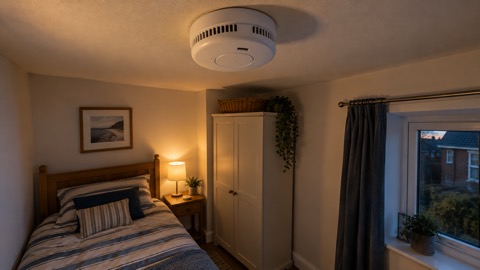 FireAngel FP2620W2-R Alarm
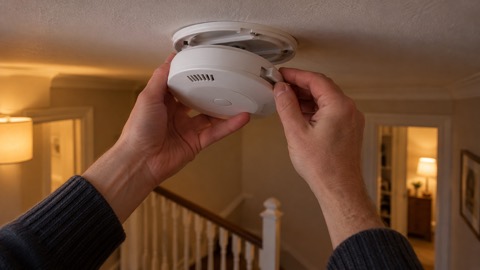 FireAngel ST-632 Smoke Alarm
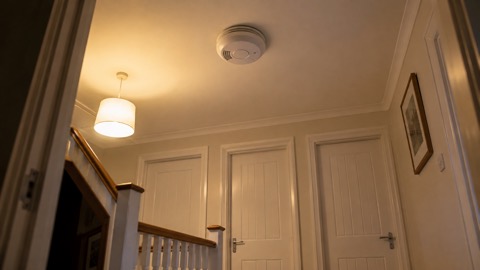 FireAngel ST-750 Smoke Alarm
 FireAngel SW1 Smoke Alarm
 FireAngel SW10 Smoke Alarm
 FireAngel SM-SN-1 Smoke Alarm
 FireAngel FA6611 Smoke Alarm
 FireAngel FA6615 Smoke Alarm
 FireAngel FA8620BW Alarm
 Kidde 2030-DSR Smoke Alarm
 Kidde 2030-DCR CO Alarm
 Kidde 10Y29 Smoke Alarm