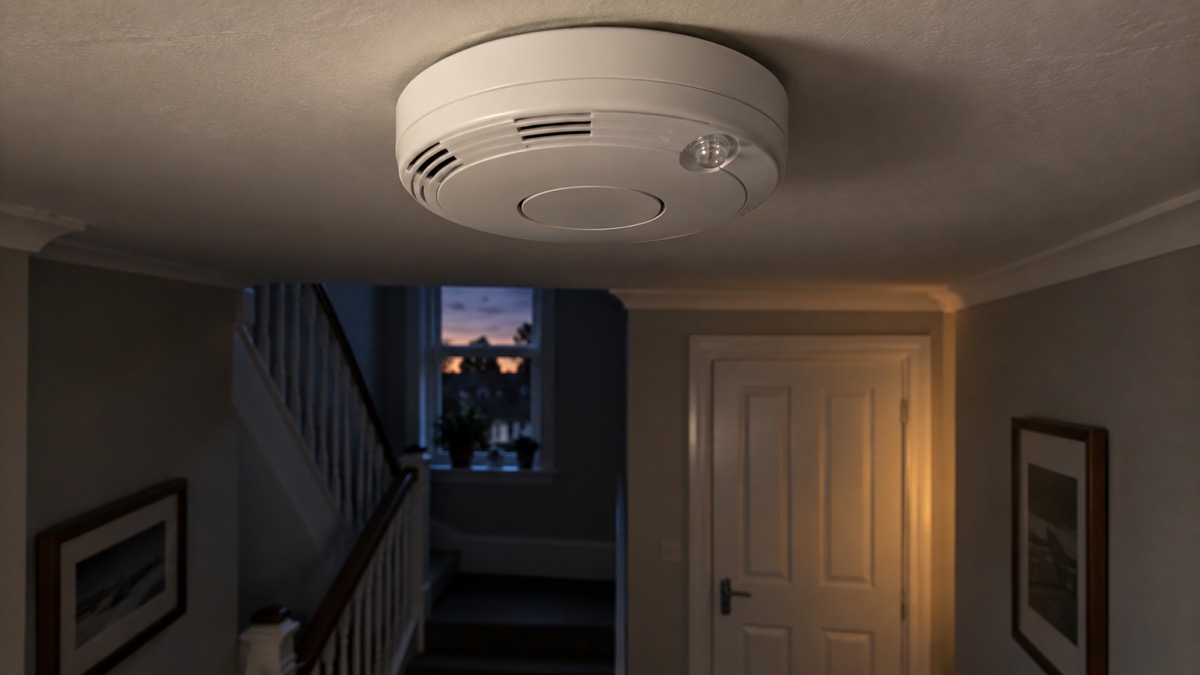
The FireAngel FA6611 is a battery-powered optical smoke alarm with a built-in escape light. When the alarm triggers, an extra-bright light comes on automatically and illuminates your escape route in the dark, which matters most at night, when smoke and a power cut can leave a hallway black1. It runs on 2 x AA alkaline batteries, supplied with the alarm, and the maker gives a battery life of up to 3 years under normal conditions1.
The alarm sounds at 85dB(A) at 3m, the minimum the maker quotes, and it is 118.1mm across and 31.5mm deep2. FireAngel gives it a 10 year sensor life and a 5 year warranty, and the maker's manual says to replace the alarm every 10 years1. It is certified to EN 14604:2005+AC:2008, and the maker lists the FA6611-R as suitable for BS 5839-6:2019 Grade F2 installations1.
If you already own one, the three things that keep it working are a monthly test, fresh AA batteries when it chirps, and a position away from steam and cooking fumes. If you are choosing an alarm, the escape light and the quiet test are what set this model apart from a plain optical alarm, and the sections below set out what it can and cannot do.
An optical alarm with a light that shows you the way out
The FA6611 is an optical smoke alarm, which means its sensing chamber detects the smoke from slow, smouldering fires that produce thick smoke before flames1. That is the fire that most often starts at night in a home, and it is the reason an alarm in a bedroom or on a landing earns its place. FireAngel's manual notes that optical alarms of this family are suitable for detecting slow smouldering fires, and that like other smoke alarms they can be set off by steam, so they should not be placed near bathrooms3.
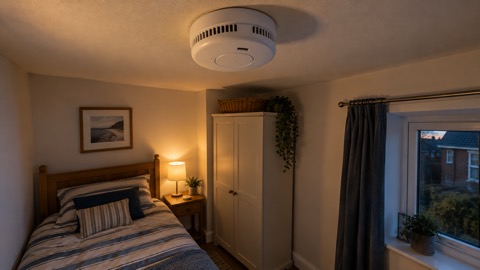
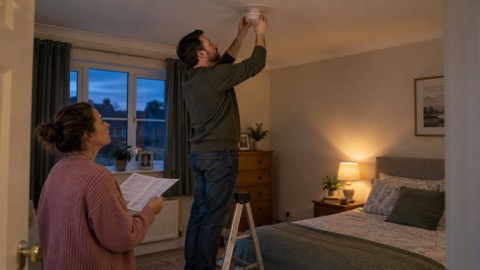
The escape light is the feature that distinguishes this model. FireAngel describes it as an extra-bright light that illuminates your escape route, and says it activates automatically when the alarm triggers, lighting the way in the dark1. In a real fire the value is obvious: smoke hides doorways, and a power cut can take out the landing light at the same moment. The maker recommends the alarm for bedrooms for exactly this reason, because the light gives immediate illumination if smoke is detected while you are asleep4.
The FA6611-R, the current version of the alarm, adds a quiet self-test, Sleep Easy mode and a slimmer 32mm profile, and FireAngel describes it as the direct replacement for the end-of-life ST-623E smoke alarm1. If you are moving from an older FireAngel model, the ST-632 and SW1 pages cover those alarms, and the smoke alarms guide sets out how optical alarms compare with ionisation types.
Specifications
The figures below are the maker's own, from the FA6611 datasheet and product page1. Where the product page and the datasheet give the same measurement in different units, both are shown.
| Specification | Figure |
|---|---|
| Type | Battery-powered optical smoke alarm with escape light2 |
| Sound level | 85dB(A) at 3m, minimum2 |
| Diameter | 118.1mm (product page lists 118mm)1 |
| Depth | 31.5mm (product page lists 32mm)1 |
| Weight | 175g2 |
| Batteries | 2 x AA alkaline, included, replaceable1 |
| Battery life | Up to 3 years under normal conditions1 |
| Sensor life | 10 years1 |
| Warranty | 5 years2 |
| Certification | EN 14604:2005+AC:2008; BS EN 14604:2005+AC:2008 with CE and UKCA marks, Grade F21 |
| Installation | Wall or ceiling, fixings supplied2 |
| Operating temperature | 4°C to 38°C2 |
| Operating humidity | Up to 90% RH, non condensing2 |
| Storage temperature | -20°C to +60°C2 |
| Storage humidity | Up to 93% RH, non condensing2 |
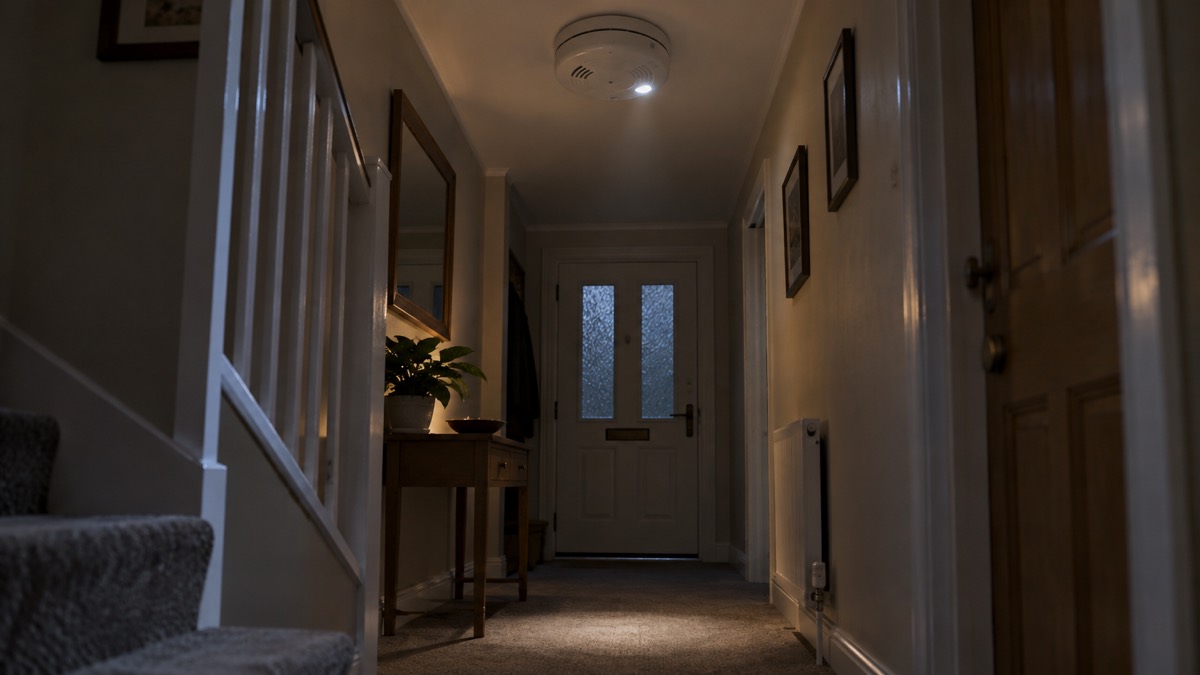
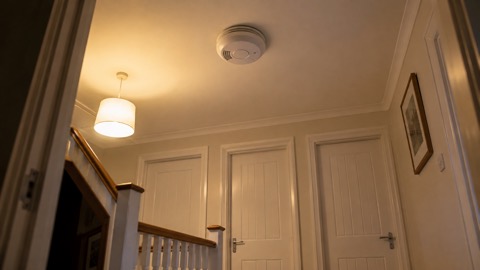
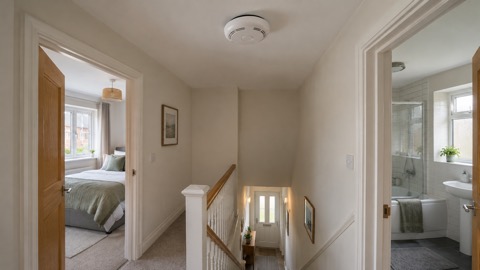
The maker's manual adds siting advice that applies to this alarm: fit smoke alarms at least 300mm from light fittings and walls, and for the earliest warning fit them in all rooms where the temperature stays between 4°C and 38°C3. FireAngel's product page goes further, recommending an alarm on the ceiling of every storey, including hallways, landings and bedrooms, at least 300mm from any wall or light fitting and at least 500mm from any corner, and keeping alarms at least 500mm from air vents, fans and light fittings1. Do not fit one directly above a cooker, inside a bathroom or in a garage, and avoid spots where the temperature regularly goes above 38°C or below 4°C1. For the wider question of placement, see where to fit smoke alarms and how many smoke alarms a home needs.
What the alarm sounds like, and what to do when it goes off
In a fire the FA6611 sounds three beeps continuously and its LED flashes once per second3. The product page describes the same pattern as three continuous beeps per second at 85dB1. When you press the test button the pattern is different: three beeps, a 1.5 second pause, then three beeps, with the LED flashing once per second and the escape light shining3. Knowing the difference matters, because a test you started yourself should never be mistaken for the real thing.
FireAngel's manual is blunt about what to do:
"NEVER IGNORE ANY ALARM. If an alarm is sounding, it is warning you of a potentially hazardous situation. Do not ignore i"
If you are not absolutely certain of the source of the fire, get everyone out of the house immediately3. That is the instruction the maker gives, and it matches the advice of every fire and rescue service: get out, stay out, and call 999. Once outside, the house fire page walks through what to do next, and if you cannot get out, what to do if you cannot escape a fire covers closing yourself in a room and making yourself known.
Children need particular thought. The government's fire safety guidance for parents and child carers warns that some children may not be woken by smoke alarms5. FireAngel's manual says experience has shown that children may not be woken by fire alarm tones, that children should never be left alone, that sleeping children must be woken and taken outside, and that the fire and rescue service should always be called without delay3. A rehearsed plan is what turns that warning into action, and the fire escape plan guide sets out how to build and practise one.
Testing once a month: the quiet test and the full-volume test
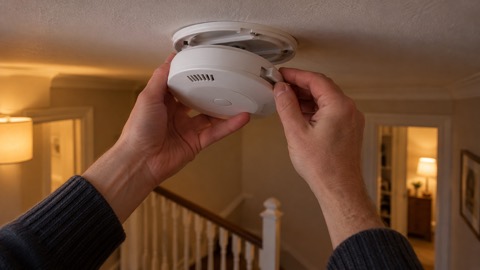
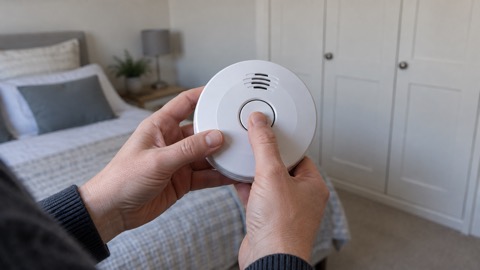
FireAngel advises testing the alarm at least once a month1. The FA6611 has a large central test button, and the FA6611-R adds a quiet self-test: a single press tests at reduced volume, at least 10dB below the full alarm, while a double press runs a full-volume 85dB test1. The maker's manual gives the same instruction for the family: to hear the alarm at full volume, double press the test button3.
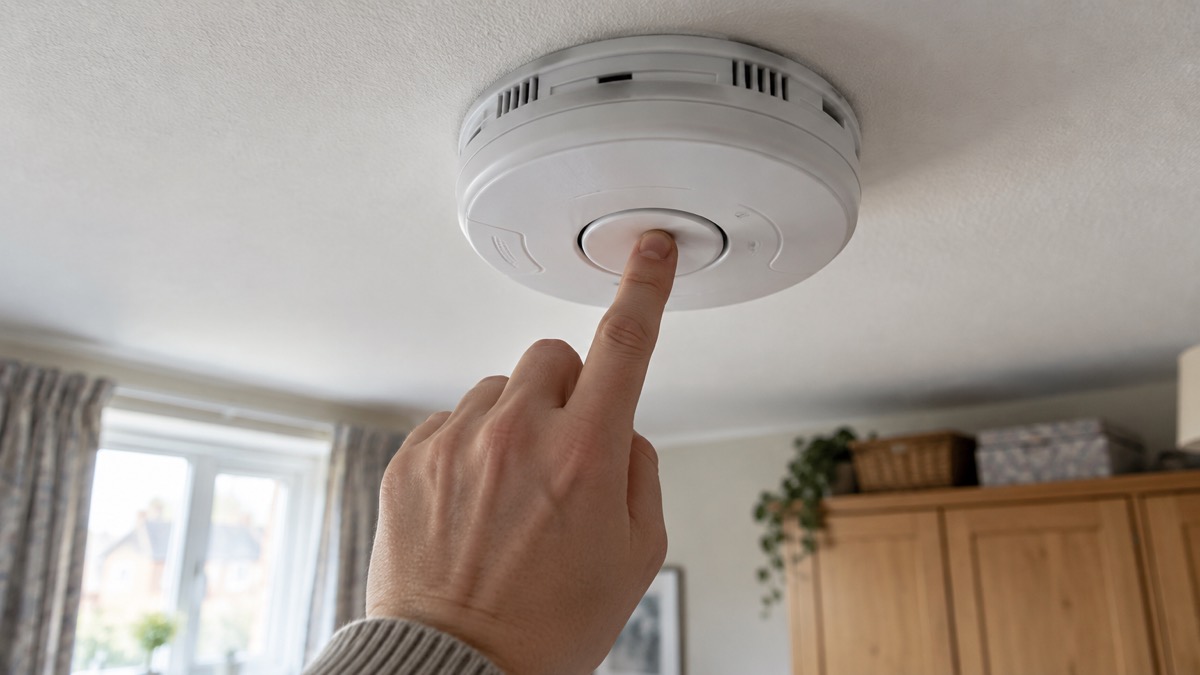
That two-stage design is useful in a household. A quiet test lets you check the alarm works without setting off a full-volume siren that frightens children or disturbs neighbours, and the maker recommends it for bedrooms for that reason4. A full-volume test is still worth doing from time to time, because it is the only way to confirm the alarm can actually reach the sound level it is rated at. Whichever you use, the test is not complete until you have heard the sound and seen the light.
A monthly routine is easy to forget, so tie it to something you already do, such as the first of the month or a bin day. If the alarm does not sound, or beeps when you are not testing it, FireAngel advises consulting the manual, because the battery could be running low or the alarm could be coming to the end of its life and need replacing6. The testing alarms page covers how often to test smoke and carbon monoxide alarms together, and when to replace an alarm explains the end-of-life signs.
Low battery chirp, Sleep Easy and end-of-life warnings
When the battery runs low, the FA6611 chirps and the red LED flashes once every 40 seconds1. The datasheet describes the same signal as a beep approximately every 40 seconds when the battery needs replacing2. That chirp is the alarm telling you to act, not a fault to be lived with.
Sleep Easy is the feature that makes the timing manageable. It silences the low battery chirp for 8 hours, so a chirp that starts at 2am does not have to be dealt with in the dark2. The alarm still detects smoke during Sleep Easy mode, but the manual is clear that you must replace the batteries within 30 days, and that once the batteries have been replaced the Sleep Easy feature is disabled for 30 days3. There is also a limit: you can silence a low battery chirp a maximum of 10 times, and the alarm cannot be silenced if it indicates a fault or end of life3.
The end-of-life signal is different from a low battery chirp. FireAngel's manual describes it as one triple beep every 40 seconds and one triple flash every 40 seconds, and warns that the alarm may not signal an alert, so it must be replaced immediately3. The product page adds that if chirping continues after you replace the batteries, the 10 year sensor may have reached the end of its life and the alarm needs replacing entirely1. The maker's manual says to replace the alarm every 10 years3.
| Signal | What it means | What to do |
|---|---|---|
| Chirp and red LED flash every 40 seconds | Battery running low1 | Replace the 2 x AA batteries, within 30 days if you use Sleep Easy3 |
| Triple beep and triple flash every 40 seconds | End of life, may not signal an alert3 | Replace the alarm immediately3 |
| Chirping continues after new batteries | Sensor may have reached end of life1 | Replace the alarm entirely1 |
If you are unsure which signal you are hearing, the smoke alarm chirping page sets out the common patterns.
Which AA batteries to use
The FA6611 takes 2 x AA alkaline batteries, and FireAngel supplies them with the alarm1. The maker's manual lists the batteries it considers suitable for the FA6611 and FA6615: Energizer E91 Alkaline, Duracell AA MN1500 Alkaline, GP AA GN15A Alkaline and Energizer AA L91 Lithium3. The product page says the alarm can be replaced with any standard AA alkaline battery1.
Battery life is up to 3 years under normal conditions1. That is a long time to remember, so write the date you fitted the batteries on the alarm or in a note, and replace them when the chirp starts rather than waiting for a convenient weekend. The sealed or replaceable battery alarms comparison explains the trade-off between an alarm you re-battery and one with a sealed pack.
Cutting down false alarms from cooking, steam and dust
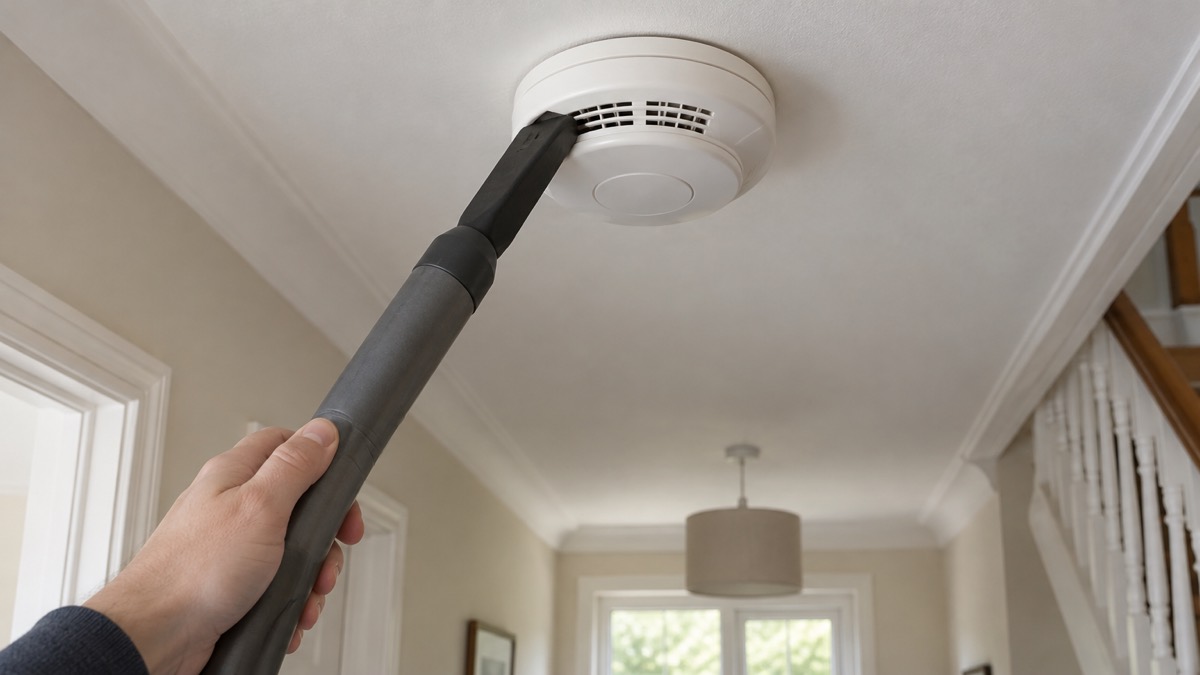
False alarms are the main reason people take a smoke alarm down, and the causes are well understood. FireAngel says false alarms are usually caused by steam, cooking fumes, dust or insects entering the sensor chamber1. The maker's advice is to vacuum around the sensor and reposition the alarm away from kitchens and bathrooms1. Northamptonshire Fire and Rescue Service gives the same diagnosis, that the most common source of false alarms is contamination such as dust and small insects within the sensor chamber, and says cleaning by vacuuming around the central detection chamber or blowing it out with the cold setting on a hair dryer normally resolves it7.
Placement prevents most of it. Scottish Fire and Rescue Service advises trying not to fit smoke alarms too close to the kitchen door, because steam and cooking fumes are the most common cause of false alarms8. FireAngel's product page says not to install a smoke alarm directly above a cooker, inside a bathroom or in a garage1. The FA6611-R has a hush function that silences nuisance alarms for a few minutes1, and the maker's datasheet for the FA6611 lists reducing nuisance cooking alarms as a feature2.
For the kitchen itself, a heat alarm is the better tool. FireAngel describes heat alarms as ideal for kitchens, garages or unconverted lofts, where fumes or dust make false alarms more likely9, and Scottish Fire and Rescue Service notes that heat alarms can help you avoid false alarms caused by cooking fumes such as frying food or burning toast10. The heat alarms page and the heat alarm or smoke alarm comparison set out where each belongs, and the false alarms page covers the wider fixes.
Caravans, motorhomes and other places to fit it
FireAngel lists the FA6611-R as suitable for hallways, landings, bedrooms and leisure vehicles including caravans, campervans and motorhomes1. The datasheet confirms leisure accommodation vehicles are covered2. The maker notes that the escape light is especially valuable in a confined space where visibility during a fire is limited4.
The practical points are the same as at home. Fit it to the wall or ceiling using the fixings supplied2, keep it within the operating range of 4°C to 38°C and up to 90% RH non condensing2, and test it monthly. A caravan that sits unused through a cold winter will see temperatures well below the operating range, so check the alarm before your first trip of the season rather than assuming it is fine.
Support, warranty and where to get help
FireAngel's technical support line is 0330 094 5830, with email technicalsupport@fireangeltech.com and support online at www.fireangeltech.com/support11. The maker gives support hours of 9am to 5pm Monday to Friday and an address at Vanguard Centre, Sir William Lyons Road, Coventry CV4 7EZ13. Fire and rescue customers are given a separate number, 0800 141 256111. FireAngel also lists a general sales line on 02476 323232 and an email at sales@fireangel.co.uk4.
FireAngel says its customer support specialists are based in the UK and can help with product advice, installation queries and troubleshooting by phone, email or live chat14. FireAngel offers the option of a 7 year life guarantee on some models2. If your alarm was fitted by a fire and rescue service and is still covered by its guarantee, some services direct you to FireAngel on freephone 0800 141 256115. North Yorkshire Fire and Rescue Service, for example, says to ring FireAngel on 0800 141 2561 and they will arrange replacements for issues during the 10 year period17.
For alarms designed for people who are deaf or hard of hearing, see smoke and CO alarms for deaf and hard of hearing people. FireAngel also sells carbon monoxide alarms, water leak sensors and temperature and humidity sensors, covered on the FireAngel brand page and the carbon monoxide alarms guide18.
Sources (18)
- FA6611-R Smoke Alarm product page, FireAngel, 2026-10-28
- FA6611 datasheet, FireAngel, 2026
- FA6611, FA6615, FA6620 and FA6720-R smoke and heat alarm manual, FireAngel, 2024-09
- FireAngel product FAQs, FireAngel, 2026-10-29
- Fire safety for parents and child carers, GOV.UK, 2022-05-25
- Maintaining and testing your FireAngel smoke alarm, FireAngel, 2024-08-27
- Smoke and carbon monoxide alarms, Northamptonshire Fire and Rescue Service, 2026
- Smoke and heat alarms, Scottish Fire and Rescue Service, 2025-04-14
- HM-SN-1 kitchen heat alarm, FireAngel, 2026-08-21
- Kitchen safety, Scottish Fire and Rescue Service, 2024-11-11
- HW1-R manual, FireAngel, 2024-09
- FA3313, FA3322, FA3328 and FA3820 manual, FireAngel, 2024-09
- FP1640W2-R manual, FireAngel, 2019-05
- Carbon monoxide safety, FireAngel, 2026-07-31
- ST-632 manual, FireAngel, 2021-06
- SW1 user manual, FireAngel, 2019
- Safe at home frequently asked questions, North Yorkshire Fire and Rescue Service, 2026-08-18
- Smoke alarm guide, FireAngel, 2026-07-15
 FireAngel FP2620W2-R Alarm
 FireAngel ST-632 Smoke Alarm
 FireAngel ST-750 Smoke Alarm
 FireAngel SW1 Smoke Alarm
 FireAngel SW10 Smoke Alarm
 FireAngel SB1 Smoke Alarm
 FireAngel SM-SN-1 Smoke Alarm
 FireAngel FA6615 Smoke Alarm
 FireAngel FA8620BW Alarm
 Kidde 2030-DSR Smoke Alarm
 Kidde 2030-DCR CO Alarm
 Kidde 10Y29 Smoke Alarm