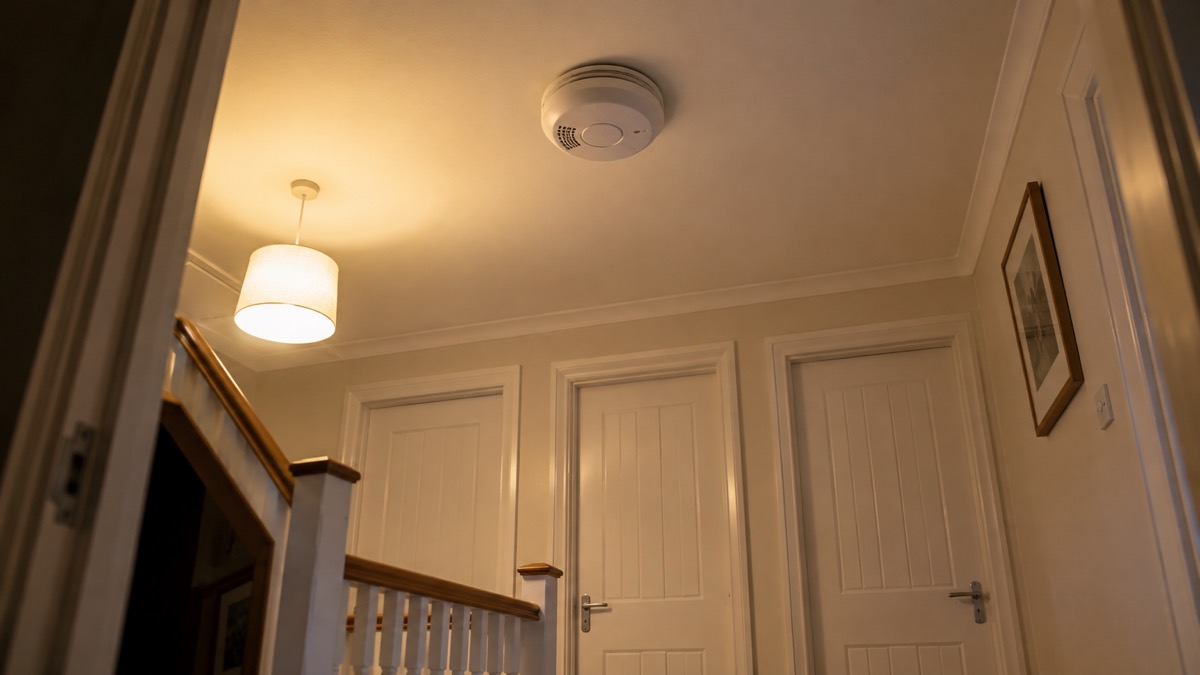
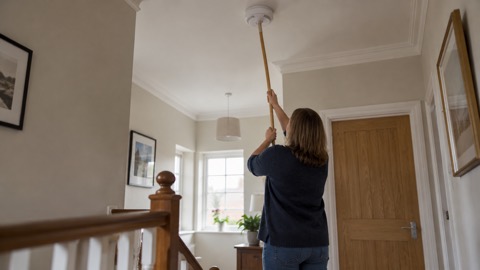
The FireAngel ST-750 is a battery-powered smoke alarm with a sensor that combines optical detection with a heat response, and a sealed battery the maker says lasts the life of the alarm. It is fitted to a ceiling or wall, it switches itself on when it is twisted fully onto its base plate, and it is tested with a large central button you can reach without a step ladder1. If you are holding one and wondering how to fit it, the maker's manual for the ST-750 FLEX says to wait for 5 seconds for the alarm to settle then test the alarm3.
If you already have one on the ceiling, the things that matter most are the weekly test, the quarterly clean, and knowing what the noises mean. A single chirp every 40 seconds is a low battery warning, and the maker says to replace the alarm immediately and certainly within 7 days3. A red LED flashing separately from the chirp means a fault3. The alarm is not linked to anything else in the house, and it does not detect carbon monoxide2.
This page sets out what the ST-750 does, where it should and should not go, how to fit, test and silence it, and when the whole unit has to be replaced. It is written from the maker's own datasheet and manual, with fire and rescue service guidance where it bears on the same points.
What the ST-750 is and what it does
The ST-750 is a Thermoptek multi-sensor smoke alarm1. Thermoptek, in FireAngel's description, combines optical sensing with thermal enhancement for a rapid response to fire2. In plain terms, it is looking for smoke and responding to a rise in heat at the same time, rather than relying on smoke alone. The maker's manual calls it a multi-criteria high performance detector and a 10 year life smoke alarm3.
The battery is the part that decides how you live with it. The datasheet lists a 10 year sealed for life Panasonic battery that removes the need to replace the battery1, and the manual describes an internal lithium power pack3. There is no battery compartment to open and no cell to buy. That is convenient, but it also means the alarm is a single sealed unit: when the power pack or the sensor reaches the end of its life, the whole alarm is replaced, not just the battery.
The rest of the specification is what you would expect of a modern domestic alarm, and it matters for where you can put it. It is certified to BS EN 14604: 2005 +AC:20081, carries the BSI Kitemark and is independently certified5, and the case is ABS plastic rated UL94 VO fire retardant1. It measures 130mm across and 34mm deep and weighs 155g1. It is designed for ceilings and walls1, and it is a standalone alarm: the manual states that it will not communicate with other smoke alarms or fire alarm systems3.
| Specification | Figure |
|---|---|
| Sensor type | Thermoptek Multi-Sensor1 |
| Battery | 10 year sealed for life Panasonic battery1 |
| Alarm sound level | 85dB(A) at 3m (minimum)1 |
| Dimensions | 130mm diameter x 34mm depth1 |
| Weight | 155g1 |
| Operating temperature | +4°C to +38°C1 |
| Operating humidity | Up to 90% RH non-condensing1 |
| Storage temperature | -20°C to +60°C1 |
| Installation positions | Ceiling or wall1 |
| Certification | BS EN 14604: 2005 +AC:20081 |
| Warranty | 10 years1 |
Where to fit it
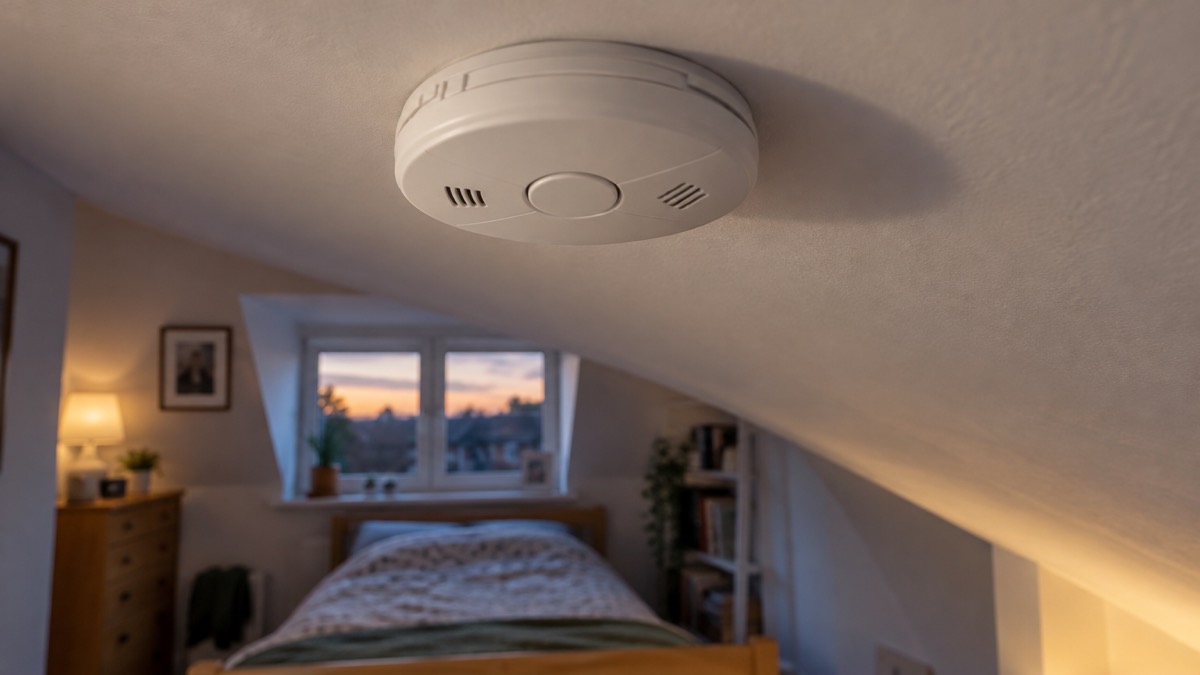
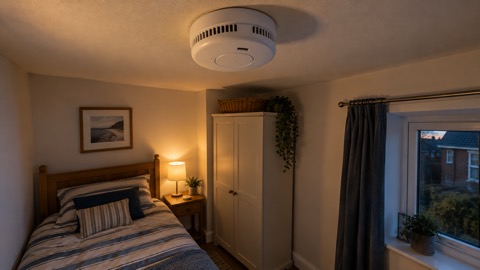
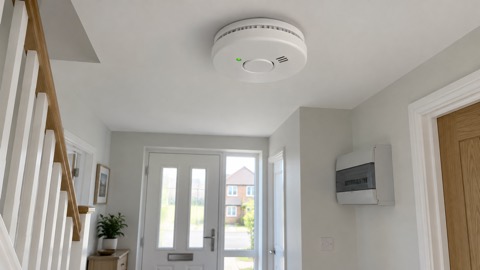
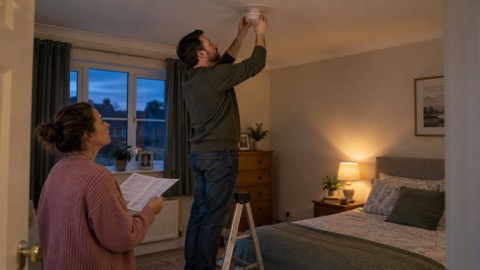
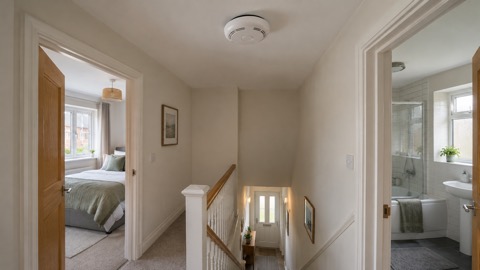
Fit the ST-750 to the ceiling of every level of your home. That is the baseline from Lincolnshire Fire and Rescue, which advises fitting a smoke alarm to the ceiling of every level of your home, in bedrooms where there are bunk beds or high sleepers, and in any room with an increased risk of fire6. The maker's manual takes the same line for existing buildings, saying at least one unit should be installed on each floor or level of the property3.
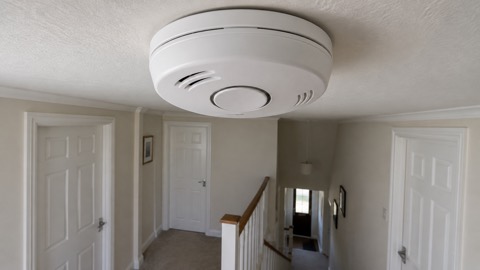
The detail that catches people out is the exact position on the ceiling. The manual says smoke alarms should be positioned at no more than 600mm vertically below the highest point in the room, and at least 300mm from light fittings and walls, ideally as central as possible3. If you are mounting on a wall instead, the top of the detection element must be between 150mm and 300mm below the ceiling and at least 300mm from a wall3. Those distances are there so that smoke reaches the sensor rather than sitting in a dead pocket of still air near a corner.
A short checklist for siting it:
- One alarm on every floor or level, as a minimum3.
- On the ceiling, no more than 600mm below the highest point of the room3.
- At least 300mm from walls and light fittings, as central as possible3.
- In bedrooms with bunk beds or high sleepers, and in rooms with an increased fire risk6.
- On a wall, only with the detection element 150mm to 300mm below the ceiling and at least 300mm from a wall3.
If you are working out how many alarms a whole house needs, or where each type belongs, the wider guidance on where to fit smoke alarms and how many smoke alarms a house or flat needs covers the room-by-room picture. The ST-750 is one option within a wider choice of smoke alarm types.
Where the ST-750 must not go
The kitchen is the first exclusion. FireAngel says a smoke alarm is not recommended for installation in a kitchen, and that you should install a heat alarm in kitchens instead, because of the likelihood of nuisance alarms from cooking fumes2. The manual is a little more nuanced: it describes Thermoptek alarms as "toast-proof", meaning they can be positioned in areas close to kitchens that may be affected by cooking, but says kitchens themselves should be covered by a self contained heat detector3. So the ST-750 can go in the hallway outside the kitchen; the kitchen ceiling is for a heat alarm, such as the FireAngel HT-630 kitchen heat alarm or another heat alarm.
There are other limits in the manual worth knowing before you drill:
- Do not open the case. Attempting to open it will invalidate your warranty3.
- Do not block the vents, disable the alarm, paint it, or use solvents or cleaners on it3.
- Do not burn it3.
- It is not intended for any non-residential, commercial or industrial application3.
- In a new build it can be installed as additional protection only. It cannot be used as a substitute for the hard wired interlinked system required by building regulations in new builds3.
- In flats, bedsits, motels, hospitals, care facilities, boarding houses and dormitories it can be used in individual rooms only if a primary fire detection system meeting regulatory requirements already exists for common areas such as lobbies and hallways3.
Fitting it: the battery switches on when it locks onto the base plate
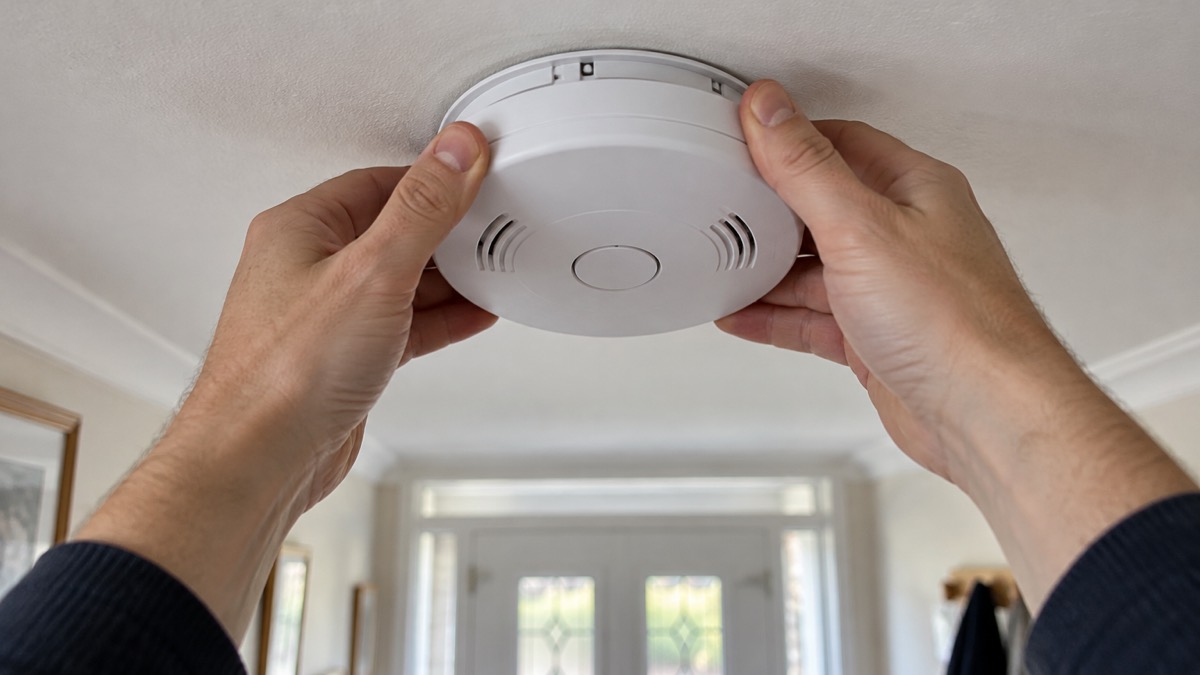
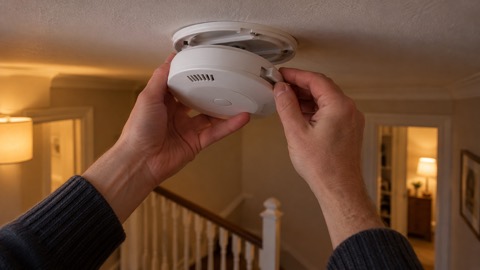
Fitting the ST-750 is deliberately simple. The datasheet describes it as easy to install with automatic battery engagement on the base plate1, and the manual explains the mechanism: the power pack is automatically enabled when the alarm is fully locked on to the base plate, and deactivated when it is removed3. There is no tab to pull and no battery to clip in.
The sequence, following the maker's instructions for its battery-powered alarms, is:
- Fix the base plate to the ceiling or wall in the position you have chosen3.
- Position the alarm on the plate, then turn clockwise until it is locked into position7.
- Make sure it is twisted fully. Turning it fully is what activates the battery7.
- Wait 5 seconds for the alarm to settle, then test it3.
Turning it "as far as possible" matters. FireAngel warns that when fixing an alarm to the baseplate it is important to turn it as far as possible to ensure it is engaged and secure, and that a snug baseplate needs extra force8. If the alarm will not sound when tested, the manual's first checks are that it has been rotated clockwise fully onto the base plate and that the centre of the test button has been pushed firmly3.
If you are replacing an alarm that a fire and rescue service fitted, the ST-750 is described by the maker as an ideal replacement that in most instances will not require changing the baseplate2. Check the old base plate against the new one before you assume that applies to yours.
Test it every week with the central button
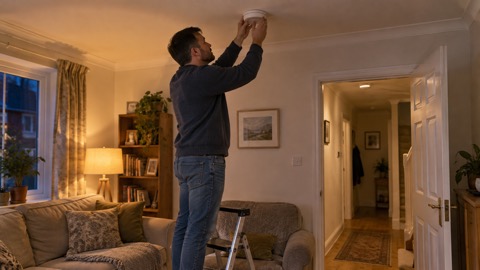
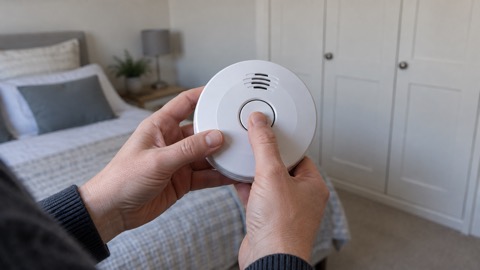
Test the ST-750 once every week3. The large central button is there to make that easy: FireAngel says testing your smoke alarms no longer requires a step ladder, because of the large central push button2, and the datasheet lists it as the Test and Smart Silence button1. Press and release it, and the alarm gives two cycles of three loud beeps3.
A weekly test is not a formality. It is the only way to know that the sensor, the sounder and the power pack are all still working together. Fire and rescue services make the same point in their own guidance, and the general advice on how often to test smoke and CO alarms sets out a routine you can keep to.
If the alarm does not sound when you test it, work through the maker's checks in order3:
- Make sure the alarm has been rotated clockwise fully onto the base plate.
- Push the centre of the test button firmly.
- If the alarm has been silenced and is in low sensitivity mode, it may not test. Wait 15 minutes and try again.
- If it was recently fitted and fails to self test, contact Technical Support.
Smart Silence and Sleep Easy: quietening false alarms and low-battery chirps
The ST-750 has two features for the two noises that most annoy people: the false alarm and the low battery chirp.
Smart Silence deals with a known false alarm, such as burnt toast. The datasheet says it allows the alarm to be silenced for up to 10 minutes in the event of a known false alarm, and that during those 10 minutes, if additional smoke is detected, the alarm will sound1. The manual adds that the alarm automatically returns to full sensitivity within 10 minutes, and that if the level of smoke reaching the alarm is very high the silence will be overridden and the alarm will continue to sound3. In other words, it buys you ten minutes to clear the air, not ten minutes of blindness to a real fire.
Sleep Easy deals with the low battery chirp. FireAngel says the large button activates a Sleep Easy function that silences low battery chirps for 8 hours, giving you a period of peace2. The manual says you can silence the audible chirp for 8 hours by pressing the test button, and that the feature may be repeated up to 10 times, but is not a substitute for replacing the smoke alarm3. The datasheet gives the same limit of up to 10 uses1.
| Feature | What it does | Limit |
|---|---|---|
| Smart Silence | Silences the alarm for up to 10 minutes during a known false alarm1 | Sounds again if more smoke is detected; returns to full sensitivity within 10 minutes1 |
| Sleep Easy | Silences the low battery chirp for 8 hours2 | Can be used up to 10 times; not a substitute for replacing the alarm1 |
If your alarm is chirping and you want the full list of causes, see why your smoke alarm keeps chirping. For persistent false alarms, how to stop smoke alarm false alarms covers the wider fixes.
Replace the whole alarm after 10 years, or within 7 days of a low battery warning
There are two replacement clocks on the ST-750, and they run on different timescales.
The first is the sensor life. FireAngel says the sensor life is 10 years, so to ensure your home remains protected it recommends replacing the alarm after 10 years2. The warranty runs for the same period1. Write the fitting date on the back of the alarm or in your phone, because nothing on the unit will remind you at the ten year mark.
The second is the low battery warning. When the power pack runs low, the unit emits an audible chirp once every 40 seconds3, and the manual says it will continue to warn of this low power pack condition for at least 7 days3. The maker's advice is to replace the alarm immediately, and certainly within 7 days3. Fire and rescue services give the same seven day limit in their own words: replace your alarm or its battery immediately, and certainly within seven days, as your alarm may not have enough power to warn you of a real fire after this time4. Because the ST-750 has a sealed battery, "replace the battery" means "replace the alarm".
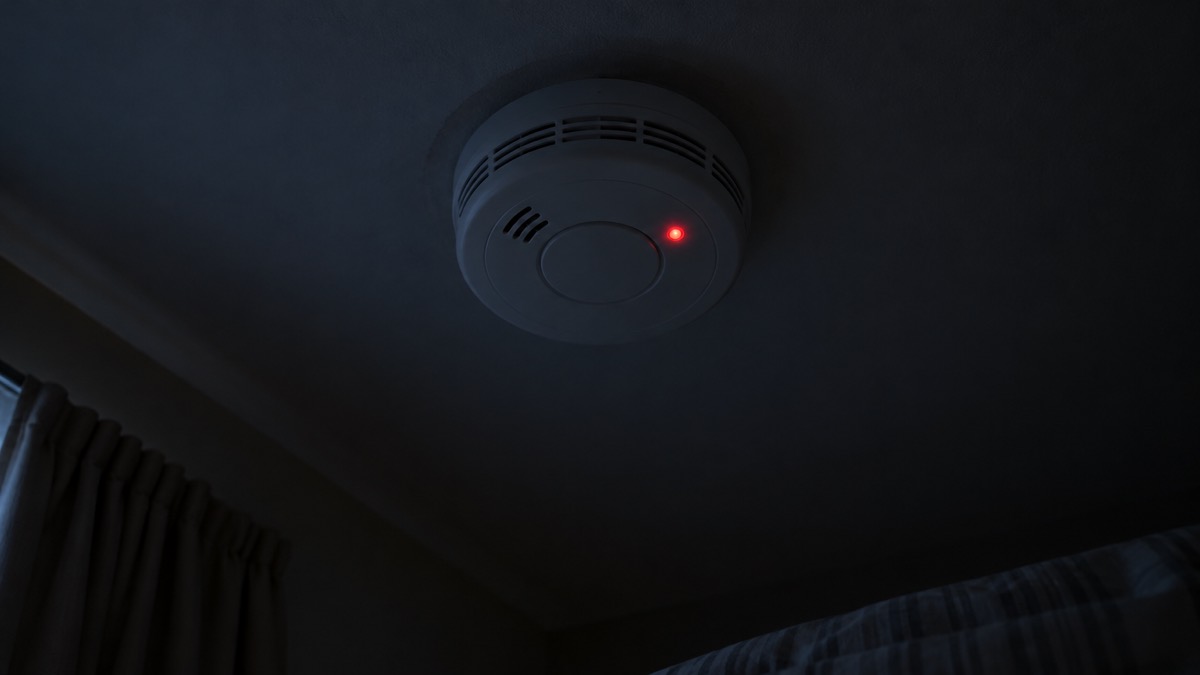
The red LED tells you which situation you are in. In normal condition the red LED on the front should flash rapidly every 40 seconds to show that the alarm is active3. If the red LED flashes at a separate time from the chirp, a fault is indicated: contact Technical Support if the alarm is within warranty, otherwise replace it immediately3.
Support, warranty and disposal
FireAngel's technical support line is 0330 094 5830, open 9am to 5pm Monday to Friday10. You can also reach support by email at technicalsupport@fireangeltech.com or online at www.fireangeltech.com/support, and the company's address is Vanguard Centre, Coventry CV4 7EZ11. The manual is available in large text and other formats on request3. FireAngel says its customer support specialists are based in the UK and can help with product advice, installation queries and troubleshooting by phone, email or live chat5.
The warranty is 10 years1. The manual sets out the terms: it covers the original retail purchaser, is not transferable and requires proof of purchase. A replacement alarm carries the remainder of the original 10 year period, and FireAngel may offer a similar alternative if the model is unavailable. Damage from accident, misuse, disassembly, abuse or lack of reasonable care, applications not in accordance with the manual, and Acts of God such as fire or severe weather are not covered3.
When the alarm reaches the end of its life, dispose of it properly. The manual says it is ideally suited for disposal within the waste electronic and electrical equipment (WEEE) recycling scheme, and should not be disposed of with household waste. Once removed from the base plate the power pack deactivates and the chirp stops. Do not attempt to open it and do not burn it3. Your local council can tell you where to take small electrical items.
Carbon monoxide, linking and other alarms
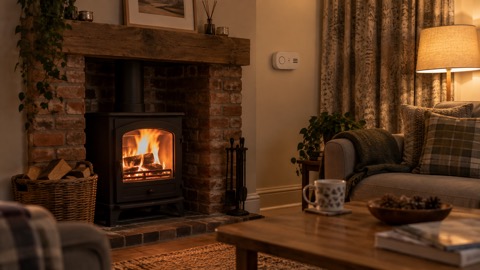
The ST-750 is a smoke alarm and nothing else. FireAngel states plainly that it is a smoke alarm only and does not detect carbon monoxide2. If your home has a gas boiler, a solid fuel stove, an open fire or any other fuel-burning appliance, you need a separate carbon monoxide alarm as well, chosen and sited according to its own instructions. The guidance on whether you need a CO alarm and where to put a carbon monoxide alarm covers that side of the house, and the FireAngel FA3820 is one example of a dedicated CO alarm.
The ST-750 is also a standalone alarm. The manual says it will not communicate with other smoke alarms or fire alarm systems3. If you want every alarm in the house to sound together, you need a range built for it. FireAngel's Pro Connected alarms are described by the maker as wirelessly interlinked, so that if one alarm is triggered all alarms in the home will sound, and they can be monitored through the FireAngel Connected smartphone app12. The Spec+ range uses Bluetooth to interconnect up to 50 alarms, exclusive to the FireAngel Professional range, preventing interference or cross-connection with devices outside the network14. The wider subject is covered in interlinked alarms: how linking works and wireless or wired interlinked alarms.
| Need | What the ST-750 does | What to look at instead |
|---|---|---|
| Smoke detection on each floor | Yes, as a standalone alarm1 | Nothing else needed for this job |
| Every alarm sounding together | No, it will not communicate with other alarms3 | A wirelessly interlinked range such as FireAngel Pro Connected12 |
| Carbon monoxide detection | No, smoke only2 | A dedicated CO alarm, such as the FireAngel FA382015 |
| Kitchen fumes | Not recommended in the kitchen2 | A heat alarm, such as the FireAngel HT-63016 |
Cleaning, caravans and everyday care
Clean the ST-750 once every three months using a vacuum cleaner fitted with the soft brush attachment, then wipe it with a slightly damp cloth. Do not use solvents or cleaners, and do not paint the alarm3. FireAngel's general guidance is to run a soft brush adaptor on your vacuum along the edges and face of the alarm, noting that this may cause a false alarm, and that a soft cloth can also be used on the face17. Fire and rescue services often suggest a monthly pass: Mid and West Wales Fire and Rescue Service advises cleaning once per month by vacuuming around the alarm and wiping over with a damp cloth to remove any dust18, and Manchester Fire and Rescue Service suggests a slightly damp cloth or the soft brush attachment of a vacuum cleaner19. A monthly vacuum with a quarterly deeper clean covers both.
The ST-750 is suitable for use in mobile homes and caravans3. It is rated for operating humidity up to 90% RH non-condensing and for temperatures from +4°C to +38°C1, so keep it within those conditions and out of damp, unheated spaces in the depths of winter. As in a house, fit it on the ceiling and test it every week.
For the wider picture of how the ST-750 fits into a household's fire plan, see smoke alarms: types and how to choose one, when to replace a smoke, heat or CO alarm, and the fire safety checklist for your home. FireAngel's own range is described on the FireAngel brand page.
Sources (19)
- ST-750 Data Sheet, FireAngel, 2024-09
- ST-750 Multi-Sensor Smoke Alarm, FireAngel, 2026-08-21
- ST-750 Manual, FireAngel, 2021-06
- Smoke alarms, Devon and Somerset Fire and Rescue Service, 2026-02-17
- Carbon Monoxide Safety, FireAngel, 2026-07-31
- Fire alarms and carbon monoxide detectors, Lincolnshire County Council, 2026-10-29
- Installing your battery powered heat alarm, FireAngel, 2024-10-17
- RF-BW-T Interlink Push Fit Base, FireAngel, 2026-08-21
- Problems with smoke alarms, Devon and Somerset Fire and Rescue Service, 2026
- Combined manual SP500, SP510, SP520, SP530, SP540, FireAngel, 2026-06
- FA3313, FA3322, FA3328, FA3820 EU Manual, FireAngel, 2024-09
- Pro Connected Smart Accessible Control Unit, FireAngel, 2026-10-28
- Our Solutions, FireAngel, 2026-07-27
- Multi-Sensor Smoke & Heat Alarm, Spec+ SP520 | FireAngel, FireAngel
- FA3820-EUX10-T Carbon Monoxide Alarm, FireAngel, 2026-08-20
- HT-630 Kitchen Heat Alarm, FireAngel, 2026-08-21
- Maintaining and testing your FireAngel smoke alarm, FireAngel, 2024-08-27
- Smoke alarm maintenance and problems, Mid and West Wales Fire and Rescue Service, 2026-10-29
- Problems with your smoke or heat alarm, Greater Manchester Fire and Rescue Service, 2026-10-29
 FireAngel FP2620W2-R Alarm
 FireAngel ST-632 Smoke Alarm
 FireAngel SW1 Smoke Alarm
 FireAngel SW10 Smoke Alarm
 FireAngel SB1 Smoke Alarm
 FireAngel SM-SN-1 Smoke Alarm
 FireAngel FA6611 Smoke Alarm
 FireAngel FA6615 Smoke Alarm
 FireAngel FA8620BW Alarm
 Kidde 2030-DSR Smoke Alarm
 Kidde 2030-DCR CO Alarm
 Kidde 10Y29 Smoke Alarm