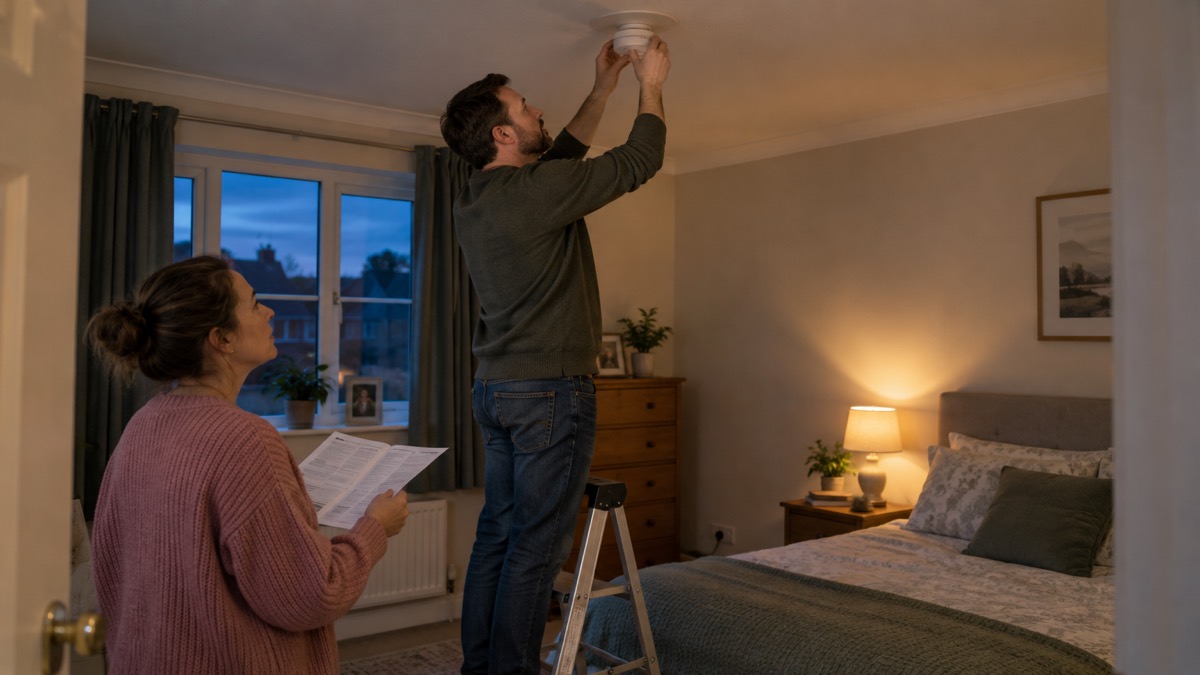
The FireAngel FA8620BW is a battery-powered optical smoke alarm that links wirelessly to other FireAngel alarms over Bluetooth. It is sealed for life, with a battery FireAngel rates for up to 10 years under normal operating conditions, and it is designed to be fitted to a ceiling or wall in a landing, hallway, bedroom, lounge or dining room1. When one linked alarm detects smoke, the others sound too, so a fire in the kitchen can raise the alarm in an upstairs bedroom.
If you already own one, the three things worth knowing are these. Test it monthly by pressing the central Test button2. If it chirps at night, one press silences it for 8 hours, up to 10 times, and you replace the alarm the next day2. And after 10 years you replace the whole unit, because the sensor and the battery reach the end of their life together1.
If you are deciding whether to buy one, the case for it is straightforward: a sealed 10-year battery means no annual battery change, Bluetooth linking means no wiring between alarms, and the maker states it is certified to EN14604:2005 +AC:20081. The case against is that it is a smoke alarm only. It will not detect heat alone or carbon monoxide, and it needs compatible FireAngel alarms to form a network.
What the FA8620BW is and what it suits
The FA8620BW is an optical smoke alarm, which means it looks for smoke rather than a fast rise in heat. FireAngel lists the sensor technology as Optical UltraSenseTM1. That matters in a hallway outside a bathroom or near a kitchen door, where steam and cooking fumes are the usual cause of false alarms.
It is a standalone alarm in the sense that it needs no mains wiring and no control panel. It runs on a 3V DC sealed battery and communicates over Bluetooth at 2.4GHz1. FireAngel sells it as part of the FireAngel One range, and the same range includes a heat alarm, a combined smoke and heat alarm, a carbon monoxide alarm and a wireless gateway1. If you want a whole-home system rather than one alarm, that range is the set to build from.
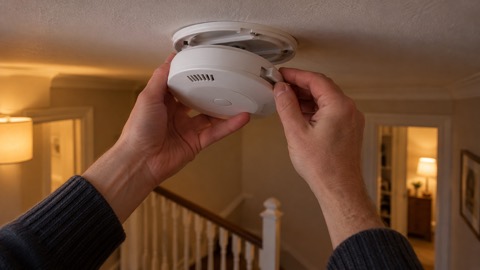
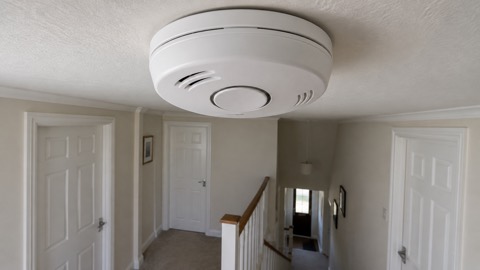
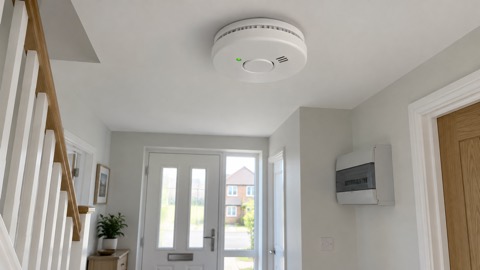
The physical package is modest: 118mm across and 37.5mm deep, weighing 155g give or take 5g1. FireAngel says it is made using more than 50% recycled plastics, and the product page says recycled plastic is used in its manufacture1. An adhesive pad is included for installation, and the alarm must be fitted on its base plate to activate3.
It suits a household that wants a sealed-battery smoke alarm with wireless linking and no electrician. It does not suit someone who wants mains power with a battery backup, or a single alarm that also covers carbon monoxide. For those, see our guides to battery or mains alarms and combined or separate alarms.
Where to fit it
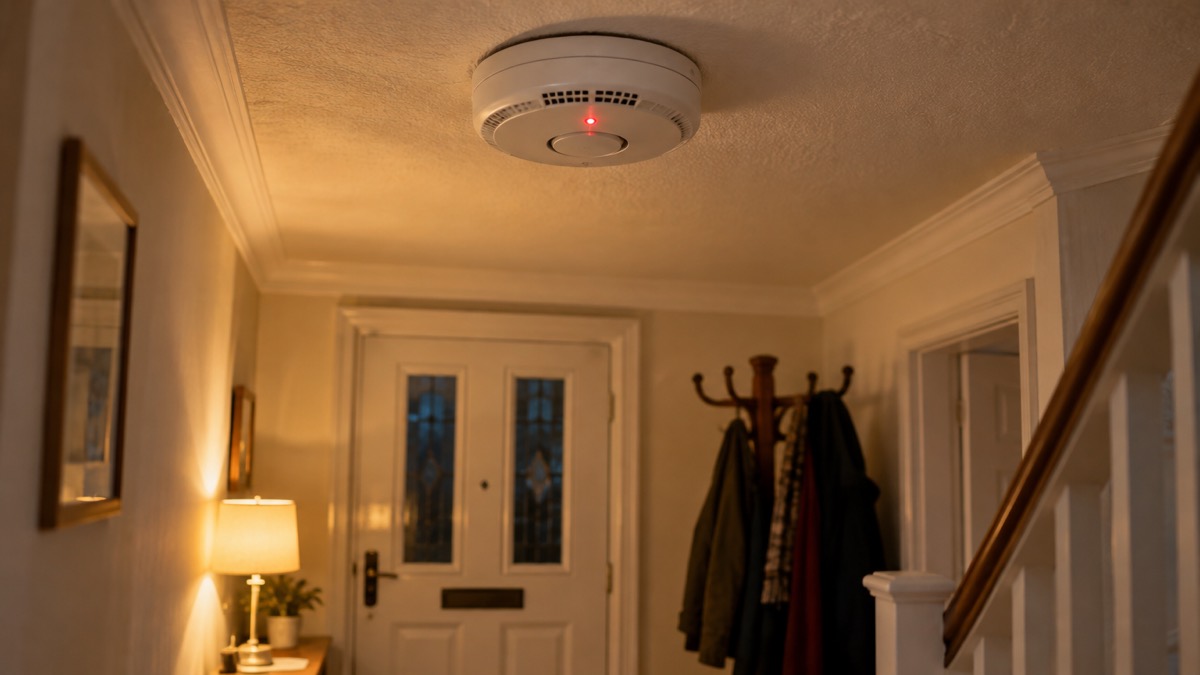
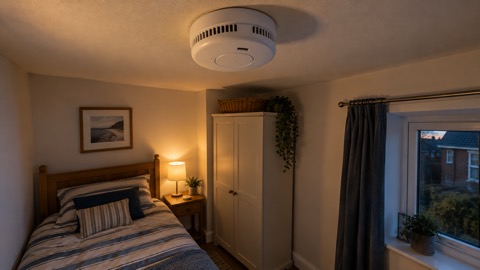
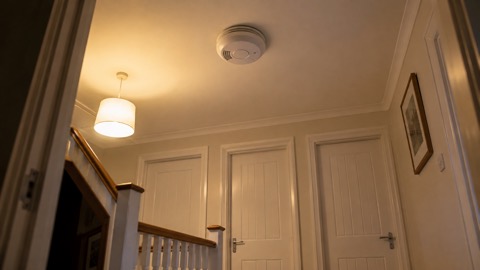
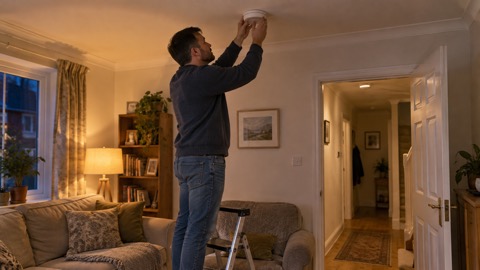
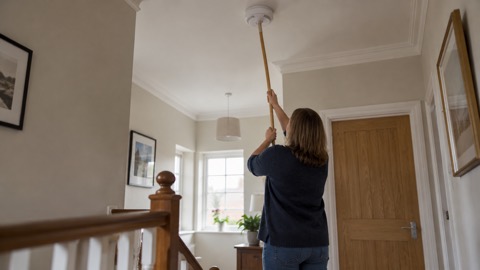
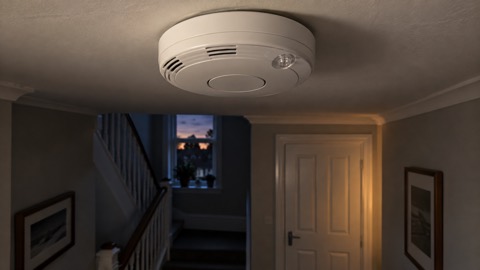
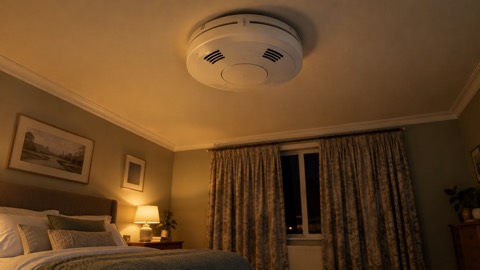
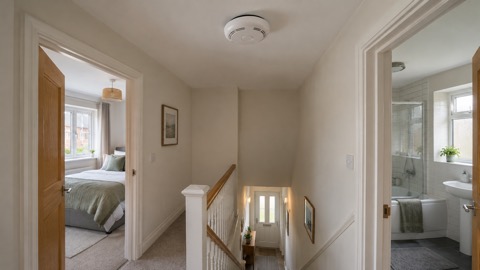
FireAngel lists the landing, hallway, bedrooms, lounge and dining rooms as suitable locations, and gives ceiling or wall as the installation positions1. The product page adds that it can be installed in houses, flats, bungalows, maisonettes, caravans and motorhomes3.
The logic behind those rooms is escape routes and sleep. A hallway or landing alarm gives the earliest warning to someone moving between rooms or asleep behind a closed door, and a bedroom alarm covers the room where people are least responsive. A lounge or dining room alarm covers the rooms where fires most often start from electrical faults or smoking.
Two practical points decide whether the alarm works as intended. The first is the environment: it operates between -10ºC and 40ºC at up to 93% relative humidity, non-condensing1. A steamy bathroom, a freezing loft or a conservatory that bakes in summer sits outside that, and the alarm may false alarm or fail. The second is the fixing. FireAngel's pairing instructions say to install the alarm on its base plate, at which point it automatically enters Secondary mode2.
For the detail of siting, including distance from walls and cookers, see where to fit smoke alarms and how many smoke alarms a house or flat needs. If you are fitting alarms in a flat, our guide to fire safety in flats covers the shared parts of the building.
Linking up to 20 alarms over Bluetooth
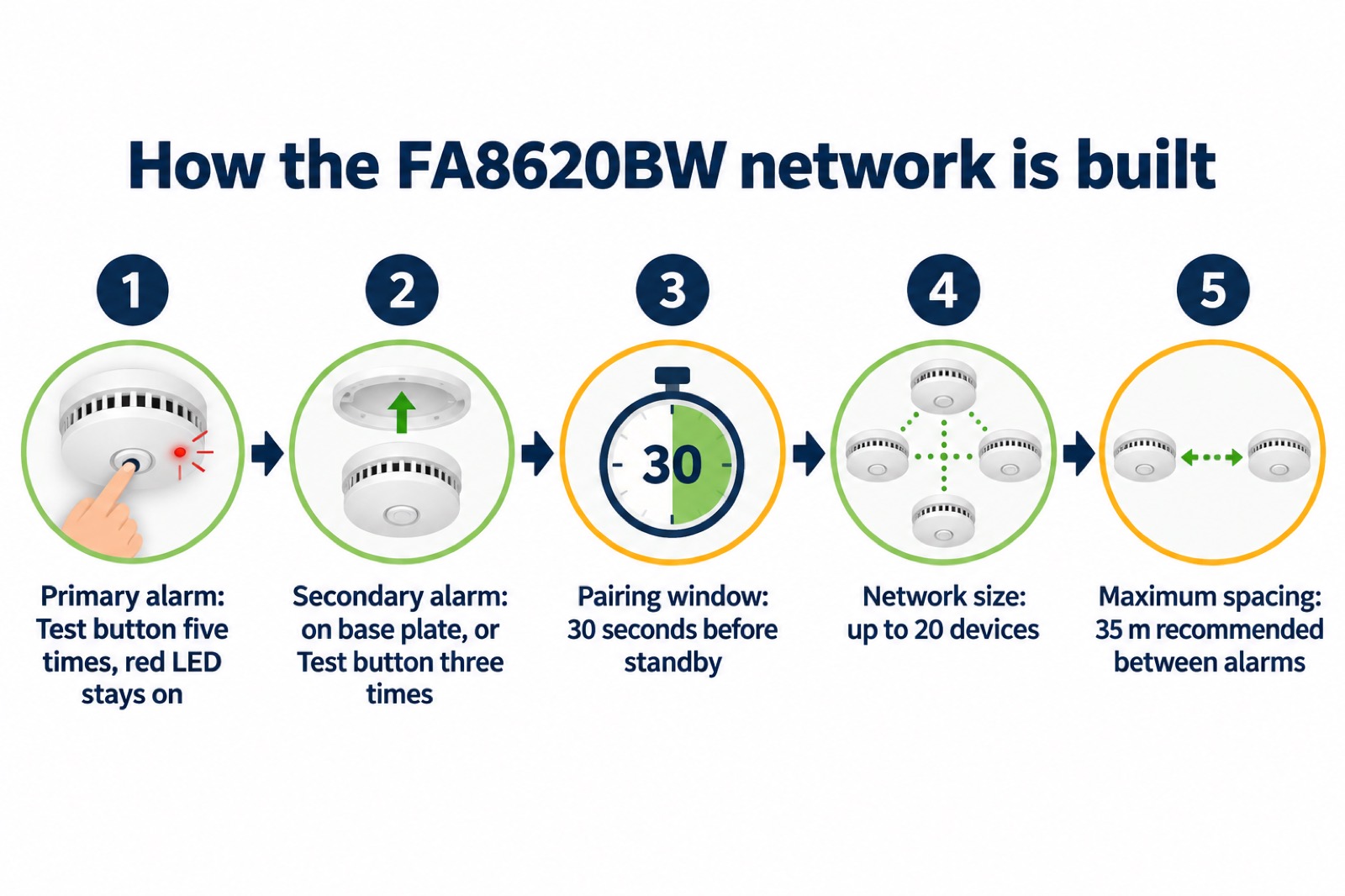
The FA8620BW connects up to 20 devices by Bluetooth wireless interlink1. FireAngel's manual for the alarm describes the pairing process in two roles: one alarm acts as the primary, the others as secondaries.
To set up a network, FireAngel's instructions are:
- Press the Test button on the first alarm five times in quick succession to put it into Primary mode. The red LED stays on and it searches for devices in Secondary mode2.
- Install the second alarm on its base plate, which puts it automatically into Secondary mode, or if it is already installed press the Test button three times in quick succession. Its red LED flashes slowly2.
- When pairing succeeds, the secondary alarm chirps once and returns to standby, and the primary alarm also chirps and stays in Primary mode2.
If a device is not paired within 30 seconds it returns to standby automatically2. Alarms also leave pairing mode on their own: Primary after 5 minutes, Secondary after 30 seconds. A single press of the Test button exits manually2.
Range is the part that catches people out. FireAngel recommends not exceeding 35 m as the maximum distance between alarms in a network2. The FA8620BW datasheet gives a maximum interlink distance of 20 m, or under 150 m in clear air1, and the manual quotes a Bluetooth communication range of over 100 m in an open field2. Those figures describe open air; walls and floors cut them down. In a normal house, keep alarms on the same floor close and accept that a network across three floors may need a repeater or a different approach.
What the beeps and flashes mean
The FA8620BW uses sound patterns and the red LED to tell you what is happening. Learn the four that matter before you need them.
| What you see and hear | What it means | What to do |
|---|---|---|
| Red LED flashes once every 40 seconds | Alarm is active and working | Nothing2 |
| 3 beeps, a 1.5 second pause, then 3 beeps, LED flashing once per second | Test in progress | Nothing, it is a test3 |
| 3 beeps continuously, LED flashing once per second | Fire detected | Get out, call 9992 |
| Chirp and red LED flash once every 40 seconds | Low battery | Replace the alarm within 30 days2 |
| Double beep and double flash every 40 seconds | Sensor fault | Replace the alarm immediately2 |
The sensor fault pattern is the one to take seriously. FireAngel's manual states that with a sensor fault the alarm may not signal an alert and should be replaced immediately2. A chirping alarm that you have silenced ten times is not a nuisance; it is an alarm telling you it can no longer do its job.
When you test a linked network, pressing the central test button on any paired alarm makes all connected devices sound, and after 8 seconds they flash their red LEDs twice per second for a total of 5 minutes2. That five-minute flash is normal and stops on its own.
Testing it, and what to do if it will not sound
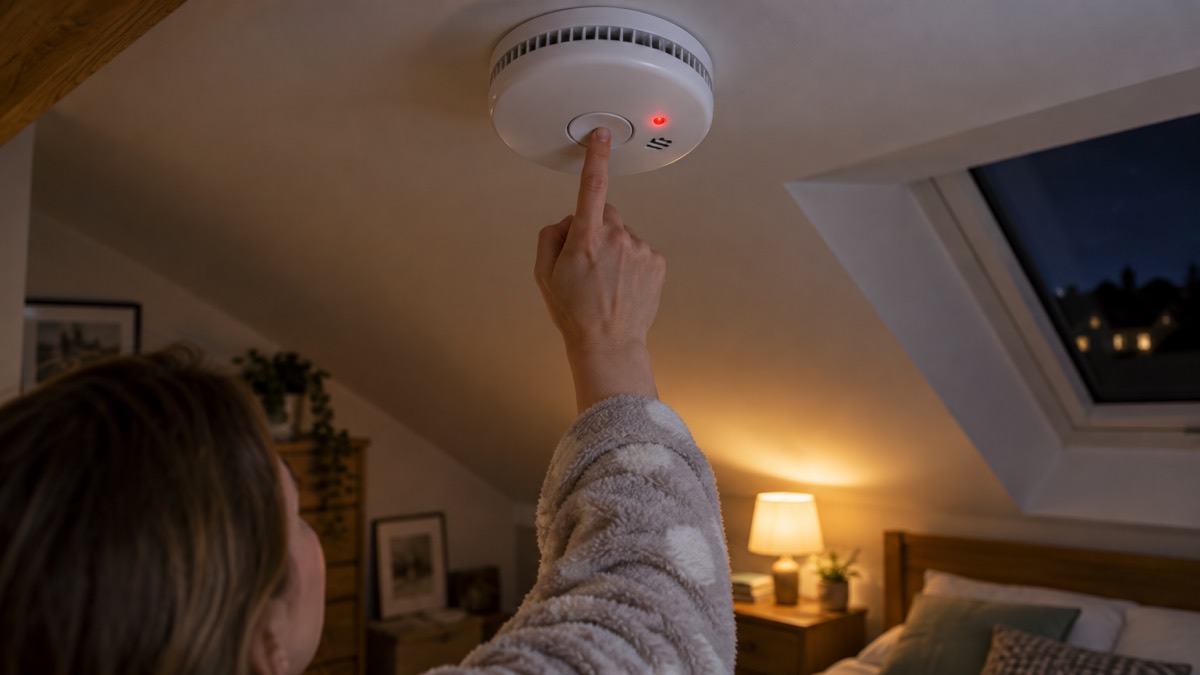
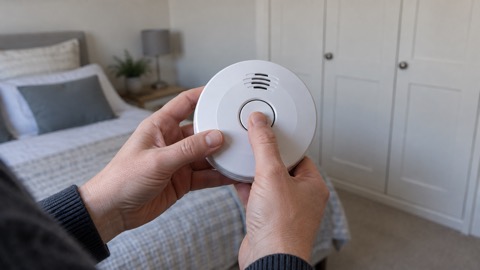
FireAngel's instruction is to test the alarm monthly by pressing the central Test button2. A single press sounds a reduced volume; to hear the alarm at full volume, double press the Test button2. The maker gives the alarm sound level as at least 85dB at 3m1.
If the alarm does not sound during a test, work through these in order:
- Check the device is activated and give it a few seconds to settle after first installation2.
- Double press the Test button for full volume rather than a single press2.
- If the alarm was silenced in low sensitivity mode it may not test. Wait 10 minutes and try again2.
If it still will not sound, or it beeps when not being tested, FireAngel's guidance is to consult the manual, because the battery may be running low or the alarm may be at the end of its life and need replacing5. Manchester Fire and Rescue Service's advice for a problem alarm is to contact the manufacturer, and it lists FireAngel's freephone support number as 0800 141 2561 for alarms fitted by Greater Manchester Fire and Rescue Service and still under guarantee6.
For how often to test and what a proper test involves, see how often to test smoke and CO alarms.
Battery life: up to 10 years, then replace the whole alarm
The FA8620BW has a sealed for life battery rated for up to 10 years of protection, and FireAngel's manual states 10 years under normal operating conditions, sealed for life and non-replaceable1. The sensor life is the same: replace the unit after 10 years of operation1. The alarm gives a clear reminder to replace it after 10 years, and that reminder can be silenced1.
This is the single most important thing to understand about a sealed-battery alarm. You do not change the battery; you change the alarm. The 10-year figure is a rating under normal conditions, not a guarantee, and a cold or damp location can shorten it. Write the installation date on the alarm or in your phone so the replacement date is not a guess.
When the battery runs low, the alarm chirps and the red LED flashes once every 40 seconds, and FireAngel says to replace the alarm within 30 days2. At night, one press of the Test button silences the chirp for 8 hours, with the red LED continuing to flash once every 40 seconds, and you replace the alarm the next day2. You can use that silence a maximum of 10 times, and it will not work if the alarm is signalling a fault or end of life2. FireAngel's datasheet for a related model describes the same feature as silencing a low battery chirp for 8 hours, usable up to 10 times7.
Children, sleeping and the limits of any alarm
An alarm that sounds is not the same as a household that wakes. FireAngel's manual warns that experience has shown children may not be woken by smoke alarm tones, that children should never be left alone in a house, that families should have a rehearsed fire escape plan, and that you should call the fire and rescue service without delay no matter how small the fire2. Essex's fire safety guidance makes the same point: some children may not be woken by smoke alarms8.
The practical response is a plan, not a louder alarm. Rehearse what each person does when the alarm sounds, including who checks on children and anyone who needs help to get out. Our guide to making a fire escape plan walks through it, and what to do if a fire starts in your house covers the moment itself.
"Some children may not be woken by smoke alarms."
Linking heat and carbon monoxide alarms
The FA8620BW is a smoke alarm, so it belongs in circulation spaces and bedrooms, not in a kitchen where cooking smoke would set it off. For a kitchen, a heat alarm is the right device, and FireAngel's FA8720BW heat alarm is part of the same wireless range1. Our guide to the FireAngel FA8720BW heat alarm covers it, and heat alarm or smoke alarm explains which goes where.
For carbon monoxide, FireAngel lists the FS1326-T battery CO alarm as compatible with the FireAngel One range, alongside the FS2126-T multi-sensor smoke alarm and the FS1226-T heat alarm9. Linking a CO alarm into the same network means a carbon monoxide release in a boiler room raises the alarm in the bedrooms. Our guide to carbon monoxide alarms covers what they detect and where they go, and what to do if your CO alarm sounds covers the response.
FireAngel also sells a wireless gateway, the FP1000W2 Pro Connected Smart Gateway, which connects its alarms to a wider system9. If you are building a network across a large house, that is the route FireAngel offers; the FA8620BW on its own is limited to 20 devices over Bluetooth1.
Warranty, support and disposal
FireAngel warrants the FA8620BW to the original purchaser for 5 years from the date of purchase, with replacement at FireAngel's discretion free of charge2. The datasheet states the same 5-year warranty1. The product page notes that warranty periods across the range are usually between 3 and 5 years, so check the packaging and manual for your unit, and keep the receipt because the warranty is not valid without proof of purchase3. A replacement alarm carries the remainder of the original warranty period, and the warranty is not transferable2.
For support, FireAngel's UK technical support can be reached at technicalsupport@fireangeltech.com or on 0330 094 5830, and large text and other formats of the manual are available on request2. FireAngel says its customer support specialists are based in the UK and can help with product advice, installation queries and troubleshooting by phone, email or live chat10.
At the end of its life, do not put the alarm in household waste. FireAngel says to dispose of it through the waste electronic and electrical equipment (WEEE) recycling scheme, not to open it, not to burn it, and to check with your local authority, retailer or technical support because regional variations apply2. Our guide to when to replace a smoke, heat or CO alarm covers the timing, and smoke alarms: types and how to choose one covers the wider choice.
Sources (10)
- FA8620BW-R Smoke Datasheet, FireAngel, 2026-07
- FA8620BW, FA8720BW and FA8922BW Smoke, Heat and Combo Manual, FireAngel, 2026-05-08
- FireAngel FA8620BW-R product page, FireAngel, 2026-10-21
- Combined manual SP500 to SP540, FireAngel, 2026
- Maintaining and testing your FireAngel smoke alarm, FireAngel, 2024-08-27
- Problem with your smoke or heat alarm, Greater Manchester Fire and Rescue Service, 2026-10-29
- SP510 and FA4250BW Spec Datasheet, FireAngel, 2026-06
- Protecting your family: fire, Essex County Council, 2026-10-29
- FP1000W2 Pro Connected Smart Gateway, FireAngel, 2026-10-28
- Carbon monoxide safety, FireAngel, 2026-07-31
 FireAngel FP2620W2-R Alarm
 FireAngel ST-632 Smoke Alarm
 FireAngel ST-750 Smoke Alarm
 FireAngel SW1 Smoke Alarm
 FireAngel SW10 Smoke Alarm
 FireAngel SB1 Smoke Alarm
 FireAngel SM-SN-1 Smoke Alarm
 FireAngel FA6611 Smoke Alarm
 FireAngel FA6615 Smoke Alarm
 Kidde 2030-DSR Smoke Alarm
 Kidde 2030-DCR CO Alarm
 Kidde 10Y29 Smoke Alarm