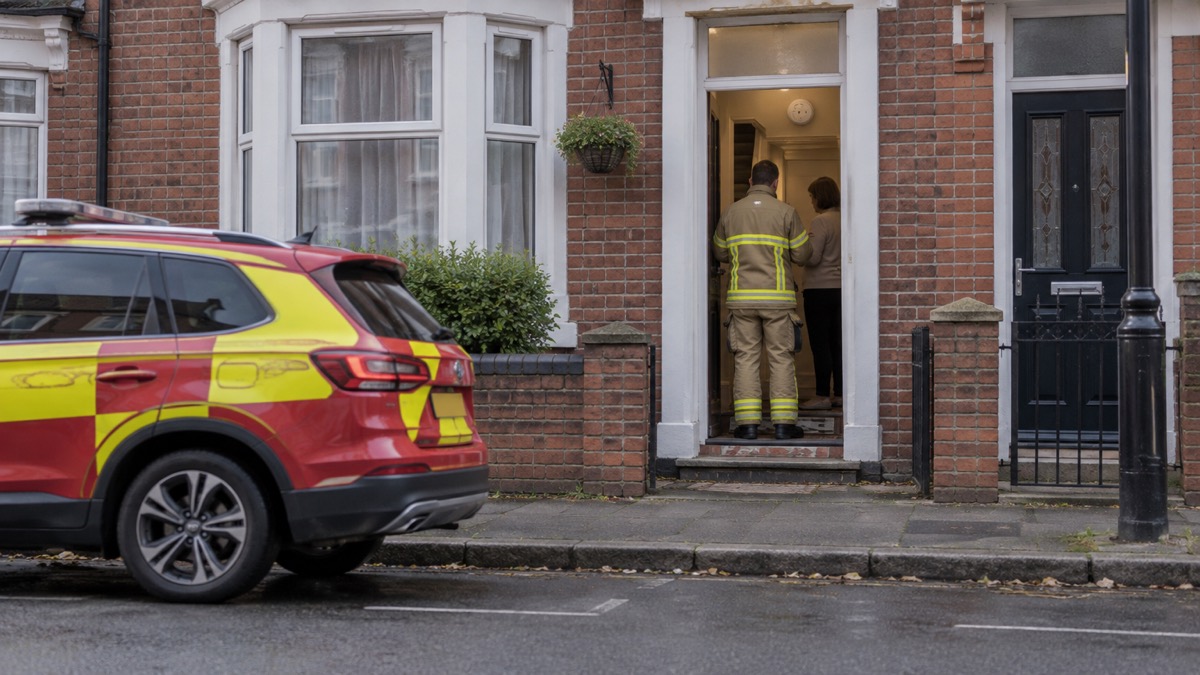
A smoke alarm and a carbon monoxide alarm do different jobs, and neither replaces the other. Smoke alarms detect smoke and fire; CO alarms detect carbon monoxide, a gas you cannot see, smell or taste. Fire and rescue services are clear that both types should be installed in your house1. The question is whether to buy one combined unit that does both, or two separate alarms.
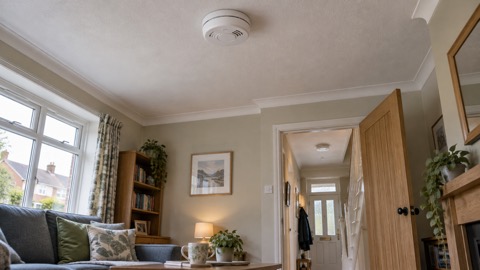
For most homes the answer is a mix. Fit smoke alarms on every level of your home, and a CO alarm in every room where fuel is burned, including gas cookers, open fires and log burners3. A combined alarm can cover a room where both a fire risk and a fuel-burning appliance sit together, but it cannot always go exactly where each function needs to be. The safest approach is to plan the positions first, then choose the alarms that fit them.
This page sets out where each type belongs, where a combined unit can fall short, what certification to look for, and how long the alarm and its battery should last.
Smoke alarms and CO alarms detect different dangers
Carbon monoxide is produced by appliances that burn gas, oil, coal or wood, and it gives no warning of its own. A CO alarm is designed specifically to detect it. A smoke alarm is designed to detect smoke and fire1. Because the two dangers are different, the two alarms are different, and a household needs both2.
An alarm is a warning, not a fix. The Health and Safety Executive for Northern Ireland stresses that CO alarms must never be regarded as a substitute for the proper installation, maintenance, servicing and cleaning of appliances that use gas, coal, oil or any other solid fuel11. The same point appears in fire service guidance: detectors are not a substitute for proper installation and maintenance of fuel-burning appliances12. Public Health Wales adds that fitting an alarm should not be used instead of regular checks of appliances13.
Smoke alarms work the same way: they do not prevent a fire, but they give the earliest possible warning, which gives the best chance of getting out safely14. So the choice between combined and separate alarms is about coverage and placement, not about replacing good appliance care with a gadget.
Combined or separate: where each one belongs
The placement rules for the two alarms overlap but are not identical, and that is the heart of the decision.
For carbon monoxide, the advice is consistent. Fit a CO alarm in all rooms containing fuel-burning appliances, and make sure it can be heard throughout your home15. The NHS says to get a CO alarm for each room of your home that contains appliances that burn gas, oil, coal or wood16. Fire services recommend at least one CO alarm per household, with additional units for each floor, near sleeping areas, and close to potential sources such as gas appliances, wood-burning stoves or attached garages1. CO alarms should be installed ideally near bedrooms and living areas4.
For smoke, the advice is to place working smoke alarms on each level of your home, particularly near sleeping areas6. Fire services put it simply: near the sleeping areas and on every level5.
| Room or area | Smoke alarm | CO alarm | Combined unit suits? |
|---|---|---|---|
| Hallway and landing | Yes, one per level | Not usually needed | Separate smoke alarm |
| Bedroom areas | Yes, near sleeping areas | Yes, ideally near bedrooms | Either, if sited well |
| Kitchen with a gas boiler or cooker | Often causes false alarms when cooking | Yes, if a fuel appliance is present | Usually separate, see below |
| Living room with an open fire or log burner | Yes | Yes, in the same room as the fire | Combined can work |
| Garage attached to the house | Not usually | Yes, near the potential source | Separate CO alarm |
The independent testing organisation Which? makes the key point: the optimum siting for a CO alarm and a smoke alarm might not always be identical. In many homes the correct place for the CO alarm would be the kitchen if the boiler and gas cooker are both there, but it might not be appropriate to fit the smoke alarm there because of repeated triggering during normal cooking8. A combined unit in that kitchen would either be badly placed for CO or prone to false alarms from cooking.
Where a combined alarm can go wrong
A combined alarm is only as good as its position. Properly sited an alarm can save lives; improperly sited it is as much use as a chocolate fireguard17. That blunt line applies doubly to a combined unit, because one position has to serve two different detection jobs.
The common failures are predictable. A combined unit fitted in a hallway to catch smoke may be too far from the boiler or fire to detect CO quickly. A combined unit fitted in the kitchen to sit near the boiler may go off every time you fry something, and a household that keeps silencing it may eventually ignore it. And a combined unit in a room with an open fire is sensible for CO, since the risk of carbon monoxide poisoning is higher with open fires and a carbon monoxide alarm should be placed in the same room as the open fire18, but it still needs to be close enough to the fire to work.
There is also the question of coverage. If you rely on one combined alarm to cover a whole floor, you may miss the CO risk in a second fuel-burning room. Fire services recommend a CO alarm in all rooms containing solid fuel appliances, gas appliances or paraffin heaters19, and in rooms with a fixed combustion appliance such as a gas fire, gas boiler, log burner or open fireplace20.
A further risk is product failure. In November 2025 the Office for Product Safety and Standards published a recall of certain Deltronic Security AB Environmental Alarm units, warning that when the battery is failing they may not provide the necessary alert to a remote monitoring centre where fire, smoke or carbon monoxide is detected22. The lesson for any alarm, combined or separate, is to test it regularly and replace it at the end of its life rather than waiting for it to fail.
What a combined alarm does: the FireAngel SCB10-R
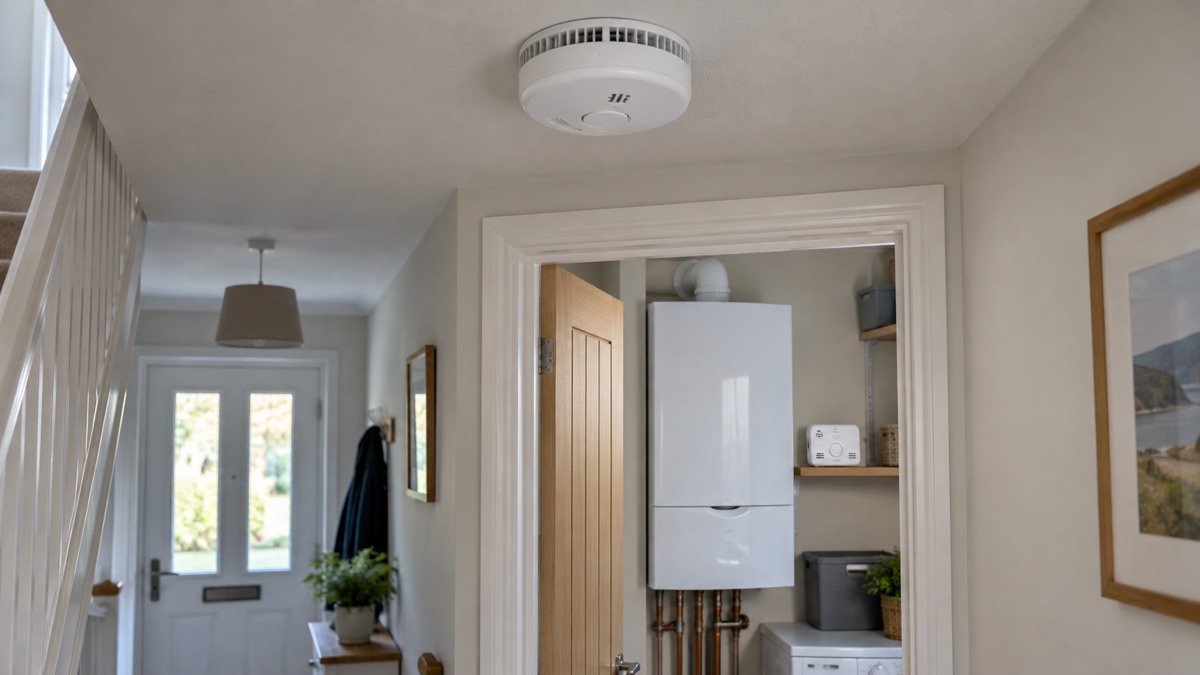
A combined alarm packs two sensors into one housing, so it sounds for either smoke or carbon monoxide. The FireAngel SCB10-R is an example: a combined CO and smoke alarm, standalone, with a sealed battery, 10-year battery life and a large display10. Note that in the Which? test it was tested only for CO, not for the smoke function, so the CO performance is the verified part.
FireAngel also makes a heat and CO alarm, the Spec+ SP530, which combines Class A1 heat detection with carbon monoxide detection in a Grade D1 alarm23. That is a different combination: heat alarms respond to rising temperature rather than smoke, which makes them suited to kitchens and garages where smoke alarms would false alarm. If you want to know how heat and smoke detection differ, see Heat Alarm or Smoke Alarm: Which Goes Where.
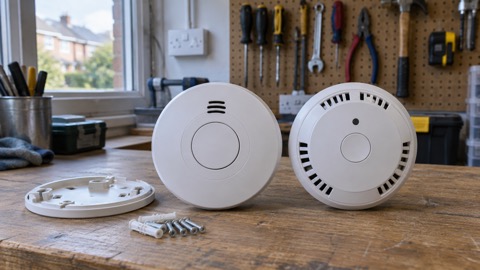
The SP530 comes with the alarm unit, a ceiling base plate, screws and wall plugs, a fitted dust cover, and an installation and user guide23. FireAngel states it is verified for consistent heat and carbon monoxide detection performance by SGS23. That is the maker's own claim for its own product, not an independent test result.
What a combined alarm cannot do is cover two rooms. If your boiler is in the kitchen and your open fire is in the living room, one combined unit cannot sit in both. You would either fit two combined units or, more usually, a smoke alarm in each area plus a CO alarm in each fuel-burning room.
Battery power: replaceable or sealed for life
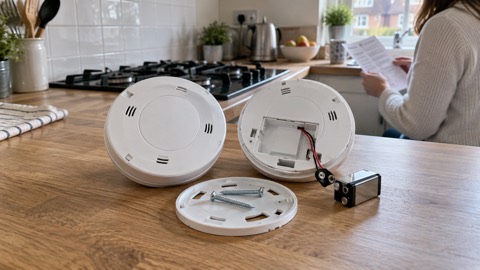
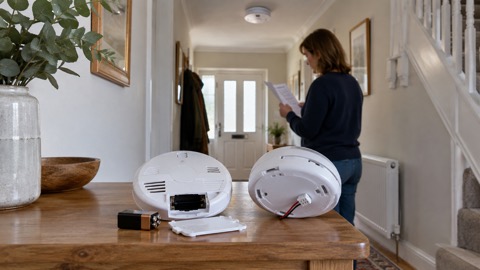
Battery choice matters as much as the sensor. Official guidance leans firmly towards sealed, long-life batteries where a battery alarm is chosen. For rented homes, where battery-powered alarms are selected, alarms with sealed-for-life batteries are the better option rather than alarms with replaceable batteries9. The Scottish Government says that if a CO alarm is battery-operated, it must have a sealed battery for the duration of its lifespan24. The Northern Ireland Fire and Rescue Service advises considering a sealed long-life 10-year battery if buying a battery smoke alarm25.
Which? gives the practical reason: if you do not want the hassle of changing batteries, go for an alarm with a sealed battery designed to last the lifetime of the detector10.
| Battery type | What it means | Who it suits |
|---|---|---|
| Replaceable battery | You change the battery, often every 12 months in a standard smoke alarm26 | Alarms where you will reliably test and change batteries |
| Sealed 10-year battery | Battery lasts the life of the alarm and cannot be changed | Households that want set-and-forget protection25 |
| Sealed for life of the unit | Battery sealed in for the detector's lifespan24 | Rented homes and busy households9 |
A standard smoke alarm with a replaceable battery needs a new battery every 12 months26. A sealed unit avoids that chore but means the whole alarm is replaced when the battery or sensor reaches the end of its life.
Certification to look for: BSI Kitemark and EN 50291
Certification is the clearest signal that an alarm has been tested to a recognised standard. For the CO function, look for compliance with British Standard BS EN 50291-1 and the BSI Kitemark logo7. The Health and Safety Executive for Northern Ireland says to ensure the alarm complies with British Standard EN 50291 and carries a British or European approval mark, such as a CE or Kitemark28. Lincolnshire Fire and Rescue says only buy alarms certified to British Standard EN50291 with the British or European approval mark, such as the Kitemark20. Warwickshire Fire and Rescue Service advises choosing battery-powered CO alarms that meet BS EN 50291 and looking for the BSI Kitemark21.
For caravans, motorhomes and campervans, Humberside Fire and Rescue Service says to ensure there is a CO alarm tested to BS EN 50291-2 and kitemarked29.
For smoke alarms, look for the British Standard Kitemark and Loss Prevention Certification Board (LPCB) symbols, which show the alarm is approved and safe20.
A combined alarm needs to satisfy both standards. Which? reports that there are three fully compliant combined smoke and CO alarms on the market, Kitemarked by BSI to both EN 50291 for the CO function and EN 14604 for the smoke function8. That is a useful benchmark: if a combined unit does not carry both marks, treat it with caution.
Warranty and alarm life: 7 to 10 years
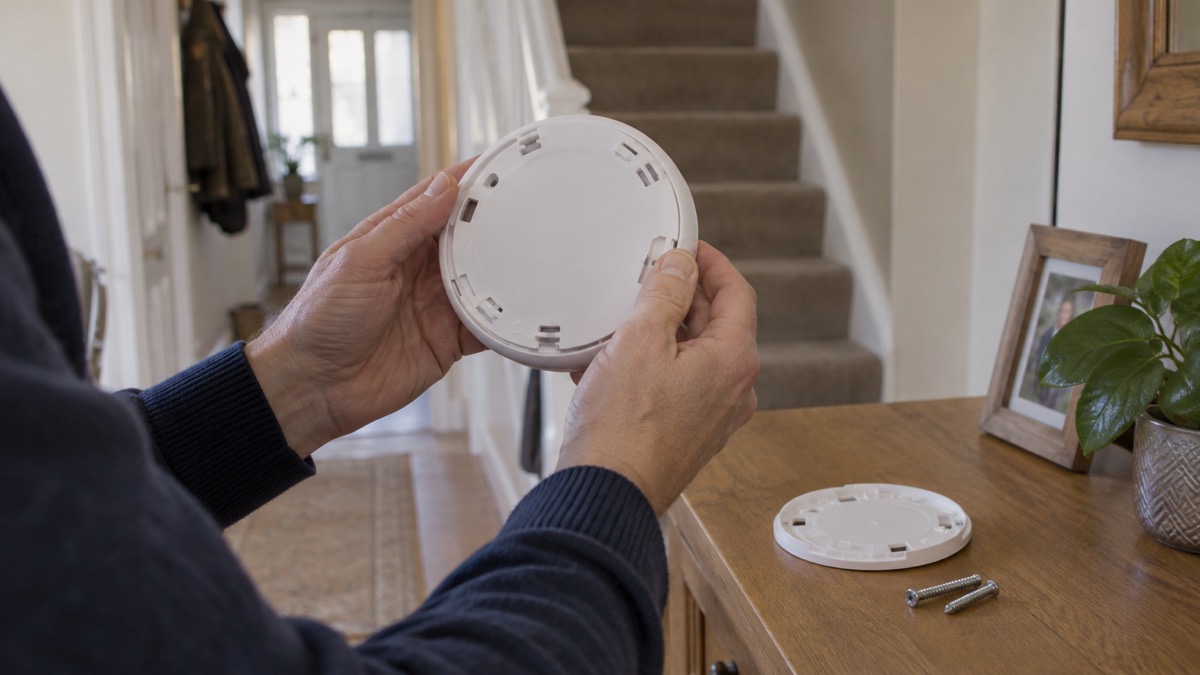
An alarm does not last forever, and its sensor degrades. The Health and Safety Executive for Northern Ireland says attention should be given to the life span of the unit, which can range from one to six years depending on the manufacturer and the expected life span of the batteries; some have replaceable units, others are sealed in for the life of the unit28. Bedfordshire Fire and Rescue Service gives a more typical figure: most alarms will last between five and seven years, with some lasting as long as 10 years7.
| Alarm type | Typical life | Battery |
|---|---|---|
| Standard smoke alarm | Replace battery every 12 months26 | Replaceable |
| Sealed battery smoke alarm | 10-year battery26 | Sealed |
| CO alarm | Five to seven years, some up to 107 | Varies; sealed or replaceable |
| Combined smoke and CO alarm | Follow the maker's replace-by date | Often sealed 10-year10 |
The practical rule is to write the fitting date on the alarm or in your diary and replace it at the end of its stated life, not when it starts to misbehave. If you are unsure whether an alarm is due, see When to Replace a Smoke, Heat or CO Alarm.
Support, guarantees and who to contact
If your CO alarm sounds or you suspect carbon monoxide, act immediately. Bedfordshire Fire and Rescue Service advises opening all doors and windows, moving outside into fresh air, and calling the Gas Emergency Service on 0800 111 9997. Do not wait to see whether you feel unwell. For the full sequence, see What to Do If Your CO Alarm Sounds or You Suspect Carbon Monoxide.
For health information about carbon monoxide, the Public Health Agency in Northern Ireland offers detailed advice on 0300 555 011411. In England, Scotland and Wales, contact NHS 111 or your GP if you are worried about symptoms; the NHS page on poisoning sets out what to do16.
If you rent, your landlord has a legal duty. Under the Smoke and Carbon Monoxide Alarm Regulations, a landlord must ensure smoke alarms and carbon monoxide alarms are repaired or replaced once informed and found to be faulty30. Cheshire Fire and Rescue Service repeats the same duty: repair or replace smoke and carbon monoxide alarms if they are reported as faulty32. Report a faulty alarm to your landlord in writing and keep a copy.
If you are deaf or hard of hearing, fire services suggest considering interlinked smoke alarms that connect to a telecare, carecall or lifeline system33. See Smoke and CO Alarms for Deaf and Hard of Hearing People for the options.
For product safety, check the government's product recall pages before relying on an unfamiliar or second-hand alarm. The Kidde CO2 Klem Valve recall in February 2024 is a reminder that recalls happen and are published by the Health and Safety Executive34. That recall concerned a valve, not a home CO alarm, but the principle is the same: check the model and batch if you are unsure.
Sources (33)
- Smoke alarms and CO detectors, Warwickshire County Council, 2026
- Safe home heating, Warwickshire County Council, 2026
- Think fire safety when saving money on your energy bills, Devon and Somerset Fire and Rescue Service, 2022
- Safe home heating, Warwickshire County Council, 2026
- Safe home heating, Warwickshire County Council, 2026
- Safe home heating, Warwickshire County Council, 2026
- Carbon monoxide leaflet, Bedfordshire Fire and Rescue Service, 2026
- Carbon monoxide alarms, CO-Gas Safety, 2024
- Housing standards, Cherwell District Council, 2026
- Carbon monoxide detectors, Which?, 2026
- Carbon monoxide, Health and Safety Executive for Northern Ireland, 2026
- Carbon monoxide, Devon and Somerset Fire and Rescue Service, 2026
- Weather and health, Public Health Wales, 2026
- Home safety partnerships | Devon and Somerset Fire and Rescue Service, Devon and Somerset Fire and Rescue Service
- Carbon monoxide: the silent killer, Wiltshire and Swindon Prepared, 2026
- Poisoning, NHS, 2025
- Fire safety for carers, Devon and Somerset Fire and Rescue Service, 2026
- Carbon monoxide, Greater Manchester Fire and Rescue Service, 2026
- Fire alarms and carbon monoxide detectors, Lincolnshire County Council, 2026
- Safe home heating, Warwickshire County Council, 2026
- Product recall: Deltronic Security AB Environmental Alarm, Office for Product Safety and Standards, 2025
- Spec+ Multi-Sensor Heat and Carbon Monoxide Alarm, FireAngel, 2026
- Fire and smoke alarms in Scottish homes, Scottish Government, 2024
- Other safety, Northern Ireland Fire and Rescue Service, 2026
- Smoke alarms, Staffordshire Fire and Rescue Service, 2026
- Fire safety in the home, Westminster City Council, 2017
- Carbon monoxide alarms, Health and Safety Executive for Northern Ireland, 2026
- Caravan, motor home and campervan safety, Humberside Fire and Rescue Service, 2026
- Additional advice for tenants, Greater Manchester Fire and Rescue Service, 2026
- Fire safety, Greater Manchester Fire and Rescue Service, 2026
- Smoke alarms, Cheshire Fire and Rescue Service, 2026
- Hearing and sight difficulties, Dorset and Wiltshire Fire and Rescue Service, 2025
- Product safety report: Kidde CO2 Klem Valve, Office for Product Safety and Standards, 2024
 Heat Alarm or Smoke Alarm
 Sealed or Replaceable Alarms
 Battery or Mains Smoke Alarms
 Wireless or Wired Alarms
 Optical or Ionisation Alarms
 CO2 vs Powder Extinguishers